

“Vampire at Midnight” is now on DVD!
Gripped by a serial killer dubbed the Vampire Killer, Los Angeles is on high alert as not one single piece evidence could be recovered from the more than a dozen crime scenes where women’s’ necks are ripped to shreds, their bodies are drained of blood, and their corpses dumped for police to discover. With detectives baffled, cowboy cop Roger Sutter is ordered by the reckless antics-frustrated Captain to stay away from case but when Roger follows a lead that lands in his lap, two people wind up dead and the killer slips through his grasp, the captain suspends him from the force. Focusing all his energy into a newfound romance with apartment complex neighbor and aspiring pianist Jenny Carleton, Roger finds himself back onto the killer’s trail when his time with Jenny goes from special and exciting to acutely avoiding his every advance. Roger suspects the Vampire Killer behind Jenny’s sudden change in behavior. Unofficially back on the case, the off-duty Los Angeles homicide detective finds himself in the middle of the Vampire Killer’s ritual to seduce Jenny into his coven as one of his blood brides.

The maverick cop versus the serial killer narrative “Vampire at Midnight” is the 1988 investigative thriller with a horror edge from editor-producer Gregory McClatchy (“The Great American Girl Robbery,” “Terror in the Aisles”) in his first, and only horror credited, feature length directorial. Also, lesser known as “L.A. Midnight, “Hypnos” or “Murder at Midnight,” the entrancing, modern vampire script is penned by “Danger Zone II: Reaper’s Revenge” writer Dulany Ross Clements from a story by fellow “Danger Zone II” collaborators Jason William (actor in “The Great American Girl Robbery” and “Flesh Gordon”) and Tom Friedman (“Time Walker”). Skouras Pictures served as the production company and the theatrical distributor with Friedman and Williams also in a producing capacity.

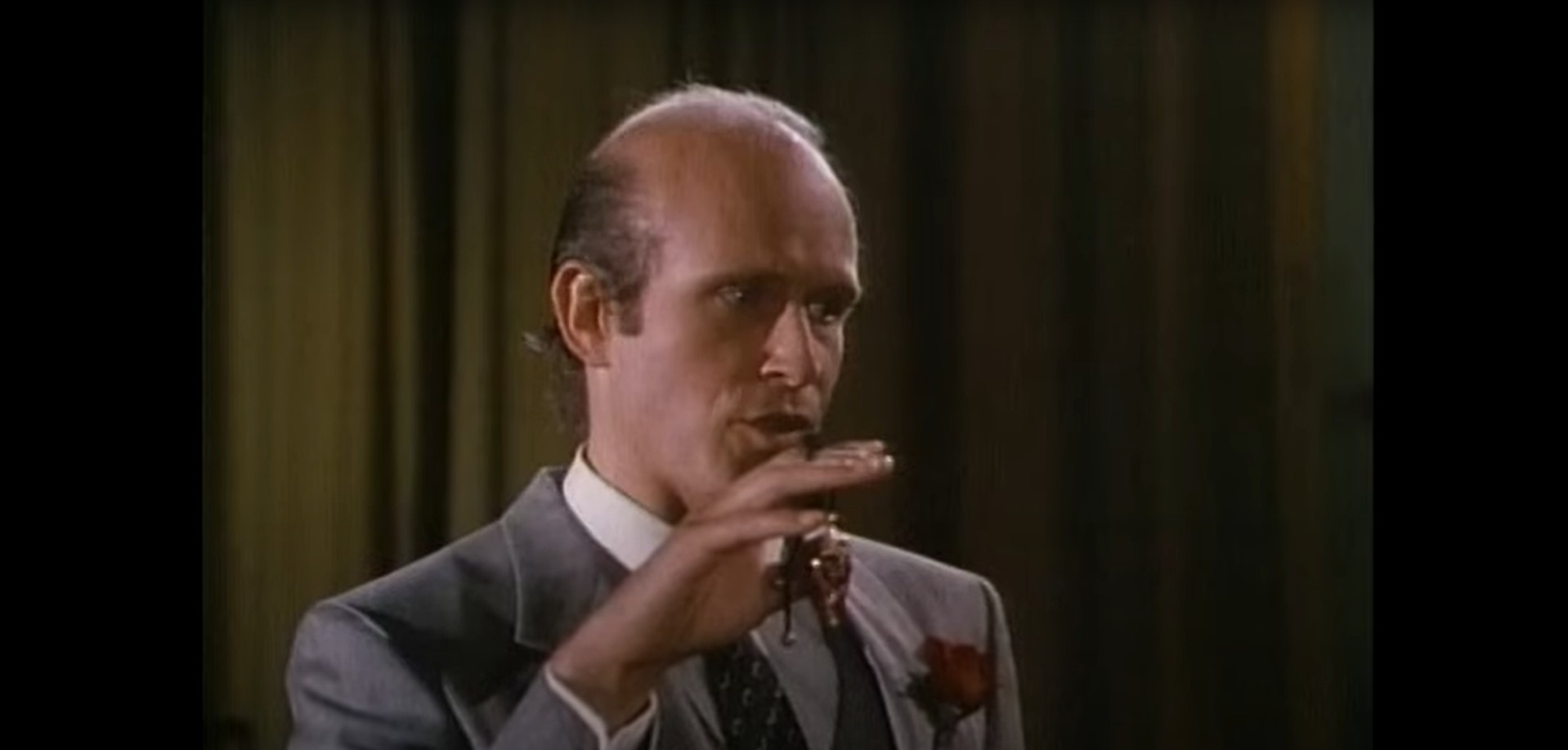
Much like with his lead kidnapper role in “The Great American Girl Robbery,” as well as other skin-a-matic films like “Alice in Wonderland: An X-Rated Musical” or “Flesh Gordon,” producer, conceptual storyteller, and principal star Jason Williams puts himself into the rough-and-rugged hero to get the girl, or girls, half naked in his arms. As unorthodox method cop bending procedure to get results, Williams molds handsome homicide detective Roger Sutter to the quintessential trope of a good cop doing everything he can to get the job done, even if that means skirting around lawlessness. Roger is pitted up against pure vampiric evil who welcomes the lawlessness under the façade of a doctor of hypnotism specializing in unleashing clients’ frustrating mental blockages in their careers and goals. Argentine-born Gustav Vintas has the physical look of a sophisticated villain (see “Lethal Weapon,” “Verne Miller,” and “Midnight”) with his stage 6 receding hairline and foreign accent and “Vampire at Midnight” also fits the bill with Dr. Victor Radikoff, a smooth talking and charming manipulator who can literally hypnotize his clients into anything, such as serving their necks up to his fangs or be beguiled assassins. Caught in the middle is aspiring pianist Jenny Carlton, Roger’s beautiful blonde neighbor turned girlfriend turned slave to Radikoff’s hypnosis powers. Jenny is played by the one-and-done feature film credited Lesley Milne in a rigid performance that’s critically subsided by her well-defined figure, one of several to go topless alongside “Saturday the 14th Strikes Back’s” Jeanie Moore, “Hollywood Chainsaw Hookers’” Esther Elise, and “Angel III: The Final Chapter” Barbara Hammond. The film rounds out with Christopher Nee, Robert Random (“Toke”), Jonny Solomon (“Peephole”), Ted Hamaguchi, Richmond Shepard (“Simon, King of the Witches”), and Ceclia Kaye (“Don’t Be Afraid of the Dark”).

“Vampire at Midnight” is the modern vampire film that tries to blend the old tropes with the new folds. The malevolent Dr. Victor Radikoff has the menacingly creepy charm and suavity of Bram Stoker’s tale of Count Dracula flirting up against Max Schreck’s appearance as the horribly grotesque Count Orlok in the F.W. Murnau’s bastard film, “Nosferatu: The Symphony of Horror.” While the latter may just be an opinionated statement or judgement on Gustav Vintas’s physical naturality, not to say Vintas is grotesque or horrible looking at all, but rather his physical characteristics are atypical of the master vampire, resembling more closely to the baseline Nosferatu with a receding hairline, slender stature, and a uniquely contoured face. Being set in Los Angeles, the gothic qualities that instill fear, dread, and medieval facets from Dracula origins are all but lost, but you must remember, this isn’t Dracula. This is Dr. Victor Radikoff, the prestigious hypnotist of the affluent, and that speaks true to the hip city of angels setting full of funky-sexualized interpretative dancing and late-night comedy standups as well as fitting into the budget to keep the indie film costs low for the sleek new take of the vampire trope to freshly entertain late 80s audiences. However, “Vampire at Midnight” doesn’t go plot unscathed with the first act leaning heavily into L.A. paralyzed with Vampire Killer fear and the cops nervously on edge and disheartened by the lack of evidence and leads; the atmosphere felt more despairing and darker with the killer staying one step ahead and a body count slowly rises upward. Then, the tone shifts slowly from a tough terrorizing case to crack to Roger’s incessant hard-on for a rather focused and naïve pianist. The case only becomes interested in again when Roger receives a happenstance call in and he’s back in the saddle of his cowboy cop antics until he’s not again, being, in my opinion, unjustifiably suspended for shooting down a suspect trying to kill him and the suspected Killer getting away. It’s as if the police, as well as the media and the public perception, left the case to fizzle out while the relationship between Roger and Jenny builds up for the sole purpose of being broken by, again, happenstance in Radikoff’s chance meeting with Jenny at a socialite party where she’s hired to play piano.
Arriving onto a MVDVisual DVD, this obscure hypno-vampire gem is entranced with new life. Unfortunately, however, the new release is not a technically impressive one with its 720p resolution and pillar box 1.33:1 aspect ratio in regard to video. The MPEG2 DVD5 handles the compression without a substantial hitch. Other than the lower resolution that creates some blurry/fuzziness, here are no seemingly other issues in the codec, such as macroblocking, or banding. Blacks retain its void inkiness even inside the confines of a lower contrast, but the grading is nonexistent that results in flat coloring and little life in the range spectrum. The film has a shot-on-video look, but the transfer is rendered from a 35mm print digitized with little touchup for DVD. The original print has only minor imperfections, a brief scratch here and there, but no major damage to note. The English language Dolby Digital 2.0 Mono doesn’t elevate the new release either. Dialogue isn’t terribly feeble, but it definitely isn’t robust through the single channel where depth doesn’t have an influence. The overall quality of the recording is not bad with a clean presentation that’s layered in an expertly designed arrangement; big kudos should go to editor Kaye Davis and sound mixer Vic Carpenter who enrich “Vampire at Midnight’s” filmic posture as the two do competently dance together between the audio and video editing. English subtitles are optionally available. MVD’s standard release is bare bones without special features. The standard DVD Amaray sports the beautiful gothic and blood dripping poster as the front cover; however, the backside contains three out of the five stills of Ester Alise, one involving Robert Random, and one with Random and Gustav Vintas and what makes the backside a curiously funny duck is the four blocked together stills are not from the film and were plucked directly from IMDB.com. Instead, they are from different cult films starring Random and Alise, such as Alise’s “Hollywood Chainsaw Hookers.” The disc is pressed with the same cover art image. The rated R release is region free and has a runtime of 93 minutes.
Last Rites: Gregory McClatchy keeps this L.A. vampire picture in constant postulation with an unconscious red herring that’s stable until the very end, but the story pivot strains too far from its gritty and dark cop-chase-killer opening by focusing more on a love polygon of sex, deception, and true devotion, a swivel that puts a stake right in the heart of this 80’s exuberant story.
 It's Bloggin Evil!