EVIL Seduces the Woman of her Dreams. “Vampyros Lesbos” reviewed! (Severin Films / 4K UHD and Blu-ray)

Men Beware of the “Vampyros Lesbos” now on 4K UHD and Blu-ray

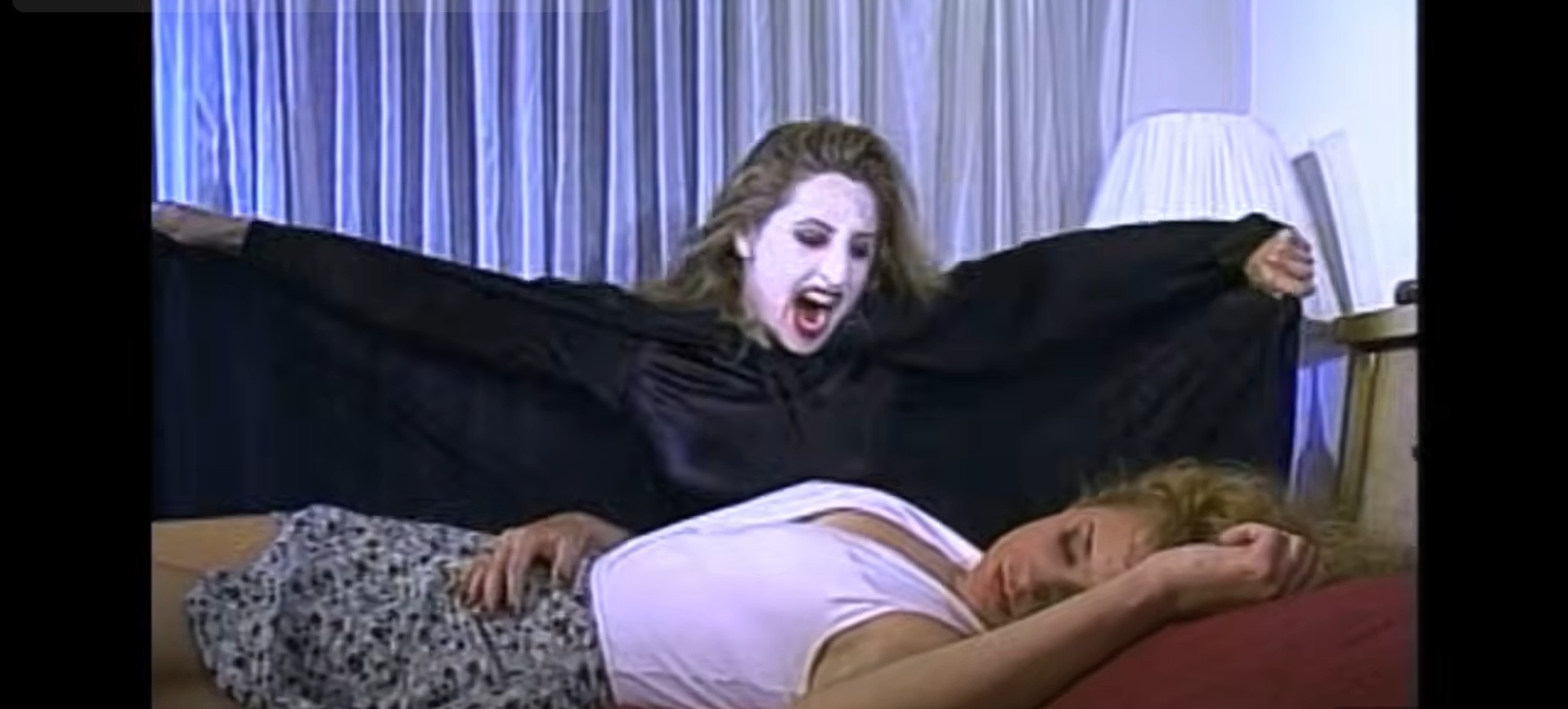
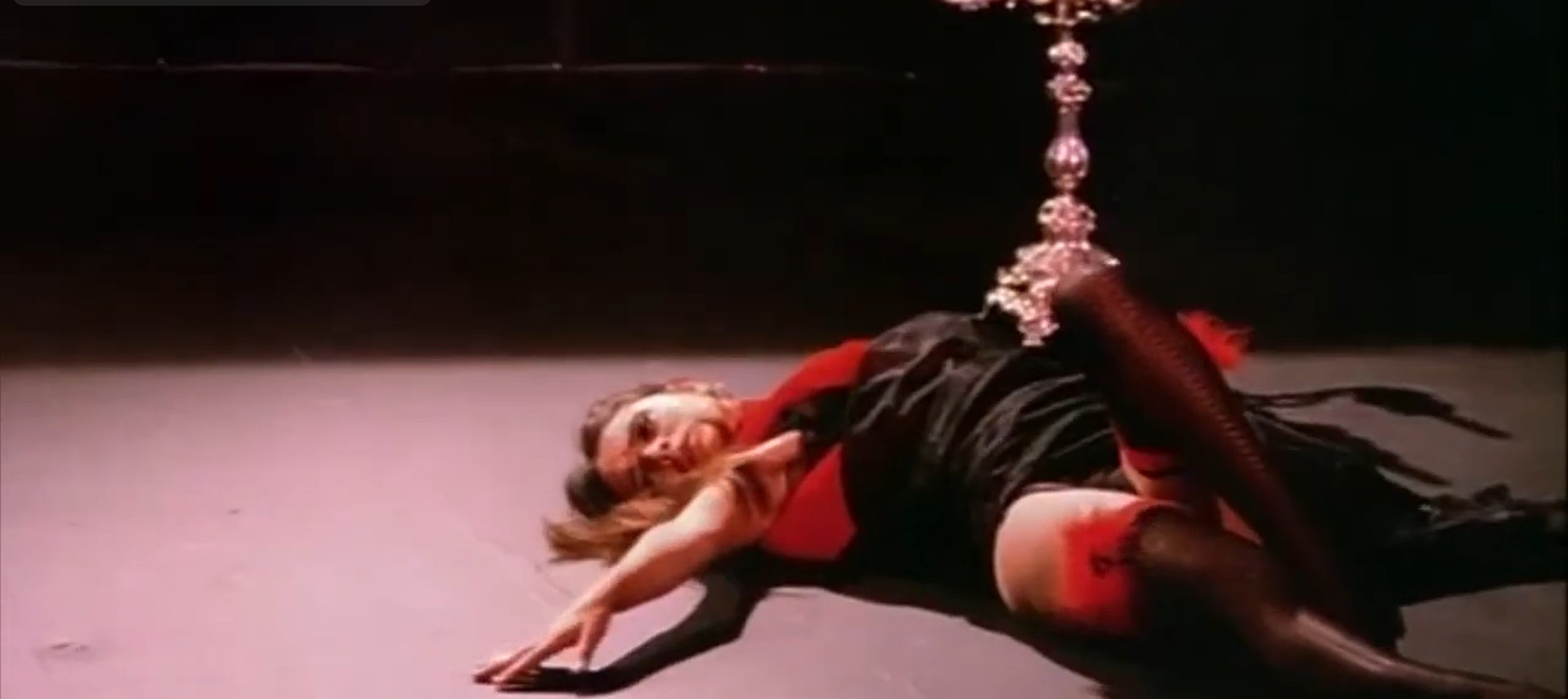
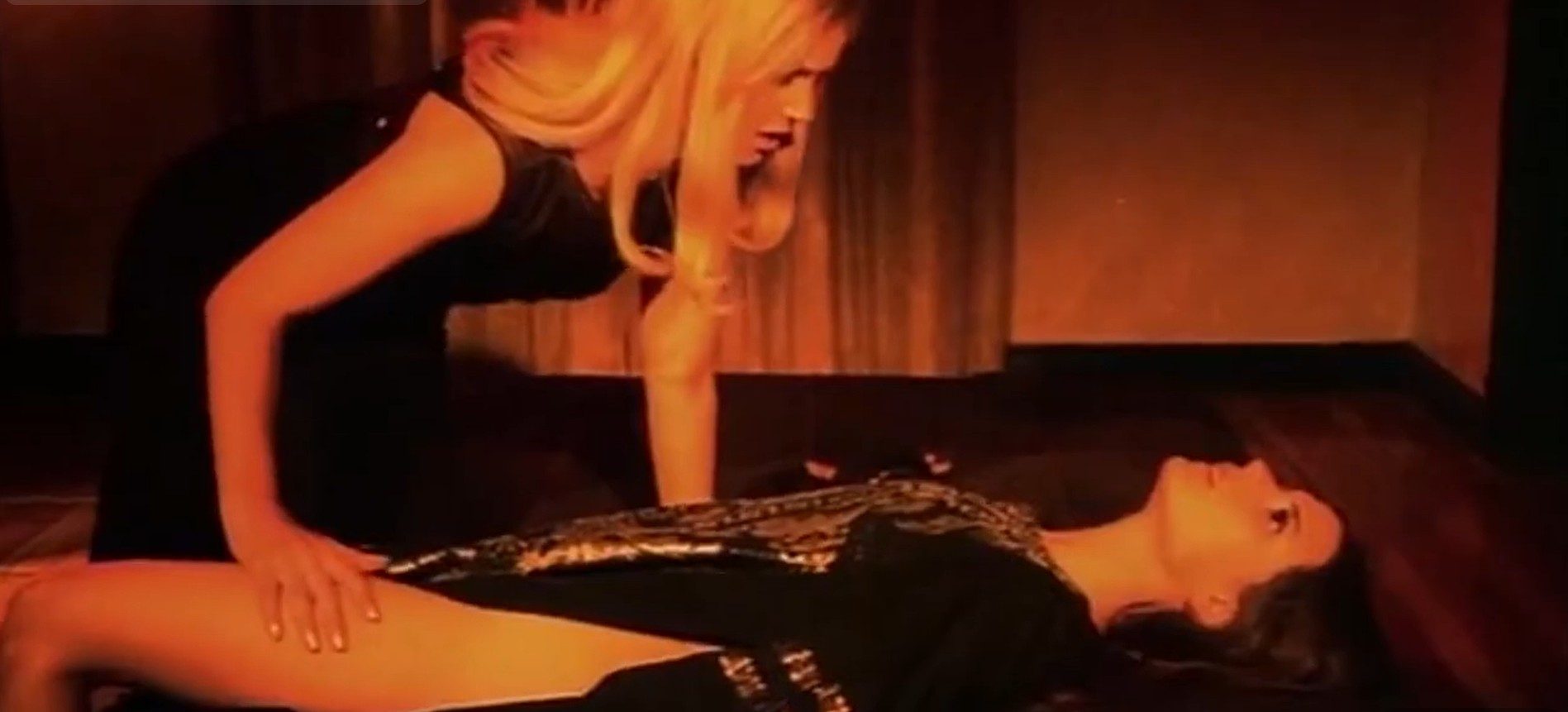
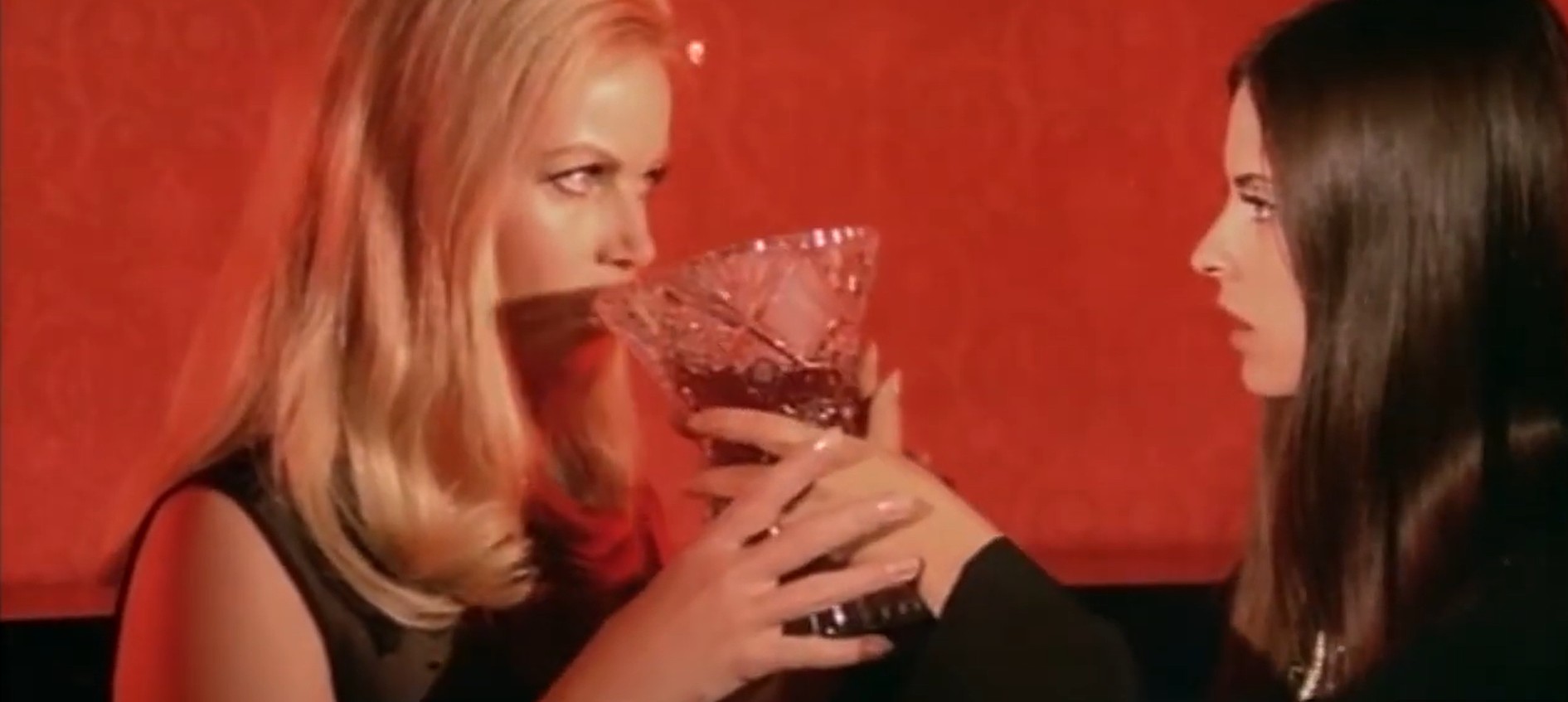
Linda’s dreams vividly disturb her with imagery of an idyllic island where blood rivulets watercourse down curtains while being in the romantic embrace of a swarthy beautiful woman.  These dreams are so powerful she must see a therapist about them.  When attending an nude performance art show with husband Omar, she’s shocked to see the woman on stage is the same woman from her dreams.   The coincidence lingers with Linda on her business trip to a Turkish island where she meets Countess Nadine Carody to discuss a large inheritance from a Count Dracula.  Come to her surprise, Countess Carody is the same woman from on stage.  Immediately, Linda’s under Countess Carody’s suggestive sexual influence of a lesbian vampire.  When Carody falls deeply for Linda, she will stop at nothing to have her whole, as one of her, to pass along the tradition of inherence as Dracula has done for her, but Omar, the psychiatrist Dr. Seward who’s familiar with vampirism, and a Memmet, a hotel clerk moonlighting as a rogue and vindictive vampire hunter, aim to help Linda from Carody’s grasp one way or another. 

The director behind some of Europe’s sleaziest erotic-horrors, such as “The Sadist of Notre Dame,” “Ilsa, the Wicked Warden,” and “A Virgin Among the Living Dead,” Jesús Franco, aka Jess Franco, was a prolific cult icon of the past, the present, and will still be in the future.  The Spanish born filmmaker grew up in the Francisco Franco dictatorship for over 30 years but that didn’t stop him from expressing his artistic freedom with the 1971 released “Vampyros Lesbos, “ a German production set in Turkey that mirrors the classic Bram Stoker tale but with teaks of character, scenery, and sexual orientation albeit “Dracula” is too thought to be a homoerotic tale to some filmic scholars.  Compositely filmed in Turkey, Spain, and Germany, “Vampyros Lesbos” is a production of Tele-Cine Film und Fernsehproduktion, Central Cinema Company, and the Fénix Cooperativa Cinematográfica with Karl Heinz Mannchen as executive producer and Artur Brauner as producer, both of whom worked on Franco’s “The Vengeance of Doctor Mabuse,” and the story, based loosely off of Stoker’s tale, is penned by Franco. 

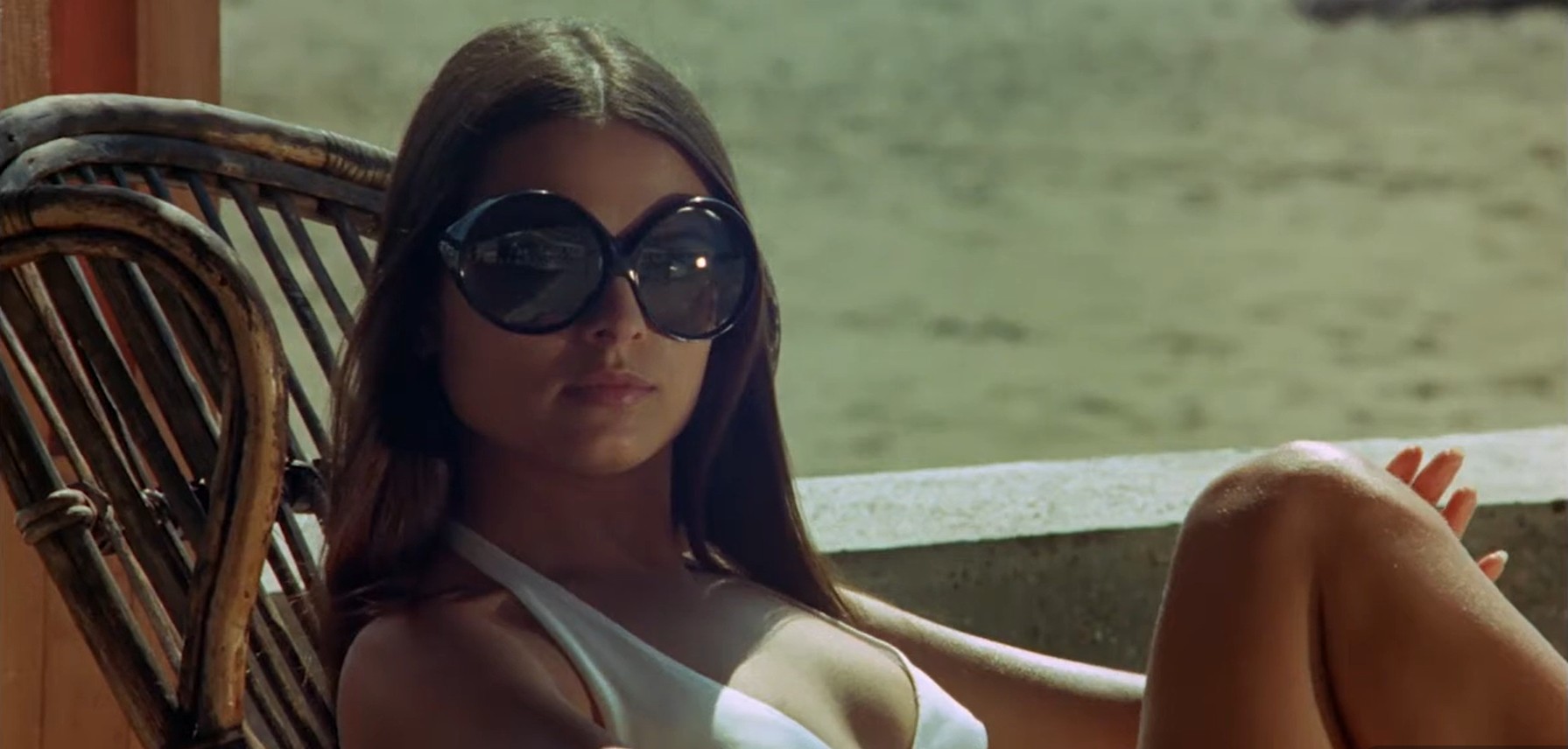
Like other Franco productions of this caliber, the cast is comprised of internationals, ranging from Spain to Sweden, from Britian to Switzerland, and to finally Germany without a single Turkish thespian in sight despite the story’s setting locale of Istanbul.  As mentioned briefly above, “Vampyros Lesbos” follows a threadbare version of Bram Stoker’s iconic Gothic tale that trades the grotesque Gothicisms for sunnier skies and idyllic island houses.  The basic principal characters are present from Stoker’s story but have been tweaked to fit Franco’s feverous surreal aesthetic that has a really sink its teeth into the homoerotic indulgencies.  Swedish actress Ewa Strömberg (“The Devil Came from Akasava,” “She Killed in Ecstasy”) resembles something along the lines of a Jonathan Harker-type but instead of being in real estate, like Harker, her character Linda Westinghouse is an inheritance lawyer dispatched to Countess Carody’s island home where she is bewitched by Carody’s infatuation and lust for her lifeforce.  Countess Carody is the obvious counterpart to Count Dracula but spun in a way that makes Bram Stoker’s story more like a tangent rather than remake as it’s Count Dracula’s fortune Countess Carody is inheriting.  Spanish actress Soledad Miranda (who also costarred with Strömberg in “The Devil Came from Akasava” and “She Killed in Ecstasy”) is the sultriest creature on the screen in Carody’s nude and neck biting pastimes and coupled with the easy-going Linda, Strömberg and Miranda sizzle as lesbian lovers very comfortable with each other’s performances and bodies.  Van Helsing is embodied by Dr. Seward but with reverse tendencies that do not require the doctor to be the stake to stop vampirism but rather entertain an unexpected twist trait that’s quite opposite.  Seward is played by British actor Dennis Price (“Tower of Evil”) and is a comparable Van Helsing amongst the previous lot but definitely less harrowing and dramatic than most.  Seward’s deranged patient Agra is the final piece to the Stoker narrative semblance as the story’s Renfield.  German actress Heidrun Kussin (“The Swingin’ Pussycats”) does not eat or feign eat bugs and other nightcrawlers to aspire being a vampire but retains Renfield’s psychic connection while going hysteria topless as she squirms in bed for her master’s return to whisk her away into the night.  “Vampyros Lesbos” rounds out the cast with new cast not familiar to Bram Stoker’s “Dracula” with Andrea Montchal (“Eugenie de Sade”) as Linda’s husband Omar, José Martínez Blanco as Countess Carody’s loyal bodyguard Morpho, Paul Muller (“Lady Frankenstein”) as Dr. Seward’s assistant Dr. Steiner, and Jesús Franco in the role of Memmet, a hotel clerk with a visceral vendetta against vampires. 

Arguably the most notable film out of the prolific Jesús Franco filmography, as I believe it to rival another outstanding piece of work from Franco, “Eugenie… The Story of Her Journey into Perversion, starring Christopher Lee and Maria Rohm based off the Marquis de Sade novel, “Vampyros Lesbos” is perhaps Franco’s most recognized piece film that has a sliver of notoriety while also spurring a remake years later in a 20-minute short film in 2008 by Matthew Saliba.  Most of Franco’s repitoire can be said as messy, a mash up of other films recut to make a new film, hackeneyed, and a complete dull, but “Vampyros Lesbos” is different.  It’s also not the same Eurosleaze one might be familiar with in regard to his catalogue; in fact, “Vampyros Lesbos,” despite the name, doesn’t even feel like sleaze.  There’s a naturality about it underneat it’s Bram Stoker-homoericism message sans the gratuitous nudity that’s more of a playful exploration of sexuality.  The only resemblance of sex is through the vampiric rite of seductive foreplay and subsequential drinking of the blood and with only Linda and Countess Nadine in scenes of embrace.  Not even poor Linda’s husband, Omar, has conjugal interactions and that plays into the whole theme of the story that Oman and Linda have this sexless relationship and here comes along Countess Nadine and her oozing sexpot of Linda’s fantasies inside a one-side power dynamic.  There’s no degenerate-filled debasement in this sexploitation, one the story’s traits that actually separates itself from “Eugenie,” and Franco, like with “Eugenie” on this element, actually helms an artistic aesthetic with good editing, crafty angles, and a varied cinematography blend of natural and stylized imaging. 

Provocative European sexploitation that isn’t busk European sleaze, “Vampyros Lesbos” is zenith Jess Franco, a social-political rebel and artist unafraid to tell a story that won’t tickle everyone’s interest but definitely be an archetype of the director’s caliber.  Severin Films proudly presents “Vampyros Lesbo” onto a new 4K UHD and Blu-ray dual-format set with a 4K presentation scanned from the original 35mm negative.  The 4K UHD is compressed with HVEC encoding onto a BD100 and the standard Blu-ray is AVC encoded onto a BD50 with respective resolutions of 2160p and 1080p.  The European 1.66:1 widescreen is the aspect ratio on both formats, but the UHD uses DolbyVision to expand upon the already lush color pallet with a richer complexity within the color scheme even though Franco loves his most muted black dressings on characters and on sets.  The extra pixels offer deeper textural, mostly auspiciously perceived in the club scenes that present a room of textures and in often brightly lit captures that don’t washout the details but rather define them more accurately.   The standard Blu-ray offers the same approach but brought back a step or two due to format limitations on the color scale and pixel count but a lesser keen eye won’t take much notice.  The original negative print shows no egregious mishandling damage or degrading emulsion wear.  The only audio track available is the German Mono ADR track with optional English subtitles.  This release does not contain the English dub that’s lost out there in physical media land.  The mono track has a flat tone with no depth to speak of and is full of desynch between dialogue movements and audio overlay but never hides behind the other single output layers. German Manfred Hübler and Sigfried Schwab eclectic score is a fun listen with brass, piano, sentur, light drums, and bass compiled to an era swanky main score that’s quoted being a sexadelic dance party, and rightfully so.  There’s even a distorted vocals on a slow beat jazz track that provides the unsettling and sultry notes for the underplayed horror side of this sexploitation.  Special features on the UHD includes audio commentaries by Kat Ellinger, author of Daughter of Darkness, and a collab between film academic Aaron AuBuchon and Oscarbate Film Collective’s John Dickson and Will Morris.  The UHD concludes with the German theatrical trailer.  The standard Blu-ray has more wiggle room for bons features with all the above from UHD, plus an interview with Jess Franc just prior to his death Interlude in Lesbos, an interview with Stephen Trower, author of Murderous Passions:  The Delirious Cinema of Jesús Franco, a Jess Franco career appreciation by “Anora” director Sean Baker The Red Scarf Diaries, the Stephen Thrower hosted In the Land of Franco, Part 12 looks at iconic locales from Franco’s films with a primary focus on “The Sadist of Notre Dame” which his set in Paris, France, an interview with Soledad Miranda historian Amy Brown Sublime Soledad, a 3-minute mini interview with Jess Franco labeled Jess is Yoda that provides some comedic flair and “Star Wars” references, and the German opening title sequence.  Physically, Severin’s release has a stark, hard contrast cardboard O-ring slipcover with Soledad Miranda in a seductive position starring right aback at you in front of black background.  The backside of the slipcover contains no technical information but does have review quotes, credit acknowledgments, and lingering stare between Countess Carody and Linda Westinghouse.  Inside you’ll find the classic 4K UHD Amaray with Severin’s original Blu-ray art from 2015, commissioned by graphic artist Ben Benscoter.  There is no reverse image on the sleeve.  The discs are held separately with one each side of the interior.  The 89-minute film is not rated and is region free for global enjoyment.

Last Rites: Jess Franco’s “Vampyros Lesbos” is on the select short list of how the Spanish director should be judged by existing and new fans of his work and remembered in his long career and legacy as a truly psychedelic, auteur driven, lesbian vampire film with plenty of women-centric allure and flesh.

Men Beware of the “Vampyros Lesbos” now on 4K UHD and Blu-ray

EVIL’s Vampiric Power Over the Homunculus is Short Lived! “Decadent Evil” reviewed! (Full Moon Features / Blu-ray)

The Remastered “Decadent Evil” is now on Blu-ray!

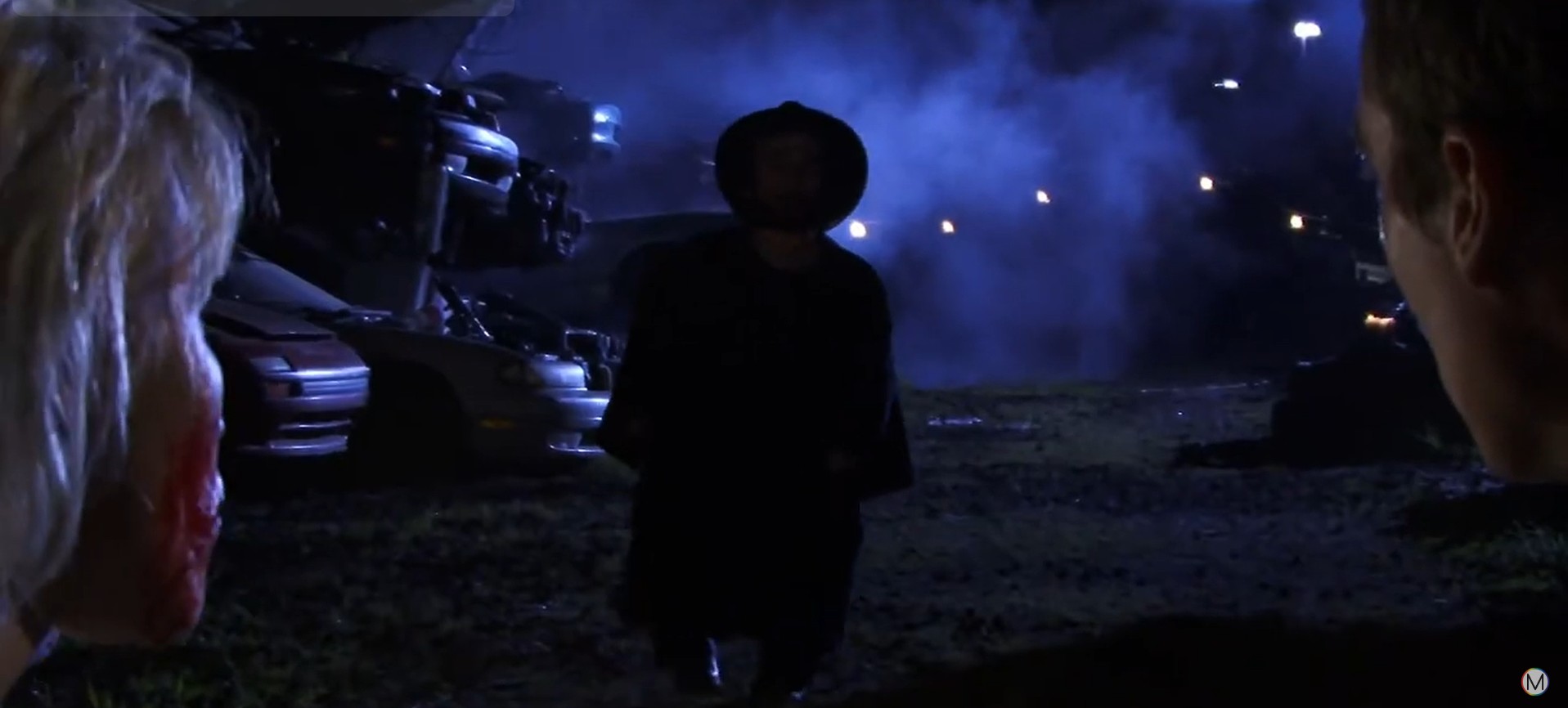
An evil vampiric bloodline has stretched from Europe to U.S., specially in the Los Angeles area, where Morella, a centuries year old master vampire, collects the blood of innocent victims and she requires just one more soul to fulfill a prophecy to be the most powerful and invincible vampire ever.  Morella is so cruel she even transformed her once lover into a homunculus, a scaly and green shrunken humanoid, to keep as a caged pet.  When two of Morella’s thralls are uncovered working at a strip club by a dwarf vampire hunter with a grudge, she finds obtaining the last soul to be challenging, especially when one of her subservient vampires, Sugar, is against the whole bloodsucking attribute and falls in love with the strip club DJ.  With Sugar, the DJ, the homunculus, and the vampire hunter standing in her way of total immortality of godlike proportions, Morella has little allies in her corner but has the majority of evil power behind her ancestral lineage. 

An early 2000’s Anne Rice facsimile, “Decadent Evil” is Charles Band and Full Moon’s other Gothically romantic infused vampire feature behind “Subspecies” and “The Vampire Journals,” which are technically all part of the same “Subspecies” universe in one way or another.   The “Puppet Master” and “Trancers” cult filmmaker helms the 2005 low-budget feature and cowrites it alongside a staple Full Moon screenwriter Domonic Weir (“Evil Bong”) in what would be one of Weir’s first feature length films for the longtime genre producing company after gifting the horror community with a “Critters” screenplay in 1986.  After a few minor re-writings of Hong Kong actioners for an English dub, Weir returns to horror with Full Moon and indulges Band on his diminutive obsession with tiny terrors.  And what may you ask is the small creature in a sexy-slathered vampire flick?  A homunculus is written into the story, of course!  Band produces “Decadent Evil” not under Full Moon but Wizard Entertainment in collaboration with Shoot Productions and Astonishing Features with Jeremy Gordon and Jethro Rothe-Kushel as association producers on the Los Angeles based shoot. 

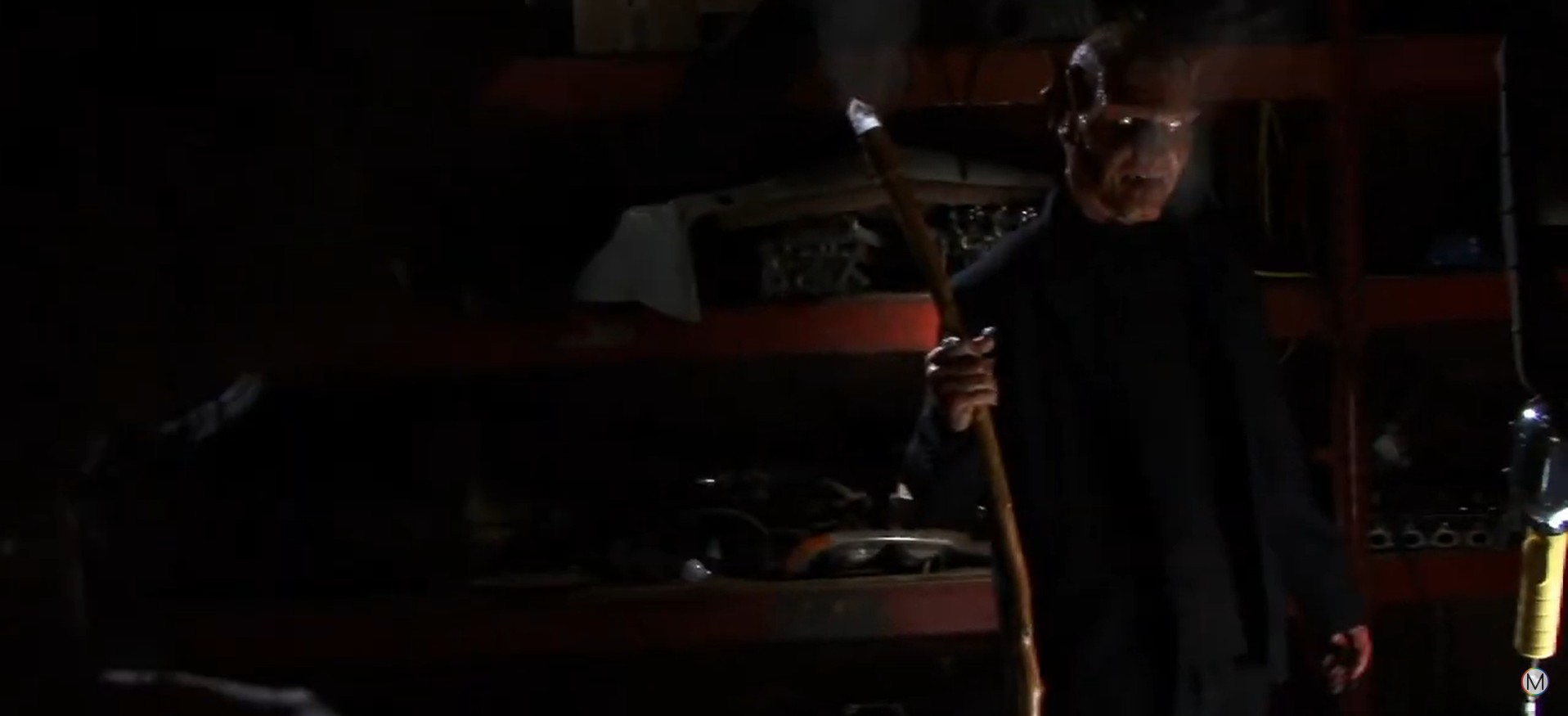
The prologue backstory of “Decadent Evil” can be misleading as to who the main characters will be with a restructured, recut introduction made from bits and pieces of scenes of “The Vampire Jounrals,” another Full Moon production, that uses a power Euro male vampire bloodline as the basis for Morella’s L.A. homebase of operations, which include the ying yang, naughty and nice, vampiric sisters, Sugar and Spyce.  “Blood Dolls” and “Prison of the Dead’s” Debra Mayer, a late 1990’s scream queen for about a decade and half until her eventual departure from acting, plays the head vampire in charge Morella with a firm grip on her subservient thrall, the angsty and gothic-inclined Spyce (Raelyn Hennessee, “Cutter’s Club”) and the sweet-and-innocence exuding Sugar (Jill Michelle, “Erotic Secrets”).  The sisters go through the motions of obedience but to an extent with Sugar basically disavowing her vampire blood in hopes for a romance relationship with her strip club’s DJ Dex (Daniel Lennox, “The Black Magic”) and Spyce pushes the limits of her own control, like a teenager testing their parents, by drinking the blood of those meant for Morella’s grand power count.  With a 67-minute runtime, “Decadent Evil” doesn’t have the minutes to really explore the characters that force the actors to be plain, act plain, and never be anything more than plain.  Even Phil Fondacaro, the headlining star and most recognizable face of the troupe, must purge backstory in a flash upon his acute introduction mid-way through.  The “Willow” and “Ghoulies II” actor is a vengeful vampire hunter after his father falls victim to Morella.  April Gilbert (“The Butcher”), Roger Toussaint (“Illicit Dreams”), John F. Schaeffer, and, of course, it wouldn’t be a Charles Band picture without a half-naked adult film star in Harmony Rose who goes topless for the cause. 

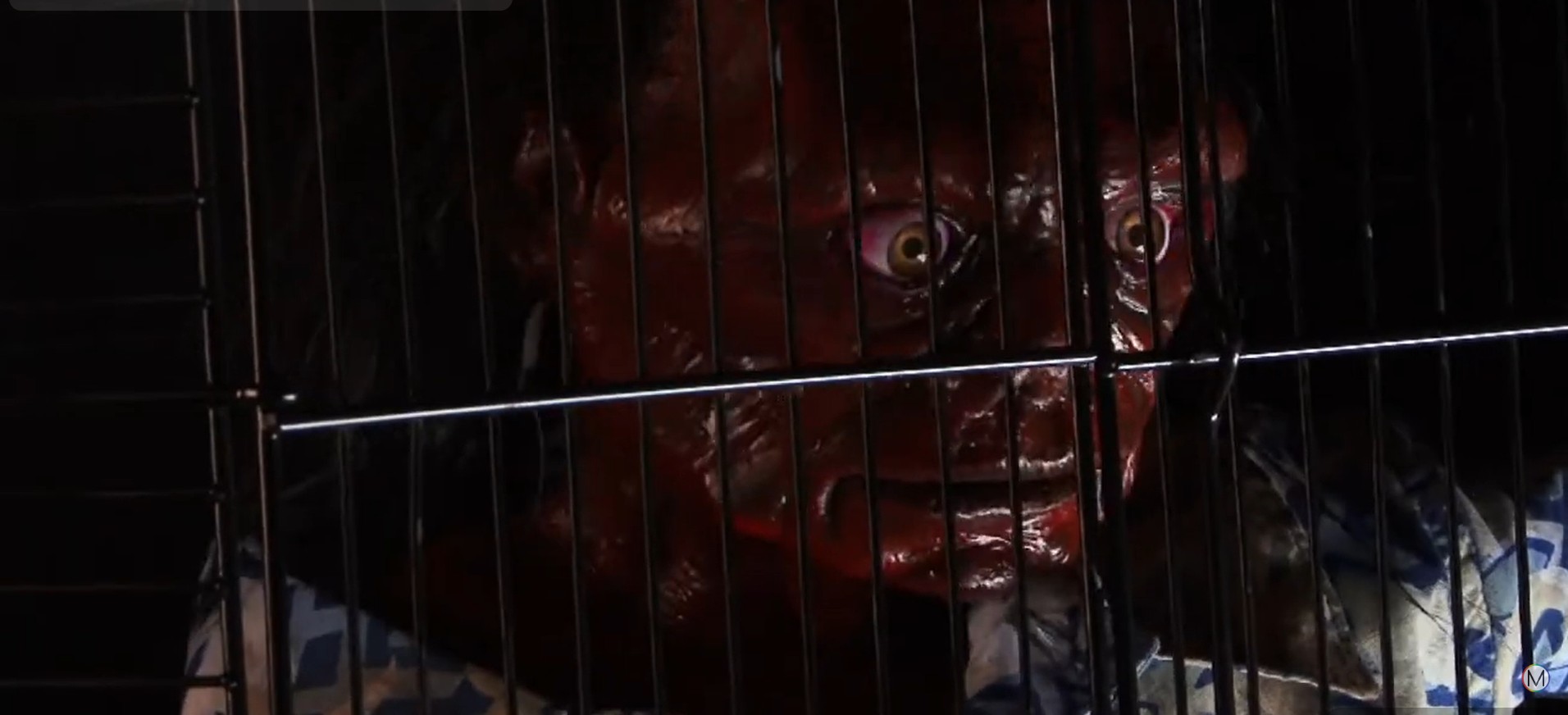
Locally shot near the company home base of Los Angeles, full of either Full Moon actors or greenhorn actors, little-to-no budget for practical or computer generated effects, a runtime of under an hour, and the tacking on of “The Vampire Journals” at the beginning to extend the length to just that under the hour mark is a true show of low-budget colors from Charles Band and Full Moon.  The premise of Morella becoming an omnipotent vampire through a scrapbook collection of pure blood is a solid enough premise that is unfortunately not explored enough to become invested, turning this Full Moon venture into what it has become over the last couple of decade, a feast of female-casted eye candy and fatigued nostalgia without implementing anything new to the vampire or horror genre.  There’s also the matter of the homunculus that becomes a centerpiece and eventually tops as the main motif that hangs around in a bird cage and perversely has eyes for blood while simultaneously carrying around a major libido with scenes of molesting and raping involving the pint size creature.  The whole idea is a bit off, added to sate Charles Band’s fascination of with small creatures, and only adds mild interest in its development through the story which ends in a perversion of slapstick that, again, doesn’t fit, this time in the narrative tone. 

Full Moon continues to upgrade their catalogue, and the “Decadent Evil” films are the latest to be AVC encoded onto a BD25 with a remastered, high-def, 1080p, resolution for the first time ever in HD with a transfer scan form the original 35mm negative.   The early 2000 film sustains a fair amount of its 35mm charm despite most companies flocking to the less expensive digital format and this helps retain a richer saturation and an organically bold image that accentuates the hardlines and elaborately dressed gothic interiors and the smoke-filled darkness of the strip club.  The rest of the settings are standard fair, but the focus is within Morella’s L.A. mansion that has a mistress vampire’s touch.  The digitized conversion and the upgrade in pixels have cleaned up the image some but hasn’t exactly wowed with impressive measure as the details often fluctuate outside stylized lighting and smoke.  There’s often superb, granule detail on the homunculus’s shiny wet gland-filled dermis and deep contoured bone structure in the obvious puppet’s face and head.  The English audio comes with a couple of uncompressed formats with an PCM 5.1 and a 2.0 Stereo.  The 5.1 is more than enough for dialogue, soundtrack, and the ambient environment, though the latter is more for immediate focal points rather than the natural course of surroundings.  For instance, the homunculus’s heavy breathing and slippery skin provide characteristics to the already unique character but since much of the narrative is held indoors in a still mansion, there’s not much to the audio atmospherics, and even the strip club is doused with a rock track that swallows any other diegetic and nondiegetic noise.  Dialogue prominently in front but can struggle with depth in the 5.1 mix that often doesn’t pick it up; there’s better discernibility within the dual channel that maintains a front forward audio rather than trying to diffuse the already distance stilted audio.  “Decadent Evil’s” soundtrack is less carnivalesque than other Full Moon productions because Richard Band is not at the orchestrator helm, providing “Deathbed” composer James T. Sale’s soap opera Gothicism and playful low-tones more opportunities to flourish with this campy vampy film.  Extra features include a behind-the-scenes with snip interviews with the cast, a blooper reel, the original trailer, and other preview trailers from Full Moon Features.  The physical release mirrors much from the same line of DVD to Blu-ray upgrades with standard Amaray case.  The one-sided sleeve art illustration is new, which is a fine collage of characters, yet is uncredited.  There’s no inserts or other tangible extras on this region free, 74-minute, unrated vampire indulger. 

Last Rites: Fans of Full Moon’s “Subspecies” and ‘The Vampire Journals” will find “Decadent Evil” to stagger in its more modern affiliation with a meek story having little-to-no bite, favoring more the shorter stints of an arbitrary homunculus inclusion and Phil Fondacaro’s flyby hunter.

The Remastered “Decadent Evil” is now on Blu-ray!

Under Hypnosis, You’ll Do Anything For EVIL! “Vampire at Midnight” reviewed! (MVD Visual / DVD)

“Vampire at Midnight” is now on DVD!

Gripped by a serial killer dubbed the Vampire Killer, Los Angeles is on high alert as not one single piece evidence could be recovered from the more than a dozen crime scenes where women’s’ necks are ripped to shreds, their bodies are drained of blood, and their corpses dumped for police to discover.  With detectives baffled, cowboy cop Roger Sutter is ordered by the reckless antics-frustrated Captain to stay away from case but when Roger follows a lead that lands in his lap, two people wind up dead and the killer slips through his grasp, the captain suspends him from the force.  Focusing all his energy into a newfound romance with apartment complex neighbor and aspiring pianist Jenny Carleton, Roger finds himself back onto the killer’s trail when his time with Jenny goes from special and exciting to acutely avoiding his every advance.  Roger suspects the Vampire Killer behind Jenny’s sudden change in behavior.  Unofficially back on the case, the off-duty Los Angeles homicide detective finds himself in the middle of the Vampire Killer’s ritual to seduce Jenny into his coven as one of his blood brides. 

The maverick cop versus the serial killer narrative “Vampire at Midnight” is the 1988 investigative thriller with a horror edge from editor-producer Gregory McClatchy (“The Great American Girl Robbery,” “Terror in the Aisles”) in his first, and only horror credited, feature length directorial.  Also, lesser known as “L.A. Midnight, “Hypnos” or “Murder at Midnight,” the entrancing, modern vampire script is penned by “Danger Zone II:  Reaper’s Revenge” writer Dulany Ross Clements from a story by fellow “Danger Zone II” collaborators Jason William (actor in “The Great American Girl Robbery” and “Flesh Gordon”) and Tom Friedman (“Time Walker”).  Skouras Pictures served as the production company and the theatrical distributor with Friedman and Williams also in a producing capacity.

Much like with his lead kidnapper role in “The Great American Girl Robbery,” as well as other skin-a-matic films like “Alice in Wonderland:  An X-Rated Musical” or “Flesh Gordon,” producer, conceptual storyteller, and principal star Jason Williams puts himself into the rough-and-rugged hero to get the girl, or girls, half naked in his arms.  As unorthodox method cop bending procedure to get results, Williams molds handsome homicide detective Roger Sutter to the quintessential trope of a good cop doing everything he can to get the job done, even if that means skirting around lawlessness.  Roger is pitted up against pure vampiric evil who welcomes the lawlessness under the façade of a doctor of hypnotism specializing in unleashing clients’ frustrating mental blockages in their careers and goals.  Argentine-born Gustav Vintas has the physical look of a sophisticated villain (see “Lethal Weapon,” “Verne Miller,” and “Midnight”) with his stage 6 receding hairline and foreign accent and “Vampire at Midnight” also fits the bill with Dr. Victor Radikoff, a smooth talking and charming manipulator who can literally hypnotize his clients into anything, such as serving their necks up to his fangs or be beguiled assassins.  Caught in the middle is aspiring pianist Jenny Carlton, Roger’s beautiful blonde neighbor turned girlfriend turned slave to Radikoff’s hypnosis powers.  Jenny is played by the one-and-done feature film credited Lesley Milne in a rigid performance that’s critically subsided by her well-defined figure, one of several to go topless alongside “Saturday the 14th Strikes Back’s” Jeanie Moore, “Hollywood Chainsaw Hookers’” Esther Elise, and “Angel III:  The Final Chapter” Barbara Hammond.  The film rounds out with Christopher Nee, Robert Random (“Toke”), Jonny Solomon (“Peephole”), Ted Hamaguchi, Richmond Shepard (“Simon, King of the Witches”), and Ceclia Kaye (“Don’t Be Afraid of the Dark”).

“Vampire at Midnight” is the modern vampire film that tries to blend the old tropes with the new folds.  The malevolent Dr. Victor Radikoff has the menacingly creepy charm and suavity of Bram Stoker’s tale of Count Dracula flirting up against Max Schreck’s appearance as the horribly grotesque Count Orlok in the F.W. Murnau’s bastard film, “Nosferatu:  The Symphony of Horror.”  While the latter may just be an opinionated statement or judgement on Gustav Vintas’s physical naturality, not to say Vintas is grotesque or horrible looking at all, but rather his physical characteristics are atypical of the master vampire, resembling more closely to the baseline Nosferatu with a receding hairline, slender stature, and a uniquely contoured face. Being set in Los Angeles, the gothic qualities that instill fear, dread, and medieval facets from Dracula origins are all but lost, but you must remember, this isn’t Dracula.  This is Dr. Victor Radikoff, the prestigious hypnotist of the affluent, and that speaks true to the hip city of angels setting full of funky-sexualized interpretative dancing and late-night comedy standups as well as fitting into the budget to keep the indie film costs low for the sleek new take of the vampire trope to freshly entertain late 80s audiences.  However, “Vampire at Midnight” doesn’t go plot unscathed with the first act leaning heavily into L.A. paralyzed with Vampire Killer fear and the cops nervously on edge and disheartened by the lack of evidence and leads; the atmosphere felt more despairing and darker with the killer staying one step ahead and a body count slowly rises upward.  Then, the tone shifts slowly from a tough terrorizing case to crack to Roger’s incessant hard-on for a rather focused and naïve pianist.  The case only becomes interested in again when Roger receives a happenstance call in and he’s back in the saddle of his cowboy cop antics until he’s not again, being, in my opinion, unjustifiably suspended for shooting down a suspect trying to kill him and the suspected Killer getting away.  It’s as if the police, as well as the media and the public perception, left the case to fizzle out while the relationship between Roger and Jenny builds up for the sole purpose of being broken by, again, happenstance in Radikoff’s chance meeting with Jenny at a socialite party where she’s hired to play piano.

Arriving onto a MVDVisual DVD, this obscure hypno-vampire gem is entranced with new life.  Unfortunately, however, the new release is not a technically impressive one with its 720p resolution and pillar box 1.33:1 aspect ratio in regard to video.  The MPEG2 DVD5 handles the compression without a substantial hitch.  Other than the lower resolution that creates some blurry/fuzziness, here are no seemingly other issues in the codec, such as macroblocking, or banding.  Blacks retain its void inkiness even inside the confines of a lower contrast, but the grading is nonexistent that results in flat coloring and little life in the range spectrum.  The film has a shot-on-video look, but the transfer is rendered from a 35mm print digitized with little touchup for DVD.  The original print has only minor imperfections, a brief scratch here and there, but no major damage to note.  The English language Dolby Digital 2.0 Mono doesn’t elevate the new release either.  Dialogue isn’t terribly feeble, but it definitely isn’t robust through the single channel where depth doesn’t have an influence.  The overall quality of the recording is not bad with a clean presentation that’s layered in an expertly designed arrangement; big kudos should go to editor Kaye Davis and sound mixer Vic Carpenter who enrich “Vampire at Midnight’s” filmic posture as the two do competently dance together between the audio and video editing.  English subtitles are optionally available.  MVD’s standard release is bare bones without special features.  The standard DVD Amaray sports the beautiful gothic and blood dripping poster as the front cover; however, the backside contains three out of the five stills of Ester Alise, one involving Robert Random, and one with Random and Gustav Vintas and what makes the backside a curiously funny duck is the four blocked together stills are not from the film and were plucked directly from IMDB.com.  Instead, they are from different cult films starring Random and Alise, such as Alise’s “Hollywood Chainsaw Hookers.”  The disc is pressed with the same cover art image.  The rated R release is region free and has a runtime of 93 minutes.

Last Rites: Gregory McClatchy keeps this L.A. vampire picture in constant postulation with an unconscious red herring that’s stable until the very end, but the story pivot strains too far from its gritty and dark cop-chase-killer opening by focusing more on a love polygon of sex, deception, and true devotion, a swivel that puts a stake right in the heart of this 80’s exuberant story.

“Vampire at Midnight” is now on DVD!

EVIL Sinks Its Teeth into the Reach of the Worldwide Web! (Full Moon Features / Blu-ray)

“Death Streamer” Now on Blu-ray!

A trio of struggling horror video podcasters stumble across a dark web stream while content mining for their derelict house of God set macabre show Church of Chills.  When they stumble upon a bloodcurdling ritual of drugging women and man vampirically ripping out and feasting on their necks, the footage is all too real based on their research and investigation into the underground live streams that rack up thousands of views and subscribers.  Eager to piggyback off the streams’ success, the Church of Chills reveals the callous, artery puncturing content to the world.  The live streaming ancient vampire master, seeking sacrifices to bring the end of days upon the world, is none too happy with the intruders doxing his content that has amassed a large following and warns them with omnipotent power, sending the three into flight or fight for their very lives and the for the sake of the world.

As the famous chorus line from the legendary rock-n-roll band AC/DC once sang, If you want nudity, you got it!  Or was it blood?  Either way, Charles Band’s “Death Streamer” you get plenty of both!  The new tech, modernized vampire lurks from out of the classic, gothic shadows and becomes the next inspirational concept from the longtime, distinguished founder and filmmaker of Full Moon Entertainment and the “Trancers” and “Head of the Family” director, Charles Band.  The 2024 feature is written from Band’s concept into story detail and dialogue by Neal Marshall Stevens, the screenwriter behind “Thir13en Ghosts” remake “Hellraiser:  Deader” and who has since become a Full Moon staff writer with credits going from touching the “Puppet Master” franchise with “Blade:  The Iron Cross” to new content with “AIMEE:  The Visitor,” penned under Stevens’ pseudonym of Roger Baron as so too with “Death Streamer.”  Full Moon Entertainment’s Charles Band and Nakai Nelson produce their latest with a budget aid alley-oop by a crowdfunding campaign.

“Death Streamers” core cast has small but mighty with Aaron Michael McDaniel debuting in his feature film role as Alex Jarvis, the egocentric host of Church of Chills, and his two beautiful assistants in Emma Massalone as Edwins and Kaitlin Moore as Juniper struggling in a power dynamic over who has creative control over the show while staying financially afloat being unhoused living inside test in a defunct house of God.  Convincing audiences the trio of being adept and meticulous with computers and a video podcast is a hard sell when they live in popup tents and rariely leave the church grounds without much background other than short spats of the show’s brief history, but nonetheless, the three M’s – McDaniel, Massalone, and Moore – make their character emotions and pangs work to the story’s advantage rarther than have it feel like a detrimental free for all for the spotlight.  Creeping into that bright circle is the dark heart of vampire streamer Arturo Valenor, played Sean Ohlman.  The sex club proprietor, operating in the underground markets, drugs beauties with his own blood, rips their clothes off, and has his way sucking the lifeforce from their tender necks.  This dark web act is unearthed by the Church of Chills team and becomes the focal point for them to piggyback and drive-up subscribers with real life macabre only to be discovered and threatened by Valenor’s ever-present powers. Ohlman makes for a good hip vampire but doesn’t exact that gothic depravity of a classic bloodsucker in Valenor’s more erotically inclined sacrifices.  Only in the very showdown end do all four principals find themselves in the same scene together, previous working separately across the worldwide dark web or through Valenor’s giant floating eyes of foreboding.  Yes, floating giant eyes is pretty trippy and old school.  The rest cast constitutes as one half of Valenor’s vampiric acolytes with Chili Jean as the blood serving barkeep and Travis Stoner as the gimp-masked muscle and the other half half-naked Valenor victims in Llana Barron, Piper Parks, and it wouldn’t be a Full Moon Feature without an adult actress making an appearance with Maddy May going fully nude.

“Death Streamer” follows the same formula Full Moon has been following the last few years by pulling inspiration from the latest and greatest, perhaps even from the ugliest, flavor of the month cultural impact item has to offer.  2020 saw the release of “Corona Zombies” to bank off the pandemic, also from 2020 was “Barbie & Kendra Save the Tiger King” spun from the popular Netflix documentary of the same “Tiger King” title surrounding convicted felon Joe Exotic, “AIMEE:  The Visitor” featured sensationally the dangers of A.I. during the artificial intelligence concern of rise, especially amongst the arts industry, and, lastly, a slew of video content infused storylines as TikTok, Facebook Live, X Live, and many other platforms become an overconsumption of media with “Bad Influencer,” “Attack of the 50ft Camgirl,” and “Subscriber” being a few examples.  “Death Streamer” fits in the latter category as well by following a what seems to be an endless horizon of streaming content from music, to vidcasts, to live feeds in today’s highly consumable media world where everybody, and their brother, has streams to be viral.  “Death Streamer” using today’s tech to try and modernize the mythos of one of man’s longstanding lores, vampires.  Charles Band’s two-prong locations keep costs of the crowdfunded dollars down while pushing much of the cashflow toward effects, both practical with off-screen trickery and blood spurts, and compositional VFX that sees large floating eyes and thousands of chirping bats, as well as getting essentially all the female actresses at least to a bare-chested level with even one using her holy cross chest tattoo, nested right between her mammaries, as the final nail in the coffin for one unlucky, or maybe very luck, vampire with a death by a gratuitous emblematic exposure.  Hands down, “Death Streamer” has the best kill scene I’ve seen this year!

Be a subscriber to the end of the world with Full Moon Feature’s “Death Streamer” now available on Blu-ray. The AVC encoded, 1080p high-definition, BD25 seems adequate for the presentation flushed with warm red, blue, and green color filters. Details are sparse depending on the artistic alleyway inside Valenor’s club or inside his POV camera-specs, brighter the gels, lesser the finer points to the textures. The church setting, or the Church of Chills HQ, puts together a better angled lighting and a starker contrast by way of deeper shadows. Insignificant compression issues despite the single layer format but we’re not receiving the cleanest, most refined, looking picture image that’s presented in a 2.35:1 aspect ratio. Two English encoded audio outputs are both Dolby Digital compressed with a 5.1 surround sound mix and a dual channel 2.0 stereo. Not the strongest or dynamic reproduction of the original, raw audio as it suppresses the action and removes the multiple channel pathways, rendering over mostly in the front channels in what the listing is more 5.1 in name only. Dialogue comes over clean and clearly enough without a spark of obstruction and is layered above the environment as well as what’s usually an overpowering Full Moon carnivalesque or Gothic score. English closed captioned subtitles are available. Special features include a behind-the-scenes of the regularly archived and accompanying Videozone specials, the “Death Streamer” premiere held in Los Angele was cast, crew, and a few select Full Moon friends, such as Barbara Crampton, with a Charles Band pre-movie few words, and a lineup of Full Moon trailers. The standard release of the Blu-ray Amaray has a pulpy illustrative cover art of a bloodied mouth Valenor and his two acolytes splayed in red, blues, and purple. The region free release comes not rated and has a just above an hour runtime of 72 minutes.

Last Rites: As the vampire canon expands with age, new grooves are etched into the classical monster’s lineage tree and “Death Streamer” is a cyber-ghoul knot ready to leave its influential mark only to have its fangs nulled down and overshadowed by the all-powerful naked female figure in another fair-weather Full Moon Feature.

“Death Streamer” Now on Blu-ray!

EVIL Chews Through Its Own Loved Ones as “The Vourdalak” reviewed! (Oscilloscope Laboratories / Blu-ray)

“The Vourdalak” Available Now at Amazon.com!

The special emissary of the King of France is ambushed by Turks in an isolated Slovic countryside.  With his carriage and clothes stolen and his driver-servant dead, Monseigneur Marquis Jacques Antoine Saturnin d’Urfé has nothing more than the clothes on his back.  He finds himself in the home of Gorcha, an enemy of the Turks, who resides with his three adult children, a daughter in law, and a grandson, but Gorcha was not presently there to greet his hapless visitor until his returns later that day from fighting the Turkish raiders.  Yet, aside from the oldest son Jegor, the family’s superstitious beliefs lead them to doubt Gorcha returning home human and instead has returned as vourdalak, or a blood hungry vampiric creature who feeds on his own loving family to turn them all into the same unnatural ilk.  From an outsider’s point of view, what Marquis d’Urfé witnesses initially is a strange peasant family’s irritational fear turn into a harrowing horror as one-by-one the family members reach an unfortunate end after the return of Gorcha.

Based off the gothic novella “La Famille du Vourdalak. Fragment inedit des Memoires d’un inconnu” from Russian author Aleksey Konstantinovic Tolstoy, a story that plays on the etymology of the Slavic folklore word Wurdulac, or a vampire-like creature, that exacts a similar transpiring fate as described in the above plotline of Adrien Beau’s “The Vourdalak.”   The writer-director fleshes out the 1839 Tolstoy story, one that’s predates Bram Stoker’s “Dracula” by nearly 60 years, for his own period set rendition created for modern times almost two centuries later in 2023 as his debut feature-length film.  The French film is cowritten alongside Hadrien Bouvier who doesn’t depict the vampiric creature as a nobleman, or even a man of wealth, but rather as a likely lowly serf of the countryside under a noble or lord.  Yet, the script, very much like Tolstoy’s novella, is contained within the family and their home rather than expanding across continents and seas, as in Stoker’s “Dracula.”  “The Vourdalak” is produced by “Alone in Berlin’s” Marco and Lola Pacchnioni and Judith Lou Lévy (“Zombie Child”) under the production banners of Les Films du Ball, Master Movies and, in association with, Cinemage 17 and Amazon. 

A period piece with an intimate cast brings closer together the targeted era of late 18th century to early 19th century costuming, articles, and, to extent, performances that sell the monarchial times of French aristocracy and Slavic provincials living humbly on the fringes of an everlasting Russo-Turkish war that spanned decades.  Leading the charge is the only French aristocrat portrayed character in the story played by Kacey Mottet Klein (“The Suicide Shop”).  Dressed in traditional Empiric style high collar shirt, petty coat, and a white wig and garishly garnished with white pale-looking makeup with mouche, an adhesive mole, to reflect their wealth and status, Klein’s prim-and-proper, yet prudish and prissy, Marquis Jacques Antoine Saturnin d’Urfé is finely out of his element with a satisfiable character arc that has the Monseigneur go from a squeamish snob to finding compassion, sympathy, and courage amongst darkness aimed to swallow a family whole as d’Urfé’s high society and fantastical life clashes with the real world with war, necessity, death, natural beauty, unconventionalities, and consideration through another type of fantasy lens, a troubling, insidious darkness that plagues and feeds on the blood from within a domestic design that’s ruthless as it is unfathomable.  Jegor (Grégoire Colin, “Bastards”) is the loyal eldest son, Piotr (Vassili Schneider, “The Demons”) is the sexual orient ambiguous second son with external emotions unlike his other brother, Sdenka (Ariane Labed, “The Brutalist”) is the free-spirited but melancholic beauty, Anja (Claire Duburcq, “She is Conann”) as Jegor’s more than practical and realistic wife and young Vlad (Gabriel Pavie) is Jegor and Anje’s preadolescent boy.  The aforenoted characters are all embodied by a physical, living person to play the role but Gorcha is a horse of another color.  In fact, Gorcha’s not a living thing at all and is actually a puppet personified by two puppeteers and voiced by director Adrien Beau.  The puppet has an emaciated appearance, resembling closely to those used in “Return of the Living Dead, and with the power of green screen, the animating arms and bodies are overlayed out and Gorcha lives and breathes with an animatism spirit that’s creepy as all Hell with an underscoring tow of vampirism. 

In its essence, “The Vourdalak” embraces the simplicity with a less-is-more atmosphere, a self-assured reliance in the palpable and practical, and a confidence in its cast to extract the drama and horror of a longstanding folklore and deliver its poignant potency with eccentric diversity and steady anxiety.  Beau drenches dread into every crevice that sticks like humidity to its subdued black comedy attire.  Yes, “The Vourdalak,” though grim and dark, has a sliver of comedy course through its bloodlet and lapped up veins from the main character’s perspective who, at first, is quite out of his comfortable, aristocracy element being wiggled into a lower-class family’s unusual dysfunctionality.  There’s also the puppet aspect integrated into living, breathing actors as if one of their own and that certainly as a basic layer of absurd surrealism, the French know a thing or two about liberal arts absurdism.  Beau’s shooting style resembles a blend between the fixed camera and low-key lit silent films, also implementing throwback spyglass shots that were widely used in the early cinematic period, and the Euro-horror movement of the 1960s to early 1980s with an ominous romanticism, a dark and creepy-fog environment, and tinged to cooler shades of soft blues and greens all the while lightly touching upon themes of sexuality, homosexuality, and family structures that often collide with one another to stir the pot and overshadows the imminent danger in front of them. 

“The Vourdalak” is unpredictably grotesque in the most amusingly macabre way and is now on a region free Blu-ray release from our friends at Oscilloscope Laboratories.  AVC encoded onto the BD50, the high definition, 1080p resolution, might throw audiences and purveyors of physical media for a loop when the picture isn’t as fine as expected for a modern released picture.  That’s because Adrien Beau shot “The Dourdalak” in Super 16mm that enlivens a grainy and soft toned picture that can appear slightly blurry, resembling the ilk of European horror from the 1960s-1980s  Presented in an anamorphic widescreen 2.35:1 aspect ratio, Beau is very committed the coldness of bleak grays, blues, reds and the variant fused shades of purple, pink, and teals that sparingly envelope the entire frame with a lens tint in surreal moments, such as fever dreams or emulated night shots.  Though unfocused at times, plenty of distinction can still be rendered, such as the very stooge features and qualities of the Gorcha puppet.  The French DTS-HD Master Audio stereo track is an audio sensory mini-triumph.  In its modest sound design, minor qualitative sounds instill creepy atmospherics, especially the sound prominence of a raw chewing theme associated with the vourdalak creature’s folklore.  Adrien Beau also better animates and personifies his Gorcha puppet with a wheezy and struggling voice over for who is supposed to be a very elderly father-grandfather in an undernourished and skeletal appearance with sunken, bulging eyes and a near fully exposed teeth. The special features include two of Adrien Beau’s short films “Les Condiments Irreguliers” and “La Petite Sirene” as well as a behind-the-scenes featurette that’s more of the raw footage of animating and acting the Gorcha puppet without the visual effects removing the puppeteers. The Oscilloscope Laboratories Blu-ray comes in a clear Amaray case with soft, airbrushed quality composition artwork of a calm Marquis Jacques Antoine Saturnin d’Urfé being feasted upon around his neck by the vourdalak. The reverse side contains a still image of a medium-far shot of one of the more powerful images in the film of a graveyard d’Urfé passes through as if it was a revolving doorway in and out of death. A simple yellow title and label name are splayed across the disc, consistent and normal per the company’s design, and the film is not rated with a runtime of 90 minutes.

Last Rites: Rarely do I give a five-star review for a film but Adrien Beau’s “The Vourdalak” is a fascinating and frightening visualization of Aleksey Konstantinovic Tolstoy story that trades visceral images for palpable ones in a folkloric entrancement of unnatural beings disrupting the natural world, a concept worth chewing on the nape of the neck for.

“The Vourdalak” Available Now at Amazon.com!