EVIL Inspires a New Concert. “Nightmare Symphony” reviewed! (Reel Gore Releasing / Blu-ray)

“Nightmare Symphony” is a Falsetto of Praise for Lucio Fulci.  Purchase the Blu-ray Below!

Unable to cope with another large box-office failure, the American indie horror director, Frank LaLoggia, is in the travails of a make-or-break psychological thriller overseas in Kosovo.  With an executive producer forcibly pulling LaLoggia’s creative marionette strings and the film’s screenwriter displeased and disapproving LaLoggia’s arm-twisted version of the story, the struggling director finds himself frantic and in the middle of a breakdown caught between a rock and a hard place with a postproduction from Hell.  Those around him, the conceited producer, the upset screenwriter, the pushy wannabe actor, and more, are being hunted down and brutally murdered by a masked killer and the imaginary line between Frank’s reality and paranoia grows in intensity coming down the wire of completing his career-saving, or rather lifesaving, film.

Long time since I’ve heard the name Frank LaLoggia enter the dark corners of my brain as it relates to the horror genre.  The director of 1981’s “Fear No Evil” and 1995’s “Mother” had seemingly vanished from the director’s chair spotlight and more-or-less, or rather more so than less so, vanished from the broader film industry altogether.  Then, Domiziano Cristopharo’s “Nightmare Symphony” suddenly drops on the doorstep and there’s Frank LaLoggia, starring in the lead role of an Italian horror production.  Domiziano, known from his entries of extreme horror, such as with “Red Krokodil,” “Doll Syndrome,” and “Xpiation,” engages LaLoggia to act in an unusual role, as himself, and turns away from the acuteness depths of uber-violence and acrid allegories to a toned down, more conventionally structured, narrative inspired by the Lucio Fulci psychological slasher “Nightmare Concert,” aka “A Cat in the Brain.” Co-directed with first time feature director Daniele Trani, who also edited and provided the cinematography, and penned by the original screenwriter of “A Cat in the Brain,” Antonio Tentori, “Nightmare Sympathy” plays into questioning reality, the external pressures that drive sanities, and weaves it with a meta thread and needle. The 2020 release is produced by Coulson Rutter (“Your Flesh, Your Curse”) and is an Italian film from Cristopharo’s The Enchanted Architect production company as well as companies Ulkûrzu (“Cold Ground”) and HH Kosova (“The Mad MacBeth”).

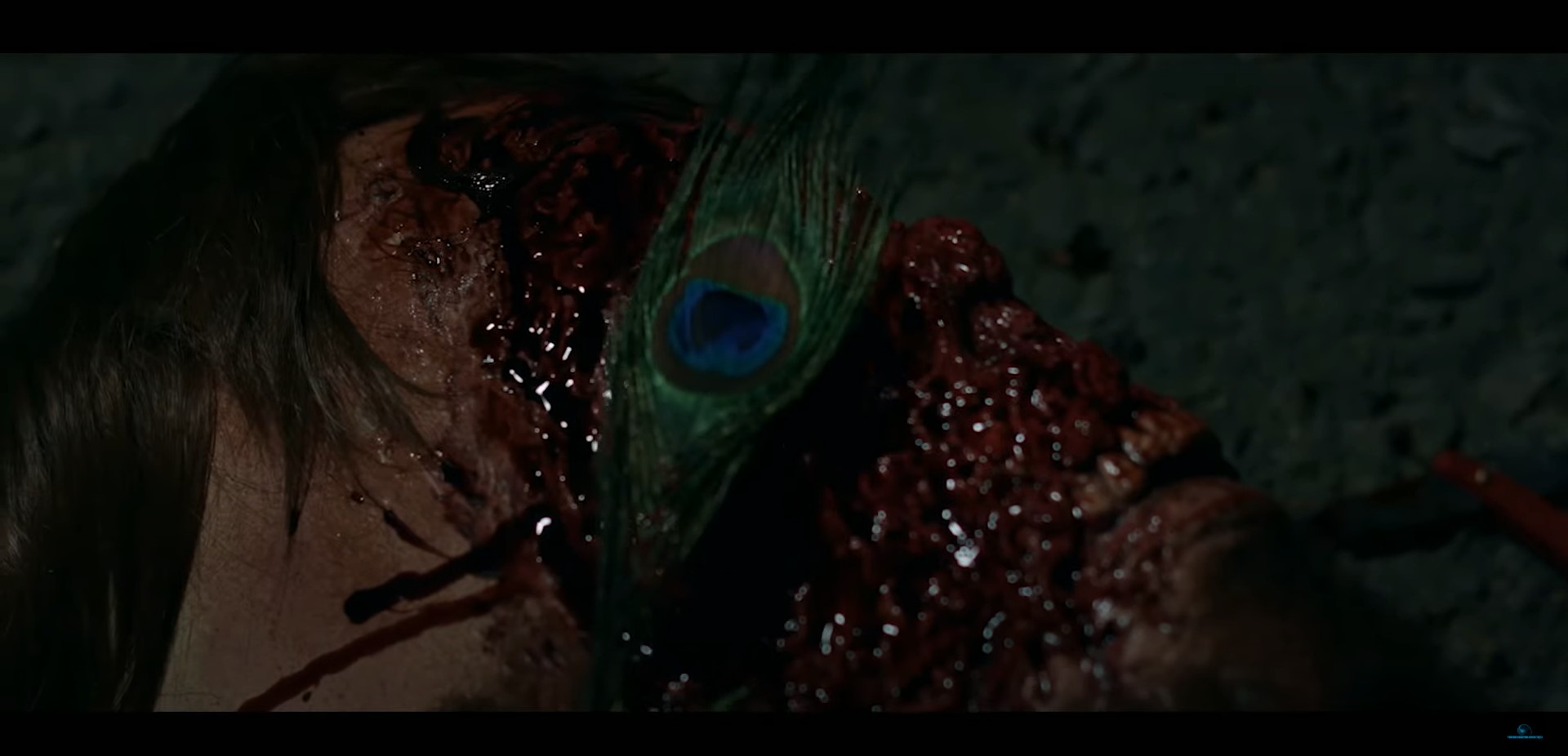
Much like “A Cat in the Brain,” Frank LaLoggia depicts his best Lucio Fulci representation as a horror filmmaker whose storyline production mirrors the individual slayings surrounding him. As a character, LaLoggia is not entirely aware of the murders as the peacock headed slasher’s string of sadism runs parallel to LaLoggia’s post-productional workload. Cristopharo pays a simultaneous tribute to not only Fulci but also LaLoggia with a built-in brief, off-plot moment of the editor, Isabella, a good friend and longtime partner of LaLoggia, running a reel of “Fear No Evil” to reminisce over his debut picture. Antonella Salvucci (“Dark Waves,” “The Torturer”) plays Isabella but also LaLoggia’s pseudo film lead actress Catherine in a dual role performance with the latter marking Salvucci’s topless kill scene that hits and sets up the giallo notes. Isabella denotes the director’s only real friend with everyone else, from the screenwriter to the executive producer, push their own self-gratifying wants onto the American filmmaker from all angles. A vulgar herd of personalities descend upon LaLoggia to exact their strong-willed ideas on how the film should appear and be marketed. From the screenwriter Antonio (Antonio Tentori, ‘Symphony in Blood Red”), the imposing desperate actor David (Halil Budakova, “Virus: Extreme Contamination”), to the uncultured and pushy executive producer Fernando Lola (Lumi Budakova) and his aspiring actress Debbie (Poison Rouge, “House of the Flesh Mannequins”), they all look to exploit LaLoggia’s modest career for their own benefit. Performances vary with a range of experience, and we receive more noticeably rigid recites and acts from the Kosovo cast in a clashing pattern with the Italy cast that has worked with Cristopharo previously. Ilmi Hajzeri (“Reaction Killers”), Pietro Cinieri, and Merita Budakova as a chain-smoking lady stalker that has glaring eyes for Frank LaLoggia.

While not necessarily thought of as a remake, “Nightmare Symphony” is certainly a re-envision of the Fulci’s “Cat in the Brain.” What Cristapharo and Trani don’t quite well connect on is connecting all the pieces of the psychotronic puzzle together into what is meant to be expressed. The giallo imagery is quite good, a praise of the golden era period in itself, with a mask and glove killer, the closeup of gratuitous violence, most of the score, and the stylistic visuals imparted with ominous shadow work, foggy and violent dream sequences, and with congruous cinematography and editing of earlier giallo. Plus, audiences are treated to not only the aforementioned Antonio Tentori, screenwriter of “Cat in the Brain,” but also have composer Fabio Frizzi score the opening title. Frizzi, who has orchestrated a score of Lucio Fulci films, such as “Zombie,” “The Beyond,” “Manhattan Baby,” and even “Cat in the Brain” just to select a few notable titles, adds that proverbial cherry on top to evoke Fulci directing “Nightmare Symphony” vicariously through Cristapharo and Trani. There are some questionable portions to reimagining’s take on the original work that are more the brand of the contemporary filmmakers. The presence of death metal prior to one of the kill moments puts the overall giallo at odds with itself in a fish out of water aspectual scene composition. Another out of place component are the external characters that are not directly involved with LaLoggia’s peacock-head themed slasher; the ironical venatic of an animal hunting down people is the reversal of a Darwinism theory that instead of sexual selection, the beautiful and elegant peacock forgoes using grace to attract and aims to survive by natural selection and thus the killer kills to remain alive. However, the story and the directors never reach that summit of summation and with the oddball characters adrift from the core story – such as the stalking woman and the eager actor – “Nightmare Symphony” flounders at the revealing end with its severe case of blinding mental delirium.

With a cover art of an upside skull overfilled with film reels and unfurling celluloid through the soft tissue cavities, “Cat in the Brain” continues to be reflected in “Nightmare Symphony” up to the release’s physical attributes on the Reel Gore Releasing’s Blu-ray. Presented in on a AVC encoded BD25, with a high definition 1080p resolution, and in a widescreen 2.35:1 aspect ratio, the Reel Gore Releasing espouses the Germany 8-Films’ Blu-ray transfer for a North American emanation, which might explain some of the complications with the bonus features that’ll I’ll cover in a bit. Situated in a low contrast and often set in a softer detail light, “Nightmare Symphony” doesn’t pop in any sense of term with a hazy air appearance and a muted color grading that goes against the giallo characteristics, especially when the clothing and set designs have the same desaturation or are colors inherent of low light intensity. Despite appearing like a slightly degraded transfer on a lower BD storage format, compression issues are slim-to-none with artefacts, banding, or blocking and this results in no tampering edge enhancements or digital noise reduction. The release comes with three audio options: A German DTS-HD 5.1, German DTS-HD 2.0 Master Audio and an English and Italian DTS-HD Stereo 2.0 all of which are Master Audio. The German audio tracks are a dub from the 8-Film Blu-ray and the 5.1 offers an amplified dynamics of the eclectic soundtrack and limited environment ambience. Dialogue remains outside the dynamics on a monotone course but is clean and clear with good mic placement and a neat, fidelity fine, digital recording. The German dub has a distinct detachment from the video because of its own layer environment, sounding a little sterile than the natural English or Italian, but works well enough as expected with the supplement multi-channel surround sound. English SDH and German subtitles are optional. Bonus contents feature a behind-the-scenes which is entirely just a blooper reel, an English language interview with co-director Domiziano Cristopharo whose secondary language is English, the original soundtrack playlist, and the teaser and theatrical trailer. I mentioned an 8-Films’ transfer complication with the bonus content because there’s is also an interview with Italian screenwriter Antonio Tentori that’s only in German dubbed and subtitled with no option for English subtitles or dub. When you insert “Nightmare Symphony” into your player, an introductory option displays to either pick German or English and I considered this to be the issue for the German only interview with Tentori; however, that is not the case as both country options are encoded in German for the interview, so at the beginning option display, I would recommend the German selection because the setup will have contain all audio options for the feature whereas the English selection will only contain the English 2.0. Reel Gore Releasing’s Blu-ray comes housed in a red snapper case, the same as the company’s release of “Maniac Driver,” and has a less tributing reversible cover art with more revealing and illustrated aspects of the narrative. The release is region free, unrated, and has a runtime of 78 minutes. Another little fun fact about the release is the incorrect spelling of the director’s name on the back cover that credits his surname as Christopharo instead of Cristopharo. Influenced by Lucio Fulci beyond a shadow of a doubt, “Nightmare Symphony” proffers the Horror Maestro’s less notable credit with a companion piece that punctuates both films love for the giallo genre, love for the violence, and love for the morbidly unhinged human condition.

“Nightmare Symphony” is a Falsetto of Praise for Lucio Fulci.  Purchase the Blu-ray Below!

The Doctor’s Out. EVIL Will Make this “House Call!” reviewed! (Wild Eye Releasing / DVD)

“House Call” on DVD home video and Available to Purchase at Amazon!  Click the Cover Art to Buy.

Eager to prove to her parents she is responsible and old enough to undertake the babysitting duties of her little brother all by herself, 16-year-old Miriam is reluctant to phone her parents when little brother Vince becomes highly feverish in fear that they will take away future responsibility opportunities.  Instead, Miriam makes a late-night call to the family’s primary physician and begs for a discreet house call.  Hours go by and Miriam becomes increasingly concerned about Vince, but when the doctor is found dead on her doorstep, her brother’s welfare acutely alters from his feverish illness to the maniacs outside looking to score big on the family home.  The night turns into a fight for survival as the home alone siblings must outwit two murderous thieves who have their lustful eye on the teenage Miriam as well. 

Based off the novella of the same title from horror writer Ty Schwamberger, “House Call” is the first Schwarmberger piece to be adapted and completed into a full-length feature film.  The 2013 production’s script is adapted by Shannon Casto and while the credits list accompanying partner Michelle Henderson as the director, IMDB lists Casto as co-director the film. Both have worked alongside each other between 2005-2013 under their House, Texas-based independent film production company, Little Oak Film Group, which has churned out modest range of low-budget horror with “Sinner,” “Gut Instincts,” and “Protégé” to note as a select few.  Their joined by Parrish Randall as the third wheel in the director’s chair, – again, a credit that IMDB list but the film doesn’t but wouldn’t surprise me knowing a little more history between the trio.  “The Quick and the Undead”-starring and “Slaughter House”-directing Randall essentially helped segue Casto and Henderson into their own production company having the aspiring filmmaking duo under his wing in various crew and cast capacities as the owner of PRP Motion Pictures.  The Little Oak Film Group cofounders serve as executive producers on this self-made, little-known home invasion, survival thriller. 

Parrish Randall not only serves as co-director and provides the foundational support Casto and Henderson used to jumpstart their careers as filmmakers, but the platinum blond actor with dark facial hair from Groesbeck, Texas is also one of the lead principal characters, playing the nefariously nurtured John who has ambitions to live up to his mentor’s unfettered insanity and depravity.  Randall evokes his lite version of Bill Mosely’s Otis Driftwood without the full support of the deranged family.  There are inarguably many issues with how John is portrayed with an overflowing amount of dialogue despite Randall stealing the story with a magnetic presence on screen.  John’s expositional to a fault and is continuously repeating the same dialogue over-and-over, such as pointing out and elucidating again-and-again that Rock is his mentor.  Rock, played by Bill Dubois (“His Will Be Done”), features in a flashback of a cowardly John aiding and abetting Rock in the murder-robbery of a young couple and Rock is supposedly grooming pupil the way of psychopathy, but there really is not clear instruction from Rock other than provoke gun-drawn offices while your partner flees for his feared life. Now, after that character defining moment, John has become Rock incarnate and has also taken a student under his wing to invade, rob, rape, and murder in the family home of Miriam, played by Rachel Paul in her debut lead role, and Vince, played by Vincent Galyean. “House Call” deploys not only neighborhood disturbances but also disturbing undertones of the rape and murder of children as Miriam is 16 years old and Vince is ballpark 6-9 years of age. As kids under distress, tonal precision might not be Paul and Galyean strong suit, but their cues of delivery are on point where often times child actors tend to be forced or uncertain in conviction to sell the act. “House Call” rounds out the cast with James McCreight (“The Caretaker”), Troy Reynolds, Paul Moomey, Alison Esparza, Roger Dunn, Kristopher Smith, Chelsea Turcheck, Chi and the most experience and credited actor on set, Joe Grisaffi (“Doll Factory,” “Axe Murdering with Hackley”), as the creepy-glaring neighbor, Mr. Henderson, with the receding hair line and large hair.

While many issues come to the front of the mind regarding “House Call’s” poor longevity status, to be retained as a solid source of entertainment, and to be a total thrill at the edge of your seat home invasion horror film, the one major issue that egregiously needs mentioning is the lack stimulus surrounding John’s gut-stirring need to be as brutal as possible at this specific spot. Unlike Bryan Bertino’s “The Strangers” where the masked intruders mark their presence as simply just because, “House Call” drops the ball on even the most basic of unscrupulous principles amongst the villains. In fact, the flash back with mentor Rock puts John into a completely different, greatly sympathetic, and concerned light without ever exhibiting that epiphany of realization into becoming the crime’s worst-of-the-worst. John also mentions on multiple occasions how the scoped-out house is full of the nicer things, but once we’re inside, it’s all upper-middle class, mediocre monied valuables that don’t justify the cause. An implied reason for John’s obsession for pillaging is to solely have his way with teenage Miriam who, in another over explained bit of exposition, saw her outside washing down the family roadster. What’s baffling about his Miriam anecdote is that we the scene played out live as in a flashback sans the moment John set eyes on Miriam. Instead, we’re treated to the introduction of creepy neighbor Mr. Hendersen who gives Miriam an up-and-down once over and the scene is definitely more piquant than John’s drive by but misses a crucial plot point that drives the story to the moment of John’s and his accomplice’s introduction. Perhaps, the flashback serves to misdirect Mr. Henderson’s sleaze toward a pre-judgy determination that flips the script later in the last act. “House Call” doesn’t quite nail where it wants to be emotionally with lightly peppered comedy, oversalted exposition, and a sepulchral tone of child rape and murder that yearns to break the surface of its under seasoned bake.

In what’s likely interchangeable functions between Michelle Henderson, Shannon Casto, and Parrish Randall to oversee this adapted film to completion, as aspect that can be easily assessed when seeing their names credited multiple times under various roles, one thing is for certain – “House Call” is the epitome of independent horror moviemaking spirit. It all culminates to this point, an at home DVD release that can now stretch across the global in a region free decoding format. Wild Eye Releasing, in association with TomCat Films, presents “House Call” onto an unrated DVD with a widescreen 1.78:1 aspect ratio. A modern day, handheld SOV film, “House Call” crusts over with numerous blocks of noise interference, details are lost in the inferior resolution, the contrast between blacks and adjacent hues mesh together without firm delineation of objects, and the color palette, which is really the only thing good about the presentation’s lossy source material, has a handful of moments of vibrancy but for the most part is flat. The English language Stereo 2.0 audio mix has better integrity in reproduction. Slightly boxy through the two-channel output but dialogue remains clear and clean without crackling, popping, or hissing and has a meager but manageable, successful depth with no real range to note. Wild Eye’s standard releases normally go big on the bonus features and “House Call” is no exception to the route with only a handful of Wild Eye preview trailers of other films and I still applaud the distributor’s trailer creator because that craftsman (or craftswoman) can splice-to-sell a D-grade movie in under a minute. Release’s physical appearance comes in a standard black DVD snapper with a tenebrous cover art of a man silhouette front facing an every-room-lit stately manor and holding an axe by the side. A bit misleading but the gist of the story is there. Repeatability on the Ty Schwamberger adapted novella is time better served reading, or re-reading, the author’s original story as “House Call” is a 70-minute busy signal that will fail to connect with audiences.

“House Call” on DVD home video and Available to Purchase at Amazon!  Click the Cover Art to Buy.

EVIL Terrorizes the Parisian Women of the Night! “A Woman Kills” reviewed! (Radiance / Blu-ray)

“A Woman Kills” Now Available on Blu-ray! Click the Cover Art to Purcahse!

The execution of Hélène Picard, a convicted murderer of prostitutes in Paris, France circa 1960s, is carried forth and thought to have snuffed out a string of brutal killings.  Louis Guilbeau carried out the execution orders that gave Pairs a moment of relief and a sense of safety for the working girls on the streets, but when the similar murders spark public fear and the newspapers compare the scenes as Hélène Picard handywork, Paris is once again thrown turmoil with a serial killer.  Is Hélène Picard really dead?  Is it a copycat?  Or did they not catch the real killer?  Guilbeau, unphased by the recent atrocities, begins an affair with the lead investigator into the murders and continues to always be one step behind the suspected female culprit with no remorse, no shame, and no limits to her brutality against prostitutes.

Thought to be lost in obscurity for forever, the reels for French director Jean-Denis Bonan’s “La femme bourreau,” aka “A Woman Kills” was discovered in 2010.  The master of the unfinished film became destined to be born again with a new home video release as Bonan’s debut directorial embodied parallelisms of the French sociopolitical unrest and protests, known as the Paris economic-stopping May 68 event, during the late 1960s, and hitched a ride on the narrative wave of post-“Psycho” gender identity complexes within the confines of a La Nouvelle Vogue, or the French New Wave movement.  Though “A Woman Kills” was the inaugural film of the young director’s career, Bonan simultaneously also became one of the few to document in real time the May 68 upheaving protests as he and the crew went back-and-forth filming a fiction story and nonfictional protests.  The film incorporates a semi pseudo-doc that treats the script like a mixture between a crime thriller and the experimental qualities of its playful, singsong soundtrack and harsh editing.  The 1968 film is a production of Luna Park Films and is self-produced by Jean-Denis Bonan.

For those casted in film, “A Woman Kills” was there first auteur film if not their first feature film role all together. What could be considered as a blend between New French Wave and Neorealism, Bonan rarely has his cast express their own vocal cords. Lots of action and expressiveness devour the attention but that doesn’t go on to say Bonon completely nixed dialogue altogether with his montage of interviewees, a jest-and-jovial troubadour descriptive songs of the scenes, the narrator’s file readings of victims, the newsboys hawking of murder headlines, all become the dialogue in lieu of the real McCoy. The cast does have their voices heard in rare moments, often in scenes of great exposures and difficult in detail. A case in point is Claude Merlin as the prison executive Louis Guilbeau. Merlin, who went on to be involved in another May 68’s connected film from 2001, “Toutes les nuits” or “Every Night,” is eager and excited in character when going into the medical details of the various way his profession executes prisoners or falls into a somber regarding his mother’s abusive behavior to him when he was just a boy. Guilbeau’s dialogued moments are precise and point plots toward his character and toward the end game. The affair Builbeau has with police investigator Solange Lebas, from Jean Rollin’s “Rape of the Vampire” and Bruno Gantillo’s “Girl Slaves of Morgana Le Fay’s” Solange Pradel, provides roughly the equal amount of dialogue time in a role that’s typically casted for men, a lead investigator on a high-profile murder case. Gender reversal and identity themes are accentuated by Merlin and Pradel’s tenues of the characters. Myriam Mézières (“Spermula”), Jackie Raynal, Catherine Deville (“Rape of the Vampire”), and Velly Beguard (“Endless Night”) work out the remaining cast.

I wouldn’t necessarily call “A Woman Kills” avant garde.  In fact, I firmly believe the propagating audio and video experiments and the themes are far from it.  Bonan borrows a little here and there from different techniques and cinematic trends to fashion a stake in the French New Wave movement.  Splashes of eroticism, which are greatly descriptive visually and narratively, don’t warrant “A Woman Kills” to be a full-fledged erotica film.  The same can be said about the crime or investigator angle that too just seems to be woven sporadically through this melee of classification. Pseudo-documentary montages and script narrator push the labeling in another direction as well. “A Woman Kills” doesn’t exactly fit into a mold, wears patchwork pastiche, but also has flare ups of Bonan’s call to add chaos into the traditional scheme of filmmaking. More so linear than not, the narrative transitions between scenes without a care for being comprehensible early on. Heavily relying on the narrator to give exposition on the background of the notorious prostitute murderer Hélène Picard and how she became under the executioner’s thumb, this event provides framework in introducing the executioner Louis Guilbeau and his professional ups-and-downs that ultimately land him working in the prison system. The association that connects the murders, Louis Guilbeau, and Hélène Picard is all very vague during initial proceedings and Gérard de Battista’s freeholding over-the-shoulder camera work provides passim POV shots and agley angles to keep the wheels of motion mysteriously slipping in order to not fully grip the reality of the situation. Bonan borders the edge of German Expressionism toward the third act by disenchanting the way of guilty thinking aesthetics and to root the killer in insanity on various levels, ending with a chase sequence that is seemingly endless amongst a pile of building rubble and ruin.

A provocateur of storytelling and of the celluloid vision, director Jean-Denis Bonan finally has his film, “A Woman Kills,” released onto a limited-edition Blu-ray home video from Radiance Films twelve years as being unearthed. First released on DVD in 2016, distribution for the film was all but easy due to Bonan’s deemed unclassifiable feature by large scale and indie firms. Today, the original reversible 16mm elements have gone through a 2K restoration scan for the feature’s Blu-ray debut and the presented in the original 1.33:1 aspect ratio and black and white format. For being undiscovered for four decades, unfinished, and receiving literally no support from any state funds to complete, the image has remained nearly pristine with only a few dust specks and faint scratches being the worse of the wear. The Cinémathèque de Limousin and the restoration by producer Francis Lecomte doesn’t feel to have overcorrected the natural grain or go high on the contrast but rather retain much of the classic, original elements for an honest viewing aside from the liner notes mentioning a few special effects added to remove equipment from out of the picture. Father time has forgotten all about Bonan’s lost relic, staving off age degradation to those with more day-to-day exposure. The French language Dolby Digital mono track also retains a remarkable, near stainless net result. The absence of the camera whirring and lack of electrical interference points to a complete dub track of the actors’ voiceovers to which the dialogue is distinct with only a handful of crackling peppered in throughout. English subtitles are optional on the menu settings and offer an error free, well-paced synchronization. The bonus features include a video introduction to the feature by Virginie Sélavy, an audio commentary by Kat Ellinger and Virginie Sélavy, the trailer, and a 37-minute, newly updated 2015 documentary On the Margin: The Cursed Films of Jean-Denis Bonan featuring one-sided interview responses from Bonan, cinematographer Gérard de Battista, editor Mirelille Abramovici, composer Daniel Laloux, and actress Jackie Rynal. There is also Bonan’s short films – “la vie breve de Monsier Meucieu,” “Un crime d’amour,” “Tristesses des Anthropophages,” Mathieu-fou, “and “Une saison chez les hommes.” The limited to 2,000 copies release does not disappointment with tangible material within this clear snapper, untraditional Blu-ray case that doesn’t sport the Blu-ray logo at the top. Much like Bonan’s work, the Blu-ray, too, rebels against marketing norms with cover art that displays the film’s synopsis and documentary bons feature on the front cover. The reversible cover also has the original 2016 DVD art on the inside along with a limited-edition booklet featuring “A Woman Kills” essay by film author and scholar Catherine Wheatley and writer-broadcaster Richard Thomas regarding the film’s themes and Bonan’s short films. The 51-page booklet also includes newly translated interviews and offers film credits as well as black and white stills of “A Woman Kills” and other Bonan credits. The feature has a runtime of 69 minutes, the release is region free, and Unrated. Jean-Denis Bonan disrupts the narrative routine, but his film remains a timeless, psychosomatic portrayal with a contentious backdrop of French sociopolitical unrest that makes the context of “A Woman Kills” that much more engrossing.

“A Woman Kills” Now Available on Blu-ray! Click the Cover Art to Purcahse!

A Gnostically, Esoteric EVIL Acid Trip. “Archons” reviewed! (Syndicado / DVD)

“Archons” are Watching You.  You Can Watch Them on DVD!  Click the Cover to Purchase!

A once promising, up-and-coming rock trio struggles years later to exit the shadow of their only hit song. They embark on an acid-stimulated spiritual canoe trip down the meandering river pathways of British Columbia, hoping the creative juices will flow under the influence while connecting the native wilderness. Along the way, they pick up a beach camping super fan and continue their trek toward mapped out checkpoints and take a hit of acid at each stop. The drugs have seemingly taken effect in a strange, voyeuristic way as if someone, or something, is watching them at each campsite. The visions become terrifyingly vivid as a pair of humanoid creatures rummage through their gear during the night and survey them from afar no matter where the band are or how far they travel. To make the situation worse, the acid they’re ingesting might be the root cause that not only expands their mind beyond the brain’s limited scope but also grows a biological entity wriggling for more room space.

The influence behind Nick Szostakiwskyj’s “Archons” is something fascinatingly outlandish in what’s a simile to the Scientology handbook. Rulers of the realm, creators of the physical universe, guardians of the celestial heavens, architects of the kingdom of darkness, archons, as some historical cultural teachings would have it, rise above traditional and conventional spiritualities with an expanse and infinitude of spiritual knowledge as related to the Gnosticism belief system. For the Vancouver filmmaker, Szostakiwskyj adapts the ideology with a bad acid trip in his 2020 cosmic horror that was once under the working time, “Hammer of the Gods.” “Archons” is the third feature film for Szostakiwskyj and the second otherworldly horror following “Black Mountain Side,” a precursing complementor that also captures the spectacularly natural, yet ominous lit, Canadian terrain in the Winter opposite season compared to “Archons’s'” Summer. The independent Canadian feature is A Farewell to Kings Entertainment production and is produced by Szostakiwskyj with Cameron Tremblay and alongside with the now defunction A Farewell to Kings Entertainment executive producer team of Samantha Carly and Steve Kaszas, who are now in the leadership team of Alright Alice Productions, and James and Susan McDonald.

“Archons” is tightly casted with less than a handful of canoers being spied upon by the gnarly gatekeepers of the universe. The story surrounds the spiritual and drug-laced scull trip of Dog Sled, a three-piece rock band who have lost their creative mojo and star power momentum with a fickle music fanbase. Lead singer Mitchell Ashley-Hoffman doesn’t have the emotional range to synthesize great lyrics but has the vocals of a sway fans and is played with Kurt Cobain-esque and mellow concern by Josh Collins. Rob Raco and Samantha Carly play bassist and songwriter Eric and drummer Olivia, aka Liv, and the pair are more in tune with each other while Mitchell mind wanders and drools over the ride hitcher and tarry eyed fan, April (Parmiss Sehat). The Vancouver based cast have enough chemistry to be slowly dismantling as a band on the fringe of collapse with backdoor dealings from one of them aiming to go solo into the limelight and to hold secrets that lead to life-threatening consequences all in the name of spiritual retreat.  However, to the extent of the being followed, spied upon, and endangered by hostile creatures, the character concern level is too low as if apathy for interdimensional beings that at first were cloaked and now are full view is not at the top of the internal fear alarm list for any of them.  The situation is written downplayed and the subtle actions to understand what’s in front of them mutes the anxiety for the audience.  “Archons” rounds out the cast with radio voices, minor roles, and two archons with Billie-Rae Grant, Lauren Donnelly (“Viral”), Michael Dickson (“Driver From Hell”), Timothy Lyle (“The Revenant”), Cameron Tremblay, Nathaniel Gordon, Marc Anthony Williams (“Black Mountain Side”), and Quinton Boisclair (“Demonic).

“Archons” has this beautiful backdrop of British Columbia’s topographical nature in a panoramic view in a breathtakingly serene opening shot and continues the wilderness motif with a thick forest and a never-ending river that seemingly swallow a group clearly not in their usual element.  “Archons” also has a beautifully disturbing breadth of perception concept laced with drugs and the gnostic universe.  The cosmic horror element is not forced or over-the-top being wrapped and shrouded in ambiguous mystery that keeps audiences glued to the progression baby steps before coming to terms with a dropped veil that causes reactionary looks over your shoulder with every unexplainable sound not in view.  Szostakiwskyj is in no hurry to quickly build an underlayer reality that ties into a dualistic system of two worlds running parallel to each other and colliding when drugs produce the sneak peek behind the curtain.  What shouldn’t be seen is clearly bad for the protagonists’ health, much like drugs in themselves if abused, and Szostakiwskyj plays into that limitation of the mind as if the part the brain or the organism that allows to see it all overloads, or overdoses if you will, the network of tissue and neurons until it bursts outward like a Yellostone geyser in a spray of blood in what is a pretty neat and simple effect, one of the few practical effects by Geoff Ingeberg in this rather performance driven film, as well as a neat scene to behold while the group travels down river when the unexpected pop occurs.  “Archons” is open for a numerous of interpretations, leaving the possibilities endless, but we don’t exactly know where Eric the bassist obtained the snack baggie drugs, what the creatures are intently undertaking, or if the vague final scene is the aftermath of a horrible acid trip gone fatally wrong and has dislodged memories of events, jumbling them up to the point where nothing makes sense and leaves more questions than answers.  The story definitely ends with more desires in detail, delineation, and context but isn’t the less-is-more concept the bread-and-butter of cosmic horror where the unknown is the scariest part that makes us feel infinitely small knowing the world around us is infinitely bigger?

Splice into a new and startling reality with your own DVD copy of “Archons” courtesy of Syndicado Distribution. Stored on a DVD9, “Archons” is presented in a widescreen 2.39:1 that enhances the initial landscape shots in the opening scenes. From then on out, Cameron Tremblay’s cinematography sticks to eyeline mid-to-closeup framing with a here-and-there upward angle to inject foreboding if the scene calls for it. Despite being pitch black, the aphotic zones Tremblay creates without the use of artificial lighting or tinting day scenes provides a sobering and somber authenticity of young people being stalked in the woods. Syndicado stakes a larger storage capacity for a low-budget film and the result pays off despite the decoding 5-6Mbps rate with the blacks looking especially inky without an inkling of compression issues, such as banding or splotchiness that plague darker scenes. The cooler color pallet digs a little more into bleak atmospherics, but there are warm pops of the BC bush with lime green leaves. The English Stereo 2.0 challenges to be more potent than it should be as the quiet and desolate trek the nature should incite more directional channels for a sound design that relies on the rustle of branches and the creatures’ low gutturals off in the distance and in an undeterminable bearing. What’s essentially a bare bones release, the region 1, clear cased DVD comes with the theatrical trailer on a static menu that also includes chapter selection. “Archons” is unrated with a runtime of 88 minutes. A low-key cosmic horror with eye-opening chills, “Archons” is cabbalistic cinema for the selective few who will understand it but does harp on the relatable proverb of with seeking fame comes a price.

“Archons” are Watching You.  You Can Watch Them on DVD!  Click the Cover to Purchase!

Before Careful What Hotel You Book Online. There Just Might be an Ancient EVIL Lurking in the Basement! “The Ghosts of Monday” reviewed! (Cleopatra Entertainment / Blu-ray)

 “The Ghosts of Monday” is now on Blu-ray Home Video!  Click to Cover to Purchase!

A small film crew of ghost hunters travel to the Grand Hotel Gula, a magnificent resort that accommodated tourists from all over the world, to document the hotel’s horrible past on a rare 53rd Monday of a year when the hotel befell into notorious tragedy as guests attending a party were poisoned and the three owners had committed suicide soon after.   Eric, the director of the show, is on his last leg to make the show a success as he becomes pressured by local benefactors and even the show’s host personality, Bruce.  At the request of Bruce, Eric brings his wife Christine who Bruce raised as a child.  From day one, the empty stunning foyer and luxurious accommodates pale against the ambient creepiness of the dark corridors and basements and the ominous sounds that lurk from within the shadows.  When the shooting commences into an investigation, the unsuspecting filmmakers find themselves in an ill-boding situation with an ancient evil that has been kept hidden away from the world for eons.

I want to prelude this review by saying that my thoughts are with Julian Sands family and if there is any hope left to grasp onto, we want sincerely to yearn for the outcome of Julian Sands disappearance in the hiking region of Mount Baldy, California to be a positive one and see the actor, the husband, the father of three alive and well.  As an entertainer, Sands gave us a malevolent sorcerer in the “Warlock” trilogy and providing us with notable performances in David Lynch’s “Naked Lunch” and the fear of spiders-inducing “Arachnophobia.”  Since the turn of the century, Sands has more-or-less fell out of the limelight with sustaining his presence mostly on direct-to-video releases and appearances on TV series.  The British actor’s latest low-budget horror “The Ghosts of Monday” is a film helmed by Italian director Francesco Cinquemani on the little-known getaway island of Cyprus, a country located in the Mediterranean Sea.  Cinquemani, who typically directs his own scripts, co-writes the film with Andy Edwards (“Zombie Spring Breakers,” “Midnight Peepshow”), Mark Thompson-Ashworth (“POE 4:  The Black Cat”), and Barry Keating (Killer Mermaid,” “Nightworld: Door of Hell”).  “The Ghosts of Monday” appears to be a blend of region myth and cultural belief pulled locally and from the stories of Greeks Gods into one abandoned hotel horror full of cult sacrifice and betrayal, produced by the “S.O.S.:  Survive or Sacrifice” producing team of Loris Curci (“The Quantum Devil”), Marianna Rosset, and Vitaly Rosset under the Cyprus production company, Altadium Group.

Julian Sands might not be the principal lead of the story but is a major player in what culminates into an ambuscade of doomsday deliverance at the expense of others.  As the documentary’s host and a Cyprus local, Sands plays the eccentric, often frisky, heavy drinker Bruce who has been a father, or the adopted father-figure as it’s not entirely clear, to Sofia (Marianna Rosset, “S.O.S.:  Survive or Sacrifice”).  Christine is distant and disordered returning to her Cyprus homeland with her husband Eric, the director, played by “The Turning’s” Mark Huberman.  Almost seemingly estranged from each other, Eric and Sofia display some noticeable pensive and tension-riddled issues between them that the story never fully fleshes out for the audience.  Christine is under medication for a sleep disorder, Eric’s feeling the pressure from powerful producers, and none of that external strain has defined or even as much delineated itself in full in their aloof relationship that has glimmers of hope and smiles as the wall between them is more up than it is down despite Eric’s constant vigil over her.  Performances from Rosset and Huberman meet the need of concern, desperation, and pressure forced upon them more from in the outside than in, especially in Huberman with a slightly better angle on his creative-driven, project-lead sudden derailed from his narrow focus to deliver a quality product as his career careens out of control and that brings out his rougher edge we see in the latter half of the story.  In comparison, the more iconic and recognizable figure, Julian Sands, doesn’t land his role well in what could be seen as if his performance landing gear only had one wheel down before touching pavement but was able to jerry-rig a not-big-enough wheel to get him safely through.   “The Ghost of Monday” has some mysteriously odd and menacing individuals in hotel owner Frank (Anthony Skordi, “Carnal Sins”), his wife Rosemary (Maria Ioannou, “Waiting Room”), and the producer couple Dom (Loris Curci), and Pat (Joanna Fyllidou, “Girls After Dark”) as hovers, prowlers, and the overall conventional creeps in the corner, watching you.  On the other side of the coin, you have a film crew who are more or less victim fodder for the evil powers to be with Anna (Kristina Godunova) and suspected lesbian lovers in sound designer Christine (Elva Trill, “Jurassic World:  Dominion) and cinematographer Jennifer (Flavia Watson) because A/V is just another acronym for LGTBQ+.  With the exception of Frank and Rosemary’s background on why they bought the forsaken hotel, none of the other characters constitute a piece of the pie as they are thrown into the mix, sprinkled with tidbits of intrigue, before their dispatched into the feast or famine categories.

We have ghosts in the title. There are cult members, sometimes shrouded in obscuring clothing, sometimes just lingering exposed outright. We have silent but deadly twin girls with kitchen knives. There is also a slithering creature lurking in the basement. “The Ghost of Monday” is a variety show of vile villains with very little coherence to bring the elements together, but what is clear is a mythical being at the center of the surrounding maelstrom that’s quickly closing in on the protagonists. With the script penned by a cohort of writers experienced in resort massacres and killer aquatic creatures, all director Cinquemani has to accomplish is the effectuation of ideas, but what results is haphazard derision from what feels like “Ghostship” in a hotel and looks like “The Shinning” without the isolating madness all in the confines of a very shaky and marred cinematography. The core of the story is inadvertently lost amongst the competition of where audiences should retain their attention which is a shame because at the core is a deeper, broader, and more mythically rich in Grecian horror with a gorgon immortal that’s equated as the devil itself and linked to life’s destruction if not sacrificed a corporeal shell.  Viewers will be treated to only a glimpse of that circling terror during the climatic end and, more than likely, budgetary reasons ground the story’s larger-than-life concept with only a mixed bag clash of content leading up to the end.

Plugged as Cyprus’s first native horror production, “The Ghosts of Monday” arrives onto a Blu-ray home video release from the Cleopatra Entertainment, film division of Cleopatra Records, and Jinga Films with MVD Visual distributing.  The featured release is presented in a widescreen 2.35:1 aspect ratio, shot on what IMDB has listed as the Sony CineAlta Vince with a Zeiss Supreme Prime Lens.  The AVC encoded Blu-ray retains a quite a bit of compression issues throughout the entire digitally recorded package as video ghosting is the biggest image culprit.  I’m sure that type of ghost was not what “The Ghosts of Monday” were referring to in the title.  Aliasing, banding, and small instances of blocking also appear occasionally and in conjunction with the ghosting which makes this transferred format nearly impossible to watch with hardly any detail in what should be a high-definition release that renders closer to 480 or 720p as the video decodes at a low 22 to 23Mbps average.  The Blu-ray has two audio options, an English 5.1 Dolby Digital and a LPCM Stereo 2.0. Though both outputs render nearly identical because of the lack of explosions or an extensive ambient track, the surround sound mix offers a better side to the A/V attributes with a barren-disturbance sound design and a solid score that keeps the concerned glued to the television sets, waiting for something spooky to pop out from behind. Dialogue doesn’t perceive with any issues with clear and clean conversation, as expected with most digital recordings, and is greatly centered and balanced without sounding echoey and out of depth’s scope. The bonus features are scantily applied with only an image slideshow and feature trailer, plus trailers from other Cleopatra Entertainment productions, such as “The Long Dark Trail,” “Frost,” “A Taste of Blood,” “Baphomet,” “Scavenger,” “The Hex,” and “Skin Walker.” The physical attributes of the release come with a traditional Blu-ray snapper cast with latch and cover art, that’s slightly misleading, of a glowing apparition. The region free release has a runtime of 78 minutes and is unrated. “The Ghosts of Monday” doesn’t buck the trend for Cleopatra Entertainment’s string of C-grade horror but is an unusual, new venture in the sense of strictly being a horror story without an eclectic soundtrack of signed artists to carry it through to the end.

 “The Ghosts of Monday” is now on Blu-ray Home Video!  Click to Cover to Purchase!