EVIL is a Game Invented by Child and Ran by Clones! “Terminus” reviewed! (Blu-ray / MVDVisual Rewind Collection)

“Terminus” is a Win for the Rewind Collection! Buy it Here!

Super genius boy Mati programs an artificial intelligence RV known as Monster to trek through adversarial armed forces infested territory in a long-haul driving competition to reach Terminus where the winner will receive their weight in gold.  The Doctor, a mad cloning scientist who created the child, aims to subvert the government with Mati’s and the rest of his “unborn” clones under the malicious intentions of his superior named Sir.  When the lone driver Gus, an American woman competing in the game, is imprisoned and subsequently murdered by a ruthless Major after Monster unusual malfunction, Gus is able to pass along the Monster’s accessibility password to her inmate and lover Stump, a compassionate, for-the-people rebel against the military cruelty.  For his love for Gus and to do what’s right, Stump reluctantly joins Monster and a slaved orphan girl to finish the game while the boy genius Mati observes innocently from Terminus, but Doctor and Sir have other plans to use their clones and Monster to subvert government control.  

As you can tell from the synopsis alone, the French-German coproduced, science fiction dystopian actioner “Terminus” makes about as much sense as jumping out of an airplane without a parachute – an exhilarating ride without any understanding from a safety cushion.  Director Pierre-William Glenn, who was born at the height of Nazi-occupied France in 1943, helms the dystopian, futuristic picture from a script cowritten between Alain Gillot, Glenn and Patrice Duvic’s modifications, and Wallace Potts addition of English dialogue.  Glenn, whose main profession is a cinematographer, with a prior 1987 select filmography including “Death Watch,” “The Murdered Young Girl,” and “Wheel of Ashes,” removes his eye from the camera viewfinder to being incorporated into all aspects of the production for one of his first feature length films.  Anne François produces the film that was shot much in the landscapes and studios of Bavaria and Hungary under the European coalition of production companies of Initial Groupe, Les Films du Cheval de Fer, Films A2, CBL Films, and Cat Productions.

The script calls for and delivers color characters in a science fictional scope of subversive intentions, mad science, lone wolves, flawed good guys, mysterious pasts, unjustified brutality, and other varietal traits that run the gamut in this wild and untamed neo-revenge and sense of duty narrative.  For Pierre-William Glenn, he likes to color outside the lines, shading layers with precise measure to flesh out their nature, such as with Stump, a bleeding heart, anti-violence, maverick unwilling to see the impoverished and innocent violated by authoritative rule, played by French rock-n-roll singer and actor Johnny Hallyday.  Stump’s story stretches from how he lost his hand to his reasoning for joining the fight for Terminus unlike his companion Gus embodied by a notable American actress, “Indiana Jones and the Lost Ark’s” Karen Allen.  Gus’s is specifically pointed out as American, perhaps only in the U.S. cut, but her background or reason why she plays the game is ultimately lost or never provided in the cryptic conversations she has with stump during their incarceration intimacies.  We don’t even know why Gus is finitely taken out of the game by the callous Major (Dominique Valera) by either the eluding to the Major’s men gang-raping her or just severing her legs.  Again, very cryptic.  Allen co-headlines with the then up-and-coming “Das Boot” breakout star and Berlin, Germany born Jürgen Prochnow donning three roles, beginning with the head villain and red kimono-cladded Sir and his two clowns, the boy-genius creating “Doctor” and his more brutish field task rabbit Little Brother.  “Robocop 2’s” Gabriel Damon plays whiz kid Mati, designer of the game and of Monster whose being manipulated by Sir as a guinea pig for a super army of super smart clones like himself.  Julie Glenn, daughter of director Pierre-William Glen, brings up the rear as slave girl Princess.  While Julie is no princess Leia joining the rebellion, the young actress is kept mostly quiet without much dialogue to give the gradually important character silent with only a couple of defining narrative moments that save the day.  

“Terminus” has the componential makings of a surreal science fiction fantasy with a “Mad Max” tarpaulin overtop a “Flight of the Navigator” dominant core involving an A.I. Monster truck as a sanctioned, and calculating, entity guiding a path through the onslaught of roll caged government vehicles that drive about as good as Stormtroopers shoot.  Clones are at the precipice of usurpation and the international game of drive hard and fast becomes a ploy for the genetic deception, but Glenn can never really harness that energy at the heart of “Terminus’s” well-built special effects, fascinating characters, set locations and production designs that evoke a failed, if not futile, future.  The oppression angle loosely holds the yoke while Sir and his clones barely scratch the surface of being the true villains lurking in the shadows.  Instead, much of “Terminus” is contained around Stump and Monster’s fostering trust and solidifying the key connection between Mati and Princess and what they mean to a semisoft society.  “Terminus” is terribly lighthearted despite the story’s ugliness which is fleeting at best and audiences will not be confident in what they’re watching that have been intended for general audiences or restricted to an age limit as it all depends on which version, either U.S. or European, is viewed. 

Landing as the 66th release on the MVD Rewind Collection sublabel, “Terminus” provides two varying versions on a new Blu-ray release.  The AVC encoded, 1080p high-definition, BD50 is a collaborative release between MVDVisual and Multicom with a spectacular visual palette from a 2K scan of the original 35mm negative.  There are two cuts of the film both presented in different aspect ratios based on country.  The European Director’s Cut exhibits in the Eurpeaon 1.661 and incorporates back into the story all the edited violence and expands upon scenes with more context and accents by a whole 32 minutes, clocking in a total runtime of 115 minutes, comparatively to the U.S. version’s severely cut 83 minutes and is scene re-edited sequences.  The European Director’s Cut is slightly more compressed horizontally whereas for US audiences is more vertically but there’s no overall image loss other than the cuts themselves.  Grain appears and appeases healthily with little-to-no damage on a softer, lower contrast that brightens details but retains good textural value, especially around facial and skin features with equally organic tones.  Both cuts come with a LPCM 2.0 Stereo mix; however, the Euroean Director’s Cut is strictly French with optional English subtitles while the US Version is English with optional English subtitles.  Fun fact:  Both cuts are of the same film but two different shoots as because due to financial obligations and marketing, production had to principal shoot the same scenes in two different languages and thus is why if it looks like Karen Allen’s mouth appears to be saying the French words, she is actually speaking French.  However, both dialogues are a product of ADR so there’s some dyssynchronous between image and dialogue.  Even Monster’s voice is changed radically between the two films with a more computerized squeaky female (or child) voice in the Euro-cut and a hip-hop and slang crafted male voice that’s less robotic.  Both features handle the Stereo about as well as any front-loaded sound output could but a little more power in this track could go a long way with the explosions, crashes, and visual effect audio bytes being less emphasized and underfoot of the dialogue differences.  Encoded special features include a new video interview with Jürgen Prochnow on the film and growing up in the German/US industries, a new We All Descent – The Making-of Terminus featurette that sees interviews with Pierre-William Glenn’s now adult children Vincent Glenn and Julie Glenn, the latter had the role of Princess in the story, and archival, French dialogued, English-subtitled interviews with the director.  A photo gallery and the original theatrical trailer round out the extras.  The MVD Rewind Collections continues to provide the never-old, always-awesome faux retro encasement with a cardboard o-slipcover with artificial poster wear imagery of an illustrative composition of Johnny Hallyday, Jürgen Prochnow, and Karen Allen and a VHS sticker as the cherry on top.  The reverse cover of the primary, inside the clear Amaray case, has more colorfully alternative and little more kid friendly cover art and the disc is pressed with the plastic grooves of a VHS tape.  An unlikely reviewed PG rated release has region free capabilities to be played across the globe. 

Last Rites: Neither cut of “Terminus” outlines a clear-cut picture, but that ambivalence dotes cult and spurs disarray in parallel function that urges more from a story that wanes to the very end. At least the new MVD release is exceptional!

“Terminus” is a Win for the Rewind Collection! Buy it Here!

Three Million and Staying One Step Head of the Cops is EVIL’s Masterplan! “The Cat” reviewed! (Radiance Films / Limited Edition Blu-ray)

“The Cat” Limited-Edition Blu-ray From Radiance Films Now Available!

Two ex-cons hold up a Düsseldorf bank for 3 million German marks.  Armed with handguns and brazen with their daytime theft, the two men hold hostage a handful of alarmed employees, rounded up before the bank opens for business, including the bank manager.  Going into the heist with a money figure in mind, the vault is discovered with only 200,000 inside, but that was to be expected as the arrival of the police surround the building adjacent to the towering Nikko Hotel where a third man, the mastermind, spies down from one of the upper floors, instructing the two armed men inside of his plan as well as spying on the police activity aimed to thwart the robbery.  Always one step ahead, police, bank employees, and even the bank manager’s wife are all a part of the organized crime for the riches, and maybe even exact a little retaliation in the process too. 

The 1988 released, German crime-thriller “Die Katze,” or “The Cat,” is an intense ruse engrained with deception, affairs, and a saturated with emotional weight.  Helmed by directed Dominik Graf (“The Invincibles”) put the Munich-born, drama-comedy filmmaker to the test with the Christoph Fromm script, adapted from the 1984 novel Uwe Erichsen, entitled Das Leben Einer Katze, aka The Life of a Cat.  “The Cat” would be Graf and Fromm’s second feature together who, four years previously, collaborated on the slice of life for carefree, bike friends suddenly finding themselves in the unemployment lane of “Treffer” and who would then go to after “The Cat” with the gambling comedy “Spieler” two years later.  “The Cat” is a production of Bavaria Film and Zweites Deutsches Fernshehen and is produced by George Feil and Günter Rohrbach (“Das Boot”), shot on location at the Hotel Nikko in Düsseldorf as well as in studios in Munich.

“The Cat” contains a hierarchy amongst the thieves with Britz (Ralf Richter, “Das Boot,” “Sky Sharks”) being at the bottom as a hot-headed hired gun, Jungheim (Heinz Hoenig, “Das Boot,” “Antibodies”) is next step up as the managerial ex-con looking to score big with reprisal, untamed purpose, and, lastly, the only man who can keep Jungheim from spiraling out of control and the spying eye from the tower radioing orders is the mastermind behind the heist plan with a calm as a cucumber demeanor and a cool cat, or katze, finesse and his name is Probek (Götz George, “The Blood of Fu Manchu,” “Scene of the Crime: A Tooth for a Tooth “).  But, as we all know and as the old proverb goes, there is no honor amongst thieves, yet Graf’s filmic adaptation does instill some counterbalance against that adage by keeping a sliver of diligence within their circle but there is an underlining truth well-hidden under-the-table, only informing those down the ladder what they need to know, when they need to know.  As tension ebb and flow from each personality type, throw into the mix an equivocal loyal woman (Gudrun Landgrebe, “Rosinni”), an intelligent officer in charge of hostage operation (Joachim Kemmer, “The Vampire Happening”), and a stubborn and quick to catch-on bank manager (Ulrich Gebauer) and the ensembles ensues an edge of your seat volatility elevated by the steadfast performances with the actors unhinged and let loose to exact their roles.  With lots of moving pieces to the characters’ actions, supporting parts are key to the success, adding flavor to their persona types and unravelling more about who they are and how audiences are supposed to perceive them as either friend or foe.  Sbine Kaack, Heinrich Schafmeister, Claus-Dieter Reents, Iris Disse, Water Gontermann, Bernd Hoffman, Uli Krohm, and Klaus Maas co-star. 

Hardboiled in a game of pursuit and evasion, Dominik Graf finds without difficulty the essence of Uwe Erichsen’s thrilling crime novel staying mostly in one location, evolving the story as the police try every trick in the book to thwart who they believe to be ordinary bank robbers and as the confidence, and perhaps a little brazen cockiness, slowly builds self-assured success. This constant stream of checks and balances between the hard focused, unobservant antitheft division of Germany’s finest and the cooperative crooks consisting of brawns following instructions of the brain keeping ahead of a fate less fortunate never lets down, never idles, and never diverts attention. “The Cat,” in a way, feels very much like 1988’s “Die Hard” from director John McTiernan, a steady source of one-upping the good guys peppered with moments of unvarnished, graphic violence and dark, unforeseen levity, minus a lone wolf John McClane hero behind enemy lines. The very opening scenes of Götz George and Gudrun Landgrebe engaged sexually are raw, sensuous, and sweaty but are under top a jaunty soundtrack that mismatch the heat of the moment in its cheerful, breezy Eric Burden and the Animal’s tune “Good Times,” a track with lyrics that speak of regrets of negating better moments with unsavory choices finds more of a potent meaning at the gun blazing finale where facing death is an inevitable outcome for one’s poor decisions.

UK label Radiance Films releases “The Cat” in the North American market for the first time with English subtitles in a limited-edition Blu-ray with a Dominic Graf approved high-definition transfer, newly graded by Radiance Film, onto an AVC encoded, 1080p, BD50. While the heist concept may be familiar conceptually to “Die Hard,” the look of the film also has that natural grading of “Die Hard” as well with Radiance infused punctuations on skin tones with a natural hardness. The print used was a digitized file, likely already spruced from an extracted print used by Euro Video in 2017, but Radiance retains the organic grittiness as well as the grain in their own sprucing up that sees a muted hues appear more intense. Presented in a widescreen 1.85:1 aspect ratio, I’m curious to know if “Die Katze” was cropped in post to avoid nudity in the love scenes between George and Landgrebe that appear stretched with more pixelation and are oddly framed, as if portions were sliced off and positioning did not change. The German audio mixes include lossless DTS-HD 5.1 Master Audio and a stereo 2.0. The surround mix lets loose and gives way to all to all of “The Cat’s” range in securing side and rear channels with ambient police activity, fireball explosion crackling, and the echoing of cavernous settings juxtaposed against more intimate and cozy locations. Dialogue renders clear, robust, and prominent with a seemingly errorfree, newly translated English subtitle synchronicity albeit the pacing being a little rapid. No signs of compression issues nor any print damage or unpleasant hissing or crackling. Special features include new German-languaged, English subtitled interviews with Dominik Graf, screenwriter Christoph Fromm, and producer George Feil, a scene-select commentary with Graf, and the film’s trailer. Like the rest of Radiance’s catalogue, “The Cat” comes with a clear Amaray with an OBI strip overtop the reversible cover art. The reverse side displays the original home video and poster art. A 19-page color picture booklet features an essay by freelance culture writer and film critic Brandon Streussnig All the Good Times That’s Been Wasted, plus cast and crew credits and transfer information and acknowledgements. The region A/B encoded playback release has a runtime 118 minutes, is not rated, and is limited to only 3000 copies.

Last Rite: A masterful crime thriller, “The Cat” claws away the fuss to unsheathe realism and Radiance Films delivers the Germanic, harrowing heister in all its glory with a Hi-Def release.

“The Cat” Limited-Edition Blu-ray From Radiance Films Now Available!

Being Tailored to be President of the United States ist sehr Böse! “Der Bunker” review!

screen-shot-2016-09-14-at-8-46-13-pm
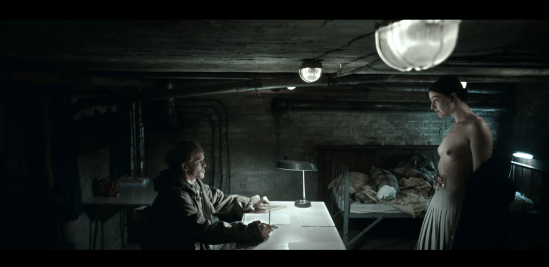
Seeking the luxuries of peace and quiet in order to fulfill the work of an important academic theory, a young student rents out the basement of an old bunker converted into a family home. Surrounded by the solitude of snow and trees, the bunker is the perfect place for the student to concentrate on his work. Until the couple renting the bunker basement decides the student must continue the unorthodox home-schooling of their eight-year-old son to put him on the path of becoming the President of the United States. The student becomes mixed up in a peculiar family’s ambitious affair twisted far from normalcy and teetering on the borderline on insanity.
screen-shot-2016-09-14-at-8-42-26-pm
“Der Bunker” is the first feature film from writer-director Nikias Chryssos and Chryssos delivers an artistically abstract film about the modernistic conventional ways of growing up through childhood told through an obsolete perspective. Produced in Germany, the film makes light of how parents raise and shelter their children, especially their sole child. The home setting is literally a bunker, a fallout shelter from the age of war. “Der Bunker” particularly points out the American child raising culture with Klaus, the eight-year-old son of mother and father, going through semi-strict tutoring of memorizing the every nation’s capitals in efforts of becoming, one day, the President of the United States. Chryssos overkills the symbolism column with continuously displaying the staleness of a stuck-in-routine in over-parenting from the outdated 1950’s style of the clothes and retrofitted bunker to the eight-year-old Klaus being depicted by a 30-something actor Daniel Fripan.
screen-shot-2016-09-14-at-8-45-09-pm
Fripan is one of four cast members to star in Chryssos film and the only actor portraying a named character with Klaus, leaving all others generically labeled with father, mother, and the student; however, Klaus and the Student are essentially the same person, a dual presence who start off polar opposites that are trapped inside the bunker and looking to break free from it’s buried confines when their individual identities begin to blur. Fripan’s key to “Der Bunker” working conceptually as the ‘man-child’ with Fripan’s attributed short stature, innocently mature face, and a well-performed immature persona that solidifies the Klaus role as nothing more than child forced to grow externally, but not internally. Pit Bukowski’s more of an automaton when we first meet him wondering through the snowy terrain in search of the bunker. His Student character starts to dwindle as he literally becomes a fixture of the bunker as Klaus starts to shine and thrive in not only his studies but in his maturity, confronting his Mother’s will. Bukowski’s internal switch goes dynamically well with Fripan even though their physical façades remains intact. Mother and Father are portrayed by Oona von Maydell, daughter of “Das Boot’s” Claude-Oliver Rudolph, and David Scheller and both compliment each other by donning an opposite reversal of roles where Mother is the stern, firm hand of the family and Father stays home to clean and be a teacher for Klaus.
screen-shot-2016-09-14-at-8-45-51-pm
Chryssos’ telling of the family and the Student’s psychosexual relationship between the story’s bookends goes above and beyond the Oedipus complex. Oona von Maydell’s Mother has a power fastening all the male characters in an intriguing way despite her minor, yet undesirable, physical deformity plaguing as a patch on her right leg and also despite that her rational stemming from a grave voice, connected to her deformity, comes from beyond their world. As if destined to play the part, Maydell acts the lead as the family’s matriarch while also being subtly coy and provocative to bluntly upfront about her sexuality as a means of control; Maydell seemed very comfortable with her onscreen upper torso nudity in some awkward and uncomfortable scenes. Her onscreen husband, David Scheller, deems himself an academic, an educated man with knowledge more vast than that of the outside world because of this thirst for literature. Yet, Scheller plays a scattered Father whose torn between being a literal mentor, the punisher, and the glue to keep the bunker from being engulfed by giving into Mother’s symbiotic celestial being. Father copes with heavy medication that literally warps his mind when he can’t seem to control everything from the Student’s appetite to his convincing of the Student to take on the tutoring role for Klaus, even if it’s not plainly displayed. Scheller does a remarkable performance breaking down his character to a crumbling lame duck.
screen-shot-2016-09-14-at-8-46-59-pm
“Der Bunker” and the bizarre go hand-in-hand. Only a unique mindset with skewed vision could have pulled together such a twisted dark comedy tale of the mortal coil in holding your children to your hopes and dreams for them. Colorfully unapologetic, “Der Bunker” canisters another world sluggishly revolving through multiple levels of layers of psychosexual and frustrating concepts that flaunts a conventional cinema defiance attitude to establish bold filmmaking possibilities. In short, director Nikias Chryssos shoots high and doesn’t miss with his first run. The Artsploitation Blu-ray release features a vividly clear anamorphic widescreen 2.35:1 presentation of the Kataskop Film Production. Audio options include a Dolby Digital German 5.1 Surround sound with very detailed optional English subtitles. An abundant of bonus material is hard to pass up, especially with a director’s commentary and deleted scenes that expand more about the character’s traits and backgrounds. Rounding the extras are outtakes and trailers from Artsploitation film arsenal. This Blu-ray release is meticulously thought out to deliver a high caliber video and sound quality for such as odd German film concerning one youngish boy’s progressional path of self-reliance from a sheltered life style.

Buy “Der Bunker” on Amazon.com! A Psychosexual experience!