Sometimes, You Can Feel EVIL Tightening Around Your Throat. “Death Knot” reviewed! (Well Go USA / Blu-ray)

“Death Knot” Hangs Loose on Blu-ray! Purchase Your Copy Here!

Hari and his sister Eka receive the tragic news of their mother’s suicide.  They return to their rural childhood village home to attend her funeral and prepare arrangements for the family home, but the siblings are met with a cold shoulder as the locals have shunned their mother, fearing her as a black magic practitioner who made a pact with the Devil himself.  The suicide and the village distress illicit different responses in both children – Eka wants to put everything behind her and live her life in the city of Jakarta. While Hari drowns himself of guilt over his mother’s death as he hasn’t visited his mother in years and wants to cherish the time left of his mother’s house, despite the not so pleasant childhood memories of his mother’s descent into mental instability.  When a upcoming storm makes leaving the village impossible, in what the superstitious locals note as The Harvest to claim souls, Hari, Ek, and Eka’s husband, Aldi, are forced to stay the night and that’s when strange visions and odd behaviors evoke the presence malevolent entity, an ancient deity, to beleaguer Hari and Eka into submitting to its will.   

Not too many Indonesian horror films see the light of day, buried beneath the massive manufacturing machine from the West, such as North America and Europe, that churns out films about every 8 seconds, the same rate in which babies are born at in the U.S, but that doesn’t mean the country known for its idyllic 17,000 islands and Buddha temples doesn’t have a repertoire of horror. In fact, obscure cult celluloids like “Lady Terminator” and “Satan Slaves,” known to those with indie horror running through their veins like crack cocaine, are the exemplar of the scarcely noticed Indo-horror collective and now that modern technology provides streaming servies far and wide from every corner of the world and advances in filmmaking make accessibility and recording film considerably cheaper and easier to complete, getting exposure becomes greater to other titles mostly hidden gems from the rest of the narrowed focused general population. Point in case, Cornelio Sunny’s “Death Knot” debuts his occult thriller that incorporated the grimly prophesized myth known as the pulung gantung that speaks of a great, fiery meteor being a harbinger of suicide and in Indonesia, the most common suicide method is by gantung aka hanging. “Death Knot,” also known as “Tali Mati,” isn’t the only film based on the myth, but what separates this film from other myth-based works is that the pulung gantung is still relevant today with highly resolute belief amongst the underprivileged and poorer neighborhoods. Sunny co-wrote the script with Ike Klose and is produced by Ismail Basbeth under Sunny’s company banner Matta Cinema in association with Kathanika Entertainment, SRN, and Umbara Brothers.

To ensure his debut directorial goes without a hitch, Sunny slides into the lead role of Hari and how Sunny and Klose write the character counterintuitively to screenplay 101 by not building him up, providing background, or instill preconceived notions through the acts. Hari’s a clean slate from start to near finish from scene one that involves him waking out of a horrible dream about his mother after briefly texting his sister. Written to have no depth in existing or having interests in anything, Hari’s hyper-focus is his mother’s legacy and commorancy, leaving his current mundane left in Jakarta to worry about his decease mother he hasn’t seen or talk to in years. Sunny is swarthy handsome, strong in subdued stubbornness, and limits his range toward his character in being the nondescript nonbeliever of occultism that innately scares the dickens out the poor village people. Hari and sister Eka (model/actress Widika Sidmore, “May the Devil Take You Too”) toss crumbs of background about growing up with an absent father and a community abhorred mother but appear unruffled by a broken home and, for the most part, shrug much of that rich backstory from their tabled history. Sidmore does a better job bottling Eka’ fear and loathing of a place that dejects her existence as villagers shun them for their devil pact bloodline and, eventually, the ooze of unwantedness seeps out of her to the point of being an emotional mess. Only when her loveable and amenable goofball husband, Adi (Morgan Oey, “The Deadly Love Poetry”), suddenly grows an obstinate backbone and refuses to leave the village, acting strange with an uncomfortably warped smile on his face as he fixates his glare deep into the forest, does Eka’s emotions pour toward a direction and hone in on a purpose until she, herself, falls into the same possessed-like predicament that befits her more than Adi but would be two perfectly ear-to-ear, Chesire cat-grinning candidates for Parker Finn’s horror-hit, “Smile.” The entity that has dominion over them isn’t so subtle, but Oey and Sidmore’s performances are, in a good way, awkwardly creepy and perfectly executed. Oey’s mimicking of a twist on the Balinese dance Hari’s mother performed in the opening scene before her demise and with what looks to be Hari’s mother silhouette impelling the dance in the shadows is “Death Knot’s” eeriest moment that lands traditionalism and supernaturalism into a single scene of shadows and visitants.

“Death Knot” is a slow burn, dread building, culture integrating, ambitious debut feature from actor-turned-director Cornelio Sunny.  Performance driven with little-to-no special effects, the surrounding morose atmospherics of “Death Knot” relies on the cast and it’s portentous, jump scare score to deliver a palpable fear without a perceptible villain, keeping very much in tune with one of Indonesia’s notorious folklores.  The limited budget constrains Sunny to character exposition and pursuance of self-selling the concept of an entity inhabiting friends and family with only their God-given talents and appearances to construct ominous opposition.  Descriptively, the notion sounds monotonous in tone, substandard in achieving a certain level of jitters, and gridlocked from a story perspective, but Sunny and his counterparts are able to feed the idle monster with energetic enthusiasm that turns the notion on its head with menacing and foreboding results, amplifying to one of the story’s other themes of paralyzing guilt that affects Hari from moving forward in life because of that equivocal estrangement between him and his mother.  However, one of the biggest problems to come out of “Death Knot” is the ambiguously fated ending for Hari, surrounded by a 50-yard radio of melee weapon-holding villagers like he’s been suddenly dropped in the middle of the Resident Evil 4 video game.  Perhaps not making the connection more evident, Sunny and Klose do faintly paint the picture of social class tensions with big city Hari, Eka, and Adi being met with aversion by the lower-class, rural village who have a strong belief system in the supernatural but is not a major clash or even an apprised motif represented only by a few aloof moments.  I was also hoping to see the myth’s harbinger of death with a great fireball in the sky to signify the beginning of The Harvest, aka hangings to usurp soul energies to feed the devilish deity, but that didn’t happen considering the budget for limited-to-no visual effects. 

“Death Knot” has this somber quality in its characters who are dropped into an unwelcoming village on a dark and stormy night scenario that puts a very Plutonian stamp on what kind Hell-crafted mark an ancient, malevolent God has left on forgotten land.  Well Go USA Entertainment picks up and distributes the home video rights to Cornelio Sunny’s debut hair-raising feature with a Blu-ray release. Presented in a widescreen 1.78:1 aspect ratio, the cinematography by Gunna Nimpuno captures the elemental beauty of rural Indonesia with rolling fields as far as the eye can see and the integrated towns built into hills becomes one seamless graft of spartan man living humbling on nature. Night shot continuity is Nimpuno’s weakest link in the arrangements of shots between the house at night and the forest at night. Outside the house is a natural pitch black with little lighting other than a green gel or another warm color in the house exterior but the forest scenes, every single one, are glazed with blue tint during day shooting to fabricate night sequences. The reproduction compression on this AVE encoded BD25 is rather good with little-to-no signs of banding, artefacts, or other lossy content issues. The Indonesian DTS-HD 5.0 Master Audio is digitally a solid track with a lamentably fine, back of the mind, sound design harmonized with an intense summitting score. There are also no issues with the digital tracks, any audio compression, and each track plays its role in sundered channels, creating an omnidirectional biodome that immerses you into the Sunny’s intimate family curse. English subtitles are option and are well-synched with grammatical accuracy. Aside from the opening previews of other Well Go USA titles, there are no other bonus features with this release. The physical features include the traditional Blu-ray latching snapper with a creepy enough illustrated cover art of a small smiling evil figure standing and surrounded by an engulfing forest. Inside is a leaf insert advertising other new Well Go USA distributed films. The film is not rated with a region A coded playback and has a runtime of 101-minutes. Cornelio Sunny first efforts don’t go unnoticed as “Death Knot” hooks with a mystery that slowly unravels the ugly truth of material myth and renders a stagnant guilt out of a powerfully, paralyzing combination of estrangement and loss.

“Death Knot” Hangs Loose on Blu-ray! Purchase Your Copy Here!

Never Cry EVIL Unless You Mean It! “Night Visitor” reviewed! (Ronin Flix / Blu-ray)

“Night Visitor” Creeping Onto Your Doorstep!  Now on Blu-ray!

Never-on-time high school senior Billy Colton can’t seem to catch a break in arriving to class on time. To make matters worse, Billy makes up a lame excuse for every tardy to his surly history teacher, Mr. Willard. On thin ice with Mr. Willard with only a few weeks left to graduation, Billy must keep his nose clean in order to not make any more waves that’ll cost him his diploma. When a new, extremely sexy, call girl neighbor moves in next door, Billy becomes entranced by her casual sexual affairs. So much so, Billy sets up a telescope from out his bedroom window to spy on her and convince his naysaying friends of her profession by sneaking a rooftop picture catching her in the middle of a tryst. What Billy sees is his neighbor being stabbed to death and the culprit is none other than his history teacher, Mr. Willard, continuing his conducting of Satanic rituals and sacrifices on local prostitutes. Because of his reputation for making up stories, no one believes Billy, not even the police, and he’s forced to attend Mr. Willard’s class with both parties having the knowledge of what really occurred. Billy’s desperation sends him to seek the help of a retired detective, Ron Devereaux, a close friend of Billy’s late father, and extreme measures must be taken by Billy to prove a killer’s identity and to stop Mr. Willard from coming after him.

“Night Visitor” is the 80’s alteration of the classic Aesop fable, “The Boy Who Cried Wolf.” The 1989 teen-campy cult horror is the first venture into feature length films by Rupert Hitzig, producer of “Wolfen” and “Jaws 3-D.” The twisted, modernized story derived from the fable was penned by Randal Viscovich to sought to provide nods to other films, one film in particular, “Fright Night,” shares a story parallel or likeness of an older teenage boy spying on the carnal rendezvouses of his alluring neighbor and ends up becoming involved in something far more sinister. At one point in time the film was under the working title, “Never Cry Devil,” a spin on the fable idiom cry wolf, Hitzig’s final product eventually landed on “Night Visitor” and the graphic nudity and cannibalism pared down for general audience consumption. Premier Picture Corporation served as the production company with Alain Silver (“Kiss Daddy Goodbye,” “Mortuary Academy”) producing, Randal Viscovich and Richard Abramites associate producing, and Tom Broadbridge (“The 13th Floor”) and Shelley E. Reid (“Nine Deaths of the Ninja”) as executive producers with United Artists serving as film rights distributor.

At the center of the story is a coinciding dual lead. One might be more prominent in the beginning, but the second soon catches up to run alongside in an even dichotomy of good and evil. Derek Rydall (“Popcorn”) plays into the stereotype of a hang loose teenage boy named Billy Colton on the edge of adulthood with a penchant for voyeurism as he spies on the late-night sexual commerce of her blonde bombshell neighbor. Rydall introduces mis makings of an energized, poofy-haired hunk who might be a little bit naive as a closeted peeping tom and looks to score with an older woman despite exhibiting and declaring feelings for his longtime friend Kelly (Teresa Van der Woude, “Killer Workout”). Who can blame Billy when Billy’s new neighbor was a Playboy Playmate? Shannon Tweed (“Cannibal Women in the Avocado Jungle of Death”, “Of Unknown Origins”) seduces, arouses, and paints by the numbers in what she does best – to be the sexiest woman on screen. Having never really dug herself out of being typecasted, Tweed humble horror beginnings is about the extent of her range before being cornered in the sex-thriller market and the Playmate of the Year 1982 is great fun to watch onscreen as her sex-working-kittenishness character, Lisa Grace, causes Billy Colton to steam in his pants. As much as it was a joy to watch Rydall and Tweed chart a possible older woman, younger man fling (fun fact: Tweed was supposedly playing a 26-year-old but was actually 31-32 and very much looks her age in the film), I thought Allen Garfield (“Diabolique”) and Michael J. Pollard (“Scrooged”) as brothers rollicking as Satan acolytes or rather just Garfield’s character Mr. Willard is the Satanist and Pollard as brother Stanley is just insane and fancies mentally manipulating the furniture as he calls the working girls him and his brother abduct and hold in the basement. Pollard is absolutely demented! All of the snarky quirks, plus a slew of scampish facial expressions and remarks, turn the fun-loving eccentric into a total maniac of truly scary proportions. Garfield’s method approach offers a different kind of demented, one that’s calculating and cunning to counter his brother’s outward lunacy. “Night Visitor” rounds out the cast with more gifted, recognizable talent in Elliot Gould (“Dead Men Don’t Die”), Richard Roundtree (“Shaft”), Scott Fults (“Hide and Go Shriek”), Brooke Bundy (“A Nightmare on Elm Street 3: Dream Warriors”), Henry Gibson (“The ‘burbs”), and adult film actress Teri Weigel giving Shannon Tweed a run for her money in the skinemax department as the basement-bound prostitute.

If you had told me “Night Visitor” was a strictly a chilling cut thriller, I would have not believed you and would recommend psychiatric help. Aside from the opening scene of a hooker being violently snatched and grabbed into a gothic black car, “Night Visitor” has the hallmarks of a teen comedy amped up on sex-driving hormones, teenage melodramatic antics, and parades light-hearted teen comedy up until throats are slit, chests, are daggered and Michael Pollard wildly wields a chainsaw with an impish grin. The blithe spirit soon turns dark and grim as the carefree attitude of the hero goes toe-to-toe with stern and Satanic teacher, a wonderfully metaphorical relationship to the extreme that’s universally relatable as everyone has had an encounter with a discontented classroom instructor at least once growing up. Surprisingly stark how bleak the film turns, an overwhelming sense of dread lingers after that second prostitute meets her maker in a ghastly way that, as far as kills go, isn’t very radical but the true nature of the subject matter is shaded so well that the moment literally hooks you into the story as you start to connect what just might happen next to the new neighbor. One aspect that felt lacking was that there isn’t much depth to the Willard brothers’ Satanism; a few upside-down pentagrams, a goat’s head, Baphomet’s goat head statue, a topless sacrifice with chant, and Allen Garfield’s robe and elaborate horned masked, which is an excellent design, are all the thin layer of thematic elements but still retains sufficiently the Willards connection to Satanism. Whenever the story moves from Billy Colton’s obsession to expose Mr. Willard, much of the narrative then focuses on the interrelationship of Zachary and Stanley Williard which is mostly a nonaggressive superior and subordinate kinship. Stanley, who caters to Zachary’s every request and even squeezes for him fresh orange juice, plays along with his brother’s inadequate display of being a disciple just to get his own malevolent kicks out of tormenting women of the night. There’s this unexplained fixation with prostitutes that puts forward less a Satan worshipper and puts forward more a pair of mania driven maniacs quenching a thirst for blood by offing the lower class of society that no one will miss. A brief scene backs up this theory of an angry prostitute chewing Captain Crane’s ear off about protecting the girls on the street and he just casually strolls along, waving her off as if to say, yeah whatever.

Ronin Flix, in association with MGM and Scorpion Releasing, urges you to never cry wolf in this tale of terror as “Night Visitor” lands on a Blu-ray home video, distributed by MVD Visual. The 1080p, high-definition release comes with a brand 2019 transfer master that’s clean as Mr. Willard’s rap sheet with no 35mm celluloid impurities, no aged wear or tear, and a healthy amount of unadulterated grain, presented in a widescreen 1.78:1 aspect ratio. Color grading has excellent appeal and defines the natural color palette greatly amongst the delineated details and appeasing textures. The DTS-HD Master Audio 2.0 stereo is on the only audio mix on the release and while it provides clean and clear dialogue track, the depth is often disproportion to the characters on screen. Much of the dialogue is in the forefront channel of the dual outputs, making every sentence feel closer than it should actually be in the stationary location of the character. Other than that, transfer’s hyper free of hiss, pops, and other audio blights. Option SDH subtitles are available. Bonus content has the original theatrical trailer and brand-new interview with director Ruport Hitzig, editor Glenn Erickson, and writer Randal Viscovich who all share a commonality regarding “Night Visitor,” the story was trimmed down of all of Viscovich’s nasty bits and shocking ending and made more upbeat for a better sell. Physically, “Night Visitor” comes in the traditional blue snapper keep case with brilliant red and illustratively glowing cover art of the sacrificial mask. The back cover claims the cover art is reversible, but it is not. The Blu-ray is region A encoded, has a runtime of 93 minutes, and is rated R. The cast alone is worth the price of admission as “Night Visitor” preys on the inculpability of Satan’s most righteous worshipper and on the power position of a role model with a secret life who has it out for the boy who cried wolf too many times.

“Night Visitor” Creeping Onto Your Doorstep!  Now on Blu-ray!

Channeling the EVIL from the EVIL DEAD! “Slaughter Day” reviewed! (Visual Vengeance / Blu-ray)

SOV “Slaughter Day” on Bluray for the First Time Ever!

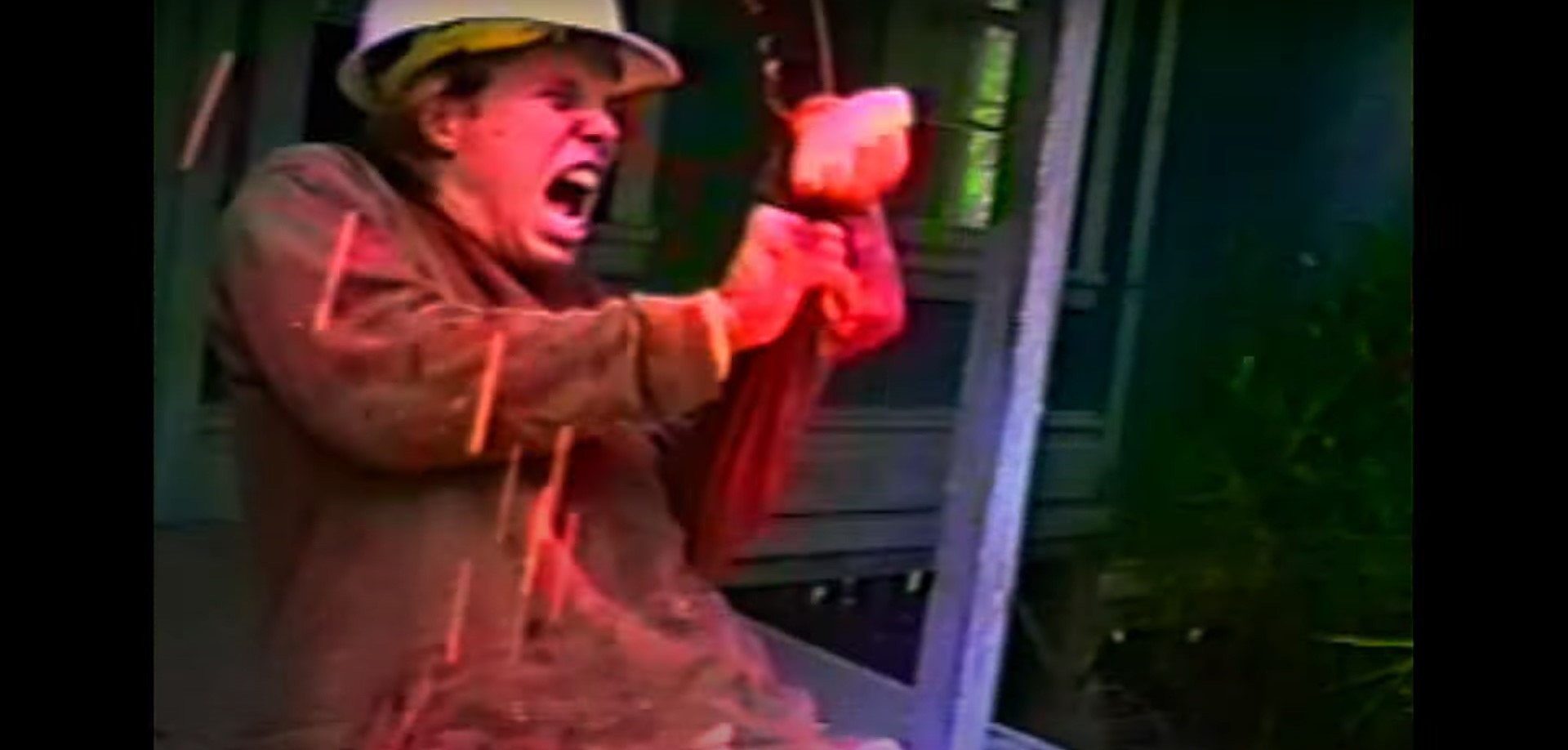
A pair of friends who run a small construction company drive up to an isolated cabin project in the outskirt nooks of Hawaii.  When they arrived, they encounter disgruntled employee John Jones who dabbles in the dark occult.  Having murdered already one of their construction crew members, Jones invokes the evil from the book of the dead, the Necronomicon, to bestow upon himself unnatural powers to seek revenge for years of abuse on the job.  Enslaving two other members of the construction Crew, Jones relentless goes after his former employers who must fight tooth and nail for every minute of their lives.  The fight stretches across the island and spills into the streets, abandoned factories, tropical brush, and even on the side of a mountain. 

“The Evil Dead” meets “Double Dragon!”  A fierce bareknuckle fight against a malevolently possessed construction crew is the not-stop action and gore premise of the Brent Cousins’ “Slaughter Day.”  The heavily influenced Sam Rain and “The Evil Dead” 1991 shot-on-video occult survival horror is co-written by Brent’s twin brother, Blake Cousins.  The twins’ filmic debut concept where a maniacal occult enthusiast goes on the offensive with his vindictive side by conducting dark, Necronomicon evil against the two construction supervisors is pieced together, scene-by-scene, from the various shorts created when they were adolescents.  The four short films from their inspired youth were revisited and remade into a full length feature film financed by a nearly a next-to-nothing zilch budget, but with more than a little can-do attitude, a group of close friends and family, and a willingness to drench the cast in splatter bags fill of fake blood, Brent and Blake’s balls-to-the-wall, commercial grade equipment schlocker never lets up and pays endearment to the legendary video nasties that have stimulated their need for tangible blood-shedding effects.  “Slaughter Day” is a self-funded labor of love under the Cousins Brothers Productions and is made in one of the more tropical places on Earth, the Big Island of Hawai’i, with a few scenes shot in the town of Honokaa.

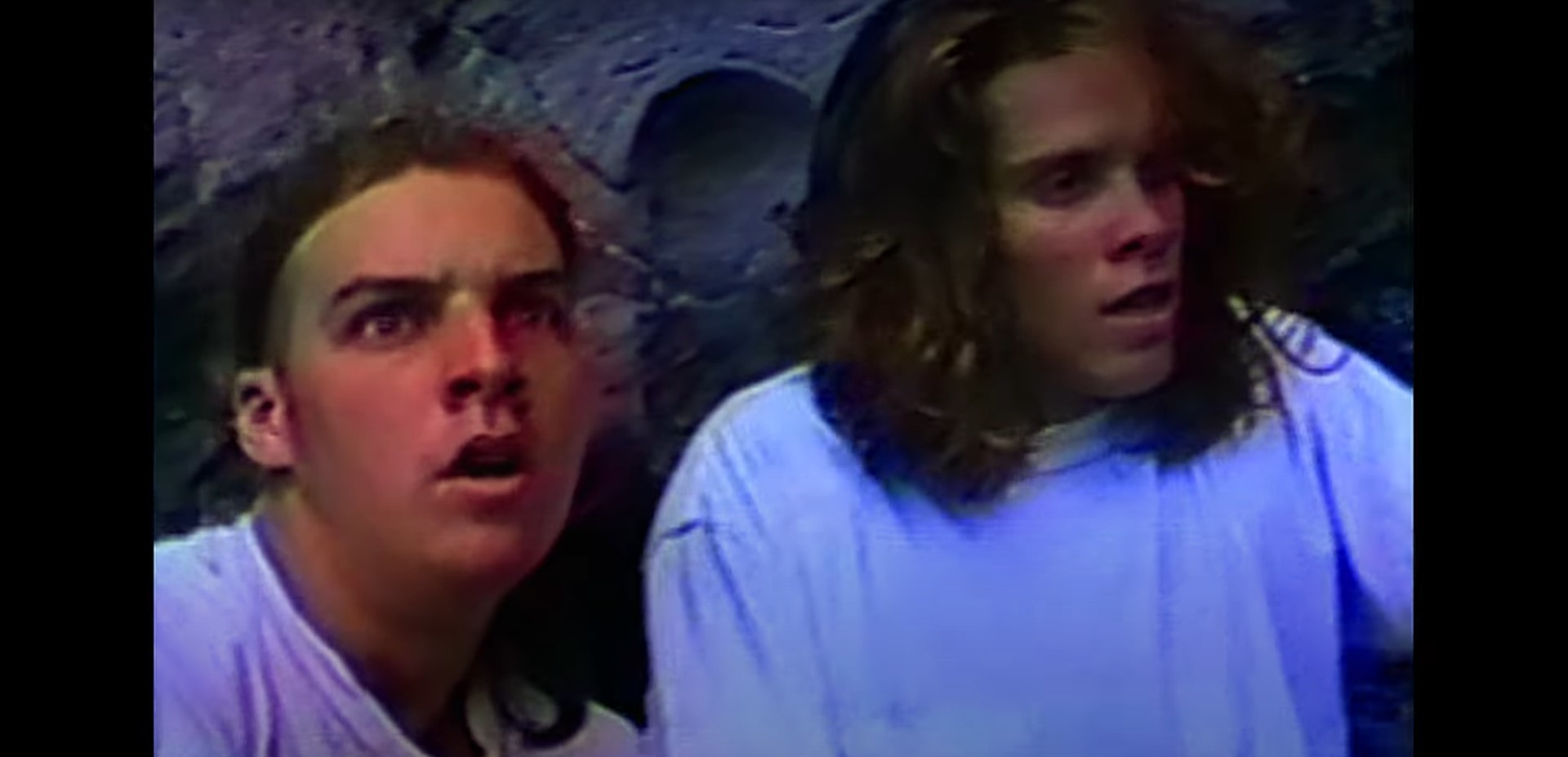
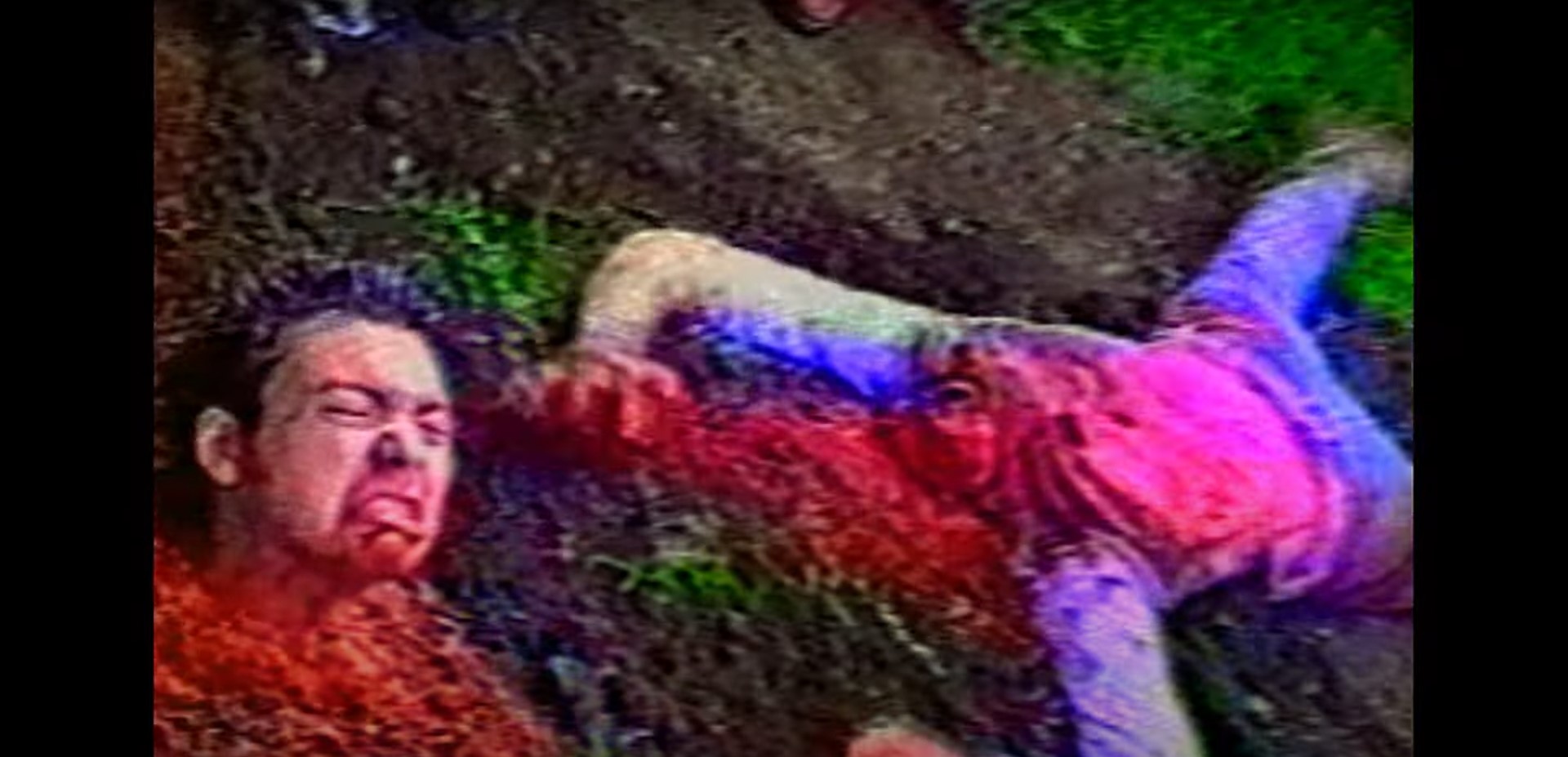
Aside from being one of the two writers, Blake Cousins jumps in the front seat to become one of the hapless heroes in the suddenly twisted, Hellish ride of that classic story of good versus evil. Blake embodies one of the few aspects that makes the viewing of “Slaughter Day” so infectiously exciting with a high intensity level somewhere around near redline critical. The intensity spreads to each and every actor in front of the camera and with Blake’s breakneck pacing as the film’s post-production editor, there’s a side-scrolling, beat’em-up video game quality about the whole run through. The acting isn’t terribly good with haywire yelling and screaming from start-to finish with a lack of professional training that gives way to under developing a story, but story be damned, the brother Cousins ambitiously puts caution to the wind by balancing out the acidic acting with exceptional camera work that occasionally would involve hazardous to their own health amateur stunt work. The unharnessed and unpadded fight sequence in the back of the pickup truck gets mad props in succeeding instead of squashing someone’s head under the tire. If everyone lives and you get the shot, it’s a win, right? The fight sequences themselves are extensive, as I aforesaid, the breadth of the short feature is like experience a live action “Streets of Rage 2,” and they have the smack of decent choreography with near miss blows and head whips. Some of the bigger fake hits lack sterling results but are nonetheless entertaining and expected. “Slaughter Day’s” cast is made up of essentially a closeknit group of friends with performances from Sam Bluestone, Dave Anderson, John Lambert, Kulaka Branco, Jeremy Couchiardi, Joe Ross, and Lincoln Ross who all have never again seen the gaffer lights of another film production.

“Slaughter Day” has many flaws: bad acting, continuity mistakes, not much of a plot, etc. While honest attempst were made to rectify a handful of those sore points, those very same imperfections are what make “Slaughter Day” ironically perfect in the SOV canon. Some of the gags land relatively smooth, such as being John Jones being bent backwards in half and sucked into a copy of the pop media cultural influencing H.R. Giger’s Necronomicon book, and others kind of flounder in the lukewarm stew of unskilled technical know-hows. Yet, I do firmly believe the brothers achieved a memorable salute to Sam Raimi’s breakthrough 1981 video nasty, “The Evil Dead” in pulling more so the macabre-isms then comedic slapstick elements of the “3 Stooges.” Brent and Blake obviously understood what they wanted to see and how much familiar content they wanted to rework to open the recesses of our memory banks to access and recall “The Evil Dead” playbook, but then the flyby the seat of their pants filmmakers take their committed vision farther by adding certifiably crazy stunts and be big and bloody as all bloody hell! Severed limbs, decapitations, exploding shotgun bursts, and impalings are difficult for even the most seasoned effects artist, taking sometimes years to master a simple effect to perfection. With “Slaughter Day,” the brothers are unafraid to take risks, something the filmmakers proved with audacious stunts, by rendering a practical effect inclined storyboard or script thought to the screen tactic and owned it with a pinch of panache pizzazz!

“Slaughter Day” might be release number five for Visual Vengeance but is clearly the Wild Eye Releasing cult-horror SOV sublabel’s second adulation of “The Evil Dead,” following “Bloody Muscle Body Builder in Hell.” The rough-and-ready S-VHS quality, presented in a full screen 1.33:1 from the original standard definition master tapes, can take on a grueling affect with a below par outcome. Tape lacks the proper color resolutions and that displays here immensely with full of deep and warm purples, reds, and yellows that you’d think the brothers were using gels to tint the picture. Tape wears, static interference, tracking lines… you name it, ‘Slaughter Day” visually had it. Delineation and details are deduced to a softer, overlapping ghost image that barely yokes together resolution pertinent pixels. Like always, Visual Vengeance’s disclaimer warns of the consumer grade equipment issues. These issues extend also into the English Stereo audio mix with a consciously underlay of static shushing, lo-fi dialogue recording, and zero depth and range to add more fuel to the “Slaughter Day’s” chaotic fire. Perhaps that’s why the dialogue is terribly rampant with the hope to invigorate and illicit engrossing captivation. The video game punch throw sound bites are a good touch and a innovative way to keep with the fighting game motif. The special features include a new audio commentary by directors Brent and Blake Cousins, a new audio commentary with Visual Vengeance’s own Matt Desiderio and Rob Hauschild, a quickly paced new interview with the Cousins Brothers regarding the genesis of “Slaughter Day” and they’re excitement about the new Blu-ray release, all four original “Slaughter Day” shorts, an earlier short entitled “Full Metal Platoon,” the “Slaughter Day” theme song, trailers from other Cousins films, such as “Rising Dead,” and the original trailer cut. Physical release features include a mini poster of the Visual Vengeance cover artwork, a three-page colorful essay from long time cinema contributing writer Tony Strauss, retro Visual Vengeance stickers that has graced all the company’s releases so far, a reversible cover art with new artwork as well as the original VHS art, and a cardboard slipcover with a heavily demonic and menacing Thomas “The Dude” Hodge design. The film comes unrated and has a runtime just shy of an hour at 58 minutes. I always get the warm and fuzzies when obscure works of art receive the red-carpet release treatment and “Slaughter Day” is an exemplar of SOV at its best while being innately its technically worst. Lots of ambition, lots of derived creativity, and lots of guts behind and in front of the camera to make a life-long dream of filmmaking come true.

SOV “Slaughter Day” on Bluray for the First Time Ever!

Become Wrapped Up in EVIL with “The Shroud” reviewed! (SRS Cinema / DVD)

“The Shroud” now available on DVD from SRS Cinema!

Centuries before, an evil witch is brutally tortured and killed while covered in a white shroud. In present day, a nun, part of a special sect vowed to never let the unholiness of the shroud deviltries be unearthed from the forgotten rubble of a divine stupa, is raped by two men wearing masks. With the help of a hired obtainer, the nun will stop at nothing to get her hands on, even at the defiance of her brother’s advice, but the shroud’s a bewitching mistress and its power are intoxicating. Breaking her piety pact with God and her sworn duty to protect man from wickedness, the nun succumbs to the sin that drips from the shroud’s blood-soaked fabric and exploits its personification powers of evil doings by not only exacting revenge on her attackers, sending the shroud to assassinate her attackers without an ounce of mercy, but also converting her devout habit to a shameless, promiscuous one of immorality.

A made-in-Italia possession film about a killer burial garment and a nun with big guns giving out the last rites. What could go wrong? The immediate impression arises a lot of interest in this 2022 released inanimate killer object flick from writer-director Fabrizio Spurio. As Spurio’s third feature in the horror genre, “The Shroud” envelopes the 50-year-old, Rome-born director’s first ambitious single story length venture behind the more episodic anthology, “Innesti,” and the more obscure “Vanity,” that taps into the willingness participation to do anything for stardom. “The Shroud” embarks into a more religious and supernatural discourse that clashes the sin and the sinner with a blurry line of empowerment. Made with pennies, or rather made on the Italian centismos on the Euro, “The Shroud,” or “Sindome,” is a production of the Dario Argento and Lucio Fulci inspired Goreproduction company, cofounded by Spurio with Francesco Lagonigro tacked on as a fulltime collaborator in shooting low-budget, independent, free-thinking cinema of underground horror.

The last time I saw the sultry lead Italian actress and extreme indie horror luminary, Chiara Pavoni, was in the avant garde “Xpiation” helmed by one of, if not the dominant, underground horror filmmaker, Domiziano Cristopharo.  In her motherly-voyeuristic role, Pavoni radiated with dark, sphinxlike desire in her well-dressed, pin-up sex-symbol performance of longing and control.  Pavoni doesn’t stray far from that archetype with her latest role in Spurio’s “The Shroud” as she plays a woman of virtue, a nun to be more exact, who has quickly turned lubricious and vindictive after her being raped.  Pavoni is certainly bodacious on screen as she adorns tight-fitting outfits that barely contain her snugly-packed large chest, exposing a Mariana Trench deep cleavage in a Spirit Halloween sexy nun getup for much of her role’s sordid side.  As a thespian performer, Pavoni has the subtle moves of a temptress who knows what she wants but dialogue deliveries are something left to be desired as the “Demonium” actress goes through the motions of plain speak as does much of the other cast, including the Goreproduction producer costar Francesco Lagonigro. Lagonigro plays her object obtainer who, by the seducing forces of the shroud, turns into her sex-slave or gothic lackey as visions of death please feed him the sensation of guilty pleasures. Lagonigro’s version of a factotum is about as cheesy as they come with a glaring lowered brow and white and black face paint to embellish something that looks nowhere near sinisterism. If we’re supposed to take Lagonigro’s maniacal manservant role seriously than Spurio, and Lagonigro for that matter, misses the mark badly in a poorly sized up rendition of a Renfield like stooge. “The Shroud” rounds out the cast with many miniscule, nearly nonspeaking roles with Paolo Di Gialluca (“7 Sins”), Andrea Pucci, Allesandro Massari, Giuseppe Andreozzi, Sara Lagonigro, Monica Rondino, and Andrea Pacilli and Samuele Lagonigro who composed the score for the film under the moniker, Sam and Andy.

As you can see, “The Shroud” is a family production for the Lagonigros who won’t hesitate to pitch in to make Francesco’s lewd and crude extreme horror on a bar tab’s worth. Conceptually, “The Shroud’s” an appealing idea of religious hypocrisy and the natural human desire to be immoral. Rules are meant to be broken as Spurio seizes control the very one thing a woman should have control over – her body. By introducing rape by two masked men, Spurio rips away that control and for a nun who whole schtick is to abide by God by maintaining purity in keeping her holy temple intact, she must seethe with humiliation in front of her Lord and inevitable turn away from him because there is nothing left unadulterated to give. She has sinned, whether intentional or not, and so the tainted nun must keep on sinning in various ways: lust, revenge, and murder. Despite being on a budget, Spurio’s ability to liven up a plain white tablecloth is what making movies is all about as the shroud lives and breathes on screen, moving in an agile manner, and becomes a physical presence that can gore a man through. Sleight of hand scene reversals bestows the shroud with a life of its own, creating a slithering dolman of death that looks great in the humble presentation. That kind of DIY special effects translates the same across the slender 76-minute with practical gore gags that rest above mediocracy, and I can say that with a straight face. “The Shroud” will have very few claims to cult fame with a slew of sloppiness that takes the zero-dollar expenditure and makes it appear even cheaper than pocket change. There’s even a scene where the director is clearly reflected into the frame, not even an attempt to hide or review for need to reshoot.

“The Shroud” is warm and cozy when it’s not trying to kill you! SRS Cinema, a leading purveying of underground cinema, releases Fabrizio Spurio’s “The Shroud” on DVD as part of the company’s extreme and unrated nightmare fuel label. Distributed through MVD Visual, the region free DVD5 is presented in an unmatted widescreen 1.85:1 aspect ratio with a commercial grade quality of a standard definition camcorder that maxes out on the higher side of output of a 720p resolution and so the final result looks fairly okay for DVD. For much of the natural lighting, the high contrast works extremely well, creating deep shadows that make the film feel richer than its actual value, but the details and textures are often soft and bleary, washing out any kind of tactile material. Luminescence of green and blue gels as well as double overlays are used to symbolize nightmares and shroud vision are more headache inducing than a stylish solution when mingled with an industrial engine rumble or high-pitched and stretched vocal score with some piano keys tossed in to mix it up. The Italian language dual-channel stereo is a lossy, unbridled catchall. As much as the audio is purely soundtrack, there is still an insurmountable of sounds being captured by the camcorder mic that softens the desired prominent audiles, such as dialogue which becomes trapped in a cavernous state of echos and various levels of pitch inconsistences. The subtitles on the SRS DVD appear to be translated by a person with English as not their primary language as a tone of grammatical errors, punctuation mistakes, and absolutely zero capitalization tarnish an already low-rent feature. If you can work your way through the strangely designed menu options to the bonus features, you’ll find included raw take bloopers, photo gallery, music videos starring Chiara Povani and Francesco Lagonigro, and SRS trailers. The physical package is perhaps the best part of “The Shroud” with a true-to-form beautifully dark illustration of the most memorable character faces to exhibit in the film, crafted and designed by Avery Guerro. “The Shroud” is an estimable underground piece of the extreme horror art pie but slacks in unnecessary places and becomes an exemplar of a shoddy and careless production that ultimately hurts the overall value of its genus.

“The Shroud” now available on DVD from SRS Cinema!

The Fourth Go-Around with an EVIL Icon Is An Inferior Copy. “Jeepers Creepers: Reborn” reviewed! (101 Films / BD-R)

Laine and her boyfriend Chase drive toward Jackson, Louisiana where Chase has planned a fun-filled weekend in the land of the notorious Creeper legend and where the annual HorrorHound festival lures fans from all over the world for a carnival celebration of horror. Rolling her eyes at Chase’s complete obsession with the Creeper and his love for horror, Laine indulges her boyfriend’s every geeked-out whim, including entering a contest for a chance to enter a Creeper inspired escape room held at a dilapidated manor house on the outskirts of town. The lucky winners and the producing team find themselves lured into a deadly trap orchestrated by a cult loyal to the Creeper and Laine, who has been handpicked by his disciples, learns through premonitions that the Creeper hungers for her unborn child. Trapped inside with an unstoppable winged monster hunting them down, Laine and Chase implore the others to fight back against a living legend of lore.

Fascinating is the monster that is the Creeper, a versatile humanoid with batlike wings, a serious sniffer, and a flesh-eating connoisseur with the strength of 10 men and a primitive, yet effective assorted arsenal of deadly melee weapons. The Creeper is a modern marvel and icon of contemporary antagonistic favorites this side of the early millennium having arrived on the big screen now over two decades ago back in 2001 and producing now four films between that time span, but within those 21 years, a tremendous controversy has tarnished the good name of the “Jeepers Creepers” legacy. That name is “Jeepers Creepers” creator Victor Salva who conviction as a child sex offender might not have stopped him from directing three “Jeepers Creepers” films but certainly put the rubber stamp of disapproval against any kind of box-office success with audiences steering clear of work. 2022 saw promise for the Creeper with a new, fourth entry entitled “Jeepers Creepers: Reborn,” a title resembling a phoenix being risen from the fiery ashes type of project that removed Salva not only from the director’s chair but also any kind of substantial compensation for the legal rights. Timo Vuorensola (“Iron Sky”) steps into frame as the franchise’s newest visionary to hopefully resurrect the Creeper from the depths of indirect persecution. With a story written by Sean-Michael Argo (erotic-fantasy-horror writer of “Sineaters” and “Fable: Teeth and Beasts”), “Jeepers Creepers: Reborn” promises new blood and a new creative process with possible white glove treatment without the sully of sin behind the scenes. The first “Jeepers Creepers” film to be shot almost entirely in the United Kingdom with a few Louisiana locale shots, the fourth flight of the Creeper entry is a coproduction between Black Hanger Studios and Orwo Studios.

With a new “Jeepers Creepers” installment focused on adverting attention away from its creator, “Reborn” comes with an overhauled cast, including a new face toward the Creeper.  Instead of Jonathan Breck returning to resume the role in a fourth film, complications from an overseas production, English actor Jarreau Benjamin tackles the role with everything he’s got and with everything he has to work with.  Breck cobbled together large boots for the assimilation of a western horror villain with a mischievous and ruthless personality as he toys with his food before he eats it in the first three films.  Benjamin does a remarkable job attempting to emulate much of the same albeit the Creeper have a slightly different look because of Benjamin’s build and face structure.  Nonetheless, as the Creeper, the greenhorn fills in quite well tormenting conned prey that includes on screen couple Sydney Craven (“York Witches Society”) as Laine and Imran Adams as Chase.  To be honest, Craven and Adams had little emotion weight beyond a fantasy and lust dynamic and couldn’t find character and story support in what seems to be more of a close acquaintance rather than a highly involved and evolved romantic relationship.  They’re teamed with producers of a reality show, game show, some kind of vague media show of sorts, as the unfortunate lucky winners of an escape room challenge as well as a local Jackson resident, Stu, with a Duck Dynasty beard and salty arura about him, played by Peter Brooke (“Wrong Turn 5:  Bloodlines”) and I wanted to know more about Stu.  Is he good or bad?  Is he a patsy?  He’s mysterious but likeable and he’s written enigmatically up to a point but the descends into just another ordinary link in the chain. Ocean Navarro (“Infamous Six”), Matt Barkley, and Alexander Halsall round out the victims corralled by the cult of the Creeper. The Creeper worshipping group represented by a local shopkeeper (Georgia Goodman), a fire and brimstone preacher (Saverio Buono), and a horror hostess named Madam Carnage (Jodie Mcmullen) are a flake of a bigger scab that reveals nothing about their reasoning or their cause in helping every 23rd year for 23 days and the element of the cult cheapens the story because it goes unexplained. Overall, the performances are steady, if not slightly cliche at times, and the cast rounds out with Dee Wallace (“Cujo”) and Gary Graham (“Robot Jox”) with a familiar and strong opener that gets the blood going.

That very 15-or-so minute opener is “Jeepers Creepers: Reborn.” That’s it. That’s the film. It’s classic Creeper with a new, beaten down, larger box truck, starkly different from his rusted Chevy HD COE that’s like a supercharged street-legal tank but with the same BEATINGU double entendre license plate and malevolent-ripping energy that would make anyone’s heart race with fear as he tailgates and blares the horn at high speed. Yet, the opener quickly rescinds into an unsolved mystery-like episode and from that point on, Vuorensola and Argo work diligently to rapidly dismiss the first three films by meta means with one of the principals stating the Creeper stories gave way to three films, hence why the fourth film is subtitled “Reborn” and acts more like a reboot than a sequel. Perhaps that is why the plot adds a stronger motivation for the Creeper who is hellbent on extracting a prenatal child from Laine. “Reborn” invokes a return to the premonition theme that go hand-and-hand with the Creeper’s return as Laine has visions of her the centerpiece of attention, covered in blood, and a baby carriage containing, supposedly, the target, but the story is so far up the abstract tail with the visions and conjectural dialogue, we never receive a straight answer as to why the Creeper is after the peanut-sized pregnancy. With any of the four films, the Creeper dispatches prey in various neat ways with a primordial arsenal of medieval killing tools and the scenes of slaughter don’t disappoint. There’s actually a gory moment of a scalp flip and a brain snack that’s well executed. What kills “Reborn” with a stake through the heart is the rotoscoping at climatic end. Clunky, chunky, and disproportionate, the actors appear to be standing and moving around in a 2D environment with unintended rigid actions that dispel realism after a wonderful show of makeup and practical effects in the first two acts.

You don’t have to wait another 23 years to see the Creeper as “Jeepers Creepers: Reborn” lands on UK digital platforms on October 10th and on UK DVD and Blu-ray October 24th courtesy of UK distributor 101 Films. The just-before-Halloween release will contain a 15 certification and is available preorder at the https://101-films-store.com/. Unfortunately, I’m unable to dive into neither of the DVD or Blu-ray spec details or give a full critique of the audio/video aspects as a BD-R was provided for feature screening purposes only. The screener also didn’t have any bonus features and included only an English subtitle option. The film runs clocks in at 88 minutes and is shot with an Arri Alexa camera. “Jeepers Creepers: Reborn” might have dropped the surface level controversial dead weight but can’t fully shake the stigma and in an opportunity to reboot or rebrand the franchise, the effort is squandered by production snafus and shoddy presentation that’ll put the Creeper asleep for another 23 years until the next film.