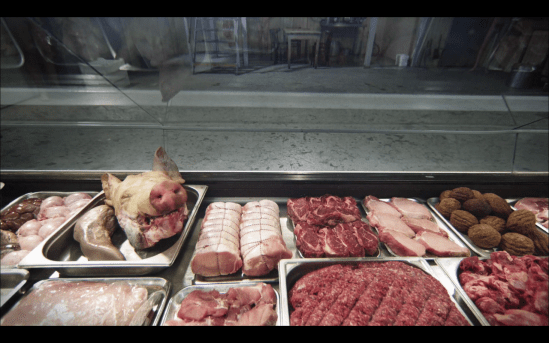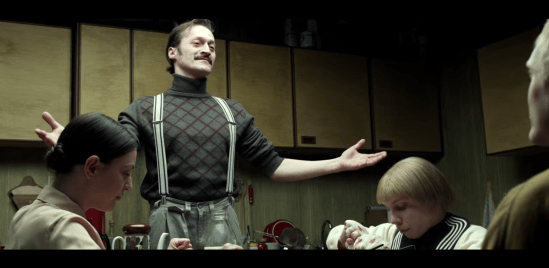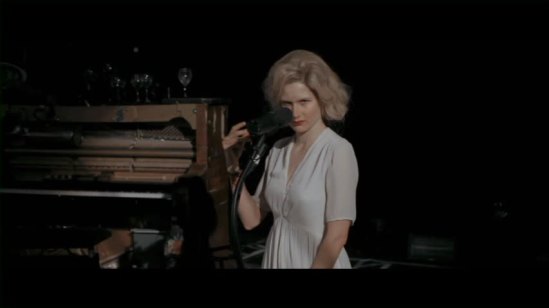
Time Travel to an Evil Future! “Counter Clockwise” review!

vlcsnap-00001
Ethan Walker is a brilliant scientific engineer, though he doesn’t look it with his long fire-hued beard and pot-belly midsection, but Walker, along with his colleague, believe to have accomplished the impossible: teleportation. When Walker decides to try his machine on himself, the realization of something terribly wrong overwhelms him. Walker didn’t invent a teleporter, he accidentally constructed a time machine, sending himself six months into a grim future where his wife and sister have been brutally murdered and he’s the sole prime suspect. The only way to make sense of the future and to solve the crime against him is to travel back to the past multiple times to unravel a sinister plot and stop the murder of those close to him.
vlcsnap-00002
To simply and conventionally tagline “Counter Clockwise,” George Moise’s 2015 directorial debut can easily be described as Terry Gilliam meets David Fincher. Part sci-fi thriller part dark comedy, the adventure of Ethan’s misadventures ingeniously signifies a harsh outlook on the saltiness of our predetermined universe while encountering outrageous and weird characters along the time warp. Ethan, no matter what he does or how he does it, has to use the accidental time machine to thwart the brutal death of his wife and sister and while his reasoning sounds fairly comical being the groundwork of what Albert Einstein calls madness, on-screen it’s rather heartbreaking and tragic to see this guy, an everyday looking joe, desperately attempt to deconstruct, from the unsolicited help of his future selves, a dastardly plot that will destroy everything he holds dear.
vlcsnap-00003
Penned also by George Moise, based off a story by brother Walter Moise, along with the film’s lead star, Ethan himself, Michael Kopelow, “Counter Clockwise” will change the way critics will perceive time travel storylines by not as a means of zipping back only once to change the forsaken past, but as a respawning Shakespearean tale of tragedy in order to continue to amend a hapless situation. A respawned Super Mario had more luck saving Princess Peach through the thicket of Koopa Troopas and the fire breathing Bowser. Though the character Ethan repeats his voyage, the way “Counter Clockwise” is written doesn’t convolute itself in the repetition, staging clues as a window into beyond the present and generating eerie and problematic, if seriously disturbed, episodes that doesn’t give Ethan a minute from tirelessly being objective. Combine those elements with George Moise’s neurotic direction and the result seizes to capture not only science fiction aficionados, but movie enthusiasts of every category in this genre-breaking feature. From the first moment of the opening scene, a strong familiar inkling of Ridley Scott’s “Alien” washes over you; the subtle hum of machinery, the slow panning from side-to-side, the very soft touch George Moise applies is uncanny and so endearingly respectful that the direction doesn’t feel like an absolute rip of Scott’s 1979 space horror classic.
vlcsnap-00004
Kopelow is the centerpiece that glues the story whole. As Ethan, Kopelow’s gentle giant approach is such a stark contrast to the surrounding darkness that has embodied nearly every other location and character, even his lip flapping, hard loving mother. Extreme opposite on the polar spectrum is voice actor Frank Simms as Roman, head of major corporation aiming to steal pioneered technology from Ethan at any cost. Simms’ talent has two settings in this film, hot and cold; his sound binary method works to composite a character so reasonably rational that when Roman snaps, a trickle of pee squeezes out and runs down your leg at his abrupt and menacing counter personality. The rest of the cast follows suit with pinpoint precision on their coinciding characters and even the eccentric cameo performances were otherworldly good from Chris Hampton’s relishing water fountain patron to Marty Vites one-eyed creepy landlord. Ethan’s landed in bizarre world that hums a very familiar tune in Terry Gilliam’s “Fear and Loathing in Las Vegas” while the amount of downbeat content spurs moments of gritty David Fincher thrillers, especially in one particular scene with the brawny New Jersey native Bruno Amato being the ultimate bad guy henchman by raping a dead woman for spite and for pleasure. The cast fills out with Devon Ogden, Kerry Knuppe, Joy Rinaldi, Alice Rietveld, and Caleb Brown.
vlcsnap-00006
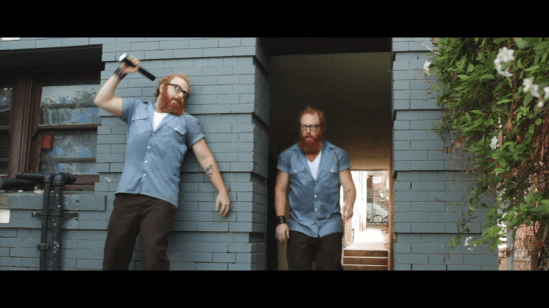
The Sex Scene Crew production, “Counter Clockwise,” is not an effects driven project. The indie sci-fi film relies on the trio of coordination efforts in refined editing, camera angles, and practical effects to deliver the intended message. Like I said before, George Moise is neurotic, providing the attention and detail to every scene as if a climatic money shot. Value is placed in the story and in the direction rather than diluting and cheapening with overrated, big budget computer generated special effects that can snap a film’s heart and soul like a thin twig. The biggest effect comes in the form of a composite, placing two Ethans in the same scene and working action off each other. Even the time traveling sequences are a basic edit that’s well timed with simple lighting techniques, gentrifying low budget films more toward a respectable level of filmmaking.
vlcsnap-00007
Artsploitation Films’ DVD release of “Counter Clockwise” is an edgy rip in space time continuum sci-fi thriller presented in a widescreen 2.35:1 aspect ratio with Dolby Digital 5.1 surround sound audio option. Image quality pars well with modern releases and the same can be said about the audio, especially with the prevalent dialogue. Aside from conventional specs, Moise adds a sensory surplus to stimulate sight and sound hell-bent to strike an unnerving chord strummed simultaneously with providing an awesomely surreal effect. The DVD contains bonus features include “The Making of Counter Clockwise featurette, going behind the scenes of pre-production, production, and post-production. There are also five deleted scenes with commentary and a trio of commentary tracks that include the director, director and editor, and director and co-writer. “Counter Clockwise” is 91 minutes of time hopping suspense, packed with adversity and pitch black humor from start to finish and finish to start.

Click Above to Time Travel to Amazon and Buy this Title Today! (And not six months from now…)

Dutch Avant-garde is the Next Evil on the Butcher’s Slab! “Meat” review!

screen-shot-2016-09-23-at-8-50-29-amA young and beautiful butcher shop assistant succumbs to the middle-aged butcher’s sexual advancements and fantasies at the workplace after she catches glimpses his sorrow, but when the butcher ends up naked on the shop’s floor with his throat cut, the assistant becomes the number one murder suspect for an inspector who coincidently looks almost identical to the deceased butcher. As the investigation deepens into the assistant, the inspector’s solemn, solitary life blurs to an assimilation into the butcher’s and his suspect turns from being a prime target to being a crucial part of the his physical and mental altering integration into the dead butcher.
screen-shot-2016-09-23-at-2-45-58-pm
“Meat” is a powerful transcending film seismically barreling through a Lynchian structure consigned to provoke the consequences of unhappiness and the consequences of poor choices during unhappiness. Directors Victor Nieuwenhuijs and Maartje Seyferth have orchestrated a moderately expressionistic arthouse Dutch drama told in a spiraling sexual context. The meat in “Meat” and the sex in “Meat” clearly share a correlation, peppered as motifs from start to end, and the positive and negative dimensions of the two are so obscured that pinpointing the differences between them are impossible, but both are for sure the last hope for the butcher and his assistant Roxy to embody the essence of sex and meat for opposite reasons. Whereas Inspector Mann simply drags wholeheartedly through his existence, expressing his numbness toward his mundane job and harshly breaking up with his lover without an ounce of compassion. Its until the butcher’s case lands in his lap does the Inspector shows signs of life again.
screen-shot-2016-09-23-at-2-36-30-pm
If you notice that lead actor Titus Muizelaar’s dual roles have purposefully generic labels. The butcher is credited as just the butcher while the Inspector has a proper name, but the name Mann is just as indistinguishable as if the character was christened Guy. The synonym character was intended for blending, to blur their personas, and to transform one into another. To explore the transformation, “Meat” begins a parallel between the butcher who, in a metaphorical sense, has his cake and eats it too and the inspector painstakingly limps from one spot to another. A contrasting experience between the two firmly establish their individualities. Then, the film shifts gears midst a catalyst with the butcher’s mysterious death, forcing the female assistant, an uninhibited role performed uninhibitedly by Nellie Benner, to be the resilient gateway for the inspector. Third gear shifts into the inspector being more and more intrigued, if not extremely envious shown very subtly, by the butcher’s seemingly unchained facade. Each character emits an expressionless stature with a deep-rooted ugliness burrowed inside and each desire a change in their turmoiled lives, whether it’s sustaining love, seeking love, or able to love in order to battle every aspect of oppressive depression.
screen-shot-2016-09-23-at-2-55-21-pm
The uncomfortable open and intimate relationship between the butcher, Wilma Bakker’s Tiny, and the shop owner and the psychosexual workplace harassment involving the enthusiastic, video-documenting assistant filets the juicy bits from the bone with numerous innuendoes and explicit carnal exhibitions taking brazen residence within the animal blood stained walls of the butcher’s small meat market. You’ll never look at steak, pork chops, and leg of lamb the same way again! Only when “Meat” transitions into that second gear does the erotica becomes less erotic and more forced and horrifically exploitive. Scenes of undisclosed rape and of blatant genitalia speak upon that aforementioned correlation of raw meat and sex; no choice is given to the cow when the cow is killed and slaughtered for the cow’s delicious beef and the same can be said in sex as it’s taken without much consent and it’s being reaped for the benefit of others.
screen-shot-2016-09-23-at-9-22-48-am
Graphically infrasexual and skewed beyond simplicity, “Meat’s” refreshingly loaded with unpleasantries and basted moistly with an outer layer of perversion that drips into an oven of thriller surreality. The Artsploitation team lives up to the moniker by, after being long overdue, crafting a home video release of 2013’s “Meat” aka “Vlees” onto DVD and on digital home video. The digital screener provided for review doesn’t give much insight into the audio and video qualities or speak to the testament of the special features. However, “Meat” is a phenomenal film that’s well-aged and ready to be rubbed, tenderized, devoured in all senses of the meaning.

Buy “Meat” on DVD!

Being Tailored to be President of the United States ist sehr Böse! “Der Bunker” review!

screen-shot-2016-09-14-at-8-46-13-pm
Seeking the luxuries of peace and quiet in order to fulfill the work of an important academic theory, a young student rents out the basement of an old bunker converted into a family home. Surrounded by the solitude of snow and trees, the bunker is the perfect place for the student to concentrate on his work. Until the couple renting the bunker basement decides the student must continue the unorthodox home-schooling of their eight-year-old son to put him on the path of becoming the President of the United States. The student becomes mixed up in a peculiar family’s ambitious affair twisted far from normalcy and teetering on the borderline on insanity.
screen-shot-2016-09-14-at-8-42-26-pm
“Der Bunker” is the first feature film from writer-director Nikias Chryssos and Chryssos delivers an artistically abstract film about the modernistic conventional ways of growing up through childhood told through an obsolete perspective. Produced in Germany, the film makes light of how parents raise and shelter their children, especially their sole child. The home setting is literally a bunker, a fallout shelter from the age of war. “Der Bunker” particularly points out the American child raising culture with Klaus, the eight-year-old son of mother and father, going through semi-strict tutoring of memorizing the every nation’s capitals in efforts of becoming, one day, the President of the United States. Chryssos overkills the symbolism column with continuously displaying the staleness of a stuck-in-routine in over-parenting from the outdated 1950’s style of the clothes and retrofitted bunker to the eight-year-old Klaus being depicted by a 30-something actor Daniel Fripan.
screen-shot-2016-09-14-at-8-45-09-pm
Fripan is one of four cast members to star in Chryssos film and the only actor portraying a named character with Klaus, leaving all others generically labeled with father, mother, and the student; however, Klaus and the Student are essentially the same person, a dual presence who start off polar opposites that are trapped inside the bunker and looking to break free from it’s buried confines when their individual identities begin to blur. Fripan’s key to “Der Bunker” working conceptually as the ‘man-child’ with Fripan’s attributed short stature, innocently mature face, and a well-performed immature persona that solidifies the Klaus role as nothing more than child forced to grow externally, but not internally. Pit Bukowski’s more of an automaton when we first meet him wondering through the snowy terrain in search of the bunker. His Student character starts to dwindle as he literally becomes a fixture of the bunker as Klaus starts to shine and thrive in not only his studies but in his maturity, confronting his Mother’s will. Bukowski’s internal switch goes dynamically well with Fripan even though their physical façades remains intact. Mother and Father are portrayed by Oona von Maydell, daughter of “Das Boot’s” Claude-Oliver Rudolph, and David Scheller and both compliment each other by donning an opposite reversal of roles where Mother is the stern, firm hand of the family and Father stays home to clean and be a teacher for Klaus.
screen-shot-2016-09-14-at-8-45-51-pm
Chryssos’ telling of the family and the Student’s psychosexual relationship between the story’s bookends goes above and beyond the Oedipus complex. Oona von Maydell’s Mother has a power fastening all the male characters in an intriguing way despite her minor, yet undesirable, physical deformity plaguing as a patch on her right leg and also despite that her rational stemming from a grave voice, connected to her deformity, comes from beyond their world. As if destined to play the part, Maydell acts the lead as the family’s matriarch while also being subtly coy and provocative to bluntly upfront about her sexuality as a means of control; Maydell seemed very comfortable with her onscreen upper torso nudity in some awkward and uncomfortable scenes. Her onscreen husband, David Scheller, deems himself an academic, an educated man with knowledge more vast than that of the outside world because of this thirst for literature. Yet, Scheller plays a scattered Father whose torn between being a literal mentor, the punisher, and the glue to keep the bunker from being engulfed by giving into Mother’s symbiotic celestial being. Father copes with heavy medication that literally warps his mind when he can’t seem to control everything from the Student’s appetite to his convincing of the Student to take on the tutoring role for Klaus, even if it’s not plainly displayed. Scheller does a remarkable performance breaking down his character to a crumbling lame duck.
screen-shot-2016-09-14-at-8-46-59-pm
“Der Bunker” and the bizarre go hand-in-hand. Only a unique mindset with skewed vision could have pulled together such a twisted dark comedy tale of the mortal coil in holding your children to your hopes and dreams for them. Colorfully unapologetic, “Der Bunker” canisters another world sluggishly revolving through multiple levels of layers of psychosexual and frustrating concepts that flaunts a conventional cinema defiance attitude to establish bold filmmaking possibilities. In short, director Nikias Chryssos shoots high and doesn’t miss with his first run. The Artsploitation Blu-ray release features a vividly clear anamorphic widescreen 2.35:1 presentation of the Kataskop Film Production. Audio options include a Dolby Digital German 5.1 Surround sound with very detailed optional English subtitles. An abundant of bonus material is hard to pass up, especially with a director’s commentary and deleted scenes that expand more about the character’s traits and backgrounds. Rounding the extras are outtakes and trailers from Artsploitation film arsenal. This Blu-ray release is meticulously thought out to deliver a high caliber video and sound quality for such as odd German film concerning one youngish boy’s progressional path of self-reliance from a sheltered life style.

Buy “Der Bunker” on Amazon.com! A Psychosexual experience!

Internal Evil is Subtle. “Fever” review!

vlcsnap-00001
High school classmates Pierre and Damien have just murdered a street woman inside her own apartment days before their French placement examinations. After hearing of the gruesome news, Zoe, a young optician working on the same street, recalls the two boys bumping into her, dropping a black glove on the sidewalk, and she begins to formulate her own radical theory, putting two-and-two together that the teens could be the very culprits fleeing calmly from the scene. Meanwhile, Pierre and Damien continue on with their examination studies over the Easter holiday, believing their heinous crime was not personal but of chance, making the offense not a crime at all. Zoe continues her pursuit of curiosity toward the murderers by not informing the authorities of her suspicions; instead, Zoe uses the crime to become self-aware of her fragile and stagnant relationship with her long time boyfriend while the two teens perverse over the concept of committing another murder.
vlcsnap-00004
Leave it to the French to make a bloodless and non-violent crime drama that’s more arthouse than conventional. Based on the Leslie Kaplan 2005 novel, “Fever” is the 2014 freshman film from writer-director Raphael Neal that dives sharply from the murderous act and into the internal struggles that lead Damien, Pierre, and Zoe into a turmoil path. Pierre and Damien think they both won’t be affected by their crime and that their moral conscious will remain clean on the philosophical notion that chance doesn’t warrant being unethical, immoral, or lawfully wrong. Damien basks in this belief more than Pierre, but still succumbs to the inevitable intrinsic battle. Yet, the two boys face separate inner warfare: Pierre’s frightened he’ll be caught by Damien’s nonchalant cockiness, looking over his shoulder constantly and fretting the off chance a witness has already spilled their dastardly secret to authorities whereas Damien fears that his chance theory is being blown to smithereens due in part of his ancestral legacy where his grandfather had cooperatively slain hundreds, if not thousands, of Jews during World War II because the Nazi’s ordered him.
vlcsnap-00003
Neal’s envisioning, as a director and a writer, flounders with a wishy-washy, by the waste side, telling when trying to convey the character centric story. From the beginning, Pierre and Damien’s sociopathic nature weakens from time to time with an invading moral conscience, like with in Pierre, but Damien’s difference lies with him questioning his justification of murder, but Pierre and Damien’s quiescent state about their family’s issues spots the story like a dirty window unable to view through clearly, leaving a vague and murky background and present state of mind for both characters. The twosomes’ up-and-down state of minds displays no consistence in their behaviors as they’re friends one instance, squabbling and bickering the next, then back to friends shortly after. Issues with angry and abandoning fathers, lustful mothers, and, apparently, genocidal grandfathers have deeply rooted themselves into the boys’ psyche like poisonous mushrooms kept in the dark to thrive to be eaten by mistake. Neal never relays that sense of foreboding wickedness. The same goes with Zoe as a character with really no background whose starting to go through a metamorphous, reforming her position in an unexciting relationship and developing, through subtle hints, a strangling desire after learning about to incident across from her shop. Yet, her full transformation never completes itself, placing her character, and the teens, into a volatile decline of shortcomings.
vlcsnap-00002
Though not too familiar with the actors themselves, their performances overshadow the film’s overall divergent plots. I was very struck by Martin Loizillon’s portrayal of Damien with the cold-heartedness that completely blankets his façade and his exerting of unorthodox spontaneity that doesn’t shy away from creating an uncomfortable scene. Pierre Moure contrasts Loizillon appropriately with a shyly frigidity, secretly yearning for more blood, Pierre Simonet. The red-headed Julie-Marie Parmentier displays the same kind of coldness reflected by the Pierre and Damien, but in actress’s own style of curiosity and intrigue with a minuscule hankering for sexual fetishes or self-morbidity. Then there’s duo lingo French singer Camille playing a role of non-fictional popular song artist Alice Snow whose hit English single, “Fever,” serves not only as the title of Neal’s film, but also symbolizes the foundation of the characters’ conflicts.
vlcsnap-00005
Artsploitation Films courteously distributes the Strutt Films’ production of “Fever” onto an unrated DVD with a sleek widescreen presentation with a 2.35:1 aspect ratio. The video’s clean with bright, Spring-like colors opposite the more customary, French influenced film noir that’s more common toward crime thrillers. The French 5.1 surround sound mix comes with English subtitles. While the soundtracks and the dialogue tracks are distinct and lively, there’s a slight error involving omitted subtitles, but the flaw only affects a petite portion of the dialogue, if you’re not tuned into French dialogues. “Fever” displays a mixture of psychological drama that mirrors the infamous Chicago crime of Leopold and Loeb of 1920 and Fyodor Dostoyevsky’s pathologic philosophical novel “Crime and Punishment.”

Click the image above to buy “Fever” from Amazon!

Anybody and Everybody Can Be Evil! “The Summer House” review!

vlcsnap-2015-10-15-21h56m30s13
Markus lives the perfect life: a lucrative job in construction management, an adoring and faithful wife, and a beautiful and smart daughter about to tend a prominent English school. Yet, Marcus finds solace in a double life by living his true self as a bi-sexual man with a secret, younger male lover from one of his construction projects, leaving his wife frustrated and destructive in their foundering marriage. When Markus’s construction colleague Christopher finds himself being squeezed by the taxing agency, Marcus offers to help out a little. Christopher asks his 12-year-old son Johannes to be nice to and to spend time with Markus’s 11-year-old daughter Elisabeth in a show of good faith towards Markus’s good will. With Johannes around most of the time, Markus tries to keep grounded his uncontrollable desires for Johannes, but invites Johannes to Markus’s family’s summer house. Through the summer, Markus and Johannes form a relationship, but not everything is as it’s seems when hidden agendas and surprising outcomes could potentially destroy everyone involved.
vlcsnap-2015-10-15-21h54m42s207
An intense psychosexual, “The Summer House” zips straight out of Berlin from writer-director Curtis Burz who touches upon more taboo subject material than one might be able to withstand without feeling guilty, dirty, or rotten. Burz’s pen weaves through one man’s constant struggle between maintaining a barely afloat marriage to a wife he loves because of their daughter and his secretive bi-sexual life in an affair involving a much younger man. Burz also remarks on Markus’s wife Christine and her battle with near tragic depression; she’s complicit in Markus’s affair by allowing him, with only little resistance, to continue, yet Christine wants Markus to rediscover his love for her on his own. The pen continues to weave through the stories of the children, Johannes and Elisabeth. The very nature of a child feels exploited here in more ways than one, but the film’s end game takes an usual twist, one I can’t spill here without spoiling the finale fun. Burz continues to drop dark material presented and staged in a glowing-like and vividly colorful mise-en-scene throughout that would suggest happiness or perfection for all involved; however, the nagging, gloomy undertone remains behind the scenes and unseen and that’s the kind of sadistically gratifying contribution added by director Curtis Burz.
vlcsnap-2015-10-15-21h55m17s55
“The Summer House” is a socially controversial film without being overly in your face with it. Nothing is explicit with the subtleties being just enough to make your stomach feel uneasy and to make your jaw clench with anticipation. The scenes with Markus (the then 40-year-old Sten Jacobs) and Johannes (a certainly under 18-year-old Jasper Fuld) kept building the tension between them and Jacobs portrayed a creepy, over-anxious and over-persistent pedophile uncomfortably well whereas Fuld plays his part just as convincingly as a seemingly tolerable young boy who may or may not be curious about Markus’s intentions toward him. The vexation Christine discharges is all due in part, greatly toward, of the leading lady Anna Altmann’s performance. Altmann captures a wife in marriage limbo, looking to rekindle a broken family stuck in stalemate due to her husband’s mid-life sexual crisis while maintaining her daughter’s precociousness. Nina Splettstößer feeds off Atlmann’s motherly performance by portraying Elisabeth as quiet and intelligent, yet passive and conniving who sees her mother as someone who hates her because of how stringent her mother is toward her.
vlcsnap-2015-10-15-21h55m59s216
The story’s complex web becomes stickier and the spider draws even closer when Markus’s secret sleepovers become exposed, creating a twist ending not even M. Night Shyamalan could conjure up. However, the story behind Markus’s colleague Christopher and his wife Anne feels ignored and neglected. Aside from Christopher incidentally being the catalyst between Markus and Johannes, Christopher and Anne’s scenes seem unnecessary. One scene has the both adult couples seemingly in the early wine and dine stages of a swinger party, but once most of the kissing between Anne, Christopher and Christine is out of the way, the scene falls short with a quick cut to just Markus finishing off with his wife Christine with all their clothes still on. Christopher and Anne come and go in barely a handful of other scenes that don’t tie into much of the story and would have either been better if either explored further into their adventurous lifestyle to get a better understanding of Johannes or leave them out all together.
vlcsnap-2015-10-15-21h55m08s223
Overall, “The Summer House” is deserving of it’s numerous film festival awards and a solid release for not only Artsploitation Films, but also as a film that has been Berlin born even if the film released nearly 3 years ago. Certainly very relevant to today’s modern multi-societal problems including the dissolving of families, behavioral issues with not only pedophilia, but with depression, and to round out the pleasantries with scrofulous affairs. The Artsploitation Films, in a metaphorical broken and cracked pane glass over a solemn Markus family DVD cover, has a widescreen 1.85:1 ratio release with a German and English 2.0 audio track is accompanied with bonus features that include deleted scenes, cast and crew interviews, and a trailer; all content clocks in at around 195 minutes total – not bad all around for an independent feature.