Watch William Shatner Shell EVIL With Explosive Munition! “Devil’s Revenge” reviewed!


Obsessed in locating a relic that has cursed his family for generations, archeologist John Brock desperately searches the cave his difficult father’s dispatches him to to locate and destroy the artifact that has plagued his lineage. His last expedition kills a man and John begins to question his father’s ranting and whether a curse actually exists, but when a mysterious accident sends him to the hospital, horrifyingly devilish visions nearly kills him in the unconscious state. As he snaps back to reality, John is hellbent on ridding the relic’s clinging evil and his family joins him for one last expedition to the cave that’s also a portal to hell and the Devil is waiting for him.

The above synopsis sounds terribly convoluted for such a rectilinear plot of the William Shatner story of demonic spelunking entitled, “Devil’s Revenge,” from 2019. The “Devil’s Domain” and “Halloween Pussy Trap Kill! Kill!” director, Jared Cohn, tackles the position’s obstacle of frustrations working with a rumored overly difficult Shatner as well as flushing out a cohesive story suited strappingly as can be on establishing a hell bound narrative with little backstory mythology from a script by Maurice Hurley, a writer on “Star Trek: The Next Generation.” What’s unusual is Hurley isn’t credited at the end or on the backcover of the Blu-ray and it’s a project he supposedly collaborated with Shatner up until his death in 2014 at the age of 75. Luckily, Cohn’s on the record saying Shatner was professional and precise, a true credit to his skill. “Star Trek” does become a constant motif not inside the frames, but more behind the camera with the cast, including Shatner, and Hurley who is the creative parent of one of outer space’s biggest nemesis, The Borg. “Devil’s Revenge” is a far cry from the final frontier, seizing on the border fringes of the underworld that seeps above ground.

Trekkie fans will appreciate the Captain Kirk star’s uncharacteristic doomsday pessimism and grand finale grenade launching that turns demons into canon fodder. Shatner is a savage as John’s fanatical father, bombarding his grown, near middle-aged, son with constant disappointment and disparagement that becomes one source of John’s (“Blood Lake: Attack of the Killer Lamprey’s” Jason Brooks) dire motivations to risk his family inside the gaping mouth of the netherworld, a questionable and ill-advised move especially when death is evident. Brooks is a career television and TV movie actor who can settle right into a third rate production with ease without batting a condemnatory eye lash. While Shatner and Brooks’ one-sided family role quibbles over languishing curses and John’s inability to man-up for the situation goes into the hilariously bad category, the second “Star Trek” star, Jeri Ryan from the “Voyager” series, lands a subdued role as John’s foot mat wife who just goes with the punches without making too much of a wake serving as John’s better half and reasonable conscious. Ryan and Brooks’ on-screen relationship is a supposed marital one, but the chemistry just isn’t present and wanders into questionability with their relationship status. The script’s backstory on John and wife is obliquely exposed through exposition without any of the visual depth and discharge of fleshing out a better dynamic for Ryan and Brooks to work with in building their characters. The remainder of the cast list includes Ciara Hanna (also from “Blood Lake: Attack of the Killer Lamprey”) and Robert Scott Wilson (“American Fright Fest”) as John’s college(?) aged kids who add little substance to the narrative.
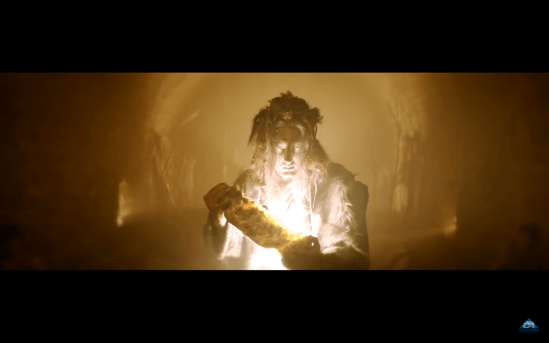
Without a better way of putting this, there’s much to demerit against “Devil’s Revenge.” The concept is sound: a disarrayed and browbeaten archeologist must locate an evil transmitting relic from destroying his family with a everlasting demonic curse. Sounds good, right? Combine that with Shatner blasting demons to smithereens with a multi-barrel grenade launcher, the potential for a solid and fun viewing experience would be a no-brainer. However, what’s sold is the made in China version of what’s being marketed. Hard to imagine Maurice Hurley’s, the man who helped re-pioneered space exploration and developed The Borg adversaries, script was so out of whack and had gone into various limp curvatures that I don’t expect all blame should point to him for the posthumous misstep as the direction is emphatically coarse and incoherent of too many ideas without any connective tissue much unlike boldly going where no man has gone before. In fact, many filmmakers have gone this route before by taking all sense of a rounded script and dissolving it the way Cohn does. The path Cohn ultimately takes is to splice loads of unnecessary and repetitive flash backs into the story to try and retain into viewers over and over again the events that conjured hell’s minions to surface. I’m sure we saw the same scenes at least five or six times from beginning to end, even during the opening credits. There’s also a looseness about how this curse attaches itself to John’s family from long ago that inexplicably goes without being conveyed and we find ourselves asking, why these people? What have they’ve been suffering through all these years? What makes them important? The curse seems rather recent rather than historic and for John’s family legacy to go uncharted just poses too many unanswered questions. What’s fundamentally right is Inan, the head demon, who represents the best parts of the “Devil’s Revenge’s” netherworld rock and roll presence with a large and ghastly humanoid with blank, fiery eyes and a protruding clasping mouth and the visual effects surrounding Inan are pretty good despite their some minuscule glossy bad aftertaste. An aftertastes that extends into Shatner using the grenade launcher with the goofiest of detonations in an unrealistic distance between him and his targets without so much of a single piece of shrapnel grazing his well postured gun-toting stance.

MVDVisual distributes “Devil’s Revenge,” a Cleopatra Entertainment production, onto a region free, special edition Blu-ray and soundtrack CD combo. The Blu-ray is presented in a widescreen, 2.78:1 aspect ratio, in a BD-25 with a 1080p transfer. “Devil’s Revenge” implores more than the natural lighting used through much of the 98 minute runtime and while natural lighting isn’t a flaw in any sense, Ryan Broomberg’s cinematography falls flat, uninspired that doesn’t represent well the presentiment eventualities past, present, or future. Technically, “Devil’s Revenge” isn’t soft around the details albeit minor banding in closer quarters of the cave. Practicality versus the computer imagery really do go head-to-head between Vincent Guastini’s (“Art of the Dead”) special effects and the visual effects team of Eric Chase (“The Black Room”) and Mike Rotella (“The Predator”). The detailed rubber body suits and the composited explosions akin to the military hellfire creatures were bombarded with in monsters movies from the 50’s are of the campy independent film culture and purgative of any expectations of the Devil actually making good on revenge. The English language Dolby Digital 5.1 surround sound audio is not as lossy as the usual Cleopatra Entertainment Blu-ray releases and certainly regales with the theatrics of a William Shatner monologue (can’t you tell I love me some Shatner). Range and depth are concurrent appropriate with each other and dialogue is clean and clear. Surprisingly and rarely does a Cleopatra Entertainment releases goes without a soundtrack intertwined with the score that contracts their signed artists from parent company Cleopatra Records; instead, we receive a brooding industrial score composed by Jürgen Engler, co-founder of German punk band “Male” and “Die Krupps,” which can be gorged on as the film’s coveted silver-lining. Luckily and conventionally for a Cleopatra special edition release, an un-cursed 13-track CD of Jürgen Engler’s score accompanies the feature Blu-ray. That being the height of the special features, other bonus material includes a picture slideshow and theatrical trailer. “Devil’s Revenge” won’t shudder your bones to milky pigments of sawdusts and will likely strikeout with fans, as perhaps the Devil’s actual revenge for portraying him so ill-conceived. Still, I suggest checking out the Jürgen Engler’s gnawing and insidious industrial score, a gleaming highlight for sure.

Check it out for yourself! “Devil’s Revenge” on Blu-ray.


Sanities Dissolve in a Concoction of EVIL! “Ladyworld” reviewed!


When a catastrophic ecological event traps eight teenage girls celebrating a birthday inside a house, they find themselves at the mercy of limited resources and with no adult supervision. With every window and door inescapably blocked, being trapped isn’t the only obstacle that looms over their adolescent minds when factions begin to form between sane and insanity as their cache of already scarce food and water quickly dwindle. Before her eventual disappearance, the birthday girl spoke of seeing a man attacking her right before the destructive shaking that left them befuddled. The remaining girls quickly line their thoughts in various ways from either spiraling out of control and embarking on a psyche control measure to deal with the haunting information or accepting the information and use it as a fear inducer for power. One-by-one, fears are exploited and minds are broken down to their most hostile and primal qualities that rapidly become an epidemic to those still in the realm of reality.

To preface director Amanda Kramer’s “Ladyworld,” there’s little background exposition or visual representation to really set the stage of psychological deterioration. The 2018 thriller can be said to be a modern, all-female take on the William Golding 1954 novel, “Lord of the Flies.” Produced by Pfaff and Pfaff Productions as well as A Love and Death production film, “Ladyworld” is essentially female centric and comes close to being true to form to its title in front and behind the camera with the debut feature directorial from Amanda Kramer. The script was also co-penned by Kramer and Benjamin Shearn. “Ladyworld” is credited as a festival circuit novelty with institutions such as the TIFF New Wave, BFI London, and Fantastic Fest, but “Ladyworld” is also novel in another way as in a doppelganger representation of Amanda Kramer herself as a filmmaker who sincerely believes in art house expressionism.

While all the actresses involved, portraying eight teenage girls, are spectacular in their own rite or as a pack, one particular actress stands out above the rest in name alone and more recently because of her debut in a popular science-fiction-horror Netflix series set in the 1980’s. Yup, “Stranger Things’” Maya Hawke, daughter of Ethan Hawke and Uma Thurman, has a co-starring role that elicits the use of her usually charmingly raspy voice into a gasp of unnerving bellows amongst her colorfully expressive mental deprivations. Yet, Hawke’s role, though equally headlined, seems more supportive against musician and television actress Ariela Barer and “Quija: Origin of Evil” actress Annalise Basso as the two teenage girls that consistently butt heads to jockey for leadership. The tension created between Barer and Basso is plumed unanticipated friction and is about as wild as any unpredictable scenario can muster. The last prominent character, the introduced unstable Dolly, has familiar parallels Ryan Simpkins’ Fangoria Chainsaw Award nominated performance in the also predominated all-female film, “Anguish,” from 2015. Simpkins trades in supernatural crazy for disastrous crazy as a teenage girl with a penchant for adding ten years her junior. Together, alternate and combative personalities fluctuate the proceedings, marking “Ladywold” unpredictable from not only Amanda Kramer’s broad-minded expression stance but also in solitary performances manage to flow as one. Rounding out the cast is Odessa Adlon, Tatsumi Romano, and Zora Casebere.

“Ladyworld” is an interesting experimental film and, unfortunately in this opinion, that’s about as far as this film might top in a market filled with visual pops, depth performances, and something new and shiny at every angle and turn. “Ladyworld” comes off a bit monotone to the preceptors in a flat line of congealed, unwavering tension from start to finish, despite coming to a head. Structurally, Kramer frames their environmental entrapment with just enough to make their plight more feasible without having to visually showcase it; the assumption, in one interpretation, is a Californian earthquake that resulted in a landslide that blocks all the windows and doors with hundreds, if not thousands, of pounds of pressure against the opening. Though this is only one interpretation of events, Kramer is very good at cascading the effect into being much more dire by reminding us that no sires can be heard, cell service has ceased, and all hope is lost within the limited space their held. That kind of compelling of the unknown and cerebral warping uncertainty is quite alluring, but that gripping element is not found equally invasive throughout.

MVDVisual and Cleopatra Entertainment has positive womenism vibes with Amanda Kramer’s “Ladyworld” being released onto DVD home video. The 94 minute presentation is in a widescreen, 16:9 aspect ratio format that leans conveying more to a bland and flat coloring scheme. Essentially faded, no pops of primary hues are implemented as if to devoid all hope from a helplessness scenario. Details are a bit fuzzy too resulting from an aliasing issue or jaggies around the outer edges of things. Usually with Cleopatra Entertainment releases, lossy audio tracks have been rearing their ugly heads which would cause many questions marks with reviewers familiar with Cleopatra Entertainment as its a sublabel to Cleopatra Records – a Los Angeles-based independent record label, but with “Ladyworld,” the English dual channel audio tracks is rather robust with accompanying range and depth. However, the Callie Ryan experimental acapella instrumental can be nails on a chalk board that, again, sets a gloomy tone that consistently punches you in every perceivable sensory organ. Bonus features are slim, including an image slideshow and the theatrical and teaser trailer. “Ladyworld” has niche appeal, but Amanda Kramer and crew really put themselves out into the cinema-verse with style and performance to ultimately deliver a surreal and frightening tapestry of the unhinged and underdeveloped teenage psyche.

Own Amanda Kramers all female casted “Ladyworld!”

Make a Deal with EVIL, EVIL Will Come Calling! “The 27 Club” review!


Kurt Cobain. Robert Johnson. Amy Winehouse. Jim Morrison. Jimi Hendrix. All these recording superstars have one tragic thing in common: their fame engrossed lives ending horribly, sometimes violently, at the young age of 27 at the height of their careers. Their deaths are a part of an elite group called the 27 Club that incorporates effervescent celebrities from all walks of fame. When another popular rock star ends up mysterious deceased a night after his concert, the same concert that student journalist Jason attended, the eager academic finds himself at the right place, at the right time while researching and documenting the notoriety of the 27 Club. While hallowing out the club’s infamy, Lily, a wild and struggling musician, enters his life on a connective collision course toward his research that evidently surrounds itself around an ancient Latin-based text. The book is binding to those seeking rock star status in exchange for their souls and with a steep decline in her musical career, Lily provokes satanic rituals with exploiting help from the love struck Jason, but the only thing Lily didn’t count on was her unexpected love for him back.

The actual 27 Club lore continues to be an interesting notion. A curiously notorious concept that flew under the radar for this reviewer up until happening upon and diving into the Patrick Fogarty’s written and directed soul-bargaining tale regarding the idea’s parameters as the film’s foundation. Fogarty, the staple music video director for bands such as Black Veil Brides and The Burning of Rome, tests his hand at satanic, soul-swallowing horror, simply titled “The 27 Club,” for Cleopatra Records cinematic sub-division, Cleopatra Entertainment, and is co-written a mythos script alongside “Clownsploitation’s” Joe Flanders and Michael Lynn. Even if nothing more than a freak coincidence, Fogarty processes an innovative take on the 27 Club that has spanned over century and, perhaps, provides a little education and knowledge to those outside the music industry.

Many iconic rock stars rise from the grave to spit philosophical truths and knowledge, constructed as miniature prologues of a chaptered story, intertwined with a relatively unknown cast beginning with headlining leading lady Maddisyn Carter as the toiled Lilly seeking refuge in any drug or sexual partner her beautiful disaster can ensnare in a world of deaf tone destruction. Her character is intended to be refracted by the introduction of the 27 Club research journalist, Jason (“Mutants'” Derrick Denicola), who just happens to be around when another musician kicks the proverbial bucket, but Carter maunders through the relationship with Jason and unable to materialize compassion, losing any slither of internal conflict Lilly may possess. Todd Rundgren, Cleopatra recording artist and a member of the progressive rock band, Utopia, headlines polar opposite of Carter on the cover of the home media release only and not as a chief player in this possession plot. The role downsizes his long legacy in the music biz and though a small role and acting isn’t Rundgren’s first love, the rocker tops as being one of the film’s better moments as a record store wise-guy patron doing the right thing and a creepy video-chatty music professor. “The 27 Club” tortures the cast of remaining souls with Adam Celantano, Kali Cook (“Victor Crowley”), Zack Kozlow (“Devil’s Domain”), Mr. Chromeskull himself Nick Principe (“Laid to Rest” and “Chromeskull: Laid to Rest 2”), Jason Lasater (“Death Tunnel”), Zach Paul Brown, Emily Dalquist, Eugene Henderson, wrestling superstar John Hinnigan, Gogo Lomo-David, Tasha Tacosa (“Halloween Pussy Trap Kill Kill”), and, my personal favorite, Killjoy’s Victoria de Mare!

Novel backstory might be one thing, but a comprehensively sound one is another and while “The 21 Club” begins like a John Carpenter cask of embolism-depth imagination and beguiling, if not apocalyptic hinting, descent into oblivion, Fogarty’s film collapses when Lilly and Jason seek out a couple of drug dealers to understand the book’s portentous contents. Conveniency and rushed theatrics push a scene-to-scene overhaul that forgets to breathe and come up for air, losing that dramatic, dire consequence associated with a thriller. No consequences steep the pot to forge a luxury of sympathy or any type of relation toward the characters. Jason and Lilly’s dynamic was hot and cold at best and why Lilly kept Jason around after learning of his possession of the book is a complete mystery. The exposition isn’t conveyed properly in this instance and their coupling wipes on a thin wave toward the finale. There’s also the common motif of a sex tape – Jason records his and Lilly’s sexual encounter after a night of clubbing and Lilly’s record producer explicitly states if there’s a sex tape out there that might risk damaging her career – and then that information goes dark, nothing but crickets to line an explanation to why her sex tape would be important to the story. If a stipulation of her fame agreement with the reaper was to not lie or become involved scandalously entangled, the sex tape would be the perfect real world-relating catalyst that fully encompasses the fame-to-fallen storyline.

Cleopatra Entertainment and MVDVisual release a sweet, multi-format package perfect for home entertainment of Patrick Fogarty’s “The 27 Club.” The all region DVD/Blu-ray combo set also includes the compact disc soundtrack to the movie that features music from Todd Rundgren featuring NIN’s Trent Reznor and Atticus Ross, plus Die Klute, Bestial Mouths, The Anix, Jurgen Engler and more. The full HD, 1080p Blu-ray, which was viewed, is presented in a 1.78:1, widescreen, aspect ratio. The 97 minute digitally shot film has a wonderful color palate that often shutters from natural tones to one or two-toned primary color filters with also a desaturated approach to the 27 Club’s most recognizable members conducting a foggy room soliloquy. Banding issues have noticeable effects in various stages of darker scenes, especially surrounding a humanoid figure. The English language Dolby Digital 5.1 surround sound has insignificant bite through the multi channel conduit that denotes continuous issues with Cleopatra Entertainment’s home video releases. With a recording penchant for talent in the music industry, the expectation is high in delivering bombastic results flowing from one through five and presenting a singular comprehensive result, but the range and depth lack beside the powerhouse release and instead, find more solace in the third format of a traditional CD soundtrack content with great musical contents. Bonus features include two interviews with the film’s stars, Maddisyn Carter and Darrick Denicola, slideshow, trailers, and of course, a CD soundtrack all underneath a slipcovered jewel casing. “The 27 Club” spins a concoction of malediction around historical tragedy that’s more heinous hoopla and than harrowing horror and while the release bursts with razor sharp teeth and high pixelating resolution, channelling all the material rudimentary didn’t stay glued together in the end, hurting the character progressional arch and thinning out the hair-raising filament.

Pre-order “The 27 Club” available June 11, 2019!

Evil Isn’t Home. “Death House” review!


Top law enforcement agents, Boon and Novak, achieve special access through steep sacrifice during job assignments and are permitted to tour their upcoming placement in the highly exclusive Death House, the ultimate maximum and multi-level penitentiary home to the nastiest criminals known to society and the deadly threat to mankind in a metaphysical way. Death Houses uses virtual reality to keep inmates stimulated to the point of calm submission as well as drugging the homeless and the unwanted to supply killers with victims upon victims in an their personalized virtual surroundings, but when an outsider uses an EMP to knock out all power within the facility, the cages are open and the ruthless animals are free to overrun, beating to death the guards and staff. Boon and Novak must fight their way to the bottom level that hold the Five Evils, criminals with grotesque supernatural abilities and a wickedly grisly past, where the two agents believe the Evils are their best hope for survial against a Five Evils acolyte named Sieg and his faithful jailhouse followers.

Considered as “The Expandables” of horror, “Death House” had gained almost instant fandom solely from the long-list of horror icons in the cast. Director B. Harrison Smith (“Camp Dread”) re-writes most of Gunnar Hansen’s original “Death House” story produced by Cleopatra Entertainment and Entertainment Factory. Cleopatra Entertainment is more notably a music label that has delved into films the last few years and, in my opinion, haven’t faired positively in the horror genre, but “The Texas Chainsaw Massacre” star fought tooth and nail to try and get his script off the ground, even in the face of death. “Death House” saw release after Hansen’s death, but from interviews with the filmmakers, Smith had almost totally revamped the original treatment, leaving The Evil’s at Hansen’s request if his script was to be entirely cleaned. Shot right in this reviewer’s backyard of Philadelphia, Pennsylvania at the historic Eastern State Penitentiary, the defunct prison is an ideal location as the “Death House” due in part to John Haviland’s separate cell design and gritty appeal that was once of the home of Al Capone, but more of the focus is on the interior than exterior with green scenes and Los Angeles shots constructing the story-lined scenes.

Like aforementioned, “Death House” has been called the “The Expendables” of horror. An immense, if not soaked, cast of horror fan favorites are peppered about around the main characters of Agent Boon and Novak. “Sushi Girl” and “Zombeavers” star Courtney Palm embodies the Agent Boon character with G-man toughness, but finds difficulty leaving that b-horror mentality with shakiness in working climatic scenes. Palm’s also roped into doing an extremely gratuitous shower scene with Cody Longo (“Piranha 3D”) as Agent Novak. Novak’s a hotshot and Longo has the looks and the talent to out perform his character, but Smith’s script doesn’t do justice to either Boon or Novak’s character that blatantly underwhelms their performances with cameo star power and a shoddy narrative. Dee Wallace (“Cujo”), Barbara Crampton {“Re-Animator”), and Kane Hodder (“Jason Goes to Hell”) have prominent roles that are pertinent to the story and are enjoyable to see them in more of a supporting capacity. Andrenne Barbeau {“The Fog”), Sid Haig (“The Devil’s Rejects”), Vernon Wells (“The Road Warrior”), Bill Moseley {“The Devil’s Rejects”), Lloyd Kaufman (Mr. Troma), Michael Berryman (“The Hills Have Eyes”), Tony Todd (“Candyman”), Sean Whalen (“The People Under the Stairs”), Debbie Rochon (“Killer Rack”), Bill Oberst Jr. (“Deadly Revisions”), Felissa Rosa (“Sleepaway Camp”), Danny Trejo (“Machete”), Tiffany Shepis (“Abominable”), Brinke Stevens (“The Slumber Party Massacre”), Camille Keaton (“I Spit On Your Grave”), Gunnar Hansen (“The Texas Chainsaw Massacre), and R.A. Mihailoff (“Leatherface: Texas Chainsaw Massacre”). Whew. Rounding out the remaining cast is Lindsay Harley (“Nightmare Nurse”), Vincent M. Ward (“The Walking Dead”), and Bernhard Forcher.

While the genre star-studded ensemble cast is a wet dream for horror fans, “Death House” fails in numerous filmmaking categories with the first being the most important, the script. Smith’s re-work of Hansen’s original story requires another drastic once-over, or two, as the final result attempts to push, stuff, and cram 100 lbs of multi-subgenre elements into a 10 lb, inflexible bag, cramping the ambitious project with dis-connective storyline tissue braced together with shoddy visual effects, like the two agents free-falling down a bottomless elevator shaft and able to precisely shoot their targets on each level. The overall result of “Death House” just endures an unfinished varnish and seems slapped together with pre-schooler glue and claggy spit. Singular moments surface as diamond specks amongst cubic zirconias, like the Mortal Kombat fatality-esque practical effects, but are too far and in between to muster up an enjoyable film. The Five Evils definitely and desperately needed more presence in the story instead of just flexing the talking heads muscle; well, the only two Evils to say anything at all were Bill Moseley and Vernon Wells. The Five Evils didn’t quite have that oomph to be a force to be dealt with as Gold-described beings who philosophical interpretations on the concept of good and evil.

Cleopatra Entertainment and MVDVisual present B. Harrison Smith’s long-anticipated “Death House” onto DVD home video. The unrated, all-region DVD is presented in a widescreen format that displays some frayed flaws like contrast; there’s way too much inky black in the dark scenes and little-to-no definition in more visible sequences. The compression suffers from blotchy artefacts at times too and lacks hues, which works with the gritty tone inside the Eastern State Penitentiary’s decomposing walls of rubble and decay. Visual effects are glossy with virtually no textures to give detail or, essentially, life amongst the continuous death. Bonus features include multiple interviews with director B. Harrison Smith, Courtney Palm, and more. Also included is a behind-the-scenes feather, a gallery slideshow, and theatrical trailer. Despite being true to the title and highly anticipated since it’s inception into the public market, “Death House” ultimately disappointments as an unfurnished mess enlisted with big names in the horror domain that’ll unfairly sell the film on it’s own, but all-star cameos won’t establish “Death House” as a solidified cult favorite, being unfortunately one of the biggest release flops of 2018.

Evil Lusts, Stimulates, and Impregnates! “The Black Room” review!


Paul and Jennifer Hemdale snag a great deal on their dream home withstanding an ugly past considering the previous homeowner who disappeared without a trace and a woman ending up badly burned. Despite the stigma surrounding the house, the Hemdales vow to turn their first home into a marital love nest, but every instance in which one of them is ready to break in the new home underneath the sheets, the other falls flaccid, as if something is keeping them from making love. Beneath the first floor, in the darkest part of the basement, there lies a locked black room with ritualistic pagan writing sprawled inside every wall, floor, and ceiling surface and an demonic incubus, lying in wait for the perfect opportunity to reinstate a master plan to take over the world. When Paul becomes a host for the incubus, the body count rises when repairmen, friends, and family come calling to their home and Jennifer must discover what’s causing her husband to act like a perverted jerk before she too falls into the incubus’s malevolent grip.

“The Black Room” mixes dark demon humor with perversions in a butt-cheeky horror comedy written and directed by Rolfe Kanelsky, whose credits in “Nightmare Man” and “Emmanuelle 2000: Emmanuelle’s Intimate Encounters” have sure to have aided in the director’s seamlessness in blending an erotic tone with an aggressive horror element. Kanelsky’s cavalier approach to the 2016 film, “The Black Room,” hints at the Sam Raimi approach with the unexpected and the bizarre mischief of the demon and a violin heavy folk-artsy soundtrack style with jump scare after jump scare techniques, but without going full blown with “The Three Stooges” antics as Raimi is well-known to implement. Instead, Kanelsky’s far more subtle and isn’t afraid to be verbally pun awful, even during more positionally vulnerable scenes involving actresses. Whereas most horror films uses horror as an exploitative tool or an ultimate means to be hacked to pieces, “The Black Room” transforms nudity, and sex, into a running joke much like a Troma production would gravitate to, with “Tromeo and Juliet” being a prime example, and then punch the joke into hyper drive by either being overly gory or ridiculously impractical.

In all honesty, “The Black Room” is the second Cleopatra Entertainment title reviewed at Its Bloggin’ Evil, with the first being a clunky deal-with-the-Devil thriller entitled “Devil’s Domain” by director Jared Cohn, but Cleopatra’s latest entry into the demonic hierarchy enrolls more star power to provide legitimacy in the horror realm by casting horror hall of famed actress and “Insidious” series star Lin Shaye as the snarky previous house owner with a dwelling secret and as well as “Species” series and “Ghost of Mars” actress Natasha Henstridge as the lovely Jennifer Hemdale. Shaye’s dedication to any project, big or small, places the four-decade-careered actress as a beacon of hope for the indie project and Henstridge, still oozing that blonde bombshell of sexiness image, is the proverbial cherry on top. Shaye and Henstridge bare a heavy cast presence without having to bare much skin, but there’s a fair amount of nudity to behold from actresses Augie Duke (“The Badger Game”), Jill Evyn, Alex Rinehart, cheesy horror goddess and “Killjoy” actress Victoria De Mare, and a full frontal nude debut by Milena Gorum in her first credited film. When you’re done ogling over the female roster, a tall, baritone voiced Lukas Hassel illuminates as the sleazy parasitic host of an sex-crazed incubus, embracing every tall, dark, and handsome aficionado to dream of Paul Hemdale in a variety of gore-raunchy segments while maintaining a straight face about the filth that seeps from his character’s mouth. Rounding out this cast is a “Skarkansas Women’s Prison Massacre’s” Dominique Swain as the film’s third headliner on the Blu-ray cover and intro credits, one of my personal favorite supporting actors James Duval (“Cornered!”), Caleb Scott, Robert Donovan, and with genre favorite Tiffany Shepis.

While the story’s nuts and bolts of “The Black Room” consists of demons, possession, and world domination, lots of sex, sex talk, and sexual situations litter every scene. Yes, the demon is an incubus and by very definition of the term, a demon who makes sexual advances on women while they sleep, whole-heartedly defines the amusing premise. Maybe with Kanelsky’s background in softcore erotica, sex comes second hand and writing all the associations with the act is easier for the filmmaker who installs both main characters, Paul and Jennifer, with an insatiable sex drive from beginning to the end. Even with side characters untarnished by the incubus’s powers, such as the perverted water heater repairman, become a slave to the story’s grossly sexual tension. Now, I’m not complaining, but the continuous play on sex is odd without the slither of a moral growth. After all is said and done and the characters walk away from a deadly supernatural cluster-you-know-what, neither Paul and Jennifer progress, knowing nothing more from when they first started, and plateau to a level right from the start when first purchasing the dreadful dream home.

Cleopatra Entertainment and MVDVisual present “The Black Room” on a region free Blu-ray with 1080p on a 2.39:1 aspect ratio. Coloring is everything and the range of hues in “The Black Room” vividly crisp off the screen and the filter lighting smoothly goes unnoticed when sudden changes from natural to red flare up. For most of the 91 minute runtime, a clean image plays out a levelness throughout, but film grain presents itself in last moments of said titular room and the digital effects are gaussian soft that it’s penalizing. The English Dolby Digital 5.1 mix has a compressed audio that’s not up the spec when considering Cleopatra is a major record label. The dialogue is clean and prevalent, but sorely soft at times with ranges between ambient, soundtrack, and dialogue fluxing more on the lower volume totem poll rather than being beefy and in charge. Audio is passable, being free from damage and distortion, but a little more range would do this demon dance some justice. Bonus material includes commentary with director Rolfe Kanelsky, star Natasha Henstridge, supporting actor Augie Duke, and producer Esther Goodstein, a slew of extra and extended scenes, a severely anemic behind-the-scenes short, a brief blooper reel, slide show, storyboards, and the film’s trailer. When considering between the two demonically-charged Cleopatra Entertainment productions “Devil’s Domain” and “The Black Door,” there’s no contest as the latter is technically a much better film and a lot of fun to watch and sure to be every gore and sex-hound’s wet dream with titillating special effects, especially with an invisible entity seducing a sleeping Alex Reinhart with a major titty-twister, and a dark sense of humor of unholy pleasure.

“The Black Room” on Blu-ray!