
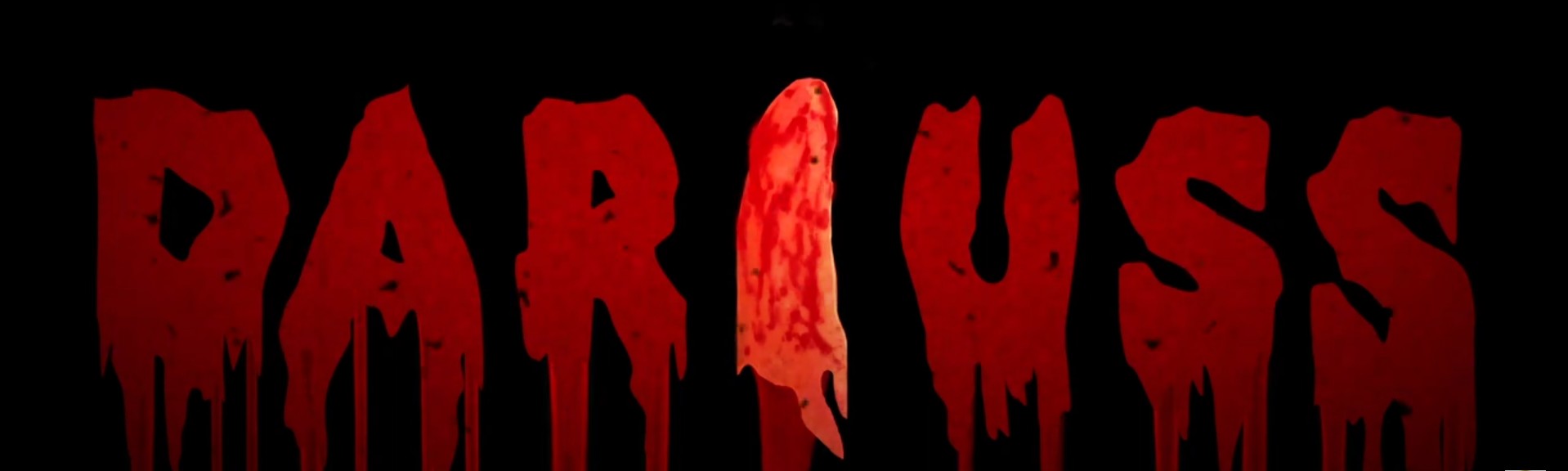
Find Out Who “Dariuss” Is With this SRS Release!
An experimental vision quest of loss, grief, and death takes refuge in a small English town, inside an old and quaint English house. A mother grieves for the loss of her child, sobbing uncontrollably and mindlessly wanders with distant stares as the heart pains for her child. The grandmother, doing what she can, comforts her daughter’s newfangled distraught nature while the husband, grieving in his own isolated way, stays out late at night to drink himself into a stupor. When madness lurks about their home and intrudes upon their privacy, a vile and heinous loss of life bathes a depraved lunatic in their fluids. Neither mother, father, nor grandmother is safe from terrific travesty in corporeal form. A sickness has arrived to cure the inconsolable, eradicating them slowly of the pain in the most painful of ways imaginable, and doing it all with a bloodstained maniacal grin stretching from ear-to-ear.

A hellish loop of defeating pessimism, “Dariuss” fringes the black void areas around reality and escapism that evoke the uncomfortable nature of people and the unpredictable tides that turn for the worst when already at rock bottom. “Dariuss’s” brackish, brainsick narrative is the brainchild of Guerrilla Metropolitana, an Italian artist crafting his underground and dark cinemaverse of misanthropic mayhem and esoteric eroticism. The writer-director Metropolitana lives and creates out of London, UK and “Dariuss” is his 2023, debut feature-length film behind an oeuvre of distressing shorts of human imperfection and immortality encroached by a constant line of madness. Metropolitana not only self-funds and produces his film, where he achieves total control to push back against not only major studio norms but also conventional independent stratagem, but provides the avant-garde cinematography, unorthodox editing, an experimental score and sound design, and even costars the trench coat covered naked body of the antagonistic killer.

One element to not forget to mention before going through the cast is that “Dariuss” is completely without dialogue. Metropolitana’s sound design manipulates and repeats many sound clips, such as the plops of water droplets or the high-pitch lip trilling, to fashion an uncomfortable audio sensation sporadically strung throughout that parallel’s the coupled low tumbling score and baby laughter, the later more so when referring to child loss or the abhorrent reincarnation of the child. Ila Argento holds the majority screen time, especially since the pregnant woman credited as Sarah Isabèl is also Argento as well in some sort of meta crafting or illusion, and she plays the grieving, depressed wife wailing, screaming, and just distantly starring in vast quantities and in a daze of mirrored or painted inversions about the English home. “Dariuss” is more than just extreme performance art as it embodies interval wretchedness associated with trauma, or in this case more specifically, loss through a reverse world looking glass. As the wife is tended to by the grandmother, played with apneic conditions and posturing concern is Marie Antoinette de Robespierre, Archibald Kane’s the husband role is scantily around for a father who just lost a child and when the father is in frame, he’s idling in his car drinking, or rather gulping, from a bottle. Both the grandmother and father roles are a part of Metropolitana’s message of a shattered family structure of insincerity and disconnect. Feeding on that dysfunction is the childlike maniac, played by Metropolitana himself, with rapacious amusement off the back of the household’s suffering. Almost as if the maniac is a reincarnation of the lost child, perceived by play like antics in a nearly naked and hairless state and audible by the babylike, post-introduced laughter, returning home to exact horrific horseplay on his family involving rape and murder and cannibalism alongside the frolicking and breast milk chugging.

Let’s preface with an important fact that “Dariuss” will not be everybody’s cup of tea; in fact, Metropolitana’s film is more like bitter black coffee with a pungent, sour smell as a narrative series of images, like a splayed, taped together string of polaroids, giving godawful glimpses of grief and gore. Sounds and images repeat that beg for madness to emerge out of the nouvelle vague filming style, experimenting with various inverted images, mirrored and angled shots, different types of aged filters and strange lighting, various camera speeds, and oddly framed shots will subject audiences to pricklier sensory sensations than the depicted violence and gore, which is graphically ghastly and extreme with necrophilia and cannibalism. Story structure also veers into non-linear territory but the gist of the acts is present, if not loose and equivocal for open interpretation and choice cinema characteristics that stray from normal convention, to mold a beginning, middle, and end in only a way Metropolitana can construct by contrasting melancholic grief with stagnating indifference, with a maniacal pleasure of a sandbox of sinew, and, in way, comical by way of the insanity with disturbing imagery mixed with playful mischievousness.

Just who is Dariuss? That’s the obstruse person perhaps at the centermost of this ghastly, grisly story that’s now on DVD from SRS Cinema as a part of their Extreme and Uncut label. The DVD comes MPEG2 encoded, 480p standard definition, 5-gigabyte DVDR that showcases a wide-range of filters, inversions, lighting designs, grading, and you name it, “Dariuss” likely did it of cinematography techniques that stay in the rough patches of eccentricity rather than being comfortable in the fairways. Picture quality fluctuates and varies depending on the aesthetic chaos methods being deployed, leaving behind not the sharpest looking picture with noticeable pixelation on anything above a 32″ television but not enough of an eyesore to be an imperceptibly deterrent. Depth has fair spatial qualities but range and saturation is pretty limited to an anemic neutral palette to only when the monochrome or higher contrasts are not in play. The LPCM 2.0 stereo contains no organic matter, meaning that none of the sound is captured within the scenes, as Metropolitana modulates, manipulates, and modifies singular notes and tones for creepy and ear-splicing effect. This also pertains to the soundtrack being completely devoid of dialogue to give the auteur complete authority of how his film she be heard and every bit of that sound design is front loaded and high-powered but to an intended unrefined audio art. English captioning for the deaf and hard of hearing is available. Special features encoded are a behind-the-scenes still gallery and SRS trailers while the standard Amaray comes with an SRS illustration of the film’s original one-sheet, transposed to the disc pressing. There are no inserts included nor slipcover. SRS Cinema’s release is region free and has a runtime of 62, ideal, or even a tad bit too long, for this type of experimentation.
Last Rites: Not to be confused as a nail-biting, popcorn thriller, “Dariuss” will only speak to a select few able to bend the mind to impressionistic, dark eroticism and savagery, both qualities of which Guerrilla Metropolitana has and depicts in droves.
 It's Bloggin Evil!