Invincible-Seeking EVIL Loves to Hide Behind Strip Clubs! “Decadent Evil 2” reviewed! (Full Moon Features / Blu-ray)

The Sequel “Decadent EVIL II” Bites Hard! Check It Out!

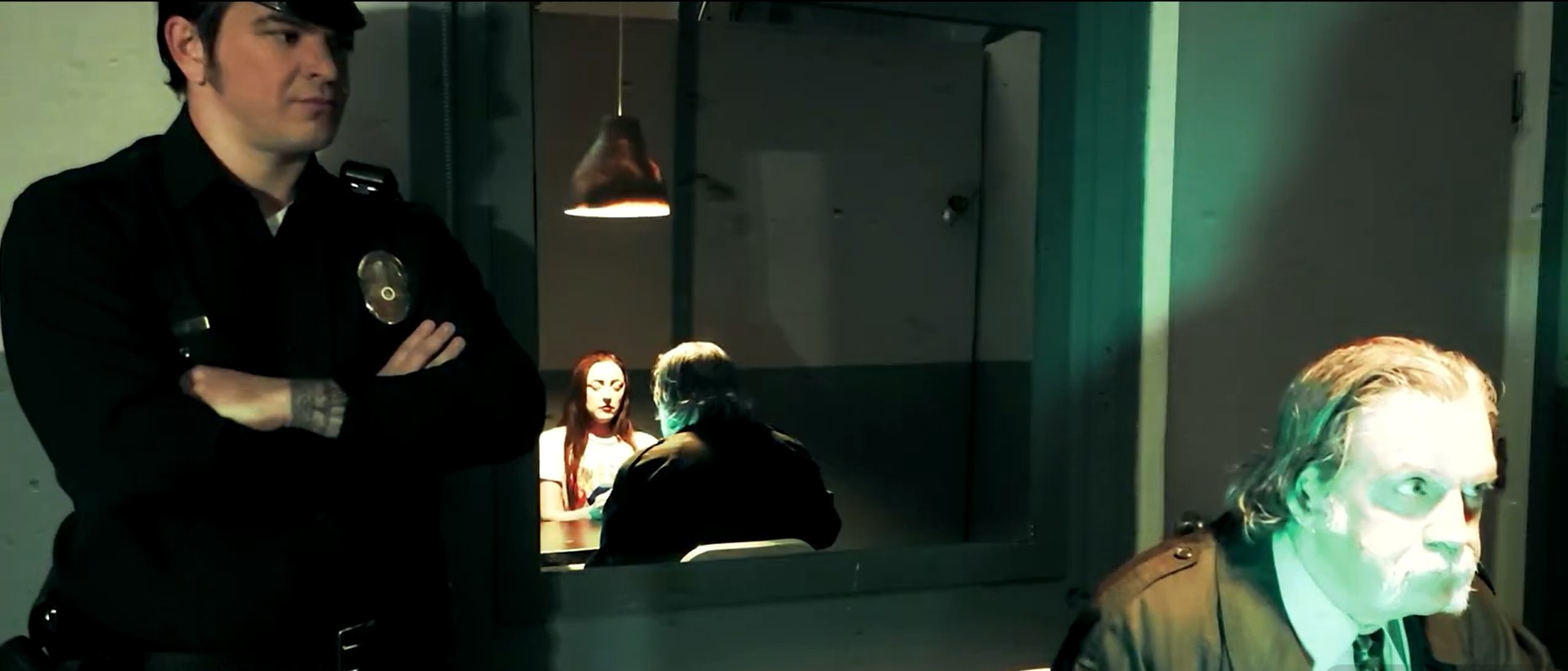
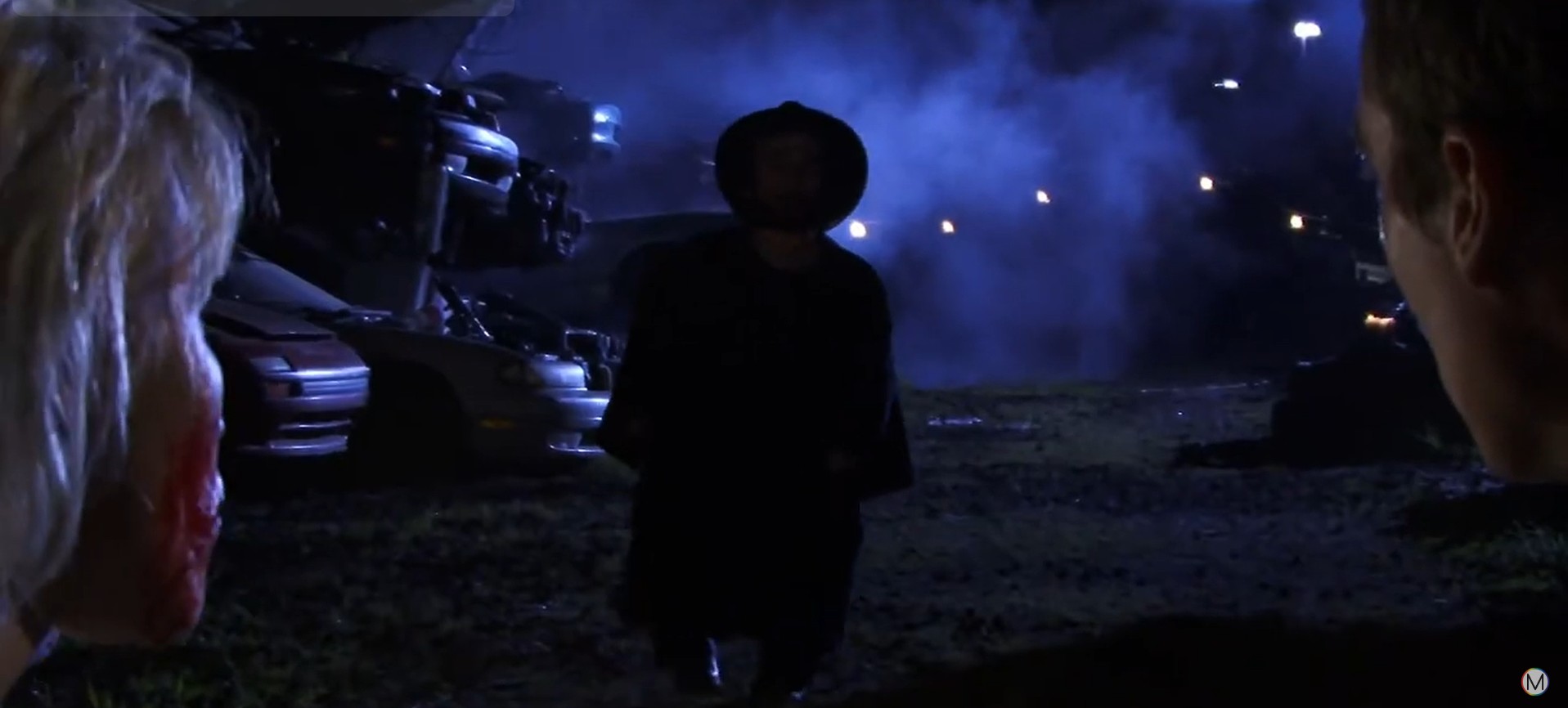
After barely surviving Morella, Dex and Sugar, along with carrying around the homunculous Marvin, traverse across the country to find a vampire master.  Their plan is to take a drop of his blood needed for a resurrection ritual to bring vampire hunter and Marvin’s son Ivan Burroughs back to life after sacrificing himself to stop the deadly, megalomaniac Morella.  Ivan’s golden tracking cross brings them to midwestern gentleman’s club full of possible seedy suspects as the master vampire – the vampiric-attributed club owner Janos, the stern and scary club manager Burke, or even the club’s beautiful top dancer Lena are all suspects.  To uncover the master vampire, Dex and Sugar work their way to being hired at the club in order to snoop around.  Meanwhile, dancers and customers are winding up dead nearby.  As the investigation continues, Dex, Sugar, Marvin, and even the undead Ivan must work together to find the master vampire and stop him from continuing what Morella started. 

“Decadent Evil II” is a direct sequel to the 2005 original that returns Full Moon founder Charles Band (“Puppet Master”) to the director’s chair and writer Domonic Muir to pen the follow-up.  Same vampire tricks, more topless strippers, and a ragtag team of vampire trackers has this 2007 subsequent feature feel like a heel biter by keeping the story going without a lot of time lapsed.  Band retains his personal interest in pint size creatures and nude women in the sequel while keeping costs down as much as possible with limited locations and special effects fields filled in mostly with strippers doing their routines in between.  Band also returns as producer alongside Bill Barton (“Blood Forest”) and Joe Magna (“Dangerous Worry Dolls”) with James Synder, Jon Morrey, and Dana K. Harrloe serving executive producer under Band’s Wizard Entertainment, now Full Moon Productions.

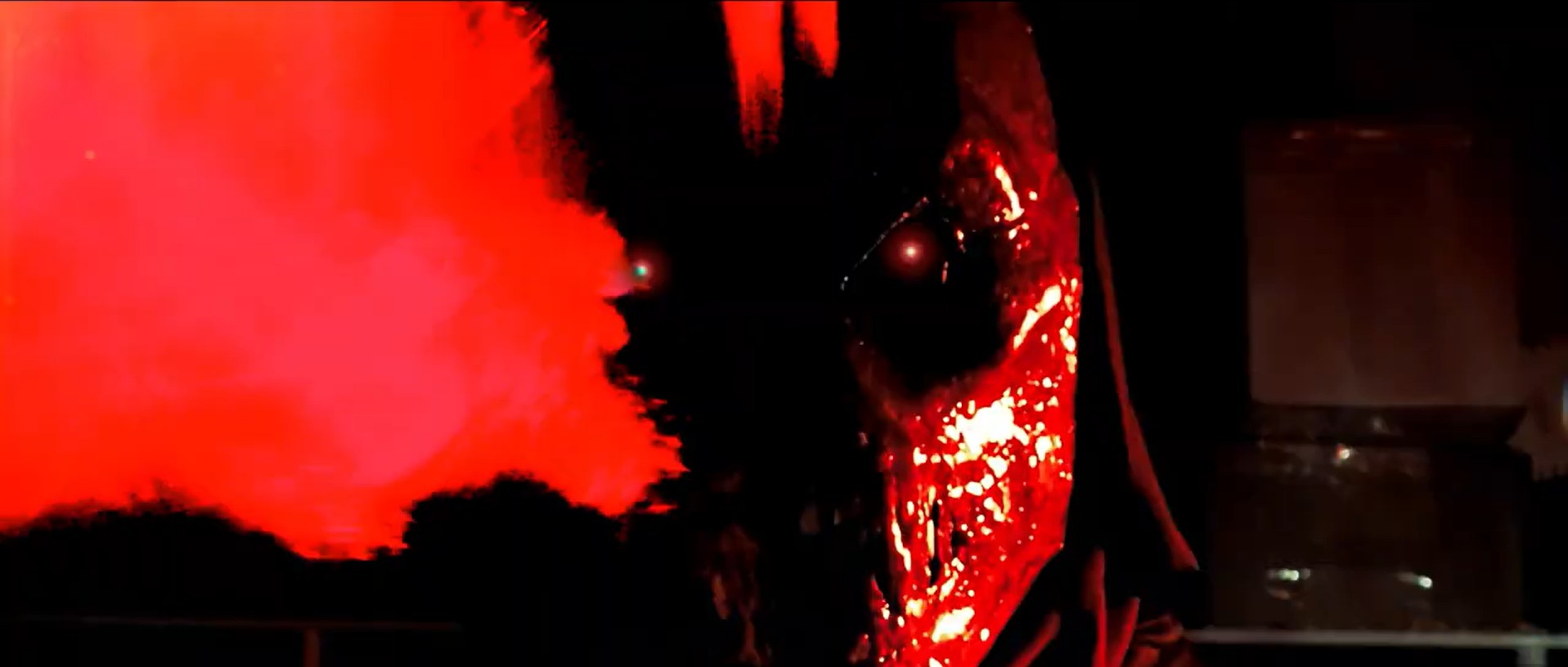
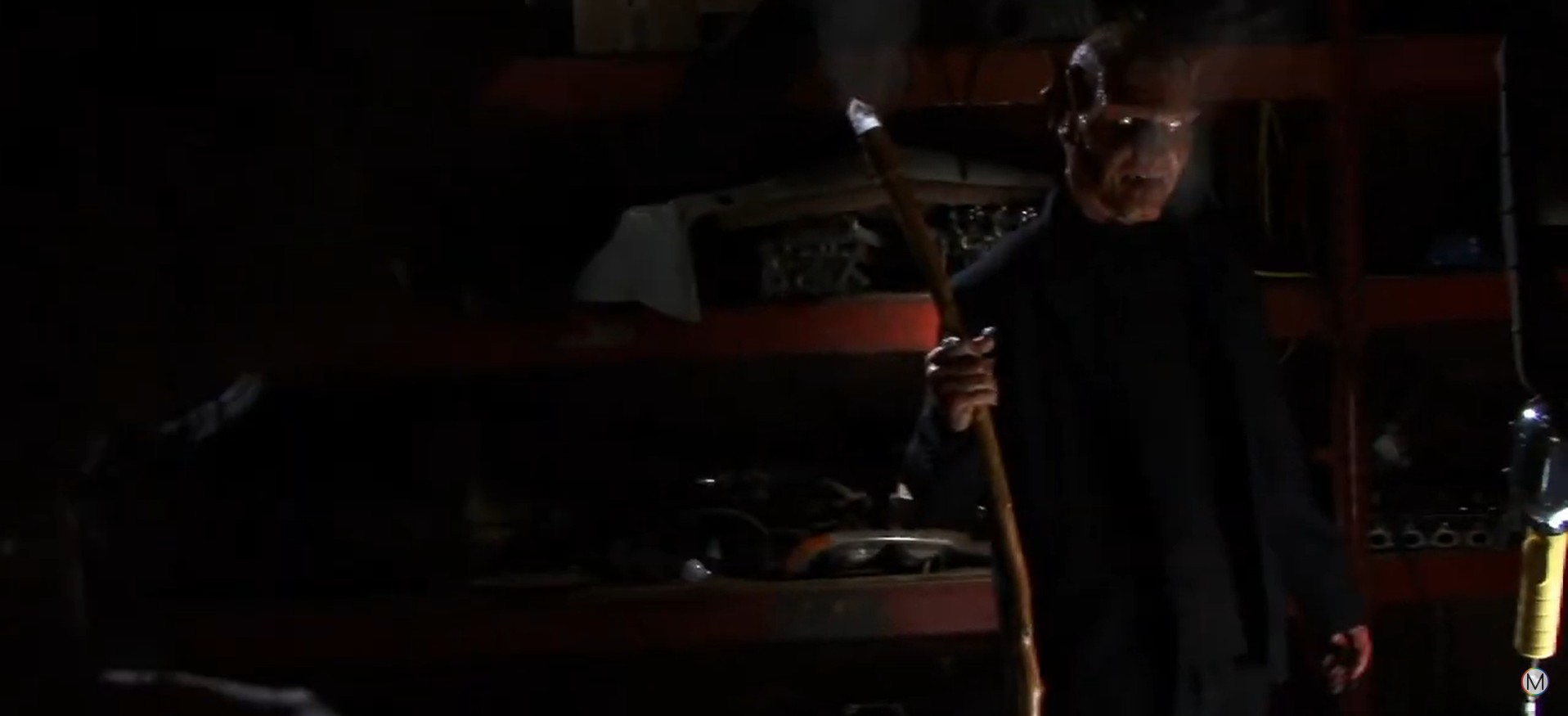
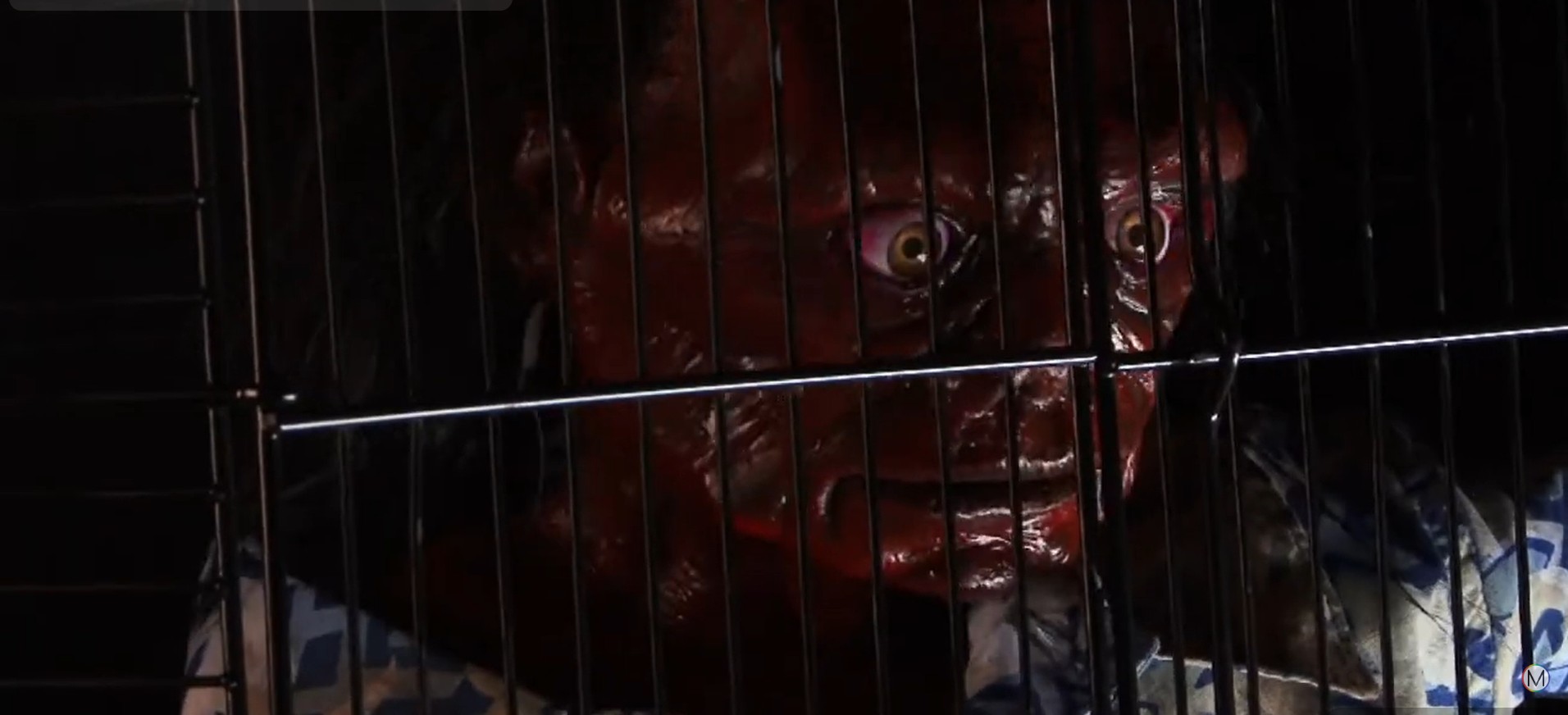
Jill Michelle and Daniel Lennox return to their respective roles of being a vampire-human love story couple, Sugar and Dex.  No longer hiding secrets from one another and on-the-road together, going from one dingy hotel to the next, the carry around the corpses of Ivan Burroughs in hopes to one day resurrect him by securing master vampire blood.  Ivan Burroughs, unfortunately, is played by a new actor, one who in my opinion is an upgrade from the already great Phil Fondacaro (“Land of the Dead”).  Ricardo Gil replaces Fondacaro as the vampire hunter with a vindictive vendetta.  Gil does have similar features to Fondacaro but has more personality in his delivery, making Ivan Burroughs more sarcastic and rougher around the edges than the first subdued portrayal with less snarkiness, and that gives the sequel more notability against the first film.  The vampire lot doubles in villainy with a master vampire purposing sporting his beastly side of a red vampire bat head, complete with pointy airs, conical snout, and elongated fangs, and which, in all honesty, makes him look more like the Prince of Darkness of traditional appearance.  The master vampire hides amongst the human pool of the gentleman’s club to mist the air with mystery of who it is with a suspect list including a club owner Janos (Jon-Paul Gates, “Alice in Terrorland”), club’s top stripper Lena (Jessica Morris, “The Haunted Casino”), and club manager Burke (James C. Burns, “A Haunting at Silver Falls”).  Mike Muscat, Lillie Nyx, and Rory Williamson make up the rest of the cast.

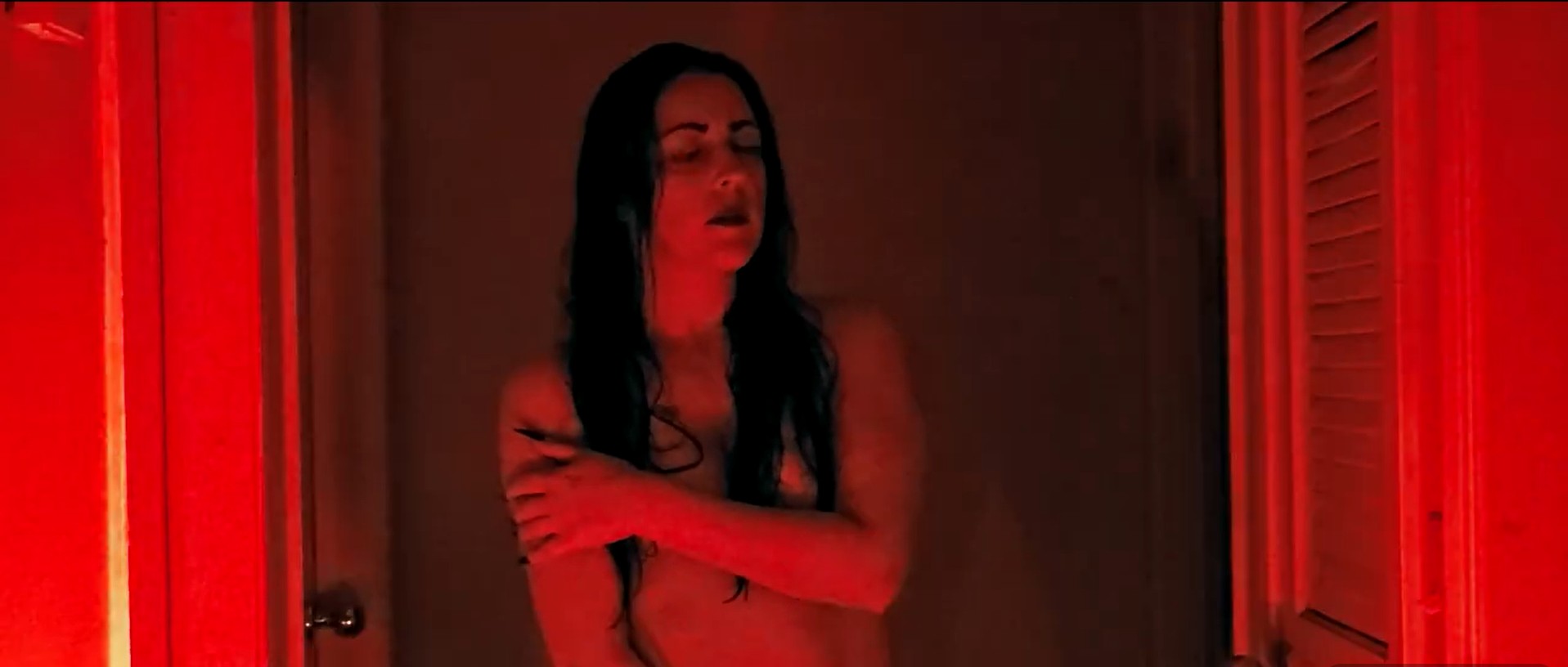
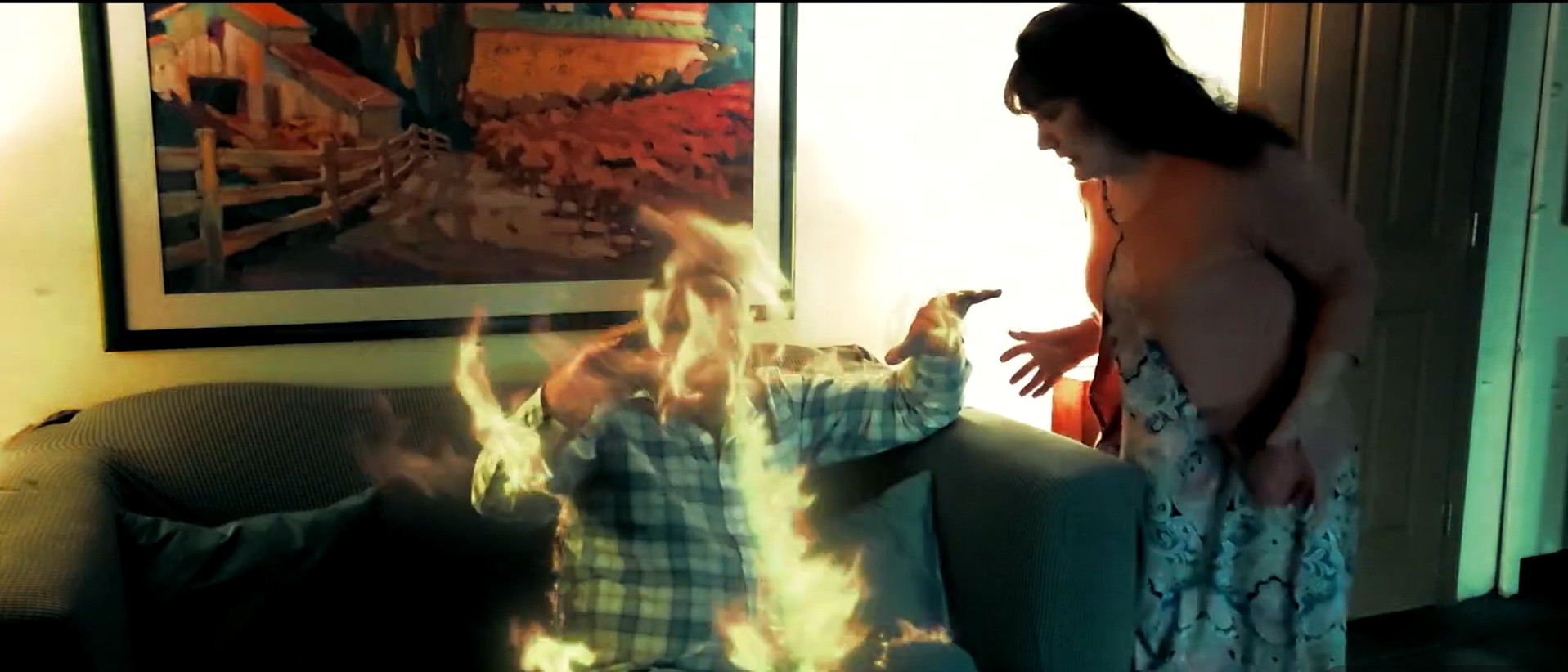
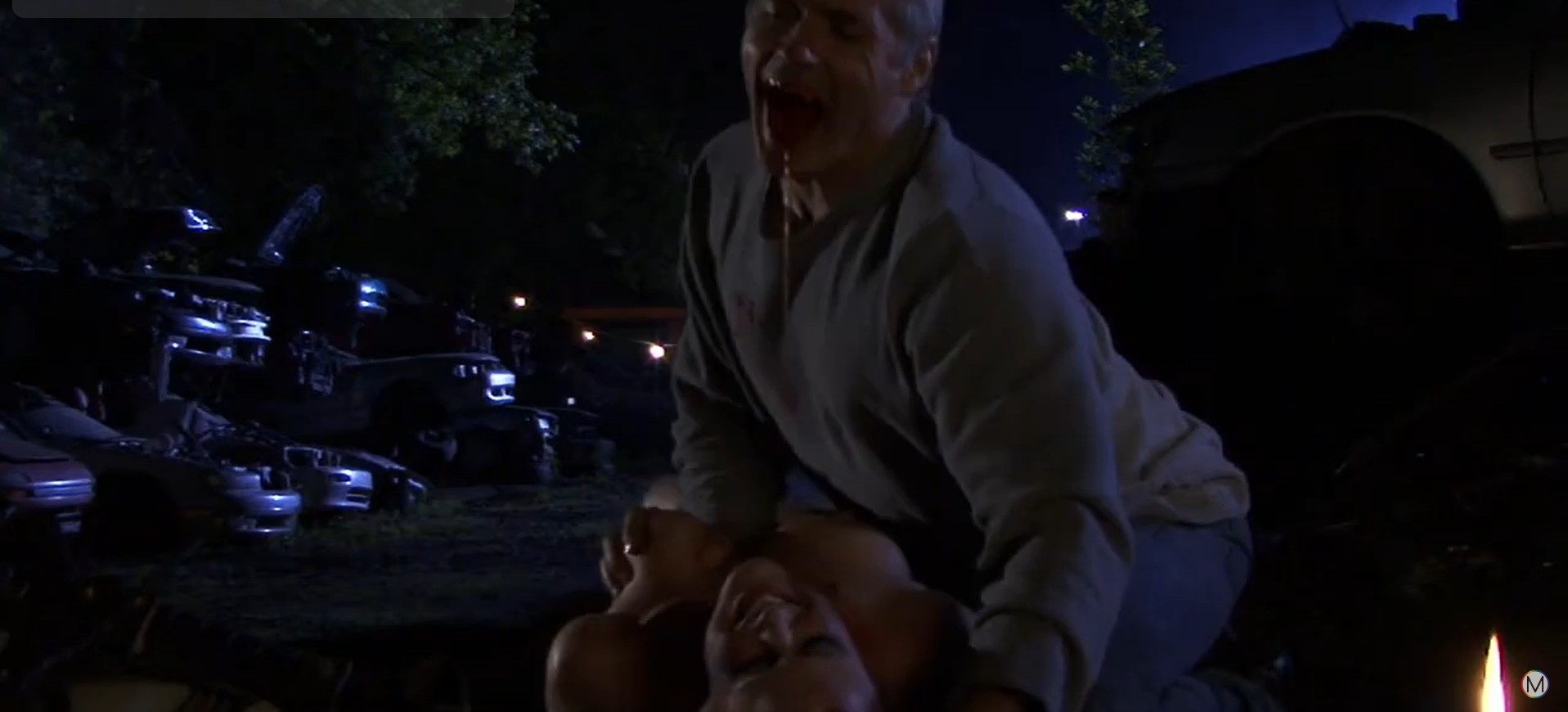
“Decadent Evil II” is comparable to the original film with both being watermarked by Charles Band need for small creatures, campy horror, and substantial number of topless women, the latter being more prominently risky in the sequel with extra suggestive stripper poses that focus on the crotch area to lay gingerly into that filmmaking golden role of bigger and better for a sequel.  “Decadent Evil II” does teeter that idea with also a doubled antagonist pool and a higher body count but not necessarily containing, and also being a sorely lack of, gore that more-or-less stays the same from the original film with a rivulet trickles of blood running down necks and chins.   Band and Muir do take the vampire out of the Gothic setting, one that Morella had resided herself into living at a mansion of marble and stone, and they trade it for an automotive junkyard, an ill-fitting home for a well-dressed vampire whose lived centuries in human culture.  One locale that has remained constant throughout both Band’s films are strip clubs and channeling the success of such gentleman’s club with bloodsuckers as “From Dusk till Dawn, both films prominently display them with great grandeur for the B-roll stripper moves.  With being a sequel, I held quite a bit of disappointment for the story that follows the same thematics as the first, the main being a singular master vampire garnering souls to become invincible and there’s nothing to accentuate that idea even further as it’s surrounded by, again, much of the same – Dex, Sugar, and Ivan, the inexplicable homonculous and his strange attributes, and a strip clubs.  Even the final scene remains familiarity with instead of Marvin making love to another homunculous, he makes doggy love to a full-size person in a cringy and uncomfortable last scene moment.

Charles Band’s “Decadent Evil II” receives it’s Hi-Def Blu-ray as a part of a long and arduous of converting Full Moon’s films to Blu-ray.  The AVC encoded, 1080p resolution, BD25 offers Full Moon’s catalogued 239 title a new pixel perspective of a saturated color palette inside its darker shaded tone.  The details are mediocre as much of the finer points are lost in low light, gel lighting, and haze but the compressions aim to be stable without any artefacts to note on lowest capacity Blu-ray.  Plenty of inky and less visible delineating contrast is a credit to the gaffing and director of photography Terrance Ryker for a soap opera-noir aesthetic.  For the first time ever, the film is presented in HD in a widescreen 1.78:1 aspect ratio.  The audio options are an English LPCM 5.1 surround and a stereo 2.0 that caters to District 78’s alternative, indie rock during the club sequences but elucidates and livens up the dialogue to where nothing obstructed with ambiguity.  Hardly any depth to the sound design as characters never wade beyond medium shots and range is limited to mostly the dialogue track along with imitation actions one would see in a low budget production or cartoon.  English subtitles are not available on the Blu-ray.  Extra features include a behind-the-scenes, a 42-minute featurette Battle of the Bands with a little stroll down memory lane for Charles Band as well as musical ventures for the film, stripper auditions for the Visions Night Club, the original trailer, and Full Moon trailers.  The physical presence is much of the same from Full Moon with a standard Blu-ray Amaray with relatively new artwork focusing on the homunculous rather than the vampires.  The sleeve is one sided with no inserts inside.  The region free Blu-ray has a runtime of 81 minutes and is not rated.

Last Rites: Like stuck on repeat, “Decadent Evil II” doesn’t offer a different type of narrative but ups the amount of nudity and vampires without much formidability in this lackluster sequel.

The Sequel “Decadent EVIL II” Bites Hard! Check It Out!

EVIL’s Duality May Be More Than What Meets the Eye. “The Ugly” reviewed! (Unearthed Classics / Blu-ray)

“The Ugly” Limited Edition Blu-ray Now Available!

A famed female psychologist is requested to work the possible acquittal case of a serial killer named Simon Cartwright and understand his possible motive for slashing his victim’s throats at seemingly random.  Unscrupulously tormented by a pair of odd orderlies, Simon Cartwright calmly carries himself as a humble, articulate, and friendly conversationalist and confessed killer with a darker side, an ugly side that drives him to kill at will.  Cartwright gives her the anecdotal trappings of his kills that prove to be unprovoked and unsystematic from a side of him he can’t ignore.  Confounded by this, the psychologist pushes him to brink for an exact reason, one Cartwright keeps buried deep inside his subconscious that may or may not be supernaturally driven.  As Cartwright’s past continues to haunt him and with the psychologist assertive herself into his psyche, the dangerous method of analyzing criminal behavior won’t stop a plagued killer from killing again as his next victim might just be sitting across from him in the cross-examination room.  

Themes of split personality, past abuse and trauma, and the limited authority of control course through “The Ugly’s” veins like acid, sweltering with tension and ready to burn a hole through the safety of custody and storytelling once the twisted truth is told.  New Zealand filmmaker Scott Reynolds debuted with his feature length film back in 1997. Reynolds also wrote the script that kept an intimate approach between killer and doctor, kept audiences guessing the supernatural aspect, and made taut the lead-up moments filled with human tenderness that went into subsequent violence that painted a portrait of a conflicted killer afflicted by derangement that might not be his own.  Shot in Auckland, New Zealand, “The Ugly” is a production of Essential Films with funds from the New Zealand Film Commission and is produced by “Jack be Nimble” producer Jonathan Dowling.

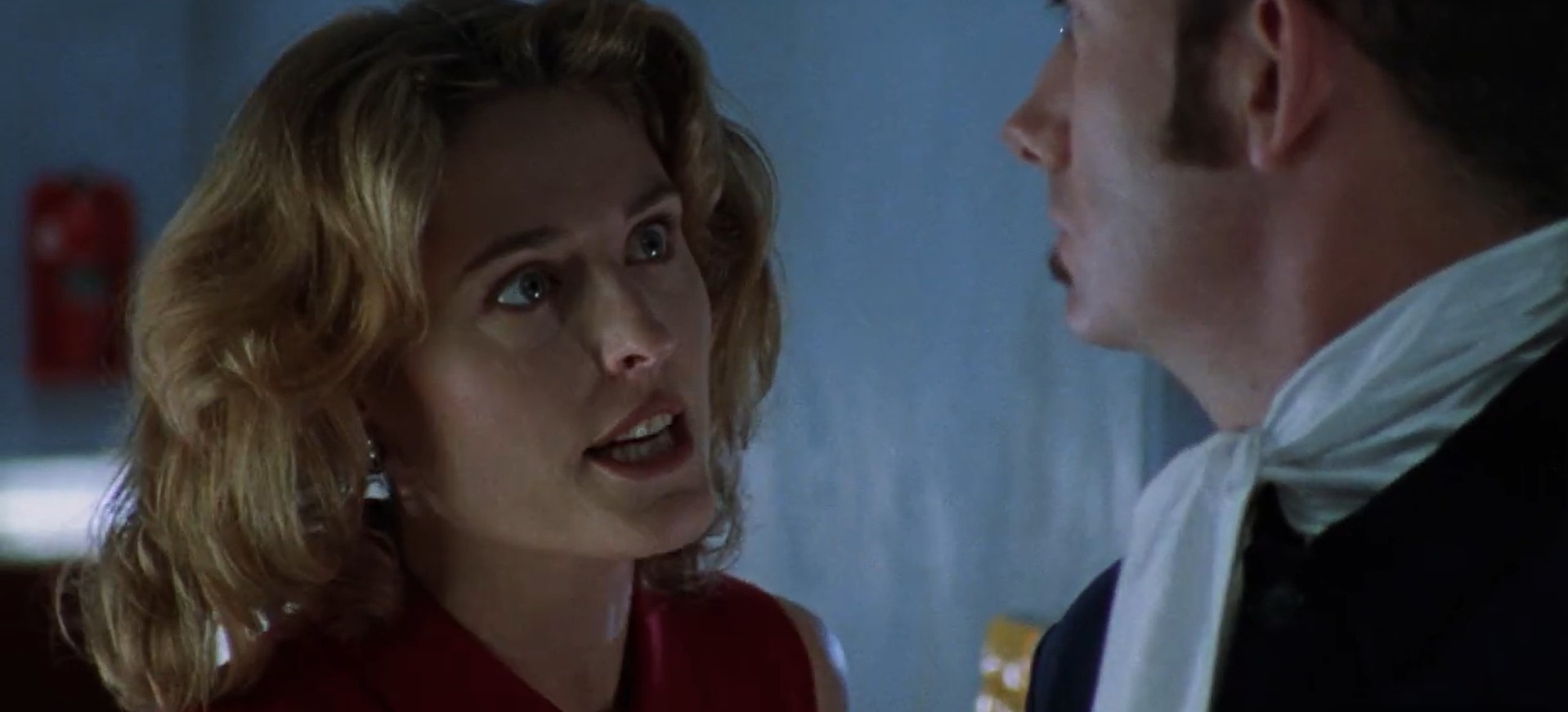
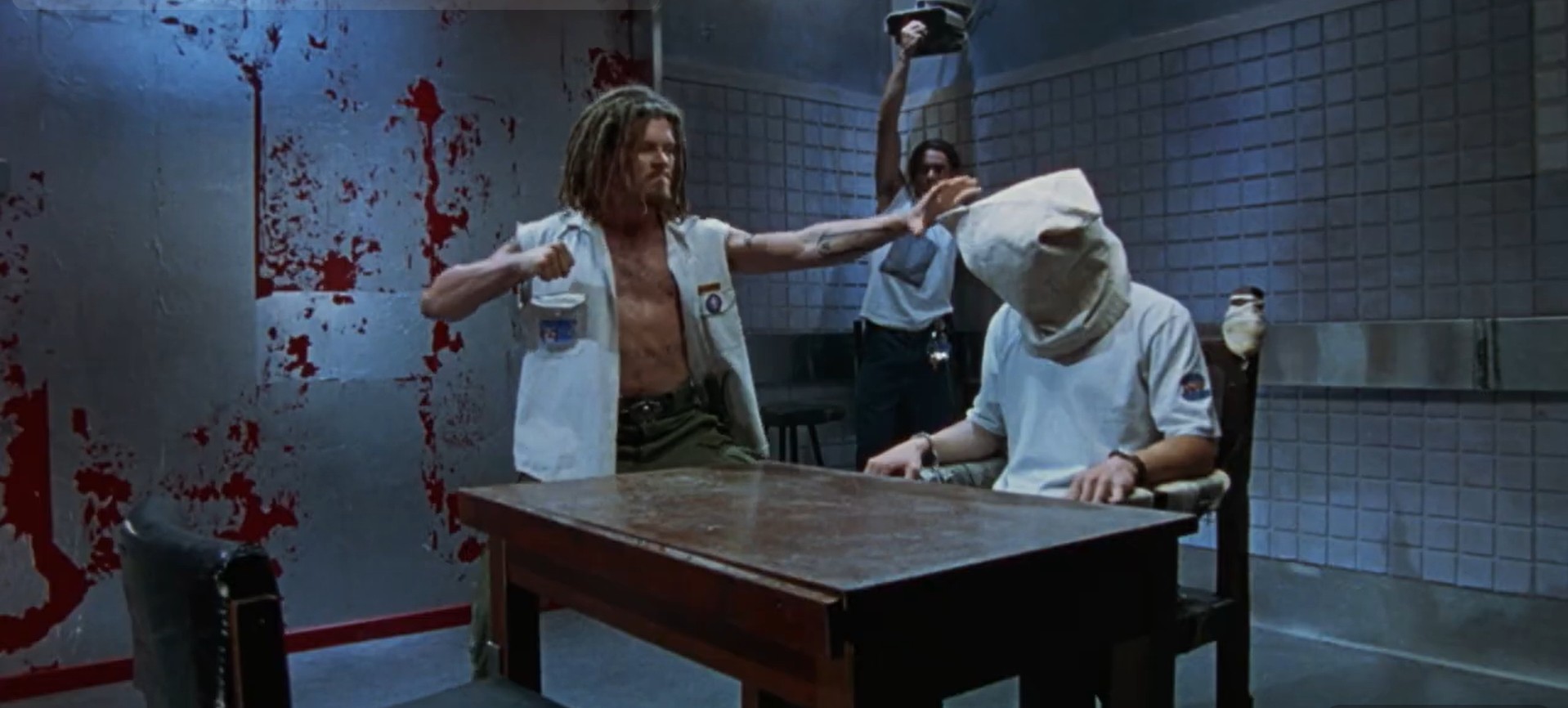
In a vague mirroring of Dr. Hannibal Lector and FBI Clarice Starling from “Silence of the Lambs,” there’s still the intention to understand the mind of a serial killer.  In the Clarice-like role is a civilian, a psychologist to be more precise, one that has received recognition to get the most dangerous criminals released from incarceration, is Dr. Karen Schumaker, played by Rebecca Hobbs (“Lost Souls”) that would be her biggest lead role in the New Zealand film market.  Opposite her, across the table mostly and chained to a chair, is Paolo Rotondo with a cold stare and a handsome face that doesn’t exactly say I’m a serial killer.  When graced with a prosthetic that makes half his face appear melted or scared in fleeting glimmers or reflections, scenes that often felt needed more attention or a longer say, that’s when Rotondo could exact his intimidation upon the viewer as the true monster, as Cartwright has referred to himself in more words.  Instead, Cartwright’s a clean shaven, well-dressed, and respectable Patrick Batman type without the three-piece suit and the Huey Lewis and the News obsession and not as King’s British and as quirky in his demeanor as Anthony Hopkins as Lector.  Both characters fall and fail hard to the supporting case of the two orderlies and their employing resident psychologist.  Sporting dreads and walking with confidence like a WWE wrestling being introduced, Paul Glover (“The Locals”) has more flavor in his mostly stoic intimidating orderly performance alongside his more animated and ragdoll movement buddy in Chris Graham (“Moby Dick”) as the two mistreat the Cartwright with disdain.  Their employer, Dr. Marlowe, has a snooty creepiness about him that’s akin to being a mad scientist-type that’s fits into the goon orderly dynamic with Roy Ward (“Perfect Creature”) at the helm.  Darien Takle and Vanessa Byrnes costar as chief supports. 

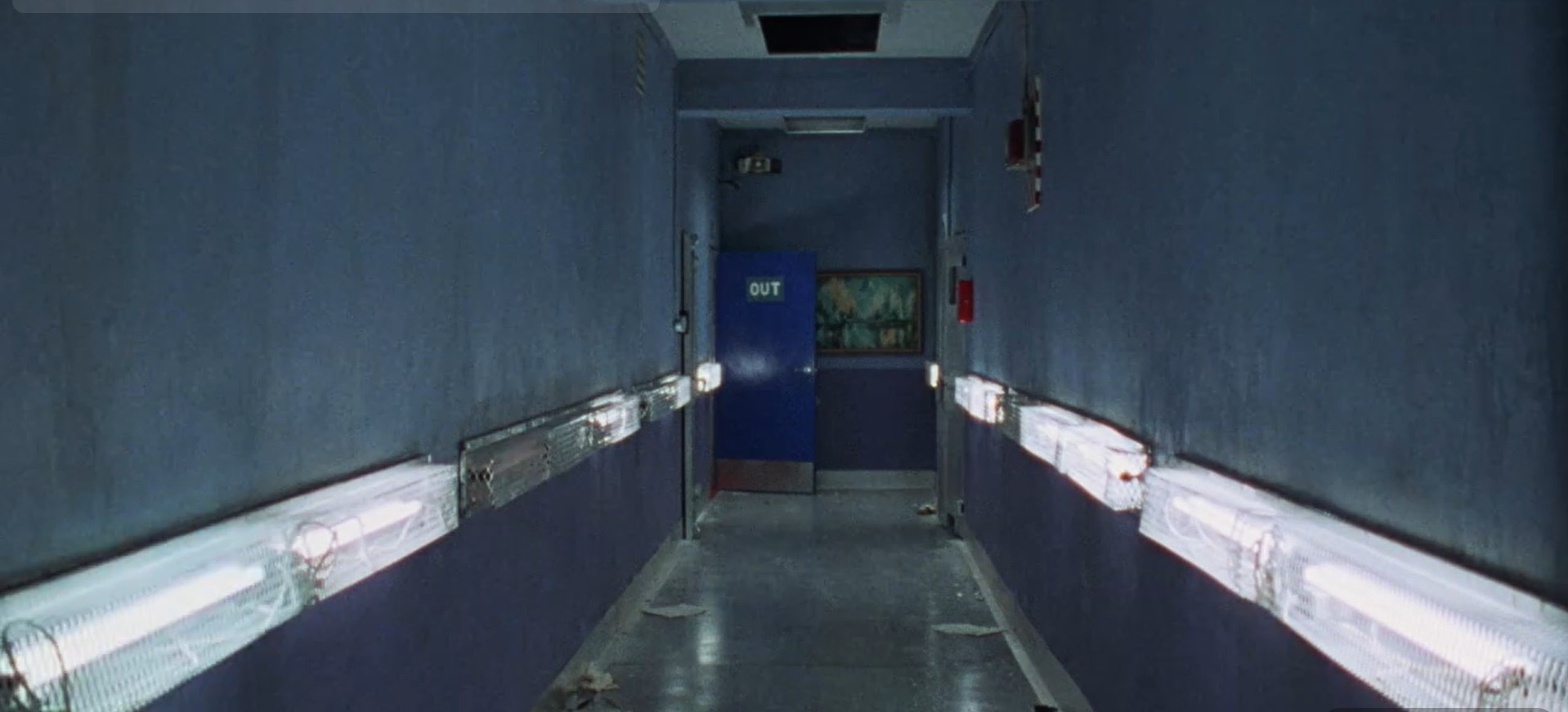
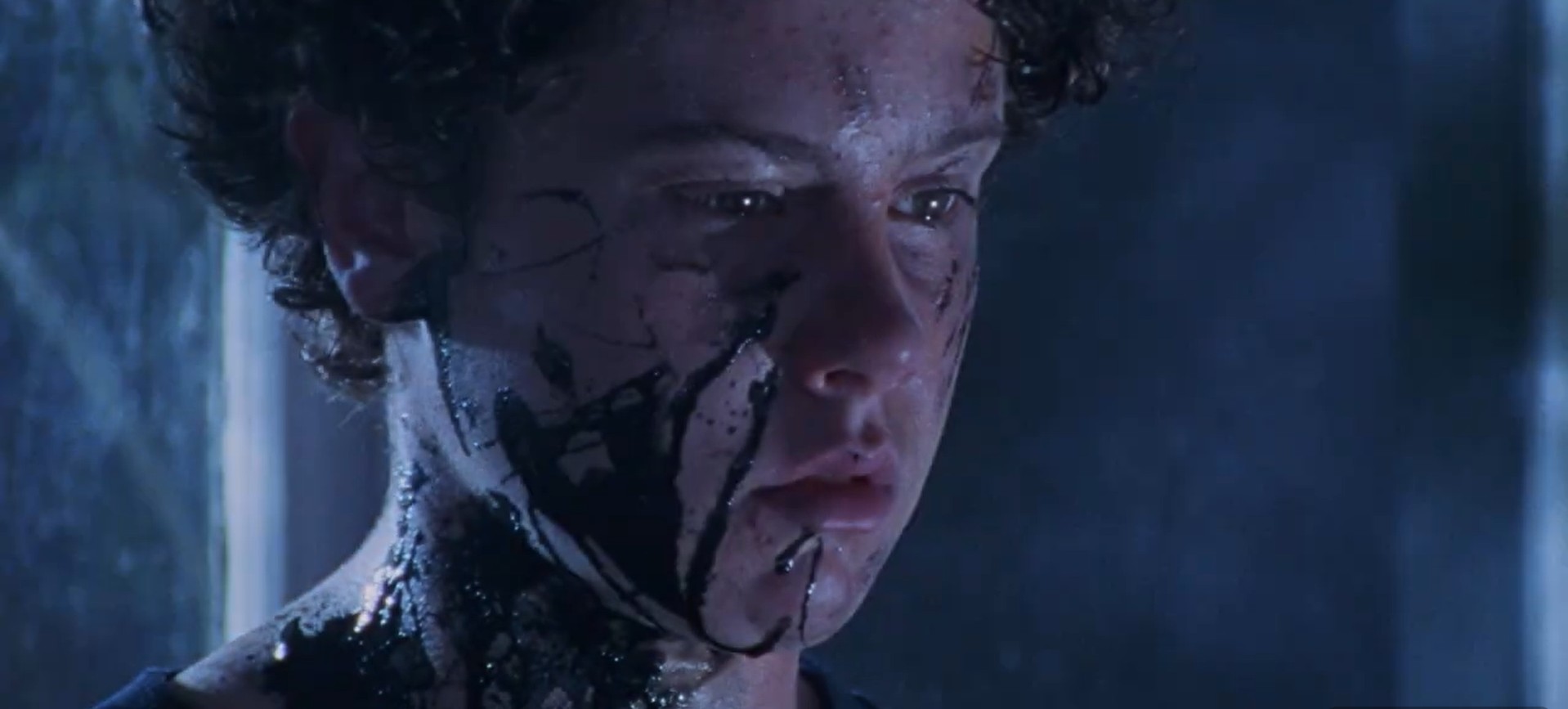
‘The Ugly” is certainly a child of the 1990s with that glossy gleam without it a lens flare spark of digital anamorphic.  The aesthetic matches the subject matter with dreary, cold, and gloomy nu metal nuisances, teetering on the edge of being also grungy.  Editor Wayne Cook’s transitions and cuts are indicative of the era in filmmaking with whooshing transitions and flashes of disorienting cuts, such as white outs or seamless segues.  This techniques also translates into Simon Cartwright’s headspace with acute and fleeting glimpses of his mental state visualized into the real word, or it’s the real world sheathed by a layer from beyond the grave, but either way his perspective quickly provides a glimpse into his reason for killing, his duplicitous degradation into insanity, and that it can be projected to others outside the exclusive rights of his person.  Most of the story is told anecdotally through Cartwright’s perspective and as storyteller, his events are muddled by his own struggle with killing that becomes more evident as the story progresses.  What’s most interesting about Reynold’s film is it’s reality bending to keep the audience engaged as he puts the psychologist character, Dr. Karen Schumaker for those who forgot, right into the frame of his story as a third party speaking directly to Cartwright and only Cartwright can see and hear, but she’s implemented naturally as if sitting at the table with the storied characters or being a part of a three-way conversation that but not truly.  Between these style characteristics and the narrative’s odd macabre, along with the deep black, sour crude oil shaded blood, “The Ugly” is grimly beautiful with visuals and stimulating to watch. 

Unearthed Films, under their Unearthed Classics sublabel, provide a new Collector’s Edition Blu-ray release to the table.  The AVC encoded, 1080p high-definition resolution, BD50 has stored on it a 4K restoration from the film’s original 35mm interpositive and looks neat as a pin presented in it’s 1.77:1 widescreen aspect ratio, rendered with a well-diffused color palette of a lighter blues and grays that contrast starkly with the deeper black blood in a semblance of a dystopian or alternate reality in circa late 90s to early 2000s films.  Saturation is copious with all colors and the details are sharp mostly in the peripheral setting with the focal objects having be defined nicely but there is some textural loss on the skin and clothing under its higher contrast.  The audio formats within are an uncompressed LPCM 2.0 Stereo of the original theatrical audio and a relatively uncommon 4.0 DTS-HD MA that caters to the side and back channels rather than a central output and a LFE subwoofer, so the track is not as deep and resonating and it discerns as such with more range and less punchy impact that encompasses at the dialogue, ambience, Foley, and soundtrack excellently considering.  Dialogue is clean and clear without obstruction or touchups to the original audio files.  English SHD and Subtitles are available for selection.  The collector’s edition contents include an isolated score from composer Victoria Kelly (“Black Sheep,” “The Locals”), a 1997 radio interview from New Zealand with writer-director Scott Reynolds, an audio commentary with chief principal actors Paolo Rotondo and Rebecca Hobbs, Reynolds’ early 90’s short films “A Game With No Rules” and “The M1nute,” “The Ugly Visual Essay” compares “The Ugly” to true crime serial killers of reality, a photo gallery, and the original theatrical trailer.  The physical presence of “The Ugly” is anything but with it’s beautiful packaged design, beginning with the commissioned Slipcover cover art that wholly embodies the essence of the story, rather than being an exploitative mislead, by Scott Jackson of Monsterman Graphic.  The clear Blu-ray Amaray case has a reversible sleeve with the same Jackson art with the reverse containing the film’s original one-sheet artwork.  Inside is a 6-page booklet a pair of essays by Jason Jenkins along with monochrome and colored stills.  The disc is also pressed with a tense hunting scene as well.  The 18th Blu-ray title for the Unearthed Films’ sublabel is region A locked, not rated, and has a runtime of 93 minutes.

Last Rites: As far as understanding the mind of a New Zealand serial killer, Scott Reynold’s “The Ugly” depth charges reality with not only a promising supernatural layer but also a strange world these characters live and act against that invigorates a rather talkative and anecdotal story with eccentric and uncomfortable personalities that rival the killer himself.

“The Ugly” Limited Edition Blu-ray Now Available!

EVIL Would Be to Not Allow Yourself to Enjoy Japanese Gravure! “J-Girl Yummy: Mitsuha Kikukawa, Toka Rinne, and Reona Kirishima” reviewed! (Gravure Glamour Girls / Blu-ray)

You Can Find Mitsuha Kikukawa, Toka Rinne, and Reona Kirishima on DVD and Blu-ray at JGirlYummy.com

The J-Girl Yummy series presents three gorgeous new women who are prevalent from the pornographic Japanese Adult Videos (JAV).  Instead of hardcore assembly of action that often doesn’t feel as intimate as maybe one hopes, your favorite starlet now only has eyes for you in this softcore series that nearly leaves nothing to the imagination.  Mitsuha Kikukawa (“My Father Steals My Beautiful Fiancé,” “My Compliant Pet”), Toka Rinne (“Mamacita Stories,” “Married Woman’s Cheating Heart”), and Reona Kirishima (“Countdown to Nakadashi,” “On a Stormy Night – I found Myself Alone with My Sister-in-Law Upon Whom I had a Crush”) find themselves as the next trio lot for the showcasing series that explores their solo talents and provides a one-on-one between their hot bodies and the camera, seducing the lens with playful flirtation, a captivating allure, and a stimulating interaction that breaks the fourth wall as they stare, talk, and moan back with inviting eyes for their loyal fanbase. 

In a world where sex sells, any form of the vice is surely to be valuable.  Hardcore adult films reign as king amongst viewers but there’s also a sizable market for softcore productions, if the ever-desired Skinemax and more highly sought after risky mainstream erotic dramas were not prime evidence enough to make the case.  Across the oceans and lands, hailing from Japan, and landing in the North Americas are the gravure videos, Japanese media of idols, or models, posing suggestively with innocence, brazenness, and fun time pleasureful.  Gravure videos are typically bikini-cladded women, but the Gravure Glamour Girls produced J-Girl Yummy series go the extra mile by rolling back the clothes with the Japanese censorship working overtime trying to keep the pelvis area obscured from view with impenetrable strategically placed objects.  The films offer no credits other than its centerpiece idol on all surfaces of the packaging and in the encoding on the feature.   

We begin with Mitsuha Kikukawa, the now 28-year-old from Tokyo measures in at 5’5” tall with a waist at 61cm (24 inches) that curve down to just above a 3’ hip span and a Japanese F cup bust, equivalent to a U.S size between B and C cup.  With a high and full cheek bone structure, large round eyes, and pearly white teeth underneath a lighter color bob cut, Mitsuha has petite in all the right places of her traditional Japanese physique with a nicely round and slightly larger than hand size breasts and thick tail end around the thighs and rear.  Mitsuha’s presence the best example of erotic foreplay without any physical interaction with a partner as she’s able to work the camera with her eyes, mouth, and body language by herself and that speaks to her level of rising arousal talent coupled by her unique look that closely resembles a live example of an Anime interpretation of a young girl.  Each scene introduces a new element into her working the camera to maximize the intended result, to provoke the viewer’s keen feelings for their obsession, or sex in general, and Mitsuha is the clear winner amongst her J-Girl Yummy counterparts. 

Next, Toka Rinne from the China prefecture feels like a whole foot taller than Mitsuha but according to her stats, Rinne is the same 5’5” in height.  Waist and hips are similar too at 58cm (23 inches) and 90cm (35 inches), making this Amazonian-built like woman smaller around the torso than Mitsuha, despite a small and immaterial front pooch belly, yet her bust size measures in a 98cm, a Japanese I cup, that would secure a U.S. 34D.  Rinne also has long auburn-black hair down to mid-back with a big smile and almond-shaped eyes, Rinne has a classical Japanese face that can be slightly masculine in some areas, such as cheek bones and chin and while she may have more of an hour glass figure with a large rack to appease breast men, she tightens and tucks her chin while leaning her forehead forward slightly.  This might be age related as she’s a whole 6-7 years older than her counterparts, born in 1990.  This is about the tip of the iceberg for her awkward and stiff movements in front of the camera, as if she doesn’t know how to work her hands on herself and she nearly sticks to a single pose for most of the clothes on portions.  Rinne’s body carries her through each scene but is less adventurous within the confines of her imagination to pretend being an intimate partner where it counts. 

Lastly, we come to Tokyo’s Reona Kirishima, the shortest of the three standing at 5’ tall that translates to her 56cm waist (22 inches), hips (33 inches), and a perky D cup bust, a healthy C-cup in the U.S.  Kirishima has lower back length dark hair with a red tint stringing through overtop her girl-next-door-face, well-manicured, slightly freckled face in which she looks more Latina than Japanese.  Though cute and appetizing in all regards to her physical appearance, her camerawork lacks the energy and the sensuality that graces the lens with little-to-no smiles but rather dull, blank stares; her eyes are not overly unique to warrant gazing alone.  She poses half-heartedly through her scenes with a hand timidity and rigidity in her movements, often revealing her hesitation where and how to move her body and, likely, working off verbal instruction from the videographer.  Though lacking kinetic enticements, Kirishima does unveil a little more bush area than Mitsuha (who has no bush) and Rinna (who has some bush).  This opens more opportunity for visual cues for the viewers’ imagination to run wild when teasing just below the top waistline of her bikini bottoms and with her last few scenes, Kirishima may be the most adventurously provocative gravure model of the three despite her lack of expression. 

Each gravure idol entry follows a similar formula that begins innocently enough in the backyard with a simple strip down of clothing, moving toward a semblance of athleticism, such as Mitsuha playing with a toy bat and ball that speaks to her love of baseball, Rinna’s bouncy-in-all-the-right-places jump roping, and Kirishima working the hips quite well with hula hooping.  After breaking a sweat going through the fun physical play motions, it’s time to get ironically down and dirty with a shower scene that begins with a coursing shower head around the button-down white shirt to finally ending up in the tub of murky soap water.  In between, each lady does soap up and massage themselves, missing no spot of skin in the process.  Kirishima nearly bypasses the censorship leg spread in her bath water which is less opaque compared to the others.  From there, it’s sexy secretary time as the ladies’ don similar black skirts, white button downs, and thigh-high or full black stockings that cover a bad girl’s lingerie beneath, slowly being unveiled in an enticing dress down as they longue seductively on leather or velvety upholstered furniture.  Through all the down shirts, up skirts, extreme closeups, thrustings, grindings, and overall peeling back of innocence, the next to last scene embarks head first into a spicier flair by already skimping down the idols into lingerie or bikini in a more vibrantly hot colored walls and décor and introducing a toy of sorts, such as a glass phallus or a fur wand, to accentuate and punctuate their desire and kink.  This sets up the JOI or POV scene of intercourse simulation to the eventual explosion of the male kind right onto the idol’s chest.  These scenes drop the soundtrack and volume up the in-scene sound for erotic dialogue or moaning.  However, not all three participate in the grand finale with Toka Rinna having either opted out or her footage was not included as her video ends with the spicier scene prior; speculation is that since Rinna had retired from JAV a few years prior, she may have opted out of a ”sex” scene.  There’s plenty to like from each three gravure idols but I do wish production was more attended to especially around covering up certain scuffs on the models’ bodies with simple makeup, such as a pair of clotted scrapes on Mitsuha’s hand or even removal of the Band-Aids on the back of Kirishima’s ankles, and this surely speaks to the limited crew and price value of the series and something we’ve noticed before with our last J-Girl Yummy trio review of Ryo Harusaki, Ai Haneda, and Aoi Kurungi.

From Pink Eiga and Gravure Glamour Girls, Mitsuha Kikukawa, Toka Rinne, and Reona Kirishima are now personally available to you in high-definition on the J-Girl Yummy gravures.  The Blu-rays are AVC encoded, offer 1080p resolution, on a 25 gigabyte BD-R, presented in a widescreen 1.78:1 aspect ratio.  Organic image and lots of natural lighting use, the picture often appears with a resulting soft effulgence, or a heavenly light to go with the heavenly bodies, but there are also no counteractive measures to stop the overexposure, washing out some of details not only in the backdrop but also on the body and face.  The digital quality, in its natural state, can’t re-produce the exact detail without a filter or touchup but this more natural approach provides a realism to the gravure despite the non-compression issue image loss.  A BD-R does not replicate or help retain the picture integrity to its fullest, but the J-Girl Yummy product encoding still manages to sustain a sharper image.  I did notice on Reona Kirishima’s static menu some macroblocking with the replay loop but that’s the extent of the glaring artefacts.  I suspect there is an issue with the encoding as Mitsuha and Toka come with an elevator music layer with the static menu but for Reona there is no music but the menu still loops.  The Japanese PCM Stereo is mostly silent during the feature with a genre variety of music from instrumental piano lounge to alternative rock, to a dabble in a low-key synth mix, often rough cutting from on to another in the same scene.  Dialogue, mostly pleasure derived moans and groans, does come about in the last simulated sex scene from the idol and is organically resonating within the given space and unfiltered camera mic.  There are no translation subtitles with the feature dialogue.  Special features are generally the same across the board that includes a captioned interview with the model just after wrapping the gravure, focusing primarily on their sexual habits and pleasures while dipping toes into their personal time favorites, such as hobbies when not filming scenes.  Compared to Mitsuha and Tokas’ interviews, Reona was extremely short with only a couple questions and a statement to the fans.  There is also a still gallery with each idol, the J-Girl Yummy trailer for them, and a preview of the next gravure model.  The Blu-rays come in standard Amaray with half-naked model front and center overtop a black banner with their name and a rainbow design in the backdrop.  Inside is an insert card with a definite NSFW image of them.  Each title is unrated and are region free with runtimes of 60 minutes for Mitsuha, 58 minutes for Toka, and a full feature-length of 80 minutes for Reona.

Last Rites: Sex is subjective. Depending on your desires and your hots for certain Japanese models, these gravure ladies – Mitsuha, Toka, and Reona – could make for great softcore sessions tailored to be tease in a solo performance that makes intimate and sexy. One thing is for sure, J-Girl Yummy series eases the most beautiful women adult stars from the East to the West and we just might not be ready for them yet!

You Can Find Mitsuha Kikukawa, Toka Rinne, and Reona Kirishima on DVD and Blu-ray at JGirlYummy.com

EVIL is Waking Up to Find Yourself Married as a Simple Wife to An Abusive Island Fisherman. “Splendid Outing” reviewed! (Radiance Films /Limited Edition Blu-ray)

“Splendid Outing” on Limited Edition Blu-ray!

President Gong Do-hee is an elite executive on top of the business world that’s mostly male-dominated profession.  Securing trade agreements, being head speaker at events, and forming relationships with male peers of other nations, President Gong is exhausted by the end of the day, returning home to regain recharge even if that means not spending time with her two children by letting the governess oversee play and bedtime.  Vivid dreams of being called to the seaside by a mirror image of herself and her therapist reminding her of her dead twin sister in relation to the dream sends President Gong on a road trip to the shore where she’s tumultuous caught up in a riot and chased by a mob only to find herself waking up to four fishermen handing her off to an agitated Island fisherman, Lee Min-Joo, who claims to be her husband.  Seeming stripped of her life on the mainland, she’s constantly under surveillance and abused by Lee’s certainly of her place under him as a dutiful wife by cooking, cleaning, hosting, and taking care of their crippled daughter. Gong Do-hae plays along, submitting to Lee’s instruction, until the right moment to escape back to Seoul where her past life may not be there anymore. 

Coursing with gender inequality, patriarchal oppression, and imposter syndrome, director Kim Soo-young (“Sorrow Even Up in Heaven”) challenges reality with a surrealistic dissociation and inescapable threat of being forcibly tied to an insufferable situation in his 1978 drama-thriller “Splendid Outing.” The South Korean film, originally titled “Hwaryeohan wichul,” is written by Cho Moon-jin (“Dying in Your Arms”) as a personal nightmare where one loses their existence and cut off from the rest of the world, essentially torpedoing their life before and being replaced or forgotten.  Kim Tae-su’s longstanding Taechang Productions (“Deadly Kick,” “Red Eye”) produces the feature from Seoul on the mainland to the adjacent unnamed islands where filming took place.

Without dishonoring or neglecting her costars’ performances, Yung Jeong-hie is “Splendid Outing’s” one woman show as the stoically exhausted President Gong.  From her POV entrance being escorted to her office where the camera turns to face her undivided business façade to the moment she steps into her affluent home with a nanny and maid, the “Village in the Mist” actress can rub elbows with elite professionals as if gender didn’t exist but there’s still this unbalanced tension that’s unsettling for President Gong, one that’s a male-driven society that flippantly places expectations of systematic conventions in regard to women’s placement within the workforce and society.  That pressure through peer misconduct induces anxiety, subverting her subconscious into a trip toward the seaside where being called to ends up being appallingly costly in a mind-boggling spirit-breaking deconstruction of herself.  This is when she meets Lee Min-joo claiming to be her husband, a brutish fisherman with an abusive hand and tongue with stereotypical, old-fashion perspective on where wife should be spending their time.  “Eros” actor Lee Dae-kun rendition of the role depicts an uncouthly aggressive and maybe even on the spectrum with his island bumpkin behavior.  Lee Min-joo’s not niceties extent beyond his mistreatment of Gong with womanizing ways and thievery.  Being trapped on the island, there’s nothing Gong can do is bide her time, time the punishment, and try to use her decision-making skills for the right time to escape but even when she does, the life that she once knew is over like it never existed before.  Those who saw her daily only see a faint resemblance in who they now considered long dead, her children have moved out of their family home with no mention of a forwarding address, and even her bank accounts of whittled down to nothing to complete the total erasure of her life after a year of living on the island.  “Splendid Outing” rounds out with significantly minor supporting roles in Lee Yeong-ha as the visiting island doctor and Kim Jeong-ian as Gong’s island daughter. 

From the opening walk-through of President Gong’s daily schedule and interactions to the oppressive nature of Lee Min-joo’s husbandry, themes of inequality stack up and out of “Splendid Outing’s” Lynchian narrative that courses like a bad dream of subdued impostorism.  President Gong single-handed success is stolen away by the cackling jabs of male perception that women should get married, someone to take care of them.  That seemingly innocent interaction brings big consequences to the executive’s psyche, inducing dreams of the seaside and her sister, and influencing a far drive to an unnamed fishing town where she doesn’t provoke to be whisked away in an unconscious state only to awake married, handed off to a stranger claiming to be her husband.  From there, President Gong is not only top executive of her class but rather in the position she has feared most – in stereotypical relationship with conventional gender roles of men providing, women working, and its askew gender dominance controlled and welded like a weapon by the uneducated island man called her husband.  Other than dreams and flashbacks during Gong’s time on the island, Kim Soo-young doesn’t lean on fantastical uneasiness to culture the effect.  The situation itself bores that sensation right into your core and frantic motions kick in to try and piece the puzzle together of how, why, and when she ended up on a strange fishing island with a strange fisherman.  Combination of her twin sister and the seashore experienced during the dream deduces possibility – perhaps her twin sister isn’t dead but just ran away?  Or perhaps President Gong is mistaken for her deceased twin and the man claiming to be her husband is her brother-in-law?  And even with sprawling open-aired island with jagged rocky hills and lush nature, a feeling of claustrophobia encompasses her as there’s no escape from the island, a hovering over every move husband, and the distance between neighbors creates a sense of confining isolation.

Coming back from dead, President Gong lost everything, or so she thought.  For Kim Soo-young and “Splendid Outing” coming back from the video graveyard, their feature fairs better, gaining all the glow-ups of a new and improved release with Radiance Films’ Blu-ray.  The limited-edition, single disc Blu-ray, “Splendid Outing’s” world-wide debut on the format, comes AVC encoded with 1080p high-def resolution onto a BD50.  The digitized transfer is produced from a 4K scan from the 35mm negative stored at the Korean Film Archive that was sent to Radiance Films for restoration at the Heavenly Movie Corp and presented to us today in an anamorphic widescreen 2.35:1 aspect ratio.  Overall, the picture looks phenomenal with a natural diffused saturation, depth of focus in the details between background and foreground, and a fabric texturing that presents no challenges to distinguish.  Skin coloring appears also organic and captures enough glinty sheen of sweat and wet soaked skin and the coarse nature of a days long stubble.  The original print has survived the test of time to assist in producing a freshened up and restored transfer but there are noticeable but minor and faint instances of vertical scratching, mostly on the viewers’ right side of the frame.  The Korean language PCM mono mix offers an adequate mix that harnesses the surrounding the background noise and integrates it harmoniously in with the dialogue and sound designed or hard sound effects.   Dialogue tops the layers with a vigorous ADR that matches the movements with pleasing synchronicity, especially early on in President Gong’s routine where numerous different languages are spoken, such as Japanese and English before entirely switching solely to Korean.  The range extends from the hustle and bustle of a city urbanscape to the coastal sounds of calling seagulls and water splashes against rocks and shores.  Improved English subtitles are available with this Blu-ray.  Limited to 2500 copies, the catch them if you can special features a new audio commentary from Ariel Schudson, writer of classic gender and Korean films, a new opinion interview with “Peppermint Candy” and “Burning” filmmaker Lee Chang-dong, a new interview with assistant director Chung Ji-young, and a Pierce Conran visual essay Stranded But Not Afraid:  The Island Women of Classic Korean Cinema.”  The interviews are in Korean with English subs.  The Blu-ray comes with Time Tomorrow’s new (primary) and the film’s original artwork (reverse) with an informational technical and synopsis obi strip behind the plastic of a clear Amaray case.  The disc is pressed in the Radiance Films’ conventional single block color of mostly pink with black lettering for the title.  The insert contains a 35-page color picture and essay booklet with essays and excerpts from Chonghwa Chung, director Kim Soo-young, and Pierce Conran along with the cast and crew credits and Blu-ray release notes and acknowledgements.  The region free playback gives all nations the availability to enjoy the 94-minute, unrated mainland to island mystery and psychological thriller. 

Last Rites: “Splendid Outing” is a trip down the rabbit hole and Kim Soo-young is Lewis Carroll surrealistically asserting our Alice, aka President Gong, onto a topsy-turvy island of a have-no-say and abusive marriage, ideals and concepts not of her own nor not of her favor. Soo-yonng’s story deconstructs the consummate family idea into an utter nightmare subverted by a male influenced traditionalist society.

“Splendid Outing” on Limited Edition Blu-ray!

The Demon Concubine Is After the EVIL Power of Demon Summoning Upon Earth! “Saga of the Phoenix” reviewed! (88 Films / Limited Edition Blu-ray)

Own “Saga of the Phoenix” on Blu-ray from 88 Films!

For 660 years, Ashura, the Holy Virgin of Hell, has used her powers to resurrect demons from the underworld.  With the help of virtuous fighters Lucky Fruit and Peacock from the spirit realm, has renounced her temperamental intentions to use her powers for evil ever again and live beside the mortals under the warmth of sunshine.  When she accidently summons demons on Earth, Ashura is brought before Master Jiku and the Divine Nun to access the damage and reign judgement.  They sentence her to live in cell of the relaxed Buddha for all of eternity, but she persuades them one chance to live amongst the humans for seven days, just enough time to live under and enjoy the only thing she wants, the sun.  The Demon Concubine has a different plan for Ashura.  Seeking her demon resurrection powers, the Demon Concubine aims kill her but with the help of Lucky Fruit, Peacock, and her new human friends, Ashura will battle against the Demon Concubine and her demonic forces. 

“Saga of the Phoenix” is the Golden Harvest produced, 1989 released sequel following quickly behind the 1988 released “Peacock King.”  Based off the Japanese manga “Peacock King” written by Makoto Ogino from 1985 to 1989, the action-fantasy film was codirected by returning “Peacock King” director Ngai Choi Lam (“Riki-Oh: The Story of Ricky,” “The Cat”), aka Lam Nai-Choi, and newcomer to the series Sze-Yu Lau (“Forced Nightmare,” “My Neighbors are Phantoms!”) with “Game of Death” actor Biao Yuen stepping away from writing the follow-up and be more involved on the acting by returning to one of the main roles from “Peacock King.”  The script is from a confluence of Japanese and Hong Kong screenwriters, initially scripted by Japanese manga adaptation to television screen writer Hirohisa Soda and then adapted by Tsui-Wah Wong, You-Ming Leung (“Once Upon a Time in China”), and Sau-Ling Chan, none of whom were involved in “Peacock King.”  Hong Kong’s cult and genre film product Lam Chua (“Erotic Ghost Story, “A Chinese Torture Chamber Story”) serves as producer on the Golden Harvest and Paragon Films Hong Kong-Japanese coproduction. 

Gloria Yip returns as the Holy Virgin of Hell, Ashura.  Having never seen “Peacock King,” I’m not sure what type of temperament Ashura donned in a role where the character seems like one of the main antagonists according to the synopsis, but for “Saga of the Phoenix,” Ashura is joyful, childlike mischievous, and humble and is the center focus between the forces of good versus evil.  Als returning is Biao Yuen, but not in his screenwriter role.  Yuen, known for starring alongside female martial artist and star Cynthia Rothrock in “Righting Wrongs,” reprising Peacock, a fierce spirit realm guardian who befriends Ashura along with fellow guardian Lucky Fruit, played by Hiroshi Abe (“Godzilla 2000”) who replaced Hiroshi Mikami from the first film.  Much of Yuen is taken out of the story while being in frozen captivity by the Demon Concubine, leaving Abe and Yip to better struggle one-on-one connecting in the human world, facing human problem, and accessing the threat from the Demon World.  Yip’s candid antics exact the innocence of a young child like making snarky faces when corrected or obsessing over trivial things like sunshine, and especially when Ashura befriends a small, gremlin-like troll or creature named Tricky Ghost and holding it like a favorite stuffed toy, and this leaves Abe to be the role model, or the parental guardian if you will, stoic in stance and a reasonable thinker for his character.  It all comes off as silly until Ngai Suet and the Demon Concubine enters the frame.  The “The Ghost Ballroom” actress Suet takes on the evilly empowered role armed with seven demon subjects to do her bidding, such as trying to kidnap Ashura, and Suet runs with the role caked in a pale makeup, high pointy eyebrows that open up her eyes, and shoulder-padded dark dress.  Embroiled in the spirit world clash are two mortal siblings in Chin (Loletta Lee, “Mr. Vampire Saga IV”), who saves unintentionally saves Tricky Ghost, and her mad scientist brother Tan (Shek-Yin Lau, “Resort Massacre”) who finds himself in bitter rivalry with Tricky Ghost’s mischief ways spurring some comic relief into the fantastical brew and they represent the workable relationship between man and godlike individuals.  “Zatoichi” series actor Shintarô Katsu is in the role of Master Jiku, “Carmen 1945’s” Yûko Natori is the Divine Nun, and Noriko Arai (“Death Note”), Megumi Sakita (“Bodyguard Kiba”), and Yukari Tachibana (“The Scissors Massacre”) as the three nun warriors to round out the Hong Kong-Japanese cast.

If you’re familiar with director Lam Nai-Choi, then it comes no surprise to you the kind of practical effects juggernaut “Saga of the Phoenix” can become and, in the end, doesn’t disappointment.  Choi often overscales the effort of tangibility, bringing unbelievable imagination and larger than life objects to manifestation without much, if any, assistance from computer generated imagery, and in the late 1980s, that technology wasn’t exactly perfected to what modern cinema sees today with skilled visual artistry and the introduction of artificial intelligence that’s on the verge of possibly shoving itself into the actor pool once the kinks are worked out.  In “Saga of the Phoenix,” the palpable physical presence involved is mostly at the finale third act where good versus evil face off between Ashura, Peacock, and Lucky Fruit and the ravenously aggressive Demon Concubine, the latter transforming like a Power Ranger Megazord into a gray-skeletal winged creature large enough to tower over the heroes and wide enough to swallow them nearly by three times.   Of course, this is not to say there hasn’t been other practical effects along the way which include demons inhabiting dragon statues, high wire acts of characters soaring during fight sequences, and the little mischievous imp, Tricky Monkey, from being a manipulated puppetry that weirdly reminisces Jim Henson’s “Labyrinth.”  The painted optical tricks to render color bolts of energy weaponry are a nice classic touch toward a pop of color as well as creating the inherent superhuman element of the principal players.  For someone going into “Sage of the Phoenix” headfirst without having seen or any knowledge of “Peacock King,” room for the film to standalone is rather thin but not egregiously reliant on the first film.  There’s a bit of recapping at the begging with narrative voiceover and get some clue-ins about the past from the dialogue but there’s still quite a bit unexplained, such as Ashura’s behavior fabled to be a powerful demonic necromancer who has somewhere along the way had a change of heart and we’re not privy to why.  That sense of uncertainly never really goes away through the comedy, action, and laser-firing, high-flying martial arts sinew, that something is innately missing from the story that’s saturated with wuxia themes. 

If looking to increase your bicep’s muscle mass, 88 Film’s limited-edition Blu-ray is weighty with content and it’s only one disc!  The AVC encoded, 1080p high-definition resolution, BD50 is encoded with a cherished updated 2K restored transfer from the original 35mm negative that looks unquestionably majestic on screen.  Vibrant and diffused evenly colors, high decode rate, and flawless textures, there’s nothing to dislike about this release, visually technical.  Deep in the color range and Chi-Kan Kwan’s sundry cinematography that offers vast length shots and a warm neon haze of blue and magenta through tint or gels, with a matted golden peacock rising against the monstrosities of the demon world, “Saga of the Phoenix” resurrects an aesthetic only Lam Nai-Choi could manifest from pure imagination.  The original negative is virtually pristine with no signs of damage or wear to note, nor any compression issues to note.  The uncompressed PCM Cantonese 2.0 mono offers a forward heavy diegetic sound that separate each layer favorably diversified. Clean and clear ADR make for easy discernability, capturing every bit of dialogue despite the post-production mis-synchronous acceptance. Laser action, creature roars, and other detailed measured sounds really give “Sage of the Phoenix” body, depth, and range that makes it an overall A/V highlight amongst its wuxia genre counterparts that tend to omit the smaller particulars of a scene. English subtitles pace just fine and are errorfree in a UK text. Most of the heavy lifting is done by the physical presence of the 88 Films Blu-ray that’s housed in a rigid slipbox and sheathed in a cardboard O-Slip, both containing new arranged illustrated artwork by R.P. “Kung Fu Bob” O’Brien that’s takes the true elements from the film and places them on the cover in a sure-fire canvas of what to expect. The clear Amaray cases also has O’Brien artwork as the primary cover art with the reverse side featuring the original Hong Kong poster art. Along with the O-slipcover, other limited-edition contents include a two-sided collectible art card and a 40-page illustrated book with color pictures and essays from Andrew Heskins (From Panel to Screen) and David West (The Japanese Connection), along with featured Japanese cover art Kujakuoh-Legend of Ashure. If the physical properties were not enough, the encoded content, available on the LE and Standard Edition, will bring this set home as it details with an audio commentary by Hong Kong Cinema Experts Frank Djeng and F.J. DeSanto, alternate footage from the Japanese cut of the film, executive producer Albert Lee discusses the international distribution plan from Golden Harvest Sage of Golden Harvest – The International Connection, an image gallery, and the original trailer. The 88 Films release is unrated, has region A and B playback, and has a runtime of 94 minutes.

Last Rites: Wuxia movies like “Saga of the Phoenix” are no surprise to where John Carpenter found influence for “Big Trouble in Little China” and it’s the director Lam Nai-Choi who didn’t shy away from the difficulties and inauthentic problems of physical effects but the film has its own innate issues with story that downgrade from a saga to just being an epic picture with winged creatures, bright energy blasts, and a lovely Gloria Yip succumbing to age, and status, regression with her Holy Virgin From Hell role.

Own “Saga of the Phoenix” on Blu-ray from 88 Films!