

In September of 1997, the Anderson family vanished from their remote home on Briar road, leaving behind scores of scattered blood, a lynched dead body, and a house keeper in mental shambles. Seventeen years later, Jeanie and her son Adrian move into the Briar home with the legendary and infamous reputation for being ghastly haunted. Living on hard times with her father being laid off from the region business, Angela reluctantly accepts a good paying caretaker position for Adrian at the notorious Briar home. When a local drug runner gets wind that his stash’s repository is no longer vacant, a dangerous game of retrieval pits the desperate small time dabblers against a supernatural force living inside the home that puts Angela, consequently, in the middle of a terrifying standoff.

Sheldon Wilson. A name that’s under the horror radar for most horror fans, but for this particular reviewer, this particular fan, Sheldon Wilson has had a major influential role in bringing a wealth of horror to my life. The director’s 2004 film “Shallow Ground” was the first domino piece to fall that a started landslide of independent horror cinema to come flooding into my presence and opening up my world, my eyes, to the many facets of the genre. I fell hard for “Shallow Ground” that led to the foundation of a grand and glorious horror collection that would be acknowledged Rob Zombie, who’ve I’ve heard, has an extensive film collection. Wilson’s latest venture “The Unspoken” has reminded me that horror can live in the restraints of the past and can be bold with an unforeseen twist.

Now, “The Unspoken” epitomizes the very definition of generic titles, but the premise goes far beyond being geriatric with similarities, but not on the same elaborate scale, to the 2012’s “The Cabin in the Woods” by exploiting the genre’s familiar tropes but shifting, at the very last moment, to an ending that’s well received and a breath of fresh air. From the Wilson films that I’ve experienced, his story structure is orchestrated in a detailed manner making the subtleties pop with saturated intensity. With “The Unspoken,” Wilson’s indirect jump-scare style is very much engrained and effect goes without diluting the entire film as some, examples such as some of the recent Halloween films, have done in the past to the point of tiresome and ungratifying.

A satisfying cast genetically makes up the captivating story with young and upcoming scream queen Jodelle Ferland in as the lead role of Adrian’s desperate caretaker Angela. Ferland has quite the stint in horror starring in such memorable films as the recently referenced “The Cabin in the Woods,” “The Messengers,” and as the young child in 2006’s strong video game adaptation of “Silent Hill.” Ferland possesses that scared and innocent persona and she leaves nothing on the table when forcing to battle against a supernatural danger that can animate a decaying, jaw-severing dog corpse. Pascale Hutton, Anthony Konechny, Chanelle Peloso, Lochlyn Munro (Freddy Vs. Jason) and a passing-through role for “The Hitcher” remake’s Neal McDonough as a local sheriff rounds out the rest of the “The Unspoken” cast. Sunny Suljic, who portrays the unspoken Adrian, solidly performs as the creepy and mute, Damian resembling child even with his bad young Elijah Wood haircut. Together, the ensemble plays their respective roles with as much as earnest as the next film with more of the focus on Angela and Adrian throughout with supporting characters driving much of the storyline, funneling toward a surprising catalytic event.

For the majority of the film, “The Unspoken” meets the harsh criteria fans need and desire from their horror films with some solid practical effects, no CGI effects, a story-driven plot, and a haunted house full of good scares with tidbits of blood and gore in between them all. There’s even a little nod of respect for the “Amityville” series. Only insignificant character underdevelopments raise a few unanswered questions about situations perhaps more pertinent to the motivation of the story such as the forbidden relationship between Angela and best friend Pandy which floundered a bit out of place within the confines of the plot and went stagnant when more about the Briar home became revealed or when Pandy’s more-or-less boyfriend Lutheran and his drug scheme goes through the sharp blades of a blender.

The Lighthouse Pictures produced and Arrow Films UK distributed paranormal disturbance feature “The Unspoken” hit retail shelves and online markets September 5th. I’m unable to review video and audio quality with a region 2 DVD-R and there were no bonus material available from the static menu. However, Wilson’s film fairs with a sharp and clean appearance without the bedazzling of a Hollywood budget; the director’s use of the slow panning method and focusing on unsettling camera angles to transform an ordinary mountain home into a menacing dark presence doesn’t require much touchup in order to terrify audiences. If you’re a fan of quiver inducing, nail biting horror with a good M. Night Shyamalan twist at the end, “The Unspoken” will leave you completely terrified and utterly speechless.
Tag Archives: practical effects
An Evil Chessboard of Blood and Guts! “The Demon’s Rook” review!

Young Roscoe is lured to an underground dwelling dimension by an ancient demon of peace. The demon takes Roscoe as his pupil and mentors him for years the ways of the powerful dark arts, but when Roscoe unknowingly opens the gates of hell by releasing three powerful and evil demons from their vessels, his master is killed and Roscoe flees back to his quiet earthly town with the evil demons in tail. Now the three pure evil beasts ascend topside and reek havoc amongst the quaint little town using mind control upon their human prey, re-animating the dead back to life, and conjuring the evil out of innocents’ souls. Roscoe has the only supernatural power to stop them, taught and passed down to him by his late demon master, but will he have enough strength to save what’s left of his humanity?

First off, “The Demon’s Rook” is my first favorite release of the 2015! A freshman film from James Sizemore rises to the top and absolutely destroys, or rather obliterates, any horror release I’ve watched and reviewed the past two months. Sizemore eviscerates the 1980’s and early 1990’s horror, tangles and twists all the elements together, releasing a grotesquely creature-feature of awesomeness.
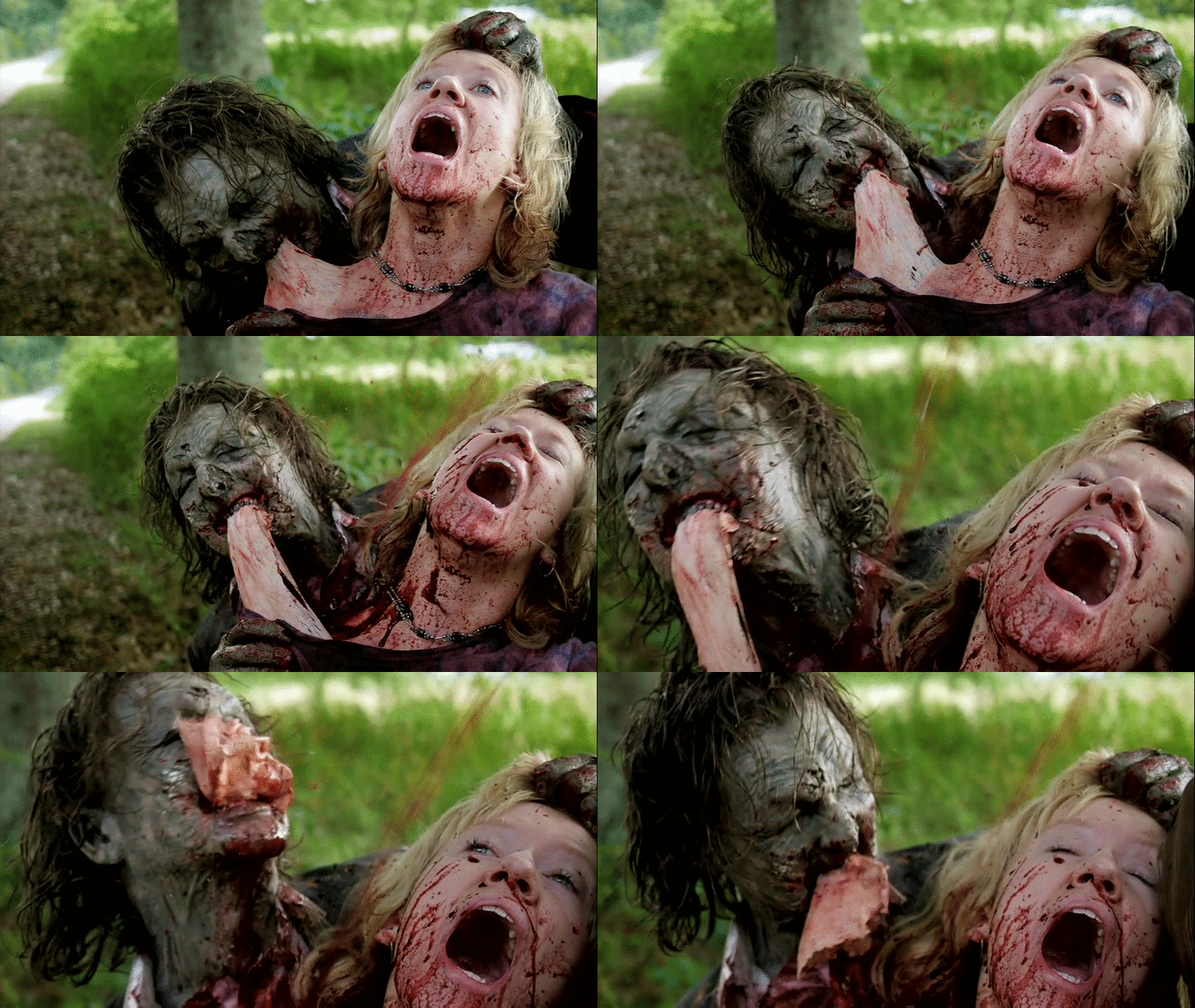
The detail on the practical effects are so finely tuned and done well that in trying to point out the rubbery, obviously fake demon body parts was seriously pointless. Every thing from costumes, to makeup, to exploding heads were rock hard solid in the results, even the sometimes over-zealous gore scenes in other gory films were exact and on point with camera angles, the right amount of blood, and not too hard to swallow when it came down to suspending disbelief.

The fantastic-driven story combines many horror subgenres from, the obvious, demonology, to the living undead. This doesn’t feel like another “run for your life while we’re being chased” type film as there are various facets and layered tangents to the story. Many characters are introduced and are quickly, but properly, disposed of and, for a film like “The Demon’s Rook,” this type of catch and release is suitable because death becomes a character and without death, in a movie with demons and zombies and black magic, you need death to breathe and live and in order to fully embody that death character you need victims and Sizemore, along with co-write Akom Tidwell, breaks the bank with disposable characters.

Tim Reis’s cinematography is beyond brilliant with the use of prominent coloring. The red, green, blue dense fog settings create an atmosphere like none other while the editing, cut also by Tim Reis, is easy on the transitions and easy to follow. Sizemore tackles the special effects department and seizes the moment to be relentless on the use of fake blood. These Georgian filmmakers will need to be watched closely as “The Demon Rook” is underground gold and I wouldn’t be surprised if we see rush of more films into production from this crew. The dialogue is my only small beef with “The Demon’s Rook” as it’s bit bland and a bit expositional, but I’m really reaching to find a flaw here. Most of the ambiance and dialogue becomes a bit jumbled at the beginning with sudden stops in sounds creating goofy transitions. However, this all seems to clear up fairly early.

Technically, the Cindedigm DVD looks amazing in a clarity sense with only a few blurry moments during forest scenes in it’s 16:9 widescreen format. The sound is balanced and consistent throughout even during the scenes or montages tracks from rock bands come into play. No sign of audio stifling nor hijacking. Plus, a good amount of extras come with the release such as deleted scenes, a making of, a gag reel, and bonus short film from Sizemore entitled “Goat Witch” which is just as amazingly disturbing.
Bringing old time practical monster classiness to the modern age is risky business, but director James Sizemore’s and Akom Tidewell’s passion and thirst for hallmark classic demons and zombies resurrects legends back to the indie scene and by adding in his own terroristic tastes, the Black Rider Productions duo also conjures up something new with the vibrant coloring. I would compare Sizemore to the satanic or cult likes of Rob Zombie, to a young George A. Romero with the zombies, and to a special effects genius such as Tom Savini. Don’t consider Sizemore a hack of icons; he’s certainly not, but he displays his own style by slowly sliding that sharp blade into the stomach with perverseness pleasure and that, my friends, is Sizemore’s contribution to chaos.
 It's Bloggin Evil!