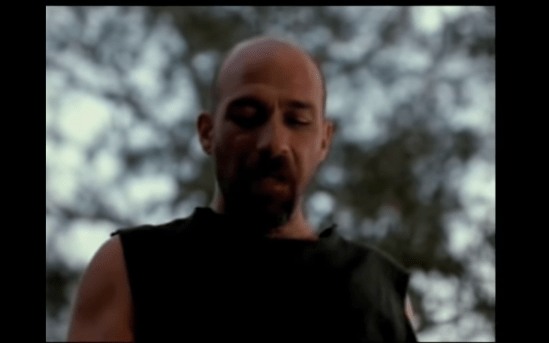
Screenland’s Bright Lights Can Turn One Lonely Man EVIL! “Hollywood 90028” reviewed! (Grindhouse Releasing / 3-Disc Blu-ray and CD)

“Hollywood 90028” 3-Disc Collector’s Edition Can Be Preordered Here!

Having moved West from a small Ohio town a few years back, photographer and video cameraman Mark found himself stuck shooting nudie reels for a low-budget porn producer.   A solitary life lends Mark more freedom then most to wonder about and driver around on the streets of Hollywood with ambitions for a legit job of shooting regular material that doesn’t humiliate him.  Troubled about his childhood past involving the death of a younger brother and with his frustrations within his video film capturing vocation, Mark finds himself in the company of young, attractive women who find him easy to talk to and attractive as well, but when Mark reaches a limit, aberrant thoughts take over and he strangles them to death.  When he meets starlet Michele on one of his shoots, Mark believes he’s found the woman for him, one that can relieve the pressures of life and work with nothing more than her beauty.  For Mark’s abnormal mind, love at first sight might not be that easy.
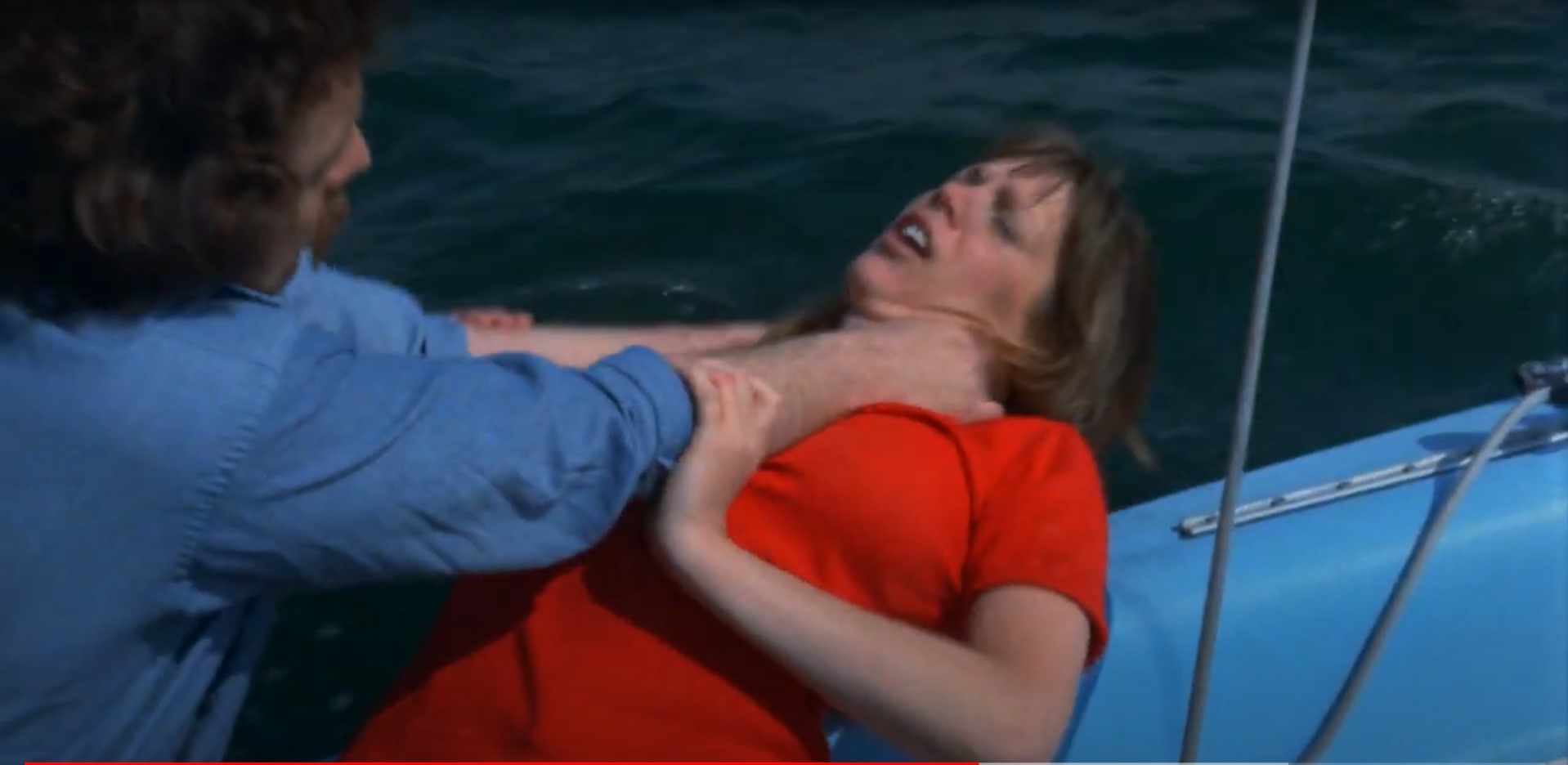
Writer-director Christina Hornisher tackles trauma induced behavior and the Hollywood pull of small-town aspirations chasing dreams in the drama-suspenser character piece of “Hollywood 90028.”  Hornisher’s debut feature film released in 1973 also became her only feature credit as a director who supplied arthouse substance but also embodied a different kind of substance, the grueling confiscation of hope for work, stardom, and love, perhaps even sliding into a bit of escapism, as the bright lights of Hollywood draw the flies to the flame.  Shot on location in and around the Hollywood, Los Angeles area that also had scenes fillmed directly at and underneath of the self-referential hillside Hollywood sign landmark before the iconic, globally recognized attraction had been fenced-off with visitation restrictions post-film in the 1980s and further protected with security systems in the mid-1990s.  Hornisher also self-produced the film which was also known under alternate titles as “The Hollywood Hillside Strangler,” “Twisted Throats,” and “Insanity.” 
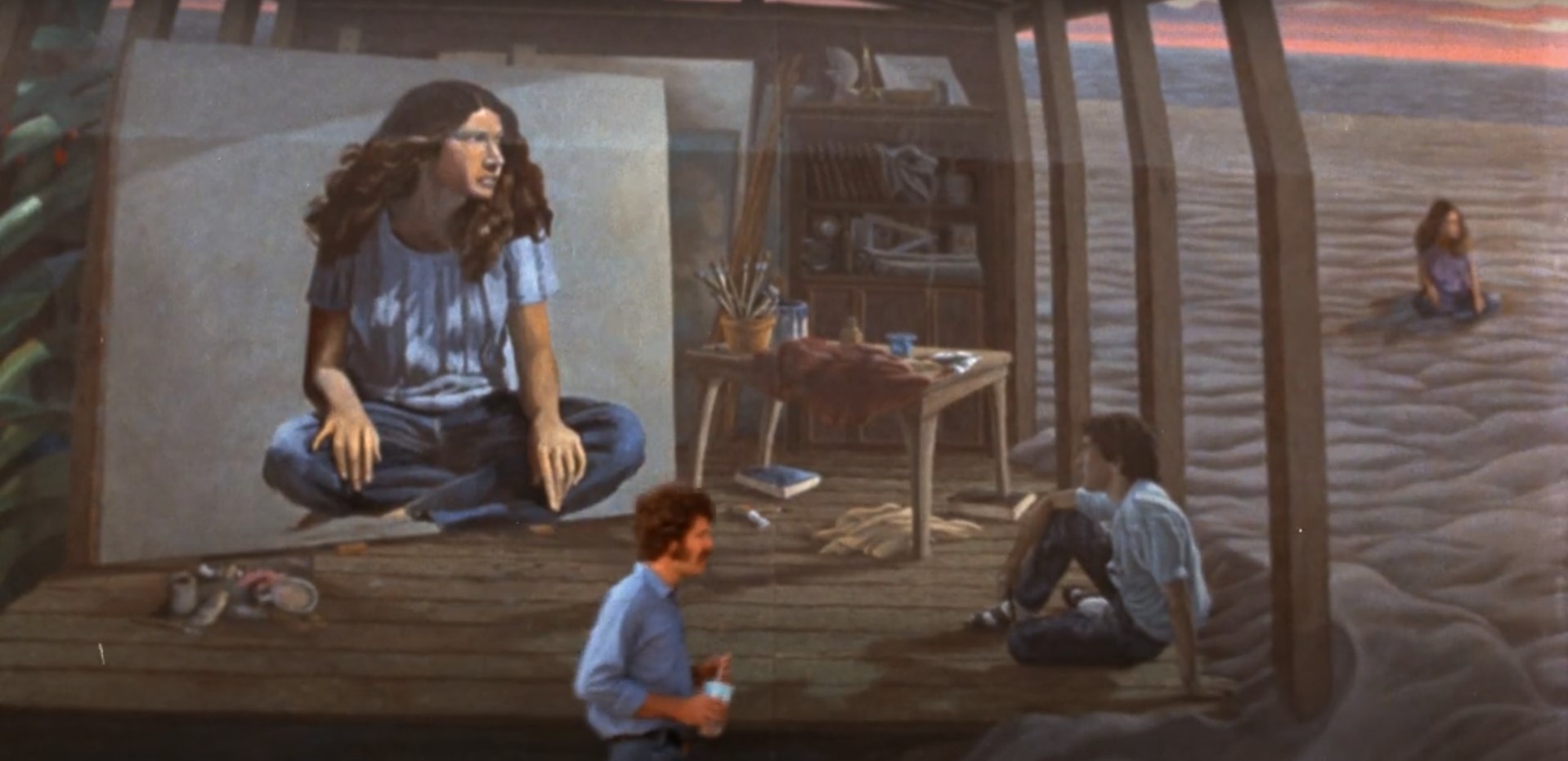
Christopher Augustine, who would also have a part in “The Doll Squad” of the same year, played Mark the calm and restrained pornography cinematographer and editor.  Not as sleazy as his title, Mark’s reserved nature doesn’t stop him from photographing and working diligently on splicing film without completely cutting off from the world but does make him quiet, observant, and intriguing, or so does Michelle thought.  Michelle’s a smalltown girl who moved West to work in the fame industry who soon finds herself being financially forced out of legit paying gigs for more sordid, sleazy work.  Played by Jeannette Dilger, who would actually have a role in the adult film “Young, Hot ‘n Nasty Teenage Cruisers” a few years later, she would spark chemistry with the mustached Augustine that allows their Mark and Michelle to fall in love that isn’t amorously glamorous but has innocent notes of flirtation and a lot of walk-and-talk realism onscreen relationships tend to omit.  Hornisher determines Mark to be the centerpiece of her character study.  Every scene caters to Mark’s interactions with Michelle, his professionalism with sleaze producer Jabol (Dick Glass), and the two other women he meets and eventually strangles.  Where Hornisher isn’t her best is in the building up of Mark’s suppressed sociopathic behavior, stemmed from a brief opening montage of a preteen Mark and his large family that implies his involvement in the accidental death of a younger brother, with ever delicate triggering that doesn’t solidify calling back to his aggressive-resulting trauma.  “Hollywood 90028” cast rounds out with Dianna Huntress, Beverly Walker, Kia Cameron, Ralph Campbell, Melonie Haller and Gayle Davis.

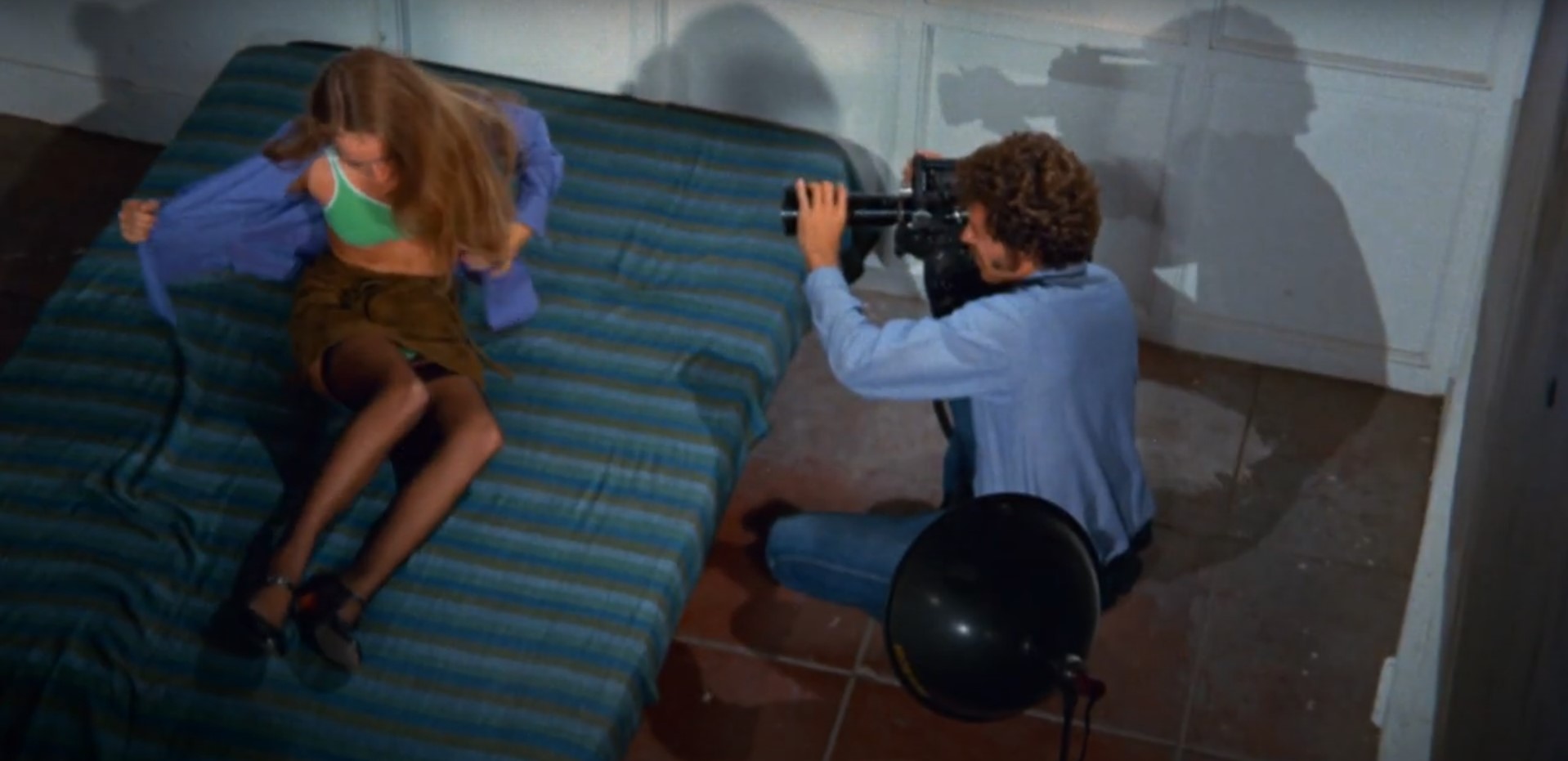
Though her first feature credit, Hornisher had the makings of a competent, auteur filmmaker.  “Hollywood 90028” evaded the conventional narrative structure and one-trick pony photography with more arthouse ambition that saw not only panning and tracking in her cinematic cache, but a stunning and incredibly quick finale zoom out from the Hollywood sign of smooth drone quality but completed in 1973 with a helicopter soaring over the Hollywood district.  Use of spliced-in cells of modeled sex representation as well as sign denotations of the character’s dialogue and thoughts, a kaleidoscope lens utilized during an intimate love scene, and the greater use of off-screen dialogue over on-screen conversating creates a thin layer of psychological realism in contrast to the actual realism between Mark and the rest of the characters.  Mark’s sullen display of emotions throughout the story culminates with his unconscious destructive demise after finally expressing a sliver of elation with Michelle but that’s also when he realizes that his tragic past and present psychosis will never let him go and will destroy anything that tries to replace it.  In one theory, Hornisher might have kept Mark in the same clothes throughout most of the picture to depict a deranged mental image; his constant choice of clothes is a hangup that can’t be let go for sharp-eyed viewers who wish he’d change out of his denim, long-sleeved shirt and denim jeans.  Unlike Mark’s unchanging denim statement, Hollywood in Hornisher’s film is a city captured in time; much like the Hollywood sign had gone from an area of loitering to now protected from the public, the fornicated fleapits and the colorful and character-building structures of Hollywood have long since been razed and rebuilt into the more glamourous, if not still snakebitten, Hollywood you see today. 
Grindhouse Releasing has gone the extra mile in not releasing a standard version of “Hollywood 90028” with standard fare and a rink-a-dink, barely passing muster transfer, but releasing a definitive chef-d’oeuvre of this lost Christina Hornisher film.  The new 4K restoration created from the original 35mm negative makes a statement that they underrated, underappreciated and the underbelly of indie cinema will not be ignored and, instead, be celebrated in retrospect, recoloring, and painstaking supervision in the efforts of all areas of rejuvenation.  The 3-disc, Blu-ray and CD set has an AVC encoded, 1080p high-defintion, 50 gigabyte capacity on the feature disc.  Presented in anamorphic widescreen 1.85:1, the Grindhouse Releasing restoration gives “Hollywood 90028” a fresh coat of paint on a precise saturation spectrum and illuminates details from the limitations of untouched, processed 35mm triacetate.  The original negative appears to have survived the test of time with barely perceptible, thin vertical scratches that were more sporadically sparse than a nagging nuisance.  Grain’s healthy and natural looking in the overlap and the contrasts levels clarify stark delineation and depth, attributing to finer details on textures and skin tones when mostly interior scenes.  Exteriors lose some definition because of the natural lighting and contrast levels typically lower to more create deeper shadows and amalgamation between object and background.  Video bitrate decodes a nice low 30s Mbps. The back cover does not provide explicit specs for the audio but my setup picks up the English language mix as a DTS-HD master audio stereo (the menu setup states mono) is the adequate acquaintance to the visual elements with an ADR dialogue recording, that to note has nothing to do with the release’s presentation, does feel detached in some regard to the visual character temperament despite its well-preserved clarity and projection, but the real star of the audio makeup is the Basil Poledouris (“RoboCop”, “Starship Troopers”), remastered by Jussi Tegelman soundtrack that is a delicate and absorbing mix of piano, wind-instrument, and percussive that reflects Mark’s wondering loneliness and reserved longing as well as introducing jazzier sax and guitar tracks for livelier montage moments.  Suddenly, we’re thrust into string-laden, semi-dark and low-tones for Mark’s buried spiraling. English subtitles are available.  Grindhouse Releasing had some so bonus content they added a second disc with the first containing audio commentaries with film enthusiast Marc E. Heuck, the film’s editor Leon Ortiz-Gil, and cult and porn director Tom DeSimone who attended UCLA with Hornisher, the original, unrestored, X-rated alternate scenes, Christina Hornisher’s experimental 16mm short films, cameraman outtakes, still galleries, radio spots and trailers under the “Hollywood Hillside Stranger,” the “Hollywood 90028” trailer, and the Grindhouse Releasing coming attractions.  The second disc contains retrospective interviews with stars Christopher Augustine, Jeannette Dilger, Gayle Davis, and editor Leon Ortiz-Gil in a near feature length making-of, a theater presentation discussion with Christopher Augustine, and a Tom DeSimone retrospect on Christina “Tina” Hornisher.  The third disc, a soundtrack CD of Basil Poledouris eclectic composition, is 17-tracks deep and comes in a customer sleeve inside the beautifully illustrated and tactile slipbox.  Instead, a slightly larger than normal Blu-ray Amaray case without the Blu-ray logo with the original poster art as primary cover with the new slipbox art on the reverse side.  The Blu-rays set on top of each other, staggered, on the right side while the left houses a 24-page booklet filled with color pictures, poster art, and historical, anecdotal, and analytic context essays from Marc E. Heuck, David Szulkin, Richard Kraft, and Jim VanBebber.  Grindhouse Releasing’s region free “Hollywood 20008” hits retail and online stores November 26th and has an 87-minute runtime under it’s not rated package

Last Rites: Grimy Tinsel Town sets the backdrop and insidiously swirls inside the mind of the forefront encased and bejeweled inside a Grindhouse Releasing special that’ll never have you look at Hollywood the same again.

“Hollywood 90028” 3-Disc Collector’s Edition Can Be Preordered Here!

The Slammer is Full of Correctional Officer EVIL in “Lust for Freedom” reviewed!

The Jailed Chicks “Lust for Freedom” on Blu-ray!

Broken by the violent death of her partner, who she was also engaged to marry, after a drug bust goes south, undercover officer Gillian Kaites abandons law enforcement and drives across country in an internal turmoiled mess.  She’s pulled over by a Georgia County cop after she aids a frantic woman fleeing to escape two men in a black van.  Framed for narcotics possession by the corrupt officer, Gillian is drugged and locked away in the County’s women’s penitentiary overseen a strong-handed matron and an unscrupulous warden who dabbles in prostitution trafficking, drug smuggling, and even the occasional snuff filmmaking.  Back into a cellblock corner, Gillian must defend herself against the warden’s goons, protect other girls also falsely incarcerated, and lean into the sympathetic ear of the same corrupt cop that framed her after voicing his years of disgust with the warden’s malfeasance.

Part II of our bamboozled behind bars and following the 1986 examination of Eric Karson’s military simulation turned enslavement “Opposing Force,” is our next feature helmed by another director named Eric, notably Eric Louzil, with “Lust for Freedom.”  The debut film of Louzil, who went on to helm “Class of Nuke ‘Em High Part II and Part II” for Lloyd Kauman and Michael Herz of Troma Entertainment as well as slaving over standalone horror and sleazy schlockers in “Bikini Beach Race” and “Night of the Beast,” was also the first feature penned by the American-born, UCLA grad with a penchant for low-budget lewidies, cowritten alongside the “Shadows Run Black” writing duo, Craig Kusaba and Duke Howard.  With the working title of “Georgia County Lockup,” which in actuality the film was shot in various California and Nevada locations, such as Ely, Nevada, “Lust for Freedom” is an 8 x 8 cell of nudity, violence, and corruption under the co-production companies of Mesa Films and Troma Entertainment, with the latter reediting the original script and adding ADR adlibs to apply a sexed up and Troma-fied integration of product into their independent collection.  Louzil and Laurel A. Koernig produce the film with Troma bigwigs Lloyd Kaufman and Michael Herz as executive producers.

“Lust for Freedom” has many eccentric characters with many assorted plotlines in what is essentially an all women battle royal brawl in the cat-scratchin calaboose.  Stirring up trouble like a piece of scrap metal lodged in the gears of a well-oiled machine is tall and beautiful former cop, Gillian Kaites.  Played by Melanie Coll in her only known role, Kaites is only the bear in the bees’ nest, forced into confinement under false pretenses and to be subjugated by the likes of a wayward officialdom with lust in their eyes, greed in their pockets, and a disdain for disobedience.  Coll’s a bit flat footed with her performance and her Karate Kokutsu Dachi stance could use some improvement, but the tall, muscular, curly haired and light blonde actress can wield a multi-round popping automatic rifle with authority.  Stark against her Amazonian physique, not in a hard pressed and sexualized way, is main antagonist is the unbecoming Southern gentleman Warden Maxwell under the balding and overweight guise Howard Knight, but Kaites is more in tune against the procrustean penitentiary matron Ms. Pusker and Judi Trevor gives a Hell in a cell pastiche of early fascist women of Roger Corman produced WIP films, enforcing her will with prison muscle in the miscreant tough Vicky (Elizabeth Carlisle, “Evil Acts”) and the oversized guerilla (professional wrestler Dee “Matilda the Hun” Booher, “Spaceballs,” “DeathStalker II”).  Ultimately, Kaites sees her only path to escape through the very same person that wrongly confines her in the first place.  William J. Kulzer (“Class of Nuke ‘Em High Part II:  Subhumanoid Meltdown”) doesn’t quite fit the corrupted bill of Sheriff Coale, a mild manner and seemingly reasonable officer who goes with the despicable flow of sex trafficking amongst other indelicacies.  Yet, maybe that’s the purpose in Kulzer’s character, to be conflicted by the choices he and his callous cohort has made that made him stick out as the least repulsive individual behind the concreate and metal barred big house.  “Lust for Freedom” rounds out the cast with Donna Lederer, John Tallman, George Engelson, Rob Rosen, Shea Porter, Rich Crews, Raymond Oceans, Elizabeth Carroll, Lor Stickel, and Joan Tixei.

Gratuitous, full-frontal lesbian sex.  Yes, “Lust for Freedom” appeals to the very definition of its own title, like many other WIP productions and though a core element to the integrity of the subgenre, the creamy smoothness of two curvaceous, naked bodies getting it on shouldn’t always be the main selling point.  Luckily, Louzil ponies up more salacious material for his pinks in the clink caper.  An elaborate spiderweb of activity balloons and pulsates outward from the moment Kaites crosses path with an evening-dressed escapee being chased by a scary looking Native American and his sociopathic hooligan partner in a black van.  “Lust for Freedom” may be hammy and cheesy but what it’s definitely not is dull in its multifaceted approach to expose character layers.  Some characters grade more toward deviancy, such as Warden Maxwell and Ms. Pusker, while others are lifted toward a more redemptive means, such as with Sheriff Coale; that shepherd “Lust for Freedom” into a culminating jailbreak.  The narrative doesn’t necessarily focus around Kaites but she’s on a redemption arc to dig her out of a despair pit and into a fight worth fighting for purpose after the death of her finance, set up in the opening act.  As she evades the Vickey’s directed infringement to rough up the new girl, Kaites takes under her wing a fright clink chick named, another wrongly accused prisoner after being taken wandering the road, a theme that is a reoccurring motif from Kaites to Donna in thinking the young women can manage the world and their problems on their own accord but at a cost. However, whatever semblance is left of Louzil’s original script has likely been lost once Troma revamped it into the finished product you see today. Riddled with choppy cuts and incoherent segues, we have to wonder about Kaites’ role that may have been transmuted into a lesser core commodity in the final product.

Troma Entertainment releases a high-def, Blu-ray release of “Lust for Freedom.” The AVC encoded, 1080p resolution, widescreen release, in a 1.78:1 aspect ratio, compressed from its original aspect ratio of 1.85:1. Lloyd Kaufman mentions Louzil had shot the film on 16 mm and Troma subsequently blew up the negative to a 35 mm print that reframes the transfer for projection. Image-wise, the picture appears relatively clean albeit a plush grain and a few visible 16 mm cigarette burns with little-to-no age wear or exposure issue and the BD25 storage format has capacity aplenty to render an adequately compressed image with hardly any loss to the quality. Since the quality is heavily granulated, definitely no DNR implemented, the compression doesn’t suffer from a lack of a sharper, restored image. The audio is an English language Dolby Digital 2.0 Stereo can be echoey at times, as if the boom is catching warehouse reflection, but dialogue does topple in an appropriately laid out track mix that’s intertwined with hair metal band Grim Reaper’s titular “Lust for Freedom” single. We don’t get a ton of depth in the close quarters of the prison set but neither do we receive any depth in the exteriors either, sustaining most of the volume in a forefront stasis. Troma adds spotty ADR to kitschy up to Troma’s ludicrous level and its quite evident like a sore thumb that doesn’t quite match the ingrained audio mix. There are no subtitles available. Extras include the original DVD intro by Lloyd Kaufman, which also plays automatically at the startup of the feature, a directory’s commentary by Eric Louzil that is asynchronous with the feature in what is an approx. one-minute delay behind the Louzil’s retrospect, the original theatrical trailer, an interview with Lloyd Kaufman, a brief, brief clip of Eli Roth’s encouragement to just go and do a movie to the best of your ability, a Troma-themed showcase of one of their more modern Tromettes – Mercedes the Muse, the Radiation March, Gizzard Face 2: The Return of Gizzard Face, which has been on a slew of Troma’s releases over the past year, and coming attractions from the independent company. The Blu-ray comes in a tradition snapper with a guard tower, barbed wired, and Gillian Kaites with a semi-auto in her grip and barely cladded and torn clothes. No insert inside the case and the disc pressed art is the same as the cover illustration. This Troma release comes unrated, is region free, and has a runtime of 94 minutes. Plenty of desire for “Lust for Freedom,” busty babes behind bars barely bores and this vintage Troma keeps the WIP lacquer wet with self-satisfactory sadism and sexual spiciness.

The Jailed Chicks “Lust for Freedom” on Blu-ray!

Nothing Will Stop EVIL From Being EVIL! “Chaos” reviewed! (Dark Force Entertainment & Code Red / Blu-ray)


Visiting home on break from UCLA, Angelica visits her close friend, Emily, at her parents’ secluded country home. With nothing else better to do in the small rural town just outside Los Angeles, the two teenage girls set off early to attend a local rave deep within the woods at the reluctance of Emily’s overprotective parents and to kickstart what could be a drink and dance fueled night, they aim to push the limits and find a drug pusher to score ecstasy as the first priority to make a dull party fun. They run into Swan who promises the best ecstasy as he leads them to his cabin away from the rave. What Angelica and Emily find is themselves caught in the middle of a ploy by a sadistic gang lead by the ruthless Chaos, whose wanted in 4 states for his barbaric and merciless methods and looking for something fun to play with and torture. The cat-and-mouse game with the girls makes an interesting turn when the gang arrives at Emily’s parents’ house when their van breaks down and the parents suspect them in Emily’s sudden disappearance, veering the night into unreserved chaos.

“Chaos” is the intended true love song remake to Wes Craven’s 1972 sadistically vile “The Last House on the Left” that’s co-produced by Marc Sheffler, who play Junior Stillo in Craven’s film, and, at one time, Krug himself, David Hess, was attached to the project. “Chaos’s” conception is the brain child of Steven Jay Bernheim and David DeFalco, with the DeFalco wielding the hammer of writer and director, and the pair have collaborated a few years earlier on another DeFalco directorial, a comedy horror entitled “The Backlot Murders.” In the eyes of the filmmakers, the amply charged exploitative “Chaos” shares more in common with the original “The Last House on the Left,” despite having no official connection other than the ties with Marc Sheffler, and that the more commercialized remake of the same original title, released four years after “Chaos” in 2009 by Universal Pictures Home Entertainment (UPHE), lost that raw camerawork and visceral storytelling that depicted the abhorrent human malevolency that’s capable from within us all. “Chaos” is essentially a self-funded project from Steven Jay Bernheim’s Bernheim Productions.

Though Sage Stallone, the late son of the iconic action movie star, Sylvester Stallone, receives front cover bill due to, in perhaps, his name alone, but the film is called “Chaos” which centers the story around the “Heat” and “Laid to Rest” actor, Kevin Gage. In some kind of cosmic circumstances in regards to recent events, before the Kelly Preston settled into married life with John Travolta, she was once wedded to Gage, marking “Chaos” as a timely film from 2005 and a just so happened upon my lap occurrence for this review. Yet, Gage, a seemingly giant of a man with a resemblance build toward WWE/WWF’s legendary Bill Goldberg, utilizes his intimidation appearance, transferring all the good and gentleness that’s described of him from fellow costars into a pure embodiment of evil whose misogynistic, bigoted, a killer, and just a downright bad guy giving way a testament to the character’s adverse moniker. Gage brings to the table a formidable tone, viperous wit, and a clean cut brutality in the most sordid and unforgettable ways that makes him stick out as portraying one of the most inhumane villains in the last 15 years of the cinematic universe. Chaos’s infamy is by ingenious design from the Marc Sheffler and David DeFalco collaborations who, along with the actors’ faux backstories, meticulously craft each of the gang’s personalities. Sage Stallone’s Swan seems like a similar parallel version of Sage in reality as a chain-smoking, reserved individual sans the perverse context. “The Love Witch’s” Stephen Wozniak is a complimenting character that offerings a different personality with Frankie and Frankie’s feels like a two-bit slime ball with long, greasy hair, an unkempt beard, and a scrawny figure but can produced an evil that’s step or two back from Chaos; Frankie is a character you’ll love and you’ll love to hate, making Wozniak’s performance singular and one of the best in the film. Then, there’s Daisy, the only female of the group though more butch than delicate, and Kelly K.C. Quann (“Baberellas”) adds a dose of Southern inhospitality to Daisy’s brutish beauty. “Chaos” rounds out with a bunch of victims; hell, everyone’s a victim, but the cast includes Deborah Lacey, Scott Richards, Maya Barovich, Chantal Degroat, Ken Medlock, and Jeb Barrows.

“Chaos” absolutely equates toward the unflinching callous themes from “The Last House on the Left” of violence amongst various degrees of people, youthful ingenuousness, and systematic racism with the latter being extremely relevant and on point, years earlier, of the current social climate in America. Yet, with any remake, “Chaos” yearns to stand on its own by instituting an unmeasurable sense of graphic violence that will churn stomachs, advert eyes, and belly-up the throes of disgust. For a good portion of “Chaos,” the exploitation narrative is fairly run-of-the-mill, damn near walks the same line as Craven’s story, with a sadistic gang kidnapping two young women for their own amusement only to then wander unknowingly into the arms of retributive parents, but two scenes sticky out and go beyond the course of customary exploitation fodder and into necrophilia, mutilation of body parts, and a perverse way to kill another human being with such tactless intentions that the act makes the other gang members splay questions, doubt, and fear amongst their faces. The film opens up with a written warning, not so much on the intense scenes themselves, but resembling more of a public service announcement for parents that what you’re about to see does and will happen to the youth of land, but these shocking scenes are just that, for shock value, and that a small percentage of people partake in such grisly matters. “Chaos” is violence upon violence, leaving no room for conscious absolving resolutions in the unofficial capacity of a remake that pungently separates itself with extreme violence and that’s saying something considering Craven’s visceral first course.

As the bestow flagship release of Dark Force Entertainment, “Chaos” arrives onto a deluxe special edition Blu-ray in association with Code Red and distributed by MVDVisual. Transferred through to a 1080p, high definition scan, from the original 35mm negative, complete with extensive color correction, and presented in a widescreen, 1.78:1 aspect ratio. “Chaos” doesn’t look very chaotic anymore in regards to the image quality; instead, the before stardom cinematography by Brandon Trost (“Lords of Salem” and “Halloween” remake) creates the voyeuristic position of the audience is now visually distinct with stable color markers that are more in tune with the premise’s raw approach. The English language dual channel stereo mix renders softer than desired, especially in the first act as Angelica and Emily converse through the woods. The teenagers dialogue are nearly mumbling on their rave trek with depth issues perplexing their relation to camera. Range seems to be well faceted: rustling leaves through the woods, the clank-clunks of a rustic van, the ground skirmishes. All seem to exude exact decimals of their intended value. Even the firing of firearms has a pleasantry about it. The special features include brand new interviews with co-producer Marc Sheffler, who goes in-depth pre-production and production while also touching upon his other interests before concluding with director David DeFalco and a man in a banana suit making an appearance and offering up dick jokes, and actor Stephen Wozniak with a fountain of information about his time on production, his fellow cast, and about the filmmakers as he is being interviewed in front of a locomotive museum. I love the absurd, obscurity of it all. The bonus material rounds out with commentary from the director and producer as well as the original theatrical trailer. The lewd and radical “Chaos” has engrossing roots of violence that burgeon into realm of rarity or, if not, into sadomishsim extended by the filmmaker’s deepest darkest desire, but what’s transpires on screen is difficult to look away from which begs the question, is it morbid curiosity or is there something far more sinister within us all?

Own “Chaos” on on the new “Blu-ray” release!