The Cycle of Life Can Be EVIL. “Vivarium” reviewed! (Screener/Vertigo Releasing)


Gemma and Tom are a happily in love young couple who are looking to purchase a starter home. They visit a real-estate agency for a brand new housing development called Yonder. Met by a strange and persuasive real-estate agent, they’re convinced to follow the unusual agent to tour the neighborhood that has been marketed as the family forever home with everything they could ever need and want. A row upon row of identical houses and yards go as far as the eye can see and before the tour of the rather ordinary house number 9 ends, Gemma and Tom find themselves alone inside with the bizarre agent gone. Their efforts to leave the mysterious residential suburbia proves impossible as each turn leads them back to house number 9. When a box containing a baby boy is left at the doorstep with a note to raise the child to be released, the young couple reluctantly reside into domestic confinement.

Vivarium defined is an enclosure, container, or structure adapted prepared for keeping animals under seminatural conditions for observation or study or as pets, like an aquarium or a terrarium. “Vivarium,” the 2019 movie, embraces the definition, twisted into an idiosyncratic neighborhood block of duplicity from the “Without Name” director, Lorcan Finnegan. Story concept is flushed out by Finnegan and “Vivarium’” credited screenwriter, Garret Stanley, in their second collaboration for the director’s sophomore feature endeavor that’s a panicking puzzle in every square foot of Yonder’s backwards backyard. The film resonates with echoes of Finnegan and Stanley’s seminal short film, “Foxes,” from 2012, revolving around a couple living in a remote and forgotten housing development and become drowning in obsession, madness, and malaise as shrieking foxes surround their isolated home. There’s an equating animalistic instinct to each film that brandishes many of the same motifs as well as joining themes that are corralled in Finnegan’s copious foreboding and disconnecting dehumanization narrative. “Vivarium” is produced by XYZ Films (“Tusk”), Fantastic Films (“Stitches”), PingPong Film, and Frakas Productions (“Raw”).

The happy, young love birds are played by Imogen Poots (“Green Room” and “Black Christmas” 2019 released remake), who has an underlining affinity for not typecasting herself in the same role, and Jesse Eisenberg (“Cursed” and “Zombieland”), who manages to step a foot outside his conventional performance of a rattle mouth, know-it-all. However, Eisenberg deserves the praise of a man with severed ties from reality as the actor embraces a reserved manic by channeling Tom’s obsessive need to dig, an aspect of his handyman profession he’s good at in perhaps providing an escape from cage-less confinement, and being the bearer of skepticism of caring for an abnormal child. Gemma has complications of her own confronting her educator responsibilities for young children. She struggles with internal conflict, does she still use her innate care and instruct a young mind or in self-preservation, take Tom’s passive aggressive approach? Poots and Eisenberg share a mutual, caring bond that defines Gemma and Tom kind of steady, kind of loose relationship that gradually devolves civilly, like the amicable breakdown of a marriage revealing lost, but not forgotten love between two people. Along with the surreal atmosphere, “Vivarium” grades well in the creepy kid department with the child in Tom and Gemma care, but don’t even bother giving a name. Dubbed with a playful man’s voice, a shrill scream ignited by displeasure, a knack for imitating, and always dressed in Sunday’s best, Senan Jennings’ middle aged boy presence is a supernova of chilling proportions with a performance that gives his co-stars a run for their money while Eanna Hardwicke is equally spasmodic and creepy as the grown up, young man version of the boy with a little more alienating know-how and clandestine about his origins.

Finnegan and Stanley pursue thought-provoking substance of human corporeal limitations and how we, as humans, cycle through them with such cavalier ease. The opening scenes examples this with the practice of the common cuckoo laying their mimicry egg inside the nests of other birds. As a brood parasite amongst birds, the cuckoo egg hatches and the cuckoo chick pushes out the mother birds’ inborn chicks and becomes the sole chick in the nest with the surrogate mother tending to the cuckoo’s dietary needs. When the cuckoo is matured, it is grossly larger than the mother bird and, also, mimics the bird species to an extent, much in the same way of the boy or young man Gemma and Tom surrogate as being the unintended mimicry that infiltrates and ousts the limitations of his foster parents. Finnegan and Stanley also explore the parental lifecycle with the theme that our children will replace us, extend our legacy, but we will ultimately be forgotten. “Vivarium’s” craft dictates a larger scale, disproportionate, otherworld teemed with secret subterranean corridors leading to other disturbing observatory immures, making for a stimulating meta-induced terrarium as we watch miniature versions of Jesse Eisenberg and Imogen Poots suffer inside a screen from the comfort of our couch.

If you’re stuck at home, living the quarantine life you’ve always wanted, “Vivarium” may just break of your introverted stance on home with it’s “Black Mirror” and “Twilight Zone” encouragement. Because of the COVID-19 pandemic, the Vertigo Releasing and Wildcard Distribution released film has circulated digital only on the following platforms in the UK: iTunes/Apple TV, Amazon, Sky Store, Virgin, Google Play, Rakuten, BT, Playstation, Microsoft, Curzon Home Cinema, and BFI Player. Unfortunately, I will not be able to comment or critique of the audio, video, or bonus features of this release due to the varying elements of a digital screener. Novel, suspenseful, and a great film to brood over, yet difficult envisaging, “Vivarium” truly resembles slithers of somber dimensions of an upside world with lashings of surveillance paranoia.

Amazon Prime Video is one way to watch! Rent or Buy “Vivarium” with Prime Video

One Tough Cop Takes Out the Failing System’s Trash! “Vengeance: A Love Story” review!


Fourth of July. A holiday that celebrates the birth of the United States of America becomes the physical and psychological dismantling of a widowed mother named Teena who is viciously attacked while taking a woodsy shortcut home with her young daughter, Bethie. Beaten nearly to the end of her life and dragged to a vacant boathouse, Teena is gang raped by each of her four assailants and while Bethie managed to free herself from her attackers, the child is helpless as she witnesses her mother’s near-death assault. Bethie’s testimony and positive ID of the rapist is a seemingly slam dunk win for prosecutors that will hopeful open a slither of recovering hope for Teena, but when the accused parents hire an expensively sharp attorney that spins and attacks Teena’s character that night, the case quivers on the edge that leans more toward a non-guilty verdict. Detective John Dromoor, who found Teena unresponsive after the assault, had previously met with Teen and was familiar as a humble, energetic, and friendly acquaintance, but now seeing the single mother struggling to cope not only from her rape, but through a justice system that’s feasibly flawed, the Desert Storm, Purple Heart veteran embarks onto a covert, vigilante path to rid the world of justice elusive scum.

“Vengeance: A Love Story,” inspired by the novel with an edgier, yet more shocking title, “Rape: A Love Story,” written by Joyce Carol Oates, provides the foundational narrative for the Nicholas Cage produced and Johnny Martin directed 2017 dramatic thriller that’s quintessentially an alternate model of rape-revenge of inherent brutality and toxic judicial bureaucracy challenged by moral renegades defending the decency with lethal force. Penned by John Mankiewicz as his only non-TV related project, “Vengeance: A Love Story” is not like “Live Free or Die Hard” or an “Independence Day” in the sense that’s not a 4th of July type film, granted those two aforementioned films are plump with large scale action and though Johnny Martin is a stunt man turned director, his third feature film, set in upstate New York near the Niagara Falls, doesn’t regale tales from his previous trade that includes stunt work in “Zombieland” to “Se7en” and many, many more.

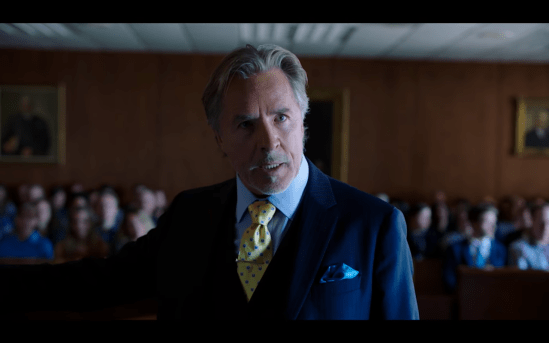
The introduction of detective John Dromoor staked out in his undercover squad car with a partner whose planning to pop the question to his girlfriend with a diamond ring. As his partner proudly displays the marital finger token, Dromoor is all business; in fact, Dromoor is all business, all the time. Reserved like Catholic deacon and deadly with firearms, Dromoor doesn’t have time to crack a smile and shows little emotion even when being a proxy of vigilante justice for an friendly acquaintance. “Mandy” star Nicholas Cage doesn’t rightly fit this role. The charismatic and eccentric actor runs through John Dromoor sedated with horse tranquilizer symptoms of stultified sluggishness, but when the moment strikes, like a rattlesnake latching on in a blank of an eye, the killer charisma of rugged resilience comes to the forefront, a quality Cage portrays well, and with vengeance in the title, should have reared up and lasted more often to let the very fervid fiber of the word sink in. When Dromoor meets Teena for the first time in the bar, prior to attack, romance seemed to beguile them between Dromoors lack of personality and Teena’s giddy, if not superfluous flirty radiance as she provides him her call me digits, but there was no romance, or at least no more romance provided, afterwards. Straying not so far from her cheerleader pepped character in “The Cabin in the Woods,” Anna Hutchison douses herself in a familiar upbeat tempo that quickly burns out when her character becomes the victim of gang rape scene. The wake of that scene challenges Hutchison to be more than just a pretty face, but an emotionally and physically battered woman suffering from traumatic stress and slut shaming. Hutchison’s goes through the various stages of trauma and the powerful relevancy has more staying power than the whole Dromoor vengeance byproduct, sending Nicholas Cage’s retribution into more of a subplot gray area. The remaining cast includes Talitha Eliana Batemen (“Annabelle: Creation”), Deborah Kara Unger (“Silent Hill”), Joshua Mikel (“Last Shift”), Rocco Nugent (“Dracula: The Impaler”), Joe Ochterbeck, Carter Burch, and “Miami Vice’s” very own Don Johnson as the hot shot prick lawyer, Jay Kirkpatrick.

Having coursed through the film’s various themes of rape, shaming, and the malfunctioning legal system, one more important theme inherently stands out with real pertinent clout issues. While two suspects, who are brothers, are arrested by Dromoor and his public servant colleagues, their venomous mother pursues hellfire guidance from a priest of the Catholic faith and as the father offers his spiritual insights, which is harmlessly conventional within the priest’s parameters, he also provides contact information for an expensive lawyer who represents the ill repute. Layers upon layers of thick symbolize can be extracted from the brief allegory, like an onion being unraveled toward a rotten core, unveiling the lengths and means of religious impurities. The fact that this priest knows of and has contact information for a powerful defensive attorney really speaks to Joyce Carol Oates’ deep-seated opinions rolled up in a single brilliant scene, but that’s where the momentum unfortunately ceases. There’s a schlepped through court hearing that’s entertaining enough and Dromoor’s barbaric rogue undertaking of the law that dishes out cold-hearted kills, but aspiration to convey more substance loses steam, the editing is systematically chunky, and Dromoor has this weird dynamic with Teena and her daughter that feels unintentionally stalker-ish and predatory. Yes, Dromoor protects and serves with unauthorized capital punishment, but without providing a deeper context of his purpose to what really motivates him to do what he’s doing, the act of retribution impressions another pressed upon imposition toward a mother and daughter’s prolonged anguish and feels more gross than justified.

FilmRise and MVDVisual distributes “Vengeance: A Love Story” on a full HD, 1080p Blu-ray presented in a widescreen, 1.85:1 aspect ratio, and the digitally shot video remains untarnished by nature or, lack of, age. No compression issues with the image quality and colors are super vibrant with a wide range of hues to take absorb. Skin tones, night scenes, and even the minimal visual effects address pinpoint consistency throughout. The English DTS-HD 5.1 surround audio track favors a strong, upfront dialogue track leveled with score and ambiance. The surround sound quality, when suitable, explodes through the channels with evidently solid range and depth. Runtime is 100 minutes and there are no other bonus features other than the film’s trailer, which has been consistent with FilmRise distributed releases. Nicholas Cage’s usual droll is riding the pine in “Vengeance: A Love Story” as if the Academy Award Winner wasn’t being paid enough to speak or act madly so he mentally sat this vendetta thriller out; however, the story has meaningful aspirations and the violence, though fleeting, is spiteful and merciless, framed around with tactless pacing, gratuitous macho shots, and circumstantial, at best, motivational retribution.

Click Above to Purchase the Blu-ray!

Strippers aren’t evil! Stripperland review!

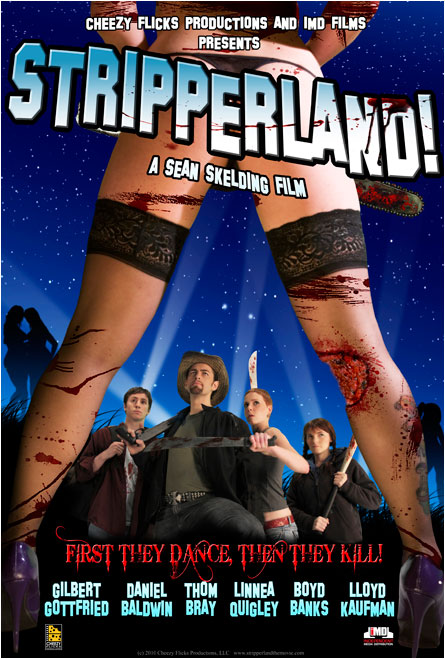
In all my days I would never consider the exotic profession of a stripper to be a bad thing.  These (sometimes) youthful ladies contribute to society just like the rest of us and perform a gentleman’s entertainment that will forever be the loner’s safe-haven and open ear to deaf, faux sympathizers.  Director Sean Skelding sees the pole dancing society to be the evilest place on the face of the earth as his film, Stripperland, has strippers from all shapes and sizes, dolled up in cheesy outfits, run an undead amok eating the guts of the living and mindlessly dancing to hip-hop music.

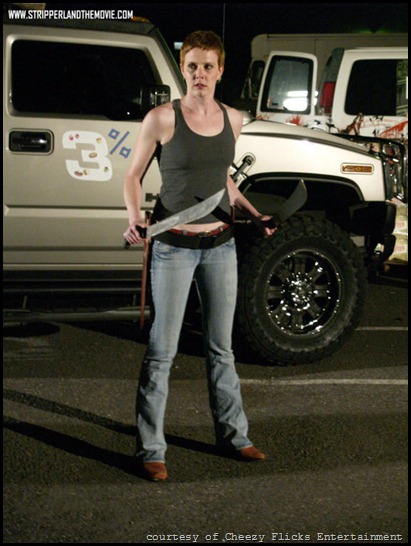
Idaho is an annoying college kid who lives by a set of exotic dancer rules that help him survive a world of undead, flesh eating strippers.  He meets Frisco, a man on a mission to destroy every stripper that steps in his path and to fulfill an obsession for home made baked goods, and they embark on a journey to Oregon, but before they arrive, West and Virginia, two uninfected females, trek with them in search for their Grambo.

Sean Skelding has a vision and that vision is to recreate that vision in a parody.  Stripperland parodies Ruben Fleischers’s 2009 Zombieland and, in all honestly, doesn’t do it very well.  Having strippers only come back to life to eat the living doesn’t make much sense to me; to have them dance to hip-hop music and crave one dollar bills as a distraction ploy has the same effect.  I get it, Skelding, Strippers are the epitome of mindless drones who seek nothing but sparkly objects, a fistful of George Washingtons and just want to dance all night long.  This concept could have been done with another storyline; why use Zombieland’s premise?  Stripperland isn’t a soul sucker of only Fleischer’s zomedy as it mocks a bit of Zombie Strippers (for obvious reasons) and Romero’s Day of the Dead (with Thom Bray as Dr. Logan).

Continue reading