
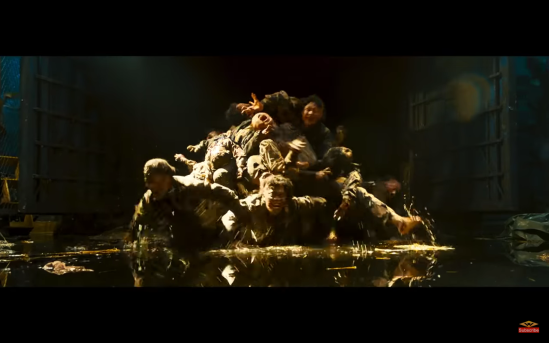
For four years after the initial zombie outbreak, a unified Korean peninsula is completely quarantined from the rest of the world with the remaining survivors having to fend for themselves. A former Korean Captain, Jung Seok, who was one of the last survivors to escape pre-quarantine and now lives in Hong Kong, is hired for a four man team to return to the peninsula and retrieve an unmarked and abandoned truck stowed with $20 million dollars in U.S. currency. With a promise from a Hong Kong mafia boss to keep part of the loot for their recovery services in order to start a new life, the team agrees to the terms and embarks on the seemingly succeed mission only to find survivors who have gone mad, pillaging their mission and conscripting them into a malicious betting game of survival in a watery pit full of zombies.
The highly anticipated sequel to South Korea’s 2016 sleeper zombie hit, “Train to Busan,” docks into U.S. theaters and VOD services on August 21st and is entitled simply, “Peninsula.” From the bullet train rails to the a devastated Korean port, the predecessor film’s director, Yeon Sang-ho, returns with a zombie overrun post-apocalypse that completely metastasized Korean derived from a biological agent quickly spreading throughout the two cinematically unified, North and South Korea. Joo-Suk Park returns as co-writer alongside Yeon to provide heart clenching, brutal action-horror suspense and a human sense of selfless compassion that won the hearts of many genre fans with “Train to Busan.” Zombie hordes rampage down streets, alleyways, and toppling over cars, fences, and other structures as a collective flesh easting unit that specializes in dominating and ravaging for the pure motive of infection and while that sounds all hip and cool that the “War World Z” and “I Am Legend” running zombie pandemonium makes for a glitzy entertainment feedbag, the Next Entertainment World and RedPeter Film production punches down on the gas pedal of gaslighting audiences with more of a “Fast and Furious: Tokyo Drift” with zombies, revving more to the tune of an exasperated exhaust rather than finishing strong with gripping storytelling.
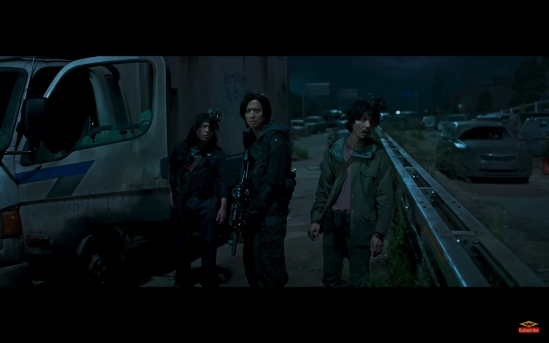
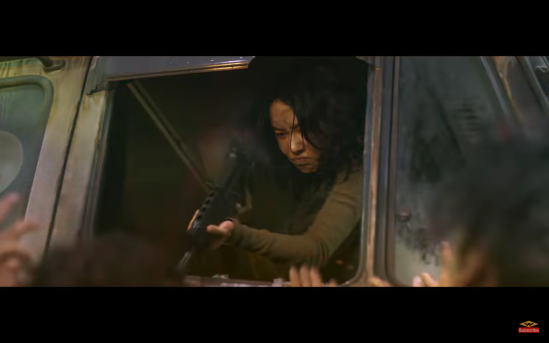
As a standalone film, the story doesn’t return the surviving characters from “Train to Busan.” Instead, a whole new set of characters reset the parameters of expectations, starting with the guilty conscious of the grief-stricken ex-soldier, Jung Seok, played by Dong-won Gang, who will star in Scott Mann’s upcoming disaster film “#tsunami.” Seok’s a reserved and stoic individual whose good a gun play, but isn’t the thinker when a plan is needed in place and while Dong-won Gang gives a par performance, the overall package of the lead character is sorely two-dimensional. This leaves room for other characters flourish, such as the mother and children Seok attempts to save on a second go-around. The mother, played by Lee Jung-hyun, has more grit that clearly defines her underlining hope for not only her salvation, but also her children who’ve known nothing but death, destruction, and meaning of being devoured growing up in the midst of a zombie apocalypse. On the slim change of success, she implements a plan to infiltrate Unit 631, former military turned murderous scavengers, to steal back a satellite phone and a truck full of cash while not becoming zombie chow or get caught in Unit 631’s sadistic survival methods. That brings us to the villains, the real villains, where are not the zombies, but the section 8 soldiers of Unit 631, Captain Seo (Koo Kyo-hwan) and Sergeant Hwang (Kim Min-jae). Though Seo and Hwang bring internal tension to the table, a mental game of cutthroat chess, they’re inevitably soft against the main threat, a combined effort of Jung= Seok and Min-jung, and don’t spill enough blood and craziness onto the screen to make them worthy of the antagonist position. “Peninsula” rounds out the cast with Kim Do-yoon, Lee Re, Lee Ye-won, Moon Woo-jin and Bella Rahim.
As almost methodical as it is with any second film in a series, “Peninsula” failed to be a rejuvenating and transcending sequel to “Train to Busan,” abandoning the first story’s benevolence for CGI flair that extends to not only the zombie hordes, but to the car chases. As excellent as the rendered zombies are slammed against the drifting cars can be represented, in what “Peninsula” can be described as an “Escape from L.A.” meets “Land of the Dead” meets “Mad Max: The Road Warrior,” the cars themselves are a product of computer imagery with little authentic driving happening. While the effects are not bad (they’re pretty good chiefly obscured by dim lit night scenes), the sensation of being scammed can’t be ignored as the vehicles operate unnaturally and maneuver in impossible situations without blowing a tire or upending or just frankly be dead in the water with an overheated and stress tussled engine that frags zombies left and right, becoming a collective character to have the highest kill count. That disingenuous feeling also spreads to the overly long-winded ending that tries really, really hard to capture a courageously defiant and heroic moment of family and personal redemption and much of the blame lies on director Yeon Sang-ho with a drawn out awkwardness and edit that made it seem satirical. In light of some positive words for “Peninsula,” the zombies are a greater, gigantic force that swarm on a colossally epic scale more so than the much more compact “Train to Busan” and, as aforementioned, the structured CGI isn’t of the degraded detail variety so the hordes never look cheap or obviously artificial alongside the more palatable, practical versions. What’s also interesting about “Peninsula” and what makes it separate from “Train to Busan,” which perhaps laid the foundation for, is “Peninsula” has integrated the western counterparts as English speaking actors chime in as U.S. Military, U.N. peacekeepers, or English mafia bosses based in the U.K. This challenges the Korean actors to speak a few different languages, especially English, inclining “Peninsula” as more of a global problem than an isolated Korean one.
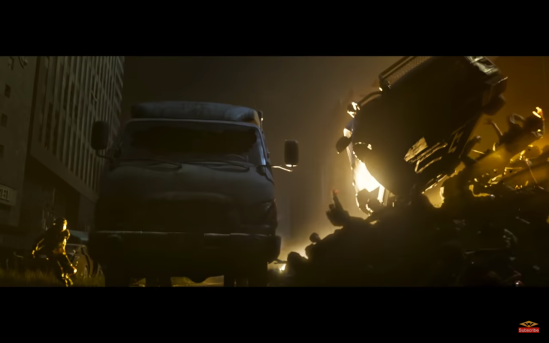
The zombie genre isn’t just defined by the ungodly amount of undead bodies reaping the world of every living soul, but is also defined by the diversity of chaos-driven social structures people find themselves confronted with in the action-heavy “Peninsula,” arriving into U.S. theaters on August 31 and distributed by Well Go USA Entertainment. This review will not contain the A/V aspects of the release as it’s a theatrical screening of the feature, but the theater specs will look something like this: projection is in scope lens format at an aspect ratio of a widescreen 2.39:1, a surround sound 5.1 stereo mix, Korean/English/Cantonese language with English subtitles, and has a runtime of just under two hours at 116 minutes. I will note that some scenes are very dark, but this only adds to the complete blackout of a civically desolated Korean peninsula. From fast trains to fast cars, “Peninsula” has retained the adrenaline popping rampant style with weaving, bobbing, and chassis chucking zombie bodies like the ball in a pinball machine despite a facile approach, but is ultimately missing that down-to-Earth social context complexity aimed to provoke thought and shed a few tears as an inferior part two of the “Train to Busan” universe.
Category Archives: action
EVIL’s a Little Furball Wielding a Submachine Gun in “Killer Raccoons! 2! reviewed! (Digital Screener / Indican Pictures)

Ten years after the campsite mayhem of a raccoon attack that supposedly killed everyone and incarcerated Ty Smallwood for a decade in the wake of a governmental coverup, Ty, who now goes by the name Casey, is released from Prison located in Independence, Colorado and meets up with his pen pal Darlene, the younger sister of Ty’s girlfriend who was murdered by the killer raccoons. The two board a train on Christmas Eve heading toward Washington D.C. where Casey will attempt to explain to Darlene just how his sister died, but the thought dead former camp counselors, conscripted by the sinister Ranger Rick Danger, team up with elite mercenary raccoons to hijack the train to usurp a military weaponized satellite manned by a trained raccoon astronaut to inflate their offshore bank accounts. With the assistance of a train porter, Casey must recall his raccoon stopping abilities in a convergence that reunites enemies and friends back together in once again a diabolical raccoon assault.

The not-so highly, yet enthusiastically wish granted anticipated sequel you never knew you wanted to “Coons: Night of the Bandits of the Night” is here! “Killer Raccoons! 2!” dusts off the taxidermized black masked and ringed tailed trash can diggers for another round of loco-motional chaos, written and directed by Travis Irvine. Though the two stories span only ten years apart, the precursor film and its predecessor are released 15 years apart with “Coons” being released in 2005, hitting under the radar of retail shelves by the indie distributor, Troma Entertainment. Irvine’s follow up film, which is also known by “Killer Raccoons 2: Dark Christmas in the Dark,” is a hot take spoof on one particular insane Steven Seagal action film from the mid-90’s, when the 7th-dan black belt in Aikido Steven Seagal still had his slim build and audiences still took him seriously, also while giving minor homage to iconic action films over the decades. Irvine’s Ohio based production company, Overbites Pictures, finances an over-the-top critter action clash with ample dick jokes and a crude sense of admiration.

On any given sequel, returning actors would step back into their character shoes, donning, once again, the persona woven specifically for that role to reignite the same soul for a new plot, but with a few titled “Killer Raccoons! 2!” the customary guidelines and conventional means of filmmaking become shot out of the sky by a giant dick shaped laser orbiting in space. Thus, comedic actor-writer Yang Miller replaces Lehr Beidelschies as Ty Smallwood, James Myers replaces Nic Maier as the camp counselor turned eunuch and number one bad guy, and Mitch Rose replaces Brian Kamerer, being the best Eric Bogosian impersonator that can be. I bet now you can guess with Seagal flick Irvine spoofs! Yet, some of the original cast returns, such as Zach Riedemaier, Kasey Cooper, Colin Scianamblo, and Tom Lyons, bracing themselves for another interspecies skirmish. The new and old cast offer a seamless one-two punch of thirst quenching pasquinade, but in all fairness, I never saw “Coons: Night of the Bandits of the Night” and don’t really have a point of reference, but the confluence of confidence surrounding these outlandish performances doesn’t perpetrate a sense of disconnect. New roles played by new blood also courses through the sequel’s jiggly veins and what better way to fight raccoons than with a hedgehog; legendary porn star Ron Jeremy harnesses the dim-wit power of Lord Helmet from Space Balls, becoming military brass with a gaudy general’s cap and an aloof sense of what’s going on. The sequel rounds out with Briscott Stevenson, Michelle Weiser, James Adomian as a version of the presidential hopeful Bernie Sanders, and comedian actor Ron Lynch as General Negligence.

By now, if you haven’t guessed, “Killer Raccoons! 2!” is a rumpus-raccoon mockery of Steven Seagal’s all aboard follow-up of anti-terrorist tactics in “Under Siege 2: Dark Territory.” At first, Irvine sets up Ty Smallwood’s eventual release from prison and coming to know his pen pal, Darlene, while also running into a few other character to which one conversation leads into how prison turns you into a completely different person, a poke in humor at itself for having not the same actor play the lead. The initial backstory ran through the typical “Airplane!” farce with a few more dick jokes, such as the satellite being christened PEN15. Get it? Once the train chugs along and the introduction dust settles, Irvine nearly does a scene for scene with the Seagal sequel, capturing almost identical shots within a familiar storyline. This hilarious reenactment flatters the only way a low budget knows how with poor composite effects that add to the hilarity and Mitch Rose really nailing Eric Bogosian; I can’t stress that enough. There are some performances that are too over over-the-top, stepping more toward terribly mindless and silly of unintentional inimical aftertastes. “Killer Raccoons! 2!” doesn’t take itself seriously and we shouldn’t take it seriously either in this fun feed error Xerox copy of “Under Siege 2: Dark Territory” run amok by pesky raccoons!

The fury-bandito train ferociously pulls into the action-packed and explosive station come October 1st onto DVD from Indican Pictures. Already released theatrically in the mid-west and on digital platforms from this past July, “Killer Raccoons! 21” will claw and scratch a foundation before physical format that will resonate more older audiences familiar with the 1995 Seagal film, but potential viewers should trust in the diversity Indican Pictures strive for and know that “Holy Hell” was an equally profanely funny feature raising eyebrows and regurgitating laughs. Since the screener is digital, there will be no critique on the A/V and there were no bonus material available from the forthcoming DVD, but there is a short bonus scene after the end credits. The broad-based humor of “Killer Raccoons! 2!” can cause long-lasting laughter from that cull the most mediocre action film and serve it up as the base for a critter-infested gun-toting comedy-thriller!

Available to rent on Prime Video!

EVIL Goes Metal! “Project Metalbeast” reviewed! (Invincible Entertainment and MVDVisual / DVD)
A top secret CIA operation, known as Operation Lycanthropus, leads two agents to a Hungarian castle where they must retrieve a sample of werewolf blood in order to create the prototypical ultimate super soldier. With his partner’s throat ripped out during the initial werewolf attack, agent Butler manages to retrieve a sample after plugging the werewolf with metal bullets, but upon returning to the secret operation headquarters in the States, his supervisor, Agent Miller, and a team of scientists pursue a more subdued approach in synthesizing an advantageous killing machine. The unhinged and impatient Butler injects himself with the remaining blood sample, transforming him into a blood thirsty werewolf. After attacking and killing a scientist, Agent Miller neutralizes the beast and places him in cryogenic suspension, hidden away in the secured basement, for future sinister endeavors. Twenty years later, a new secret operation headquarters building is erected after the first burns down, clearing the way for a new team of scientist developing game changing medical technology for burn and cancer victims by creating artificial skin out of metal, but when the project is suddenly taken charge by Agent Miller, the bewildered and upset scientists are impelled to work on human cadaver trials, placing Agent Butler’s inanimate body on the operating table for a metal skin transplant. When he suddenly awakes, the base of unsuspecting scientists and military personnel come under attack by a formidable and blood hungry beast now armored plated with a metal exterior and virtually no way in stopping it’s vicious wrath.
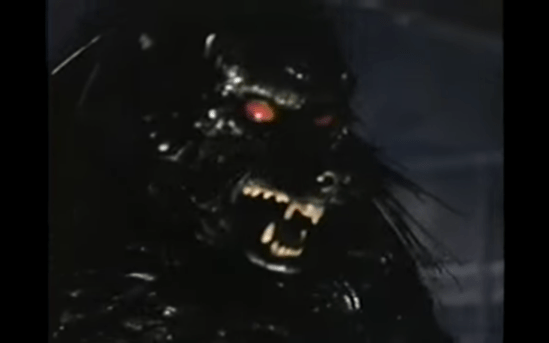
Talk about an archetypical blend of classic and tech horror, “Project Metalbeast” exemplifies the age-old theme of scientific research being usurped for control and power and the end result is fatally catastrophic. Also known as “Proect Metalbeast: DNA Overload” and just plain ole “Metalbeast,” the film was written and directed by Alessandro De Gaetano (“Bloodbath in Psycho Town”) who spun a 1995 unorthodox werewolf feature that presaged playing God in more ways than one and added a fresh and new elemental armament to an iconic, and already super, beast on the prowl. Tom Irvin, Brad Hardin, David Barrett and Wesley Wofford, who makeup (no pun intended) the special effects team of Magical Media Industries, have credits that include the “Carnosaur” killer dinosaurs and a couple of the “Halloween” franchise sequels and have applied their combined tapestry of creative talents to bring a practical, larger-than-life metalbeast to the screen that’s not only monolithic in size, but also fearsomely primal with a glint of “Terminator” characteristics in its glowing red eyes. “Project Metalbeast” was one of the last semi-cult releases of Prism Entertainment Corporation, a company that chugged out some great B-horror films mainly in the 70s and 80s with titles such as “Eaten Alive” and “Body Melt,” and one of only a few films from the associated production company, Blue Ridge Entertainment.

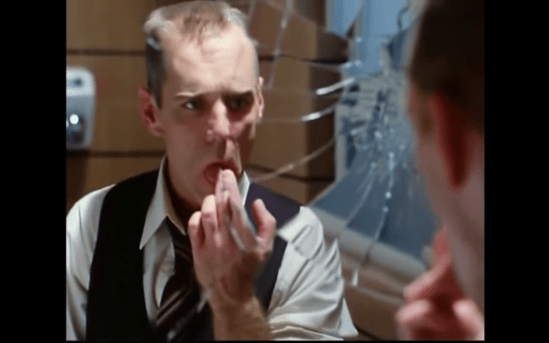
Before taking Jason Voorhees to space to metalize the already the indestructible carnage incarnate, Kane Hodder did a test run stepping inside the augmented paws of a gnarled werewolf. Instead of space, Hodder grounds his performance by barely able to walk on two hind legs in the fabricated prosthetic suit, but the veteran stuntman and character actor is the dynamo practical effects horror version compared to today’s CGI-guru, Andy Sirkis, thriving tangibly polar opposite on the character effect sake, but Hodder captures the metalbeast’s utmost power gait and stance despite the extremely limited range of motion. Another symbol success in his own right is Barry Bostwick as Agent Miller. Bostwick is best known for his hero role in “The Rocky Horror Picture Show,” but to me, he’ll always be the aloof mayor in Spin City opposite Michael J. Fox so it was challenging to accept Bostwick as a conniving cutthroat intelligence agent. Yet, the longtime actor has perfected the knack of being haughty in not only his performance, but in all his mannerisms, making Agent Miller a completely loathsome character undeterred by the sensitives of others. Opposite Agent Miller is the more rational and sensitive head scientist, Dr. Anna de Carlo, played by Kim Delaney who appeared in “Darkman II: The Return of Durant” that was released the same year. Delaney didn’t excel as the strong heroine one might expect her character to be thrust into a situation that calls for her to protect not only her life, but all the lives outside the base if the creature escapes and the scientist is more-or-less part of a splinter group derived from a team effort against the metalbeast. Costars include Musetta Vander (“Mortal Kombat: Annihilation”), Dean Scofield, Tim Duquette, Lance Slaughter, William G. Clark, and John Marzilli as the unhinged Agent Butler.
“Metalbeast” sounds like a metal title, but Gaetano works the orchestrated talents of Conrad Pope into the soundtrack and “Project Metalbeast,” at the time, was Pope’s scored feature as a composer, the classically trained musician has been the orchestrator on a variety of films, such as the films of “Jurassic Park,” “Star Wars,” and “Harry Potter.” Yet, Pope’s score is akin to Harry Manfredini, a character of the story, that maneuvers coincidingly with the metalbeast while simultaneously triumphantly denotes specific scenes of dread, victory, and intense suspense with the latter being reminiscent of Mandfredini’s “Friday the 13th” brashly intrinsic cello and violin composition when Jason Voorhees would startle victims on the screen and chase them down a moonlit forest path. While Pope’s score is invigorating, the story leans more toward less so with a tediously uninspired quality regarding the film’s semblance of a comprehensive secret operations base that has corridors stunk of a standard hospital setting and story structure that fortunes little against the beast’s point of view in which Gaetano merely removes a few frames and adds a distortion effect to the picture that peers out of the eyes of a drunkard’s discombobulated staggering as well as leaving some plot holes with the bit characters, such as the other military police who simply just vanish though the character pool has been whittled down near the climax. Plus, Bostwick’s Agent Miller doesn’t age in the 20-year gap in the story, leaving any tidbits of truth versus a metallic werewolf as dust in the wind. Even with the faults, “Project Metalbeast” without a doubt is a product of it’s decade with a touch of lycanthropy campiness illuminating a sardonically augmented military killing machine.
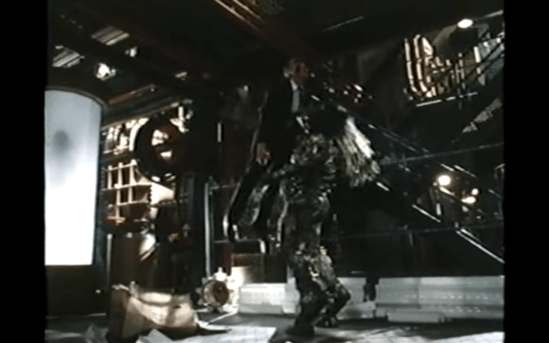
Resurrected from the video graveyard and for the first time on a home video release in the States, or at least officially, Alessandro De Gaetano’s “Project Metalbeast” lands onto DVD from independent entertainment distributor, Invincible Entertainment, and partnered with MVDVisual. Presented in a full frame, 1.33:1, the transfer looks like either a VHS rip or a scan from an unofficial DVD release with heavily lossy details amongst a washed hue overlay. There’s some transfer imperfection, such as slight scratches, but is less intrusive than the soft image. The English language mono audio is bombastic, but there’s no strength behind the explosions, beast growls, and such to emphasis the impactful scenes. Dialogue remains in the forefront behind the ambience and, even, Conrad Pope’s powerful, but non-subversive score. Depth and range are acceptable as the camera and sound relation viably work hand-in-hand. The Invincible Entertainment release is nearly bare bones without an significant transfer upgrade, no bonus features, and barely a static menu. “Project Metalbeast” lives and breathes as a poster boy of a 1990’s revamped creature feature genre that transforms a classic monster into a man’s weaponized wet dream, but the film stutters as a reserved case of conservative metal monster mayhem.

Own “Project Metalbeast” on DVD!


Available for free with a Prime Video subscription!

Sit Back and Enjoy EVIL’s Ride on the “American Rickshaw” reviewed! (Cauldron Films / Blu-ray Screener)

Scott Edwards, a struggling college student, works as a rickshaw runner on the vivacious streets of Miami. When a beautiful woman offers more than just the rickshaw fare for his service, Scott reluctantly accompanies her on a private boat secured at the local harbor for a night of sensual loving, but Scott finds himself in the middle of a voyeuristic scheme by being videotaped behind a two-way mirror and before fully copulating, Scott roughs up the secret cinematographer and the woman escapes. After realizing he forgot the tape, Scott returns to the boat to discover the man dead and all the evidence points to him, framing him for the murder. On the run and being hunted down by Miami PD and the actual killer, Scott embarks on a mission to clear his name, with the help from the woman on the boat, a stripper named Victoria, and a Chinese witch named Madame Luna, during a pivotal time of Chinese mythology that pits good versus evil entrenched sordidly around a renowned televangelist.

Perhaps one of the most offbeat action-fantasy-horror movies to come out of the U.S. in the late 1980’s, the “American Rickshaw” cinematic experience can be a mesmerizing 97 minutes of claptrap theology and clandestine villainy bedim by a witch’s obscured telepathy powers of fire, snakes, and unveiling evil with a human to pig physical transformation. Also known as “American Tiger” in the States and “American riscio” in Italy, the film has the sensation of a blend of various filmmaking abstracts and for very good reason, it is. Notable Italian filmmaker, Sergio Martino (“Torso” and “Slave of the Cannibal God”), helms the cultivation of a big-ticket American production with the ethereal supernatural essence invoked by the Europeans that results into being one of complex whirlwind of a story from a script penned by Martino, Roberto Leoni (“Sex Diary”), Maria Perrone Capano (Beyond Kilimanjaro, Across the River of Blood”), and Sauro Scavolini (Your Vice is a Locked Room and Only I Have the Key”). Dania Film, Medusa Distribuzione, and National Cinematografica serve as the Italian production companies responsible for the “Rickshaw’s” wild ride through Miami heat.

With a premise already on a high bonkers plane, “American Rickshaw’s” curiosity extends to the casting of an American Olympic gold medalist in gymnastics, the perfect 10 recording Mitch Gaylord, is cast as the male lead, Scott Edwards. The physically fit Olympic hero with little-to-no experience or exposure in acting to his name became the story’s prime suspect on the run from not only the law, but a merciless goon embodied by “Elvira: Mistress of the Dark’s” Daniel Greene. Greene already had an established relationship with Sergio Martino, having worked previously with the director on “Hands of Steel” and “The Opponent,” marking “American Rickshaw” as his first collaborated effort in being the story’s villain, Francis, who is seemingly more of the antagonist foe for Scott Edwards than his sect master, Reverend Mortom, a masquerading televangelist seeking to exploit an ancient Chinese relic for nefarious purposes and it’s “Halloween’s” Donald Pleasance to be the face of what would be established as quintessential evil. Pleasance seemingly goes along with the story even when has to snort like a pig during the character’s climatic ending, but is enveloped in a rather mundane, behind-the-scenes puppet master preaching a good biblical hellfire and brimstone game only to be castrated as a backseat bad guy with little to no vice exploration other than swindling the Chinese witch while dolled up in a kimono. The cast rounds out with Victoria Prouty, Darin De Paul, Roger Pretto and Regina Rodriguez and Michi Kobi as the young and old Madam Luna.

I’m one who never likes to research movies before watching them; I believe knowing the film in and out before viewing will more than likely become ruinous toward the quality of perception and cement a foundation of fixed judgement before the opening title credits roll. I don’t even like reading the film’s synopsis for the fear of spoiling too much on too little so I sat down with “American Rickshaw” knowing virtually nothing about the Marino anomaly and coming out relatively pleased, strangely piqued, and from start-to-finished bewildered. Off the bat, “American Rickshaw” could be grossly compared to be the East Coast variation of or, perhaps, the Italian answer to “Big Trouble in Little China” that channels less Chinese mysticism for more mysterious thriller. There are some noticeable similarities between the two films, such as for the obvious uncanny powers of Madam Luna, and then the not so obvious, but maybe more of a referential nod to John Carpenter’s film with the main character sporting a graphic tank top of a tiger that’s familiar with Jack Burton’s graphic yin-yang tank top, the young and old versions of Madam Luna resemble the young and old versions of Lo-Pan, and the scene where a prominent character gets runover by a big, red semi-truck. You know, the kind of rig Jack Burton mows down Lo-Pan with? “American Rickshaw” pales in comparison or, perhaps, shouldn’t be compared at all as Martino’s spellbinds his work by riddling it with cross cuts that attempts to discern solely by optics that swiss cheeses your mind as it tries to fill in the gaps of where the hell did that snake come from? Why did the key burn through his hand? Why is the stripper key to Scott’s Journey? What’s the reason behind Scott’s year of the tiger birth date significance toward his impelled Chinese zodiac destiny? There lies so many questions, but very few are answered; Yet, “American Rickshaw” is the wonderland tour Martino fabricates as some dysfunctional vision quest mapped with spontaneous witchery, horoscope horrors, and a devil pig in human clothing.

As the second half of the inaugural releases of Cauldron Films, “American Rickshaw” receives a limited edition Blu-ray release with a 2k restoration scan from the original camera negative. Since the review is based off a Blu-ray screener and not a physical copy, only 1500 copies being release, the A/V aspects of the package will not be critiqued, but this unrated 80’s hybrid action-fantasy-horror will receive the works, including a limited edition high quality slipcase with new artwork by Mattias Frisk, a reverse covering featuring the Italian artwork, and a booklet inside with writings by grindhouse comics writer and Tough to Kill co-author, David Zuzelo. The picture will be presented in a widescreen, 1.66:1 aspect ratio, with an English language LPCM dual channel audio track with optional English SDH subtitles. Bonus material aplenty with an one-on-one interviews with director Sergio Martino and production designer Massimo Antonello lamenting about the film while as providing a stark difference between Italian and American filmmaking in the late 1980s, a then and now look at filming locations, The Production Booth Podcast, including commentary from Samm Deighan and Kat Ellinger discussing the zaniness of “American Rickshaw,” and an image gallery. Distinct beyond anything else you’ll ever see and indelible with solid practical effects, “American Rickshaw” deserves the upgraded, horror-marketed update set apart from the poorly sultry, softcore porn “American Tiger” U.S. release that stiffens the story’s true self on retail shelves.
Shooting Up EVIL May Cause Hellish-Hallucinations! “Ozone” reviewed! (Temp Digital / Blu-ay and DVD)

On a stakeout to meet an informant, Detectives Eddie Boone and Mike Weitz are ambushed by a drug dealer named Richter and become separated in the fierce firefight. While detective Weitz tracks down their traitorous informant into a decrepit druggie den, Boone wrangles with Richter who injects him with a new street drug called Ozone. Unable to locate his missing partner for days, Eddie breaks standard police protocols to find his longtime friend and partner by digging into Ozone’s grimy underworld filled with powerful hallucinogenic manifestations from the drug that turns users into mindless mutated addicts and killing machines. Eddie will have to go through Hell to stop the distribution of Ozone and to rescue his partner from an elevated and fully transformed drug lord with unconventional powers that believes Eddie is key to his world dominance.

First, “The Dead Next Door.” Then, “Robot Ninja.” Now, TempVideo and MakeFlix present the next super-duper, 2-disc collector’s release from the visionary B-movie director, J.R. Bookwalter, with his 1995 horror film, “Ozone.” Co-written with the visual effects artist from “The Talisman” and “Subspecies 4: Bloodstorm, David A. Wagner pens his one and only option in which Bookwalter immediately took a shining to following a string of very taxing and bargain titles for a flyby label. Able to by clairvoyant with how “Ozone” should be constructed, deep inside the creative process of his auteur mind, Bookwalter felt desire to oversee the production, taking the helm on just how he would make an ambitious project come to a life on a microbudget. “Ozone” parallels the subculture of powerful narcotics, like heroin or cocaine, and amplifies the conditions of the euphoria side effects to monstrous, unpredictable heights through a labyrinth of what the hell is going to happen next? Mostly shot in Akron, Ohio, “Ozone” is a production of Bookwatler’s own company, Suburban Tempe Company aka TempeVideo, on an astonishingly low-budget of $3500 and a handpicked cast and crew.

Comprised mainly of Ohio based actors, “Ozone” finds it’s star in James Black who has previously worked with Bookwalter on “Zombie Cop” and “Chickboxer.” Black went on to stardom, making a living off of the Hollywood limelight by having roles in such films as “Soldier” alongside Kurt Russell and “Out of Sight” with George Clooney among many other television and movie roles, but Black’s humble beginnings shouldn’t be overlooked. His performance as the lead character, Eddie Boone, highlights his attributes as a leading man. The physicality of the former professional football player with good looks catches the corners of eyes that the man from Lima, Ohio can act as well as do action scenes professionally and effectively despite budget limitations. However, “Ozone’s” talent doesn’t end there with Black’s co-stars who wear multiple hats in other roles or behind the camera. Case in point is Bill Morrison and James L. Edwards as the two makeup a total of five characters in the film as well as serving to be critical components as crew. Morrison dons two roles plus crafting the special makeup effects and miniatures. Edwards supports three roles, including the main antagonist in what looks like a hefty body suit. Morrison and Edwards going through the rigors of makeup to pull off various characters with polar personalities provide “Ozone’s” well-rounded, always interesting, idiosyncratic individuals Eddie encounters through his misadventures of drug-fueled nightscapes. Tom Hoover, Michael Cagnoli, Michael Beatty, Jerry Camp, Mark S. Bosko, Wayne Alan Harold, Neil Graf, Leo Anastasio, Parris Washington, and Lori Scarlett in an unforgettable birth of a mutant baby scene rounds out this cast of colorful characters.

“Ozone” is a gooey, gory, gumshoe of a horror film baked on narcotics laced with nightmares and for the budget price of a dime bag, J.R. Bookwalter injects a full-fledged, black tar, down the rabbit hole thriller that’s akin to a Clive Barker Faustian concept. “Ozone” draws similarities from “Hellraiser” as well as could find strong congruence with “Lords of Illusions,” a film which was released the same year as “Ozone” in 1995. Instead of magicians of the occult, the use of a more salt of the Earth drug is a powerful, tangible substance that reflects relevance more so than of fantasy. Audiences can relate more to the idea of the twisted wrenching of habitual use of not only illegal drugs, but with perhaps medications, alcohol, or any number of other addictions that seemingly take over one’s life and replaces it with the worst part of themselves. The mysterious encounters Eddie Boone is subjected to during his tour of the drug enlightens the hardnose detective to an out of body horror experience wretched with disfigured humanoid shells and countless mutants determined on cornering the market on living not sober not on their own volition. The use of the new morph special effects merged with the respectable practice effects by Bill Morrison and his team gorge on body modification and overpowering death as synonymous to being high.

Just like “The Dead Next Door” and “Robot Ninja,” “Ozone” receives the king’s treatment into a duel format, 2-disc Blu-ray and DVD Signature edition release. Shot on Super-VHS C videotape in 1995 and then transferred to DVCAM in 2002 for the DVD remastering, the 2020 upgrade used the DVDCAM masters were captured as ProRes 442 HQ QuickTime video files for a new and comprehensive color upgrade, additional deinterlacing, and amend any other Super-VHS C tape imperfections. What resulted for the Blu-ray release is a super clean and enhanced look presented in the original 4:3 (1.33:1) aspect ratio of perfectly color corrected hues, brilliantly effusing various colors to coincide with the artistic storytelling of Eddie Boone’s trippy trek through “Ozone’s” chthonic evil. Seldom do minor blemishes pop up; in fact, you won’t even really notice when godsmacked on “Ozone’s” uncanny use of budgetary limitations. The English language DTS-HD Master Audio 5.1 surround sound mix is equally as impressive. Pulled from the DA-8 tape achieve of the original audio masters on an eight-track cassettes, all of the dialogue and some original sound effects were used as the basis for the new restoration in which Maui Holcomb and director, J.R. Bookwalter enhanced over the course of 18 years. Dialogue cuts to the front of the line, mixed and balanced well with the explosions, gunfire, and other skirmishes, delivering a flawless and discernable product. Depth and range render nicely throughout. The DVD specs are the original 1994 VHS version also in the original aspect ratio with an English language Dolby Digital 2.0 stereo mix. Jens C. Moller grand score elevates “Ozone” to the “next stage,” as the street mutates would coin it, offering up a bountiful, robust score that simultaneous blends action and horror seamlessly. If you’re looking for every nook and cranny bonus material on “Ozone,” you got it with an extensive bonus package on the Blu-ray disc that include a 2020 audio commentaries from J.R. Bookwalter, a 2003 commentary with the director and star, James Black, 2003 commentary, entitled “Street Zombies” from Bookwalter, bloopers and outtakes, production art and stills, news’ topic reels from 1993, promotional gallery, “Ozone’s origins explained through “Paying for Your Past Sins” with J.R. Bookwalter, “Into the Black” with star James Black and how he became involved, a 2003 location tour with actor James L. Edwards, behind the scenes footage with the only audio available is a commentary by J.R. Bookwalter, early test footage, and Tempe trailers. The DVD has additional material, such as awesomely isolating the musical score, 2020 audio commentary with Doug Tilley and Moe Porne of the No-Budget Nightmares Podcast, scenes from the Spanish dubbed version, the 1992 B’s Nest Video Magazine Intro, the original trailer, the Japanese trailer, the “Street Zombies” trailer, and more Tempe DVD trailers. The not rated, 81 minute, region free release also has optional English and Spanish subtitles. Inside the casing, which has a reversible wrap cover with the original VHS cover, housed inside a cardboard slipcover of revamped artwork by graphic designer Timothy Rooker includes an eight-page color booklet with liner notes by Tempe historian Ross Synder; it’s a good read up on “Ozone’s” conceiving and a little history on SOV of the 1990’s. Exquisitely enhanced and lush with material, the Signature Edition of “Ozone” just might be the definitive one of the wildly insane and bloodied occult cop fiction of independent horror ingenuity.

Available for pre-order. Hit shelves August 11th!

 It's Bloggin Evil!