
In the year 2022, orbital satellites carry nuclear missiles and maintain flight patterns around the moon. When a satellite repair ship, known as a “refab” ship called Spaecore 1, attempts to intercept a satellite for maintenance, the system wide computer goes into an unexplained power failure that jeopardizes communications, life support, and navigation. Drifting helpless toward sector Centrus B-40, the dark side of the moon, all hope will be lost within 24 hours unless operations can be restored, but a mysterious spacecraft, NASA’s Discovery shuttle, heads toward them and docks onto their outer hull without so much of a hail from the shuttle. Captain Flynn and Lt. Giles investigate a seemingly abandoned ship until coming across a dead body of a presumed missing NASA astronaut, eviscerated with an opening left in a perfect triangle as the cause of death, and that opens the door to more questions than answer as a sinister presence boards their ship, pursuing damnation for their souls.

Just think, in two more years, weapons of mass destruction satellites will loom just above fluffy white clouds, ready to mushroom clouds out of targets with a 10-ton yield; at least that’s what director D.J. Webster and the screenwriters, identical twins Carey W. Hayes and Chad Hayes, modeled the future when conjuring up this delectable Sci-Fi horror film approx. 20 years ago. With special effects models and techniques that withstand against powerhouse space films, such as from the immaculate effects of Alien franchise, “The Dark Side of the Moon” becomes more than just a 1973 Pink Floyd album title Fabricated out of warped creativity of old and new concepts with a Biblical horror base that only the 1990’s could loosely spin into an hour and 27 minute feature, for many of the filmmakers involved, “The Dark Side of the Moon” credits as their first taste of a feature length, large scale production, especially with the mainly music video director D.J. Webster, who loves his closeups, and director of photography Russ T. Alsobrook, as they auto clicks into a team that seemingly have experience of seasoned veterans or, perhaps, spent some secretive, unlogged time in space. Who knows, but the outcome ruminates about the dark side of religion and how each of us deal with it internally.
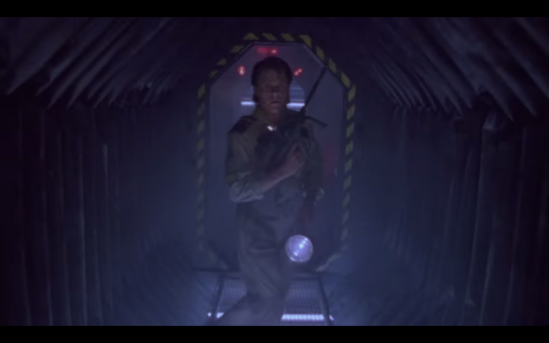
When mullets and giant framed glasses are afoot, the late 80’s, early 90’s filming era is beyond evident with interestingly gritty characters lined up for an evil figure eager to knock them down and, of course, the story’s lead character is the mullet sporting pilot named Lt. Giles Stewart who is unwittingly thrust into the fast track of a hero’s lane. Giles’s atheism framework has a pleasant sardonicism about it when face-to-face with the immortal conqueror of his ship and crew. Will Bledsoe paints Giles as such as faithless space pilot, bound to duty, and willing to do anything to just not save himself, but others. One of the only recognizable faces, at least for myself, in the cast is John Diehl. The “Stargate” and “The Shield” television actor is best at being a wild card in turmoil situations and as shipmate Phillip Jennings, the same can be expected without being utterly conventional or warrant any kind of typecast label. Another actor to note is Alan Blumenfeld as the ship’s panicky Dr. Dreyfuss Steiner. Blumenfeld, who had a role in the best Jason Voorhees film, in my humble opinion, “Friday the 13th Part VI: Jason Lives, is once again stalked by a larger-than-life villain while maintaining a profusely sweaty persona that’s symbolically intended to be true, unadulterated fear. As a whole, the cast is amazing regardless of some first time filmmakers at the helm, rounding out with “Re-Animator’s” Robert Sampson as the ship’s Capt. Flynn, Joe Turkel from the first “Blade Runner,” “Blood Frenzy’s,” and overall erotic thriller goddess, Wendy MacDonald, stunt man (“Kill Bill Vol. 1 & 2, “Army of Darkness”) Ken Lesco, and another “Friday the 13th” actor, Camilla More, or Tina from “The Final Chapter,” as the stationary sexy, ship’s onboard computer-robot named Lesli – think on the same lines as Mother from “Alien,” but in the flesh.
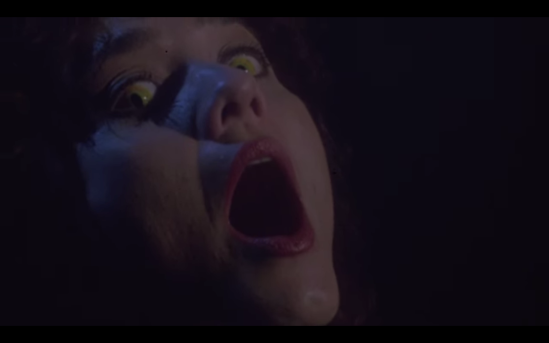
What makes “The Dark Side of the Moon” very interesting is the film being an unofficial precursor to other science fiction horror films like “Event Horizon” that was released roughly seven years later. Space as this gateway to Hell concept is sorely under-appreciated and underutilized. Space is already vastly frightening to begin with and by adding a devilish abyss aspect to it makes the idea an absorbingly scary thought. What’s also fascinating is the Hayes brother. “The Dark Side of the Moon” is the brothers’ roots film; the proverbial patient zero that spread successful movie writing careers for the twins, spawning turn of the century horror with the remake of “House of Wax” that saw the on-screen death of Paris Hilton, had “Underworld” star Kate Beckinsale track down a killer in Antarctica in “Whiteout,” and they penned “The Conjuring” that constructed its very own universe.
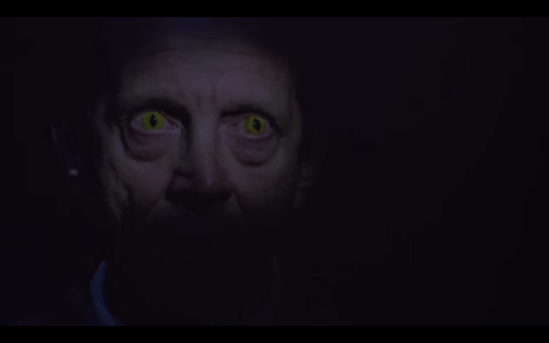
“The Dark Side of the Moon” comes in at #2 on the Unearthed Films’ Classics label distributed MVDVisual. The newly restored 4K transfer of the Wild Street Pictures production is presented in a widescreen, 1.85:1 aspect ratio, region A Blu-ray release. Surprisingly sharp despite consistent low-lit scenes and not as washed like previous VHS versions, this restoration fine tunes the nitty-gritty specifics needed for proper presentation that doesn’t falter from heavy digital noise or blotch artifacts and shows no signs of enhancing The English language LPCM 2.0 audio track is strapping for a dual channel format. Dialogue pronounced clearly, ambient spaceship clinks and clunks create atmospheric range and depth, and the relentless brooding score by “Society’s” Mark Ryder and Phil Davies delivers shuddering spinal-tingles without being monotonously dull. Bonus features include a commentary with executive producer Paul and Unearthed Films’ Stephen Biro, interviews with Alan Blumenfeld, FX artist R. Christopher Biggs, and stuntman Chuck Borden, plus vintage audio track, trailers, photo gallery, and a insert booklet that dives into about the production and the cast. All packed into a nice little slipcover package. “The Dark Side of the Moon” pioneers into the future of space horror as a good ole dread-inducing fear-monger of the great expanse, deserving this Unearthed Films’ release, hands down.
Category Archives: occult


Make a Deal with EVIL, EVIL Will Come Calling! “The 27 Club” review!

Kurt Cobain. Robert Johnson. Amy Winehouse. Jim Morrison. Jimi Hendrix. All these recording superstars have one tragic thing in common: their fame engrossed lives ending horribly, sometimes violently, at the young age of 27 at the height of their careers. Their deaths are a part of an elite group called the 27 Club that incorporates effervescent celebrities from all walks of fame. When another popular rock star ends up mysterious deceased a night after his concert, the same concert that student journalist Jason attended, the eager academic finds himself at the right place, at the right time while researching and documenting the notoriety of the 27 Club. While hallowing out the club’s infamy, Lily, a wild and struggling musician, enters his life on a connective collision course toward his research that evidently surrounds itself around an ancient Latin-based text. The book is binding to those seeking rock star status in exchange for their souls and with a steep decline in her musical career, Lily provokes satanic rituals with exploiting help from the love struck Jason, but the only thing Lily didn’t count on was her unexpected love for him back.

The actual 27 Club lore continues to be an interesting notion. A curiously notorious concept that flew under the radar for this reviewer up until happening upon and diving into the Patrick Fogarty’s written and directed soul-bargaining tale regarding the idea’s parameters as the film’s foundation. Fogarty, the staple music video director for bands such as Black Veil Brides and The Burning of Rome, tests his hand at satanic, soul-swallowing horror, simply titled “The 27 Club,” for Cleopatra Records cinematic sub-division, Cleopatra Entertainment, and is co-written a mythos script alongside “Clownsploitation’s” Joe Flanders and Michael Lynn. Even if nothing more than a freak coincidence, Fogarty processes an innovative take on the 27 Club that has spanned over century and, perhaps, provides a little education and knowledge to those outside the music industry.

Many iconic rock stars rise from the grave to spit philosophical truths and knowledge, constructed as miniature prologues of a chaptered story, intertwined with a relatively unknown cast beginning with headlining leading lady Maddisyn Carter as the toiled Lilly seeking refuge in any drug or sexual partner her beautiful disaster can ensnare in a world of deaf tone destruction. Her character is intended to be refracted by the introduction of the 27 Club research journalist, Jason (“Mutants'” Derrick Denicola), who just happens to be around when another musician kicks the proverbial bucket, but Carter maunders through the relationship with Jason and unable to materialize compassion, losing any slither of internal conflict Lilly may possess. Todd Rundgren, Cleopatra recording artist and a member of the progressive rock band, Utopia, headlines polar opposite of Carter on the cover of the home media release only and not as a chief player in this possession plot. The role downsizes his long legacy in the music biz and though a small role and acting isn’t Rundgren’s first love, the rocker tops as being one of the film’s better moments as a record store wise-guy patron doing the right thing and a creepy video-chatty music professor. “The 27 Club” tortures the cast of remaining souls with Adam Celantano, Kali Cook (“Victor Crowley”), Zack Kozlow (“Devil’s Domain”), Mr. Chromeskull himself Nick Principe (“Laid to Rest” and “Chromeskull: Laid to Rest 2”), Jason Lasater (“Death Tunnel”), Zach Paul Brown, Emily Dalquist, Eugene Henderson, wrestling superstar John Hinnigan, Gogo Lomo-David, Tasha Tacosa (“Halloween Pussy Trap Kill Kill”), and, my personal favorite, Killjoy’s Victoria de Mare!

Novel backstory might be one thing, but a comprehensively sound one is another and while “The 21 Club” begins like a John Carpenter cask of embolism-depth imagination and beguiling, if not apocalyptic hinting, descent into oblivion, Fogarty’s film collapses when Lilly and Jason seek out a couple of drug dealers to understand the book’s portentous contents. Conveniency and rushed theatrics push a scene-to-scene overhaul that forgets to breathe and come up for air, losing that dramatic, dire consequence associated with a thriller. No consequences steep the pot to forge a luxury of sympathy or any type of relation toward the characters. Jason and Lilly’s dynamic was hot and cold at best and why Lilly kept Jason around after learning of his possession of the book is a complete mystery. The exposition isn’t conveyed properly in this instance and their coupling wipes on a thin wave toward the finale. There’s also the common motif of a sex tape – Jason records his and Lilly’s sexual encounter after a night of clubbing and Lilly’s record producer explicitly states if there’s a sex tape out there that might risk damaging her career – and then that information goes dark, nothing but crickets to line an explanation to why her sex tape would be important to the story. If a stipulation of her fame agreement with the reaper was to not lie or become involved scandalously entangled, the sex tape would be the perfect real world-relating catalyst that fully encompasses the fame-to-fallen storyline.

Cleopatra Entertainment and MVDVisual release a sweet, multi-format package perfect for home entertainment of Patrick Fogarty’s “The 27 Club.” The all region DVD/Blu-ray combo set also includes the compact disc soundtrack to the movie that features music from Todd Rundgren featuring NIN’s Trent Reznor and Atticus Ross, plus Die Klute, Bestial Mouths, The Anix, Jurgen Engler and more. The full HD, 1080p Blu-ray, which was viewed, is presented in a 1.78:1, widescreen, aspect ratio. The 97 minute digitally shot film has a wonderful color palate that often shutters from natural tones to one or two-toned primary color filters with also a desaturated approach to the 27 Club’s most recognizable members conducting a foggy room soliloquy. Banding issues have noticeable effects in various stages of darker scenes, especially surrounding a humanoid figure. The English language Dolby Digital 5.1 surround sound has insignificant bite through the multi channel conduit that denotes continuous issues with Cleopatra Entertainment’s home video releases. With a recording penchant for talent in the music industry, the expectation is high in delivering bombastic results flowing from one through five and presenting a singular comprehensive result, but the range and depth lack beside the powerhouse release and instead, find more solace in the third format of a traditional CD soundtrack content with great musical contents. Bonus features include two interviews with the film’s stars, Maddisyn Carter and Darrick Denicola, slideshow, trailers, and of course, a CD soundtrack all underneath a slipcovered jewel casing. “The 27 Club” spins a concoction of malediction around historical tragedy that’s more heinous hoopla and than harrowing horror and while the release bursts with razor sharp teeth and high pixelating resolution, channelling all the material rudimentary didn’t stay glued together in the end, hurting the character progressional arch and thinning out the hair-raising filament.

Pre-order “The 27 Club” available June 11, 2019!

The Devil’s Greatest Trick is His Evil Being a Part of You. “Luciferina” review!
Natalie’s dedication to her religious vocation has led her to become a nun. Her celibacy is a symptom of disgust with her family’s household, a home the young virgin could not bear to live in another second or much rather return to that stems from an uncomfortable inkling of unnatural circumstance, but when she is informed her parents were in a tragic accident involving the death of her mother and a father bedridden by shock, Natalie reluctantly returns home. She’s greeted by Angela, her university studying older sister, and her delinquently dangerous boyfriend, Mauro, and alongside a few of Angela’s classmate, the decision to track down a shaman on an secluded island on the outskirts of town has convinced the group to seek alternative and holistic treatments, such as a brew made from the mystical Ayahuasca plant, to battle their own self-complications. What they discover is that some inner demons should be left untapped and undisturbed or else their souls will pay the consequence.
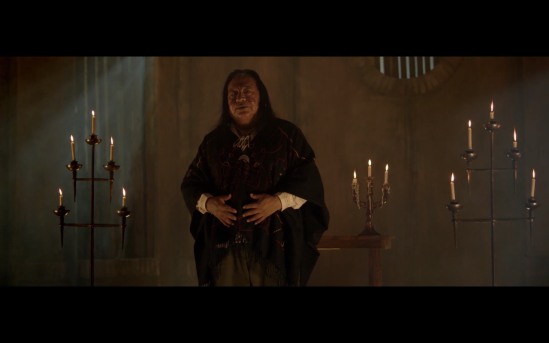
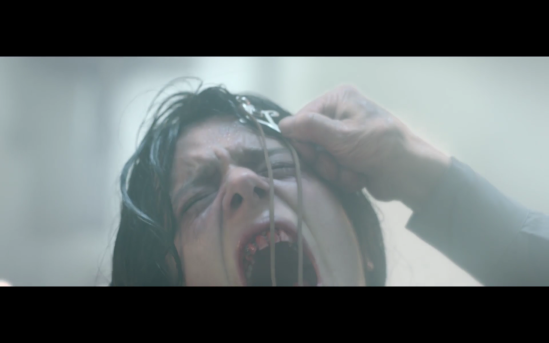
“Luciferina” is a black rites narrative saturated with psychosexual tendencies and religious divergences from writer-director Gonzalo Calzada whose horror mystery footprint, the Argentinian filmmaker’s common foundation for his prior work in “Resurrection” and “The Clairvoyant’s Prayer,” maintains a strong foothold for his latest venture from 2018 with a story of solid foreboding and overshadowing complication that’s naturally opaque, guiding viewers seemingly toward one direction and then obliterating their conjectures in an in a blink of an eye about how characters or events might play out. Layered with themes and heavy with motifs, Calzada summons the internal demon, figuratively and literally, from within an indie picture budget that’s complete with accidental demonic conjuring, eye-devouring effects, and a climax involving temple fornication of various Kama Sutra positions.
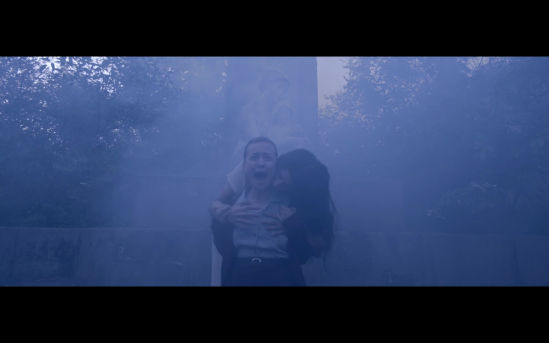
Young, beautiful, and, yet, withdrawn and plain, Natalia has embedded herself into nun-hood, a means to escape the unexplainable discomfort inside her own home and even in herself as she’s haunted by visions of a disheveled woman with crooked arms popping unnaturally out of a white nightgown, but not all of Natalia’s visions are bleak as she’s able to, at times, define a person’s gleaming aura during a momentary spell. Sofia Del Tuffo stars as the troubled vocational woman, a role that demands much from the young actress who can easily transition from a screaming and scared postulate to taking charge of her destiny by gripping Satan’s horns. Tuffo opposites Pedro Merlo as Abel who is, well, more or less a potential love interest. Abel has fire inside him sparked by his desire for Natalia, but goes full inferno after downing the Ayahuasca juice. The light and dark of Abel has Merlo flipping the script continuously and the actor keeps up with relative ease. The opinionated downside to roles Natalia and Abel might be lost in translation, but there’s a sense of disconnect between their multiple purposes: shaman visit, the unspoken connection for each other, and their intertwined destinies. These aspects go fairly unexplored or are either, in the script, diluted in the details. The supporting cast also don’t add volume to the story and though not all of the cast are like this, a good chunk are rather auxiliary for the moment of pinnacle prominence and their sub-stories are quickly squished – that’s the Gonzalo Clazada affect. The remaining cast includes Marta Lubos (“Darkness by Days”), Melena Sanchez, Francisco Donovan, Stefania Kossl, Gaston Cocchiarale (“Terror 5”), and Desiree Gloria Salgueiro.
“Luciferina’s” themes bubble quite easily to the surface, the more obvious found in the religious field, but an interesting theme is a woman’s protective, if not problematic, stance toward copulation and the guarded uterus and their right to chose. Natalia has no experience with sex and she’s constantly under the pressure of having sex, even inside the chaste nunnery. Natalia nonchalantly pushes away one of the boys in the nun’s drug rehab program with not much oomph, she then comes under siege by the forcibly accosting Mauro and his verbal rape fantasies toward his girlfriend’s younger sister, and then Abel’s internal struggle with his Faustian under guise who enthusiastically confesses his hard on to score with Natalia to bring forth more evil spawn. A common motif from the baby making is the uterus that pops up in Natalia’s dreams and her late mother’s frantic paintings that circle around the pressures of motherhood and as Natalia procrastinates under the semblance of saving her own life to further prolong her inevitable destiny, she comes to the realization running will prove for naught and becomes empowered. One thing weird in relation is not the uterus in itself, but rather the computer generated baby in the womb; the impression is okay in construction as the baby has some realism in the detail, but the adverse effect is the use of the effect that seems pointless and ostentatious.
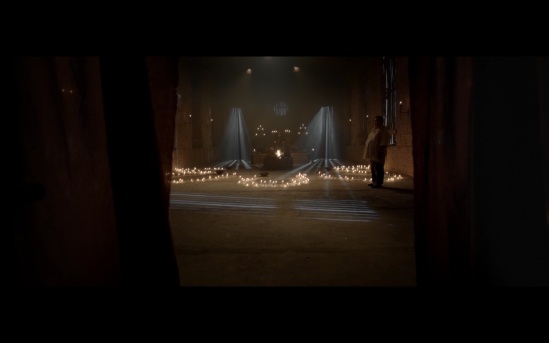
Artsploitation Films and Reel Suspects presents “Luciferina” onto Blu-ray home video. The anamorphic widescreen, 2.35:1 aspect ration, presentation is quite sharp with textures and details in a lossless image. Calzada uses much of the natural coloring in daytime sequences and the night scenes are moderately bluish and director of photography, Claudio Beiza, has immense range and depth that provide astonishing interior and exterior backdrops that can be subtly pleasing. The Spanish language Dolby Digital 5.1 surround sound substantially keeps with the tone and pacing of the story. Dialogue is balanced and verbose in the forefront. The release also comes with a Spanish language 2.0 stereo track. Both audio tracks come with English subtitles that saw minor issues with translation errors and timing. The only bonus feature available is the film’s theatrical trailer. “Luciferina’s” contemporary tale of possession and sexual innuendo is rabid. Director Gonzalo Calzada’s ambiguity of mystery horror is grossly engaging while “Luciferina” can also be glossy with splayed monstrous savagery and graphic sexual content, two genre commodities that churn easy entertainment.
Being a Gracious Host Goes Well with an Accompaniment of Corkscrew Evil! “The House” review!

Set inside the conflict of World War II, a strayed former SS lieutenant and a German paratrooper must band together and escort a Norwegian captive through the snow covered forest of the frigid Norwegian mountains. Venturing through the cold and soulless landscape, the lieutenant is baffled by his bearings as his map doesn’t correlate with his surroundings, the sun is positioned at the opposite direction, and their compass points in the wrong direction. Faced with the possibility of gangrene and hypothermia, the lost combatants are forced to take up camp in a seemingly abandoned house that fly’s a hoisted Norwegian flag and has a pot of stew left simmering on a stove burner. Their already puzzling arrival into the residence is also met with unexplainable occurrences that place the extremely cold and weary soldiers even more so on an overwrought edge as they continuously search the house of presence telling life signs. Shadows and sounds trick their senses, soon realizing that the cozy confines are an inhospitable prison and with the deadly cold nipping at the doorstep, the soldiers are left with no choice but to face a sinister absence of time inside a hostile house that toys with their psyche and questions their own mortal existence.

Quickly becoming Norway’s prominent horror filmmaker, Reinert Kiil found success with his controversial and provocative “Whore” films and had a well-received review at Its Bloggin’ Evil for his cheerfully grisly, holiday slasher classic, “Christmas Blood.” Artsploitation Films continues to wholeheartedly support the Norway born director with his next venture, the supernaturally-charged possession of a home-sweet-home feature entitled simply “The House’ or “Huset” as titled in the original tongue. Kiil typically trends with shock horror, but with “The House,” there is an expansion upon his range as a filmmaker while remaining in a field he’s finds most endearing, pulling inspiration from his childhood memory vault of B-movie horror schlock and nostalgia grandeur, and dapples with replacing his guts and gory showmanship with slowly developing and instilling fear, especially with fear of the unknown and fear of change. Audiences are going to be attached to the hip and entrenched with the German soldiers, clueless to their predicament and anxious for them with the house’s uncanny and perplexing animosity, and Kiil doesn’t show much right away, slowly simmering the taut chills lined meticulously in the story.

Paratrooper Andres Fleiss is introduced in the preface attempting to save his mortally wounded friend and brother in arms, Max. Fleiss’s passion greatly motivates him as he jump out of a plane first rather than assess whether he has a parachute on first, willing to assign blame and kill Rune, Norwegian captive, right away without any provocation as instant relief and gratification. You see, Rune didn’t kill Max and, in fact, no exposition is provided about how the three men arrived at preface’s point in time, standing on a snowy side of a mountain just on the outskirts of a forest edge. Frederik von Luttichau (“A Room to Die For”) incites the paratrooper’s sense of duty and sense of irrationality. Luttichau’s able to quickly switch gears from confident combatant to a frightened bumbling idiot whose trapped inside a complete mind scramble of a situation. Fleiss is juxtaposed against the cooler head of a commissioned officer, Lieutenant Jurgen Kreiner. The former architect from Munich uses his SS training to tranquil the anxiety; so much so that Kreiner has a strange habit of protecting Rune from expiring much to the displeasure of Fleiss. Mats Reinhardt, in his sophomore film, is a juggernaut of emotional suppression. The rigid actor perfectly suits Kreiner’s stoic rationality toward not only the malevolent shelter, but also to Fleiss’s thin patience. Both characters’ melancholy is confounding as you start to feel for these Nazi soldiers stuck in a state of limbo and Kiil writes their roles down a personal level that expresses guilt, sadness, and shame that lets you know that they’re human too, humans who have done terrible things that have become their undoing. The Norway solider, Rune, is an important piece to the puzzlement. With his background unexplained and role in the house’s occurrences, Rune becomes an integrated symbol of subtle vengeance; even Rune, in the origin sense of the word, is defined as a secret mystery. Rune, or Runes, can also imply a set of symbols in archaic German languages much like the ones used on the closet door in the house or at the title screen. The mysterious Norwegian is subjected to being always hurt, whether a bout with gangrene or being shot, Rune ceases to cease. “Christman Blood’s” Sondre Krogtoft Larsen perforates the two opposes forces as a well-executed deceitful key to the mystery and though Rune doesn’t fully explain the entirety of the house’s backstory, Larsen simply quantifies the a potential reason with his the character’s simplicity role in it all. Other character flow in and out of the story as either a flashback or a vision and they include performances from Evy Kasseth Rosten (“Dead Snow”), Sigmund Saeverud (“Christmas Blood”), Ingvild Flikkerud, and Espen Edvartsen (“Dead Snow 2”).

There are other “House” reviews that compare Kiil’s film to the likes of “The Exorcist” or an exorcist type film and while the German soldier’s narrative is spliced with a flashback sub-story of a priest performance the rites of exorcism on a young girl inside the “House,” labeling the film as such warrants a rebranding. These flashback scenes, that are not consecutive, sluggishly rolls out a bit piece in the house’s backstory that almost predates the 20th century (the trailer suggests 1901), but doesn’t, in my opinion, obviously explain all that’s happening to the soldiers forty years later. Fleiss said it best during a frantic moment when the paratrooper comes to a full realization that the reason their stuck in an unescapable phenomena is because he and Lt. Kreiner are dead. Sometimes the more blatant reason is perhaps the more conclusive as Kiil offers a breadcrumb trail to point out these two Nazi soldiers are in oblivion of atonement. From the very beginning, the three men couldn’t explain how they came together, every facet of direction is obscured, time ceases to exist, their most inner desires and offenses bubble to the surface, and even Fleiss mentions the soup, the one simmer on the burner upon their arrive, is bland to the taste for the dead have no need for senses. In short, the momentary exorcist scenes are fathomable, perhaps in-depth more with the dated slideshow series of events in the Scandes, but, in context, cheapens the film slightly and could go easily as “The House” is inherently soul crushing and effectively atmospheric.

Artsploitation Films and Reel Suspects presents Rinert Kiil’s “House,” a product of Sanctum Films, onto DVD home video. The release is presented in an anamorphic widescreen, 2.35:1 aspect ratio, shot digitally that idyllically compositions Norway’s Norefjell snowy mountain range of the Scandes. The opening title sequence has some image instability with faint pixel fluttery in the compression, but doesn’t seem to go beyond the barely visible stage. “House” isn’t a flashy conceived concept that renders a lot of texture or detail warranted scenes, but darker scenes are overly rich with black that interpreting the visuals more difficult and as a note on one of Kiil’s visional techniques on being outside in or at night, like when Fleiss is hoisting the Nazi flag, the obvious tinted lens isn’t a reasonable substitute for dusk, dawn, and night. Skin tones are a pleasantly raw in appearance and, hey, the lighting in the snow is great for obvious reasons. The Dolby Digital 5.1 surround sound is hands down the past technical feature with an engrossing atmosphere track that has depth and range to send the audible senses hiding in fear underneath the comfy blanket. The intertwining German, Norwegian, and English language tracks holds strong and upfront with clear and precise synchronization of paralleling subtitles, offered solely in English, and Kim Berg and and Levi Gawrock Troite’s powerful score portrays a film bigger than it’s budget. Bonus features include a behind-the-scenes segment, an interview with Reinert Kiil who discusses his trek through Norway film and delves a little in each of his projects, a commentary track with Kiil, a short film by the director entitled “The Voice of One’s Conscience” (aka “Samvittighetens Rost”), and Artsploitation trailers. Reinert Kiil’s “The House” is non-exuberant horror diverging toward exploring the filmmaker’s unlimited possibilities and with “The House’s” diabolical descent into invigorating terror, Norway cinema has an abundance of sheer promise for the future of horror.


Time Travel to Stop Evil via Astral Projection! “Mandao of the Dead” review!

Astral projection defined per Wikipedia: an interpretation of an out-of-body experience that assumes the existence of an “astral body” separate from the physical body and capable of traveling outside it. The otherworldly experience befalls suddenly upon Jamison Mandao, a young man living off the royalties of his late father’s flailing popular cereal brand, and his recently discovered, and also bewitching, new astral plane exploring powers land him in a macabre laced predicament with his adult squatting nephew, Jackson, and his nephew’s blood hungry, murderous ex-girlfriend, Maeve. With a little help provided by Jamison’s astral enthusiast relative, cousin Andy, and Maeve’s recent victim whose ghost is stuck in limbo, Jamison must use his astral projection to travel back in time, rearranging the series of events in order to not only appease the desperate pleads of a ghost, but to also save his daft, but good natured nephew becoming her next hapless fatality before the stroke of midnight segueing into the Day of the Dead when their chance to live again will rest in peace for eternity.
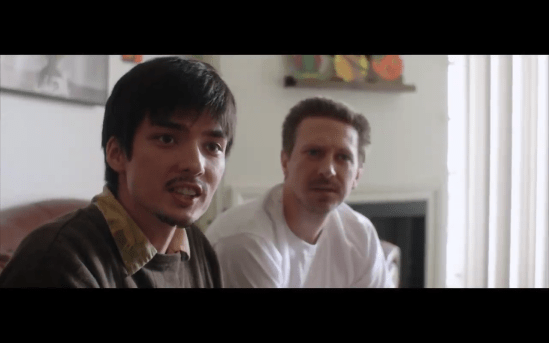
Here we go again with a time traveling genre film, the horror-comedy “Mandao of the Dead” from writer, director, and star Scott Dunn. Dunn’s sophomore feature film of 2018 dares the chances in being overly and, frankly, unnecessarily lambasted by internet trolls aiming to pick apart the film, hunting vigorously for time travel plot holes, but, and I reiterate this point again, that Dunn’s film is mainly a comedy where the laws of physics and ideas of probability have no bearing on Dunn’s grim fantasy loop. Despite the rather clichéd title suffix implying a facet from the zombie genre, “Mandao of the Dead” refers toward the post-Halloween, more traditionally Hispanic recognized Day of the Dead on November 2nd and while Dunn uses the day typically held for respect of past lives, the “Schlep” director conjures up a lively twist upon deathly circumstances that forms a cut-off date when that slither of twilight time for the dead ceases to be no more.

Alongside Scott Dunn as Jamison Mandao, Sean McBride buddies up as the freeloading nice nephew, Jackson. Dunn and McBride have previously worked together in Dunn’s first feature entitled Schlep and their rapport in “Mandao of the Dead” indubitably confirms a harmonious witty banter and a light-hearted dark comedy in fine, mechanical form. McBride’s spot on heartfelt halfwit Jackson nicely compliments Mandao’s knack for impatient contemplating. Throw a dude name Darth into Jamison and Jackson’s inert existence and things get dire and interesting. “2-Headed Shark Attack’s” David Gallegos isn’t portrayed as your friendly neighborhood ghost nor is he a malevolent one; instead, Darth begs for help and the cosmic universe delivers to him an astral projector and Gallego’s couldn’t be more sharply colorful with his spontaneous humor. Together, the three 30-something year-olds are pitted against the dark horse that is Maeve. Playing an incognito blood drinker, Marisa Hood has an innocence about her that renders a false sense of security and, in Jackson’s case, a pair of weak knees. Alexandre Chen, Sean Liang, and Gina Gomez round out the cast as characters finding their ways into the Day of the Dead debacle.

While we’ve seen where timelines become mangled by the interference of a time traveler and where the theme is fondled with in “Mandao of the Dead,” Dunn doesn’t over knead the narrative with it though certainly a centerpiece of the film as a whole. Mandao’s adventure with astral projection and his middling with the planes are only the beginning that have stirred a frenzy of unhappy campers in the spiritual world. The whole event of Mandao going back in time, twice, to save people is the proverbial tip of the iceberg and a welcoming taste of what’s to come from Dunn and his team. Shot in 10 days with a tight budget, Dunn, who also self-produced and edited the final product, has crystal clear storytelling abilities even with some of the rough, less glamourous edges encompassed within the world indie filmmaking. The characters are well written, from Cousin Andy, to Jackson, and to Darth, as their three various personalities colliding under a thin, blurry gothically influenced omen line.

“Mandao of the Dead” arrives onto Amazon Instant via Prime Video and presented in a widescreen, 2.35:a aspect ratio, and clocking in at a runtime of 74 minutes. No physical media specifications were provided now or for future release. With a budget around $13,000, the English stereo audio track and Panasonic GH5 image quality are finely calibrated and a flat out success for streaming platforms. No bonus features are included with this release. Vampirism, science-fiction, spirits, and astral planes, “Mandao of the Dead” is Scott Dunn’s golden genre-bending film of ghoulish and space and time continuum disproportions! So much so, a sequel has been announced, “Mandao of the Damned,” sparking a positive anticipated interest, by at least this reviewer, for the next chapter of a hapless, macabre adventures that Jay Mandao and Jackson will step into in the next astral plane!

