Who Let EVIL Out of the Bag? “The Catman of Paris” reviewed! (Imprint / Blu-ray)

Meow!!  “The Catman of Paris” is on the Prowl on Imprint Blu-ray!

From rags to riches, writer Charles Regnier pens one of the most popular and polarizing books of France.  Titled Fraudulent Justice, the subject matter coincidently contains secret court case information in it’s text.  Regnier stands firm his book is creative fiction while the French government think otherwise.  When a government agent of the Ministry of Archives, carrying the detail accounts of the case to be reviewed, is found slashed to death and the case file missing, the police naturally suspect Charles Regnier while also another, eccentric police theory circulates of a monstrous cat person.  Regnier, who suffers from headaches and blackouts from a tropical fever he contracted during his two year travels away from Paris, begins to suspect himself as the deranged killer on the loose, attacking and killing those around him.  Without a solid alibi and the unknown from his blackout memories, Regnier evades the police by hiding with his darling lady friend, Marie Audet, but when the headaches begin and Regnier conscious slips into a strange darkness, will he let the cat out of the bag to strike again?

Let’s travel back in time to 1946, just after the Great Second War, when the movie industry rolled film once again and take a pawing look at Lesley Selander’s shapeshifting film noir “The Catman in Paris.”  Though story set in Paris, the black and white horror film helmed by “The Vampire’s Ghost” director is a United States product shot on location at the Republic Productions studios in Los Angeles, reusing and transforming many of the company’s stout storage of Western set pieces into Parisian milieus.  From the spittoon saloons to high end restaurants and from dusty stagecoaches to redesigned aristocrat carriages, Republic Pictures aimed to take transformative risks in order to hop on the Val Lewton and his 1942 “The Cat People” success train while making statements of his own from a Sherman L. Lowe (“Valley of the Zombies”) script.  “The Catman of Paris” is produced by Belarus expat Marek Libkow who fled Europe because of World War II but the feature would be his last producing feature.

In the ambiguous role that puts into question his sanity and his humanity is the Austrian actor of “Slave Girl,” Carl Esmond.  Esmond plays the rift creating writer adored by the public and despised by the government, driving him back into a corner of continuous defense of his work that has been argued to be plagiarized form secret documents and unlawful for the access of aforesaid secret documents regarding a controversial court case decades prior. On his tail is a paranormal receptive prefect of police (Fritz Feld, “Phantom of the Opera” ’43) and a more pragmatic inspector named Severen (Gerald Mohr, “The Monster and the Girl”) who, based on little-to-no evidence, immediately suspect the writer by affiliation to the court case he could in no way possible have known. This dichotomy of theory doesn’t affect the prime suspect, doesn’t seep into a larger suspect pool, and keeps the investigation status quo up until the revealing finale, but the police state characters have subjectively targeted Regnier with all but a harassment mentality, adding to Regnier’s conflicted dismay about the association between the killings and his disassociation with consciousness – which is visualized by a series of random, inverted images of a gusty barren tundra, a buoy gushing ocean water, a dark and cloudy moon, and a black cat’s eyes at the center. Regnier finds comfort in the bosom of Marie Audet (Lenore Aubert, “Abbett and Costello Meet Frankenstein”) over his finance (Adele Mara, “Curse of the Faceless Man”) and in his promised fickleness, broke her heart before falling victim to the cat’s claw in a metaphoric gesture of aggressive sexual assault. The whole love triangle is loosely adhesive to “The Catman of Paris’s” integral entanglement of un-kittenish affairs. In fact, Regnier is very kittenish with Marie to the point that his engagement appears to be frivolously made and has locked him into an inescapable promise because of emasculating masculine posture. Instead, the writer could care less about his word, or rather conveniently forgets, as he plays footsy with the girl of his dreams. “The Catman of Paris” rounds out the cast with Douglas Dumbrille, Francis Pierlot, and Georges Renavent.

Long thought derivative of Val Lewton’s “The Cat People’s” success, Republic Pictures challenges the perspective with a cattier fracture of manhood, putting the main protagonist of their own cat person horror, “The Catman of Paris,” through the whiskery wringer of test and tribulations of harboring suspicions about oneself. Charles Regnier has seen the other side of the tracks. For all intents and purposes, Regnier was a nobody who suddenly rose to respect and wealth in the eyes of the general public with the stroke of a pen for creative thought to formulate an enthralling story, out of the fabric of his own mind he assumed he wrote. Yet, his work of fiction has also become a sign of guilt, suspicion, and unlawfulness in the eyes of the authorities. If the weight of the government isn’t burdensome enough, Regnier is also divided with personal doubt when a killer’s bodies pile during his time spent in a stint of amnesia and all of evidential signs point in his clueless direction. The more dire latter echos his former self in a subconscious belief that he isn’t his true self, such as with imposter syndrome in which he questions his current, more affluent status and fame with being contributed by a darker, murderous side, perhaps a sign of his impecunious past. The story has Regnier averting decisions to marry into opulence when he really just wants to continue his fervent pursuit of his publisher’s daughter, a sign that now he’s worth a pretty penny, he can muster enough confidence to chase after the woman of his dreams and still feel grounded to the common people despite is sudden wealth. At one point in time, “The Catman of Paris” was a harrowing horror tale with fantastic prosthetic cat features, a decent carriage chase and crash sequence, and a whodunit mystery quencher for the masses, but, for today, the 1946 is about as antiquated as they come like most of “The Golden Age of Film” features with a one-note suspense narrative and a monotone melodrama that’s imposing and frank without a lot of flair. I will say one thing about “The Catman of Paris'” twist ending is it’s not easily reckoned as Selandar has beguiling direction to pile on guilt to the point that audiences will have to submit to the director’s feline frisky hokum.
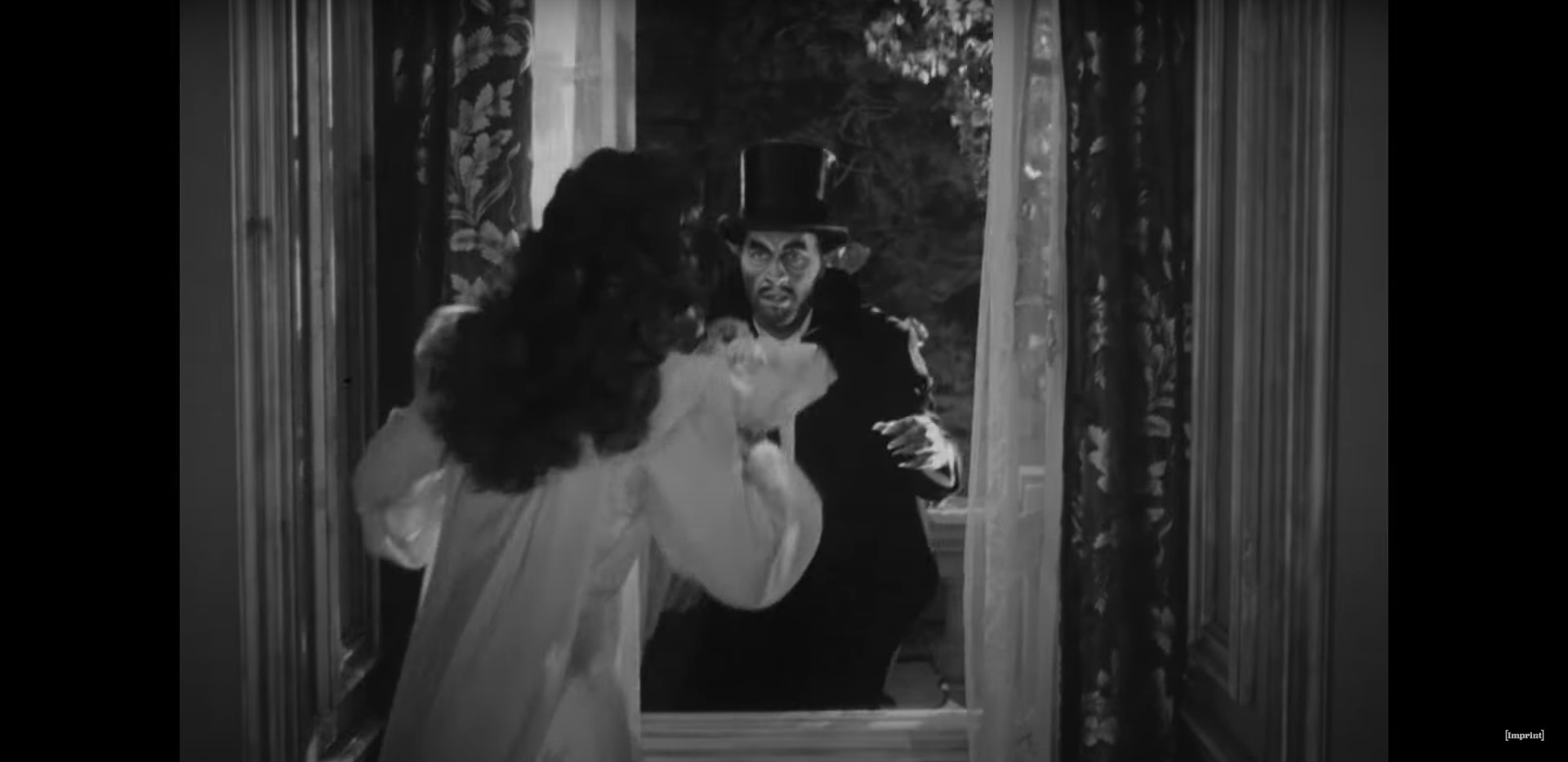
A part of the Imprint Collection, coming in at #219 on the spine, is “The Catman of Paris” on an Australian Blu-ray release. The limited edition high-definition release is AVC encoded on a single layer, BD25. The 1080p Blu-ray presentation comes from a 2017 4K scan of the original negative and is presented in the Academy ratio of 1.37:1. The original print material has sustained a few visible marks of infrequent vertical scratch damage, minor dust and dirt, total loss single frames, noticeable cigarette burns, and wavering levels in grayscale and contrast stability during edit transitions. Yet, there’s still a richness of the black and white image for the majority that refuses to fold outside the competent restoration attempt that gives dimension to a nearly 80-year-old film. The overall picture is a solid pass above par as it’s likely the best we’ll ever see in our time. The English language LPCM 2.0 mono track crescendos with a run of the mill brass band score overtop a quite clean dialogue track. Sure, the unmitigated track is slightly sullied by a consistent yet unimposing shushing with sporadic, stifled popping; however, there are no major issues with the mix and the dialogue through the dual channel is clean and distinguishable. Optional English subtitles are available. Special features include a new audio commentary track feature film historians Kim Newman and Stephen Jones, an oldfangled feature length documentary running through the cinematic history of stills and video clips from Republic Pictures The Republic Pictures Story, and a film historian Kat Ellinger video essay entitled Mark of the Beast: Myth Making and Masculinity in The Catman of Paris. Imprint’s tangible package is eye catching with color-washed front cover image on a thick cardboard side-slipcase; the illustration is pulled from one of the feature’s various marquee posters. Inside the slipcase, a character composition mockup includes the menacing Catman at the forefront with Regnier and female principals frozen in fear. The Imprint release runs at a slim 64 minutes, is unrated, and has a region free playback. “The Catman of Paris” is in servility of early Cat People productions but stands on its own two, or rather four, feet with an entrenching murder mystery that can keep you anthropomorphically guessing.

Meow!!  “The Catman of Paris” is on the Prowl on Imprint Blu-ray!

The Slammer is Full of Correctional Officer EVIL in “Lust for Freedom” reviewed!

The Jailed Chicks “Lust for Freedom” on Blu-ray!

Broken by the violent death of her partner, who she was also engaged to marry, after a drug bust goes south, undercover officer Gillian Kaites abandons law enforcement and drives across country in an internal turmoiled mess.  She’s pulled over by a Georgia County cop after she aids a frantic woman fleeing to escape two men in a black van.  Framed for narcotics possession by the corrupt officer, Gillian is drugged and locked away in the County’s women’s penitentiary overseen a strong-handed matron and an unscrupulous warden who dabbles in prostitution trafficking, drug smuggling, and even the occasional snuff filmmaking.  Back into a cellblock corner, Gillian must defend herself against the warden’s goons, protect other girls also falsely incarcerated, and lean into the sympathetic ear of the same corrupt cop that framed her after voicing his years of disgust with the warden’s malfeasance.

Part II of our bamboozled behind bars and following the 1986 examination of Eric Karson’s military simulation turned enslavement “Opposing Force,” is our next feature helmed by another director named Eric, notably Eric Louzil, with “Lust for Freedom.”  The debut film of Louzil, who went on to helm “Class of Nuke ‘Em High Part II and Part II” for Lloyd Kauman and Michael Herz of Troma Entertainment as well as slaving over standalone horror and sleazy schlockers in “Bikini Beach Race” and “Night of the Beast,” was also the first feature penned by the American-born, UCLA grad with a penchant for low-budget lewidies, cowritten alongside the “Shadows Run Black” writing duo, Craig Kusaba and Duke Howard.  With the working title of “Georgia County Lockup,” which in actuality the film was shot in various California and Nevada locations, such as Ely, Nevada, “Lust for Freedom” is an 8 x 8 cell of nudity, violence, and corruption under the co-production companies of Mesa Films and Troma Entertainment, with the latter reediting the original script and adding ADR adlibs to apply a sexed up and Troma-fied integration of product into their independent collection.  Louzil and Laurel A. Koernig produce the film with Troma bigwigs Lloyd Kaufman and Michael Herz as executive producers.

“Lust for Freedom” has many eccentric characters with many assorted plotlines in what is essentially an all women battle royal brawl in the cat-scratchin calaboose.  Stirring up trouble like a piece of scrap metal lodged in the gears of a well-oiled machine is tall and beautiful former cop, Gillian Kaites.  Played by Melanie Coll in her only known role, Kaites is only the bear in the bees’ nest, forced into confinement under false pretenses and to be subjugated by the likes of a wayward officialdom with lust in their eyes, greed in their pockets, and a disdain for disobedience.  Coll’s a bit flat footed with her performance and her Karate Kokutsu Dachi stance could use some improvement, but the tall, muscular, curly haired and light blonde actress can wield a multi-round popping automatic rifle with authority.  Stark against her Amazonian physique, not in a hard pressed and sexualized way, is main antagonist is the unbecoming Southern gentleman Warden Maxwell under the balding and overweight guise Howard Knight, but Kaites is more in tune against the procrustean penitentiary matron Ms. Pusker and Judi Trevor gives a Hell in a cell pastiche of early fascist women of Roger Corman produced WIP films, enforcing her will with prison muscle in the miscreant tough Vicky (Elizabeth Carlisle, “Evil Acts”) and the oversized guerilla (professional wrestler Dee “Matilda the Hun” Booher, “Spaceballs,” “DeathStalker II”).  Ultimately, Kaites sees her only path to escape through the very same person that wrongly confines her in the first place.  William J. Kulzer (“Class of Nuke ‘Em High Part II:  Subhumanoid Meltdown”) doesn’t quite fit the corrupted bill of Sheriff Coale, a mild manner and seemingly reasonable officer who goes with the despicable flow of sex trafficking amongst other indelicacies.  Yet, maybe that’s the purpose in Kulzer’s character, to be conflicted by the choices he and his callous cohort has made that made him stick out as the least repulsive individual behind the concreate and metal barred big house.  “Lust for Freedom” rounds out the cast with Donna Lederer, John Tallman, George Engelson, Rob Rosen, Shea Porter, Rich Crews, Raymond Oceans, Elizabeth Carroll, Lor Stickel, and Joan Tixei.

Gratuitous, full-frontal lesbian sex.  Yes, “Lust for Freedom” appeals to the very definition of its own title, like many other WIP productions and though a core element to the integrity of the subgenre, the creamy smoothness of two curvaceous, naked bodies getting it on shouldn’t always be the main selling point.  Luckily, Louzil ponies up more salacious material for his pinks in the clink caper.  An elaborate spiderweb of activity balloons and pulsates outward from the moment Kaites crosses path with an evening-dressed escapee being chased by a scary looking Native American and his sociopathic hooligan partner in a black van.  “Lust for Freedom” may be hammy and cheesy but what it’s definitely not is dull in its multifaceted approach to expose character layers.  Some characters grade more toward deviancy, such as Warden Maxwell and Ms. Pusker, while others are lifted toward a more redemptive means, such as with Sheriff Coale; that shepherd “Lust for Freedom” into a culminating jailbreak.  The narrative doesn’t necessarily focus around Kaites but she’s on a redemption arc to dig her out of a despair pit and into a fight worth fighting for purpose after the death of her finance, set up in the opening act.  As she evades the Vickey’s directed infringement to rough up the new girl, Kaites takes under her wing a fright clink chick named, another wrongly accused prisoner after being taken wandering the road, a theme that is a reoccurring motif from Kaites to Donna in thinking the young women can manage the world and their problems on their own accord but at a cost. However, whatever semblance is left of Louzil’s original script has likely been lost once Troma revamped it into the finished product you see today. Riddled with choppy cuts and incoherent segues, we have to wonder about Kaites’ role that may have been transmuted into a lesser core commodity in the final product.

Troma Entertainment releases a high-def, Blu-ray release of “Lust for Freedom.” The AVC encoded, 1080p resolution, widescreen release, in a 1.78:1 aspect ratio, compressed from its original aspect ratio of 1.85:1. Lloyd Kaufman mentions Louzil had shot the film on 16 mm and Troma subsequently blew up the negative to a 35 mm print that reframes the transfer for projection. Image-wise, the picture appears relatively clean albeit a plush grain and a few visible 16 mm cigarette burns with little-to-no age wear or exposure issue and the BD25 storage format has capacity aplenty to render an adequately compressed image with hardly any loss to the quality. Since the quality is heavily granulated, definitely no DNR implemented, the compression doesn’t suffer from a lack of a sharper, restored image. The audio is an English language Dolby Digital 2.0 Stereo can be echoey at times, as if the boom is catching warehouse reflection, but dialogue does topple in an appropriately laid out track mix that’s intertwined with hair metal band Grim Reaper’s titular “Lust for Freedom” single. We don’t get a ton of depth in the close quarters of the prison set but neither do we receive any depth in the exteriors either, sustaining most of the volume in a forefront stasis. Troma adds spotty ADR to kitschy up to Troma’s ludicrous level and its quite evident like a sore thumb that doesn’t quite match the ingrained audio mix. There are no subtitles available. Extras include the original DVD intro by Lloyd Kaufman, which also plays automatically at the startup of the feature, a directory’s commentary by Eric Louzil that is asynchronous with the feature in what is an approx. one-minute delay behind the Louzil’s retrospect, the original theatrical trailer, an interview with Lloyd Kaufman, a brief, brief clip of Eli Roth’s encouragement to just go and do a movie to the best of your ability, a Troma-themed showcase of one of their more modern Tromettes – Mercedes the Muse, the Radiation March, Gizzard Face 2: The Return of Gizzard Face, which has been on a slew of Troma’s releases over the past year, and coming attractions from the independent company. The Blu-ray comes in a tradition snapper with a guard tower, barbed wired, and Gillian Kaites with a semi-auto in her grip and barely cladded and torn clothes. No insert inside the case and the disc pressed art is the same as the cover illustration. This Troma release comes unrated, is region free, and has a runtime of 94 minutes. Plenty of desire for “Lust for Freedom,” busty babes behind bars barely bores and this vintage Troma keeps the WIP lacquer wet with self-satisfactory sadism and sexual spiciness.

The Jailed Chicks “Lust for Freedom” on Blu-ray!

That Chill from Within is the EVIL that Plagues the Mind. “Bone Cold” reviewed! (Well Go USA Entertainment / Blu-ray)

“Bone Cold” is available on Blu-ray Home Video at Amazon.com!

After a failed mission attempt by their counterparts, a pair of highly trained U.S. Black Op solders are called back from a leave, less than 24-hours on a previous mission, to drop into a snow-covered forest in Northern Ukraine.  The mission is to eliminate a Russian separatist amassing a paramilitary for insurgency strikes.  The skilled sniper and his longtime spotter assassinate the wrong target on bad intel and find themselves running for their lives when separatist soldiers begin tracking them.  Unable to evac until the mission is a success and they lose their hostile pursuers, the soldiers are hard-pressed by their handler to continue to locate and eliminate the intended target, but something else is following them.  A dark figure against the snowy white landscape hunts them.  With no other friendly assets in the area or air support, they must battle to survive the two-fronts alone, relying on their years of trust and training to get them through alive.

“Bone Cold” is the chilling 2022 psychological thriller from first time feature length film director Billy Hanson.  The Main-born, Florida State Film School alum also pens the story that tackles traumatic stress and delusions brought upon military war and operation fatigue mixed with suspenseful arms engagement, displaying phenomenal sniper back-and-forth volleys, and mixes in a sinister and ominous presence in tow.  Shot in the dual locations of Los Angeles, California, for the not-so-frigid-looking scenes, and in the director’s home state in Saco, Maine during the winter months where most of the action takes place, “Bone Cold” plays into that penetrating freeze that sends shivers down your spine as well as getting the blood pumping for the clashes of special and supernatural forces.  Hanson, along with Elise Green, Ness Wilson, Jonathan Stoddard, and music video maker Jaclyn Amor produced the film under Hanson’s own Dirigo Entertainment production company with Mind the Gap Productions and Well Go USA Entertainment handling distribution.

The story opens with a man using a metal detector on a semi-arid land until the strengthening beeps denote his bounty, a cache full of semi-automatic weapons.  Before he can enjoy the cold grip of a powerful rifle in his hand, his temple explodes with a quick blood splatter from the scoped rifle of United States Black Ops solder Jon Bryant at the confirmed behest of his spotter partner, Marco Miller.  The operatives are played by “Away the Dawn’s” Jonathan Stoddard and “Discarnate’s” Matt Munroe respectively who muster and mimic well the jarhead jargon and procedural positioning with their own brand of super soldier camaraderie, building a believable bond based on distinct posturing alone.  Narratively, we’re exclusively in synch with Jon Bryant, the expert sniper whose likely spent more hours killing marks than at home with wife Mel (Jennifer Khoe, “Fear Frequency”) and daughter Wendy (Trinity Jo-Li Bliss, “Avatar:  The Way of Water”) and slowly Jon’s reality begins to fissure under the pile of bodies that he’s claimed over his military career that translates right into the next mission before he can even decompress from the last assignment.  During their clandestine campaign, Jonathan Stoddard can sell stoic reactions with ease unlike the opposite side of the spectrum where crazy isn’t in the actor’s natural repertoire and while the unknown factor nudges a way in between the two soldiers, where their lives depend on the very stability and duty of the other, in what is a fervent wedging that puts them in a tough spot, Hanson throws in an unnecessary monkey wrench that departs from the obvious in a confounding way and trails Stoddard away from his character leading himself out of his own mental maze.  Hanson does attempt to re-ground the solders with combat and the negative affect that life-and-death struggle has on them in a hot zone and at home.  “Bone Cold” rounds out the cast with Elise Greene (“Incantation”), Jeremy Iversen (“Mantus’), and Danielle Poblarp.

Choice domestic locations give “Bone Cold” a broader, international feel, creating a bigger narrative than in actuality, and those illusionary elements provide invaluable production value on a smaller scale production.  Throw in a few Russian speakers and Billy Hanson has transported you into Eastern Europe without having to leave the filmmaker’s backyard.  A decent charge of combat and special forces verbiage tack on a competent conflict between Americans and Russians that’s kept intimate and selective to not overflow beyond the budget’s capacity to be deemed overreaching to a fault.  We’re also treated to a fair amount of fear that’s set isolated in the quiet, snowy woods where tricks played on the eyes are common and every sound resonates from every angle.  The dark figure stalking and glaring from a distance is ever menacingly taut with suspense, especially with the flawless first-time feature editing work by Hanson and co-editor Art O’Leary.  From the distance, the unknown black figure’s piercing eyes and a wide, sharp-toothed grin is undoubtedly creepy obscured behind trees, bushes, and shadows, but up close and well-lit, the creature characteristics are more a cartoon caricature in its rubbery posterior.  The connection between the paranormality of the creature and sanity-breaking guilt trauma is evidently clear as that ugliness and cold-bloodiness is from within clawing to break out, it becomes an object of neglect until it takes a ride home with you to destroy loved ones, physically and emotionally.  Ultimately, Hanson’s able to piece together an allegorical tale in a roundabout charter that encircles a moment of mass belief of what’s really out there stalking them and the unsuspected device feels like a speed bump being hit at 80 MPH so the story goes off the rails a bit to engage tactual fear with viewers that reminisces a “Predator”-esque faceoff that’s quite out of context and not as thrilling.

“Bone Cold” is a low-budget psychological thriller with a large snowbank production value brought to the Blu-ray retail shelves courtesy of Well Go USA Entertainment.  The AVC encoded BD25 is presented in 1080p, high-definition, with a 1.78:1 aspect ratio.  Since much of the duration has a bright, white snow backdrop, compressions issues are limited to only when the sun falls and night engulfs the solders, displaying some high compression low quality issues that blur the delineated trim which is fairly consistent over many Well Go USA releases as I believe their standard single layer format storage is too little for feature plus bonus material.  Shot on a Panasonic EVA 1, the picture is well balanced in contrast as we’re able to see and distinguish the background and foreground images with relative ease despite the blinding white and the lightly opaque blue lens tint provides an extra chill for the wintery setting.  An English DTS-HD 5.1 audio mix offers ample coverage across all tracks, providing an absolute dialogue package and a full-bodied milieu ambience that has capacious range and depth.  Available English subtitles are a menu option. Bonus features include a making of that’s a total package in running down cast and crew interviews discussing precisely and, in every detail, how “Bone Cold” came to fruition, a montage blooper reel, and the original trailer. Physical aspects of the release include a rigid cardboard o-slipcover with embossed title and back cover stills. Inside the slipcover is your traditional Blu-ray snapper case with latch opening with a cover art the same as the slipcover, that of the dark figure standing in silhouette in the background with a foreground, hunkered over, facing it with a rifle, soldier in the snow. Unimpressive is the disc art of a hazy snow covered Ukranian forest. “Bone Cold” has a 109-minute runtime, comes not rated, and is region A locked. “Bone Cold” has a few choice on ice moments that make the third act inconclusive as the story struggles to decide what it wants to be but Billy Hanson’s grasp on the psychological grip is crafted with an arresting visual paradigm on a paranormal level to convey the life-and-death struggles of combat fatigue and psychosomatics.

“Bone Cold” is available on Blu-ray Home Video at Amazon.com!

Cicadas’ EVIL Song Will Test Your Sanity! “The Sound of Summer” reviewed! (Unearthed Films / Blu-ray)

If You Can’t Take The Heat, Watch “The Sound of Summer” instead!  

A coffee shop employee is over the Summer’s relentless heat.  She’s also over Summer’s Cicada call of vibrational chorusing when the winged insects glide their tymbals across their abdomens to attract the season’s female sex.  In working one shift, a strange local man patrons her shop, bringing in his Cicada nets and enclosures, feeding his snared insects right in the middle of his hot coffee break.  Revolted by who she dubs The Cicada Man, and by cicadas themselves, insidious nightmare dreams and an intense itching sensation drives the girl into scratching and terrified fit.  The obsession to scratch the itch wears out spots on her skin to the point of creating open wounds to excavate the bugs she believes have burrowed their way into her body because a dream of The Cicada Man planting them inside her.  Reality begins to crumble  and delusions set in as her and The Cicada man have unfinished business that begin a downward spiral of Summertime insanity. 

The Summer season isn’t for everybody.  The oppressive heat, the swarming insects, the uncomfortable stickiness of sweat-inducing humidity, and the very essence of an overwhelming nature that can be engulfing toward a devolved transfiguration.  That’s the premise behind the 2022 Japanese extreme shock and gore horror “The Sound of Summer,” the first feature length film by a United Kingdom-born writer-director known only as Guy (aka Guy Fragments) who has lived and worked in Japanese since 2016.  Influenced prolifically by Japanese underground filmmaker Shozin Fukui (“Rubber’s Love,” “964 Pinocchio”), Guy follows Fukui’s extreme experimental horror with his own tastes and experiences built into the framework of what becomes an antithetical liking to the widely popular season that usually provides outdoor fun and sun.  In “The Sound of Summer,” the sun is the enemy and the cicadas are the siren song humming foot soldiers that infest the mind.  The body horror is a production of the director’s indie production company Sculpting Fragments, the same company used to produce the Guy’s shorts, “The Rope Maiden” and “Difficulty Breathing.”

“The Sound of Summer” runs a cast of nameless characters and at the center of the cicada madness, we’re individually tailgating one of the two women who work at the coffee shop.   Kaori Hoshino enacts the young woman’s displeasure for the Summer with constant vocal grouchiness of the heat and her visible disgust and detest of the surrounding cacophonous cicada chirping.  Hoshino works lathering loathsome into the character’s routine as a single working woman, living alone, with a daily schedule.  There’s never ostentatious gesticulation that overplays her hot hating hand.  Intermittent with seemingly mundane tasks provides a more down to earth and normal person, juxtaposed greatly with more contrast in the later extremely disturbed version of herself.  Her delusional disorder stalks her in the physical form of The Cicada Man, a rather odd, older man involved in what she considers to be childish bug-catching activities, and his presence, or maybe just the image of him, invades her mental space coinciding with everything else she dislikes about the Summertime.  The Cicada Man becomes the epitome of everything she finds repulsive yet every element of his being and the Summer sink underneath her skin, in a literal figurative combination.  In the metamorphizing macabre role of The Cicada Man is Shinya Hankawa who also has a tangent sub-story of feeding his precious insects, as well as himself, blood from the sickle opened young women he has hidden away in a derelict building.  This expresses The Cicada Man as morosely deranged but the narrative has up until now been latched onto the young woman from the coffee shop, which begs the question, is this how the young woman perceives The Cicada Man, even as far as labeling him with a slasher-esque moniker to further demonize him into being a part of a culmination toward her worst nightmare?  “The Sound of Summer’s” cast comprises of Kiyomi Kametani, Shiori Kawai, Kuromi Kirishima, Keita Kusaka, and Yuina Nagai.

Like renowned painters Edvard Munch or Vincent van Gogh, a madness quality lies within every stroke of Guy’s ‘The Sound of Summer.”  Guy pulls inspiration from his own experiences of a moderately pleasant English Summer being eradicated by the same season in Japan and it’s Hellish temperatures become a reconfiguration of the psyche when the once comfortable becomes oppressed by the uncomfortable surroundings of sensory overload.  A cultural physical representation of the season in Japan is the cicada, like the recognizable and sought after Cherry Blossoms of the insect world.  Guy uses the spellbinding cicada song with a fear-inducing frequency that vessels in psychological harm or delusional parasitosis with a visual goad of an enigmatic old man having them as pets that mixes the brain’s signals into a freefall into madness.  Yet, the audience is never outrightly explained what’s happening to the young coffee shop barista as a limited number of The Cicada Man’s spliced in scenes chauffeur in a more supernatural and macabre side separate from the woman’s narrative preponderance.  Are we supposed to be inside the barista’s disordered brain that’s going mad or is The Cicada Man offshoot sub-narrative an inside look at his bizarre insect consumed little world that slowly seeps under the Barista’s skin?   “The Sound of Summer” might be open for one’s own personal interpretation, but it’s clear in message as an anti-Summer film, an anti-bug film, and an anti-sane film with a prosthetic effects edge and a hyper-sensitive gore impact that’ll leave you scratching the most insignificant itch – just in case.

Ring in the approaching Summer season with “The Sound of Summer” on Blu-ray from extreme horror label Unearthed Films.  The AVC encoded single layer BD25 presents the film in a 1080p, high-definition resolution with a widescreen 1.78:1 aspect ratio.  Image quality is relatively stable throughout with spot areas of compression concern, such as splotching, around the darker, grittier scenes inside The Cicada Man’s rundown squat.  Details maintain their sharpness as we receive some gooey bits and pieces of unidentifiable flesh and muscular tissue.  Plus, the prosthetic applications display a coarse texture comes through the decoding well, despite a jumpy Mbps.  Guy’s approach to the cinematography takes a steady devolutionary downfall from the brightly lit and sterile to the darkly embracing and infested as if the two contrasting elements are linked by the psychological supporting wall between safety and danger, easily to crumble under natural pressures with the simple prod of gentle persuasion.  The Japanese language PCM 2.0 track distributes a fine dual channel mix that favors the sound design with cicada chorusing and the constant scratching and open wound tissue removal churning out an audible force of discord.  Dialogue is the other suitable track that’s remains clear, clean and in the forefront of the action, soundtrack, and robust sound design.  No signs of hissing, popping, or strength with the digital recording.  The optional English subtitles synch well with error free translation.  Extras include a behind-the-scenes that’s more of a blooper reel of the cast and crew making faces and messing around during principal photography, the Tokyo live-stream premiere after screening interview with director Guy and cyberpunk horror director Shozin Fukui, the Japanese premier with director and cast, and the film’s trailer.  Front cover is a grainy look at The Cicada Man in full metamorphic bloom slipped into a traditional Blu-ray snapper case with a disc art pressed with the illustrative, flesh-wounded flesh of the young victim.  The Unearthed Films release is not rated, has gore-friendly pacing at 75 minutes, and is locked with region A coding.  Special effects by “Versus’s” Susumu Nakatani and an original soundtrack by the Singaporean electronic-experimenter, Microchip Terror, “The Sound of Summer” buzzes with body horror boudoir in Guy’s directorial feature length extremity. 

If You Can’t Take The Heat, Watch “The Sound of Summer” instead!  

Down the Path of Darkness is EVIL. “The Long Dark Trail” reviewed! (Cleopatra Entertainment / Blu-ray)

“The Long Dark Trail” on Blu-ray at Amazon.com

Set in the idyllic boondocks of Northwestern Pennsylvania, two young brothers plan to escape the abusive grasp of an alcoholic father in search for a better life.  Without a plan and nowhere to go, they go around the small town to collect money from the odd jobs the brothers worked in preparation for their abscond.  While doing so, they come upon information about their mother, who abandoned them at a younger age, that sparks an desire to track her down in hopes that once she’ll lay eyes on them, she’ll want to rekindle the relationship with her two sons, but the trek deeper into the northern woods would be long and arduous through abandoned aqueducts, pine forests, and numinous burial stones belonging to an inimical cult of women controlled by a sadistic leader.  It is the cult where their mother left them to reside and it is there where they are headed on their haunting journey in hopes for a better life.

Tackling impoverished, ill-treated youth haunted by their past and uncertain about their future, directors Kevin Ignatius and Nick Psinakis write-and-direct “The Long Dark Trail” as a tale of resiliency for two close brothers relying on each other to climb out from a pit of despair.  Ignatius and Psinakis have collaborated previously together as writer-director and cowriter-actor in the misfortunate happenings comedy “My Best Friend’s Famous.”  The 2022 drama-thriller marks the first feature film for the filmmakers who explore coming-of-age through trial by fire, or by the supernatural psychological manipulation of enchanted rocks and by the coarse portents of a blood sacrificing cult.  Shot in Ignatius’s birthplace home of Warren County, PA, the two New York filmmakers shoot the low-budget venture under their independent production company, Four Eighteen Films, in association with El Jean Productions and with associate producers Michael Kraetzer (“The Slaughterhouse Killer”) and Nicholas Onetti (“Francesca”) of Black Mandala presenting the film.

“The Long Dark Trail’s” story follows two brothers played by real-life brothers, Brady and Carter O’Donnell, debuting in their first feature film.  You can tell the brothers don’t have a ton of acting experience as their dialogue is very mechanical and their movements are bit stiff and hesitant, but since the narrative revolves around their characters, antisocially bred by the abusive father’s impropriety, being socially awkward on screen, even between each other despite their off-screen brotherhood, doesn’t necessarily feel far-fetched.   “The Long Dark Trail” isn’t a heavy on the dialogue narrative, leaving much of the plot to unfold with the brothers’ wondering the forest grounds, natural and unnatural visual imagery, and the hypnotic folksy score.  From start to finish, Brady and Carter carry the entire storyline from start-to-finish with intermittent spliced in scenes of hooded cult acolytes doing obscure and violent things in what looks to be the upstairs of a vacant barn or with the earlier scenes of the boys visiting and conversing with a purpose with Mr. Barrow as he rambles on about his veteran war stories while the boys take full advantage of his porch sitting to steal food form his cupboards; a role undertook by Kevin Ignatius’s father, Paul “Doc” Ignatius.  The O’Donnell siblings shepherd much of the trail journey’s harrowing phantasms to the best of their ability but are also not limited to being just reactionary to the spooky woods.  Practical makeup effects and some visual compositions are chartered for divisive inducing dynamics in order to drive a wedge between the brothers’ already contentiousness of wanting to traverse a dark corner of God’s country to see a mother that has already forsaken them once.  Trina Campbell plays the indoctrinated mother now embedded into an outskirt cult led by Paul Psinakis’s version of a cult leader in Zeke.  Psinakis has the maniacal wild eyes and brooding aura demarcating him as a clear cut bad guy with a bunch of vary-in-age women in tow but the cult is not very clearly defined as a whole or with a purpose and when the boys stumble into their isolated camp, near that aforesaid barn full of now chopped up body parts and hunting game skulls, the exposition to follow is not presented and the real sense of danger is only palpable from Zeke and Zeke alone. 

While cast and story struggle to make ends meet with relative clarity, what Ignatius and Psinaki do really well in fashioning for effect is depicting the rural folk horror elements of vast natural landscapes that can turn looming and inescapable.  As a resident of Southeastern Pennsylvania, convenience and concrete genetically makeup my quasi suburban-urban scenery, but I can appreciate the opposite side of the state with greenery up to your neck and beyond, the solitude of a different way of life, and how one could also appreciate how menacingly engulfing that can all feel as well.  We’re also not completely stuck to the forest setting as the directors’ use riverbeds and lakeshores, sprawling grasslands, and the quaint town structures to enlarge the presence of a smaller shoot.  Kevin Ignatius isn’t just the co-director of “The Long Dark Trail,” he’s also the film’s composer, another aspect of highlight, amongst other hat wearing titles.  The catchy and mesmeric folk/bluegrass score is a real tribute to Ignatius’s musical background, having formed a band, Das Tapes, with brother Mark, by adding a layering combination of vocal sounds and banjo strumming.  The latter banjo reminisces a little bit of “Deliverance” but with an elongated cadence integrated into the brothers’ long road tour, becoming a mainstay importance to the overall lingering feel of backwater chills.  Where “The Long Dark Trail” fumbles is at the heart of project – the story.  Never really tying the elements all together, the narrative often feels abstract and unhinged in a series of randomized events between the cursed rocks, vivid hallucinations, the boys’ trauma, the women stuck in a cult of a madman, and the message on blood ties.  Was the father’s verbal and physical abuse the root cause of psychological and family brokenness?  Are the brothers’ bond and endurance being tested on the trial trail toward their last form of hope, their abandoning mother?  “The Long Dark Trail” is in a long, dark well of questions without any return of answers in a conclusion that can’t be roughly swallowed along the course of an exceptionally scored and formidable atmospheric thriller. 

“The Long Dark Trail” path leads to at home Blu-ray release from Cleopatra Entertainment, the film banner of Cleopatra Records, and MVD Visual.  The AVC encoded BD25 provides high-def resolution in 1080p of a widescreen presentation.  The Cleopatra Blu-ray does not list the aspect ratio and IMDB.com lists the film at 2.39:1 which is accurate in accordance to the release.  A combination blend of natural and lowkey lighting doesn’t appear to present too many issues with the format storage.  A few signs of pixilation in deeper negative spaces cease to only a handful of decoded moments stark contrast.  For a digital recorded film that’s churning out an average of 25Mpbs, par for the course for Hi-Def, the details don’t display to the fullest sharp potential but are certainly on the edge of so.  You can get better visuals from the brightly lit of primarily color contrasting scenes for a film that’s remains in natural grading.  Also not listed on the Blu-ray back cover is the audio specifications, but according to my player, the release comes with an English Dolby Digital 5.1 surround sound and an English LPCM stereo. The five-point multi-channel audio mix studs the soundtrack with piquant notes, harmonies, and twanging banjo chords. Dialogue is pleasantly defined through the robust soundtrack and the ambience has a nice range of rustle and depth. I’m quite surprised by this Cleopatra Entertainment release that doesn’t come with a second disc, a CD, of the soundtrack, likely due to the score not produced by the parent record label. English subtitles are optionally available. The bonus features include blooper outtakes and behind the scenes footage, an image slideshow, and the original trailer. The back cover also notes an interview with the director, but what’s on the disc is a featurette surrounding artist R.L. Black’s graphic novel artwork for the film and for the forthcoming comic based off the film. There is no interview with the director. The rest of the bonus material rounds out with Cleopatra Entertainment trailers of “The Ghosts of Monday,” “Frost,” “A Taste of Blood,” “Escape from Area 51,” Baphomet,” and “Scavenger.” The film is housed in a traditional Blu-ray snapper with a rough and ready composite of a skull looking to swallow the bicycling boys on the dark path with a dark lit moon overhead; a missed opportunity in my opinion as there’s a better poster out there for the film, a more graphic poster, of one brother’s bloody head split down the middle and opening for the other’s brothers face to show. The Blu-ray is region free, unrated, and has well-paced runtime of 78-minutes. Likely not to please by or understand by most, “The Long Dark Trail’s” coming-of-age narrative wrangles with what’s most important for a folk horror film of its kind – either to be an apparatus for breathtaking countryside imagery or of trauma that is tense-laden and tearing families to pieces – and unfortunately, the feature couldn’t be both.

“The Long Dark Trail” on Blu-ray at Amazon.com