That Chill from Within is the EVIL that Plagues the Mind. “Bone Cold” reviewed! (Well Go USA Entertainment / Blu-ray)

“Bone Cold” is available on Blu-ray Home Video at Amazon.com!

After a failed mission attempt by their counterparts, a pair of highly trained U.S. Black Op solders are called back from a leave, less than 24-hours on a previous mission, to drop into a snow-covered forest in Northern Ukraine.  The mission is to eliminate a Russian separatist amassing a paramilitary for insurgency strikes.  The skilled sniper and his longtime spotter assassinate the wrong target on bad intel and find themselves running for their lives when separatist soldiers begin tracking them.  Unable to evac until the mission is a success and they lose their hostile pursuers, the soldiers are hard-pressed by their handler to continue to locate and eliminate the intended target, but something else is following them.  A dark figure against the snowy white landscape hunts them.  With no other friendly assets in the area or air support, they must battle to survive the two-fronts alone, relying on their years of trust and training to get them through alive.

“Bone Cold” is the chilling 2022 psychological thriller from first time feature length film director Billy Hanson.  The Main-born, Florida State Film School alum also pens the story that tackles traumatic stress and delusions brought upon military war and operation fatigue mixed with suspenseful arms engagement, displaying phenomenal sniper back-and-forth volleys, and mixes in a sinister and ominous presence in tow.  Shot in the dual locations of Los Angeles, California, for the not-so-frigid-looking scenes, and in the director’s home state in Saco, Maine during the winter months where most of the action takes place, “Bone Cold” plays into that penetrating freeze that sends shivers down your spine as well as getting the blood pumping for the clashes of special and supernatural forces.  Hanson, along with Elise Green, Ness Wilson, Jonathan Stoddard, and music video maker Jaclyn Amor produced the film under Hanson’s own Dirigo Entertainment production company with Mind the Gap Productions and Well Go USA Entertainment handling distribution.
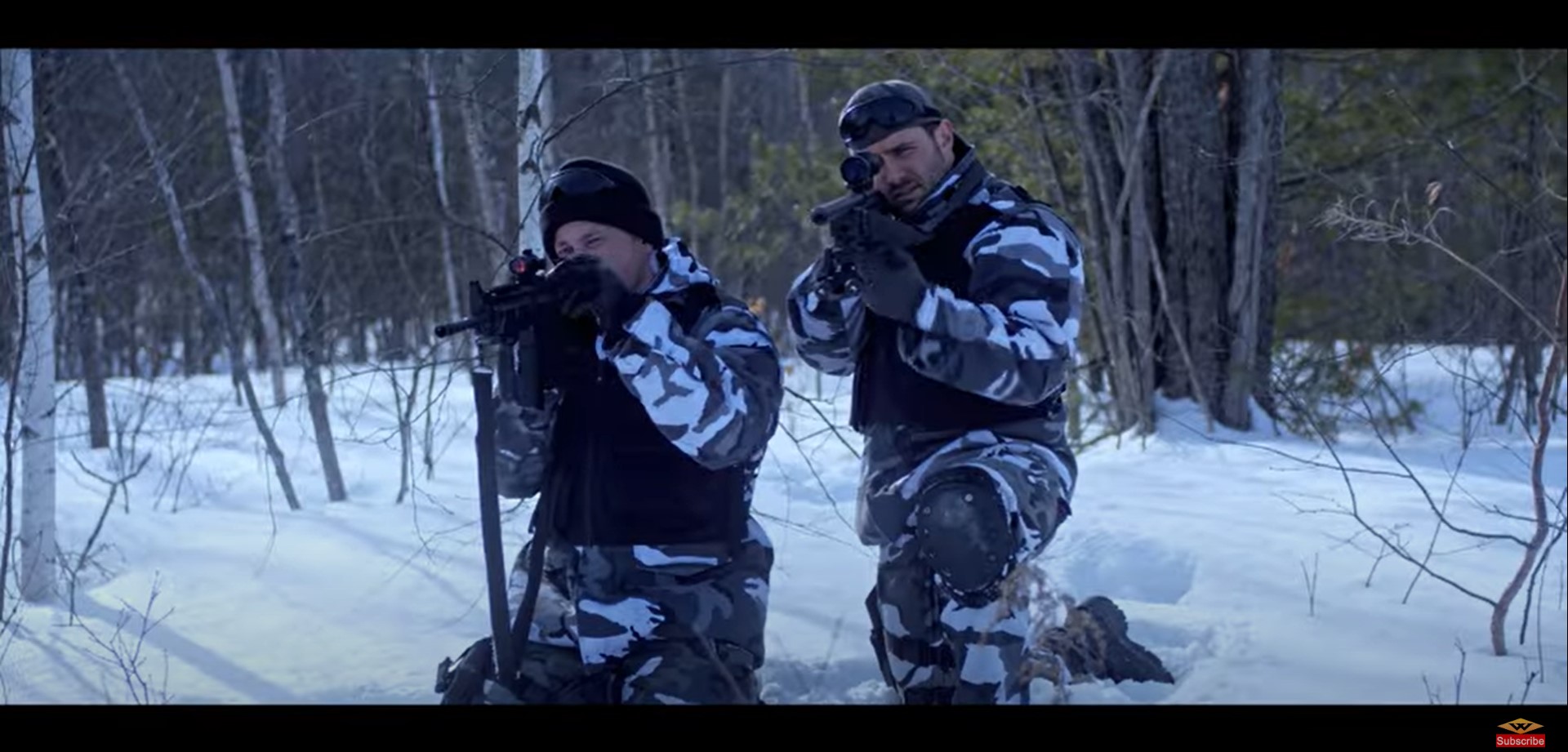
The story opens with a man using a metal detector on a semi-arid land until the strengthening beeps denote his bounty, a cache full of semi-automatic weapons.  Before he can enjoy the cold grip of a powerful rifle in his hand, his temple explodes with a quick blood splatter from the scoped rifle of United States Black Ops solder Jon Bryant at the confirmed behest of his spotter partner, Marco Miller.  The operatives are played by “Away the Dawn’s” Jonathan Stoddard and “Discarnate’s” Matt Munroe respectively who muster and mimic well the jarhead jargon and procedural positioning with their own brand of super soldier camaraderie, building a believable bond based on distinct posturing alone.  Narratively, we’re exclusively in synch with Jon Bryant, the expert sniper whose likely spent more hours killing marks than at home with wife Mel (Jennifer Khoe, “Fear Frequency”) and daughter Wendy (Trinity Jo-Li Bliss, “Avatar:  The Way of Water”) and slowly Jon’s reality begins to fissure under the pile of bodies that he’s claimed over his military career that translates right into the next mission before he can even decompress from the last assignment.  During their clandestine campaign, Jonathan Stoddard can sell stoic reactions with ease unlike the opposite side of the spectrum where crazy isn’t in the actor’s natural repertoire and while the unknown factor nudges a way in between the two soldiers, where their lives depend on the very stability and duty of the other, in what is a fervent wedging that puts them in a tough spot, Hanson throws in an unnecessary monkey wrench that departs from the obvious in a confounding way and trails Stoddard away from his character leading himself out of his own mental maze.  Hanson does attempt to re-ground the solders with combat and the negative affect that life-and-death struggle has on them in a hot zone and at home.  “Bone Cold” rounds out the cast with Elise Greene (“Incantation”), Jeremy Iversen (“Mantus’), and Danielle Poblarp.

Choice domestic locations give “Bone Cold” a broader, international feel, creating a bigger narrative than in actuality, and those illusionary elements provide invaluable production value on a smaller scale production.  Throw in a few Russian speakers and Billy Hanson has transported you into Eastern Europe without having to leave the filmmaker’s backyard.  A decent charge of combat and special forces verbiage tack on a competent conflict between Americans and Russians that’s kept intimate and selective to not overflow beyond the budget’s capacity to be deemed overreaching to a fault.  We’re also treated to a fair amount of fear that’s set isolated in the quiet, snowy woods where tricks played on the eyes are common and every sound resonates from every angle.  The dark figure stalking and glaring from a distance is ever menacingly taut with suspense, especially with the flawless first-time feature editing work by Hanson and co-editor Art O’Leary.  From the distance, the unknown black figure’s piercing eyes and a wide, sharp-toothed grin is undoubtedly creepy obscured behind trees, bushes, and shadows, but up close and well-lit, the creature characteristics are more a cartoon caricature in its rubbery posterior.  The connection between the paranormality of the creature and sanity-breaking guilt trauma is evidently clear as that ugliness and cold-bloodiness is from within clawing to break out, it becomes an object of neglect until it takes a ride home with you to destroy loved ones, physically and emotionally.  Ultimately, Hanson’s able to piece together an allegorical tale in a roundabout charter that encircles a moment of mass belief of what’s really out there stalking them and the unsuspected device feels like a speed bump being hit at 80 MPH so the story goes off the rails a bit to engage tactual fear with viewers that reminisces a “Predator”-esque faceoff that’s quite out of context and not as thrilling.

“Bone Cold” is a low-budget psychological thriller with a large snowbank production value brought to the Blu-ray retail shelves courtesy of Well Go USA Entertainment.  The AVC encoded BD25 is presented in 1080p, high-definition, with a 1.78:1 aspect ratio.  Since much of the duration has a bright, white snow backdrop, compressions issues are limited to only when the sun falls and night engulfs the solders, displaying some high compression low quality issues that blur the delineated trim which is fairly consistent over many Well Go USA releases as I believe their standard single layer format storage is too little for feature plus bonus material.  Shot on a Panasonic EVA 1, the picture is well balanced in contrast as we’re able to see and distinguish the background and foreground images with relative ease despite the blinding white and the lightly opaque blue lens tint provides an extra chill for the wintery setting.  An English DTS-HD 5.1 audio mix offers ample coverage across all tracks, providing an absolute dialogue package and a full-bodied milieu ambience that has capacious range and depth.  Available English subtitles are a menu option. Bonus features include a making of that’s a total package in running down cast and crew interviews discussing precisely and, in every detail, how “Bone Cold” came to fruition, a montage blooper reel, and the original trailer. Physical aspects of the release include a rigid cardboard o-slipcover with embossed title and back cover stills. Inside the slipcover is your traditional Blu-ray snapper case with latch opening with a cover art the same as the slipcover, that of the dark figure standing in silhouette in the background with a foreground, hunkered over, facing it with a rifle, soldier in the snow. Unimpressive is the disc art of a hazy snow covered Ukranian forest. “Bone Cold” has a 109-minute runtime, comes not rated, and is region A locked. “Bone Cold” has a few choice on ice moments that make the third act inconclusive as the story struggles to decide what it wants to be but Billy Hanson’s grasp on the psychological grip is crafted with an arresting visual paradigm on a paranormal level to convey the life-and-death struggles of combat fatigue and psychosomatics.

“Bone Cold” is available on Blu-ray Home Video at Amazon.com!

The Picked-On Runt Can Be EVIL Too. “Little Corey Gorey” reviewed! (SRS Cinema / DVD)

“Little Corey Gorey” Uncut and on DVD home Video at Amazon.com!

After losing his father to a fatal accident, little Corey Gorey is forced to relocate to a new home with his overweight, alcoholic, and verbally abusive stepmother and similarly so, racist brother-in-law, Biff.  Constantly receiving the short end of the stick, Corey tries to retain a normal life by buying Ozzy Osbourne concert tickets and meeting girls at high school, but when his bigger, older Biff raids Corey’s broom closet of a room searching for a pinup one-sheet, he discovers the concert tickets and hooks up with Corey’s dream girl from school.  In a fit of rage, Corey accidently kills Biff as the two scuffle and with that Corey sows the seeds of salvation as the teen who was constantly tormented and afraid to talk back now is eager to take his life back.  Keeping his stepmother tied to the couch and gagged from making noise, Corey dismembers what’s left of his brother into the storage freezer and includes the sociopathic girl of his dreams into the fold but when a nosy mail carriers begin to snoop around and a drug dealer is seeking payment for the cocaine he fronted Biff, the bodies begin to pile up and Corey finds himself over his head.

Talk about your unhappily ever after Cinderella story, “Little Corey Gorey” goes from rags to wreaking havoc by way of severing limbs and meat grinding body parts all the while trying to sweep a rebellious older high school girl off her feet in an attempt to run away from all the carnage and abusive adults.  Bill Morroni, credited as William Morroni in the film, wrote and directed his debut feature in sunny California that is anything but sunshine and good vibes in this 1993 released, dark horror comedy obscure to many horror fans. A real highlight of early 90’s low-budget horror done right with smartly placed and highly effective practical effects, “Little Corey Gorey” is a begrimed gem waiting to shine, produced solely by Morroni under his self-funded principal production over the course of a few weekends. 

What makes “Little Corey Gorey” half as enjoyable as it turns out to be is because of the cast.  Once plagued by unfortunate circumstances, such as an example with the untimely death Divine (“Multiple Maniacs,” “Pink Flamingos”) who was to have a lead role, that one might consider the film be cursed celluloid even before principal photography, Morroni was able to overcome with a perfectly suited set of talent to tackle Corey Gorey’s gruesome exploits of dysfunctional family survival.  The titular role was awarded to Todd Fortune whose diminutive size really plays against the larger and towering figures that make his life a living hell.  Divine would have stepped into the shoes of wicked stepmother Betty and even though Divine would have done phenomenally in a constant-drunk state of a barraging verbal abuse and torment, Pat Gallagher filled the cankerous role with despicable-inducing results and gives a real witch of a woman performance to not only Corey but also her actual on-screen son Biff.  Greg Sachs might be stiff as a board as the older brother with racist overtones and a compounding dislike for Corey, but Biff turns out twisted enough to be an antagonizing accomplice in building Corey’s pent-up survival garnished with ghastliness.  One of the more scene stealers is Brenda Pope as the bitchiest high school narcissist Jackie who has somehow swooned Corey’s rationality and has him hanging on her tongue with every lie.  From special feature commentary by Morroni, Pope was a real life true-to-form unpleasant person behind-the-scenes as well as in front of the camera but that doesn’t stop her good looks and devilishly delectable moodiness and conceitedness from drying out.   As a group, you can feel every resounding personality types and cluster of chaos that spits out sympathy for Corey despite the curated torture from those who are supposed to care for him and also feel not one ounce of pity for Corey’s tormentors turned minced meat at the hands of the water treading teen.  “Little Corey Gorey” has a neighborhood ensemble featuring parts by Edenia Scudder, Sabino Villa Lobos, Kristin Caruso, Bernice Smiley, John B. Tomlinson, and William Linehan has an escaped prisoner and mass murderer being built up by the news media with his convenient store killings only to be the only part of “Little Corey Gorey” to fizzle out in a subplot to nowhere. 

With a spiffy name, a thematically onboard cast, and some really good editing and camera work, “Little Corey Gorey” surprisingly has a lot going for it despite being shot on 16mm variational stock and using scratch audio, aka studio dubbing, that makes the 1993 feel and appear more rough and ready than necessary, like a wrinkled, toothless middle-aged man after smoking and drinking heavily for half his life, but in the grand scheme of things, “Little Gorey Corey” has held up moderately well in quality and in story.  Through the spikey colored wigs, cut off sleeve shirts, mullets running rampant, and good seat concert tickets with a price tag of $18 might have run their course over father time, bullying remains a hot topic to this day.  Dysfunctional family dynamics, blind and fatal obsession, drugs use, and being in the friend zone with a haughty hottie also hasn’t changed much.  You can’t help not feeling pity for Corey and the excruciating awkwardness of him pulling out all the stops in order for Jackie to notice his heartfelt, romantic gestures and advances only to be immediately blown out of the sky like a Chinese weather-spy balloon gliding over Montana.  Everything that happens to the thick-skinned kid culminates to a head, to a finale of penetrating his usually impenetrable, encrusted scar tissue of a shell that just seems right or justifiable that when the world pisses on you, you cut off its penis with a corded circular saw.   

“Little Corey Gorey” receives a new scan (upscaled?) of the 16mm source material and drops onto a re-release from SRS Cinema!  Though still framed in a full screen 1.33:1 letterboxed aspect ratio, the transfer looks much clearer than the original VHS release with brighter grading and an enriched image that delineates edges and some details.  The variation in 16mm stock is obvious, more so in only a handful of scenes in comparison to others, with only a very select few offering a shoddy, nearly obstructed view of focal objects.    One thing about the SRS Cinema DVD back cover is it lists a new HD transfer from original camera negative, but DVD can’t be high definition. Since the DVD and the limited-edition Blu-ray share the same cover, I assume this speck of information wasn’t removed, redacted, from the Blu-ray back cover. The English Dolby Digital 2.0 scratch track, aka dub track, is what it is – an on-budget audio format that has doesn’t quite run in the same space to the image but is still an impressive parallel audio track that synchs nearly identical to the actors’ mouths. There’s an obvious electronic hum throughout that never quits so the interference often drowns out slightly any ambient noise, if any, were added for depth and weakens the dialogue strength, which was not entirely robust at the beginning. Hair metal becomes “Little Corey Gorey’s” soundtrack to slashing with featured tracks from Creature because if you can’t hire Ozzy Osbourne to score your film, you get the 2nd, 3rd, or 10th best thing that brings the metal. The bonus features include a directory’s commentary, a 77-minute William Morroni interview that unboxes all the aspects of the film from individual cast bios to equipment availability and issues to marketing woes and to the whole kit and kaboodle in regard to his little movie, and SRS Cinema film trailers, including this “Little Corey Gory”. The DVD sports a beautifully grisly illustrated cover art, similar to what SRS Cinema accomplishes with all their other titles, with an accompaniment mustard yellow, retro-grading design. The disc art is duplication of the front cover art and there is no inserts inside the traditional DVD snapper case. The region free DVD comes with an uncut version of the film that has a total runtime of 91 minutes. “Little Corey Gorey” is a big gory lorry that drives a mean-spirited, misanthropic marvel right out of the 90’s and into our television sets as this forgotten film can no longer stay forgotten.

“Little Corey Gorey” Uncut and on DVD home Video at Amazon.com!

The EVIL is Inside Me! “Nightmare Man” reviewed! (Ronin Flix / Blu-ray)

“Nightmare Man” Is Here To Haunt Your Dreams in High-Definition!  Blu-ray Available at Amazon.com

To channel mystical help with her and her husband’s fertility issues, Ellen purchases a mask from overseas that supposed to provide fruitful results.   Instead, Ellen is plagued by nightmares of a demon figure, forcing himself onto her with a maniacally grin.  Diagnosed a paranoid schizophrenic and on medication to dilute the vivid dreams, Ellen’s husband chauffeurs her to the mountain isolated Devonshire Institute to commit her for treatment, but when the car runs out of gas and her husband ambles for gas, Ellen finds herself alone in the car at night and with the nightmare man lurking outside,   Escaping barely with her lift now that the physical form of her tormentor is no longer just in her dreams, Ellen takes refuge with a pair of couples celebrating an engagement party.  Rambling erratically about an entity no longer inside her, a debate between the group of friends question Ellen’s sanity until the nightmare man shows up and slaughters anyone in his path, but the party’s just beginning when another killer has been freed from suppression.

Pivot stories are the best!  The investments into a foundation roots a focus, provides a clear understanding of the forthcoming, and can be, for better or worse, an expectation of narrative structure.  What happens when a monkey wrench is thrown into the story and completely bends the storyline at a 90-degree angle onto another totally unexpected path?  Some would be too jarred by the jerk toward another direction, coming out of the film with a severe case of whiplash that joggles and boggles the mind, while others, like myself, would find a refreshing phoenix out of the tired ashes of a stale genre and welcome it with open, grateful arms to keep my rear-end sewn to the couch and eyes glued to the television to see what happens next!  Writer-Director Rolfe Kanefsky (“There’s Nothing Out There,” “Art of the Dead”) alters the early 2000s post-“Scream,” masked-slasher with a twist and never second guesses the decision to bounce from out of one subgenre and into another without skipping a beat.  “Nightmare Man” is a production of Delusional Films and is non-SAG, shot in the area of Big Bear, California, produced film by the father-son team of Rolfe and Victor Kanefsky and Esther Goodstein, and Frederico Lapenda.

What’s very curious as well as fascinating about “Nightmare Man’s” character hierarchy is that there isn’t just one lead principal throughout the film.  In fact, lead principals change hands at least three times and also misleads audiences into thinking someone is going to charge of the situation only to be cut down in a blink of eye and a jolt to the normal hardwires of our cerebral higher functioning.   The titular star of Rolfe Kanefsky’s “Jacqueline Hyde,” Blythe Metz, returns to work with the filmmaker as a woman overwhelmed by dreams of a demonic dybbuk of sorts who chases her and tries to force himself onto her, into her, in a violating way.  Metz convinces much later as someone suffering from delusions and paranoia but her Ellen character, a woman who is supposed to be wealthy from some of the dialogue bits, is a bit more lucid and grounded early into the story with only her frustration to lean back on to warrant being committed, which seems like a harsh and unconvincing setup for the character that also induces early suspicion on her husband’s (Luciano Szafir, “Hopekillers”) eagerness to check his wife into a mental institution.  Before long, we’re introduced to two couples, played by Jack Sallfield (aka Jack Sway), Johanna Putnam (“Feast II and III”), James Ferris (“Jacqueline Hyde”), and every fan’s favorite scream queen, who’s currently playing a reoccurring character in season 3 of “Picard,” Tiffany Shepis (“Abominable,” “The Black Room”), partaking in an intimate celebration and partaking in what mostly early 2000s portrayed characters love to participate in – sex themed conversation, games, and forbidden secrets.   Soon, the two parties collide when Ellen is chased through the woods by her African horn-masked dream stalker (Aaron Sherry) and then the situation turns into mice in a glass cage with a snake circling hungry.  Shepis doesn’t stray terrible too far from her normal cache of credits or Tromaville antics as a provocative, promiscuous, and downright master of her domain with intent.  While Shepis doesn’t necessarily compete with any other onscreen personas, as the long-time horror vet can steal a show with ease, we’re also treated to strong performances from her costars, such as Metz splitting into thirds with her diagnosed paranoid-schizophrenia, and we’re introduced to Johanna Putnam in her debut role as an engaged woman has who a dangling lesbian secret from her past hanging over her head.  The dynamic works not in a dramatic means but rather as a comedy portico tossed into the narrative structure to spruce up character conversing toward something humorous and interesting as arrows plunge into chests and knives are puncturing through lower jaws.  “Nightmare Man” rounds out the cast with Richard Moll.  Yes, Bull from Night Court, as well as “Scary Movie 2” and “Sorority Party Massacre, makes brief cameo appearance as the local sheriff and you need look very closely because the scene is so dark, you can barely tell it’s him. 

The one theme that keeps popping up in the recess of the mind is perhaps the one theme that eludes being talked enough about when overhauling “Nightmare Man” as a message bearer. Being an early 2000’s horror in the long established and well-dipped into the shadow of the “Scream,” “I Know What You Did Last Summer,” and “Urban Legend” franchises that defined the turn of century before it even happened might have had something to do with “Nightmare Man’s” lack of enticements for distributors to feel love for the man of nightmares and notice it for the novelty and the theme for what it is, an instilled paranoid fear that one’s sexual attacker leaves behind as a post-traumatic stress bomb that is everything all consuming. Kanefsky patterns the hallmarks of rape trauma stealthily into the script, disguised as a shadow, with a teethy mask, and vividly glowing and menacing eyes. Some other scenes are more obvious than others, such as Ellen’s dreams of the sinister smiling figure pinning her to the attic floor and spreading her legs right before she wakes or when she cries out, “I still feel him inside me,” while held up inside the cabin, with Kanefsky painting with a broader brush on “Nightmare Man’s” obscured presence and masked killer with an agenda that attaches itself directly in avoidance of calling a spade a spade. The kills and gore effect gags can stand up against any big budget, Hollywood production and are just unique enough to make the killer interesting in diversity and brutal enough to give “Nightmare Man” an edge sharper than the knife he wields.

If a Tiffany Shepis fan, or a fan of Tiffany Shepis in her underwear holding a crossbow and won’t be rattled by the bent elbow plot pivot, the Rolfe Kanefsky picture is an enjoyable, campy romp that gives homage to the horror films that have set the scene for “Nightmare man” to exist.   Ronin Flix plucks “Nightmare Man” out of standard definition dreamland and into the reality of high-def, 1080p Blu-ray.  Presented in an anamorphic widescreen 1.78:1 aspect ratio, the story is set almost entirely at night with more household lighting for interior shots and not too much exterior lighting to brighten objects or even cast hard-edged shadows.  While this creates more realistic atmospherics of isolating apprehension in the woods horror, Kanefsky and cinematographer Paul Deng (“Trancers 6,” “Song of the Vampire”) bathe many of the night shoots in deep blue tint and the Ronin Flix transfer appears to display in low contrast and is very dark, leaving focal objects nondelineated and obscured.  I haven’t checked out the Lionsgate After Dark DVD print of this film so I can’t compare.  There some dip in the compression decoding as the release hovers in the mid-30Mbps for good periods of time but does dip into the lower 20s and it shows with light phasing macroblocking.  When not bathed in blue, skin tones and grading often look natural and palpable.  The English language DTS-HD 5.1 Master Audio is balanced between all levels tracks, putting the dialogue in the forefront, keeping the range of ambient noises at an appropriate depth, and a soundtrack that maintains tensions rather than over intensifies to a fault.  I will say that the multi-channel lacked a significant stalwart production that didn’t provide the anticipated strength of audio.  Dialogue is clean and clear with no perceptible issues and the overall package track can be said the same.  English SDH are optional.  With the Ronin Flix release, new bonus supplementals extend more background and insight with retrospective discussions and distribution challenges associated with “Nightmare Man,” such has a new interview featurette with director Rolf Kanefsky, producer Esther Goodstein, and star Tiffany Shepis in There’s Something Out There:  The Making of Nightmare Man and a new audio track isolating the film score by Christopher Farrell (“Bus Party to Hell”).  Also included is Creating the Nightmare:  The Making of Nightmare Man – a raw footage behind-the-scenes look at some of special effects, makeup, and off-the-cuff tomfoolery during in between take down time, extended scenes, Tiffany’s Behind-the-Scenes of Tiffany Shepis weaponizing a handheld camera with her flare of sexualized humor and potty-mouth pizazz, an audio commentary track, on the audio setup, with director Rolf Kanefsky, producer Esther Goodstein, and star Tiffany Shepis, Flubbing a Nightmare Gag Reel, still photos, and a promo reel.  The physical features include a David Levine package design of an abract-esque composite of the Nightmare Man mask, Tiffany Shepis in a bra, and a knife all splashed in red lined inside a traditional Blu-ray snapper case with no insert.  The release is locked on Region A playback and the film has a runtime of 87 minutes and is rated R for horror violence, gore, some sexuality/nudity, and language – what Tiffany Shepis release wouldn’t include all of that?  “Nightmare Man” is a dream of a subgenre-bending film; sexy, gory, intense, and unpredictable, all the prefigures of a hell of a good time.

“Nightmare Man” Is Here To Haunt Your Dreams in High-Definition!  Blu-ray Available at Amazon.com

Sheen and Estevez Take Out the EVIL Trash! “Men at Work” reviewed! (MVD / Blu-ray)

“Men at Work” Now Available on a MVD Visual Blu-ray at Amazon.com

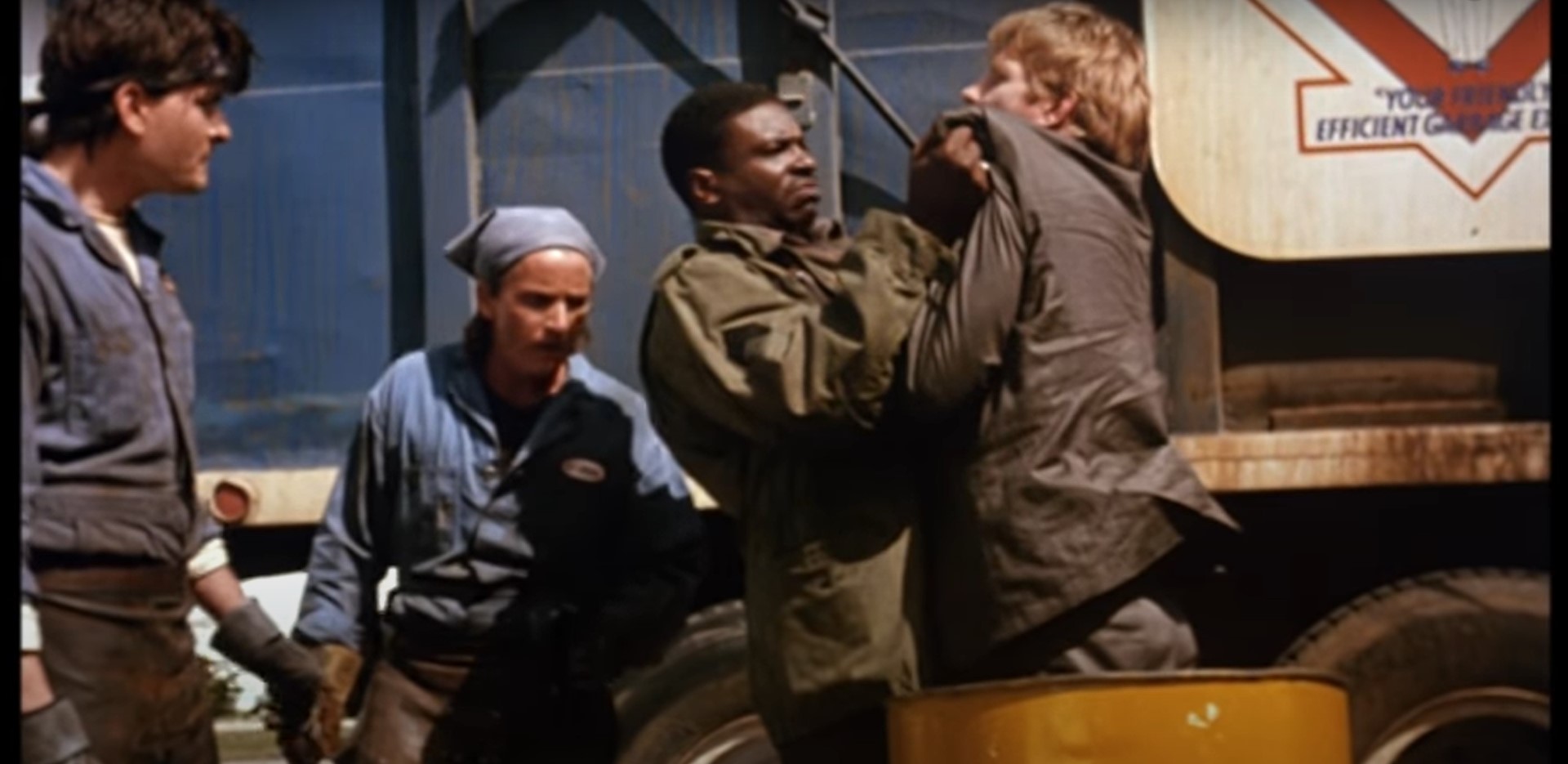
Garbagemen James and Carl are California dreamers, scoping out babes, riding the surf, and fantasizing about opening their own surf shop business one day.  Their day job goes against the grain of their live loose lifestyle, but when they discover a dead body in a trash can, the same dead body that was arguing with a beautiful woman in the building across the street and Carl shot in the butt with a pellet gun the night before, James and Carl no longer have the luxury of fun and games.  Their probational, ride along observer, a crazed combat veteran named Louis, doesn’t add to trash-slinging surfers’ comfort other than noting the strangulation marks around the neck, proving their innocence of a pellet gun murder.  The three men go into investigation mode and Carl infiltrates into the woman’s apartment for clues on what really happened but what they get themselves mixed into is manufacturer corruption on the highest level and now they’re in the crossfire and crosshairs of an off-shore, toxic waste dumping crime boss.

Seeing siblings on screen together has always been of great interest to myself because for an actor to grow up with another actor from adolescence, there’s some level of comfortability, trust, and likeminded, on the same wavelength, aptitude in the performance dynamic.  Brothers Charlie Sheen and Emilio Estévez certainly have a cozy dynamic as two laid-back garbagemen in the dark yet zany comedy, “Men at Work,” despite not sharing their Estévez surname.  Of course, this is a 1990 released film and things have changed between them and personally with themselves over the span of 30+ years, but the Emilio Estévez written-and-directed comedy is a snapshot of a relationship pairing that we didn’t see too often.  Sure, we received their performances in other genres, such as head-butting cowboys in the western-action “Young Guns” and as two sleazy pornographic film filmmakers divided by their own greed in the Jim and Artie Mitchell biographical picture, “Rated-X,” but we never again get a quirky, smorgasbord comedy that exhibits their distinct dry humor in one package.  Set on the beautiful shores of California, include Los Angeles, “Men at Work,” is a studio production from the Trans World Entertainment subsidiary label, Epic Productions, under Moshe Diamant (“Commando Squad,” “Ski Patrol”) and is produced by Cassian Elwes (“Mom and Dad,” “Knock Knock”) and Barbara Stordahl.

Safe to say that most audiences are familiar with the likes of Charlie Sheen and Emilo Estévez between their catalogue of rite of passage movies while growing up in the 1980s through the 1990s.  From “Major League” and “Maximum Overdrive” to “Hot Shots” and “Mighty Ducks,” the brothers captured comedy, action, horror, and feel-good films.  “Men at Work” is another one of those nostalgia recognized, yet slightly underrated, comedies that hasn’t necessarily aged well in regard to its comedy.  Sheen and Estévez are wonderfully poised with a pinch of mania performances surrounding a murder mystery, but the comedy has faded like washed out jeans as we’re numb to these types of comedic devices that have used and overused the last three decades.  Keith David, on the other hand, remains just as funny as the day of release as the Vietnam combat-shocked veteran, Louis, who has become James and Karl’s overseer after public complaints.  The “They Live” and “The Thing” actor costars alongside Charlie Sheen four years later after the release of Oliver Stone’s “Platoon,” which begs the question whether Estévez and Sheen are meddling with the cinematic universes just a tad, and David brings the intensity, high-energy, and overwhelming brutishness to “Men at Work’s” rather subdued, off-the-cuff antics of investigation work done by a pair of surfer dudes who have not witnessed the horrors of war.  The disturbing coolness of stride David’s character takes suits him as an angry vet with a penchant to go against authority.  The love interest in this narrative is played by the actress-turned-director Leslie Hope (“Doppelganger,” “Bruiser”) as a dead guy’s political campaign manager who just happened to be at the wrong place, wrong time accidently swapping the incriminating tape with her boss.  Did I mention the dead guy is a politician in bed with crime?  The “Weekend at Bernie’s” performance by Darrell Larson (“Android”) is one for the ages with Larson providing the slacked jaw, rigor mortis poses, and an overall deadpan dead guy.  “The Fly’s” John Getz is a suitable villain Maxwell Potterdam III, as if plucked straight from a comic book, to the quirky comedy despite being a bit hammy at times.  Potterdam’s bicker henchmen Mario (John Lavachielli) and Biff (Rufus funk musician Hawk Wolinski) are better suited to entertainment with distinct personalities that made their interactions dry and spot on funny. The cast fills out with Sy Richardson (“Repo Man”), Troy Evans (“Halloween 5: The Revenge of Michael Myers”), Geoffry Blake (“The Last Starfighter”), Cameron Dye (“Out of the Dark”), Dean Cameron (“Summer School”), and John Putch (“Jaws 3-D”) and Tommy Hinkley (“Silent Night, Deadly Night 4: Initiation”) as bike cops in a very compromising position.

“Men at Work” is one of those memorable films that teeters between the 80s and the 90s.  Mullets, denim-on-denim, large three-piece suits, and the breeziness of politically incorrect humor genetically makeup “Men at Work’s” guilty-pleasurable and amusing plot anticipatedly driven well by the two principal leads, Sheen and Estevez, who are thrusted into the wrong place at the wrong time scenario as unlikely, joshing heroes, but the stars’ arm-candied, supporting cast of character actors shape and hold together a better lasting picture as with Keith David’s unphased Vietnam veteran, bored with life as it seems during his contentious first impressions with James and Carl, to nudge the garbage-toting friends into action as if he’s spearheading a campaign back in the bush fighting the Vietcong or with the two bickering hit-men who do more damage than damage control with their opposing opinions and tough guy prides.  Estevez’s farce is directed modestly well without the visual cues or styles to assist but rather works in alignment with how Estevez shoots most of his directing gigs with perfectly framed scenes and precision panning that join the foreground, background, and characters together all in one harrowing moment, such as with the pallet gun prank that ends in the murder of the politician, and those kinds of scenes speak for themselves without having to be edited down.  The by-the-numbers pacing builds the story up until a culminating head from the two simple sanitation workers living out their mundane lives with mundane problems to the classic showdown of being outnumbered with Potterdam and his toxic waste dumping henchmen in hazard gear, and though by-the-numbers, the pacing is fairly comfortable and routine, practically natural, without ever feeling forced with the exception of Leslie Hope’s character uncharacteristically, or maybe we’re just not privy of her personal background, lends to her spur of the moment coquettish behavior with Charlie Sheen’s play-dumb, act-dumb surreptitious act in her apartment alone and then out for a late night drive to a beach with him, again alone.  Stranger danger doesn’t apply here in this moment when inviting an unknown into the personal space without the accompany of others to be a safety net and this interaction has a fabricated-feel in moving the story along.

MVD Visual releases “Men at Work” onto Blu-ray in accordance with the distributor’s retro-repository label, the Rewind Collection.  Coming in at 46 on the spine, “Men at Work” transfer is pulled straight from the MGM vault and presented with an AVC encoded, high definition, 1080p resolution in a widescreen 1.85:1 aspect ratio. The MGM transfer transposition into an hi-def BD format doesn’t reflect the full effect of a bigger, better resolution. Image details remains quite soft but the end image quality is definitely still a palatable experience with natural, stable color grading and a suitable sheen (not Charlie Sheen) of the California sun and the night lighting that is often snuffed out by stylistic grading or alternative lighting and tint sources for creative measures. The transfer master remains clear and free of damage and withering wear. The English language LPCM 2.0 stereo projects just that, a two-channel output with a lower bit, and while perhaps not a science-fiction blaster-thon picture, there’s plenty of range opportunity to warrant a hearty audio mix, but the, like the picture quality, the result is negligibly free from imperfections. Dialogue contains no hissing and is clean, clear, and free from any other issues. Optional English, French, and Spanish subtitles are available. Special features has only the theatrical trailer going for it while the physical release bears the bonus material with a reversible, illustrated cover art, a mini poster of the original poster art, and the clear Blu-ray snapper is sheathed in an O-card slipcase doctored up to be retro-stickered with video rental trappings. The PG-13 film has a runtime of 98 minutes and the release is region A locked. One of the first buddy comedies to come out of the early 90s, “Men at Work” has an audience relatable rapport with the film’s stars absorbed into struggling, yet free-spirited blue-collar roles that are unwittingly forced to take on the big, bad evil industry and though the film may have lost its comedy edge, “Men at Work” still manages to be a repeatable watched classic.

“Men at Work” Now Available on a MVD Visual Blu-ray at Amazon.com

Before Careful What Hotel You Book Online. There Just Might be an Ancient EVIL Lurking in the Basement! “The Ghosts of Monday” reviewed! (Cleopatra Entertainment / Blu-ray)

 “The Ghosts of Monday” is now on Blu-ray Home Video!  Click to Cover to Purchase!

A small film crew of ghost hunters travel to the Grand Hotel Gula, a magnificent resort that accommodated tourists from all over the world, to document the hotel’s horrible past on a rare 53rd Monday of a year when the hotel befell into notorious tragedy as guests attending a party were poisoned and the three owners had committed suicide soon after.   Eric, the director of the show, is on his last leg to make the show a success as he becomes pressured by local benefactors and even the show’s host personality, Bruce.  At the request of Bruce, Eric brings his wife Christine who Bruce raised as a child.  From day one, the empty stunning foyer and luxurious accommodates pale against the ambient creepiness of the dark corridors and basements and the ominous sounds that lurk from within the shadows.  When the shooting commences into an investigation, the unsuspecting filmmakers find themselves in an ill-boding situation with an ancient evil that has been kept hidden away from the world for eons.

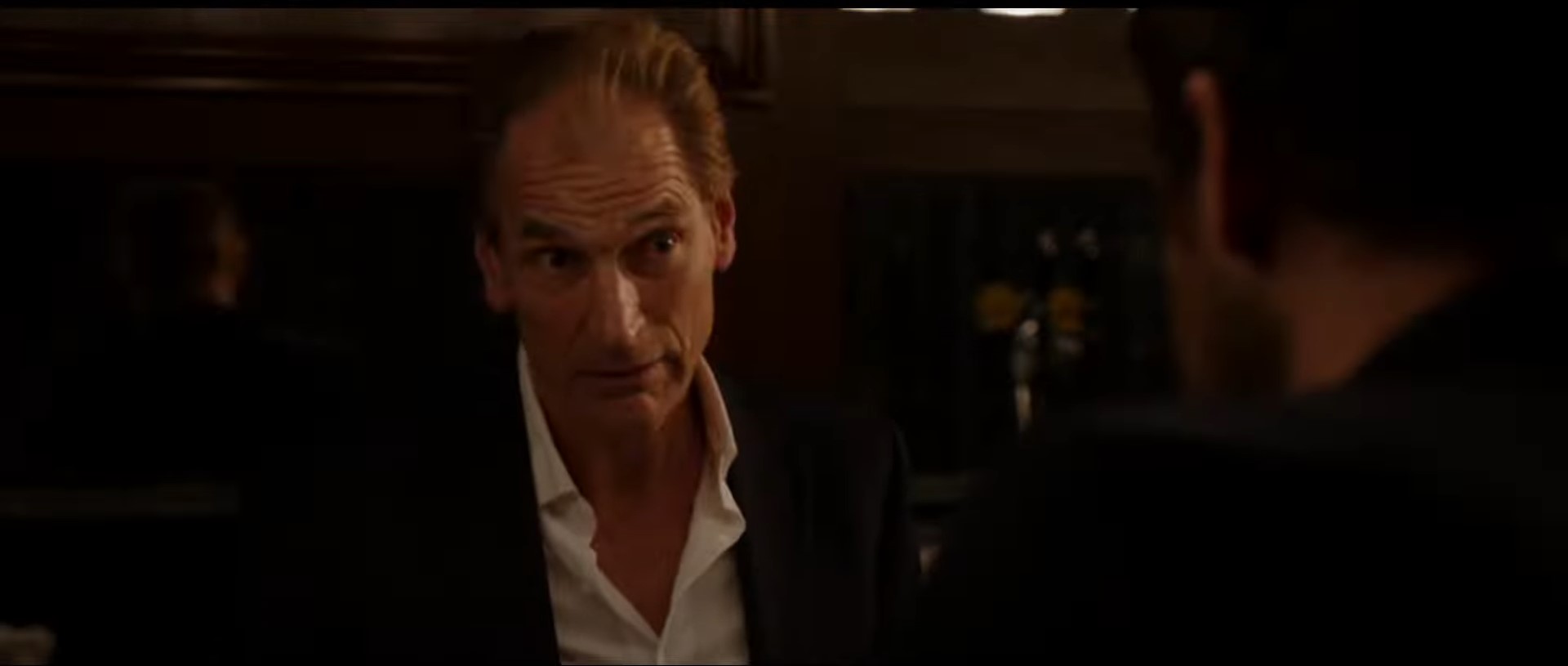
I want to prelude this review by saying that my thoughts are with Julian Sands family and if there is any hope left to grasp onto, we want sincerely to yearn for the outcome of Julian Sands disappearance in the hiking region of Mount Baldy, California to be a positive one and see the actor, the husband, the father of three alive and well.  As an entertainer, Sands gave us a malevolent sorcerer in the “Warlock” trilogy and providing us with notable performances in David Lynch’s “Naked Lunch” and the fear of spiders-inducing “Arachnophobia.”  Since the turn of the century, Sands has more-or-less fell out of the limelight with sustaining his presence mostly on direct-to-video releases and appearances on TV series.  The British actor’s latest low-budget horror “The Ghosts of Monday” is a film helmed by Italian director Francesco Cinquemani on the little-known getaway island of Cyprus, a country located in the Mediterranean Sea.  Cinquemani, who typically directs his own scripts, co-writes the film with Andy Edwards (“Zombie Spring Breakers,” “Midnight Peepshow”), Mark Thompson-Ashworth (“POE 4:  The Black Cat”), and Barry Keating (Killer Mermaid,” “Nightworld: Door of Hell”).  “The Ghosts of Monday” appears to be a blend of region myth and cultural belief pulled locally and from the stories of Greeks Gods into one abandoned hotel horror full of cult sacrifice and betrayal, produced by the “S.O.S.:  Survive or Sacrifice” producing team of Loris Curci (“The Quantum Devil”), Marianna Rosset, and Vitaly Rosset under the Cyprus production company, Altadium Group.

Julian Sands might not be the principal lead of the story but is a major player in what culminates into an ambuscade of doomsday deliverance at the expense of others.  As the documentary’s host and a Cyprus local, Sands plays the eccentric, often frisky, heavy drinker Bruce who has been a father, or the adopted father-figure as it’s not entirely clear, to Sofia (Marianna Rosset, “S.O.S.:  Survive or Sacrifice”).  Christine is distant and disordered returning to her Cyprus homeland with her husband Eric, the director, played by “The Turning’s” Mark Huberman.  Almost seemingly estranged from each other, Eric and Sofia display some noticeable pensive and tension-riddled issues between them that the story never fully fleshes out for the audience.  Christine is under medication for a sleep disorder, Eric’s feeling the pressure from powerful producers, and none of that external strain has defined or even as much delineated itself in full in their aloof relationship that has glimmers of hope and smiles as the wall between them is more up than it is down despite Eric’s constant vigil over her.  Performances from Rosset and Huberman meet the need of concern, desperation, and pressure forced upon them more from in the outside than in, especially in Huberman with a slightly better angle on his creative-driven, project-lead sudden derailed from his narrow focus to deliver a quality product as his career careens out of control and that brings out his rougher edge we see in the latter half of the story.  In comparison, the more iconic and recognizable figure, Julian Sands, doesn’t land his role well in what could be seen as if his performance landing gear only had one wheel down before touching pavement but was able to jerry-rig a not-big-enough wheel to get him safely through.   “The Ghost of Monday” has some mysteriously odd and menacing individuals in hotel owner Frank (Anthony Skordi, “Carnal Sins”), his wife Rosemary (Maria Ioannou, “Waiting Room”), and the producer couple Dom (Loris Curci), and Pat (Joanna Fyllidou, “Girls After Dark”) as hovers, prowlers, and the overall conventional creeps in the corner, watching you.  On the other side of the coin, you have a film crew who are more or less victim fodder for the evil powers to be with Anna (Kristina Godunova) and suspected lesbian lovers in sound designer Christine (Elva Trill, “Jurassic World:  Dominion) and cinematographer Jennifer (Flavia Watson) because A/V is just another acronym for LGTBQ+.  With the exception of Frank and Rosemary’s background on why they bought the forsaken hotel, none of the other characters constitute a piece of the pie as they are thrown into the mix, sprinkled with tidbits of intrigue, before their dispatched into the feast or famine categories.

We have ghosts in the title. There are cult members, sometimes shrouded in obscuring clothing, sometimes just lingering exposed outright. We have silent but deadly twin girls with kitchen knives. There is also a slithering creature lurking in the basement. “The Ghost of Monday” is a variety show of vile villains with very little coherence to bring the elements together, but what is clear is a mythical being at the center of the surrounding maelstrom that’s quickly closing in on the protagonists. With the script penned by a cohort of writers experienced in resort massacres and killer aquatic creatures, all director Cinquemani has to accomplish is the effectuation of ideas, but what results is haphazard derision from what feels like “Ghostship” in a hotel and looks like “The Shinning” without the isolating madness all in the confines of a very shaky and marred cinematography. The core of the story is inadvertently lost amongst the competition of where audiences should retain their attention which is a shame because at the core is a deeper, broader, and more mythically rich in Grecian horror with a gorgon immortal that’s equated as the devil itself and linked to life’s destruction if not sacrificed a corporeal shell.  Viewers will be treated to only a glimpse of that circling terror during the climatic end and, more than likely, budgetary reasons ground the story’s larger-than-life concept with only a mixed bag clash of content leading up to the end.

Plugged as Cyprus’s first native horror production, “The Ghosts of Monday” arrives onto a Blu-ray home video release from the Cleopatra Entertainment, film division of Cleopatra Records, and Jinga Films with MVD Visual distributing.  The featured release is presented in a widescreen 2.35:1 aspect ratio, shot on what IMDB has listed as the Sony CineAlta Vince with a Zeiss Supreme Prime Lens.  The AVC encoded Blu-ray retains a quite a bit of compression issues throughout the entire digitally recorded package as video ghosting is the biggest image culprit.  I’m sure that type of ghost was not what “The Ghosts of Monday” were referring to in the title.  Aliasing, banding, and small instances of blocking also appear occasionally and in conjunction with the ghosting which makes this transferred format nearly impossible to watch with hardly any detail in what should be a high-definition release that renders closer to 480 or 720p as the video decodes at a low 22 to 23Mbps average.  The Blu-ray has two audio options, an English 5.1 Dolby Digital and a LPCM Stereo 2.0. Though both outputs render nearly identical because of the lack of explosions or an extensive ambient track, the surround sound mix offers a better side to the A/V attributes with a barren-disturbance sound design and a solid score that keeps the concerned glued to the television sets, waiting for something spooky to pop out from behind. Dialogue doesn’t perceive with any issues with clear and clean conversation, as expected with most digital recordings, and is greatly centered and balanced without sounding echoey and out of depth’s scope. The bonus features are scantily applied with only an image slideshow and feature trailer, plus trailers from other Cleopatra Entertainment productions, such as “The Long Dark Trail,” “Frost,” “A Taste of Blood,” “Baphomet,” “Scavenger,” “The Hex,” and “Skin Walker.” The physical attributes of the release come with a traditional Blu-ray snapper cast with latch and cover art, that’s slightly misleading, of a glowing apparition. The region free release has a runtime of 78 minutes and is unrated. “The Ghosts of Monday” doesn’t buck the trend for Cleopatra Entertainment’s string of C-grade horror but is an unusual, new venture in the sense of strictly being a horror story without an eclectic soundtrack of signed artists to carry it through to the end.

 “The Ghosts of Monday” is now on Blu-ray Home Video!  Click to Cover to Purchase!