

The “Despiser” Collector Edition Blu-ray Is a Must Own!
Gordon Hauge is an inspirating artist with little motivation. Having just lost his contract work, being evicted from his home, and his wife leaving him, Gordon is left with virtually nothing, even no purpose. While speeding home late a night, Gordon swerves to avoid pedestrians in the road and crashes his car, waking up in a nightmare-scape purgatory reigned by a malevolent monster known only as The Despiser. The Despiser’s ragmen minions, governed by The Shadow Men, wreak havoc on the land by stealing nuclear warheads with the objective to rip a dimensional, absconding hole in their world that’ll lead into Gordon’s. The Despiser’s only obstacle is a ragtag group of pious, historical fighters stuck too in purgatory after sacrificing their lives for a greater good and now are missioned to release everyone from The Despiser’s malicious hold over the Ragmen souls, as well as escape limbo themselves. When The Despiser threatens his wife, Gordon joins the fight against evil and takes the battle head on.
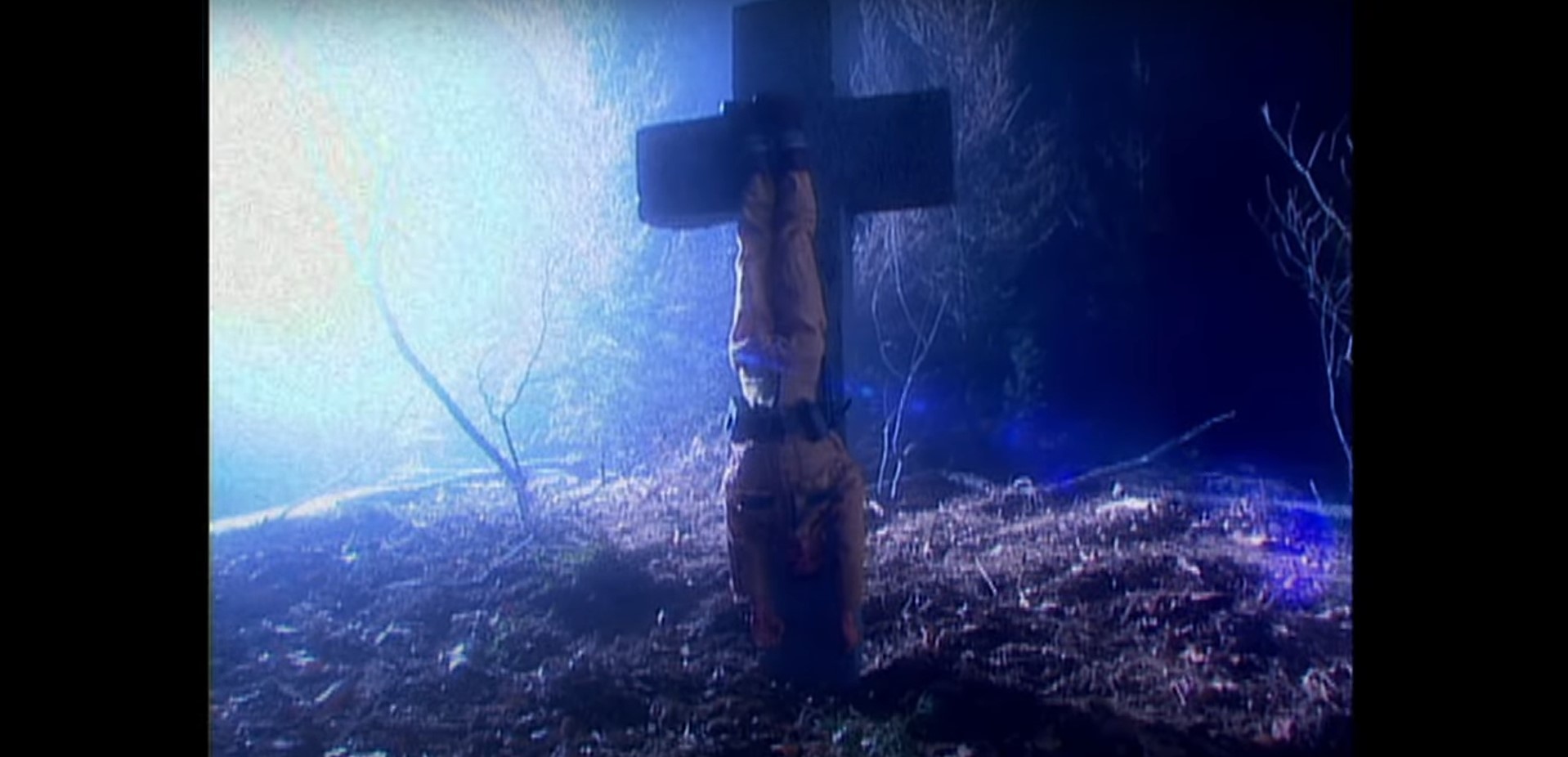
Unlike anything you’ve ever seen before in the movie category, “Despiser” is the dark fantasy, action-thriller from 2003. “Beyond the Rising Moon” and “Invader” Philip J. Cook’s own written-and-directed sci-fi odysseys distill the genre game by challenging the visual inside a unique story on a low-budget. “Despiser” is no different digging into the horror building blocks of a soul-swallowing netherworld with a goliath creature having dominion. Testing the waters with computer generated scenes still in their infancy and shot on the stringent, temperamental, and ever quality fluctuating video tape, the pre-millennium feature was shot in Cooke’s own home and makeshift production studio in Virginia of 1998, running against the wind and against the odds of coming out top with a promising product that audiences will like. Cooke’s Eagle Film’s serves as the production company that naturally puts the filmmaker in the producer’s chair.

In the role of the disoriented artist down on his luck Gordon Hague is Mark Redfield (“Dark and Stormy Night,” “Chainsaw Sally,” and the producer of the Redfield Arts Audio Podcast “The Midnight Matinee”). Brassy and cocky, Gordon Hague feels very much like a classic character browbeaten into being cheap ground coffee, diluted by his own lack of ambition with a flavorless future. That is until Gordon dies unexpectedly and becomes the prophesized champion of gung-ho, gun-toting good doers at the edge of oblivion and obliteration. Guided by Carl Nimbus, an early 1900s cavalry soldier played rather convincingly cool by Doug Brown, the group is contrived with different era, different walks-of-life, and different skillset individuals fighting the good fight against a soul-damning manipulator, whom in itself is alien to the purgatory topography of fire, brimstone, lave, and apparently littered with nuclear missiles. Fumie Tomasawa (Frank Smith), Charlie Roadtrap (Tara Bilkins), and Jake Tulley (Michael Weitz) form what’s left of the crusading squad, and each have their own personalities, backgrounds, and views toward eliminating the threat of otherworldly damnation. On the opposite side of the spectrum are the Shadow Men, the Despiser’s right hands overseeing the mindless henchmen known as the Ragmen. Shadow Men inhabit corporeal bodies and are a wild bunch of frenzy determination. In the story, there are only two individualized Shadow Man but one of those goonish souls sees three embodiments in a variety of acting styles by Dan Poole, Richard Dorton, and Mark Hyde with Jeff Rathner giving us first taste for the Shadow Men’s near indestructibility. Gage Sheridan, Mike Diesel, Chris Hahn, and Brian Neary fill in the supporting cast.

Early PlayStation graphics interlaced and spliced with live action shots of a doom and gloom purgatorial world is great way to surmise “Despiser.” Just on the precipice of fine tuning the gaming-changing visual effects at the turn of the century, movie worlds go from tangible mattes, practical backgrounds, and hand-painted compositions to simply a green or, in “Despiser’s” case, a blue backdrop screen that allows actors to do their thespian work without anything around them to interact with or bounce off a certain emotion or reaction and visual effects artists will add-in and blend worlds, creatures, and effects in post-production. Cook, along with Cory Collins, chiefly constructed an anhedonia embodied layer in between the plane of existence and the eternal beyond without losing a step with a seamless live actor application. The whole film feels like the introduction prologue short in the first “Resident Evil” game, a mix exchanging edit of virtual and physical, but Cook doesn’t just switch frames between the two formats to tell the story, the imaginative animator and filmmaker adds life into his virtual landscape without being terribly clunky or be an ostentatious show his stitchwork. Naturally with early VFX graphics, not every computer modeling element is forgiving and much of that expression lies with the antagonist, the Despiser himself. The water-dwelling, dungeon being with limited movements and remains mostly in the shadows and for good reason with a scale that likely couldn’t be conceived or achieved in a technology that hasn’t yet be refined for the desired quality and public acceptance, and while the limited scope of the Despiser is bothersome, especially having to sit through it’s same motions over and over, Cook’s engaging story eases the pain tremendously with a suicide mission enlisted with likeable characters you really don’t want to see perish in purgatory.

Evil Dam Trolls, holy light ammunitions, and nuclear missiles are only the tip of the iceberg in the new Visual Vengeance Blu-ray release of “Despiser.” The Wild Eye Releasing subsidiary label prologues with the usual A/V disclaiming but the director-supervised transfer from the standard definition master of the original tape element holds up remarkably well on an AVC encoded, 1080p, BD50. Perhaps a little radiantly effervescence, the frothy-rimmed and delicate in detail final product enhances the presentational submerged in sardonic storyline. Besides, much of the early computer-generated imagery is smooth anyway and, in contrast, the palpable pieces often standout with deeper, textured nuances. Bood spurts and muzzle flashes are, too, fashioned neatly into the frames. Presented in a pillarbox full screen 1.33:1 aspect ratio, Cook balances the coloring and lighting inside the CGI world to roughly match the out-of-the-CGI-box steely tones of blue, green, and silver tints under softer shadows. The lossless LPCM stereo mix offers up a pretty true to self fidelity that could, one day, receive an extensive channel and refining upgrade. Machine gun fire, and there’s a ton of it, spatters off with an ingrained rat-a-tat force that’s more polished than your typical indie production whose discharges sound more like cap guns. Dialogue plays to the makeshift setting strengths, providing echoes where needed in more cavernous locales to the muffled notes of long-range speak. Optional English subtitles are available. With a Visual Vengeance release you know you’re getting topnotch exclusive special features and packaging as well as archival goodies encoded onto the larger capacity disc, including two commentary tracks with director Philip J. Cook and actors Gage Sheridan and Mark Redfield on one and cult movie enthusiasts Sam Panico and Bill Van Ryn on the other, a making of “Despiser” featurette with Cook and Mark Hyde that goes deep within the nuts and bolts of it all, a handful of deleted scenes with title cards, a running blooper reel, outtakes, a storyboard to animation, the original lava-road DVD animated intro menu, a behind-the-scenes and art gallery, “Despiser” trailers, the Visual Vengeance advert trailer, and Cook’s “Outerworld” and “Invader” film trailers just beyond the fluid, cardboard cutout animated menu. But wait, that’s not all! Andrei Bouzikov’s illustrated compositional machine guns, mushroom clouds, and the four-armed Despiser, nearing Ghana-poster level but keeps in line with the filmic material, is a sight to behold on the cardboard O-slipcover. Inside, on the primary cover of the clear Blu-ray Amaray case, you get even more new art from Stefan “STEMO” Motmans that’s less tapestry art and more iconic as it is epic. The reverse side holds “Despiser'” original poster arrangement that’s simple yet effective. The disc is whimsically labeled with encircling blue, purple, green, and red evil trolls while the opposite, insert side has a folded mini poster of Bouzikov’s art, a colorful, dual-sided synopsis and Blu-ray acknowledgement sheet, and no release would be complete without the retro VHS sticker sheet. The 16th Visual Vengeance release is region free, unrated, and has a runtime of 105 minutes.
Last Rites: The soul wants what the soul wants and that is “Despiser” on a Visual Vengeance, collector’s edition Blu-ray. An out of pocket, retro-modeled, and portentous hell on Earth from beyond the stars movie too good to skip the bad parts.


 It's Bloggin Evil!