The Golden Ninja Warrior Turns Good Ninja Masters to EVIL! “Ninja Terminator” reviewed! (Neon Eagle Video / Blu-ray)

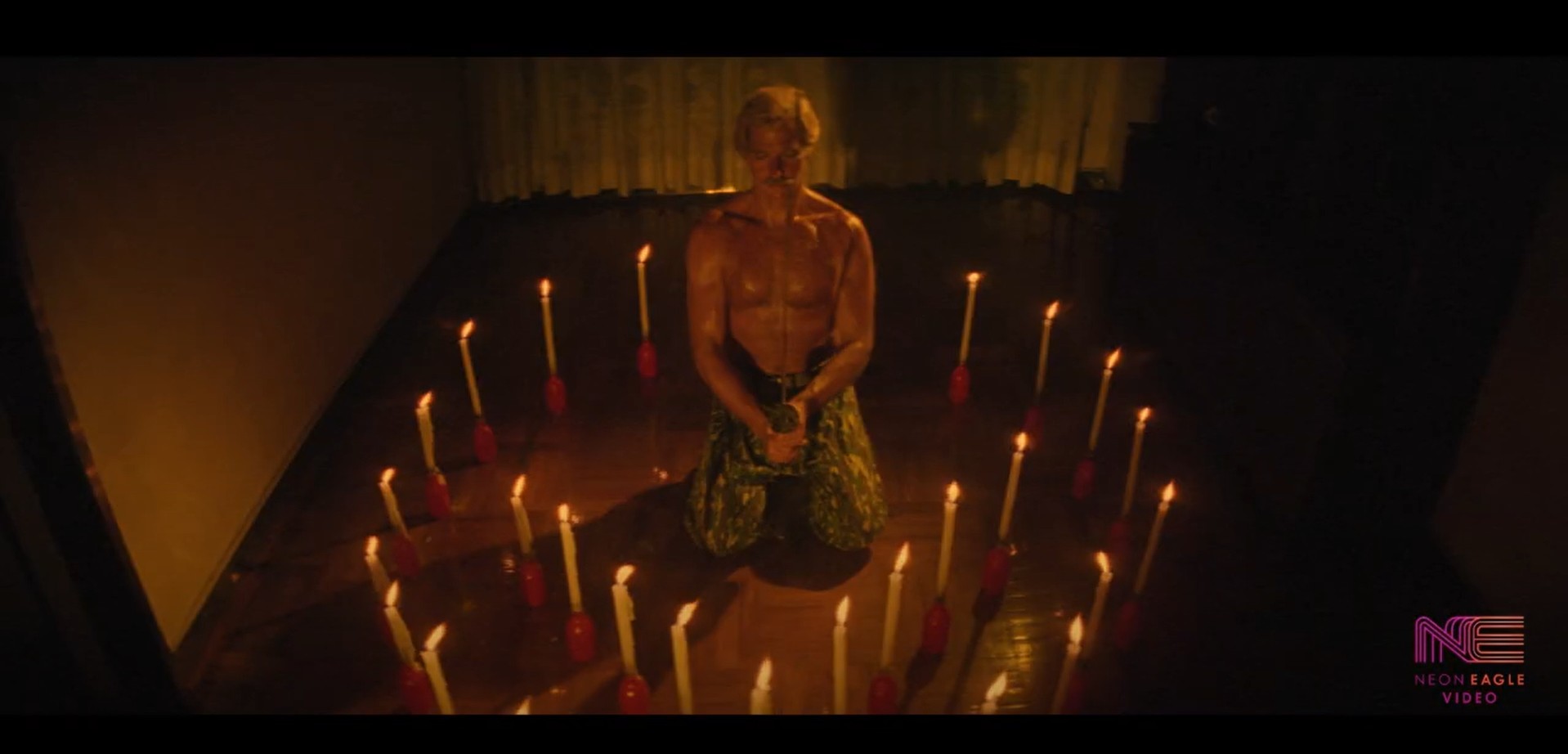
The Golden Ninja Warrior is the corrupt Ninja Empire’s most valued and powerful artifact with mystical powers to whomever posses it’s three pieces, granting them near invincibility against enemy attacks.  The Supreme Ninja leader displays the power of the golden bust, resembling a beastly torse and head wielding a katana, to three of the Empire’s Ninja Masters – Tamashi, Baron, and Harry.  The three Ninja Masters betray their supreme leader, each stealing a piece of the statue for their own intent and purposes.  With one piece back in the hands of the Supreme Ninja leader after Tamashi’s demise, the now crime boss Baron seeks Tamashi’s piece and will do anything, and kill anyone, to get it with the aid of his cruel right hand man Tiger Chan.  Meanwhile, Harry resigned from the Ninja Empire to reform the organization’s criminality but has been unearthed by the Empire’s Supreme leader with an ultimatum to return the pieces of the Golden Ninja Warrior.  With the help of his cocky and confident partner, Jaguar Wong, Harry and Jaguar investigate into Tamashi and his brother’s death, try and protect their surviving sister from those looking for Tamashi’s piece of the Golden Ninja warrior, and defeat any Baron or Empire warriors that stand in their way.
One of the numerous released Godfrey Ho productions in which the director shot new scenes with Caucasian, abroad actors and edited them into an pre-existing film his company owned the international rights.  “Ninja Terminator,” a bestowed title at the height of James Cameron’s highly popular cybernetic, time-travelling thriller “The Terminator,” is the 1986 Hong Kong feature that breathes new life into the South Korean,1984 released, martial arts gangster film “Uninvited Guest” as Ho splices new additional footage to create his own, half-cocked storyline for a cost-effective ninja themed film starring a recognizable white actor.  Ho writes and directs the IFD Films production that’s produced by Ho’s makeshift Ninja feature team of Betty Chan (“Ninja Strike Force”), Joseph Lai (“Full Metal Ninja”), and Steve Kam who regularly took popular U.S. tiltes and integrated them into their own for advantageous marketing.

Where to start with actors and actresses?  Two films shot in two completely different times with renamed characters and additional characters in a jumbled-up mesh of a ninja film.  Lets start with Richard Harrison, an American actor with muscles and good looks who couldn’t quite land the parts he wanted in his home country but found lead man success in other parts of the world, especially in the filmic industries of Italy (“Orgasmo Nero,” “One Hundred Thousand Dollars for Ringo”) earlier in his career and, in this case, Hong Kong (“Inferno Thunderbolt,” Diamond Ninja Force”) later in his career collaborating a handful of times with filmmaker Godfrey Ho.  For “Ninja Terminator,” Harrison isn’t a stealthy cybernetic ninja master but rather an idealistic, benevolent ninja master sporting a unique camo ninja-yoroi to, I guess, blend in around his home and urban environment…?  Still, the camouflaged attire has to be more clandestine than the hot red ninja-yorois of the Ninja Empire.  At least fellow western actor, Jonathan Wattis, as one of the three ninjas who stole a piece of the Golden Ninja Warrior statue and became a crime lord himself, donned a near traditional, black-dyed ninja garb.  Harrison and Wattis do the best they can being spliced into Jack Lam’s film “Uninvited Guest.”  Reconstructed or replayed to be named Jaguar Wong, for his character’s Jaguar fighting style, Jack Lam bests Wattis and levels with Harrison for screen time as a fellow principal lead despite the 2-3 year difference between principal photography but Jaguar fits in aptly enough into an inept chaos of a near nonsensical ninja narrative that jumps to inconclusive subplots with little connective tissue to the core plot.  Maria Francesca, Jeong-lee Hwang, James Chan, Simon Kim, Phillip Ko, Keith Mak, Tae-Joon Lee, Nancy Chan, Gerald Kim, Andrew Lee, and Eric Leung costar.

Cheaply made knockoffs and spirited, gung-ho capitalizing on popular film titles saw fists-of-fury in Hong Kong circa 1970s through the 1980s, much the same way the Italians also didn’t believe the copyright laws when they too took advantage with unofficial sequels, especially in the horror genre.  “Ninja Terminator” is obvious one of those projects and the sly Godfrey Ho manipulated the international market to garner new public interest in what is basically an old film with additional scene, a scheme done pretty much on the regular in various countries, even in the United States.  However, “Ninja Terminator” is not a good movie but rather a hilariously bad one weighed down by irrelevant offshoots to flesh out a scantily structured half-script.  With the additional scenes of Richard Harrison and the others spliced in, plus Jack Lam’s one-man army showdowns against henchmen and sub-bosses, the combat saves “Ninja Terminator” from full frontal embarrassment with competent choreographed fights, plenty of sword, ninja star, and ninja trickery play, and a fair amount of acrobatics, even if some of the scenes are just gratuitous cartwheels and flips in an ostentatious display of skill and of trying to raise the value of a low-budget production.  Granted, there are no cartwheels or flips in Jack Lam’s storyline, nor is there a single ninja, but Lam’s take-on-the-world scenes are confidently hip for the period and that is the jelly to the bold Ninja peanut butter that makes “Ninja Terminator” work on an amusingly bad level. 

Neon Eagle Video, a subsidiary label of Cauldron Films that focuses on the best of the worse of Asian cinema, scour the globe and deliver the best and authorized reproduction of “Ninja Terminator” on Blu-ray in North America, restored from a 4K scan of the original negative and presented in its proper anamorphic widescreen aspect ratio of CinemaScope 2.39:1. I must agree with Neon Video Eagle that this transfer renders the cleanest and clearest reproduction to date, likely ever, in this compilation of source materials to render a corrective, singular 4K scan. The AVC encoded, 1080p high-def resolution, BD50 offers ample storage to limit or squash any compression indelicacies on an already delicate Godfrey Ho production that’s been bootlegged to bastardization for decades. Corrected color timing sizes up the landscape, the mise-en-scene elements, and the characters too with a diffused scheme that holds firm vibrancy across an early 1980’s hip and preppy Japanese fashion. The audio is a forced English dub with an encoded LPCM 2.0 mono. The ADR definitely is seen and sounded as expected with total unsynchronized lips and dialogue, especially when the story is forged from splitting two films into one. What’s also evident amongst the three-prong, rough-and-ready sound design is the unrealistic fighting sounds, overzealous and overexerted to be more like the Hong Kong Kung-Fu movies of the decade before. The last element is the soundtrack that’s got some funk and groove in its ninja-yorois that likely borrowed and repurposed from another Godfrey Ho production to fit this particular need. Optional English subtitles are avaialble.. Special features include brand new material, including an audio commentary by Kenneth Brorsson and Phil Gillon of the Podcast on Fire Network, a second audio commentary by Asian film expert Arne Venema and Mike Leeder, an interview with director Godfrey Ho Ninja Master discussing the popularity of ninja films in the United States and the appropriation of the “Terminator” title as well as touching upon Richard Harrison and his onboarding onto the film, a second Godfrey Ho interview alongside separately dubber Simon Broad Golden Ninja Dubs discussing the quick and loose ADR of Hong Kong cinema, an interview with “These Fits Break Bricks” co-author Chris Poggiali Ninjamania, and the trailer. Neon Eagle Video’s standard release, showcased inside a clear Blu-ray Amaray, presents new artwork by graphic artist Justin Coffee. The reverse side of the cover holds the still capture composition of the original one-sheet. No insert material included, and the disc is pressed with the same Coffee illustration. The region free disc has a runtime of 90 minutes and though not listed as unrated, the film is surely such.

The First Authorized Blu-ray of “Ninja Terminator” Now Available!

Southern EVIL Hospitality. “Girl on a Chain Gang” reviewed! (The Film Detective and Something Weird / Blu-ray)

Become Tethered to the “Girl on a Chain Gang” Blu-ray at Amazon.com!

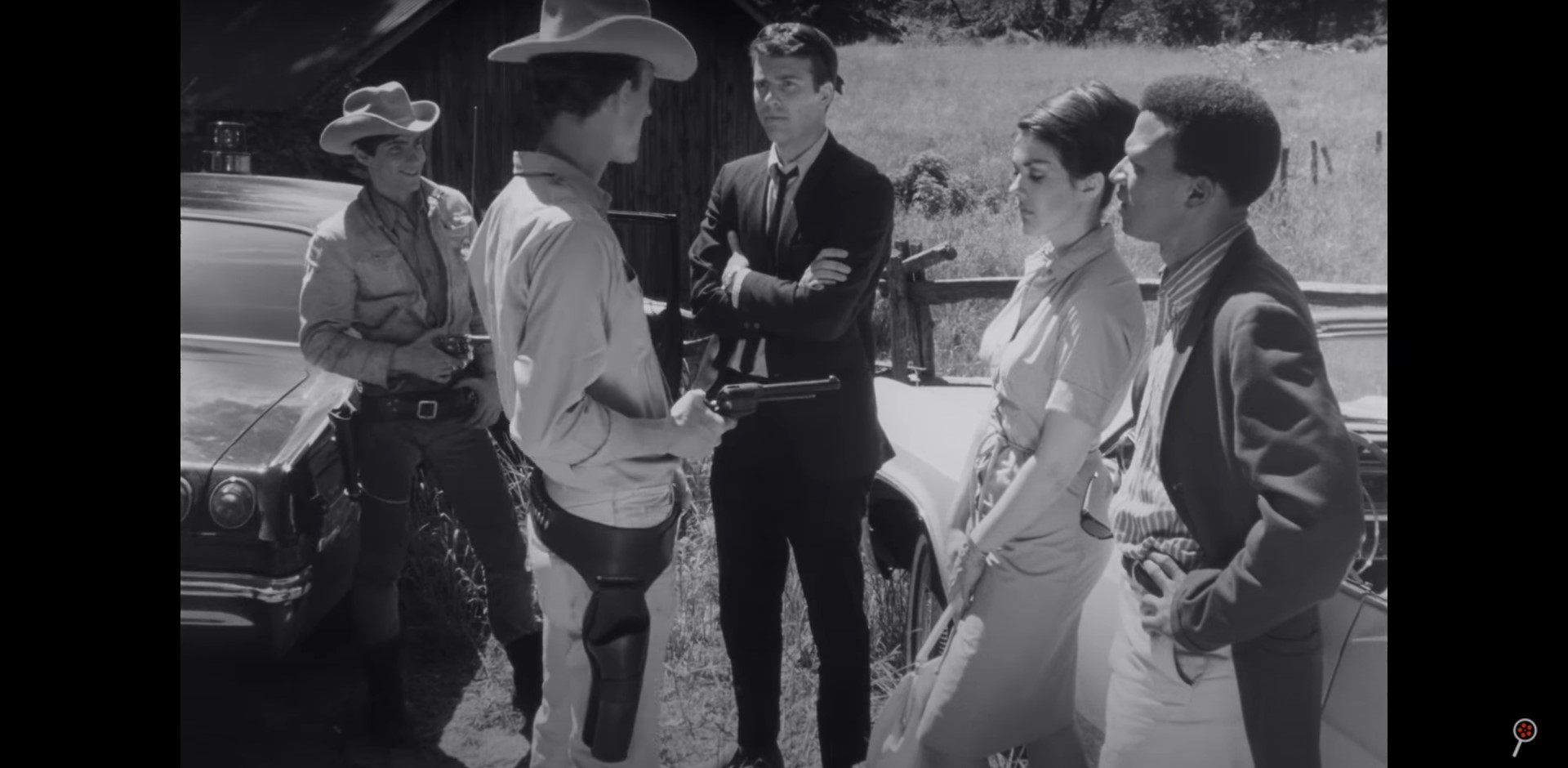
Three young Northerners travel down to the deep South city of Caron’s Landing for Civil Rights improvement on voter registration. Their convertible is pulled over by two sleazy deputies with a hankering to stick the activists with trumped-up charges and accost them with an official arrest that forces them to be before a drunk, aggressive named Sheriff Sonny Lew Wymer, Carson Landing’s very own unofficial head of the municipality between his unwavering loyal kin and those in his pocket with blackmail to gain an indefinite number of favors, for swift money-mulcting and to be the victims of Sonny Lew’s judge, jury, and execution sentencing of segregated injustice. An onslaught of abusive authority sends the lone woman of the three activists to do hard labor on a black chain gang and as she attempts to escape, she must survive Sonny Lew’s hound-led manhunt with intent to shoot-to-kill.

Hard to believe that we still live in a society where the surface level racism has improved over the centuries but systemic racism remains a vein-slithering and venomous asp prevalent still in not only public society but in education, justice system, and, well, just about everywhere you can think of and films like Jerry Gross’s “Girl on a Chain Gang,” though ostentatiously sleazy and exploitative as the title sounds, would still ring smidgens of truth profoundly, yet subtly, engrained across the nation even though the Gross’s film was released over half a century ago in 1966 when that pure hatred and ugliness was at peak efficiency, especially in the deep Southern U.S. The producer from New York City who promoted “I Drink Your Blood” and “Son of Dracula,” with Ringo Starr nonetheless, found a knack in presenting exploitation in his directorial feature debut – “Girl on a Chain Gang.” Originally called “Bayou” before a title and script rework, the Dan Olsen original story was penned by Gross and shot more locally to the auteur in Long Island, New York. Nicholas Demetroules cowrote the edgy-for-its-time script full of malversation under the Jerry Gross Productions banner with a logo that looks the hell of a lot like Warner Brothers.

Part of “Girl on a Chain Gang’s” suffocating sleaze success is due in part to William Watson’s rotten-to-the-core, corruption performance as the devilishly intelligent and despicable Sheriff, Sonny Lew.  The “It’s Alive III” actor, who made a name for himself in indie westerns as mostly playing a character on the wrong side of the law, debuted his forte into villainhood affairs with this particular Jerry Gross production by portraying an alcoholic lawman with dirt on the most townsfolk of Carson’s Landing and can persuade them like pawns or like lemmings to exact his will.  Watson’s good at what he molds for the cigar chewing Sonny Lew by never letting up  his foot off the lewdness gas pedal that drifts around internal state investigations into his distortion of the law and even around his own cronies and county bumpkins with secret banter codes that’s clear to them but ambiguous to the naked understanding.  The three young northerners are chosen to reflect the stereotypical justifications to be oppressed by racists eyes just for the way they look in skin and in dress despite their education and suitable for society behavior.  Because one man is African American and the other two whites consort with him, the activists become relentlessly targeted by the bigoted brigade led by Sonny Lew, colluded his deputies (Ron Charles and Peter Nevard), the town drunk (Matt Reynolds), the see-nothing, do nothing bar own (James Harvey), and the unlicensed town doctor (Phillip Vanyon) who is too frightened of Sonny Lew to act on his conscious.  The woman in the mix, Jean (Julie Ange, “Teenage Mother”) reduces down to being the principal object of exploitation inside the story as the titular girl in the chain gang and out being given illusionary promises of future leading lady roles by Gross yet that undertaking never fleshed out.  Between Watson and Ange, a genuine baseline of power over someone else is greatly disturbing and not terribly far from reality.  Most of the other performances are a bit ostentatiously cliched regarding small town Southerners complete with cowboy hats, being sloppy drunkards, and take with a gimmicky draw.  The cast rounds out with Arlene Farber (“Two Girls for a Madman”) as the town floozy, Sam Cutter as Sonny Lew’s public defender uncle and, also including, Ron Segal, Henry Baker, Horace Bailey, Wolf Landsman, Earl Leake, and Richard Antony.

For 1966, “Girl on a Chain Gang” is pretty dark.  Of course, some explicit and taboo subject material that were not acceptable to show on screen back then must be read between the lines, but nonetheless, there’s enough icky and sordid personalities to get your blood boiling and your palms sweaty because of how purely contentious these themes can strike at the heart of a morally conscious soul.  The hammy acting in the second half almost makes a joke out of the context and one can become caught up and lost in the blinding caricatures spouting off ridiculous renditions of the ignorant South population that isn’t supposed to have one funny bone in its body. Though the title is eye-catching and provocative, “Girl on a Chain Gang” is selling more sexism than racism. Jean is only shackled with the chain gang for the last 10-minutes or so, just enough time for a whipmaster’s disparaging remarks to be heard and for two black men to form an escape plan. The title doesn’t speak to much of the three Northerners as a whole being subjected to bigot atrocities and without reading the back cover, you’d think the 95-minute runtime would be entirely a woman in prison film of this poor and young fresh meat working the pickaxe, sweating, and chained to a row of harden convicts with both convict and guard having their way against her will. No. Jerry Gross knew how to market this film, to catch people’s attention, by selling savage social representation as dressed sexploitation.

The Film Detective and Something Weird Video unearthed the Jerry Gross debut long thought to be inspired by the murder of three civil rights activists in Mississippi in 1964 and gave it the special edition Blu-ray treatment. A well-preserved transfer is now cleaned-up eye-candy for a high-definition look this black and white feature presented in now the fairly archaic 1.37:1 aspect, aka Academy, ratio with only a few lingering thin scratch marks throughout. Trust me, we’ve seen far worse transfers and the scratches here are evident but only if you’re keeping an eye out for them. The high contrast and detail offer a good, delineated view of events on average, pulling an average of approx. 20 Mbps. Certain exterior scenes are poorer than others with a slightly more washed brightness. The English language DTS track wavers between a muted mono and a lossy 2.0 with the dialogue suffering the most and so will you know if you’re not wearing headphones as you’ll be up-and-down on the volume of your remote control. There’s a rife static hissing that does random clean up from time-to-time. The audio tracks are clearly unstable whereas the video files have fared better with Hi-Def upgrade. The not rated disc does come with bonus features including software material of a short history from genesis-to-death on Jerry Gross hosted by film historian Chris Poggiali and hardware material in the form a 14-page essay booklet by Something Weird Video’s head-honcho Lisa Petrucci and a novelty ticket of certification of jury service where you can fill in your own name to state you sat in judgement and witnessed the trail of “The People of Caron’s Landing vs. Miss Jean Rollins.” “Girl on a Chain Gang” abstracts only a fraction of deep-cutting prejudice but that makes this roughie old-timer no less important and still remains satisfyingly excessive in its violence.

Become Tethered to the “Girl on a Chain Gang” Blu-ray at Amazon.com!

The Evil Doctor is in! “Doctor Butcher M.D. (Medical Deviant)” review!

Screen shot 2016-08-06 at 8.24.03 PM
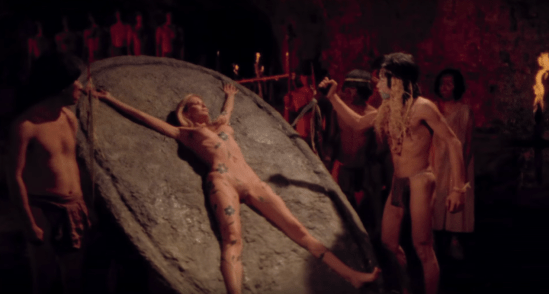
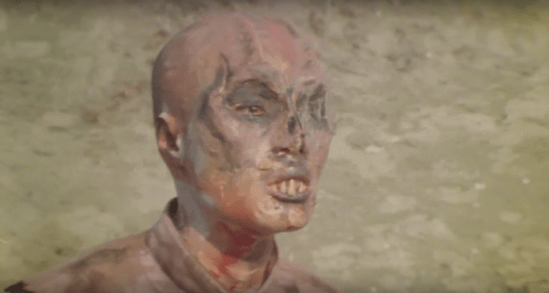
New York City hospitals are being terrorized by a crazed maniac or maniacs stealing the body parts of the deceased and local authorities are discovering the half eaten remains of torn apart bodies in the streets. When a medical orderly is caught in the act of cannibalism by nearly devouring a corpse’s heart and then commits suicide by diving out high rise window, the Doctor’s assistant and leading anthropologist Lori Ridgeway recognizes the tattooed symbol of Kito on the orderly chest, a symbol from a long forgotten tribe in the Moluccas Islands. Worshipping a cannibal God, the primitive tribe still practices the form of anthropophagy. Lori’s colleague, Dr. Peter Chandler, has been placed on a research team to root out New York City’s recent cannibal problem and when the Kito symbol clues him and his team of a possible lead, an expedition team forms to travel to the Moluccas Islands in search of the existence of inhabitants. Dr. Chandler rendezvous with a long time acquaintance, Dr. Obrero, whom has lived on the islands for years. When Dr. Obrero arranges a boat and his right hand man to accompany the expedition, Dr. Peter Chandler and team step foot into a hellish nightmare, bloodied with unspeakable and aggressive cannibal acts. Just when nothing could be worse than flesh hungry cannibals, hideously disfigured zombies frighten even the primitive locals. The island holds a dark secret and Dr. Chandler aims to unveil it no matter the cost!
Screen shot 2016-08-06 at 8.27.21 PM
Finally! The definitive 2-disc edition of Aquarius Releasing’s “Doctor Butcher, M.D.” aka the Italian cut “Zombie Holocaust,” from the Flora and Fulva Film production companies, has been released and, oh, how glorious the Severin Films release is with a super sleek Blu-ray reversible cover art – “Doctor Butcher, M.D.” title as the main cover and “Zombie Holocaust” title on the reverse side – and the high definition gore that hasn’t been gooier and oozier than ever and all in thanks to the upscaled 1080p full HD resolution transfer. Uncut with eye-gouging effects, eviscerated and mangled bodies, and packed with a slew of medical terrors and oddities, the Marino Girolami’s directed video nasty from 1980 just might get itself banned once again by the international censorship boards.
Screen shot 2016-08-06 at 8.26.32 PM
The schlock runs thick through a plot that’s eerie similar to Lucio Fulci’s Zombie (aka Zombie 2) with many of the locations and sets repurposed for the Girolami picture involving exotic land cannibalism, a mad scientist, and, you guessed it, zombies. Yet, “Doctor Butcher M.D.” rightfully receives being a detached entity, an “Annabelle” to “The Conjuring” of sorts, even when both films star Scotland-born leading man Ian McCulloch. With uncanny and grisly disemboweling special effects that turn a stomach inside out and give you a reason to make use of that barf bag provided by Severin Films as a bonus insert, some death effects didn’t go quite as planned such as, in example, when the cannibal orderly dives out a multistory window and the stunt-dummy loses an arm when crashing onto the floor. The next scene has the actor, with arm intact, lying in a pool of blood. Another scene involving Doctor Butcher and his cranium saw nearly doesn’t sell the effect when the saw itself isn’t spinning at all during close ups of a cranium cap removal. However, none of these miscues matter as the rest of the special effects trumps any other gore film of this decade.
Screen shot 2016-08-06 at 8.25.29 PM
The American bought rights to “Zombie Holocaust” were destined to be re-edited as the film had to bulk up on Americanized tastes, slightly targeting specific, well versatile audiences of New York City’s infamously sleazy and exploitive 42nd Street, which is now defunct. The additional and pointless scenes that were intercut from a scrapped Roy Frumkes’ horror anthology, “Tales That Will Tear Your Heart Out, at the beginning of the film didn’t transition seamlessly enough to cause an unfavorable reaction, but only added on to the powerful zombie train that spawned from George A. Romero and the Living Dead films. The antics of Terry Levene, an American producer and 42nd Street icon, led to guerilla marketing, an overlapping score from the late “Blood Sisters'” composer Walter Sear, and the superbly cut trailers had guaranteed butts in the seats at Levene’s, amongst others’, circuit theaters. Plus, the T&A from cult Italian actress Alexandra Delli Colli might have had something to do with putting butts in seats as well.
Screen shot 2016-08-06 at 8.28.49 PM
The story hadn’t changed much between the alternate film versions of the Romano Scandariato screenplay and the story itself is wound looser than a turn of a century Gary Busey. Thin motivations drive characters to do the stupidest things possible such as go on an expedition to a cannibal island, go to a cannibal island without state of the art weaponry and more bodies than a modern day NFL football roster, or go straying away from the safety of your group to stroll through the island’s bush alone. The obviousness is aggravating to say at the least, but omit the blatant stupidity of the characters and no one would die a horrible and gruesome death that fastens our morbid tastes to the screen. The story’s spontaneous and adventurous nature appeases thrills of a long-lost culture on an island of hell that’s ready to be explored and re-discovered and ready to taste fresh blood and organs once again.
Screen shot 2016-08-06 at 8.31.56 PM
Severin Films have outdone any previous release of the reconfigured “Doctor Butcher, M.D.” and the original “Zombie Holocaust” when discussing the video presentation. The 1080p performs at a high bitrate with a vibrant display of natural colors that diminish much of the natural grain and negative damage and exhibits finely tuned and leveled darker tones from the original 35 mm negative; a HD presentation that, and this goes without saying, naturally outperforms the the transfer from Shriek Show’s “Zombie Holocaust” DVD release in the early 2000s. The English DTS-HD Master 2.0 audio mix on “Doctor Butcher, M.D.” performs greatly without many given distortions or loss of audio while the “Zombie Holocaust” on disc two has the same DTS-HD Master option, but also gives an alternative with a linear PCM Italian only audio mix without subtitles. Walter Sear’s Stateside score and Nico Fidenco Italiano score tribute their respective nations clearly through the mastered audio mixes with Fidenco’s score surfacing here and there on the Aquarius Releasing edit. Severin Films provides an impressive list of new bonus material on each disc, with the first disc having insightful interviews with Aquarius Releasing’s Terry Levene, editor Jim Markovic, filmmaker and documentarian Roy Frumkes, “Temple of Schlok’s” Chris Poggiali, Gore Gazette editor and Butcher Mobile rider Rick Sullivan, and Gary Hertz all discussing their involvement “Doctor Butcher M.D.” and their ties to 42nd Street. The second disc focuses more on “Zombie Holocaust,” interviewing male lead Ian McCulloch and McCulloch sings “Down by the River” in another segment, FX masters Rosario Prestopino and Maurizio Trani, actress Susan Buchanan, and a look at New York City then and now piece where “Zombie Holocaust” shot certain scenes.

Buy the 2-disc Definitive edition of “Doctor Butcher M.D.” from Severin Films today!