To Be EVIL, It Takes a Little Backbone. “The Fifth Thoracic Vertebra” reviewed! (IndiePix Unlimited / DVD)

Own “The Fifth Thoracic Vertebra” on DVD. Purchase Here!

In the Gyeongbuk region of South Korea, a brand-new mattress is being delivered to a young couple’s new apartment but upon arrival, the fed-up delivery men take off when no one answers the door and leave it for the job endeavoring girlfriend who must lug up the mattress herself as she finds her boyfriend asleep on the floor. After more than year together, the threadbare relationship inevitably ends and the girlfriend vacates the apartment, but during all that time together, a mysterious mold formulates from within the mattress and surfaces on the pillow top. The mold turns sentient and uses an outgrowth protuberance to latch onto and extract the boyfriend’s vertebra for nourishment. From then on, the mattress is discarded into the world, being picked up and used by unsuspecting nourishments for the interior mold. Travelling across Korea land to difference providences, feasting on the vertebrae that becomes the building blocks of a new being, the growing mold digests to integrate itself into a human world. Absorbing the miscellanea range of emotions from its victims, what was once small fry fungi has become self-aware, compassionate, and even more hungry to live.

How do you write-up the depth of a film that’s undeniably indescribable? Syeyoung Park’s “The Fifth Thoracic Vertebra” trembles on the edge of being the epitome of that very sentiment with an abstract creature feature concept bred out of people’s raw emotions. The 2022 South Korean phantasmagoric horror, fattening itself off the dysphoric and euphoric morsels, is written-and-directed by Park as the filmmaker’s debut feature film credit that tackles life birthed out of death, such as the symbolic end of relationships and literal death, and becomes a metaphor stemmed by the natural growth phenomena of fungi, a new lifeform that grows out of rot. The Moonstone Productions indie picture is a festival favorite amongst the Fantasia Film Festival and others and is distributed onto physical media by the s streaming platform IndiePix Unlimited.

“The Fifth Thoracic Vertebra” doesn’t hone into and latch onto one core group of principals characters; instead, the travelling, moldy mattress has episodic events with interactions to various emotionally-turbulent or charged people that the being inside the dingy mattress not only cuts out and extracts a physical piece of who these characters are but also absorbs their emotional weight, in what could be considered as an incident in molding the mold into what it itself can come to be.  One-sided care and love, a tempestuous connection, contempt, amorous spontaneity, loneliness, and death feed the fungus and shape its mildewy putrescence on the mattress like the coating of an incubation chamber to ensure growth, maturity, and nutrition.  The episodic events hit and miss the gravitational pull needed land firmly on what’s being conveyed.  The woman on death’s bed was perhaps the most impactful written with regret left unsaid, unaccounted for, and is shouldered by the thing in the mattress to fulfill with a letter to the woman’s daughter to let her know about the mother’s definitive adoration.  Other instances are fleeting, perhaps lost in translation, of the evocative impression intended as the mattresses does a reach around for a clean vertebrae excision.  In either case, the now-vertebrae-less don’t even notice when a large part of their backbone is literally ripped from them in the moment; only in post-snatch do they double over in pain and unable to stand and straighten from their crippling past.  The film’s cast includes Mun Hye-in, Ham Sukyoung, On Jeong Yeon, Jung Soo-min, Kim Ye-na, and Park Jihyeon as the humanoid creature.
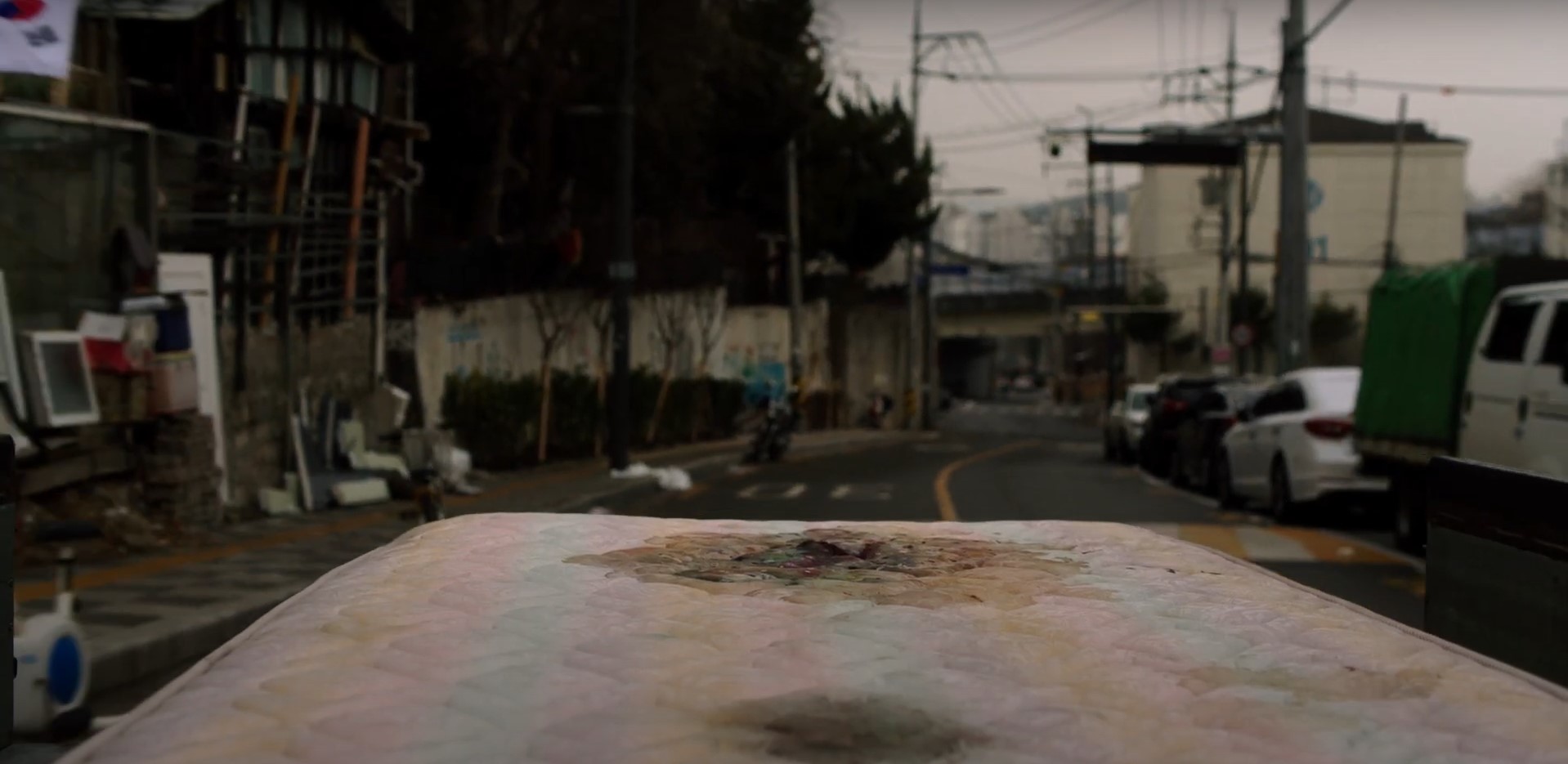
The fifth thoracic vertebrae, the T-5 spine part and not the film’s title, is located near the top-center of the spine in the thoracic grouping and it supports the abdominal muscles and feeds into the chest wall coinciding with the muscles around the rib cage, lungs, and diaphragm, to assist with breathing.  In Sye-young’s abstract, “The Fifth Thoracic Vertebra” does not brace audiences for metaphorical monsters surrounded by dreamlike imagery and esoteric purposes.  With no explanation, visual or verbally articulated, piecing together the strange circumstances is heavily relied upon our own personal experiences in life, our past mistakes, our relationship fails, our giddy fondness, and so forth to interpret Sye-young’s theoretical philosophy on the unfinished leftovers of a kaput relationship.  I believe Sye-young also felt the need to explain his film in a director’s statement on the back of a DVD that questions the whereabout “bits and scraps” of a failed relationship by anthropomorphism means and relating it all to the cycle of fungus.  While a difficult conceptual pill to swallow, “the Fifth Thoracic Vertebrae” can display beauty and disgust in a composite of odd juxtaposition in a peculiar world where a dirty, moldy mattress is an acceptable roadside pickup and debilitating excised bones of the body go without being questioned.   There’s an aloof presence that speaks symbolic volumes to the relationships depicted and with an open mind and broad, thoughtful strokes, one may see through the director’s expressionism.
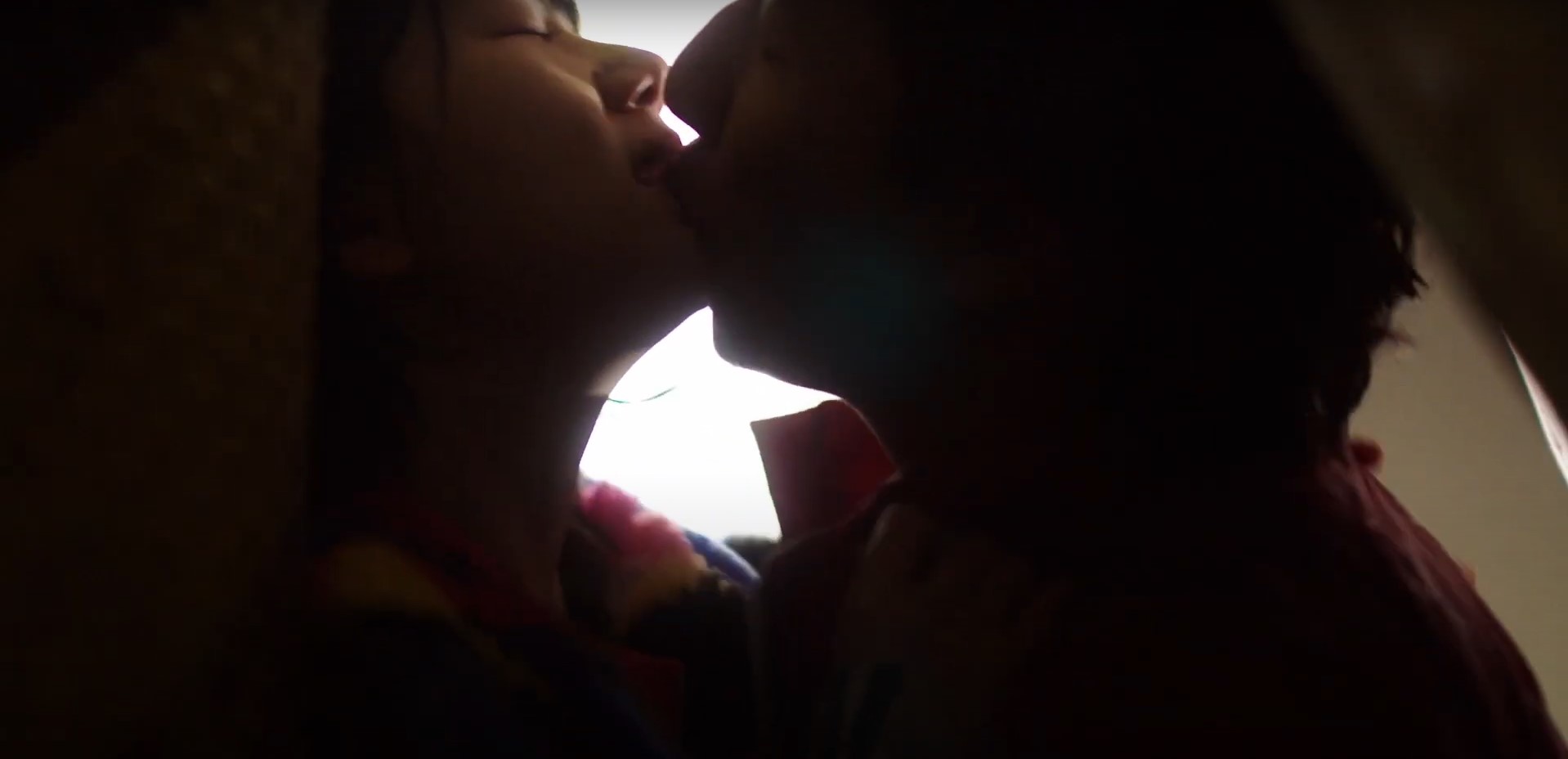
Indiepix Unlimited, an online streaming service dedicated to independent films, also caters to the physical media market with a DVD release of “The Fifth Thoracic Vertebra.”  Encoded onto a single layered 5GB DVD-R, it’s been a while since I’ve seen an official release on the recordable DVD format and for the visual picture quality that’s already on a standard definition 720p resolution, we receive a middle-of-the-road 1.78:1 widescreen aspect ratio presentation. Posterization, in voids and on the skin, is the main artefact culprit in a stylish context of warm gel yellows and greens and the seldomly naturally lit hues which are not as richly saturated but can hold its own for a DVD-R.  There’s not a ton of detail in the mattress mold and any clear view frames are obscured by distance, the cover of darkness, and the cover of blankets as, much like all else, the contours are nicely delineated but the overall color scheme of the film blend together. The South Korean uncompressed LPC 2.0 mix has a pleasing enough unassuming range and depth field that hits all the notes and presents ambience with basically what is needed to envelope the immediate surroundings around the principal objects, all balanced through the dual channels.  The burned in English subtitles are not flawless but are synched well and seemingly translated okay.  The release comes feature only and the standard DVD Amary casing comes with an eye-catching, or rather eye-starring, front cover with no outer coverings or inserts.  The disc art deliberately yells DVD-R with a plain white, barely unique logoed, ring splay.   The release comes not rated with a runtime of 65 minutes and is confirmed to play on region 1 playback.  Untested for other regions. 

Last Rites: “The Fifth Thoracic Vertebra” impresses with forlorn residue in what is an offbeat creature feature where the creature is inside the mattress rather than under it.  Yet, the story stretches the imagination too far and near a snapping point that allows for no breathing room in what is a tale of lamentable remnants that creepingly germinates spores into a melancholic mycelium overtime. 
Own “The Fifth Thoracic Vertebra” on DVD. Purchase Here!

When The Waters Rush In, It’s the EVIL in Your Head That’ll Kill You. “Relentless” reviewed! (Terror Films / Digital Screener)

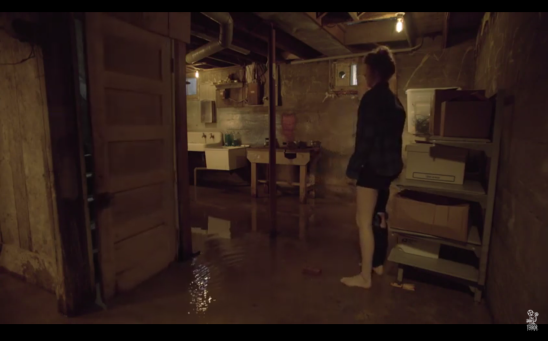
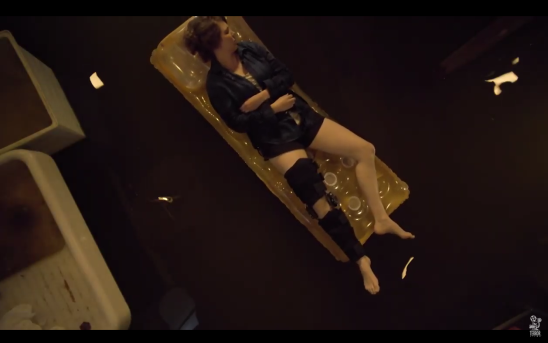
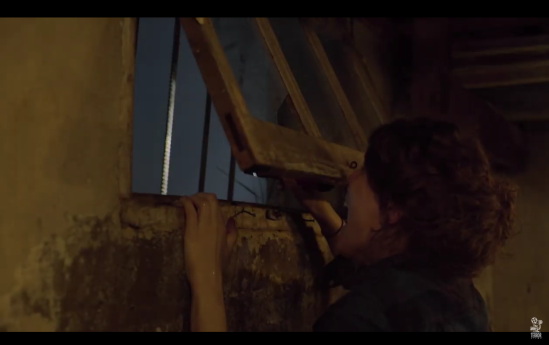
Jennifer Benson’s life is a storybook fairytale that’s embraced by her close sister, exalted by a sweet, kind husband, and excited with the news of an upcoming baby. Yet, all good things come to an end and in Jennifer’s case, in a devastating tragedy when everything and everyone she held close to her heart is unexpectedly wiped away within a single year. Physically injured and suffering from depression, Jennifer withdraws from family and friends inside an empty house, sinking lower into despondency, and letting bills and the house upkeep slip through the seemingly insignificant cracks. Jennifer eventually decides climb up a little out of her rut by cleaning up and letting go of some sentimental materials that leave painful memories by storing them in the unfinished basement, but when the basement door jams and won’t open, Jennifer finds herself trapped in a subterranean state with a large thunderstorm dumping rain that’s seeping from the basement walls, plumbing, and the ground. As the torrential rain continues to fall, the water level continues to rise with no way out.

Get ready to hold your breath in Barry Andersson’s agog of metaphorical poignant survival, “Relentless.” The filling of the fish tank mender is the director’s first and only release of 2020, following his 2019 releases of the historical drama, “The Lumber Baron,” and a 1940’s set sleep deficient thriller, “The Soviet Sleep Experiment.” Andersson continues to tell stories of intricately varied human responses as the filmmaker pens “Relentless” surrounded by themes of reactionary and recovery paths toward death with the film echoing more so with Andersson’s introductory “The Lumbar Baron” on a much smaller scale in terms of cast and setting. The story is set in or near Minnesota, a Midwest state prone to some of the United States worst flash flooding hit areas, and Andersson crafts his creative juices with that in mind to mold a symbolic cognitive descension stemmed by escapism inside creature comforts. Deodand Entertainment and Andersson’s filmic workshop company, Mogo Media, designate as the production companies.

“Relentless” indurates around being a one woman show with Rachel Weber spearheading the subject of crippled and downcast Jennifer Benson. Weber, whose worked briefly with Barry Andersson in “The Soviet Sleep Experiment,” has to operate Jennifer animatedly in a near voiceless, tacit role to simulate one alone with their thoughts and emotions. Only flashbacks limn with dialogue present the state of Jennifer’s woebegone mind as she goes from despair to reluctant acceptance by reopening the wound of concealed painful memories. Weber fulfills every inch of empty space with a tinge sorrow in some way, shape, or form but doesn’t quite convey the impact well enough to fortitude a presence. Weber’s post-flashback expressions deflect the corpus theme with no real tell of how Jennifer actually feels as she stands over a box full of memorabilia of what should be inducing whether a pensive sadness or vitalizing inspiration as she goes through an unbalanced reel of memories that include bedroom book snuggles with her sister at young age or survival life lessons with her father to up at the moment of what was supposed to be a joyous baby shower occasion that turns unexpectedly into tragic point in her life. Though the story acutely restricts the camera on Weber, the unfolding flashbacks ultimately tell the story from the past that includes stint performances from Charles Hubbell (“The Bitch That Cried Wolf”), Anna Hickey, Bea Hannahan, and Presley Grams.

“Relentless” has thought-provoking messages splayed up, down, and all around it’s encased four-walled theme of, literally, drowning in your own self pity and digging yourself out of a hole of depression. The water that gushes into the air tight unfinished basement represents the rising fathoms of depression that initially trickle in harmlessly enough, but the longer the despair drips go unchecked, as noted when Jennifer reaches out to nobody up on the top floors of her house and would rather recap wedding photos in the first act, the more intense the cascades can become when your submerged in from head to toe. Along Jennifer’s rather stagnant perilous journey, sitting on top of work benches as a hapless invalid and rummaging through miscellaneous items, she opens and goes through various storage boxes of her past that she carefully tries to keep dry by continuously moving the boxes out from the low-lying waters. Each box evokes a single memory from her past fashioned in an unchronological order and stews in a melting pot of stirred emotions that work backwards from melancholy to hope to, eventually, in my opinion, an inescapable suicide. My subjective take on Barry Andersson’s open-ended culmination is purely speculative as Jennifer’s struggles for survival may all be for naught, even in the evidence of the character leaving behind a note for storm survivors, or whomever, to collect staggering into what could be Jennifer’s tomb strongly suggests that particular path. That’s what admirable about intense thrillers, such as “Relentless,” that teases an unwritten coda for those to survive and tell the rest of the story, woven with their own personal singularities, but Andersson’s film, heavy in metaphors, lacks spirited vitality in a somber stroll through what’s innately a human fear: death.

Basements continue to retain their bad rap in the traditional horror sense as well as in Terror Films’ release of Barry Andersson’s survive-or-die succumbing to mopery in “Relentless,” distributed digitally across multiple platforms. Rigorous self preservation might be watered down, but the stagecraft and production design is top shelf quality with a simple set of a well dressed dank and bare basement where streams of water rush into from the barred awning windows and waterlogged plumbing. The basement in itself is a character of misfortune, a cell of rehabilitation, and is just simply effective in a cinematic sense without seeming overly menacingly but rather like every other basement in the world. With the digital screener, there were no bonus material included nor any bonus scenes during or after the credits. Don’t expect a nonstop nail-biter that aims to fill your lungs with asphyxia inhaled water; instead, sympathy or empathy will play significantly in “Relentless'” success with an aggregating flurry of thoughts generator in a post-traumatic vicissitude.

“Relentless” included with Prime Video and available for purchase!

Dutch Avant-garde is the Next Evil on the Butcher’s Slab! “Meat” review!

screen-shot-2016-09-23-at-8-50-29-amA young and beautiful butcher shop assistant succumbs to the middle-aged butcher’s sexual advancements and fantasies at the workplace after she catches glimpses his sorrow, but when the butcher ends up naked on the shop’s floor with his throat cut, the assistant becomes the number one murder suspect for an inspector who coincidently looks almost identical to the deceased butcher. As the investigation deepens into the assistant, the inspector’s solemn, solitary life blurs to an assimilation into the butcher’s and his suspect turns from being a prime target to being a crucial part of the his physical and mental altering integration into the dead butcher.
screen-shot-2016-09-23-at-2-45-58-pm
“Meat” is a powerful transcending film seismically barreling through a Lynchian structure consigned to provoke the consequences of unhappiness and the consequences of poor choices during unhappiness. Directors Victor Nieuwenhuijs and Maartje Seyferth have orchestrated a moderately expressionistic arthouse Dutch drama told in a spiraling sexual context. The meat in “Meat” and the sex in “Meat” clearly share a correlation, peppered as motifs from start to end, and the positive and negative dimensions of the two are so obscured that pinpointing the differences between them are impossible, but both are for sure the last hope for the butcher and his assistant Roxy to embody the essence of sex and meat for opposite reasons. Whereas Inspector Mann simply drags wholeheartedly through his existence, expressing his numbness toward his mundane job and harshly breaking up with his lover without an ounce of compassion. Its until the butcher’s case lands in his lap does the Inspector shows signs of life again.
screen-shot-2016-09-23-at-2-36-30-pm
If you notice that lead actor Titus Muizelaar’s dual roles have purposefully generic labels. The butcher is credited as just the butcher while the Inspector has a proper name, but the name Mann is just as indistinguishable as if the character was christened Guy. The synonym character was intended for blending, to blur their personas, and to transform one into another. To explore the transformation, “Meat” begins a parallel between the butcher who, in a metaphorical sense, has his cake and eats it too and the inspector painstakingly limps from one spot to another. A contrasting experience between the two firmly establish their individualities. Then, the film shifts gears midst a catalyst with the butcher’s mysterious death, forcing the female assistant, an uninhibited role performed uninhibitedly by Nellie Benner, to be the resilient gateway for the inspector. Third gear shifts into the inspector being more and more intrigued, if not extremely envious shown very subtly, by the butcher’s seemingly unchained facade. Each character emits an expressionless stature with a deep-rooted ugliness burrowed inside and each desire a change in their turmoiled lives, whether it’s sustaining love, seeking love, or able to love in order to battle every aspect of oppressive depression.
screen-shot-2016-09-23-at-2-55-21-pm
The uncomfortable open and intimate relationship between the butcher, Wilma Bakker’s Tiny, and the shop owner and the psychosexual workplace harassment involving the enthusiastic, video-documenting assistant filets the juicy bits from the bone with numerous innuendoes and explicit carnal exhibitions taking brazen residence within the animal blood stained walls of the butcher’s small meat market. You’ll never look at steak, pork chops, and leg of lamb the same way again! Only when “Meat” transitions into that second gear does the erotica becomes less erotic and more forced and horrifically exploitive. Scenes of undisclosed rape and of blatant genitalia speak upon that aforementioned correlation of raw meat and sex; no choice is given to the cow when the cow is killed and slaughtered for the cow’s delicious beef and the same can be said in sex as it’s taken without much consent and it’s being reaped for the benefit of others.
screen-shot-2016-09-23-at-9-22-48-am
Graphically infrasexual and skewed beyond simplicity, “Meat’s” refreshingly loaded with unpleasantries and basted moistly with an outer layer of perversion that drips into an oven of thriller surreality. The Artsploitation team lives up to the moniker by, after being long overdue, crafting a home video release of 2013’s “Meat” aka “Vlees” onto DVD and on digital home video. The digital screener provided for review doesn’t give much insight into the audio and video qualities or speak to the testament of the special features. However, “Meat” is a phenomenal film that’s well-aged and ready to be rubbed, tenderized, devoured in all senses of the meaning.

Buy “Meat” on DVD!