The EVIL Peruvian Whistle of Death! “Face of the Devil” reviewed (MVD Visual / DVD)


Deep inside the Amazon jungle of Peru, seven friends getaway from university life by staying at a remote riverside resort.  No cell service.  No nearby towns.  The resort shelters an idyllic retreat for those looking to escape the mundane routine of the real world, but the jungle is also home to an indigenous evil entity, some may even label it the Devil.  Better known among the locals as el tunche, the trickster spirit prays on innocence and the naïve, psychologically tormenting with a foreboding whistle indicating it’s nearby presence.   With no help in sight and nowhere to hide, the jungle comes alive with an ear-piercing whistle that seeks to swallow the seven vacationers to their doom. 

To some extent, horror lives and dies by permanency of myth and legends, cultivating inspiration from ancient, as well as new, mythical beasts and spirits and spin them into entertainment macrocosm or, perhaps, even to just simply to share the rarity of knowledge and heritage surrounding the tales.  If in American mountaintop forests bigfoot roams inconspicuously around populated areas, breeding enigma and scaring children around campfire stories, then in South American, el tunche does much of the same instillations for the Peruvians who inhabit their legendary fiend, preying on delinquent youths, in the dense jungle.  Outside of Peru or maybe even South America, el tunche is not globally known, but for one Peruvian film from 2014, local lore becomes broaden beyond confining borders and creeps right into our home video media players.  Director Frank Pérez-Garland helms the maligning mythos with “La Care del Diablo,” aka “Face of the Devil,” from a Vanessa Saba screenplay set in the ominous jungles of Peru plagued by a wandering and whistling evil spirit searching for those lost among the tall trees and foliage.  Peruvian based Star Films and La Soga Producciones spearheads the production located on set of an ecolodge in the uncommercialized area of Tarapoto just North of Lima and serving as producers are Gustavo Sanchez (“The Green Inferno”) and Varun Kumar Kapur. 

“Face of the Devil” is a hyper localized narrative that’s fully contained inside the jungles of Peru as well as a casting all Peruvian actors with zero other nationalities appropriating roles for a mythological tall tale extension that rightfully needs to be expressed by native filmmakers.  As such, you won’t recognize a face amongst the cast unless you’re eyeballs deep into South American cinema.   The film opens with a dream sequence of a young girl staring at her towering mother’s weird, unholy behavior that ends with her mother, played by writer Saba, quickly reaching out for child and abruptly awakens from the dream is Lucero (Vania Accinelli).  Lucero’s nightmares become an important reoccurrence, like an omen, that doesn’t seem to upset the college freshman despite the nightly fright, but other aspects upset her father to the point where he yells at her for wanting to go on a trip with her friends, signifying a quick trip into unspoken complications sanctioning Lucero’s mother death that worries the same fate may also fall upon his daughter.  Before we know it, a reluctantly agreed to Lucero is river boating with her six friends:  couple Mateo (Nicolás Galindo) and Fabiola (Maria Fernanda Valera), Camila (Alexa Centurion), Paola (Carla Arriola), Pablo (Guillermo Castañeda), and new boyfriend Gabriel (Sergio Gjurinovic).  The friends are seemingly full of life, love, and fun but the dynamic turns only slightly complex with love triangles that only go as far as being the butt of the weekend’s jokes.  The characters do very little in the story, splashing around in what seems to be an unreasonable number of ecolodge pools for most of the time while playing spin the bottle, truth or dare, skinny dip, or just make fun of each other because, as a trope bylaw, that is what college-age kids do to spark tensions and cause divisions, and I find the characters and their portrayers to be uninspired to do or be more that invokes the frisky wrath of el tunche.  Javier Valdez and Ismael Contrearas bookend the cast of characters as two polarizing stances on dealing with otherworldly spirits by either being cautions and frightened as Valdez is with Lucero’s papa or embrace the spirits for self-purpose as it is with Contreras who plays the resort owner. 

“Face of the Devil” has all the properties of an European-fried and campy-peppered supernatural kill tally, drawing elements from the jungle cannibal subgenre sans the cannibals and the teen slashers sans the slasher.   Instead, el tunche is an all but forgotten myth lost over time through the generations until “Face of the Devil” calls to mind the cautionary dangers of cultural wise tales for naïve and disrespectful youth who wind up on the deadly end of el tunche’s mean streak.  Saba’s script incorporates more than just your average urban legend come to life tale with a Diablo-sized pretext to why el tunche all of the sudden decides to besiege upon this particular group of vacationers.  Per the legend, el tunche gobbles up those lost in the jungle thicket, but Saba and Pérez-Garland’s religious context direction, including the motifs of the trinity cross and bodily possession, has the good-natured Lucero, infected by her mother’s randomized demonical occurrence, be the proximity key to el tunche’s unleashing.  Good versus evil also becomes strongly painted in the latter half of the narrative and is affixed to the lore’s distinctive construct.  The further Lucero is led from a path of spotless geniality, from her overprotective father, the more she experiences nightmares and the closer she is coming face-to-face with the malevolent forest entity feeding off her tarnished past.  Sadly, “Face of the Devil” weans off from nurturing el tunche into a singular idea with the entity depicted as, but limited to, an invisible presence, a black oil spill in the water, a pulsating yellow glow, or as Anna Gonsalves says in “Predator,” the jungle came alive and took them.  Even the current DVD release represents el tunche as a Lovecraftian-like creature with tentacles coiling out of the jungle river water and enclosing around a bikini-cladded sex symbol with a tattooed vagina – provocative!  Yet, inaccurate.  There are no tentacles and no woman with vagina ink.  “Face of the Devil” struggles with character motivations, sending boyfriends off into the woods without tools or guidance to find help, leaving the story to fend for itself solely on a slap-dashed gory ending that’s a little too late in salvaging the ferocity of one of Peru’s most mythical phantasmas. 

Like aforementioned, the DVD cover is a tad misleading, enticing with sex and tentacles topped with DEVIL in a big red font.  Now, you can go in eyes wide open with your own copy of “Face of the Devil” distributed by MVD Visual in collaboration with Jinga Films and Danse Macabre.  The single layer, single sided, region free DVD5 is 77 minutes presented in a widescreen 1.78”1 aspect ratio. Reason behind discerning the storage format to be a DVD5 is evident in the compression issues that clutters the picture with artifacts, leaving highly noticeable splotches to shake details to the core. There’s also the use of the vapid gray tint insipidly squashing any color and life from the lush green jungle Pérez-Garland finds himself extremely lucky shooting inside. Watching “Face of the Devil” felt cinematography akin to an episode of “The Handsmaid Tale” or “The Walking Dead” where a bland overlay masks more than just brightness and beauty of natural hues and light. The Spanish audio mixes have two lossy options – a 5.1 surround and a 2.0 stereo. Switching between the two, the 5.1 obviously has a little more robust soundtrack during the cacophony of jungle augury. Snakes hissing, bat clicks, the comprehensive soundbites of other animals in audio vibrational flight combined with the intense whistle, like a diluted train whistle, has ambient staying power to be the most effective element to el tunche’s death harbinger presence. Dialogue is less robust but prevalent and the English subtitles synch well without error. As far as special features, nothing beyond that of the static menu and there are also no bonus scenes during or after the credits. The opening title card credit sequence is about as artistic as the film allows itself to be only to then dwindling into pedestrian territory. Set in the Peruvian jungle deemed to be a major waste of location perfection as much of “Face of the Devil” buoys chiefly poolside with the cheap Dollar Store adhesive tape barely coupling a connection between local legend and the Devil in this wet behind the ears teenager-in-danger yarn.

“Face of the Devil” available on DVD at Amazon.com

Don’t Be Fooled By the EVILs of Your Mind! “Open Your Eyes” reviewed! (Gravitas Ventures / Digital Screener)


Screenwriter Jason is on a deadline.  The producer is looking for his next script and soon.  The writer finds himself in a funk in not only fleshing out his script but also with his memories as a lingering sensation clings to him as flashes of moments that don’t seem quite right haunt his reality.  As he plugs along with his writing, other strange occurrences happen all around him:  a portion of his apartment wall is deteriorating from a leak in an adjacent upstairs unit, a cat has seemingly made it’s way into AC ducts, and objects disappear and reappear.  His dormant apartment complex is frustrating and lonely when he can’t reach the upstairs neighbor or the building manager about the leak that’s destroying his wall, but when he runs into Lisa, a neighbor from down the hall, many of his concerns fade away with her striking beauty and the two start up the beginnings of a possible relationship.  Yet, there’s still something amiss he can’t put his finger on and his newfound friend Lisa might just be the key to his awakening.   

Modest psychological horror has always been a tough one to pull off.  Instead of a straight forward zombie apocalypse or a killer behind a creepy mask slashing to bits half-naked teenagers, the psychological horror subgenre has to develop disintegration details and piece together fragmentations in a whirlwind character study that hopefully materializes into logical sense.  Writer-director Greg A. Sager tackles such threadbare cognizance with the filmmaker’s latest feature, “Open Your Eyes,” a Canadian psychological horror-thriller released this month.  Sager remains firmly in the horror realm with his fourth feature film behind 2012’s demon-seeding “The Devil in Me,” 2014’s supernatural penancing “Kingdom Come,” and 2018’s extraterrestrial thriller “Gray Matter.”  Continue the trend with all his independent productions, Sager self-produces alongside his co-founding Matchbox Pictures Inc., partner, Gary Elmer, who is also the cinematographer on the project.

“Open Your Eyes” is also modest in casting with two backbone characters keeping Sager’s narrative from being an bodiless work of art.  Doing much of the heavy lifting is the Toronto based Ry Barrett and with his close connection with filmmaker Chad Archibald, Barrett has had, in many different capacities, a role in a string of B-horror, including such films as “The Drownsman,” “Antisocial,” and “Neverlost” which are all tied to the Ontario director.  “Open Your Eyes” serves only as the second time Barrett and Sager team up following the release of “Kingdom Come.”   Barrett exudes an unconscious performance in Jason’s unravelling from crunch-time screenwriter to an unglued madman living in Jason’s version of a tenantable matrix.  Jason is almost sleepwalking through a lonely existence even before meeting his neighbor Lisa, a role played by Joanna Saul in her commencing feature film act, and the struggling to keep structural integrity writer hardly suspects and worries about strange manifestations that are happening all around him.  I don’t think Sager captures Jason’s full autonomy awareness that leaves the character more blank than bothered.  Barrett and Saul have adequate enough chemistry to make their barely a courtship romance intriguing, but her character’s implementation into restoring Jason’s vital grip on reality just kind of falls into his lap without a pinky being lifted on Jason’s part to assist in his own deliverance.   Heather May and Julianna Suzanne Bailey round out the small cast.

Aside from the nuisances with the character development, the sterilized comforts of Jason’s living conditions alone provide an unconventional chill.  Though living in an apartment complex is normally assumed chockablock with tenants living their lives, Jason’s apartment building is virtually vacant, void of the hustle and bustle of occupants, with not as much as a whisper from the exterior of Jason’s top-to-bottom, side-to-side walls.   What seems to be an idyllic environment for a concentrating writer becomes an oppressive variable that yet doesn’t seem to slow down or question Jason’s momentum or leave any kind of sense of threat along the way, leaving his what should be an ominous place of mind-bending confinement hanging out to whither and dry up .  I thought the plot twist to be shrouded enough to warrant a semi pleasantly surprised and unexpected ending that connects topically to today’s real-world climate.  Not to be riding a one trick themed pony, Sager also plays upon the themes of grief over loss and how the mind compensates with overactivity and gap fillers to avoid a complete mental system overload while also subtly adding a static charge of illusory sensations to make unsettling disturbances.  “Open Your Eyes” will not scare your socks off as it’s not that kind of film; instead, expect a slow-burn mystery more puzzling than panicky as the walls begin to crumble…literally. 

Okay, puzzlers.  Get puzzling on the new mystery horror-thriller, “Open Your Eyes,” that was distributed this past June by Gravitas Ventures on DVD, Blu-ray, and digital.  Producer Gary Elmer, as director of photography, paints the dark corners with softer figures that provides a really good shadowy contrast between character and background.  Elmer’s small use of the blue tint, his over-the-shoulder hallway delph, and shallow focus add tidbits of appeal without just “Open Your Eyes” seeming like another flat indie production.  Since I was provided with a digital screener, I can’t comment to confidently on the audio and video qualities of a physical release, but presented 2.35:1 widescreen was digitally shot on a CineAlta series Sony Venice camera that effectively provides a smoother grain, especially in the inky shadows, that transmit a really rich data scheme for post-production and offers that flexibility in producing range.  Another byproduct of the Venice camera is the natural looking skin tones seen with Elmer’s film when not under a tinted lens.  No bonus material offered with the digital screener and there were no bonus scenes during or after the credits.  Perhaps with a runtime a little longer than necessary, clocking in a 99 minutes, “Open Your Eyes” is a quaint terror touching the tattered strings of a mind, body, and soul pushed over the edge and into a falsehood bred by fear and loss.

Own “Open Your Eyes” on DVD or Watch on Prime Video!

Pandemic EVIL Is Just Not For Dry Land Only! “Virus Shark” reviewed! (SRS Cinema / DVD)


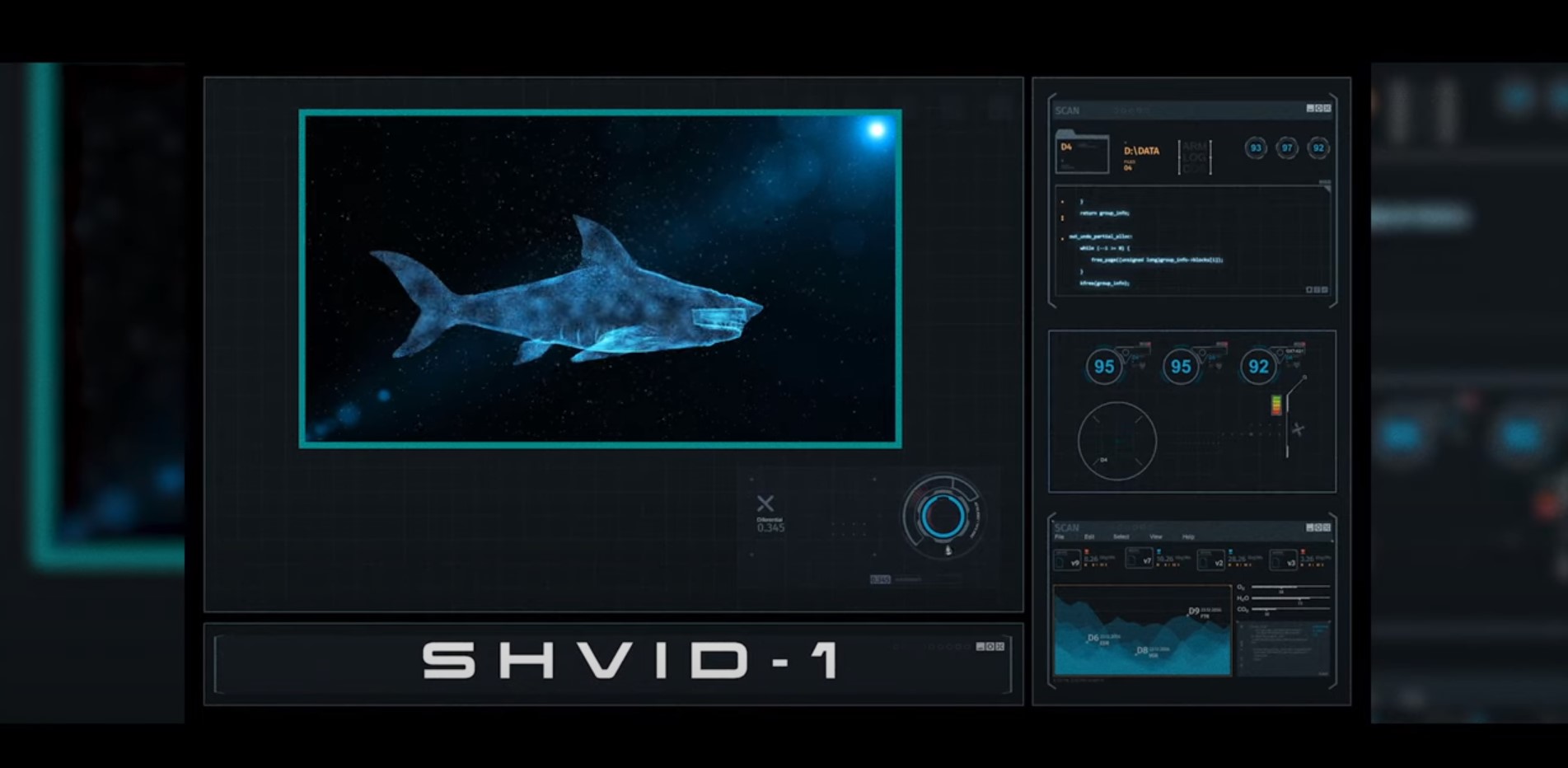
Deep at the bottom floor of the ocean is CYGNIS, a research laboratory retrofitted to be a race against the clock in finding a cure for a world devasting virus called SHVID-1.  Spread by infected oceanic sharks, a handful of shark attacks on unheeding beachgoers turns the world’s populace into mutated marauders and blood thirsty, zombified killers.  Running quickly out of time, the handful of scientists, a maintenance chief, and a security guard find themselves under pressure, literally, as the 30-year-old antiquated CYGNIS station is beginning to show signs of buckling under the ocean’s immense weight.  Factor in virus-mad sharks chomping at the station’s life sustaining systems and a betrayal by the project leader looking for cure glory in greed, a perfect storm brews 1000 leagues down overshadowing the severe global pandemic that has swallowed the world whole.  Survivors must surface topside with the cure before all hope comes crumbling down on top of them.

Okay!  I’m pretty sure director Mark Polonia parallels or exceeds my own unhealthy obsession of the sharksploitation genre with his own series of outrageous D-flicks dedicated to the gross profit of the monstrous shark rampage stigma seen in the Pennsylvania born filmmaker’s previous works in “Sharkenstein,” “Land Shark,” “Amityville Island,” “Shark Encounters of the Third Kind,” and the soon-to-be-released, the vampire and shark alliance, “Sharkula.”    Polonia’s latest, “Virus Shark,” is written by Aaron Drake and echoes the pro-Trump public ideology of willful ignorance in snubbing governmental official warnings about staying away from large crowds unmasked during the COVID-19 pandemic.  Polonia throws Megalodon-sized shade at partygoers and right wing conspiracists with SHVID-1, an obvious play on the real virus, and the sun and sand worshippers who venture into the shark infected and infested waters despite the recommended counsels to stay on shore.  Aside from the social commentary lampooning, the rest of “Virus Shark” is in shambles as a super low-end indie production from Polonia Bros. Entertainment and produced by SRS Cinema’s Ron Bonk. 

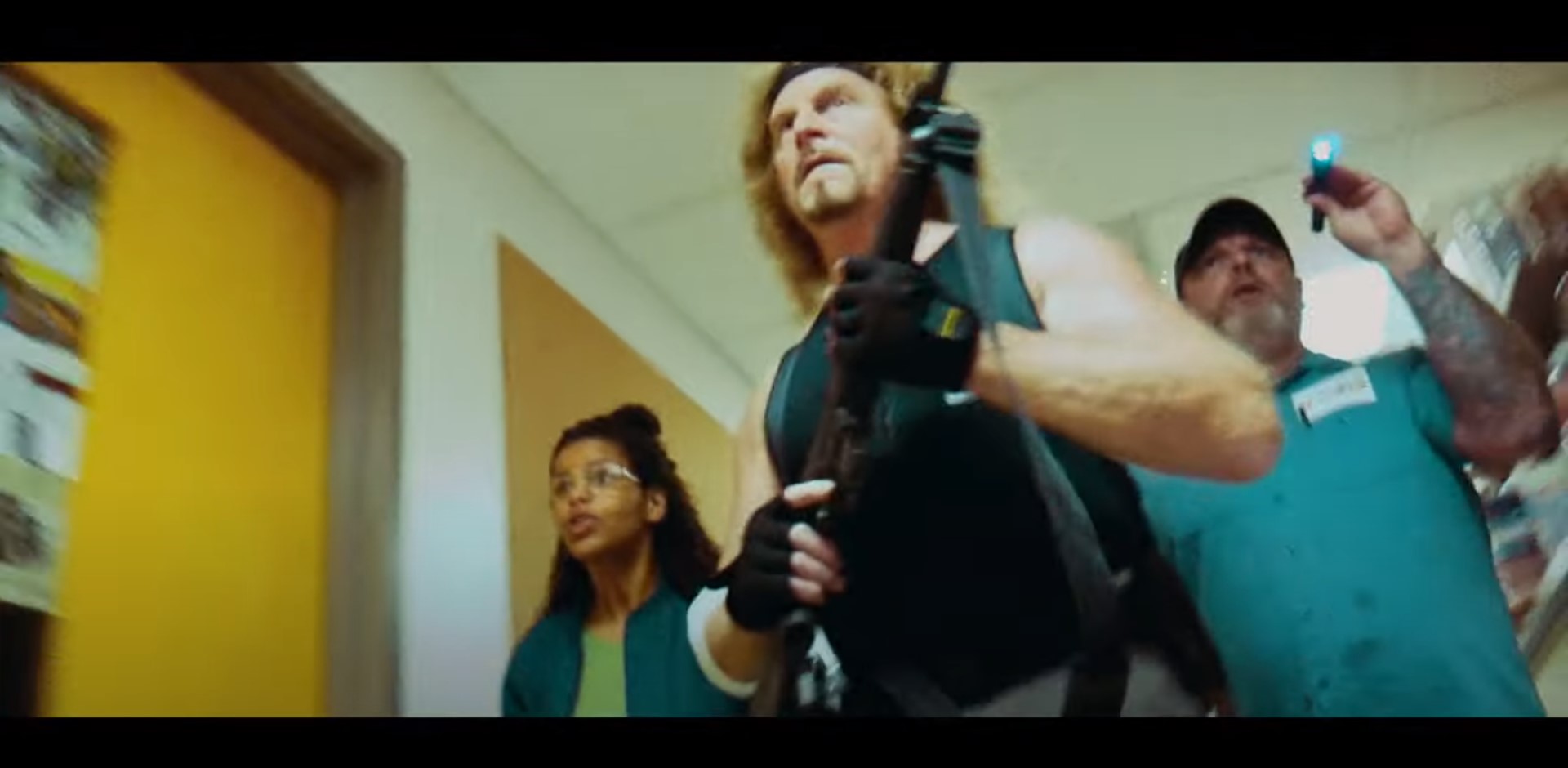
Served up as chum for contagious sharks are a troupe of regular independent staples beginning with lead actress Jamie Morgan entering her second bout with a killer shark after surviving another SRS Cinema gem, “House Shark.”  In the role of marine biologist Kristi Parks, Morgan is not free diving into the vivarium pens and wrangling or bareback riding the maneaters like “Deep Blue Sea’s” Thomas Jane; instead, the actress has a more meek stance as her limiting character transforms into a protective shield over mankind’s last known hope – a cure for the virus.  Fellow scientists Anne Satcher (Natalie Himmelberger, “Shark Encounters of the Third Kind”) and Gregory McLandon (Natalie’s real life husband, Titus Himmelberger, “Sharkenstein”) don the lab coats and spectacles to look the researcher part without actually seemingly doing anything of importance, or anything that makes sense anyway.  The team is rounded out with “Queen Crab” actors Steve Diasparra as the maintenance man Rickter D’Amato, an homage to Joe D’Amato who has helmed a trashy sharksploitaiton film himself with “Deep Blood” (read our recent coverage review here!), and the awesomely 80’s hairdo’d Ken Van Sant the dated commanded-cladded security guard and horn ball, Duke Larson.  Deliveries and any sense of conveyed emotions are a smidge above forced as if reading straight from a cue card.  The off camera stare has to be my favorite gaze into space moments, especially when an aggressive Great White beelines right toward them and the reactions are nothing more than a gaping mouth.  Van Sant wins top prize for at least giving a half-hearted attempt at empathy for a character completing a character arc.  “Virus Shark” fleshes out with Yolie Canales, Noyes J. Lawton, and Sarah Duterte who are also a part of the tight knit celluloid circle of deep-six cinema. 

Speaking of deep six, as in “DeepStar Six,” a semblance toward notable underwater horror films of the deep really do crest through “Virus Shark’s” stagnant flat surface.  Little bits of adulation toward “”DeepStar Six” with the jettisoned escape pod, “Deep Blue Sea” with the shark pool, and “Leviathan” with the topside communication sans Meg Foster sprinkle a blanket of welcoming derivativity amongst a cheaply endeavor.  When I say cheaply, I mean “Virus Shark” scrapes the bottom of the barrel with embarrassingly bad shark hand puppets, interior locations of the underwater sea lab are about as realistic as the innards of your run of the mill High School building, and every single gunshot is the same soundbite stuck on repeat, no matter the gun or the caliber.  I do admire the innovation at times.  An example I would pull would be the two miniaturized pincers matted on top of a live-action still frame used as hydraulic clamps to pickup the rather rigid shark figurine from the “pool.”  You can call it sloppy, but on a pea-sized budget, I call it thinking outside the box.  Much of the story felt underdressed, missing parts pivotal to the impelling actions that either progress cataclysmically or just drop off the face of “Virus Shark’s” malfunctioning sonar.  Under the table deals and sexual innuendos made between project head Dr. McLandon and topside liaison Shannon Muldoon are skimpy at best as well as Kristi Parks’ all for naught endgame to saving the world.  Everything seemed and felt pointless, senseless, and without merit that the “Feeders” and “Splatter Farm” director shouldn’t be totally judged by as we’ve seen much better on much lower budgets from Polonia who he and his late twin brother, John, have been around for decades making movies up until 2008 when John passed away.  Mark Polonia continues to carry the torch but the lack effort has seemingly been replaced with chugging out one scab film after the next to the tune of tone deaf gratification.

Wash your hands, wear your mask, and maintain a social distance of 6-feet from the television when swimming with the “Virus Shark,” that has beached itself onto DVD home video courtesy of SRS Cinema.  The unrated DVD is an AVC encoded single layer DVD-5 and presented in a widescreen, 1.85:1 aspect ratio.  The image quality appears relatively sharp without a hefty loss from compression, especially around the spectrum of low-cost effects that range from rigidly clean to absolutely warped and absurd, but what do you expect from a release that has the cameraman’s reflection visible in the shot and spells region with an extra I – reigion 0 – on the back cover?  Underwater sea lab shots filtered through an oceanic blue hue make due the illusion of a domed research station on the sea floor bed whereas the insides lack a production manager’s personal touch as much of the interior scenes look to be a school with an obvious swimming pool setting and many insipidly sterile hallways and rooms.  Extras on the 74 minute film include a commentary track and SRS trailers with no bonus scenes during or after the rehashed intro credits for the end credits.  The English language 2.0 mono track isn’t the peak of fidelity with the lossy audio compression and inadequate mic placement made apparent by the limited depth and range in  dialogue tracks.  The overlaid narrow foley remains on one level from start to finish finished by stock soundboard snippets.   As far as Sharksploitation goes, “Virus Shark” ranks near the bottom of the food chain.  Of course, there have been far worse killer shark films threshing in the genre pool, but the COVID parodied subaqueous actioner wades underneath the skills of Mark Polonia.

Get Infected by the “Virus Shark” on DVD Home Video!

To EVIL, Just Another Slab of Meat for the Butchering. “The Slaughterhouse Killer” reviewed! (Breaking Glass Pictures / Digital Screener)


The local swine slaughterhouse perfectly suits the solitude of Box, barely sating the fervent urge of his killer spirit, but when a young ex-con, Nathan, who is trying to walk the straighten arrow with his girlfriend, falls under Box’s wing at work, keeping that urge at bay is proving more difficult with a likeminded companion.  When the workplace bully pushes Nathan too far, Box orchestrates a killer opportunity to murder the bully in his own home as a gift to the young parolee.  The death of their intimidating colleague solidifies an unique relationship between the men, opening Pandora’s box in their small town where no one is safe from their lust for blood.  As the bodies pile up and their corpses are ground up into chuck at the slaughterhouse, their relationship is tested when a child becomes the unintended next victim, severing the unspoken principles of their bond. 

“The Slaughterhouse Killer” is director Sam Curtain’s entry into the minds of bloodlust wolves living in sheepskin day-to-day amongst the clueless flock.  The senseless violence-laden thriller out of Tasmania, Australia is the sophomore feature from the “Blood Hunt” writer-director and is co-written with Benjamin Clarke.  The pair harness their continued onslaught for aggression from “Blood Hunt’s” human race cruelty with a rumbling storm brewing, waiting, for the right conditions when two very different people find a common interest by setting a little part of their world on fire.  The indie picture is streamlined through Curtain’s Stud Ranch Films entertainment banner and is backed by Black Mandala, a big and upcoming label showcasing an expertise in extreme low-cost horror, under the producer’s eye of Nicholas Onetti who has supported a number of genre fan favorites under his banner such as “The Barn,” “Aquaslash” and has even collaborated with brother, Luciano, on the 70’s giallo inspired  “Abrakadabra” and “Francesca.”  If Onetti is attached, prepare yourself for merciless and bloody circumstances in this particular ozploitation maniac thriller. 

You obviously can’t shoot a film titled “The Slaughterhouse Killer” without the slaughterhouse setting garnished with meathook strung up and process gutted livestock much in the same way the killer can’t fall into the average-looking joe category.  In steps Craig Ingham, a Sydney born 6’4” big fella with distinct facial features that includes a gleaming bald head and an angry sneer delineating fiercely from his bulbous, pink-as-a-pig cheeked face.  Ingham has an uncompromising maniacal approach of being large and in charge under a lame façade of a daft abattoir employee.  To balance out the oversized archetype antagonist, usually from one that lumbers around in slashers genre circles, hacking away at sex-crazed teens, James Mason buoys “The Slaughterhouse Killer” from capsizing in that humdrum trope of tasteless, flat water by adding a pretty face to the madness that is equally as ugly on the inside in character in what becomes the Laurel and Hardy of exploitation horror.  However, there’s nothing remotely funny about the performances of two men becoming unlikely best buds, drinking beer, and making hamburger out of the sheila from next door, but they do act like a pair of chuckleheads searching for motivation with their roles and instead come up empty handed in the arbitrary of Curtain and Clarke’s headway halting story.   “The Slaughterhouse Killer” is simply a two man show that aims to cycle through their unusual connection with Kristen Condon (“Sheborg”) as Nathan’s girlfriend, Tracey, and Dean Kirkright (“Cult Girls”) as the unfortunate workplace bully rounding out the small cast of collateral damage characters.

One of the biggest problems with “The Slaughterhouse Killer,” a tale that’s supposed to be driven by the characters’ dysfunctional ties to society and their knack for violence, is that very lack of purpose Box and Nathan get out from the random bloodlust.  Nathan, on parole for we don’t know what, easily falls bewitched by Box’s gore giddiness and willingness to let Nathan into his little big secret.  Without Nathan’s incarcerated backstory, a sentence served that proved nothing but his ability to still land a job, doesn’t age well as the film progresses and just seems to be there in a glint of development substance that never circles back.  Box falls onto the same static line of where the hell is his arc heading as the film opens with Box resting sweaty in his whitey-tighty inside his ramshackled shack.  There’s not much too Box’s creepy disposition other than keeping his squinty eyes glued to a rather attractive woman’s behind and taking abusive orders from the abattoir boss, but what he sees in his new guy to take him on a journey of bloodletting is something of a mystery that never pans out.  Even Box’s bound and blinded plaything in a padlock trunk transcends every act met, creating a glass ceiling of knowledge to the inner workings of his warped thinker.  Box and Nathan’s nihilism and madness unleashed is the purest part of Curtain’s film as the sensation is like a fat kid in a candy store where the two men can just go to town by butchering the residents of their own town by any means seen fit to them, but in the grand scheme of cinema, there are far superior violent films to consider.

As if it was destined to be, “The Slaughterhouse Killer” finds friendship with a kindred, malignant soul to carry out dark fantasies and Breaking Glass Pictures brings us this tale of two treacherous serial killers onto VOD and DVD this month of April. Digital platforms will include Vudu, iTunes, Google Play, Amazon, Fandango, and more. Presented in a widescreen, 1.78:1 aspect ration, and recorded in 4K, cinematographer Leuke Marriott rejoins Curtain on the director’s second feature, providing 78 minutes worth of intimate imagery invasive on Box’s grimy lifestyle and Nathan’s furrowed brow by corralling much of the action directly in front of the camera. Marriott might not employ novel angles and techniques but makes up with holding tight and fast on the brutality and the meatgrinder of Box and Nathan’s vile run while also supplying a few bold filters, such as a rich blue and a light yellow, in more unsettlingly taut moments and capturing some of Tasmania’s landscape with aerial drone shots of Arthur’s Lake with the trees seemingly floating up out of the tenebrous water. “The Slaughterhouse Killer” has the title of a 80’s printed VHS SOV and leverages the ogre villain to the max, but can’t muster a rooted sense of purpose, not even a simple reason such as pure, unadulterated evil, to drive a span of violent behavior to be a worthwhile token to the viewer.

Own on DVD or Watch on Amazon Prime Video!

Family Tree Rooted by Grounded EVIL. “Sator” reviewed! (Umbrella Entertainment / DVD)


Living alone deep among the tall trees and the dark and deafening foliage around him, a tragic past involving the disappearance of his mother haunts the very core of Adam’s broken spirit as he wanders the forest he grew up in and that has also been an afflicting mystifying presence of family lore.  His grandmother, Nani, for a long time has been commenting being the receptor of a dark forest entity named Sator who internally speaks to her and has her write down unintelligible messages; Sator’s words have also whispered in Adam’s ears as well as his vanished mother’s.  Adam ceaselessly searches the clues daily, even setting up a night vision deer cam and ringing out into the woods with a homemade calling flute.  As Adam and his family struggle to rebuild their once strong bond, Sator emerges with an intent to sever what’s left of the tattered strings of family ties, bearing down on the isolated Adam in attempt to insidiously claim more of his kindred for the forest.    

Rich in personal family indispositions that trickle down to unravel everything dear, Jordan Graham’s sophomore supernatural film of a sinister spirt, “Sator,” is much better than my attempt at an alliterated sentence structure.  The 2019 film, hailing out of California, with the forest sequences from Yosemite National Park, is a blend of pristine splendor as it is a nocturnal nightmare in an allegory of mental illness and the distortion of family because of the effects.  For the “Specter” director and screenwriter, particulars of “Sator” intertwine the authenticity of the filmmaker’s ancestry with the ominous unknowns of horror in a DIY production that looks bigger and grander in worth than in actuality.    Graham’s production banner, Mistik Jade Films, and in association with Yellow Veil Pictures, the company behind the colorful demonically intrusive thriller, “Luz,” funds the film with Jordan Graham serving as executive producer alongside Jennifer Graham and Elias Adamopoulous.

“Sator’s” a family and friends affair that opens with Gabriel Nicholson silently, patiently, and near aimlessly wandering through the woods as Adam walking alongside his mutt and carrying a hunting rifle. Jordan Graham’s childhood friend since early teens, Nicholson fills adequately the role’s achy privation and does so without saying so much as a paragraph in the full 85 minute runtime. While “Sator” snuggles up to Adam’s incessant need to check deer cams and conduct daily searches around every rock, tree, and bush, the character isn’t the nucleus essential to Sator’s generational influences that spread like a cancer over Adam’s lineage and he’s where the buck stops. Instead, Jordan Graham’s grandmother, June Peterson aka Nani, bears unwittingly and unimpressed brunt of the actor’s burden to perform due to Peterson’s longtime battle with dementia. Her scenes are authentic and natural in discourse with the recollective ramblings of Graham’s family’s resident topical presence – Sator. Peterson holds all the cards for her grandson’s inspiration from the very name of the entity that speaks to her to the automatic writings set in motion during a stint of Sator’s sometimes hours upon hours of inner ear verbal instructions. Graham doesn’t exploit his grandmother, but rather tells her story in a way dementia allows her not to with recording her experience, with the papers of her automatic writings, and with extending Sator into a metaphor for family strife and mental illness. Rarely are Nicholson and Peterson on screen together, but they come in proxy of one another through the supporting characters played by Michael Daniel as Adam’s troublesome brother, Pete, Rachel Johnson as an unusual relative, Evie, and Wendy Taylor as the bygone mother only remembered in flashbacks and Adam’s documentary memories.

There are movies out in cinema land released for the sole purpose of dishing out entertainment complete with exorbitant special effects and a high profile cast surely to make good on bank statement returns and then there are some with a more somber, but well-crafted, personal story.  “Sator” is the very epitome of that latter category as director Jordan Graham’s profoundly personal story that is tailored to his specifications without the temptation of commercial success.  With dividends on the backburner, “Sator’s” arthouse quality stamps a staid dread of distressing imagery and stillness emblematic from an imprinted personal experience that has been dissected and dispersed to give the entity known as Sator a fluid corporeal form.  What also scores high marks is the ideology of Sator created by, or perhaps more accurately channeled through, June Peterson, forming the breadth of life out of an unseen concept glamourized with unimaginable abilities and attributes that can foraged out of Paganism or Satanic scriptures and have nature be the embodiment of its unholy divinity.  Graham not only unnerves you as passenger looking into eerie family history with “Sator’s” transmissions at the narrative core, but also serenades with serrating stridency in his audio and visual compositions that includes some fantastic gore and torching.  The one thing to point out that “Sator” falls short on is understanding the next jump in the narrative as Graham leaves unclear wide gaps unexplained with only a bit of passive dialogue to gnaw on to get caught up.  In a story that’s already subversive on the plainspoken, “Sator” could use some straight talk to get more inside the dissonance of the entity’s inimical ways.

Let “Sator” whisper into your ear on an Umbrella Entertainment home DVD release. The region 4 DVD comes standard in a NTSC format, like of the Australian distributor’s releases do, and is presented in a widescreen, 2:35:1 aspect ratio. Image quality is paramount for a downbeat psychological horror set inside the absence of noise of a pin drop forest and the release delivers a stunning transfer with elaborating details in the forest setting. Perhaps slightly on the darker on the scale, the engulfing blackness of the cabin, the woods, and Nani’s home add to the surrounding cryptic presence notwithstanding the absence of a body to call the villain. The darker shadows Graham creates sees better contrast in dreamlike sequences with the deep blue sky with a moon over head, the silhouette of the trees, and Adam standing small against the tall trees in his white skivvies, creating stark poetry in the image alone. Graham also incorporates a documentary style, through the mind’s eye of Adam, to replay events like flashbacks that set the stage for the present. The English language Dolby Digital 5.1 surround sound is works inline with the rubato score that creates a pulls and tugs on the emotions. The dialogue isn’t so lucky as actors can only be heard mumbling the lines with the exception of Nani with her natural, genuine talk. Like many of the Umbrella DVD releases, there are no bonus features includes and there are also no bonus scenes during or after the credits. “Sator” thrives as holistic horror with the insurmountable belief that there are far worse things out in the world than mental deterioration that spur random acts of equivocality.

Own Sator on DVD from Umbrealla Entertainment (Region 4)