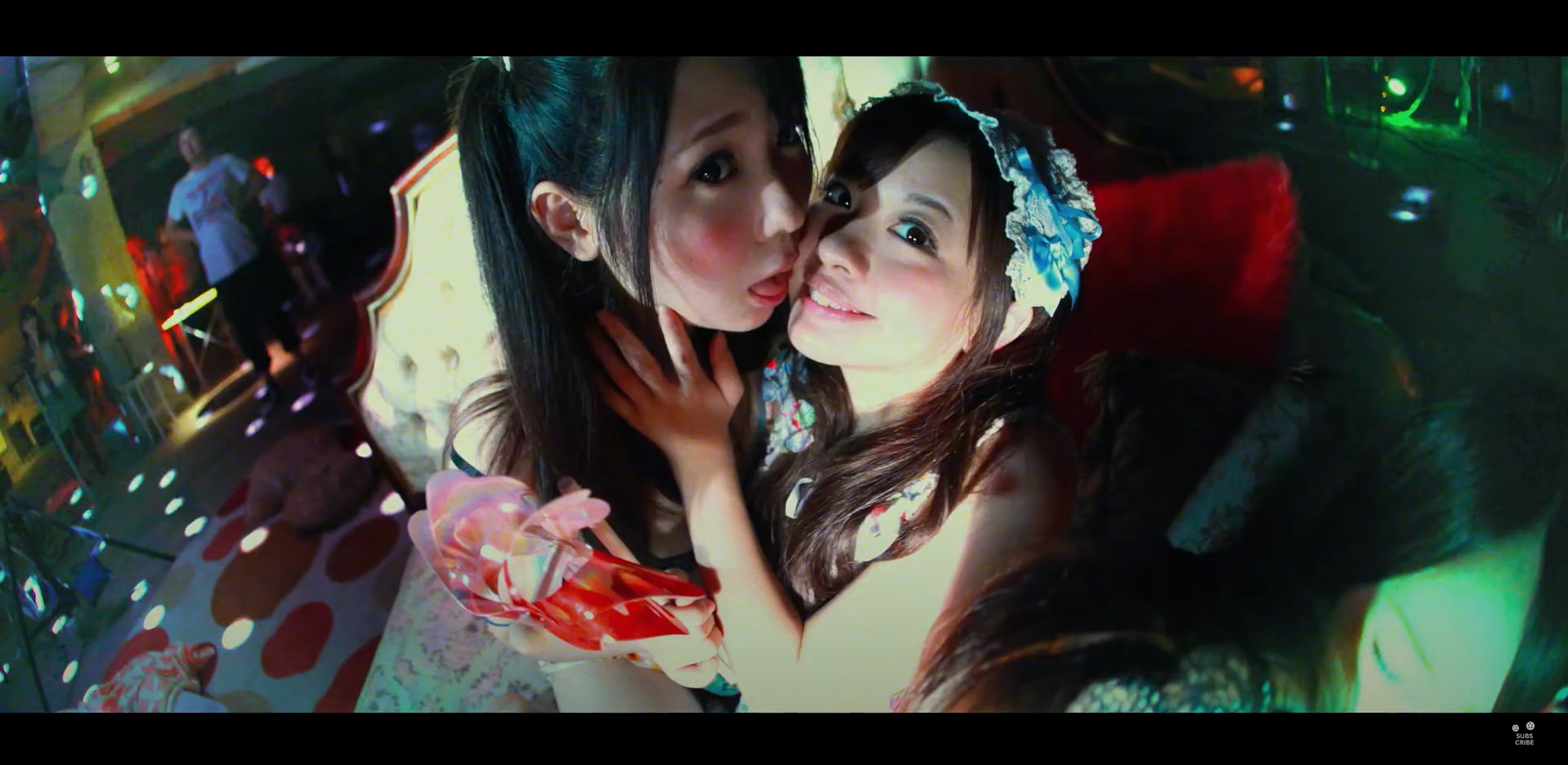
EVIL Dances Naked the Night Away! “Orgy of the Dead 2” reviewed! (MVD Visual / Blu-ray)

Get in on the “Orgy of the Dead 2” on Blu-ray!

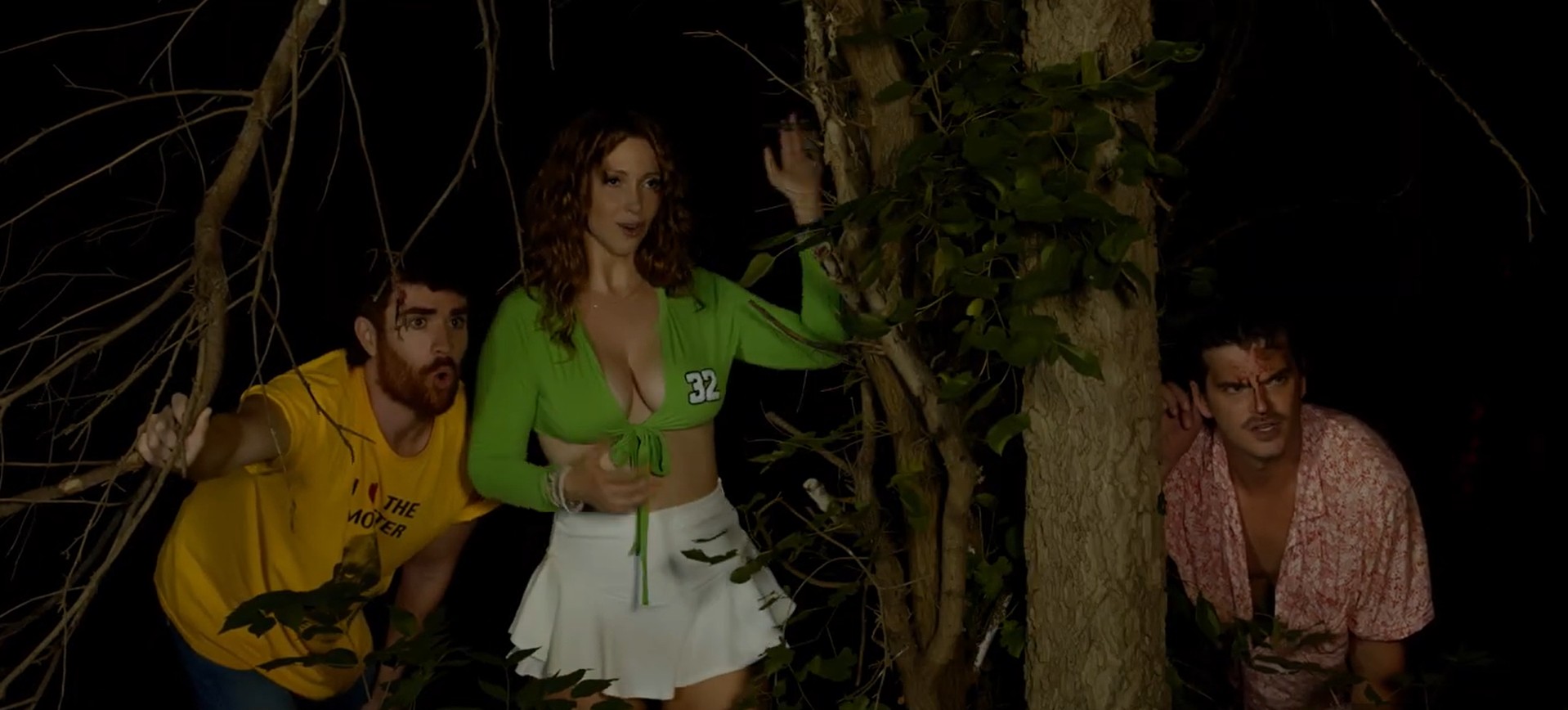
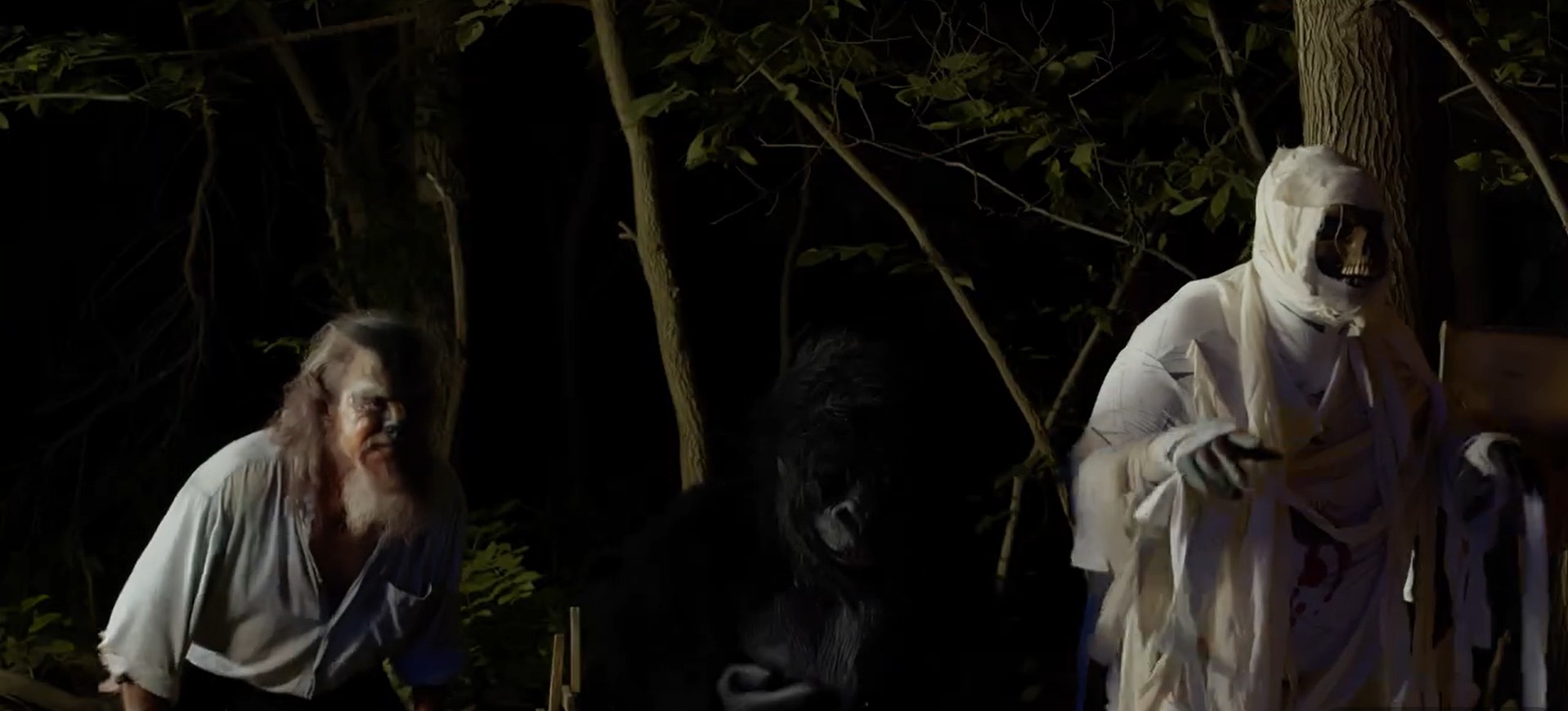
The Emperor of the dead and his Princess of the Night return from the dead to behold entertainment from the beyond.  As the Emperor sits on his graveside throne, his lap-seated Princess announces the lineup of dancing deceased, half naked women in a seduction of debauchery and death.  If the Emperor is not entertained, nor turned on, he damns their souls to Hell forever!  Four teens, on their way to the graveyard for sex and drugs amongst the dead, crash their car after some distracting roadhead, killing one of them in absent of a seatbelt.  As they search the graveyard for a living soul for help, they stumble upon the Emperor’s variety of groovy vixen and are captured to witness their dance of the dead.  As the show becomes more and more sordid, not all of the prisoners feel turned off by the show that creeps closer to their doom and their dawn.  
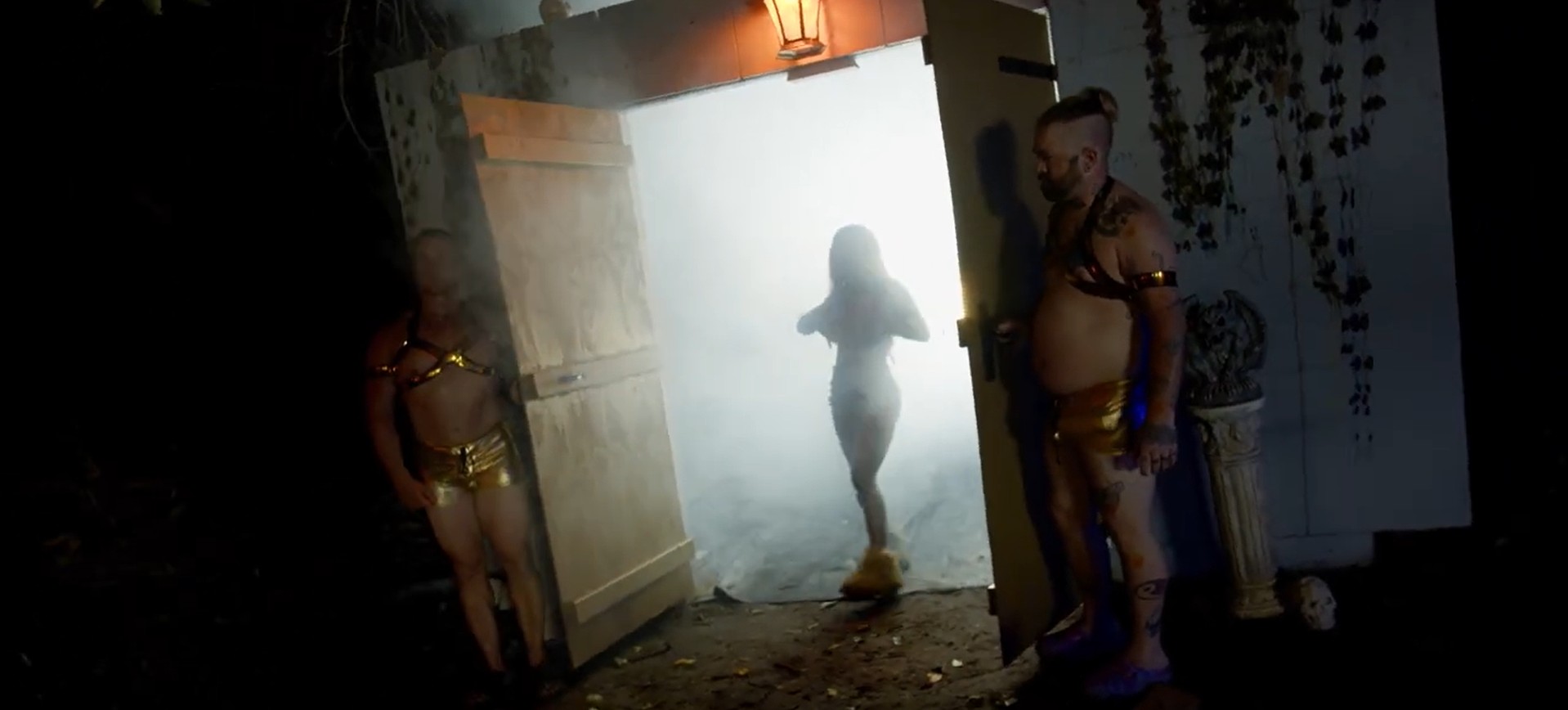
If you’re deeply knowledgeable of cult movies, have a familiarity with Ed Wood Jr. films, and have a genuine affinity for really schlocky horror and eroticism, you may have once in your life experienced the 1965 nudie-cuties erotic horror “Orgy of the Dead” that danced the graveside night away with topless stripteases challenged to entertain the Emperor of the Dead to avoid eternal damnation.  “Plan 9 from Outer Space” and “Jail Bait” filmmaker Edward D. Wood Jr. penned the then controversial and provocative script with Stephen C. Apostolof debuting his directorial effort, who then went on to do a number of exploitation pictures, such as “College Girls,” “The Snow Bunnies,” and “Five Loose Women.” The film’s rights were obtained from the Apostolof family by Andrew J. Chambers, who’s credentials followed a similar subgenre to his 1965 predecessors with “Babezilla vs the Zombie Whorde” and “Lust, Magic, and the Witches’ Sabbath.”  Chambers’s goal was to create a sequel, simply entitled “Orgy of the Dead 2” that brought back the Emperor, Princess of the Night, and a slew of scantily cladded undead women to burlesque the night away.  Chambers writes, directs, and produces the 2026 release alongside co-producer Stephen Apostolof’s son, Chrisotpher, under Chambers independent production company, HojBob Productions, and was partially crowdfunded under Indigogo.com, achieving an approx. $3,700 in pledges.
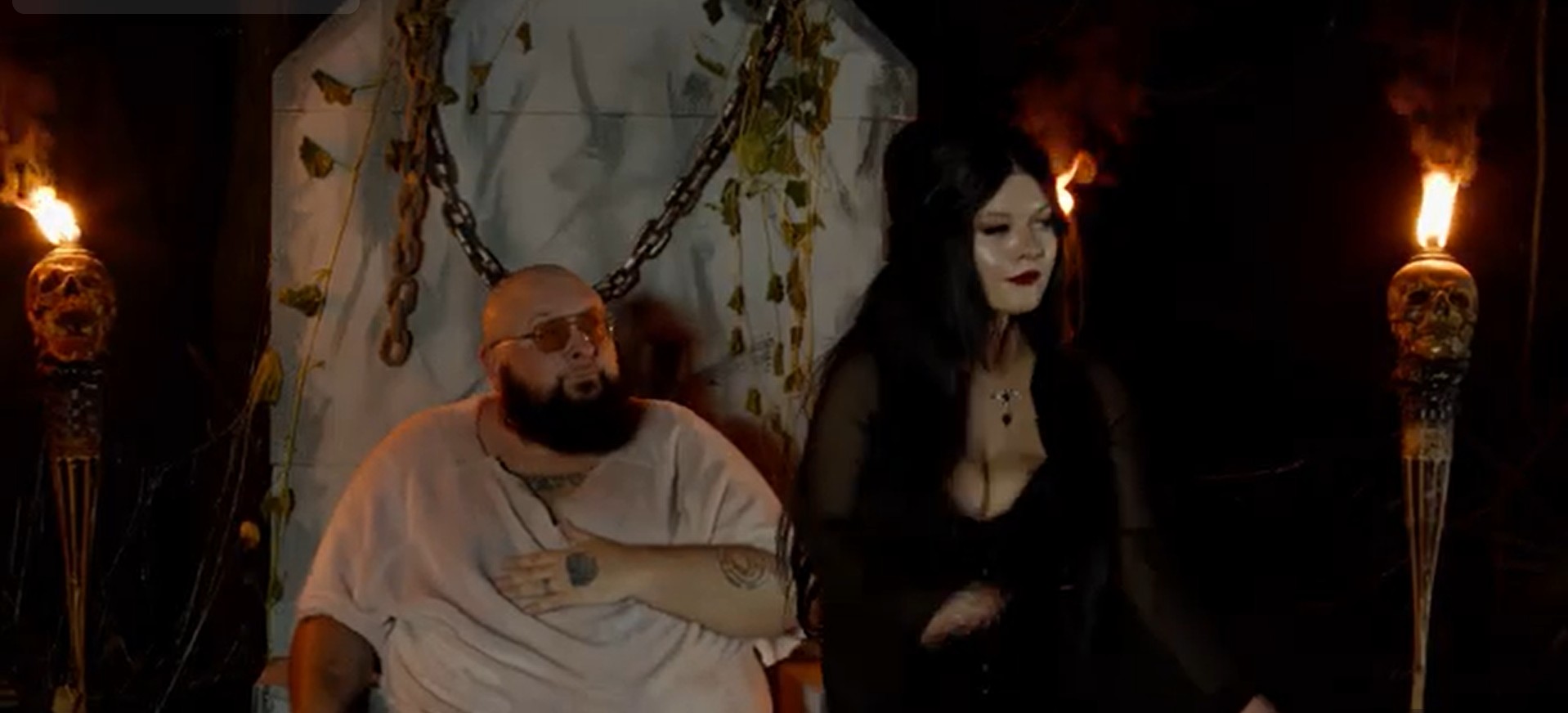
Obviously, the 60-year span between the two films doesn’t see the return of Jeron Criswell back as the Emperor (died 1982), Fawn Silver as the Black Ghoul (long retired and left pictures altogether), or Pat Barrington and William Bates as the stumbling lost couple Shirley and Bob.  Instead, the sequel features new talent in the principal parts as Mike Fantastik dons the undead ruler of darkness as the Emperor who sits on his throne to judge the decaying dancers.  Fantastik is no Criswell but the indie rapper from Nebraska brings his own licentious flair to the character by blatantly reading from cue cards just off screen.  Princess of the Night is played by pinup model Penny Aphrodite (“Pigshit”) that does resemble a bit of Fawn Silver’s Gothicism in looks and mannerisms.  The duo of Bob and Shirley are replaced with a quartette, or a pair of couples, who wreck their car after roadhead sends their car careening into the bushes near a graveyard.  Nick Somers, Adam Peltier, Jaymie Schroeder (“The Devil’s Dancers”), and Jessa Flux (“Debbie Does Demons”) are the new captured and witnesses to the Emperor’s sordid dance space of judgement.  Flux has established herself as a rising scream queen by integrating herself into any and all-types of horror films in a very unselective manner and with “Orgy of the Dead 2,” her character closely recalls other Flux’s roles of a sexed-up hot chick, making her Cindy performance not that stand out, but in contrasts, there’s an omission of emotional guilt and anger compared to the others tied to a staked crosses as they watch the perversion and death unfold.  The dancers a motley of alternate women and unabashed topless stripteasers between Stephanie Love, Bobbi Jo, Mercy Andersen, Tina Mazing, Katie Kadaver, Maia Thomas, Naomi Webb, Kaisa Neal, and Mae Devour with Michael E. Ross, Clint Beaver, Tony Kimball, Zdenek Voprada, and Morgan Molck as the Emperor’s creatures of the night. 
If any of you readers have ever seen the 1965 “Orgy of the Dead,” you’ll find the modern-day sequel to be not really a sequel in the traditional sense but more like a remake.  There’s no firm connection to the original production with Chambers bringing new nudie-cuties to the dance on the graves, a mixed soundtrack, and a totally different perverted vibe that’s cruder than it is implied to accommodate the time period in which the film is made.  Apostolof’s “Orgy of the Dead” had no plot in the traditional sense in what was more of an erotic, burlesque shindig in the middle of ghoulish-driven cemetery and, to be frank, the whole concept didn’t exactly leave an ecstatic and an aesthetic taste in my mouth with its boring static evolution further into the runtime.  I get it.  Times change, movies change, and taste change and Apostolof’s “Orgy of the Dead” might have been the hot ticket punched for some sleazy gawkers but in the early 2000s, when “Orgy of the Dead” made it to VHS, the novel idea just fell hard like a rock sinking to the bottom of a lake.  Chamber’s sequel, following the same design as the original, produces the same effect with its timeless homage to Apostolof’s original and, while that’s honorable, Chambers didn’t reinvent the wheel, he just bedazzled it with different kinks and coarser content.  Product looks even cheaper than the original on its measly $5-$7,000 budget that can only afford cardboard structures and tombstones, a glue on prosthetics, and simple in-laid practical effects.  Plenty of heart with really no soul, “Orgy of the Dead 2” is about as lifeless as the undressing undead. 
From Hojbob Productions and MVD Visual, “Orgy of the Dead 2” is a blast form the past done in contemporary times now on Blu-ray home video.  The unrated, region free release doesn’t have a lot of technical disclosure, but the release is AVC encoded, 1080p resolution, onto a 25GB BD-R with the bruised colored disc underbelly, suggesting a commercial writeable disc and muted colored, textured DVD label on top.  Presented in a 1.78:1 widescreen aspect ratio, the indie production isn’t at the summit of quality and, in fact, is rather low with poor visibility (aka lighting), compression blights such as banding and splotches, and an anemic color saturation.  The former of the three can be accepted to work in the sequel’s advantageous favor that keeps the hazy graveyard cemetery dim as possible and not be evident of key lighting that’ll throw off whatever authenticity “Orgy of the Dead 2” may possess.  The audio is an English Stereo 2.0, uncompressed but not reigned in with it’s noise static when volume levels overload with intense decibels.  Dialogue is clear but varies in strength in part to recording mic placement that can’t capture more than one person standing adjacent to the person next to the mic. The soundtrack by Aaron Gum is perhaps the best with a variety of musical genres from carnivalesque to rhapsody that loosely fits the dance number.  Special features include a making-of featurette with Andrew J. Chambers, a behind-the-scenes featurette with raw footage of takes and setups, actor Adam Peltier’s ramblings, a director and actor feature length commentary track, and the original trailer.  Released in a standard Blu-ray Amray case, “Orgy of the Dead 2” homages its predecessor with a slapped together package design of a blown up still from the actual movie and used as the front cover face.  The sleeve art is also one-sided.  Inside in the insert section, there’s a slick and nicely illustrated retroesque comic book front cover insert of the main characters.  It’s unfortunately uncredited.  The narrowly hour film, coming in at 65 minutes, is the perfect size for the BD-R capabilities.

Last Rites: If a fan of the original “Orgy of the Dead,” the sequel doesn’t stray into new territory with dancing corpses and a killer soundtrack, but don’t expect a novel sequel in this ready-made remake.
Get in on the “Orgy of the Dead 2” on Blu-ray!

A Father Goes Looking for His Missing Daughter but All He Finds is EVIL! “The World of Kanako” reviewed! (Drafthouse Films and MVD Visual / Blu-ray)

Purchase “The World of Kanako” From Drafthouse Films and MVD Visual

A washed-up former lieutenant detective now working as a lowly security guard becomes the first person to stumble into the aftermath of a gruesome, convenient store triple homicide.  After being questioned by police who suspects him of being involved because of his manic-depressive disorder, stemmed by his historical violent behavior and ugly divorce that virtually left him with nothing but his medication, the indecorous alcoholic floating through life receives a frantic call from his ex-wife about their teenage daughter, who he hasn’t seen in years and has suddenly gone missing for nearly a week.  Eager to have his family back in his life, he takes on the responsibility of investigating his daughter’s disappearance but the deeper he digs into her whereabout the more of the ugly truth surfaces between his daughter and the criminal underworld where deception, prostitution, and murder tells a different story than the one in his muddled head. 

In 2004, novelist Akio Fukamachi wrote “Hateshinaki Kawaki,” the rummaging into a lurid and pulpy underbelly of crime network through the eyes of one charismatic high school girl and her former detective father pursuing answers to her disappearance.  Fast-forward a decade later to 2014, director Tetsuya Nakashima (“Kamikaze Girls,” “Confessions”) adapts the novel’s darkness into a visual descent into lunacy under the title “The World of Kanako” from a script by Nakashima cowritten with collaboration writers Miako Tadano and Nobuhiro Monma of “3 Year Pregnant.”  The adaptation retains fidelity to the original Fukamachi story filled to the brim with violence, yakuza, sordid themes, and coldness that translates effortlessly and is well received in the likes of Japanese cinema that has decades of trenchant crime films under its wing.  “The World of Kanako” is no different yet still stands alone as an engaging entry produced by Satomi Odake (“Himizu”) and Yutaka Suzuki (“Confessions”) under the production of Gaga Communications.

The film interweaves the past and present with a bi-story to help unearth cruel intentions from what starts off as a seemingly routine plotted mystery with a degenerate, deadbeat father looking to make recompences using his investigative skills to find his daughter to quickly spiraling recklessly into an abyss of bombshell revelations.  Yet, Akikazu Fujishima continues his crusade out of his own self-pity to a more deserving, rewarding, and if not, diverting objective that reveals just about as much of his cataleptic state of being than the exhuming of his daughter’s disappearance from out of the criminal underground.  Veteran, international actor whose had roles in such films as “Memoirs of a Geisha,” “Pulse,” and “Babel,” Koji Yakusho gives a conscious performance of a flawed man with flawed tactical awareness charging headfirst and sternly stubborn into a complex web where the giant carnivorous spider of seediness hides behind the veil.  At the opposite end of the casting table is then newcomer Nana Komatsu (“Destruction Babies”) making her filmic debut in a past timeline as the titular Kanako, paralleling her father’s story by accompanying fellow high school student and constantly bullied narrator of the historical account in Hiroya Shimizu (“The Outsider”).  Kanako’s story unfolds a yakuza narrative that’s nasty and perverse while shepherding in Kanako’s role that teeters upon the audience’s perception throughout.  What Akikazu fleshes out and discovers is the reason for all the mayhem that has, more-or-less, started with him, retorting whatever sliver of moral intentions he had begun with with the fact we can’t change who we are and the children we raise in a Darwin nature or nurture, or perhaps in this case both, environment.  Akikazu and Kanako meet a variety of unsavory characters along the way that ends shockingly and cynically, completely obliterating the happy family and happy ending conventionalities.  Satoshi Tsumabuki (“Tomie:  Re-Birth”), Asuka Kurosawa, Ai Hashimoto (“Another”), Fumi Nikaidô (“Lesson of the Evil”), Aoi Morikawa (“The Killing Hour”), Miki Nakatani (“Ringu”), Mahiro Takasugi (“12 Suicidal Teens”), Munetaka Aoki (“Godzilla:  Minus One”) and Jun Kunimura (“Ichi the Killer”) portray some of those uncharacteristic archetypes.

Stylish, pulpy, and darkly themed, “The World of Kanako” has a modern grindhouse pastiche of the hardboiled Japanese noir.  The story is a wrecking ball of all good ideals and hopes, a genuine cynical representation of an unpleasant situation.  An 80/20 mixture of live action and animation splice ins, Kanako’s world is certainly represented as a chaotic coup d’état over pedestrian storytelling and dissects the human condition to test family ties, reveal lost bonds, and really scrutinize hereditary genetics.  The film’s opening is a flurry of converging images, past and present, live and animation, and narration, soundtrack, and bits of dialogue that open with the gruesome convenient store murders of three people, seemingly strangers, setting the stage and tone for the rest of the Tetsuya Nakashima’s film that’s bleak to the dying core.  The rapid editing style doesn’t incur fluff or filler moments in a slimmed down for exactly what we’re supposed to experience.   While Akikazu Fujishima may not be the best example of a hero, a loafer with anger issues, physical abuse tendencies, glutton for food, alcohol, and manic-depressive pills, a rapist, and perhaps even engaging in incestual pedophile, the protagonist majority pushes forward with relentless determination and beyond the scope of being a good father to find his daughter, but for what purpose is about as ambiguous as the imbalanced human mind and Akikazu mind sizzles with insanity that affects his legacy to the point where he feels responsible for taking care of his own.  On the flipside of the protagonist narrative, Kanako begins as a savior of bullies, working to remove the threat from those too weak to defend themselves only for them to be exploited by that defenseless and vulnerability when the yakuza and more extremists take from their emotions and bodies.  

Tetsua Nakashima speaks an entirely new language in “The World of Kanako,” derived from a mix of the compellingly twisted story of “Old Boy” and the appalling violence of filmmaker Takashi Miike.  Drafthouse Films and MVD Visual re-release “The World of Kanako” on a high-definition Blu-ray.  The 2024 release comes with AVC codec on a dual-layer BD50 and presented in a widescreen 1.78:1 aspect ratio.  The various animation styles spliced into the live action coupled with some choice primary color grading in the opening gives “The World of Kanako” a very nostalgic touch of passé pink films of the 1980s and slight arthouse surrealism feel to the likes of Nobuhiko Obayashi (“House”).  The mixture doesn’t meld into one another with detrimental effect and leaves a stark impression between the formatted visuals that creates definitive delineation.  Details also don’t bleed in the sharp textures of character faces and clothing with objects being distinct and well defined.  Darker scenes are enshrouded in intentional shadow amongst grittier interiors to better understand the gritty context, losing some details but no issues with compression, such as blocking or banding. Two audio options are available, and both are in Japanese with a lossless DTS-HD Master Audio 5.1 and a DTS-HD Master Audio 2.0. Presented with fidelity, “The World of Kanako” produces no issues with either audio track with a clear and absolute. The ambience denotes a nicely spaced standard fare of common routine movements and actions around the environment setting. Outside of that, punches and kicks knock with an authenticity and same goes with gunshots and the hit-and-runs during more tense and thrilling heights. Yes, there was a lot of hit-and-runs with Akikazu behind the wheel for most of them. English subtitles synch well and appear to be error free. Bonus features a making of featurette in Japanese with English subtitles, an equally as long interview with principal leading actress Nana Kamatsu, an interview with Akio Fukamachi, and the theatrical trailer and teaser for the film. Physical features pale in comparison to Drafthouse’s first release that came with a 11″x17″ folded mini-poster and color booklet with essays and acknowledgements. This re-release favors the slimmer model with no tangible goodies inside. The standard Blu-ray Amaray has a stark front cover image of Kanako starring forward with a blood smear behind her; the disc is also pressed with this image. The Not Rated presentation has a runtime of 110 minutes and has region A playback.

Last Rites: Welcome to “The World of Kanako,” a savage acceptance of responsibility down the rabbit hole of malfeasance. Family ties be damned as one father takes it upon himself to ensure the deed is done right by his own destructive hands.

Enter “The World of Kanako” On Blu-ray Now Available at Amazon!

The Elfmans’ EVIL Doomsday Droll! “Aliens, Clowns, and Geeks” reviewed! (MVD Visual / Blu-ray)


“Aliens, Clowns, and Geeks”, oh my, now on Bluray home video!

A struggling Los Angeles actor finds himself in an intergalactic dilemma when a interdimensional portal opens from his asshole and spits out the obelisk, a large, pointed top icon that holds the key to ruling the universe.  Evil space clowns and extraterrestrial beings rocket toward Earth to be the first to intercept the obelisk and remotely manipulate people to their way to try and snag the long-ago inseminated artefact.  In order to save the world, maybe even the universe, from the catastrophic misuse of the obelisk, the actor calls up on his transgendered brother – excuse me – his sister, a professor with expertise in interdimensional relics, and a pair of beautiful Swedish scientist assistants all the while avoiding biker space clowns, ditzy blonde sex bots, the Chinese mafia, and a secret U.S. government agency from getting their greedy hands on world-dominating or word-destroying ass statue. 

Having sat through and contemplated Richard Elfman’s bizarrely fascinating “Alien, Clowns, and Geeks,” I found myself washed over with deep regret. Regret is not in the one-sit watching of a 90-minute sci-fi comedy about a monolithic sphincter stone being a weapon for universal domination by space clowns and incorporated green men from outer space or the key for green, sustainable energy worth lucrative wealth for possible one out-of-work C-lister. The regret stems from not having watched beforehand Richard Elfman’s first experience with total creative control in his kaleidoscopic chaos a surreal fantasy “Forbidden Zone” from 1980 that has placed the filmmaker on the map as a cult director and the musical film itself retains breath and life through theatrical stage plays across the nation. Nearly 40 years later, the harebrained and mad genius mind of Richard Elfman churns a return to his unadulterated cinematic artform with no producers or studios to infringe upon his certifiable craft. Elfman writes and directs the Unfound Content (Bernie Stern, “What Josiah Saw”) and UnLtd Productions produced Elfmaniac Media production.

Who better to be your leading man of action versus the opposing forces of interplanetary evil than your own flesh and blood?  Richard Elfman casts his son, Bodhi, to take the lead as struggle actor Eddy Pine, crestfallen by his recent television series cancellation that derailed his promised financial success and famed lifestyle.  Bodhi Elfman plays to the tune of comic-action star fairly well, delivering perfectly timed high-pitched screams when prompted while still conveying a suave persona as a smooth-talking ladies’ man that bags one-half of the Swedish scientist twins, Helga Svenson (Rebecca Forsythe, “Replace”), to be the perfect combination of brains, beauty, and junkyard Kung-Fu.  Helga, and her sister Inga (Angeline-Rose Troy) are assistants to the great and all-power, well…not all power, (German?) Professor von Scheisenberg in a likeable, rememberable performance from “3rd Rock form the Sun” sitcom actor French Stewart.  In this favorable group of eclectics, world-saving heros, my personal favorite is Jumbo, the politically incorrect, yet well-represented, LBGTQ sister of Eddy Pine played the large frame build of Steve Agee (“Suicide Squad”) who, like a good chunk of Eflman’s cast for the film, takes on a dual role as a God-fearing goon dressed in a giant chicken suit for his boss Fritz the two-timing German clown (Nic Novicki, “The Sinners.”) The circus-esque troupe continues to careen toward Earth in a prototypical rocket ship full of clowns, literally, in what can be seen as an offshoot homage to “Killer Klowns from Outer Space”. The rocket is captained by “Pirates of the Caribbean” franchise actor Martin Klebba, but the boss in the big shoes, clown shoes that is, is worn by the late Vern Troyer (“Pinocchio’s Revenge”) in his last role, a role royal bestowed upon him as Emperor Beezel-Chugg. Granted, much of the emperor is played through Nick Novicki’s Fritz as Beezel-Chugg sends his conscious down to Earth to beat out the aliens from obtaining the obelisk. “Aliens, Clowns, and Geeks” has a monster supporting cast for an indie film that rounds out the list with Richard Elfman’s wife Anatasia Elfman in various roles, George Wendt (“King of the Ants”), Malcolm Foster Smith (“Parasomnia”), Marco Antonio Parra, Victor Chi, Andre Ing, Erwin Stone, and Raul Colon.

If “Aliens, Clowns, and Geeks” sounds to you like an unfurling Warner Bros. ACME production full of dropping anvils and pseudo-tunnels, you’re not alone. Elfman’s romping comedy is chockful of clowns, cigars, and sex tropes, mostly elements pulled from the director’s hyperactive brain and basking recreations that fit his outlandish selfhood. The film very much fits the man behind the camera as an off-color, atypical, crude humored, red-headed fireball zipping-and-zagging in a multitude of directions. Yet, despite the frantic antics and the crazy characters, “Aliens, Clowns, and Geeks” retains its composure as a three-act tale of redemption where one man can be the hero of his own destiny depending on the path he chooses in his seemingly despondent life where he’s lost his career, his mother’s a slutty crackwhore, and a large stone has expelled itself from his anus, creating a rift between a difficult decisive choice of short term wealth or long term doom. Pulling much of his science fiction inspiration from the 1957 “Plan 9 From Outer Space,” Elfman manages a vast, epic showdown of invading alien threats against an unsuspecting human contingent with very few locations, zipped to to-and-fro with comical orchestration, that usually fashions a feeble story structure of sitcom-syndrome weariness, but not with these colorful characters with their unconventional and unmethodical praxis that defy all logic and sensibility. Off the bat, “Aliens, Clowns, and Geeks” has menial building blocks but, if you stick with it, the film does grow on you, stimulates the endorphins of your inner child, as a live-action recollection of a Saturday morning cartoon but for adults.

Enter the maniacal mind of Richard Elfman with the MVD Visual Blu-ray release of “Aliens, Clowns, and Geeks.”  Presented in a widescreen, 16×9 aspect ratio, the digitally recorded video has no telling compression issues onto the AVC encoded pressing.  Most of the superimposed cartoony special effects are simply just that due to stylistic choices or budgetary constraints and, either way, add they greatly add to Elfman’s carnivalesque approach to clowning around.  The English 5.1 surround sound discerns no apparent issues other than a slight tuning leveling issue when someone screams as pitch level goes muted a bit.  Other than that, dialogue is clean and clear.  The music genius of Danny Elfman (“The Nightmare Before Christmas,” “Beetlejuice”) and newcomer Ego Plum, who brings with him a melody of cartoonish influences and unconventional inspirations, create a unique sound that attests to “Alien, Clowns, and Geek’s” upbeat and caricature antics.  Optional English subtitles are available.  Special features include behind-the-scenes interviews that give the cast and crew their 5 minutes recollecting works with castmates, Richard and Danny Elfman, and their total overall experience, a quick and fast-paced interview from Richard Elfman who quickly disgorges his ideas and desires, along with his heartful opinion, about the film, the music video for Ego Plum’s “Mambo Diabolico,” which you can see at the end credits, and the original theatrical trailer.  “Mambo Diabolico” is definitely a good description for Richard Elfman’s far side sci-fi comedy that’s too Ed Wood for even Ed Wood himself.

“Aliens, Clowns, and Geeks”, oh my, now on Bluray home video!

EVIL Lights Up When Peeling Skin! “Human Lanterns” reviewed! (88 Films / Blu-ray)


Own this beautiful release from 88 Films of the “Human Lanterns”

Two respected and wealthy Kung-Fu masters have a long rivalry, trying to one-up each other at any cost even if that means stooping into their personal life to gain the most public admiration.  With the annual lantern festive approaches, to have the best and brightest lantern would sustain at least a year of gloating over the other master.  When a lantern maker with a retaliation mindset against one of the more boastful masters is hired to make his festival entry, the lantern maker exacts horrifying revenge by fueling their feud behind the scenes. Kidnapping beautiful women who are dear to each master and exploiting their soft delicacies for his crazed creations, the maniac lantern maker turns the village upside down, forcing the local constable into an impossible investigate into the village’s most popular residents when none of the evidence points to the other.

“Ren pi den long,” aka “Human Skin Lanterns,” aka “Human Lanterns” is a grisly Kung-Fu murder-mystery that’ll make your skin crawl right off from your body. The stylishly colored and ethereally varnished 1982 Hong Kong film is written-and-directed by Taiwanese director Chung Sun (“Lady Exterminator) that blended the likes of a giallo mystery into the well-choreographed martial arts mania with the profound Kung-Fu screenwriter, Kuang Ni (“The One-Armed Swordsman,” “The Flying Guillotine”), co-writing the script alongside Sun. While not as ostentatiously gory or as cinematically profane as the 80’s released Category III certified films that rocked Hong Kong audiences, and the censor board, with shocking, gruesome imaginary and content, “Human Lanterns” does sit teetering on the edge with mostly a tame Kung-Fu feature that quickly turns into the blistering carnage of a basket case, or in this a lantern maker, who uses hiding as a double entendre. “Human Lanterns” is a Shaw Brothers Studio production executively produced by the oldest of two brothers, Rumme Shaw, and, then new to the Shaw Brothers’ board of directors, producer Mona Fong.

“Human Lanterns” starred two the renowned names in martial arts films from the 1970s and well into the 1980s with “Fist of Fury” and “The Swordsman and the Enchantress’s” Tony Liu as the impeccably arrogant Lung Shu-Ai with a self-image to protect more than the women in his life and “Bloody Monkey Master” and “Return of the Bastard Swordsman” Kuan Tai Chen sporting a sweet mustache as Lung’s longtime rival, Tan Fu. Shu-Ai and Chen have really spot on, well-versed, fight sequences together braided into their play off each other’s character’s haughty personas. While behind the curtain of overweening and defiance between the two masters, Chao Chun-Fang unceremoniously sneaks into the fold by happenstance as Lung offers him money for the best lantern this side of the lantern festival. Lung and Chao Chun-Fang, played with a demented, idiosyncratic duality from Leih Lo (“The Five Fingers of Death,” “Black Magic”), another master in the art of fighting in his own style, have an inimical past…well, at least thought so by Chun-Fang. In a sword dual over a woman, Lung defeats Chun-Fang and purposefully scars him above the left eye, causing him the inability to look up, and while the lantern maker has stewed for many years, training all the while to be the best fighter, his tormentor Lung Shu-Ai has nearly all forgotten about the incident and found trivial enough to ask Chung-Fang to make him a lantern and offer him out for drinks for being old buddies of yore. However, this yard pulls the wool over the eyes of self-centered, the upper class, and the unruffled nonchalant as Chung-Fang takes advantage of the Kung-Fu masters naivety and uses the rival as a screen to cover up his kidnapping deeds of the women in their lives, played by Ni Tien (“Corpse Mania”), Linda Chu (“Return of the Dead”), and Hsis-Chun Lin. “Human Lanterns” rounds out the character list with a hired assassin in Meng Lo (“Ebola Syndrome”) and a competent but out of his league village constable in Chien Sun (“The Vampire Raiders”).

The look of “Human Lanterns” is often dreamy. No, I don’t mean dreamy as in gazing into the strong blue eyes of your tall and dark fantasy man. The dreamy I’m speaking of is produced by cinematographer An-Sung Tsao’s luminescence that radiates of background and the characters through the wide range of primary hues. Tsao’s colorful and vibrant eye doesn’t clash with the vintage era piece consisting of impressively detailed sets, a costume design plucked straight from the 19th, and hair, makeup, and props (which I’ve read some of the blades were authentic) to bring up the caboose of selling the completed package of delivering a spot-on period film. When Leih Loh dons the skull mask, an undecorated and unembellished human skull, with wild, untamed hair sprouted from every side of the eyeless mask, Loh transforms into a part-man, part-beast jumping, summersaulting, leaping, and seemingly flying through the air like a manically laughing ghost. The visual cuts petrifyingly more than described and if you add an extensive amount of Kung-Fu to the trait list, “Human Lanterns” has a unique and unforgettable villain brilliantly crafted from the deepest, darkest recesses of our twisted nightmares. “Human Lanterns” has a wicked and dark side that balances the more arrogantly campiness of Lung and Tan’s hectoring rivalry. When Lieh Loh is not skinning in his workshop or Lung and Tan are not bullying each other into submission, there’s plenty of action with the heart stopping, physics-defying martial arts that just works into the story as naturally as the horror and the comedy. With shades of giallo and fists of fury, “Human Lanterns” is Hong Kong’s very own distinctive and downright deranged brand of good storytelling.

88 Films lights the way with a new high-definition Blu-ray of the Shaw Brothers’ “Human Lanterns” from the original 35mm negative presented in Shawscope, an anamorphic lensed 2.35:1 aspect ratio that more than often displays the squeeze of the picture into the frame. One could hardly tell the upscale to 1080p because of the very reason I explained in the previous paragraph of the airy An-Sung Tsao façade that softly glows like bright light behind a fog. Nonetheless, the image quality is still stunning and vivid, a real gem of conservation and handling on this Blu-ray release. The Mandarin dubbed DTS-HD 1.0 master audio is synched well enough to the action for a passing grade. The foley effects, such as the swipes and hits, are often too repeated for comfort, but adds to “Human Lantern’s” campy charm. The newly translated English subtitles are synchronous with the picture and are accurate but, in rare instances, come and go too quickly to keep up with the original language. The release comes not rated with a run time of 99 minutes and is region locked at A and B. Why not go full region free is beyond me? Licensing? Anyway, special features include an audio commentary by Kenneth Brorsson and Phil Gillon of the Podcast On Fire Network, “A Shaw Story” interview with then rising Hong Kong star Susan Shaw who talks about the competitive and easy blacklisting Hong Kong and Tawain cinema market, “The Beauty and the Beasts” interview with in story brothel mistress played by Linda Chu often harping upon not wanting to do nudity despite directors begging her, “Lau Wing – The Ambiguous Hero” interview with Tony Liu that comes with its own precaution title card warning of bad audio (and it is really bad and kind of ear piercing) as the lead man really regales his time on set and in the industry between Golden Harvest Productions and Shaw Brothers Studios, and rounding out the main special features is the original trailer. The package special features is a lantern of a different color with a limited edition cardboard slipcase with new artwork from R.P. “Kung-Fu Bob” O’Brien, a 24-page booklet essay entitled “Splicing Genres with Human Lanterns” by Barry Forshaw accompanied by full colored stills, posters, and artwork by O’Brien, a double-sided fold out poster, and reversible Blu-ray cover art that can be flipped from the same, yet still awesome, O’Brien slipcover art to the original release art. The new 88 Films’ Blu-ray set conjures a renaissance satisfaction like none other for a highly recommended, genre-ambiguous, vindictive affray.

Own this beautiful release from 88 Films of the “Human Lanterns”

Surrounded by Aquatic EVIL, No One Can Escape “The Island of the Fishmen!” reviewed! (Full Moon / Blu-ray)

Check out the scantily-cladded woman encroached upon on “The Island of the Fishmen” Blu-ray!

A French prisoner ship sinks to the bottom of the Caribbean leaving only a handful of prisoners and the Left Lieutenant Claude de Ross, the ship’s doctor, stranded on a lifeboat for weeks until they a mysterious force drives them through the fog and crash them on the rocks of a seemingly deserted volcanic island. Only a few prisoners and the doctor manage to survive the wreckage, stumbling upon a ritualistic area of empty graves and abandoned artifacts of an island society. This is where the haggard and hungry men meet the beautiful Amanda Marvin on horseback and follow her through the island jungle to a clearing where the edifice of Edmond Rackham sits imposing on them. Having left his home country, Rackham settled upon this uncharted island, garnering local Caribbean inhabitants as servants, and being a greedy treasure hunter who might have just discovered the lost city of Atlantis. There’s only one problem, the city is surrounded by aggressive fishmen kept at bay by Amanda’s famed disgraced biologist father who has fallen severely ill, charting a course for the good doctor, Lt. Claude de Ross, to be unharmed in order to care for perhaps the only person who knows how to manage the wrath of the fishmen.

A swimmingly aquatic creature feature with an all-around gratifying men in costume pastiche, familiar to the style of “The Creature from the Black Lagoon,” in Sergio Martino action-adventure horror “The Island of the Fishman.” Also know under the revamped shots of “Screamers” aka “Something Waits in the Dark,” here we have the original film in all it’s natural glory from the director of “Your Vice Is a Locked Room and Only I Have the Key” and “Torso” director Martino from a script by Martino, Sergio Donati (“Orca”), “Slave of the Cannibal God’s” Cesare Frugoni who workshopped with Sergio Martino’s older brother, Luciano Martino, (“So Sweet… So Perverse”) on the original story. Some would also say that “The Island of the Fishmen” is also a crossbreed between H.G. Wells’ “The Island of Dr. Moreau,” H.P. Lovecraft’s “The Shadow Over Innsmouth,” and, aforementioned, “The Creature from the Black Lagoon.” The 1979 Italian production stars an international cast shooting along various locations in Italy and is produced by Luciano Martino under Dania Films and Medusa Distribution.

American, United Kingdom, and, of course, Italian come together to form “The Island of the Fishmen” cast that doesn’t stray too far away from their individual innate dialects. The most pompous is he Essex-born Richard Johnson’s sadistic and fortune hungry Edmond Rackham with a caricature of a voice that isn’t like anything in his performance in Lucio Fulci’s “Zombie.” As Rackham, the inflections reminisce of a British Humphrey Bogart mixed with a one Dick Dasterdly and so Johnson comes off a bit cartoony and overly dramatic compared to the film’s panache malnourished yet earnest hero in Italian actor Claudio Cassinelli (“Murder Rock,” “The Scorpion With Two Tails”) as Left Lieutenant Claude de Ross, a ship’s doctor who suddenly becomes the medical caretaker and leading guard over a lifeboat full of hardened prisoners, some who have blood on their hands. Franco Javarone and Roberto Posse play a pair of surviving convicts, especially two at odds on how they should treat their next in rank penal officer. Though being thrust into the oversight position, the Lieutenant doesn’t have to worry about his prisoners for too long as the island’s baleful environment with jungle death traps, poisonous water, voodoo priestess, a sadistic lord of estate, and mutant fish people swimming in circles around the island’s parameter and through the cut through waterways sees to their wellbeing. “Island of the Fishmen” does have a few predominant male figures of different caliber but there are also a pair of women inhabiting the island who, too, have counteracting roles. Bond girl Barabara Bach (“The Spy Who Loved Me”) became plagued by the ocean’s frightening fishmen only two years later as the captive dame of Edmond Rackham who holds her hostage as he pushes her father (Joseph Cotton, “The Survivor”) to continue with his mind control potion over the fishmen. Then, there’s Shakira. No, not the Brazilian singer-song writer with the hypnotizing booty shaker. This Shakira is a voodoo priestess, played by Jamaican actress Beryl Cunningham (“Dorian Gray”), who works for Rackham but ultimately envisions foreboding doom on the volcanic island. Giuseppe Castellano and Franco Mazzieri round out the cast.

A whole lot is going on in this film that from the surface seems, surfacing meaning the home video covers and posters, to focus chiefly on the hostile half-fish half-man creatures that bubble to surface, check out top side for any unwanted visitors, and quickly dispatch them before disappearing under the glassy waters of the Caribbean. I adore the design of the rather stiff but crudely convincing creature suits with buggy fisheyes, razor piranha like teeth, and cladded entirely green and scaley in a design by Massimo Antonello Geleng who by vocation was more a production designer with credits including this film along with “Cannibal Holocaust,” “City of the Living Dead,” “The Church,” and “Dellamorte Dellamore” to name a few. Yet, the fishmen were not a sole source of danger on an island that had a deadly schemer in Edmond Rackham, the motif of voodoo and jungle trap throughout, a volcano ready to erupt and engulf the island with lava, and the lost city of Atlantis as the grand epic finale that pivots this story on an acute elbow left that shows a mighty ambitious story on an Italian slim budget. To put it frank, Sergio Martino was able to put all the elements together into a cohesive, coherent plot with action, horror, exploitation, and mad science fiction albeit the story’s wild and diverging concepts.

Though many U.S. audiences know this film as Roger Corman’s highly altered, New World Pictures presented cut retitled as “Screamers,” Full Moon features releases the original oeuvre of Sergio Martino with a remastered Blu-ray release from the original 35mm negative. The 99-minute film is presented in a widescreen 2.35:1 aspect ratio that captures in perfect matte composition and frame the locational miniatures, such as the manor house or the underwater Atlantis temples, in a compression that doesn’t make the structures obvious fakes. Slightly tinged yellow, the overall color palette is renders out well enough to suit the release with a pristine transfer seeing no signs of real significant damage. The English language tracks come in two formats – a PCM 2.0 and a Dolby Digital 5.1 surround sound. The English-speaking actors have their original tracks intact while the Italian cast have their original dialogue re-dubbed in English for posterity on new releases such as this one. Dialogue, nor any of the corresponding audio tracks, show any signs of fidelity issues or damage, but do feel muffled, even on the 5.1 as if the sound was boost stifled and left with some of the channels lacking vigor. Aside from Full Moon trailers, the R-rated film rides solo on this hi-def release. “Island of the Fishmen” is a small film fighting hard to swim upstream and really does a number on many different levels regarding where the audiences should focus their attention on, but I can see why Roger Corman wanted to give Martino’s film a second run after a commercial flop with a new, gory scenes edited right into the heart of “Island of the Fishmen’s” flexible, cartilaginous bones. Despite Corman’s efforts, Sergio Martino’s unmolested, original reeling reel is the one and only catch of the day for this purist.

Check out the scantily-cladded woman encroached upon on “The Island of the Fishmen” Blu-ray!