
20-Years or More Incarcerated is No Match for Tenacious EVIL! “The Rapacious Jailbreaker” reviewed! (Radiance / Limited Edition Blu-ray)

Break From Your Cage With This New LE Blu-ray of “The Rapacious Jailbreaker”

Masayuki Ueda is nabbed after murdering a drug dealer’s girlfriend during a botched meeting.  Ueda faces a 20-year prison sentence for his crime but after being processed, nothing can change his mind nor his determination to escape.  Willing to sacrifice blood for freedom, Ueda escapes and visits his lover in Kobe for a quick conjugal stop and money only to be caught again when he returns, tacking on additional years to his sentence.  His next escape plan joins forces with two other inmates and, again, his route to freedom is cut short when a brothel visit, while laying low in his sister’s village, turns into a violent brawl with another patron and the authorities round him up in the aftermath, adding more years to his sentence.  While incarcerated, Ueda must kill rival gang bosses who threaten him.  By now, Ueda’s sentence is up to 40-years, and not to be defeated by the prospect of a long term sentence, Ueda has one more desperate attempt for freedom, putting his life on the line.

“The Rapacious Jailbreaker,” aka “Escaped Murderer from Hiroshima Prison” or “脱獄広島殺人囚,”is the crime black comedy from one of the Toei Company’s aggressively eclectic and paced directors Sadao Nakajima (“The Kyoto Connection,” “Female Ninja Magic”).  The prolific yakuza and exploitation filmmaker takes the Tatsuo Nogami (“Father of the Kamikaze”) script, centered on an incessant career criminal hellbent on not spending his days in prison, and runs with it, fashioning the smidgen stitchwork of a nonfictional individual into the post-War World II, American occupation of Japan and adds inner teetering and play-by-play thought narration and the always welcoming gallows humor amongst the exploits of a stubborn felon.  Gorô Kusakabe (“Hell,” “The Red Silk Gambler”) produces the production, which is part of an unofficial Sadao Nakajima trilogy along with “Shimane Prison Riot” and “The Man Who Shot the Don.

Hiroki Matsukata, a prolific yakuza actor from the 1960s to the 1980s with such credits as “Survivor of the Massacre,” “Dangerous Trade in Kobe,” and “Battles Without Honor and Chivalry,” breaks intermittently through the gang wars and boss-laden wall of tattooed violence and varying levels of respect that’s inked the individualized stories’ skin with “The Rapacious Jailbreaker” as the titular lead character under the character’s God-given name of Masayuki Ueda, a tenacious criminal personality type with yakuza-like transgressions of drug peddling and black market trade.  However, Ueda is not a criminal without honor, even if he’s a little rough around the edges, as his loyalties lie with those who are loyal to him: a fellow partner in crime he didn’t rat out, his suffering wife (Yōko Koizumi ), his sister Kazuko (Naoko Ohtani, “Apartment 1303”), and also those who help him escape, such as  Tatsuo Umemiya’s (“Spoils of the Night”) brazen law challenger Yuji.  Yuji and Ueda match well in traits, both eager to test and take risks going against a rather lax authority grain.  Aside from the opening montage of prison routines depicting minor torture from the guards, you don’t get the sense the prison guards have much domination or enough aggressiveness to match the kind of zeal the inmates have to either run a sneaky scheme or take them on toe-to-toe to get what they want, as we see with Yuji’s disgracing efforts against the warden in order to obtain rights that are quickly dismantled by the warden’s reneging, but at the cost of his humiliation.  Matsukata never wavers or deviates from Ueda’s singular drive, layering intensity overtop his thin film of civility with every additional time added to his sentence that eventually goes beyond four decades, but you can see it not only in Ueda’s resolute eyes but in Matsukata’s as well that nothing will stop him from escaping.  The film fills out with Hiroshi Nawa, Gorô Ibuki, Tatsuo Endô, Shigeru Kôyama, Hideo Murota, Harumi Sone, and Akira Shioji in various rolls of yakuza, fellow inmates, and those crossing Ueda’s path in the outside world.
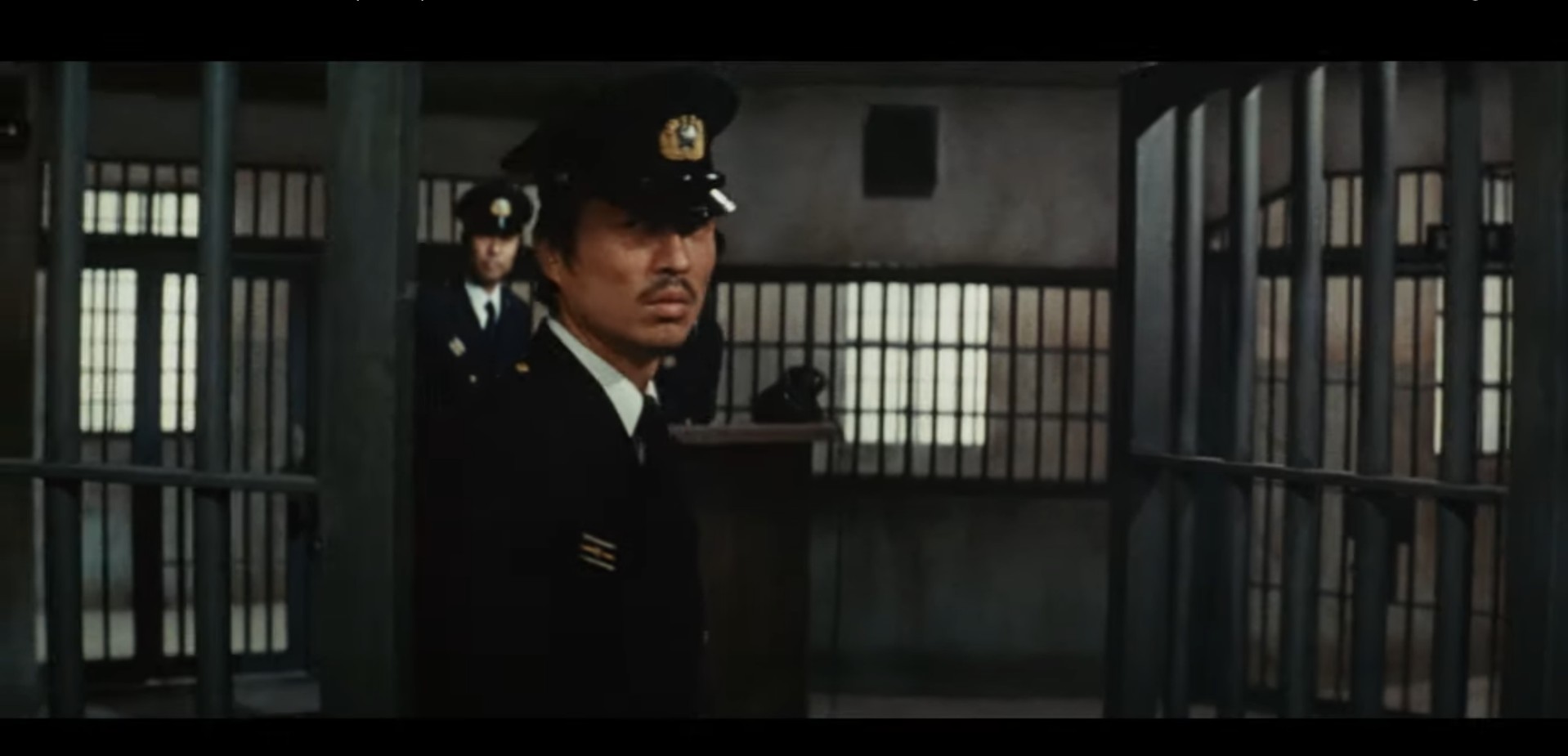
Staying on the theme of Ueda’s loyalty, which is incredibly beyond reproach given his heinous crimes, there’s something to be said for his commitment to be free as a bird but also to the people who do right by him, no matter the circumstances. His wife pledges endless loyalty despite his flaws and felonies, his estranged sister welcomes him with food and shelter, and his opening criminal accomplice provides him a weapon before thanking him for not ratting when Ueda was apprehended by police. There’s an underlining code of respect and duty intertwining the utter most wicked and those blood relations in the field of collateral damage. Ueda’s responsibility for his actions never wanes, never deflects, and never becomes a weight of guilt as the only object, or maybe even obsession perhaps, on his mind is to escape prison and make quick, easy money. His loyalty does come at a fault when his trust reaches into the weeds, especially amongst those he’s already collided head-vs-head against, such as the former head of the black market beef butchers who turns on Ueda for false promises, but it’s in that one and only instance that everything becomes clear, much more to the audience than perhaps Ueda himself, is that in order to remain just out of arms’ length of the law, he must walk his path alone as depicted at the finale moments. The post-World War II American occupation time period has an interest facade to “The Rapacious Jailbreaker’s” context. In fact, the American presence is rarely present at all with Ueda feeling the squeeze mostly in-house within the Japanese penal system with the Americans only rearing their heads in obstacle of his escape attempts in a negative light: Ueda’s standoff against Japanese officers, who won’t shoot him surrounded by a crowd in fear and respect of bystanders, comes to a quick surrender when the Americans, who are perceived to shoot on sight no matter the circumstances arrive on the scene or when his fellow escapee tries attempts to befriend American forces in a military truck only to be runover and killed without remorse or even a slow down. These seemingly insignificant instances spoke volumes against the American occupation as a non-character in Ueda’s tale of total resistance that, one that either represents the American cold passive care of the Japanese under their rule or switch the ironfisted from Japan to America to favor a more lenient system of control.

Radiance Films’ transatlantic “The Rapacious Jailbreaker” lands in the U.S. for the first time on any format, and first on this particular format globally, with a new limited-edition, AVC encoded, 1080p high definition, 50-gigabyte Blu-ray. The dual layer allows for steady color timing and pristine picture quality image that’s leans into its attractively grained 35mm stock and presented in its original widescreen aspect ratio 2.35:1. The original print, transferred into HD from the Toei Company, is nearly faultless with only minor instances of vertical scratching around the theater scene in an otherwise near clean and clear element print. Nakajima’s lower contrast allows for softer coloring and the touch points on Radiance’s treatment showcase a more relaxed but harsh grayish blue with surrounding aspects from the prison’s hoary cement floors and walls to the prison’s steely cell bars and the prisoner’s blue attire. The uncompressed Japanese language PCM mono track offers clearcut dialogue and ambient markers with a clarity on both fronts that render an intelligible layered track without any compromising issue. Kenjirô Hirose (“The Last Dinosaur”) brings a 70’s cop-and-crime swanky score with undertones of traditional Japanese Hyōshigi, the striking of sticks to create that brief and stark crack sound. New translated English subtitles are available, pacing well and are error-free. Encoded special features include a visual essay by film critic Tom Mes and an audio commentary by yakuza film expert and Sadao Nakajima historian, Nathan Stuart. Radiance’s limited-edition set comes in a clear Amaray case with a reversible cover with original and new artwork, the latter commissioned by layout designer Filippo Di Battista (primary). Also included is an obi stirp with the release’s contents, technical specs, and film plot. Limited to 3000 copies, the release comes with a 23-page black and white booklet with stills, an essay Escape as Vocation by Earl Jackson, and a 1974 review by Masaharu. The 97 minute feature comes region A-B locked and unrated from the UK label.

Last Rites: “The Rapacious Jailbreaker” is hardboiled tough as nails while being a series of comedic follies that make this tenaciously titled story of one man’s pursuit of freedom a breakout hit.
Break From Your Cage With This New LE Blu-ray of “The Rapacious Jailbreaker”

The Empire of EVIL Reduced to Prostitution, Corruption, and a Wasteland. “Gate of Flesh” reviewed! (88 Films / Blu-ray)

88 Films’ “Gate of Flesh” Now Available in the U.S.!

The American occupation of Japan post-World War II was the result of not only the Iwo Jima atomic bomb but also the relentless destruction of carpet-bombing Tokyo.  Left in near ruins and swarming with the presence of American soldiers, the Japanese people have disseminated into gangs and territories for financial gains and power.  For Kanto Komasa, she and her gang of highly motivated women prostitute themselves for sex-starved American soldiers to accure money for Paradise, the future name of their bomb-ruined, leftover-skeletal building structure revamped into an elegant dance hall where they run the show.  When a rival male gang threatens their business, another all-woman gang challenges them, an inducted outsider betrays them, and a bloodied stranger is found inside their bombed out homebase, all with the Americans military police continuously rounding up prostitutes nightly, Komasa and her gang must walk the paved road through Hell to scratch and claw toward Paradise, even if that means going against their set principles.

Since the end of the World War II Pacific campaign, Japanese novelist Taijirô Tamura’s “Gate of Flesh” has been filmically adapted a handful of times just after the war in 1947.  In 1948, directors Masahir Makino and Ozaki Masafusa first adapted the novel, followed by the Seijun Suzuki version in 1964 and Shōgorō Nishimura’s adaptation in 1977.  In this review, Hideo Gosha’s “Gate of Flesh,” also known as “Carmen 1945,” moves from samurai period actioners, such as “Sword of the Beast,” “Three Outlaw Samurai,” and “Samurai Wolf,” and into a yakuza era of storytelling that came on strong in the 1980s.  “Gate of Flesh” is no different with plenty of yakuza tropes without actually affirming the term in the dialogue.  Gosha’s tale provides more glamour, style, and substance, especially around themes of inner turmoil under outsider control and the divine praise for an enemy-built weapon of destruction, from a screenplay by prolific writer Kazuo Kasahara of “Hiroshima Death Machine” and “Yakuza Graveyard.”  The Toei Company production is produced by Shigeru Okada (“Inferno of Torture”).

“Gate of Flesh” has the interweaving stories of an ensemble with the various faceted chess piece pawns aimed to promote themselves, by cutthroat and sordid means, to a higher degree of social status and wealth improvement like queens and kings within a crummy economical and degraded societal Tokyo commune of prostitution, gambling, and survival.  There are also a few other pieces stealthier knighted behind enemy lines with more noble goals in mind.  While different storylines unfold and merge, Kanto Komasa becomes the generally sensed centerpiece, played by Rino Katase of previously directed Gosha films, “Yakuza Ladies” and “Tokyo Bordello.”  Her preparedness to take on the “Gate of Flesh” role as the female-led gang leader promising Paradise has been success before of her previous performances in Gosha’s films that contain similar traits but Katase delivers a powerhouse, immensely conflicted, act as Komasa’s hopes and dreams to dig herself out of poverty and into high-class are thwarted by deceptive ranks, a haunting past, and, of course, the more present occupation troubles of inner city gang-on-gang wardom, battling advances, negotiates, and the potential for mediation between fellow gang leaders Yoshio Hakamada (Jinpachi Nezu, “Ran”), who wants her building that’ll be lucrative in the future, and Rakucho no Osumi (Yūko Natori, “Stranger”).  Of course, there’s more to bereft Komasa’s mind with the sudden wounded appearance and peculiarity familiarity of stranger Shintaro Ibuki (Tsunehiko Watase, “The Rapacious Jailbreaker”) who has protective parallelism with the 2-ton bomb that also acts as a rival gang repellant and an explosive safety net for Komasa.  Secondary characters provide a layered depth to Hideo Gosha’s charismatic and gender-battling narrative with Miyuki Kanō, Yūko Natori, Senri Yamazaki, Shinsuke Ashida, Naomi Hase, Chie Matsuoka, and Yoshimi Ashikawa.

Surreal like a dystopian science-fiction and wasteland thriller, “Gate of Flesh” has that otherworldly, alternate reality appeal accentuated by Hideo Gosha’s colorfully grim realism that doesn’t convey truth or fact.  In fact, “Gate of Flesh” is very much rooted in reality, truth, and fact in regard to U.S. occupation of Japan after the country’s surrender between 1945 and 1952.  This drops a non-fictionalized period as “Gate of Flesh’s” backlot, corroded by the illicit prostitution that spread to satisfy and bank off allied forces.  Gosha’s film is a game of wits amongst crooks and connivers while the developing sympathy envelopes around the seemingly tough of nails Kanto Kamase with a violin-pining and sympathetic backstory colliding with the injured Colt Shin aka Shintaro Ibuki.  Ibuki himself has history, or perhaps even beef history, with the iron rule of Hakamada, but through thick and thin, Ibuki’s clearly maneuvering the chess board around protecting Kamase for clued in reasons only to be precisely unveiled near the end.  The American presence doesn’t even feel weighty, reduced to hooker johns, voiceless military police, and a one uncouthly boisterous and unpleasant Sergeant to become the poster boy from Japan’s perspective of the occupational paradigm. Other than that, the U.S. forces are background noise, a sidestepped component of a much bigger, domestic ordeal amongst the Japanese people but are still the cause of so much heartache, gangsterism, and civil war.  Sex is also a huge theme as strictly a monetary activity rather than a joyful expression of romance and liberating relief from oppression, which there is none from U.S. forces.  Kazuo Kasahara’s script skirts around the inkling of affection between two people as much of everything else is for ostentatious and desperation means in a time when there was not much else to hold onto in Tokyo after suffering defeat, aside from ruined property, cash for hope, and tattoos to honor the past. 

88 Films proudly presents “Gate of Flesh” from their UK catalogue to their quickly growing US list of titles.  The AVC encoded, 1080p high-definition, BD50 is the first home video release for the rest of the world outside of Japan with a limited-edition release, presented in the original aspect ratio of 1.85:1 widescreen.  Hideo Gosha’s style brilliance flourishes with this impeccably detailed and graded release that pedestals a rich and sustaining color palette.  The stabilization of color extends to the details as textures pop from the screen, especially in Kamase’s gang where each one has a distinct color flair and different pattern design to have them stand out amongst each other in a story that’s greatly character-individualized aware and often tangents into side characters to be worked into the parent plot.  No compression issues to note, day and night transitions have equal clarity and depth, and the Gosha and Yuko Morita’s aesthetic brings the stylistic aspects to the forefront without taking away from the schemes of skin tones and milieu details in the set design of a tumbledown Tokyo.  The Japanese LPCM 2.0 Mono mix diffuses perfectly into the single channel fold and aligns well with the picture, casting synchronous UK English optional subtitles that only had a single misspelling that I had caught.  “Gate of Flesh” has plenty of range and depth captured precisely on this 88 Films release that doesn’t show signs of audio layer wear or any compression issues.  The summiting explosion capitalizes the full potential of the mix with a story grand exit designed to be immersive as possible in its limited capacity through an assistant of visual means.  The special features include an audio commentary by film critics and analysts Amber T and Jasper Sharp, critic Earl Jackson provides an introduction on the many adaptations of Taijiro Tamura’s “Gate of Flesh” with timelines, history, and his own preference accompanied by stills, posters, and video clips, an exclusive interview with tattoo artist Seiji Mouri Flesh & Blood Tattoos who doesn’t view the Gosha’s work as a yakuza-spiced, and rounds out the content with a still gallery and a pair of trailers.  The limited-edition and numbered set, that includes an Obi strip over top a commissioned illustrative composition covert art by Ilan Sheady and housed in a clear Scanova case, contains a 23-page booklet with color photos and posters and essay notes by Robin Gatto and Irene González-López.  The cover art has a reversible side with the original Japanese poster.  Only playable in region A and B, the not rated 88 Films disc comes not rated and with a 119 runtime.

Last Rites: “Gate of Flesh” bears the weight of Taijiro Tamura’s prostitution-laden tale of survival, revenge, and hope with Hideo Gosha’s cinematic eye that captures the beauty and indomitability in the badlands of the occupied proud.

88 Films’ “Gate of Flesh” Now Available in the U.S.!