Is Deceptional Fraud More EVIL Than Psychopathy? “Paranoiac” reviewed! (Scream Factory / Blu-ray)

Get “Paranoiac” on the Collector’s Edition Scream Factory Blu-ray!

The parents of siblings Tony, Simon, and Eleanor Ashby die in a tragic plane crash. Two years later, Tony commits suicide by plunging himself off a cliff into a watery grave with his body never having been recovered from the ebb and flow of crashing waves upon the oceanic rocks. Eleven years later, the long thought dead Tony suddenly and unexpectedly returns to what’s left of his family: an overprotectively cold and matriarchal substitute in Aunt Harriet, a narcissistic and alcoholic brother Simon, and a sister, Eleanor, on the precipice of losing her mind from grief over Tony’s death. Shocked by this return, the surviving Ashby siblings split their concerns regarding Tony’s authenticity. Eleanor believes her brother is alive and has come back to rebuild the happy relationship between them whereas Simon denounces Tony’s validity and works underhandedly to either expose Tony as a fraud or to get rid of the imposter by any means necessary, especially when the conditions of receiving the Ashby family fortune have nearly come to an end and a hefty inheritance awaits his opulent tastes. Tony’s arrival causes complications with the inheritance, opens up old wounds, evokes new romantic sensations, and regresses transgressional guilt toward a fiery conclusion to the Ashby family mystery.

A ravishingly dark, mystery thriller inspired by Scottish author Josephine Tey’s crime novel “Brat Farrar” from 1949, the 1963 “Paranoiac” works from off of Tey’s dysfunctional and deceptional family building blocks and extending it into a gothic framework of demented greed in a brand-new of-shooting avenue of psychological thrillers from Hammer Films, hoping to branch off the traditional horror trunk and piggyback success off of the American released, 1960 Alfred Hitchcock film, “Psycho.” “Paranoiac” is the junior film of Freddie Francis (“The Skull,” “Torture Garden”) and penned by the longtime Hammer writer, who basically wrote all of Hammer’s classics, Jimmy Sangster (“Horror of Dracula,” “The Revenge of Frankenstein”). Anthony Hinds and Basil Keys served as producers.
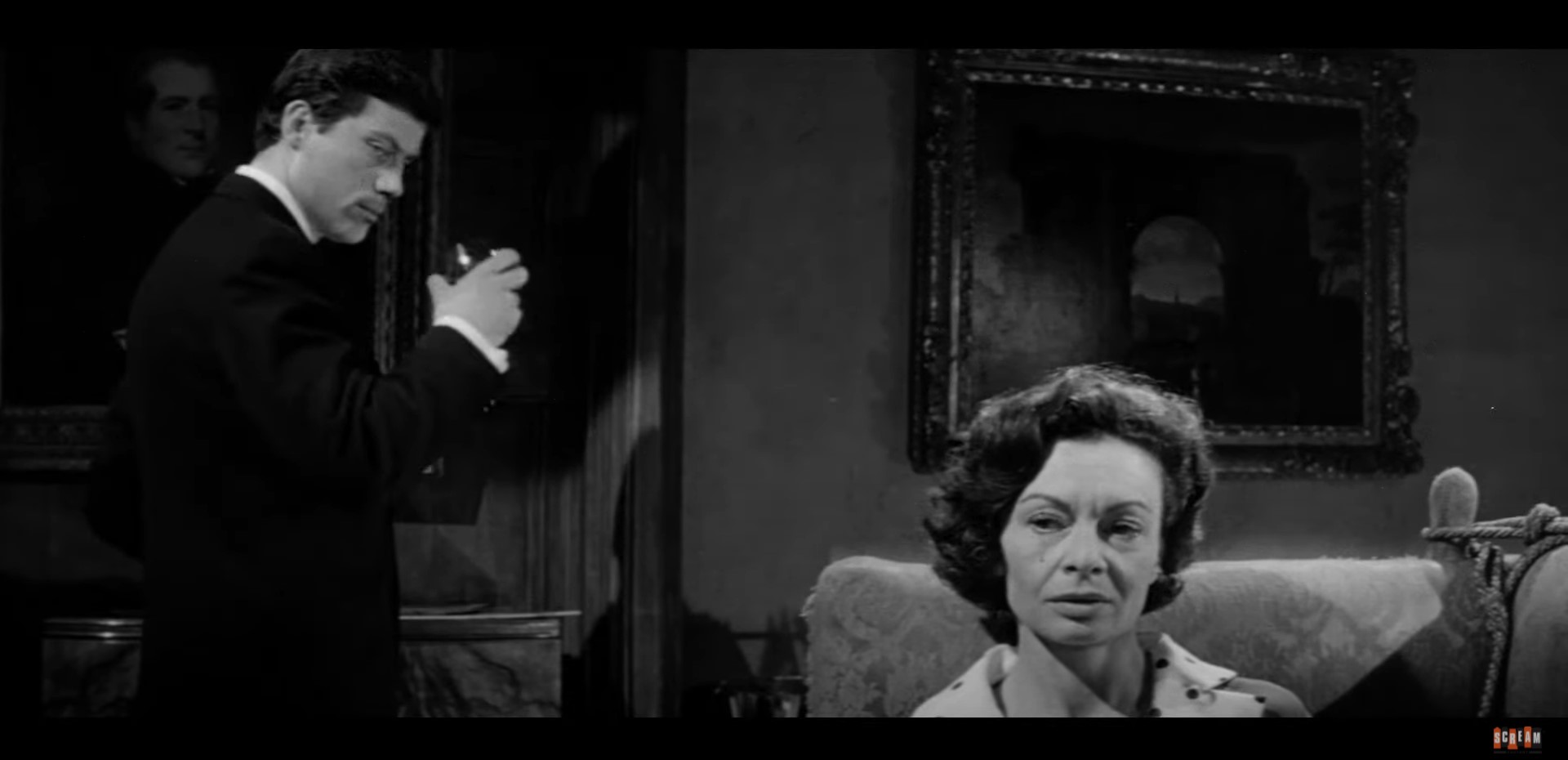
“Paranoiac’s” ensemble cast is quite brilliant in their respective roles.  Oliver Reed (“Curse of the Werewolf,” “Gladiator”) stands out immensely with a flamboyantly cruel and warped performance as the erratic Simon Ashby constantly under the influence of Brandy, Champagne, or whatever alcoholic beverage he can get his organ-playing hands on.  Reed puts out this hateful energy that can’t be ignored and outlines Simon with defined truth about where the character stands with his own flesh and blood – a callously cold and calculating black sheep.  Simon becomes fascinating in every scene, every scenario, and continues to unravel as a wild card that always leave us wondering what he’s going to do next.  Then there’s sweet and innocent but overly distraught Eleanor from Janette Scott in complete sibling behavioral polarity that sinks Eleanor further and further into madness designed by those close to her.  Scott, who also had a starring role in “The Old Dark House” that was released the same year, came aboard relatively new to Hammer but equates her status against Reed, who Hammer was grooming to be a prominent leading man for more of their productions, by selling Eleanor’s despair and the deep-seeded craving for her other, more sweeter, brother, Tony.  Encompassing the thought dead younger brother is Alexander Davion, another newbie to Hammers’ brand with, in my opinion, a neutral and bland face that doesn’t fit the Bray Studio’s swarthy and distinguished lot of male actors.  Davion’s also doesn’t do terribly much with Tony’s sudden resurrection as he folds himself back into Ashby manor.  While this could be Freddie Francis’s shrouding display of truth upon Tony’s legitimacy, there is literally no life or passion behind Alexander Davion’s eyes as he stares blankly at accusations and even Eleanor’s incestuous flirtations.  Yes, incest becomes a rummaged theme that walks a tightrope between more than just two family members.  “Alone in the Dark’s” Sheila Burrell is the stern protector in Aunt Harriet, “Blood Beast from Outer Space’s” Maurice Denham ruffles Simon’s feathers as the Ashby estate treasurer holding all of his inheritance, “The Maniac’s Liliane Brousse nurses a façade over the well-being of Eleanor and the love interests of Simon, and the cast wraps up with John Bonney as the treasurer’s fraudulent son.

Hammer had by 1963 already established itself as a horror powerhouse with the success of colorfully bold, violently stout, and sexually-saturated innuendo classic monster features, such as with “Horrors of Dracula,” “The Curse of Frankenstein,” and “The Mummy.”  Capitalizing on the coattails of Hitchcock’s “Psycho” and sitting on the adaptational rights for Josephine Tey’s “Brat Farrar,” Hammer decided to pivot into the crime and suspense thriller direction that alluded to the aftereffects of cerebral breaking blended into elements of collusion, creating an endless tense-filled turbine revolving around the whodunit particles and the who’s veneer is covertly smeared by corruption.  In a way other than the similar one word title and an unhinged theme, “Paranoiac” could be mistaken as a Hitchcockian-shot production with the larger than life and depth rich landscapes; the vast wide shots of Isle of Purbeck’s peaks and cliff steeps are engulfed oxymoronically as an idyllically menacing key peninsula landscape centric to Tony’s long thought demise as well as a place of hopelessness as the natural English Channel waves crash relentlessly onto the rocks below.  Francis and Sangster hinge the film success on the colossal subtext of brittle strength, guilt, and a vague but prominent suggestion of incest between sister and brother and brother and aunt that, in all honestly, was a personal surprise to myself that it passed the British Board of Film Certification (BBFC).  Yet, the insinuation did and paved a real pothole plague path for viewers in a good way that the story kept evolving, kept us on our toes, and when it spiraled, it spiraled quickly and sharp in a descent onto those very hopeless rocks below waiting for our emotions to be swept away lost in a mobile, violent current. 
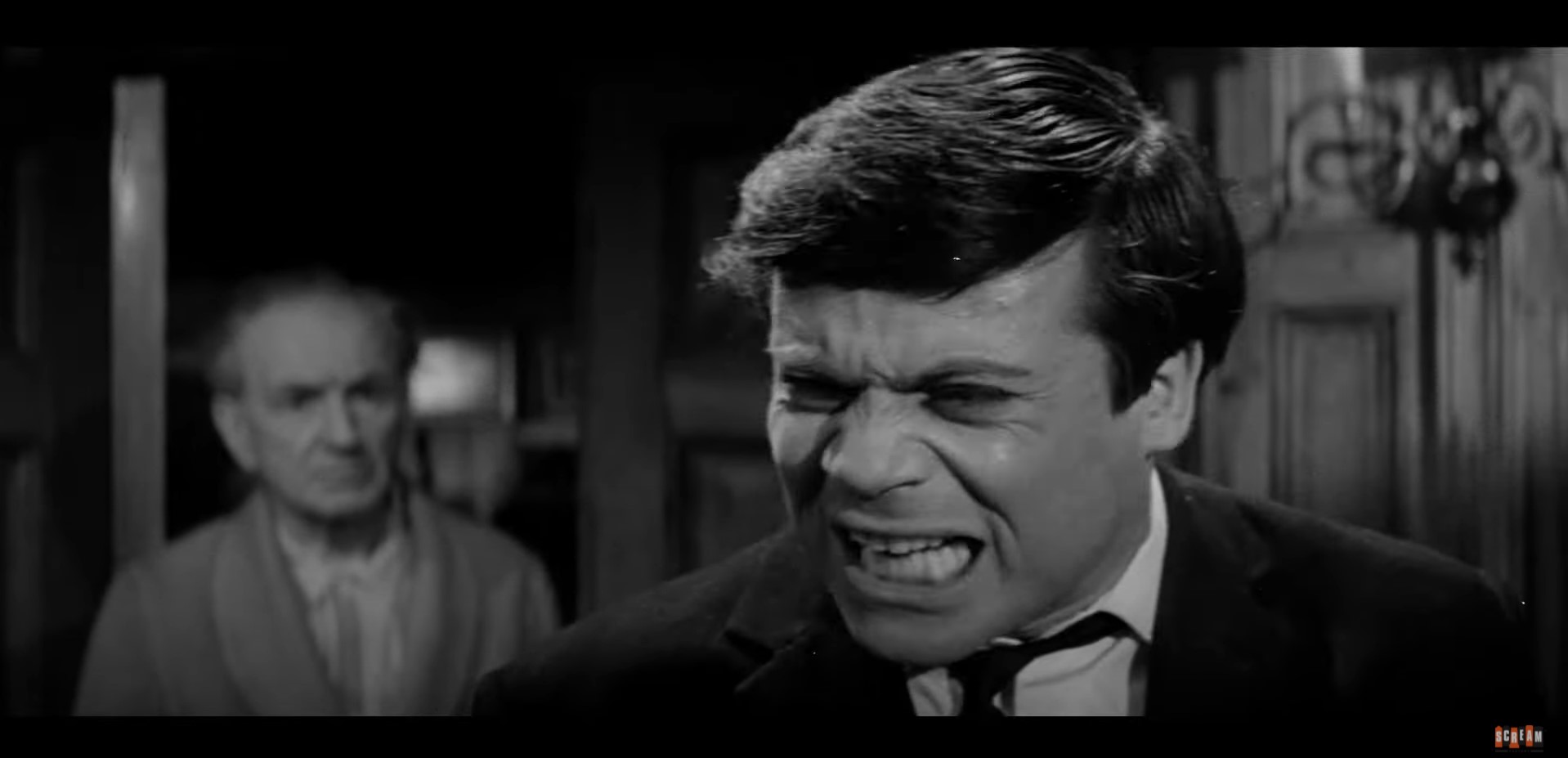
Paranoia runs rampant like an epidemic in this Freddie Francis aptly entitled sullen celluloid “Paranoiac,” the next Hammer film receiving a collector’s edition Blu-ray treatment from Scream Factory, the horror sublabel from Shout Factory! The region A locked encoded Blu-ray features a new 2K scan from the interpositive. By 1963, Hammer was well versed in technicolor, especially for Stateside releases of UK films, but “Paranoic” opts for the black and white picture in another subtle nod to “Psycho.” Under veteran Hammer Film’s cinematographer Arthur Grant, that famous gothic-cladded manor house is aesthetically fetching with in every detail captured by Grant’s 35mm camera as well as the broad wide shots in the bird’s eye view of Isle of Purbeck. Scream Factory releases the film in 1080p, full high definition of the original aspect ratio 2.35:1 with sterling results in extracting details and balancing the contrast without brightening or darkening where not needed or intended. There were no real damage spots to point out nor were any crops or enhancements made to touch up possible problematic or stylistic areas. The release comes with a single audio option in a DTS-HD Master Audio monaural track with slight static in the background. Dialogue is clean and mostly clear with an occasion hiss during more boisterous moments, but the range and depth of a faultless ambience and Elisabeth Lutyens brassy and bass soundtrack comes through symmetrically balanced. English SHD Subtitles are also optional. The special features include a new audio commentary with Film Historian Bruce Hallenbeck, two new interviews with author and critic Kim Newman in Drink of Deception and with film historian Jonathan Rigby in A Toast to Terror – two familiar faces seen in recent Scream Factory’s restorations of Hammer productions, a making-of segment that dives archive interviews with Jimmy Sangster and others going over the genesis of the story and into Hammer’s aspirations at the time, and a theatrical trailer. “Paranoiac” is more than just its creepy, bulbous mask that graces the Mark Maddox gorgeously green illustrated slipcover and snapper case cover art. Rarely does a film evolve from one narrative into another without crisscrossing the stitchwork, becoming overly convoluted beyond repair, yet “Paranoiac” digs in and dilates the already volatile chemistry with integrated and powerful performances from Oliver Reed and Janette Scott that makes this film high on the Hammer watch list.

Get “Paranoiac” on the Collector’s Edition Scream Factory Blu-ray!

It Takes Evil to Write Evil. “Shirley” reviewed! (Neon / Digital Screener)


Backdropped inside the mid-1960’s of Bennington, Vermont, famed horror fiction writer, Shirley Jackson, and her husband, Stanley Hyman, a folk literary professor at the Bennington College, welcome a young newlywed couple, Fred & Rose, in their home, but the stay isn’t for social purposes as Fred stands to be the assistant professor aiming to achieve greater success under professor Hyman and Rose becomes the happy wife whose reluctantly willing to help with household chores as the surly Shirley flounders in a writer’s rut, sour around polite company, lethargic for most of the day, and at war with her cheating husband, but Shirley finds inspiration when taking a fascination to Rose, merging her with a news story of a missing local girl that leaves Shirley entranced, catatonic, and inhibited from writing her novel. Once disdained by Rose’s very presence, Shirley exploits Rose’s eager ambitions and trustworthy attributes by befriending her as an endless flood of literary muse offerings that breathe life into Shirley’s next masterpiece.

“Shirley” is a biopic allegory of half-truths and a tale of a grim waltz between common civility and the yearning, paralyzing pursuit of opus mastering from the “Madeline’s Madeline” director, Josephine Decker. From the creator of the “I Love Dick” television series, writer, Sarah Gubbins, who adapted the screenplay from the author of “Shirley: A Novel,” Susan Scarf Merrell, provides a textural interpretation of renowned horror and mystery fiction writer Shirley Jackson during the bitter final years of her and Stanley Hyman’s unusual, yet threadbare functional, relationship. “Shirley,” in itself, is like one of Jackson’s terrifically terrifying horror stories woven together with anecdotal fragments of Shirley’s flailing existence with the new energy of a fictional young couple to drain the life from for her own benefit and is cinematically arranged the story like a perverse thriller of intellectual capitalism. The Los Angeles Media Fund (“Dark Crimes,” “The Bye Bye Man”) and the biographical drama producing powerhouse, Killer Films (“Notorious Bettie Page,” “Infamous”) serve as the production companies behind “Shirley.”

Hot off her success in the gender-dystopian television series, “The Handmaid’s Tale,” and in Leigh Whannell’s vision of a Universal monster classic, “The Invisible Man,” Elisabeth Moss embodies the titular role of Shirley Jackson with a fluid performance of a corkscrew soul. Moss aims to make Shirley as a detestable gorgon with nihilistic and agoraphobic intellect and a narcissistic view of her work she considers to be the holy grail. Moss is methodic and calculating in her character’s icy social skill set and floats half-seen above the water’s surface like an alligator hunting, ready to snap when a warm blooded meal doesn’t expect a thing. Shirley Jackson is only as interesting as her philandering other half, Stanley Hyman, who has a whole separate cache of quirks and callous intentions, though parading in a much more vibrant, lively, and gregarious manner. “The Shape of Water’s” Michael Sthulbarg has pitch perfect execution of Hyman’s managing tugboat who pulls and escorts this cruise liner-sized ego to port with an unorthodox show of a manipulation and affable disingenuous blend working tirelessly that ship to anchor after a long voyage on rough, stagnant seas. Fred and Rose enter like a parallelogram, a four-side rectangular where two sides pair together equally in length, of innocents wondering into a den of a pair of hungry lions. Then, the parallelogram flips and skews to form an twisted mirror of itself that has turned the sweet and loving Fred and Rose into a pair of awaken fragments of Shirley and Stanley. We don’t get to experience much of Logan Lerman as the assistant professor who shadows in Hyman’s overshadowing dominance, but we’re rather engrossed by Odessa Young’s onscreen reciprocity with Elizabeth Moss. Rose falls short of being the epitome of youthful innocence with a fast and loose shotgun marriage to Fred because of her pregnancy and her rendezvousing sexual appetite with Fred, but Rose’s delicate curiosity and naïve gives way for Shirley, Stanley, and even Fred to tread all over her. Young fully grasps Rose’s disadvantage in the viper’s pit that sizes her up for a great fall.

“Shirley” doesn’t bask in the spotlight of the biopic-ee’s celebrated work, like “The Lottery” or “The Haunting of Hill House,” even if it name drops the former; instead, Josephine Decker’s film is cut from the Susan Scarf Merrell cloth that disconnects and desensitizes intellect from moral conduct. Distinct lines are drawn between the couples Shirley and Stanley, whose dynamic teeters on alcohol, smokes, and a banter based on a fraction of love less, and Fred and Rose, who are teased with the taste of the good life, bow and scrape for the attention of their hosts. As the scrupulous infatuations begin to blur the lines and Fred and Rose become infected by Shirley and Stanley’s inceptive wicked cynicism, a metamorphosis occurs as the naïve newlyweds are now the bitterly tireless unable to cop with their shortcoming whereas Shirley and Stanley remain unaffected, if not, better off than from when they started, leeching the purity from the impressionable youngsters like a pair of scholarly vampires. Decker’s airy, dreamlike touch evokes another level of the already Freudian bombarded “Shirley” that’s laden with heavily schemed psychoanalytic foreplay and undercurrent human reaction to a string of unconventional occurrences.

Become the fly trapped in a web of deceits with “Shirley” heading to Hulu, VOD, virtual cinemas, and select drive-in movie theaters come June 5th, 2020 distributed from Neon. The rated R, 107 minutes quasi-biopic is presented a widescreen 1.78:1 aspect ratio. Unfortunately, a digital screener doesn’t allow me to critique the A/V quality. However, composer Tamar-kali’s subdued score lingers on the right side of brooding without feeling overly dreadful and with feeling more horrifically intrusive, complimenting Shirley’s aggressive mind rape of Rose’s psyche. There were no bonus features included with the digital screener nor was there any bonus scenes during or after the credits. Unlike the sullen, reality bending state as the titular persona, “Shirley” is an entertainingly cathartic glimpse into the worst side of erudition plagued upon those lesser informed that builds lustrous works of horror on the backs of perfidy.

Purchase the poster with Elizabeth Moss!

Two Undisciplined Girls Do EVIL in the Netherlands! “My Nights With Susan, Sandra, Olga, & Julie” review!


After years with struggling with fame, Susan finds solace in an idyllic and solitude Netherlands’ farmhouse near the waterfront. Her peaceful lodging transforms in a youth hostel as she welcomes three refuge women – Sandra, Olga, and Julie – and one man – Albert – into her life and in exchange for a place to stay, Susan embraces the company after her entanglement with loneliness. Despite Sandra and Olga’s sex-crazed psychopathy and an unhinged Albert’s voyeuristic habits, Susan has been able to maintain an even keel quality of life. That’s until the handsome Anton shows up. His arrival stirs the nest of sexual desires and has Susan questioning her reclusive lifestyle. Anton’s presence also riles up Piet, a crazed women living in a shed on the outskirts of the farmhouse. To make matters more complex, Anton becomes mixed into a murder mystery involving a dead American. Was it the mischievous sexual delinquents Sandra and Olga? Or did the wild Piet finally snap her moral conscious?

During the height of the 70’s sexual revolution, the Dutch seize the opportunity to piggyback their own free love films. Pim de la Parra’s 1978 “My Nights with Susan, Sandra, Olga, & Julie is an epitome example of the Dutch sex wave genre that shares the tantalizing groping, succulent squeezing, fornicating spooning, and …well, you get the idea. Originally titled as the longwinded My Nights with Susan, Olga, Albert, Julie, Piet, & Sandra (whew), this film is the last production of Pim de la Parra’s Scorpio Films from a script co-authored between Parra, Harry Kumel from Belgium, David Kaufman from America, Charles Gormley from Scotland, and Carel Donck from the Netherlands in a melting pot of cultural creativity. “My Nights with Susan, Sandra, Olga, & Julie” sizzles the screen with nudity in characters just walking around or riding on a child’s rocking horse stark naked that’s ostensibly organic for a story beginning with cold blooded, arbitrary murder.

Before partying the circumstantial matron of a youth hostel, Netherlands’ Willeke van Ammelrooy was Eva in “Frank & Eva,” another film by Pim de la Parra. She was also Alicia in “Blue Movie” director Wim Verstappen’s “Alicia” and also played Mira in Fons Rademakers’ “Mira.” As the evidence provides, Ammelrooy is very experienced as the leading lady role, portraying three titular characters from 1971-1974 by post-humorously acclaimed Netherland directors. Yet again, Ammelrooy plays a titular character in Susan, a country cloistered luminary seeking to be a forgotten face, but Ammelrooy steely performance of a woman pretending not to be hiding secrets is a fascinating insight into a character’s personal shielding; however, when Anton, “Wet Dreams’” Hans van der Gragt, their hot and cold dynamic creates a formidable hard love rigidity influenced by forces internal to Susan and external forces from those her immediate life at the farmhouse. Olga and Sandra have more intoxicating behaviors that run the story amok and what’s more interesting about the actresses, Franulka Heyermans and Marja de Heer, is that they’re amateur actresses according to Pim de la Parra. Cold and, yet, lively, Heyermans and Heer have mountainous ration and serve Parra genuinely. Marieke van Leeuwen, Serge-Henri Valcke, Jerry Brouer, and Nelly Frijda round out the small cast.

Pim de la Parra’s influences stem heavily from Alfred Hitchcock. The filmmaker implements voyeurism and the wrongfully accused that are essential to the Hitchcockian style. I also find it hard to believe that on the first day of shooting on Hitchcock’s birthday, August 13, that Pim de la Parra’s first scenes are that of birds on a beach. Coincidence or a little salute to the master of suspense, either way, the now retired filmmaker unifies a harrowing score with birds and a beach to not only by respects to Hitchcock, but also sets the tone of the film of an erotic thriller with blotches of dark comedy strewn in.

Cult Epics proudly releases “My Nights with Susan, Sandra, Olga, & Julie” onto a new high definition two-disc Blu-ray/DVD combo set. Presented in a widescreen, 2.35:1 aspect ratio, in a 1080p transfer from the original 35mm print, preserved by the Eye Film Institute in Amsterdam. The original print is nearly pristine with a palatable amount of stock grain and with only a minor amount of film wear. No observations of border enhancing or sharpening that would dilute the bona fide quality. The Dutch DTS-HD 2.0 Master Audio track nicely accompaniments the film with depth and range and the Dutch dialogue upfront and present and the very Hitchcock-esque soundtrack by Elisabeth Lutyens (“The Skull”) provided a perfect suspense drive score in her last composer post. Supplements includes an introduction by Pim de la Parra, poster and photo video gallery, Scorpio Films’ shorts that includes “Heart Beat Fresco,” “Joop,” and “Joop Strikes Again,” and Scorpio Films’ theatrical trailers. Cult Epic’s region 1 DVD and the all region Blu-ray release favors another Dutch sex wave cinema flavor with just modernization of an intertwinement of erotically charged lust and lives with repulsive and deadly temperaments and with Pim de la Parra at the helm, you’re going to get primo framing and angles sure to captivate.

Purchase by Clicking the Blu-ray Cover!