Niles and Holland Perry are close twin siblings who live on a countryside farm in the early 20th century. Their family has been plagued by past personal tragedy that has mentally paralyzed their mother. When everything starts to feel normal again, death returns to the farmhouse and nobody suspects that the two boys, the twins, because who would imagine that one boy would be good and the other would be pure evil?
“The Other” a 1972 gothic gem from the “To Kill A Mockingbird” director Robert Mulligan brought back to DVD in the UK by Eureka Entertainment. The ageless story of uncomfortable fear toward the yin and yang characters with a good twist that doesn’t happen at the end of the movie but rather lands right in the middle of the climax. The finale saves the best, or the most tragic, for last with a moment that will shock even those born in the 21st century. Even when you know, from your extensive movie knowledge, what to expect you can’t believe the stunning outcome written by Tom Tryon who also penned the novel with the same title.
The twins are played by real life twins Chris and Martin Udvarnoky and this throws us for a loop because you rarely see the twins sharing the same scene. Right there, you know something is up. The Perry boys are characters that are active, like any other nine or ten year old boys, and seemingly innocent enough boys with the usual boys will be boys touch. Their knack for fishing, hide-n-go seek, and swimming try to pull our attention away from one of the boy’s true mischievous nature.
Along side Chris and Martin Udvarnoky, German stage actress Uta Hagen plays the boys’ Russian grandmother who becomes the matriarch when their mother becomes almost catatonic. Another supporting cast member is a young John Ritter in one of his first films and a striking Diana Muldaur who looks almost unrecognizable from her role as Doctor Pulaski from the sci-fi TV series “Star Trek: The Next Generation.”
Eureka Entertainment’s dual format (DVD & Blu-ray) of “The Other” has beautiful 1080p even off a cheap DVD player as long as you have a decent high definition TV (my personal TV is a Vizio LED M series). The extras only include the theatrical trailer, but I believe the film will speak for itself and you can judge for yourself on the film’s February 23rd release date in the UK.
Hasn’t the hand held first person camera run it’s course? The recently popular method has been criticized as shaky, unintelligible, headache inducing, and over abused. I agree with that criticism as well, but I find there lies a bit of realism in the corners of each the richly blindingly dark and snowy static scenes of a hand held camera.
The Inside is the next flick to hop on the hand held bandwagon. A young man purchases a second hand video camera at a pawnshop and discovers that the tape is still inside the camera. He plays back to footage of five girls out on the town for one of their own’s 21st birthday party. The girls break in to an abandoned undisclosed location for a little wild times, but three vagrants break up their fun and unleash terror upon them. But when the vagrants think they have the upper hand, a supernatural evil falls upon the girls and themselves leaving all of them to fend for themselves against pure evil. When the man finishes the tape, he retraces the girls steps in search of what caused their demise.
While the shaky hand cam has more realism than any third person perspective, a great backbone of a story can make the film all the sweeter, but The Inside has a flimsy plot line that doesn’t explain what kind of evil forces these girls are dealing with nor can be explained what this “Grave Digger,” as IMDB.com has labeled the character, has gruesomely bestowed upon the victims. Perhaps the take away from this movie is that people disappear without a trace all the time and this could be a theory to how and why…? But glimpses of Satanic pentagram symbols sprayed on the wall and quick visions of Satanic goats are being tapped into the camera’s signal, which I don’t think is the correct type of signal. But this confirms some kind of ritualistic satanic practices being held and, perhaps, going terribly and horribly wrong. I feel there should be a prequel to The Inside to give us a little more insight into who or what the “Grave Digger” is.
What behoves the story to maintains a chilly manner was to keep the characters portraying like horror ignorant idiots. For example, the young man, played by director Eoin Macken himself, who bought the camera decides to retrace the girls’ steps and investigate by himself. Why not turn in the camera to the authorities after witness physical assault, rape, and supernatural evil terror of the girls? This man was not superhuman, but much rather a bum looking to pawn of his wedding ring – we aren’t privy to his background either and have to deduce what we see to come to some kind of half-cocked conclusion.
Amongst all the chaos and confusion after the supernatural shit hits the fan, the movie takes a 180 degree turn in the other direction and no longer are we invited guests at a party or the voyeurs of a perverse snuff film, but a survivor ourselves. However, the sound is much to hectic to make any comprehendible sense. All that I knew for sure was when the “Grave Digger” was about to make an appearance – a baby wailed and there was an electronic hum – which made an unfitting tell of his whereabouts, but the “Grave Digger” was an interesting looking character despite his mysterious background and his grimly cryptic intentions. He’s naked and covered and blood – if you’ve ever seen Shallow Ground then you might have a clear representation of what I’m talking about.
Much like most hand held camera movies, The Inside is no different or nothing much more special. There is an open ending, which is a common characteristic of films like these which has to do with the realism factor once again. The Inside will chill your spine, yet you won’t figure out why it chills your spine in the first place. Check it for yourself by buying your copy of The Inside at Monster Pictures.com
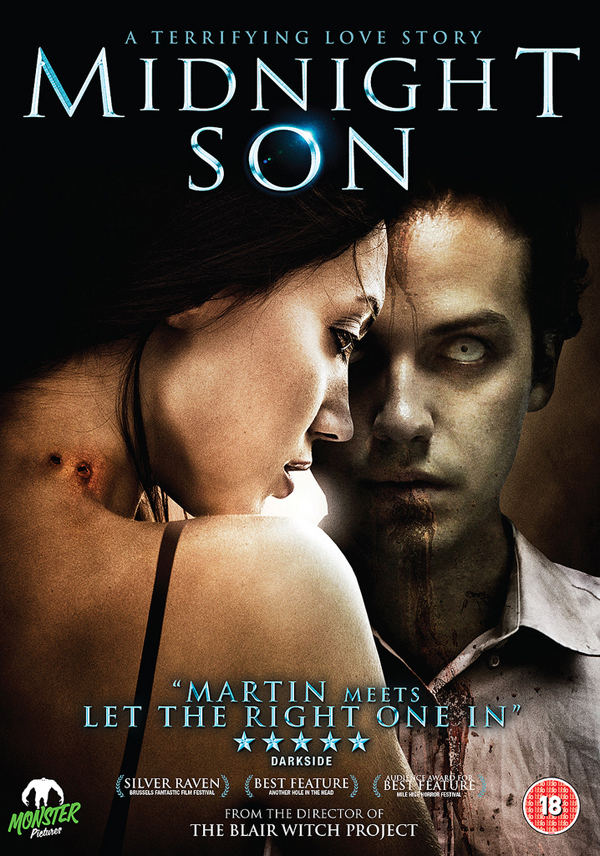
What really makes the hair bristles stand straight up on my arm is a really obscure and overlooked vampire movie. Not because I’m savagely frightened by the content, but because those films that don’t make the theater cut or have a promotional parade across the internet just get the shaft and my heart breaks when the thought occurs to me that I never would have come across such a movie if I wasn’t such a die hard horror enthusiast. My review tonight is about one of those overlooked, passed on the rental shelves, not selected at the Redbox movies called Midnight Son.
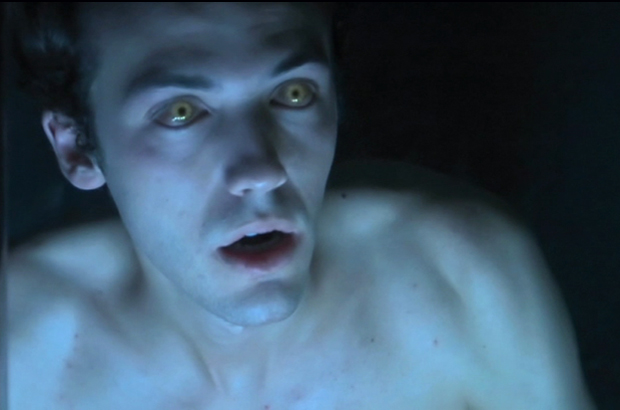
A lonely night security guard named Jacob has a rare condition in which his skin literally burns when exposed to sunlight. Jacob also can’t quench his hunger with any food with the exception of fresh human blood. The doctors tell him his condition is Anemia due his malnutrition, but Jacob dreads his ailment to something more dark. When he falls for a pretty vendor girl Mary, his condition kicks into overdrive and drives his cravings to an all new heights causing blackouts, terrible dreams, demonized eyes and a irresistible craving for blood. Before Jacob realizes that what his newfound symptoms are really about, he’s already committed dastardly deeds that will change his once dull and lonely. life.
The subtly of the film helps draw me into Jacob’s loneliness and awkwardness. His role in Midnight Son comes off as a young man’s journey of self discovery and that discovery is his transition into becoming a creature of the night – a vampire. Much of Jacob’s backstory is omitted from us with only a picture of him as a young boy with a cast on his arm is revealed. The cast represents his lifelong ailment of not being able to withstand the UV rays of the sun. Other than that image of Jacob, we know of no father, mother, siblings, or childhood home for that matter of Jacob’s past. His background is as mysterious as his condition, but Tracey Walter, legendary sidekick actor (Batman, Conan The Destroyer), hints at his metamorphosis with the epiphany statement, “like caterpillar turning into a butterfly.” My main question is is Jacob really transitioning or is he just now realizing, after all these years, the vampire qualities? He tries to confirm his suspicions by placing a makeshift cross on his forehead wondering if he’ll scold him – he retrieved the idea from Stephen Geoffry’s Evil Ed character in Fright Night. A good reference to use! However, Jacob is no Evil Ed and not even close. There are no extended canines, his reflection still reflects, and he can’t turn into a fierce winged blood sucking creature. There is no coffin to be had here. Midnight Son resembles similar movies like George Romero’s Martin or Larry Fessenden’s Habit where the idea of the vampire is so instilled in the character’s mind that is hard to believe the character is not a vampire, but Jacob is the real McCoy and that proves itself amongst the other characters we encounter – Mary and Marcus.
Mary becomes Jacob’s love interest. Their meeting happens by chance and no vampire allure was against her free will or that of we know, but Mary has her own vices. She is also a night owl who likes to party in more ways than one – long party entrance lines and long lines of coke. Mary vices are overshadowed by her feelings of endearment toward Jacob; she wants to take of him to perhaps give her purpose in life where she won’t have to vendor lollipops outside the local bar (this is where they met). Jacob realizes how slammin’ Mary’s body is and how much affection she displays him. Director Scott Lebercht could have explored this more and given more of a reason why Mary falls for an awkward, nocturnal security guard who thwarts not one, not two, but three of her advances to rock his nosferatu world. Perhaps Lebercht wanted to show that no matter the misshaped character, there will always be someone out there in the world looking for a hardship case to take care of.
Now even though Mary has a fantastic body and a cute overbite (don’t ask), Marcus is quite the interesting character. This thug sells drugs and blood out back besides the biohazard dumpsters of the hospital where he works – “everybody has their thing,” he says and it’s true that everybody has their thing, their vice, their habit, their overall weird hobby. Marcus exploits other people’s addictions and makes a criminal living doing it as a side job, but when Marcus can’t shake Jacob’s relentless need for blood, Marcus’s thuggish bite pushes and shoves an object that will literally bite him back. Jacob’s antagonist is Marcus because after their confrontation, they become one and the same.
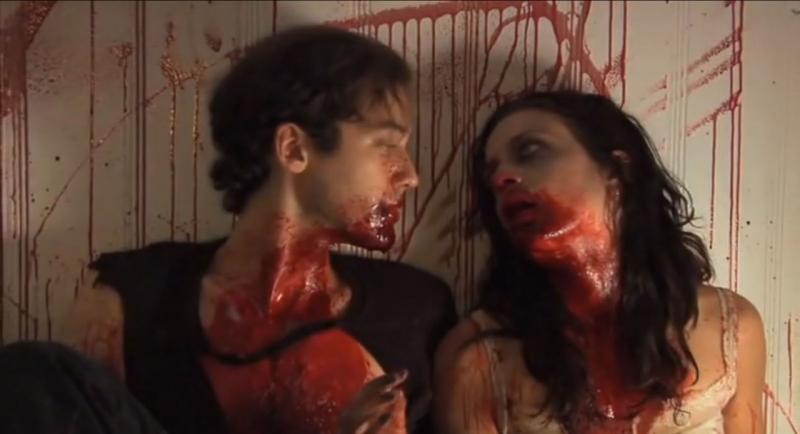
The best scene in the entire movie is the last. The scene brings the movie’s rating “contains strong gory images” to light however still tame I think the scene might be, but at least we get some sort of blood satisfaction and I love how the characters embrace and bask in their enlightened stages which begs to question – is this the beginning to the end of humanity once a reluctant embraces their true self? I’d like to see a follow up to Lebercht film and, as a side note, on my edition of Midnight Son – provided by Eureka Entertainment Monster Pictures division (thank you!) – states this film is from the director of The Blair Witch Project, but I don’t see Lebercht’s name connected to The Blair Witch Project. Am I missing some key information here? If you want the Monster Picture’s edition – being released February 11th – instead of the Image Entertainment’s edition, you’ll need a region free player as Monster PIctures is based in the UK. However, I wouldn’t like something little like crossing the Atlantic stop you from seeing Midnight Son!
Japanese horror isn’t something I pride myself on having a lot of knowledge of or contain much material about, but I do find enjoyment in what I come across even if the resemblance to an anime style becomes apparent in the storytelling. I’ll be straight forward with you right here and now, I’m not a fan of Japanese anime. No, sir. Can’t say that I am. However, my latest venture into the J-horror sends me back in time to the groovy year of 1977. The film is called House and no, not the Steve Miner feature from ’86. Also known by it’s Japanese name Hausu, House is a simple ghost tale with ambitious and groundbreaking special effects that dared much of the decade to catch up with the times.



 It's Bloggin Evil!