As Videogame Adaptations Go, This Ones the EVILEST! “Exit 8” reviewed! (Blu-ray / Visions Home Video)

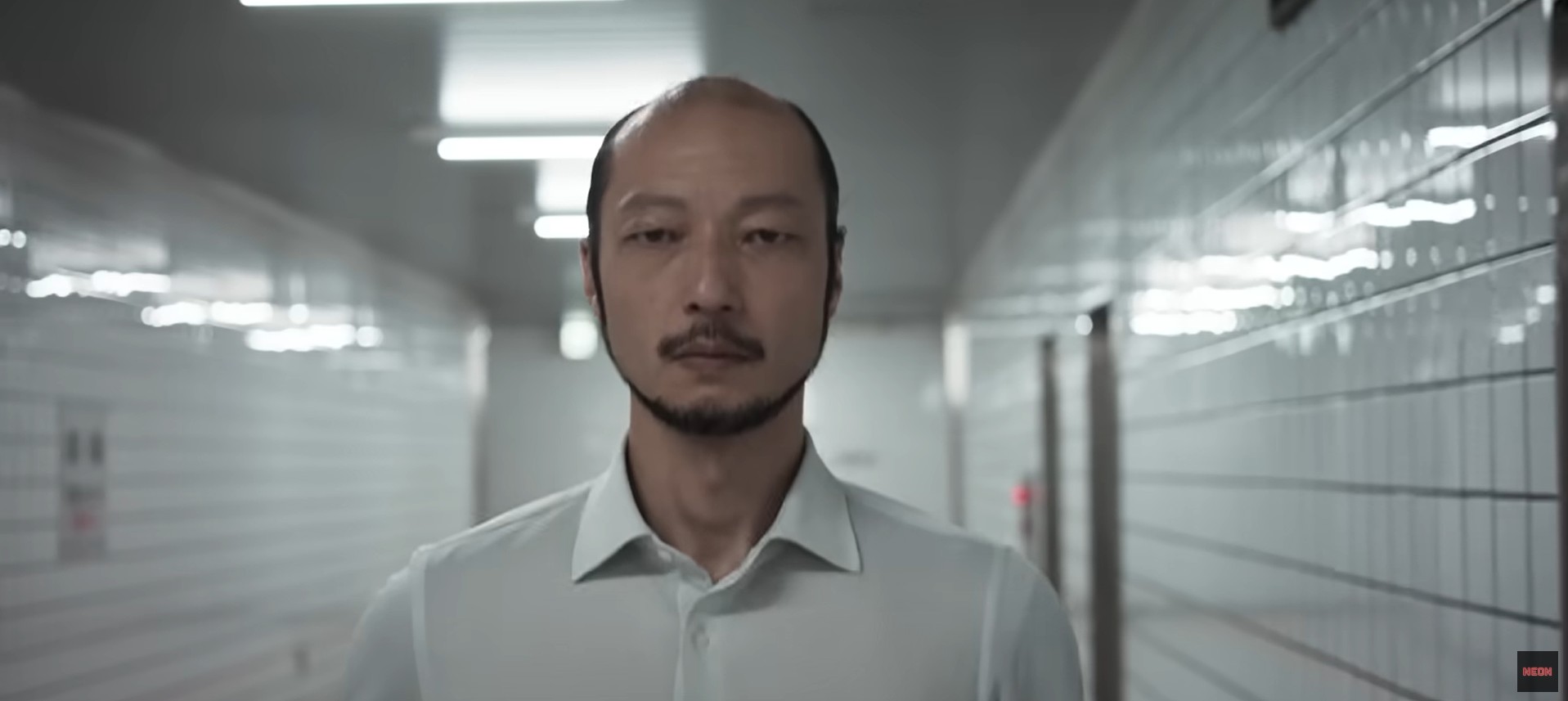
Keeping to himself and listening to music on a subway car, just like everyone else, a man exits the train car at his stop and learns his ex-girlfriend is pregnant with their child when she unexpectedly calls him.  Undecided how to feel about the news of being a father, he walks up a flight of stairs to exit the subway station only to find himself trapped in a zigzag hallway that loops the same series of advertisement images, directional signs, and a businessman walking intently down the seemingly sterile and ordinary, tiled corridor.  After reading the hallway’s information sign, noting specifically to not ignore any anomalies and providing the direction to take when an anomaly is discovered, the lost man realizes he’s trapped inside some sort of twisted game and must determine if 8 hallways are either anomalous or not to be free and exit.  If he misses an irregularity, he must start from zero again and not every anomaly is as harmless as a sign out of place.  The anomalies can psychological, monstrous, terrifying, and deadly.
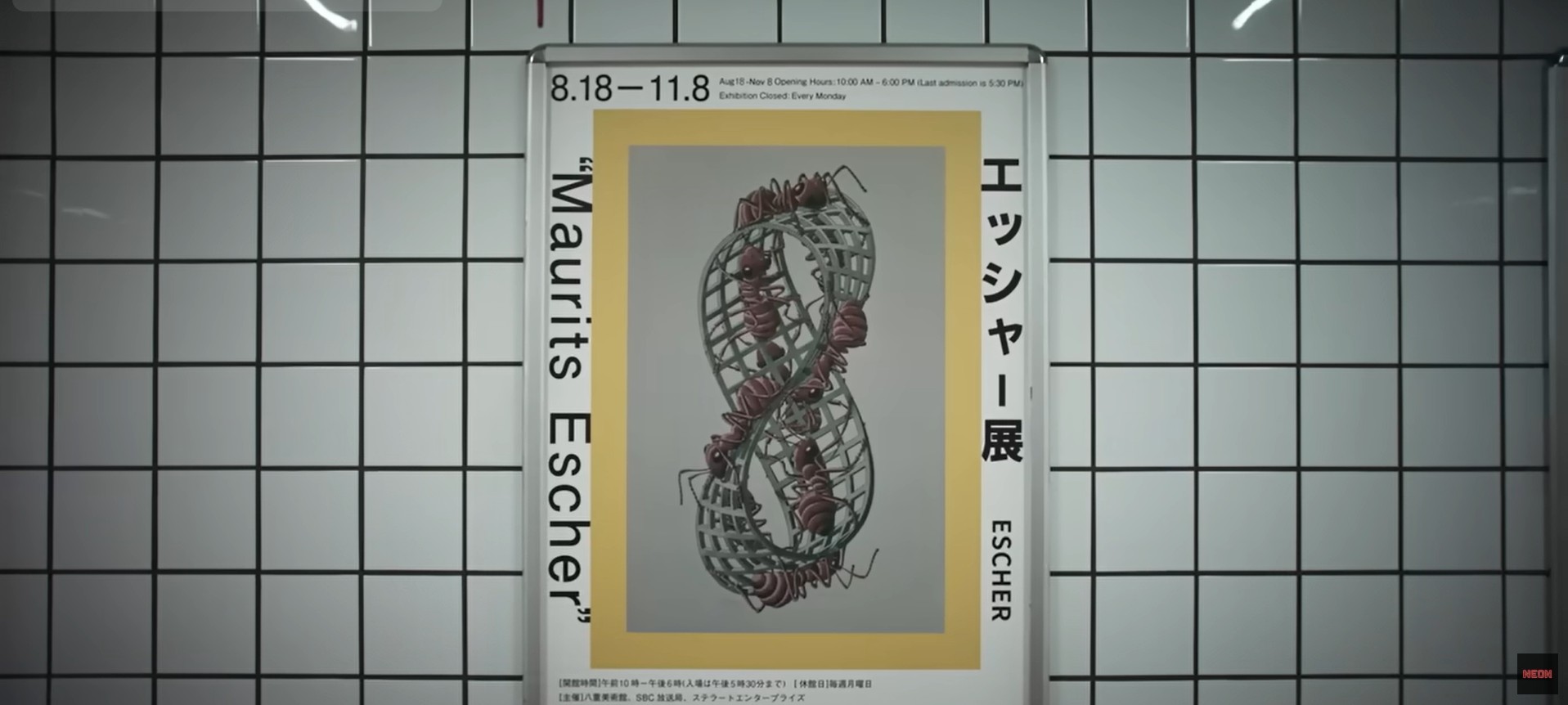
Based off the Japanese horror and psychological video game of the same title, “Exit 8,” the film, also originates out of Japan.  Kotake Create is the indie video game developer behind the “Exit 8” concept and its sequel “The Platform” from 2023 and 2024.  The 2026 film is the sophomore directed film by Genki Kawamura who co-wrote the filmic adaptation “Sai:  Juchang ban” co-writer and director Kentaro Hirase.  Both the video game and movie indulge into the theme of the Noble Eightfold Path, a teaching core of Buddhism that serves a guide from suffering to enlightenment through eight corrected attitudes, such as mindfulness, intention, and effort.  A conglomeration of producers, including Yoshihiro Furusawa, Minami Ichikawa, Taichi Itō, Yuto Sakata, Taichi Ueda, Kenji Yamada, Akito Yamaoto, and director Kawarmura, bring the film to fruition under the Toho Film Corporation and AOI Pro. Inc. and in association with Story Inc. 
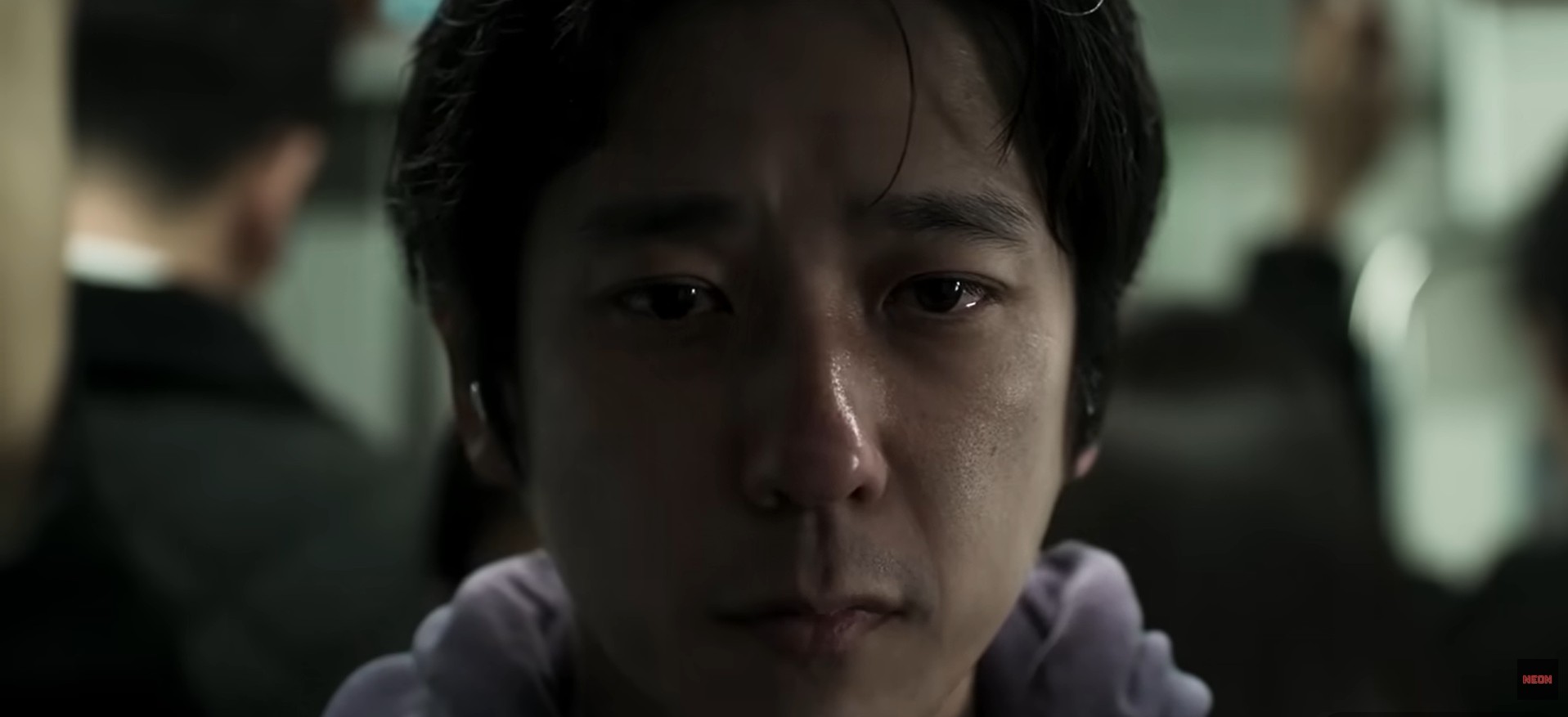
“Exit 8” has a limited cast of key characters, mostly trapped inside the sterile, tiled subway walls, playing real and unreal characters depending on the perspective in turn.  Mostly, the center focus is around a male character only known as The Lost Man, a young man who shrugs off responsibility to his fellow man as well as being undecisive when it comes down to important decisions; we see examples of this on the subway train of a businessman yellow at a mother who’s infant is crying and when his girlfriend phones him to inform him of her pregnancy in which she poises a pivotal question he can’t either fathom, process, or ultimate just decide upon.  “Letters from Iwo Jima” actor Kazunari Ninomiya plays the nameless Lost Man to character arc his way from skirting responsibility to fill him with purpose and round the character out as a person of great attention, detail, and decision.  The only downside to the Lost Man is with how he’s written on the initial experiences of the hallway loop in what’s an obvious disturbance in reality he quietly absorbs without freaking out, even to the point he’s able to quickly red and process the rules of the scenario and understand their purpose.  This, in itself, is an anomaly of human processing and rationality as the average person would be overwhelmed by surreal receptiveness and break down before they could build themselves up.  Ninomiya performance lifts the Lost Man with a more positive performance that sets the emotional rollercoaster back on track and when the audiences to get that break of the character’s mental state, its crippling effect translates and is greatly empathetic.  In the loop, the Lost Man meets the Walking Man (Yamato Kochi) who cycles passes through the anomalous-or-not corridor at an expressionless pace, but we also get his backstory too as he was once real and trapped just like our protagonist.  Another character the Lost Man meets is The Boy (Naru Asanuma), another victim playing the game, and has an eye for detail despite his quiet demeanor.  The Boy also represents the Lost Man’s future being the protector and parent to the boy as they try to escape together through the harsher anomalies.  “Exit 8” rounds out the cast with more minor parts from Kotone Hanase, Hirota Ôtsuka, Tara Nakashima, and Nana Komatsu. 
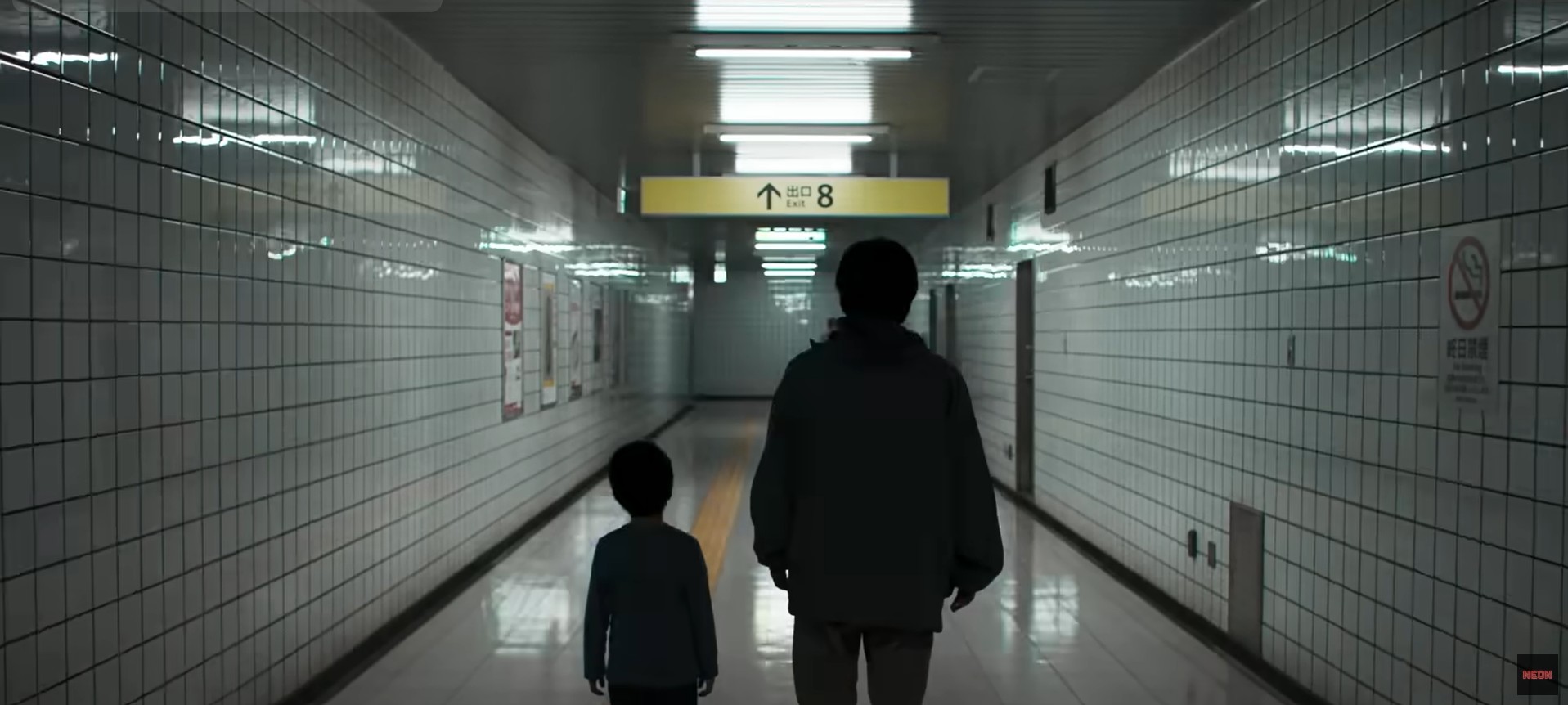
An uncanny and ambiguous horror, providing no explanation for why the man is trapped inside a loop, “Exit 8” serves to be a metaphor for life’s hard decisions, ones that affect fate in the futre.  Paying attention to the small things have the same direct result as paying attention to the much larger, obvious ones despite the being blatant and the threatening anomalies, no matter big or small, can have disastrous consequences.   Kentaro Hirase is an obvious fan of the game by rendering a faithful adaptation of Kotake Create’s creation that walks, talks, and acts just like the mystery horror and existential crises symbolizer.  There’s even a first-person perspective at the beginning of the film that provides more homage to Create’s first-person game.  After that, the switch to omnipresent third person has its own distinct brand of tension and it also achieves grabbing the fearfully fret expressions on the actors faces, that’s if they’re human or otherwise it’s creepier and menacing in the surround sterile environment that can be subtle or flooded with odd occurrences only to go back to normal in a matter of a few steps and one left turn away  Aside from vague purpose of the 8 level loop, there are more creepypasta anomalies that don’t make a lot of sense on its face but share an underlying connection to those cut off from the rest of normalcy in what’s can be considered a subconscious ensnarement of personal strife that has put them in a precarious position with unexplainable and terrifying results.  The acting carries with a repetitiveness about that that is not tired or mundane as the Walking Man walks the same corridor, at the same time, and in the same manner at least ten times in the duration, an exemplary one-note performance by Yamato Kochi to never break the automaton gait and persona no matter how involved the Lost Man gestures or speaks to him.
Visions Home Video’s “Exit 8” Blu-ray is a great addition to anyone’s collection of Japanese modern cinema or overall film library.  With a 1080p high-definition resolution, the AVC encoded BD50, presented in a widescreen 1.85:1 aspect ratio, has natural, run through digital brilliance meaning the walls are sterile white, the color saturation has an innate organic measure through primary grading, and skin tones render like they would off camera but all with the clean look of digital.  There is some noticeable aliasing on the tile that lose some of the definition and blurs as objects move through the scene, effecting in at least a couple of scenes the texturing.  The Japanese DTS-HD 5.1 Master Audio has a kick with a sound design that plays with the perspective of the Lost Man’s environment, providing excellent directional and immersive audio space from the diegetic and non-diegetic muffled and non-muffled sounds from first person perspective with earbuds in to the intensity depth of walking from background to foreground.  Dialogue has strong presence and is clear.  Subtitles are well paced and contain no noticeable grammatical mistakes in the UK English translation.  There may be some key vocabulary differences as anomalies is perhaps more British than the word used in Japan. The English subs come in two options:  SDH and audio descriptive.  The special features include a behind-the-scenes of “Exit 8,” an On the Carpet at Cannes Film Festival featurette, an On the Carpet Busan Film Festival featurette, the UK trailer and the Japanese trailer..  The stark physical presence of “Exit 8” is eye-catching with a mostly golden O-ring, cardboard slipcover with an illustrated figure eight, tiled like the subway corridor with illustrated story characters standing on it.  Sheathed is the clear Scanova case with the same primary image from the slipcover on the sleeve but drops the sheeny gold coloring for more canary yellow.  The reverse side of the sleeve has a creepy image of the Walking Man.    A double-sided, folded mini-poster and art cards of the corridor wall signs are inside the clear case with more yellow themed display pressed on the disc.  The UK 15 certified film lists two different explanations between the slipcover and the clear snaplock case.  The slipcover has strong horror while the clear case has infrequent strong language.  The region B locked region has a runtime of 95 minutes. 

Last Rites: Personal growth is hard. It’s even more difficult when a subway tunnel becomes the ultimate mind-messing and deadly trap to steer you in the right direction. “Exit 8” is a guileful guide of molding moral behavior done with a twisted circumference. This video game adaptation is one of the better ones in a long time!


EVIL Would Be to Not Allow Yourself to Enjoy Japanese Gravure! “J-Girl Yummy: Mitsuha Kikukawa, Toka Rinne, and Reona Kirishima” reviewed! (Gravure Glamour Girls / Blu-ray)

You Can Find Mitsuha Kikukawa, Toka Rinne, and Reona Kirishima on DVD and Blu-ray at JGirlYummy.com

The J-Girl Yummy series presents three gorgeous new women who are prevalent from the pornographic Japanese Adult Videos (JAV).  Instead of hardcore assembly of action that often doesn’t feel as intimate as maybe one hopes, your favorite starlet now only has eyes for you in this softcore series that nearly leaves nothing to the imagination.  Mitsuha Kikukawa (“My Father Steals My Beautiful Fiancé,” “My Compliant Pet”), Toka Rinne (“Mamacita Stories,” “Married Woman’s Cheating Heart”), and Reona Kirishima (“Countdown to Nakadashi,” “On a Stormy Night – I found Myself Alone with My Sister-in-Law Upon Whom I had a Crush”) find themselves as the next trio lot for the showcasing series that explores their solo talents and provides a one-on-one between their hot bodies and the camera, seducing the lens with playful flirtation, a captivating allure, and a stimulating interaction that breaks the fourth wall as they stare, talk, and moan back with inviting eyes for their loyal fanbase. 

In a world where sex sells, any form of the vice is surely to be valuable.  Hardcore adult films reign as king amongst viewers but there’s also a sizable market for softcore productions, if the ever-desired Skinemax and more highly sought after risky mainstream erotic dramas were not prime evidence enough to make the case.  Across the oceans and lands, hailing from Japan, and landing in the North Americas are the gravure videos, Japanese media of idols, or models, posing suggestively with innocence, brazenness, and fun time pleasureful.  Gravure videos are typically bikini-cladded women, but the Gravure Glamour Girls produced J-Girl Yummy series go the extra mile by rolling back the clothes with the Japanese censorship working overtime trying to keep the pelvis area obscured from view with impenetrable strategically placed objects.  The films offer no credits other than its centerpiece idol on all surfaces of the packaging and in the encoding on the feature.   

We begin with Mitsuha Kikukawa, the now 28-year-old from Tokyo measures in at 5’5” tall with a waist at 61cm (24 inches) that curve down to just above a 3’ hip span and a Japanese F cup bust, equivalent to a U.S size between B and C cup.  With a high and full cheek bone structure, large round eyes, and pearly white teeth underneath a lighter color bob cut, Mitsuha has petite in all the right places of her traditional Japanese physique with a nicely round and slightly larger than hand size breasts and thick tail end around the thighs and rear.  Mitsuha’s presence the best example of erotic foreplay without any physical interaction with a partner as she’s able to work the camera with her eyes, mouth, and body language by herself and that speaks to her level of rising arousal talent coupled by her unique look that closely resembles a live example of an Anime interpretation of a young girl.  Each scene introduces a new element into her working the camera to maximize the intended result, to provoke the viewer’s keen feelings for their obsession, or sex in general, and Mitsuha is the clear winner amongst her J-Girl Yummy counterparts. 

Next, Toka Rinne from the China prefecture feels like a whole foot taller than Mitsuha but according to her stats, Rinne is the same 5’5” in height.  Waist and hips are similar too at 58cm (23 inches) and 90cm (35 inches), making this Amazonian-built like woman smaller around the torso than Mitsuha, despite a small and immaterial front pooch belly, yet her bust size measures in a 98cm, a Japanese I cup, that would secure a U.S. 34D.  Rinne also has long auburn-black hair down to mid-back with a big smile and almond-shaped eyes, Rinne has a classical Japanese face that can be slightly masculine in some areas, such as cheek bones and chin and while she may have more of an hour glass figure with a large rack to appease breast men, she tightens and tucks her chin while leaning her forehead forward slightly.  This might be age related as she’s a whole 6-7 years older than her counterparts, born in 1990.  This is about the tip of the iceberg for her awkward and stiff movements in front of the camera, as if she doesn’t know how to work her hands on herself and she nearly sticks to a single pose for most of the clothes on portions.  Rinne’s body carries her through each scene but is less adventurous within the confines of her imagination to pretend being an intimate partner where it counts. 

Lastly, we come to Tokyo’s Reona Kirishima, the shortest of the three standing at 5’ tall that translates to her 56cm waist (22 inches), hips (33 inches), and a perky D cup bust, a healthy C-cup in the U.S.  Kirishima has lower back length dark hair with a red tint stringing through overtop her girl-next-door-face, well-manicured, slightly freckled face in which she looks more Latina than Japanese.  Though cute and appetizing in all regards to her physical appearance, her camerawork lacks the energy and the sensuality that graces the lens with little-to-no smiles but rather dull, blank stares; her eyes are not overly unique to warrant gazing alone.  She poses half-heartedly through her scenes with a hand timidity and rigidity in her movements, often revealing her hesitation where and how to move her body and, likely, working off verbal instruction from the videographer.  Though lacking kinetic enticements, Kirishima does unveil a little more bush area than Mitsuha (who has no bush) and Rinna (who has some bush).  This opens more opportunity for visual cues for the viewers’ imagination to run wild when teasing just below the top waistline of her bikini bottoms and with her last few scenes, Kirishima may be the most adventurously provocative gravure model of the three despite her lack of expression. 

Each gravure idol entry follows a similar formula that begins innocently enough in the backyard with a simple strip down of clothing, moving toward a semblance of athleticism, such as Mitsuha playing with a toy bat and ball that speaks to her love of baseball, Rinna’s bouncy-in-all-the-right-places jump roping, and Kirishima working the hips quite well with hula hooping.  After breaking a sweat going through the fun physical play motions, it’s time to get ironically down and dirty with a shower scene that begins with a coursing shower head around the button-down white shirt to finally ending up in the tub of murky soap water.  In between, each lady does soap up and massage themselves, missing no spot of skin in the process.  Kirishima nearly bypasses the censorship leg spread in her bath water which is less opaque compared to the others.  From there, it’s sexy secretary time as the ladies’ don similar black skirts, white button downs, and thigh-high or full black stockings that cover a bad girl’s lingerie beneath, slowly being unveiled in an enticing dress down as they longue seductively on leather or velvety upholstered furniture.  Through all the down shirts, up skirts, extreme closeups, thrustings, grindings, and overall peeling back of innocence, the next to last scene embarks head first into a spicier flair by already skimping down the idols into lingerie or bikini in a more vibrantly hot colored walls and décor and introducing a toy of sorts, such as a glass phallus or a fur wand, to accentuate and punctuate their desire and kink.  This sets up the JOI or POV scene of intercourse simulation to the eventual explosion of the male kind right onto the idol’s chest.  These scenes drop the soundtrack and volume up the in-scene sound for erotic dialogue or moaning.  However, not all three participate in the grand finale with Toka Rinna having either opted out or her footage was not included as her video ends with the spicier scene prior; speculation is that since Rinna had retired from JAV a few years prior, she may have opted out of a ”sex” scene.  There’s plenty to like from each three gravure idols but I do wish production was more attended to especially around covering up certain scuffs on the models’ bodies with simple makeup, such as a pair of clotted scrapes on Mitsuha’s hand or even removal of the Band-Aids on the back of Kirishima’s ankles, and this surely speaks to the limited crew and price value of the series and something we’ve noticed before with our last J-Girl Yummy trio review of Ryo Harusaki, Ai Haneda, and Aoi Kurungi.

From Pink Eiga and Gravure Glamour Girls, Mitsuha Kikukawa, Toka Rinne, and Reona Kirishima are now personally available to you in high-definition on the J-Girl Yummy gravures.  The Blu-rays are AVC encoded, offer 1080p resolution, on a 25 gigabyte BD-R, presented in a widescreen 1.78:1 aspect ratio.  Organic image and lots of natural lighting use, the picture often appears with a resulting soft effulgence, or a heavenly light to go with the heavenly bodies, but there are also no counteractive measures to stop the overexposure, washing out some of details not only in the backdrop but also on the body and face.  The digital quality, in its natural state, can’t re-produce the exact detail without a filter or touchup but this more natural approach provides a realism to the gravure despite the non-compression issue image loss.  A BD-R does not replicate or help retain the picture integrity to its fullest, but the J-Girl Yummy product encoding still manages to sustain a sharper image.  I did notice on Reona Kirishima’s static menu some macroblocking with the replay loop but that’s the extent of the glaring artefacts.  I suspect there is an issue with the encoding as Mitsuha and Toka come with an elevator music layer with the static menu but for Reona there is no music but the menu still loops.  The Japanese PCM Stereo is mostly silent during the feature with a genre variety of music from instrumental piano lounge to alternative rock, to a dabble in a low-key synth mix, often rough cutting from on to another in the same scene.  Dialogue, mostly pleasure derived moans and groans, does come about in the last simulated sex scene from the idol and is organically resonating within the given space and unfiltered camera mic.  There are no translation subtitles with the feature dialogue.  Special features are generally the same across the board that includes a captioned interview with the model just after wrapping the gravure, focusing primarily on their sexual habits and pleasures while dipping toes into their personal time favorites, such as hobbies when not filming scenes.  Compared to Mitsuha and Tokas’ interviews, Reona was extremely short with only a couple questions and a statement to the fans.  There is also a still gallery with each idol, the J-Girl Yummy trailer for them, and a preview of the next gravure model.  The Blu-rays come in standard Amaray with half-naked model front and center overtop a black banner with their name and a rainbow design in the backdrop.  Inside is an insert card with a definite NSFW image of them.  Each title is unrated and are region free with runtimes of 60 minutes for Mitsuha, 58 minutes for Toka, and a full feature-length of 80 minutes for Reona.

Last Rites: Sex is subjective. Depending on your desires and your hots for certain Japanese models, these gravure ladies – Mitsuha, Toka, and Reona – could make for great softcore sessions tailored to be tease in a solo performance that makes intimate and sexy. One thing is for sure, J-Girl Yummy series eases the most beautiful women adult stars from the East to the West and we just might not be ready for them yet!

You Can Find Mitsuha Kikukawa, Toka Rinne, and Reona Kirishima on DVD and Blu-ray at JGirlYummy.com

In the Middle of the Timor Sea, Lurking EVIL’s Hungry for Raft Afloat WWII Survivors! “Beast of War” reviewed! (Well Go USA Entertainment / Blu-ray)

“Beast of War” on Blu-ray from Well Go USA Entertainment!

Timor Sea, 1942 – A group of newly trained Australian soldiers are heading to fight in the second great war when a Japanese air raid torpedoes their ship, stranding seven soldiers on a floating shrapnel piece of the ship’s hull.  With little food, few defensive measures, and no water, rationing their supplies is key to survival as they float back in the direction they came.  When a hungry great white shark attacks their makeshift lifeboat, dying of thirst is no longer top concern.  Below the surface, the predator circles the prey, sniffing every droplet of blood from their wounds, and striking when the opportunity presents itself to drag one of them under the water.  As hidden danger lurks below, tensions rise above the surface between them and their warfare enemy isn’t quite done with the lot yet either.  Nowhere to run, nowhere to hide, they must fight with everything at their disposal to survive.

Most U.S. military enthusiasts know of the U.S.S. Indianapolis, a heavy cruiser warship sunk by Japanese torpedoes after delivering the atomic bomb on a covert mission, killing over 1000 naval servicemen, and dumping the rest into shark-infested waters where more lives succumbed to mother nature’s deadliest aquatic predators, but I’m sure the sinking of the HMAS Armidale in the Timor Sea is lesser known but follows parallel catastrophes and survivals to the U.S.S. Indianapolis with Australian soldiers left stranded in the middle of a shark-infested Timor Sea of the Indiana Ocean after their ship was sunk by Japanese forces.  Writer-director Kiah Roache-Turner, the Australian filmmaker behind the zombie epic “Wyrmwood” films and “Sting,” gets his feet wet with blending historical war action with sharksploitation in his latest film “Beast of War,” produced by “Daybreakers’s” Chris Brown and Blake Northfield, who saw 2025 as the year of producing period shark horror along with “Fear Below” involving a bull shark and the retrieval of sunken car in the early 1900s.  “Beast of War” is a production of Bronte Pictures and “Pictures in Paradise.” 

“Beast of War” doesn’t begin with a ship full of soldiers you barely get to know before being blown out of the water and become chum for a chomp-happy great white shark.  This route would have undoubtingly provided less setup of character and situation.  Roache-Turner takes us back to bootcamp where the ragteam bunch of privates learn fighting tactics, survival tricks, and comradery.  That last one, comradery, is an important and, in fact, it is the theme of Roache-Turner’s story introduced early in bootcamp trials and present through to the end.  Leo knows all about a comradeship being an aboriginal, Australian natives with an ancestral culture rich with a sense of community.  Embracing his heritage in the character Leo, Mark Coles Smith (“We Bury the Dead”) instills everything morally just within the ranks of man and militarism, earning the respect of his outfit apart from fellow private Des Kelly.  Sam Delich (“Christmas Bloody Christmas”) acts as a simmering bigot against the aboriginal, and perhaps to all those who are not white based off the dialogue, and this places Kelly to be the very anthesis of Leo in how he represents self-serving qualities and an intolerance for other races.  Kelly goes through satisfactory arc when he finds his back against the wall and his acts cause consequences his soul can’t recover from whereas Leo’s confidence brings him selfless courage though his own tragic backstory, the loss of his younger brother to a man-eating shark, may cause him to be more reckless against his own stare into death’s black eyes.  Joel Nankervis steps into somewhat of that little brother role for Leo as Will, a more of a thinker than a physical specimen of a soldier taken under Leo’s wing as Des Kelly shuns the weakest during comradery trials.  The remaining cast fills in with shipwreck beaten meat for the posturing, ultra-aggressive shark as well as other bootcamp attendees in Maximillian Johnson, Lee Tiger Halley, Tristan McKinnon, Sam Parsonson, Lauren Grimson, Laura Brogan Browne, and Masa Yamaguchi.

World War II soldiers versus a ravenous great white shark.  While that scenario might induce post-traumatic stress on a veteran navy seaman who lived through the watery Hell, for this guy, the sharksploitation scenario is salivating entertainment.  Highly stylized through color gels, fog, and a practical shark that’s damn scary, “Beast of War” not only brings high tension swimming beneath the surface but also educates history with a great deal sensationalism, evoking varying levels of bravery, the change in human condition, and a calming sense of sacrifice for a brother in arms, even if the shark took their arm.  The shark itself is pure nightmare fuel and though for cinematic value, it’s also an unfortunate continuation of demonization of the majestic creatures, especially when this particular great white shark acts and looks off from the real deal.  The movie shark, appearing with scars and a giant gaping mouth full of rows of flesh-ripping sharp teeth, doesn’t don the black doll eyes once eloquently put by the salty fisherman Quint in “Jaws.” Instead, this shark’s eyes are cloudy white as if possessed to prey and create havoc amongst the HMAS Armidale survivors, a menacing attribute heightened by the swallowing of an ordinance damaged air raid siren lodged in the interior gill resulting in death wailing screams that indicate its closing presence.  The shark also perches just below the surface with its nose just barely touching the water line, like a puppy dog waiting for a treat, ready to strike when a hand, foot, or even a portion of a blanket that’s wrapped around the injured becomes too appetizing to pass up.  All this adds to the element of certain death if even a toe goes into the water, removing any kind of chance from the safety nets of our minds for anyone who accidently fall or must dive into the water.  Roache-Turner doesn’t burden the shark to be the sole antagonist that spurs problematic situations from a Japanese fighter pilot, to the Des Kelly’s bigotry and self-interests, and there’s even complications from the severely injured parties that threaten their lives.  “Beast of War” is multifaced warfare with jaws. 

If you’re looking for next big shark horror, “Beast of War” on Blu-ray from Well Go USA Entertainment should be your next film! The AVC encoded, 1080p high-resolution, BD25, presented in a widescreen 1.78:1 aspect ratio, doesn’t accommodate Mark Wareham’s visual color range, tinctured with gels and hazed with fog to create that soft glow with blues, reds, and greens, with limited compression that creates black crush around the darker aspects and banding around the outer edges of the coloring. The not-so-hued scenes do depict punctilious details around fatigue textures and the stubby and course skin. The monstrous great white shark in the water, which is a little reminiscent of “Jaws 3-D’s” infamous control room scene, holds more ambiguity than when it breaks the surface, mostly around the gill to the snout to denote the scars, white eyes, and rows of razor teeth. The set stage to mimic a shrapnel raft is greatly constructed with a production design of strewn ship parts, cargo, and deceased bodies floating buoyant about and in play for the protagonist and antagonist to interact against. Wareham and Roache-Turner’s camera movements deliver dynamic scenes between calm and chaos with only seconds apart as the shark can surface at any moment. The English DTS-HD 5.1 master audio offers a complete and complex audio design that very much integrates the background sounds into the problem-at-hand fold. Japanese fighter planes, machine gun fire, explosions, air raid sirens, the swish of a shark in the water, the echoing strains of stretching bulkheads and metal shrapnel, and the back-and-forth splashes of water that give “Beast of War” that extra element of realism and suspense, channeled through the back and side channels to immense audiences inside isolation. Dialogue’s crisp and colorful amongst biting bigotry and Australian military dialect of the era with no issues and obstacles opposing the conveying conversation. English and French subtitles are available. Aside from a string of pre-feature trailer previews for other Well Go USA releases, “Beast of War” is essentially feature-only. A glossy, cardboard slipcover with an embossed title adds a textural bonus overtop the accurate described picture of action. The Amaray inside has the same primary image with no other physical contents. The region A release has a runtime of 87 minutes and is rated R for bloody violent content, gore, and language.

Last Rites: There’s nowhere to hide, nowhere to land, and no one to come save those left behind for the hungry great white in “Beast of War’s” World War II sharksploitation.

“Beast of War” on Blu-ray from Well Go USA Entertainment!

Fascist EVIL Takes on Freedom of Expression! “School in the Crosshairs” reviewed! (Cult Epics / Blu-ray)

“School in the Crosshairs” on a Cult Epics Blu-ray! Purcahse here at Amazon.

Yuka Mitamura is the smartest, most well-rounded student at her high school that’s embattled by a constant debate on whether physical edition and clubs are a necessary requisite for academic success, jeopardizing physical activities such has her best friend Koji’s Kendo club.  When Mitmura’s latent psychokinetic powers emerge, she struggles to cope with the change that’s out of her control and the new acquaintances with similar powers that show up in her life, such as with new female student Michiru Takamizawa whose sudden enrollment sees a quick rise in the ranks of school politics and sparks an insidious need for a totalitarian and fascist reign to control dissident and unapproved behavior within the school.  As an oppressive crack down on the total student body sparks a civil war amongst the students, Michiru and her mentoring demon Kyogoku aim to enslave the human race and it’s up to Mitamura, unknowingly Earth’s champion, to fight against the forces of evil. 

Adapted from the 1973 science fiction and fantasy novel “Psychic School Wars” by Taku Mayumura, “School in the Crosshairs” is every ounce those Japan famous hyper-intensity and colorfully assertive commercials with visual sparkle and great enthusiasm for their hawked products.  You know them well when they go internet viral.  The 1981 Japanese adaptation is helmed by Nobuhiko Ôbayashi, director of “Hausu” and “His Motorbike, Her island,” from no script but rather from Mayumura’s novel as script.  Keeping faithful to nearly the entire novel and adding Ôbayashi’s variegated touch, “School in the Crosshairs” is a flamboyant Earth invasion in its divisive influence of the study body, especially between the studious academics and physical clubs.  Also known as “The Aimed School” and “School Wars” elsewhere in the world, as well as titled “ねらわれた学園,” ”School in the Crosshairs” is produced by “Island of the Evil Spirits’” Haruki Kadokawa, who also produced our last Japanese reviewed title, the traumatically powerful and wonderfully performed “The Beast to Die,” under his company Kadokawa Haruki Jimusho.

“School in the Crosshairs” circles around principal character in film and in book Yuka Mitamura as she juggles her newfound powers.  Between feeling like a stranger in her body as well as the weird visitations of her powers and of the otherworldly figure with a cap and green skin and having to not only rebel against an authoritarian rule overtaking her high school but also to save all of the world from that said otherworldly and powerful figure, Mitamura’s plate is undoubtedly full for a teenage girl.  Hiroko Yakushimaru (“Sailor Suit and Machine Gun”) comes to the role as a teenage girl herself at the age of 16-17 years old by the time of principal photography and seizes the high school melodramatics with ease as the carefree smartest kid in school.  Yet, finding Yakushimaru a formidable character stemmed by her performance is not so easily rendered in an indifference projection toward her newfound abilities; Yakushimaru is unable to really compel audiences with body language or even in her dialogue on why the teen has to soul search cope when she discovers she’s different.  We get more out of Ryôichi Takayanagi (“His Motorbike, Her Island”) as the quasi love interest and Kendo club leader Koji as his kendo tournament matches and failings in academics that affect his beer story-owning family dynamics are heavily emphasized and given more weight against a floundering leading lady character with superpowers and uses those powers to put Koji in good standing amongst the Kendo culture with win-after-win.  Not until the world starts to unravel at the hands of fascist student leader and fellow telekinetic Michiru Takamizawa (Masami Hasegawa, “The Tragedy in the Devil-Mask Village”) and her despot leader, the manipulative demon Kyogoku (Tôru Minegishi, “Main Line to Terror”) in a technicolor brilliance of a cosmic showdown held within the interdimensional layers but even then the last gasp of defeat has lackluster strength after a mountainous buildup of dictatorship control and potential student civial war.  The cast fills out with Keiko Mitamura, Noriko Sengoku, Yûsuke Okada, Kôichi Miura, Hiromitsu Suzuki, Macoto Tezuka, and Kôichi Yamamoto.

Pushing a few of the acting and character flaws aside and off the table, “School in the Crosshairs” is essentially manga embodied by live-action film.  There’s stellar mass group choreography near the beginning when the clubs merge for a rush invite to encourage recruitment, there is an extravagantly caped character in green makeup and a white afro wig, and there’s the painted-on-cell colorization I’ve mentioned a few times already that really ups the fantastical sci-fi features of Mayumura’s novel with a director like Nobuhiko Ôbayashi unafraid to get deep with saturation and long in experimentation.  Themes on fear of individualism, forced conformity, friendship, and the rise up out from that powerlessness feeling for what’s right showcase through metaphorical fascism, akin to the likes of the evil Nazi Germany party with a fear mongering nationalist’s convincing motivational speeches and confidence commands that seduce the ears of the waning high school minority, the academic kids, seeking alternative solace and a way to regain control as they are not as popular in contrast to those in clubs.  The Nazi tropes don’t end there as rounding up nonconformists, Nazi-like uniforms, and even a modified heil make their way into the overall story and that’s the darkest part in “School in the Crosshairs” light and airy jeopardizing of innocence and individuality. 

Catching a glimpse of Nobuhiko Ôbayashi’s pre-“Hausu” filmmaking brilliancy is now as easy as catching “School in the Crosshairs” on a North American Blu-ray release from Cult Epics.  The dazzling high-definition and an equally impressive, supplemented release is AVC encoded onto a BD50 with a 2K transfer and restoration of the original 35mm print and presented in a widescreen 1.85:1 aspect ratio.  The “School in the Crosshairs” restoration visuals need to be seen to be believed in a newly graded touch up that offers a glassy darker side within the fascism themes and a richer color palette to make the hued pinwheel spectrum a living, breathing character between good versus evil.  The grain comes through naturally on nearly all scenes with some of the shadowy moments favoring less delineation through the consistent optical texture.  The composited effects are boldly vibrant inside a creative streak that’s idiosyncratic only to Ôbayashi and are implemented into the live scenes with precision that doesn’t make it awfully clumsy or clunky.  Cult Epics made sure to cover any and all viewer’s at-home audio setup with three Japanese language options:  an uncompressed LPCM 2.0 Stereo, a Dolby Digital 5.1 Surround Sound, and a DTS-HD MA 5.1 Surround Sound.  Each carry their own weight and attributes with the LPCM 2.0 and DTS-HD 5.1 similar in fidelity, but the DTS offers an expansive girth that fills in the left and right channels of interdimensional ambience with laser strikes and gameshow tonal keys.  Dialogue is constructed through ADR that carries a level and balanced layer field and holding its own against the fantasy ambient that sometimes rises to meet the dialogue decibel; however, dialogue is clean and clear without any issues in clairaudience.  Newly improved English subtitles are optionally availably.  The set is quite complete, and likely comprehensive, with the physical and encoded special features.  Film critic Max Robinson offers a feature parallel commentary track, Phillip Jefferies provides a video essay on Nobuhiko Ôbayashi’s body of work in Sailor Suits and Sound, an Ôbayashi film poster gallery, and the theatrical trailer.  Physically, the clear Blu-ray Amaray case keeps inside the reversible cover art with both sides featuring the Japanese poster arts and housing that package is the limited edition cardboard O-slip with a fantastic compositional design by Sam Smith.  Inserted inside is the back cover unlisted, 22-page booklet full of black and white as well as color adverts, feature stills, characters bios, and other writings but all in Japanese, no English.  The 90-mean feature comes no rated and is region free.

Last Rites: More so now than ever in the current political climate, freedom of expression endangerment is the critical theme for Ôbayashi’s “School in the Crosshairs,” a color melange of resistance against the forces of evil hard to differentiate looking like our friends, family, and the everyday student.

“School in the Crosshairs” on a Cult Epics Blu-ray! Purcahse here at Amazon.

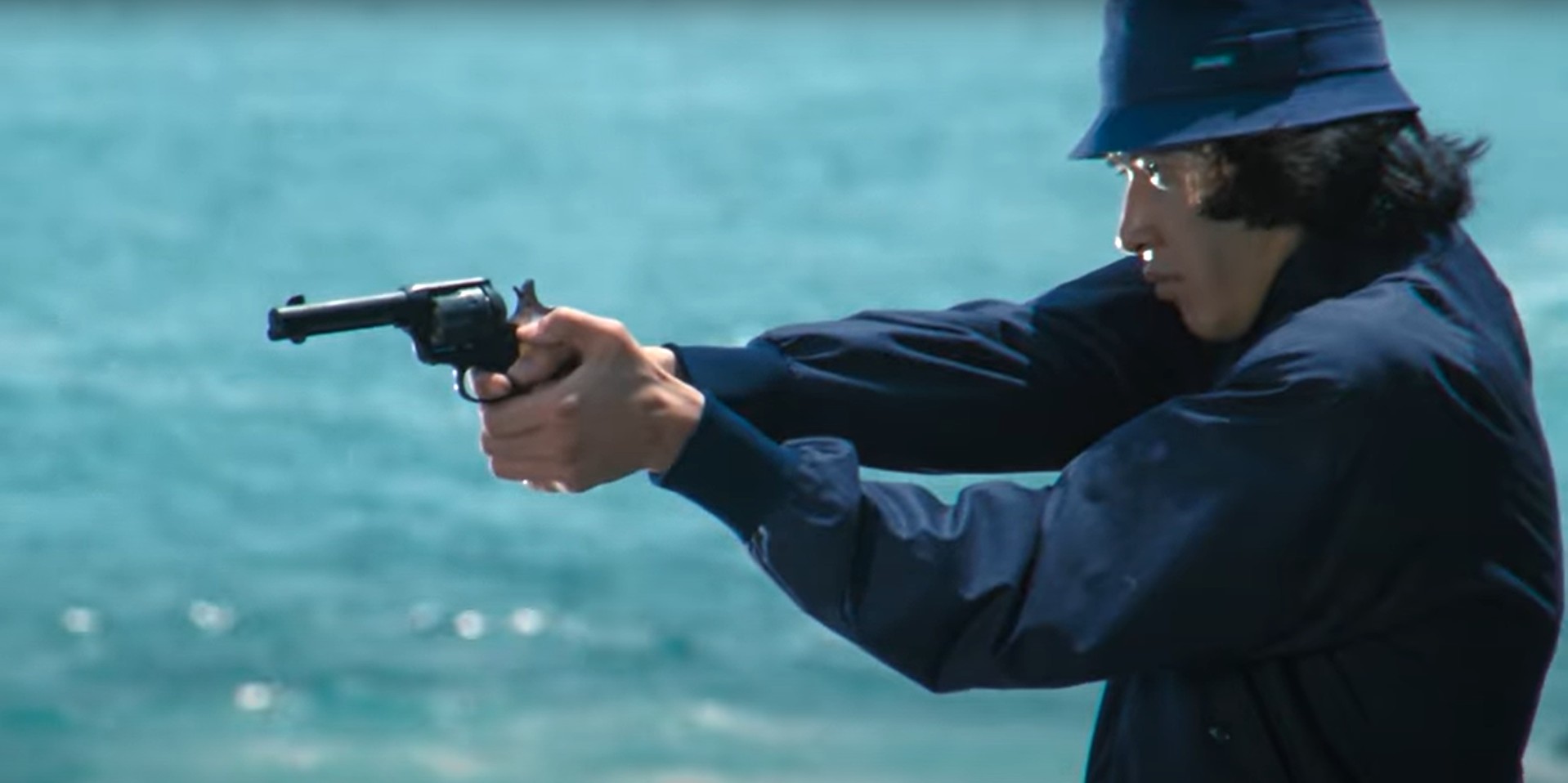
EVIL’s Path to being a Psychopath. “The Beast to Die” reviewed! (Radiance Films / Limited Edition Blu-ray)

“The Beast to Die” on Limited Edition Blu-ray from Radiance Films!

Former war journalist, Kunihiko Date, stabs a veteran police investigator to death.  He then uses the detective’s revolver and guns down three, after hours casino employees in cold blood and steals the day’s earnings.  Date’s seemingly random acts of violence and theft from a respected war journalist and photographer are not just random acts but part of a methodical plan for an upcoming heist of a bank in Tokyo’s Nihonbashi district.  Casing the bank’s security, personnel, and layout, Date’s perfect plan has one hitch; Because of the bank’s size and bustling busines, he’ll need a little help.  By chance, he comes across Tetsuo Sanada at an annual school alumni dinner with his closest friends who have a violent run-in with Sanada as their antagonistic waiter.  Seeing the same potential disregard for life and disdain for existence conventions, Date approaches Sanada and mentors him under a nihilistic wing.  Now with a plan and an accomplice, Date’s violent holdup can move forward but to what end is the length of his sociopathic carnage. 

“The Beast to Die,” aka “野獣死すべし, Yajū shisubeshi,” is the intense and violent noir-thriller from Japan, directed by “Dead Angle’s” Tôru Murakawa and a script by Shoichi Maruyama (“The Triple Cross”).  The 1980 released feature would be Murakawa and Maruyama’s second feature length production together behind 1979’s “The Execution Game,” the second film of a trilogy known as “the Japanese Game Trilogy is a visceral yakuza tale of a kidnapped hitman unable to escape the criminal underworld. “The Beast to Die” is a step away from the Japanese gangster film; instead, focuses on the interpretation of war trauma, the cynical views of precious life, and has subtle presences of U.S. big brothering, asexual themes, and coarse, unforgiving violence at the highest level of sophisticated society.  Adapted from the Haruhiko Ôyabu novel of the same name, the written origin mirrors the vehemency of visual art with the film produced by Haruki Kadokawa (“Virus”) and “The Resurrection of the Golden Wolf’s” Mitsuru Kurosawa and Tatsurô Shigaki under the Toei Company and Kadokawa Haruki Jimusho.

Undoubtedly one of the best sociopathic performances of our lifetime, “Horror of the Wolf” and the Japanese Game trilogy’s Yûsaku Matsuda is a cool, awkward, and, if not, plotting cucumber amongst the masses of jovial and hustling Tokyo denizens.  There’s a serenity about Matsuda’s Kunihiko Date that’s unparalleled, represented by blank stares, a patient demeanor, and precise movements that come in stark contrast in the film opener where Date takes down four people in one night in a show of murderous inexperienced bravado.  Even in the thick of combative survivalism, there’s only objective goal in his sweat infused brow and focused eyes while others gesture and make an invitational show of his attack or of their pleas for mercy.  Date becoming lost in classical music is a formidable way of grounding himself, not only from the high of excitement and thrills of killing, but also a way to retain sanity in the notes, an aspect he quickly unravels from when not exposed to classic music for an extended period.   Oppositely, Tetsu Sanada is full of pent-up anger as if he’s constantly hitting his head on the wall aiming to break free of the surroundings that confine his wild tiger attitude, yet Takashi Kaga (“Isle of the Evil Spirits”) maintains a personal struggle lock on the full emergence of Sanada as Kunihiko’s equal.  This dichotomy between the anger and tranquility of two sociopaths is immensely palpable that leads to a purposeful instability in a number of areas – hesitation and certainly, the sweat-inducing fear and the cooled fearless, and, eventually, the relationship’s ultimate internal destruction.  Thrown into the Kunihiko and Sanada tango is a potential love interest in the puppy-eyed Asami Kobayashi (“Sixteen Years Old:  Nymphets’ Room”) and her shared classical music and tenderness connection with Kunihiko and a happenstance Detective, played with casual approach by Toshie Negishi (“The Rapacious Jailbreaker”), being in Kunihiko’s consciously aloof presence as a pressuring force that suspects something between something off with Kunihiko and the murder of his detective colleague. 

“The Beast to Die” explores various themes around the indirect damage of post-war trauma and living and feeling like an outsider of the what’s consider the normal societal collective, but there’s another avenue to look down when consider Murakawa’s villainous protagonists.  Kunikhiko Date may have been scarred by war, but his mind always had an inkling for bloodthirst, sated through the images of a photographic lens that captured the horrors of global conflict from military losses to the collateral damage.  Upon his return to Japan, Date had lost the exciting sensation of death that has exceled his rationality beyond being Godlike, able to take life without conscious due reproach.   Sanada, in a way, is similar in his radical viewpoints but Date finds him more talk than action, held behind the line he has yet to cross unlike Date’s journalistic meatgrinder and his self-drive to kill the detective and casino workers.  As far as vices go, neither men have an appetite for sex:  Kunikhiko  watches a sex worker masturbate with little interest and his connect with Reiko doesn’t go beyond the gazes into each other’s eyes and Sanada’s fortunate relationship with his girlfriend provides him with well-off opportunity in money, business, and romance but because she dapples in rendezvous with a U.S. sailor, Sanada finds himself engrossed with spite.  Both men become essentially sexually impotent with seeing red, in anger and in blood, replacing that primal need or ravenous appetite.  The last scene between the two men becomes a crucial turning point in their cruel comradery as the forceful sex act with an unconscious woman sends the other unravelling their partnership for good.  “The Beast to Die” is a cynically cold narrative without regard for human life in the traumatizing belief one can surpass the omnipotent Gods by ending the existence of others.

A compelling dark thriller relatable to contemporary trauma feeding mentally warped violence, “The Beast to Die” arrives onto a limited-edition Blu-ray from Radiance Films.  The UK label produces a Kadakawa Coprporation-created digital 4K restoration transfer from the original and pristine 35mm print.  AVC encoded onto a BD50 and presented with 1080p high-definition resolution in a 1.85:1 widescreen aspect ratio, this Stateside edition is the picture of health with a rich palate that’s stark with contrast.  Skin tones and textures, as well as fabrics, emerge into perspicuousness without missing or dropping a beat.  Negative spaces and shadows enshroud appropriate with the keyed lit dim levels.  The grain is pleasant, stable, and natural and there are no real issues with the print itself, withstanding the test of time.  The uncompressed Japanese PCM 2.0 Stere track offers a reasonably ample sound design and fidelity with post-production dialogue, foley, and ambience recordings that creates some mismatch and distancing space between the action and atmosphere audio and the character diegetic dialogue.  There are no rough patches to mention within the audio recordings, producing more than fine discernible quality to the technical threshold.  Japanese to English translator Hayley Scanlon provides newly translated English subtitles that are spotless in the Blu-ray’s world premiere with English subtitles.  Limited to 3000 units, Radiance offers exclusive special features, including new interviews with director Toru Murakawa, screenwriter Shoichi Maruyama, and a film critique and analysis from novelist and screenwriter Jordan Harper.  The newly commissioned artwork by TimeTomorrow revamps with a new look and layout on the classic, original poster art as the primary Amaray front cover with a reversible side housing an alternate rendition.  There are new and archival essays and archival in the limited edition booklet with 27-pages of color stills, a Tom Mes Yusaku Matsude:  Lost Rebel essay from 2004 showcasing the art and films of the lead actor, a new Tatsuo Masuto essay Shadow of the Beast, cast and crew acknowledgements, and transfer notes and Blu-ray release acknowledgements.  Encoded with a region A/B lock, Radiance Films release has a runtime of 119 minutes and is not rated.

Last Rites: Radiance Films’s limited edition run of “The Beast to Die” is immaculate in every aspect – filmically, technically, packaging – and is an important piece of Japanese culture and cinematic criterion.

“The Beast to Die” on Limited Edition Blu-ray from Radiance Films!