Primitive cannibals sexually violate a brother and sister by a campfire ritual while feasting on entrails. A family in the throes of hatred and forbidden incest is torn apart between death and mercy. When these two powerful moments spur friction amongst the family, blood and betrayal runs like an unstoppable torrent. Animalistic urges take over and neither brother, sister, or father are safe from the cannibals or each other in a landscape of barren and sociopathic madness. Who will survive and come out on top of the internal upheaval when bloodlust is at its highest?
“Sangre Para la Carne,” or for the single-lingual, English-comprehending audiences, “Blood for Flesh,” is the 2019 ultraviolent and in your face gore-and-shock short-feature film from Mexican director Alex Hernández. Though completed in 2019, “Blood for Flesh” gains traction into the at-home market three years later, finding distribution on multiple independent physical media distributors as well as video streaming services. In his debut directorial, which doesn’t list the filmmaker as the screenwriter but is likely the architect of its abstract, Hernández caught the eye of another extreme auteur in “House of the Flesh Mannequins” and “Xpiation” director Domiziano Cristopharo and Italian-based TetroVideo to lift “Blood for Flesh,” fitting right into TetroVideo’s cache of erotic and extreme horror, into production and home video distribution. Shot in the arid depths of Tlaxcala, Mexico, labeled the epicenter in internationally trafficking female sex slaves to the United States, “Blood for Flesh” deluges itself with more unsavoriness, produced by Porfirio Hernández and Rodrigo Tellez Pérez.
To put it simply, “Blood for Flesh” is madness of unchecked immorality and to make something this deranged, Hernández would have needed a likeminded cast small enough to pull off callous scenes of rape, torture, and merciless death as well as aberrant scenes of incest surrounding three members of a truly messed up family. Beginning with the patriarch who is only know as the Father, played by Juan Manuel Martínez, whose subsequently becomes the violently persecuted by his own spawn after groveling at his daughter’s feet in a moment of bawling seeking forgiveness. Bound and gagged, beaten, and hung upside, the Father receives no mercy from his children and there’s no real revelation to why he’s become a subject of torture. Brother (Luis Navarro) and Sister (Erika López) fashion a complex relationship of courtship and collusion. As the Brother notes more than once in a divulging of truth the longing for his sister and his regretful reluctance in continuing the mistreatment of his father, its the Sister who seemingly has the upper hand, the hypnotic spell, over her love stricken brother and as Hernández dives into Sister’s unhinged scenes, especially where she marks her face and body with makeup, we come to realize that Sister just might not be right in the old cabeza. Now, how the cannibals – played by Christian Camara, Daniel Cruz, Enrique Diaz Duran, Aldo Palacios, and Marisela Plaza – fold into the family’s unraveling is a bit of a mystery but I’d like to think their naked savagery represents the rupture and hate between family and the cannibalism is kind of this dog-eat-dog mentality to come out on top by exploiting the other.
No matter which way you slice it, no matter how sharp the blade divides the skin, the muscle, the meat, or the bone, making sense of “Blood for Flesh” will never, ever happen as the almost an hour runtime feature, setup into chapters, is a bundle of biting brutality possibly representing a wide variety of real-world complications. The non-linear structure formulates no sensical path from beginning to end as you’re plopped right into the family’s madness from minute one and though I’m no stranger to undisguised abstract art in indie film, I can usually piece together to symbolic impressions or the weave a clear justification for most scenes in arthouse horror. With “Blood for Flesh,” I’m about as lost as a 5-year-old in a mall whose wander off from his inattentive shopaholic mother perusing the hot deal clothes racks at JCPenney’s the day after Christmas. I watch as Erika López strip away her clothes and her character’s mortality in every scene, I ponder and consider Juan Manuel Martínez’s Father’s compulsive reactions to seek forgiveness as well as to be vindictive toward his off-color and off-their-rocker offspring, and I am beguiled by Luis Navarro’s need to be inside his sister and, yet I feel nowhere near grounded to “Blood for Flesh’s” message if there is even one to be grounded to. Maybe we’re not supposed to connect with such corrosive content in what’s supposed to be just purely unabated shock content to rock the core of typicality. The cannibal scenes seem to be just an object of the director’s fascination with the ugly side of tribal horrors in a stereotyped rendition that depict them as nothing more than basal beasts that take what they want without an out of compassion and my mind continues to lean toward that high degree of barbarism to equate to a family built upon by hate, loathing, and individual interests.
“Blood for Flesh” could have easily fit in the catalogue of other extreme and underground horror labels, but this experimental purge of images and sins has found a home at SRS Cinema on the company’s Nightmare Fuel banner DVD distributed by MVD Visual. The single layer, region free, and unrated DVD is presented in a widescreen 1.85:1 aspect ratio that decompresses content around 5-6 Mbps, hovering around par for the course when considering DVD picture quality. Generally, the cinematography is bleak, like it’s content, with muted coloring or shot in the dark to avoid any colorful hues. Only when stark red filters are used, which is only one or two scenes, is when color unloads in every inch and corner of the frame. There’s some aliasing and banding in certain scenes that cause momentary distortion that make it hard to delineate exactly what you’re looking act – is it an open and bloody slit or gash or is a cheeseburger? That’s always a fun game to play. The Spanish language audio tracks come in two formats – a PCM Stereo 2.0 and a Dolby Digital 2.0. The PCM is, again, muted with a lack of robust quality the Dolby Digital has much more vigor in all the sub-tracks. Unfortunately, the pieced together soundbites lack creativity and are poorly spliced together that continuously drop off in an instant on the backend. The forced English subtitles synch okay and are captioned well. Bonus features include a filmmaker’s commentary track, interviews with the cast that come with awful Spanglish translations, and the film’s trailer. If Domiziano Cristopharo saw something unique in Alex Hernández, I have yet to see it as I’m not sold on the director’s fringe horror film that aims to just be randomize acts of violence for 59 minutes.
Sylvia Kristel. A name that is synonymous to eroticism. Kristel paved the way in mainstreaming seductive romances of softcore exploits, helping to elevate the provocative genre out of the depths of sleaze and into a more exotic trashy novel for the big screen. In her titular role in the “Emmanuelle” franchise coursed an arousing path of sexual freedom, uninhibition, and became the sumptuous and worldly window in private fantasies. Playing the role for nearly two decades didn’t stop Kristel from other high profile and lucrative projects with an array of filmmakers as well as her roles pre-“Emmanuelle” that molded the Netherlands actress into a sexual icon rather than object of male fantasies. Cult Epics acquires four films – “Playing with Fire,” “Pastorale 1943,” “Mysteries,” and “Julia” – that even though didn’t have Kristel set as a principal lead still showcased her range within the constraints of a minor, but certainly not insignificant, performance.
“Playing With Fire”
In a madcap Paris where sex trafficking is something of a sport, a wealthy French banker learns his daughter has been kidnap and threatened to be tricked out or burned alive if the kidnappers’ ransom isn’t paid. Quickly learning that another woman has been mistaken for his daughter, a wave of relief bestows him to be cautious about future attempts on his daughter’s safety. The banker hires a private detective to protect his loveliest of assets, offering to escort her to a local safehouse with the promise of sanctuary, but the P.I. is operating incognito being really one of the leaders of a surreal and lavish brothel who now has the banker’s beautiful daughter in his possession. Or is it her who possesses him?
Unlike any other exploitation-comedy you’ve likely ever seen, the 1975 released “Playing with Fire,” aka “Le jeu avec le feu,” is a wacky deep-dive of surrealistic sex trafficking from French writer-director Alain Robbe-Grillet whose obsession with prostitution rings and other filmic eroticism pursuits extends back within a decade later with “L’Immortelle,” aka “The Immortal One,” and “Successive Slidings of Pleasure.” A French production of Arcadie Productions, Madeleine Films, and Cinecompany, “Playing with Fire” masters the avant-garde art of making light of a grim topic that results in a pull of emotions. Robbe-Grillet draws out the shocking aspects of sex slavery while also encouraging a smirk or a chuckle at the whimsical characters and shooting techniques weaved throughout a burlesque narrative. Robbe-Grillet also plays with the theme of dualities with a number of the principal characters having two or more versions of themselves: Philippe Noriet plays not only the banker father Georges de Saxe but also a voiceless sleaze erotically interacting with the banker’s daughter in a very Freudian concept between father-daughter relations. His daughter, Carolina (Anicée Alvina), disguises herself as the thin-mustached private detective to thwart future any attempt at an abduction and there’s also the identity mishap with the similar looking woman mistakenly kidnapped by the ringleader. Leading us into Jean-Louis Trintignant as the ringleader Franz constantly in a revolving door switch-a-roo façade into the private detective. The presence of duality doesn’t stop being a present throughout, continuing with the banker’s butler who is also a whorehouse patron without affirmation that they’re the one and same person. Before their illegal banishment in the mid-20th century, Brothels were widely dispersed throughout Paris, but not until the Nazi occupation absorbed the houses of ill-repute that seared a bad taste of deviant humiliation and sordid disgust into the mouths’ of the French populace and Robbe-Grillet taps into that once time of unrest by splicing in a pair of isolating scenes of goose-stepping Nazi soldiers with one of the moments garmenting Anicée Alvina in uniform and marching in the ranks, suggesting a more sinister subplot afoot in the storyline. Kristel plays one of the women snatched by Trintignant’s efficiently devious Franz with virtual a voiceless performance in what’s only a symbol of strength and beauty that sets perversion ablaze as she’s taken through the motions of essentially onboarding her into slavery whoredom. “Playing With Fire” can be at times difficult to keep up with the Alice in Wonderland-like surrealism and the character dualism but persists unwaveringly with a multi-faceted narration of deceit, eroticism, and comedy full of perversions and random outbursts akin to satirical skits that make this film unpredictable yet enjoyable to behold.
Pastorale 1943
During the Nazi occupation of the Netherlands, a quaint Dutch farming village lives day-to-day alongside soldiers and German sympathizers known as National Socialists (NSB) to the Nazis, traitors to their fellow Dutch countrymen. When the Nazis learn of and round up all the dissidents and Jewish heritage people living in hiding on an adjacent, ferryboat island, a small band of unorganized resistant fighters determine the local pharmacist, a NSB member, to be the Nazi collaborator responsible for the treacherous leaking of information because his son impregnates an island village girl, teetering toward the fascist movement when mocked by her peers for her involvement with the pharmacist’s son. Inexperienced in the execution of traitors, the bungling resistance fighters learn just how difficult planning a murder can be when their scheme falls apart in a small village where everybody knows everybody.
On this second of four Sylvia Kristel features is the Spieghel Filmproductiemaatschaappij of “Pastorale 1943” which makes more prominent the Nazi regime, is set with a backdrop of a Nazi occupied Netherland town and has a cameo role of young and dashing Rutger Hauer (“Blind Fury,” “The Hitcher”). Netherland writer-director Wim Verstappen, whose had a few titles released previously from Cult Epics, such as “Obsessions” and “Blue Movie,” develops a script out of the World War II drama novel from author Simon Vestdijk with black comedic undertones and a tinge of corrosive sexuality and released the film in 1978. Pastorale, or Pastoral, refers to the typically calm and idyllic country life which the complete opposite in 1943 Netherlands with all of Europe and East Asia engulfed in war; however, this story takes place in its own corner of the world with a mini, damn near microscopic, war waged between the Nazis occupation along with domestic NSB collaborators and the inhabitants resisting against the encroaching fascism that has plagued revenue crops and instilled an authoritarian culture, such as mandating the teaching of the German language to students in Dutch schools. Kristel’s involvement with Verstappen’s “Pastorale 1943” is about as much as her involvement in “Playing With Fire” with a minor role that’s still a keystone piece to the narrative. She plays Miep Algera, a local schoolteacher disparaged by her neighbors and colleagues for having romantic relations with a Nazi officer, but has she really fallen for the officer or is she secretly conducting counterintelligence for the resistance? “Pastorale 1943’s” two-part story plays heavily embroiling and embroidering characters in the first half to the point of instituting a cornerstone character but when the narrative pivots, to the darker side of implied Nazi exterminations and the fumbling through the execution of a rightfully innocent man, Verstappen homes in on Frederik de Groot as the artist Johan Schults whose Germanic surname causes him much strife amongst his Dutch brethren but to prove himself, Schults takes charge, along with an equally green execution squad of resistance politicians, to murder the NSB collaborator, a local pharmacist Poerstamper (Bernard Droog). The Academy Award submitted “Pastorale 1943” can be light and funny then turn quickly on a dime into wartime darkness and director Wim Verstappen’s vision pops with epic World War II fascism atrocities, confined to one part of the world and without the explicit voyeurism of genocide.
“Mysteries”
After the strange suicidal death of a man named Karlson, Johan Nagel arrives to the coastal town where the death occurred. Immediately, Nagel stands out from the supercilious eccentric residents with his mustard yellow suit and fur coat, dispensing small cigars and money to everyone and every service as if they were infinite, and exhibits his own brand of strange behavior, especially with amorous feelings between two women and an unlikely friendship with a dwarf who has accepted his neighbors’ belittling jabs for humorous pleasure. As his behavior declines, Nagel’s presence unravels the coiled, seemingly impenetrable, barriers around his friends, his enemies, and his romantic pursuits that reshape their properties for the better at the dangers of his own sanity and life.
Finally, we’re at a point in the Sylvia Kristel collection where the titular star is in a lead role with this demolition of concrete idiosyncratic personalities melodrama entitled “Mysteries” from Dutch filmmaker Paul de Lussanet, based off a novel “Mysterier” by Knut Hamsun, with Sigma Film Productions as the production company. Kristel plays the steely Dany Kielland who becomes the infatuation of Nagel in an oppositional performance beautifully deranged and conducted by Rutger Hauer. The hot-and-cold and on the brink of frustration relationship between Kielland and Nagel is as resolved as an unfinished breakfast left to waste and void of complete nutrition as both characters digest morsels of desire only to explode in a frenzy of loathsome disgust in an unsavory, brittle dynamic only Hauer and Kristel could produce on screen. The other love interest involved, yet hardly feels as such until the last half hour, is an aged and more humble Martha Gude portrayed by “Last Night in Soho” British actress Rita Tushingham complete with a poor-looking frosty-colored wig. Kielland and Gude represent the two-side of society – rich and poor respectively – stuck mastering a stanch stance of an indeterminate state that Nagel barrels into and knocks down the status quo, like a bowling ball to ten pins, for the better of the coastal town. None of what Nagel does seemingly makes any sense and that’s very true to Hamsun’s novel in the unconventional, and probably unintentional, methods of Nagel’s erratic influence. “Time Bandit’s” David Rappaport debuts in his first feature film as Grogard, an achondroplasia character bulled by most of the town’s residents due to his disorder. Grogard anecdotally tells the story as “Mysteries” narrator, as if reading straight from Hamsun’s novel, the recollection of Nagel’s dichotomic behavior and, at the same time, Nagel also being a mentor, protector, and a friend that pained Grogard to watch his friend whither to death in fit of emotional exhaustion. “Mysteries” borders arthouse cinema, adaptive faithfulness, and pristine melodramatic performance that sound good in theory but not always translate well to the screen, leaving more of a perplexing impression on the whole purpose of rendering Knut Hamsun’s novel into film in the first place.
“Julia”
Every year, Patrick departs his boarding school for a short holiday with his father and relatives at his grandmother’s idyllic lakeside house. While riding the train en route to his grandmother’s, he encounters an older, yet beautiful, blonde woman inside the passenger carriage car and before he can firm up courage to act upon his sexual brimming hormones, the blonde is swept up by an older gentleman right from under his nose. Come to find out, the blonde woman is actually his father’s girlfriend in a completely open relationship when it boils down to sex. Anxious about his own insecure sexual appetite, Patrick finds himself surrounded by the perversions of his family and friends, leaving the young man hesitant and nearly impotent in bedding the woman he actually cares about, a longtime friend Julia who lives next door to his grandmother.
On the heels of “Emmanuelle,” Sylvia Kristel follows up with another licentious freedom film in Sigi Rothemund’s “Julia.” Also known as “Summer Girl” or “Die Nichte der O,” the German production from the Lisa-Film company is the earliest film on the 1970s collection with a release in 1974 and is the only other screenplay on the collection next to “Playing with Fire” that is not adapted from literature. Instead, “Julia” is a wild romp ride of young sexual exploration and the anxieties that accompany it from an outlandish and witty script by Wolfgang Bauer. “Julia” might not be based off a book, but the story is certainly an unapologetically open book about the insignificance of virginity, polyamorous affairs, lesbianism, voyeurism, and the sexual rite of passage into adulthood with the young and naive principal Patrick, or Pauli as credited, played by the late Ekkehardt Belle who passed away in January of this year. Opposite Belle, Sylvia Kristel obviously dons the titular role of Julia. Inexplicably voluptuously different from the other three films on the collection, Kristel radiates a sexual aurora perhaps infected by proxy of its release soon after “Emmanuelle” as Kristel obvious branches out to more sensible dramatic roles rather than the decor of a German sex comedy such as “Julia” that galvanized by its free-for-all eccentric caricatures including an operatic, overweight, and perverse uncle Uncle Alex (Peter Berling, “When Women Were Called Virgins”), a highly aggressive lesbian in Aunt Myriam (Gisela Hahn, “Devil Hunter”), the house maid Silvana who Myrian seduces with whipped cream and has piano-top sex (Christine Glasner), and his polyamorous father Ralph (Jean-Claude Bouillion, “The Sextorvert”) and girlfriend Yvonne (Teri Tordai, “She Lost Her…You Know What”). Comparatively flimsy next to “Emmanuelle” as a sexual journey and coming of age film but “Julia” is a hot-to-trot sex comedy with funny bits as well as sultry naught bits too.
Beautifully curated for the first time ever release in the United States of all four films is Cult Epics’ “Sylvia Kristel: 1970s Collection” on Blu-ray and DVD. The 4-disc, uncut Blu-ray, which was provided for coverage, is region free, limited to 2500 copies, and perfectly packaging to extol praise upon the robust early career of Sylvia Kristel. Presented in European widescreen 1:66:1 (with the exception of “Playing with Fire” which is displayed in an anamorphic 2:35:1), each film is newly scanned in 2K from the original 35mm elements as well as been restored. Transfers for the most part are exquisitely pristine, each harboring their own mise-en-scene mélange, but some are better than others with “Mysteries” sitting at the bottom rung of showing slightly a few more scratches and one-or-two single frame damages that flame up through the reel briefly. “Julia” also has minor scratches, but that’s really the extent of the issues with the image quality on this restored visual released with a rich color palette and textures redefined for a better palpability. Compression issues are virtually non-existent and there are no tinkering enhancements or cropping used to skirt transfer limitations. I am in awe of the audio output of the 1920kps bitrate, transmitting the highest audio quality possible for each release through either DTS-HD Master Audio 2.0 or a LCPM 2.0. Dialogue clarity comes through cleanly with French in “Playing with Fire,” Dutch and German in “Pastorale 1943,” and German in “Julia.” “Mysteries” sounds a bit muddle sometimes due to the consistently background popping interference, but the Dutch language still pulls through strongly and discernibly. Each film comes with optional English subtitles. Special features are aplenty with audio commentaries by Tim Lucas, Jeremy Richey, and Peter W. Verstraten, new and vintage interviews and promotional footage with cast and crew on ‘Playing with Fire,” “Pastorale 1943,” and “Mysteries,” a poster and still gallery on each release, and original theatrical trailers. Outside the disc contents, the collection’s rugged cardboard boxset housing unit consists of a 4-disc snapper case with vintage-still collage cover art, a 40-page illustrated booklet with color pictures and an essay on all four films written by Jeremy Richey, and a cover art poster by Gilles Vranckx. Total runtime is 429 minutes, enough to get your Syliva Kristel fill and then want more…much more. The “Sylvia Kristel: 1970s Collection” lauds the actress’s versatility of performances and ability to work with any director from any country and fans who love “Emmanuelle,” or of just Kristel, will undoubtedly fall in love with this Cult Epics comprehensive look at the Dutch icon’s outermost filmography.
On the verge of moving from her quaint apartment, Jennifer begins her morning caring for her son, Nico. Throughout the morning, her complex neighbors come knocking at her doorstep with unusual behaviors, even so with the mailman who apathetically leaves her bathroom a mess after requesting an urgent need to use the toilet. After leaving Nico with an elderly woman in an adjacent unit to do some light shopping, Jennifer comes home her son and neighbor not answering the door and figures they went out for a while. As time passes and her anxiety builds, Jennifer decides to soak in a relaxing bath but when she falls asleep, she awakes amongst a pile of dismembered bodies, subjected to ultra-violent video recordings of the neighbors who she saw earlier, and a masked maestro of anguish to help Jennifer regain life purity through pain. Through the layers of suffering, the ugliness Jennifer has to endure to survive and find her son might be an awakening she will forever regret.
From the violence saturated mind of German auteur Olaf Ittenbach comes a battle of conscious, a gore waterlogged vision, in his 2010 blood-shedding shocker, “No Reason.” Now, I may be over a decade late to the party on this title, but Unearthed Films has brought a newly remastered, fully uncut Blu-ray to physical and virtual retail shelves, reviving the “Legion of the Dead” and “The Burning Moon” filmmaker’s title from the North American grave as the Intergroove Media DVD has been out of print for a long time, and kicking my ass into high gear with diving into the surreal expressionism, splayed into every nook and cranny, of deviated behaviors and splintered thoughts. “No Reason” is a production of Ittenbach’s IMAS Filmproduktion studios and co-produced by German SOV splatter film connoisseurs, Michael Nezik and Ingo Trendelbernd.
Like Alice traversing a macabre-cladded hell on Earth wonderland is Irene Holzfurtner as the confused lost soul Jennifer More or less fully naked and bloodied half the story, crossing through portals of layered perdition in order to find her son and saving grace, Holzfurtner has insurmountable perplexity hung across her character’s face in the midst of being plopped into bedlam, taking the character on a journey pain, torment, and enlightenment bare ass naked and covered in blood in a metaphorical rebirth. Overseeing Jennifer’s trial and tribulations into being brought back reborn as it were is a sadist donning a crude Cthulhu mask and strapped tightly into a medieval BDSM attire who speaks in riddles and verse to sermonize his cathartic guidance. Markus Hettich towers a monolithic man of pain and pleather, calmly exercising his shrouded authority a healthy amount of sadism, masochism, and sadomasochism in order to undress the falsehood of Jennifer’s split spirit. Hettich pins an ideal Devil-like antagonist, rupturing through the connective tissues of the psyche with a lingering omnipresence that delivers shivers down the spine. Mathias Engel, Alexander Gamnitzer, Andreas Pape, Annika Strauss, Ralph Willmann, and Hildegard Kocian make up the supporting cast who are most cooperative being exploited by the violence and nudity that accompany their ill-fated roles of humiliation, torture, and inevitable gruesome death.
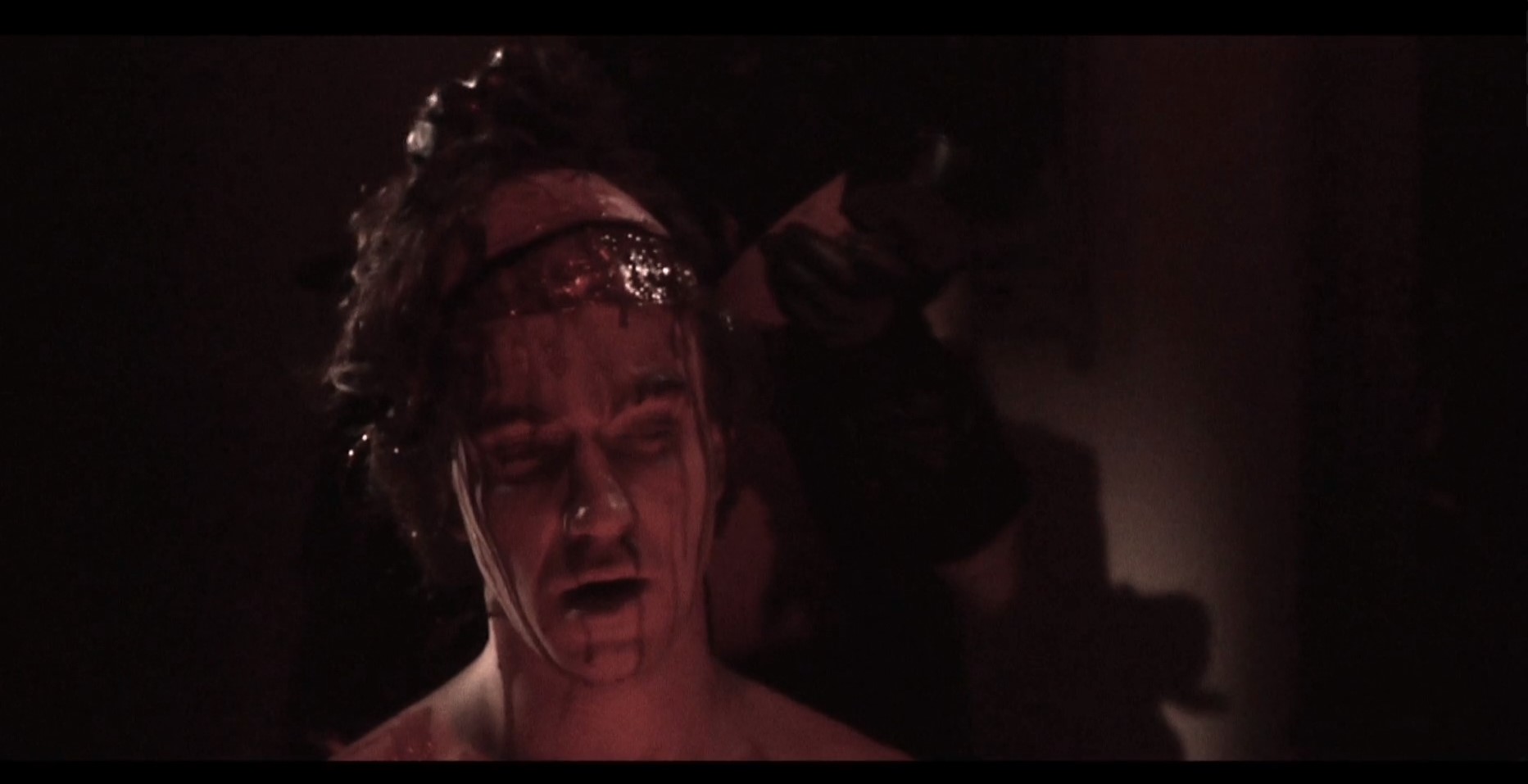
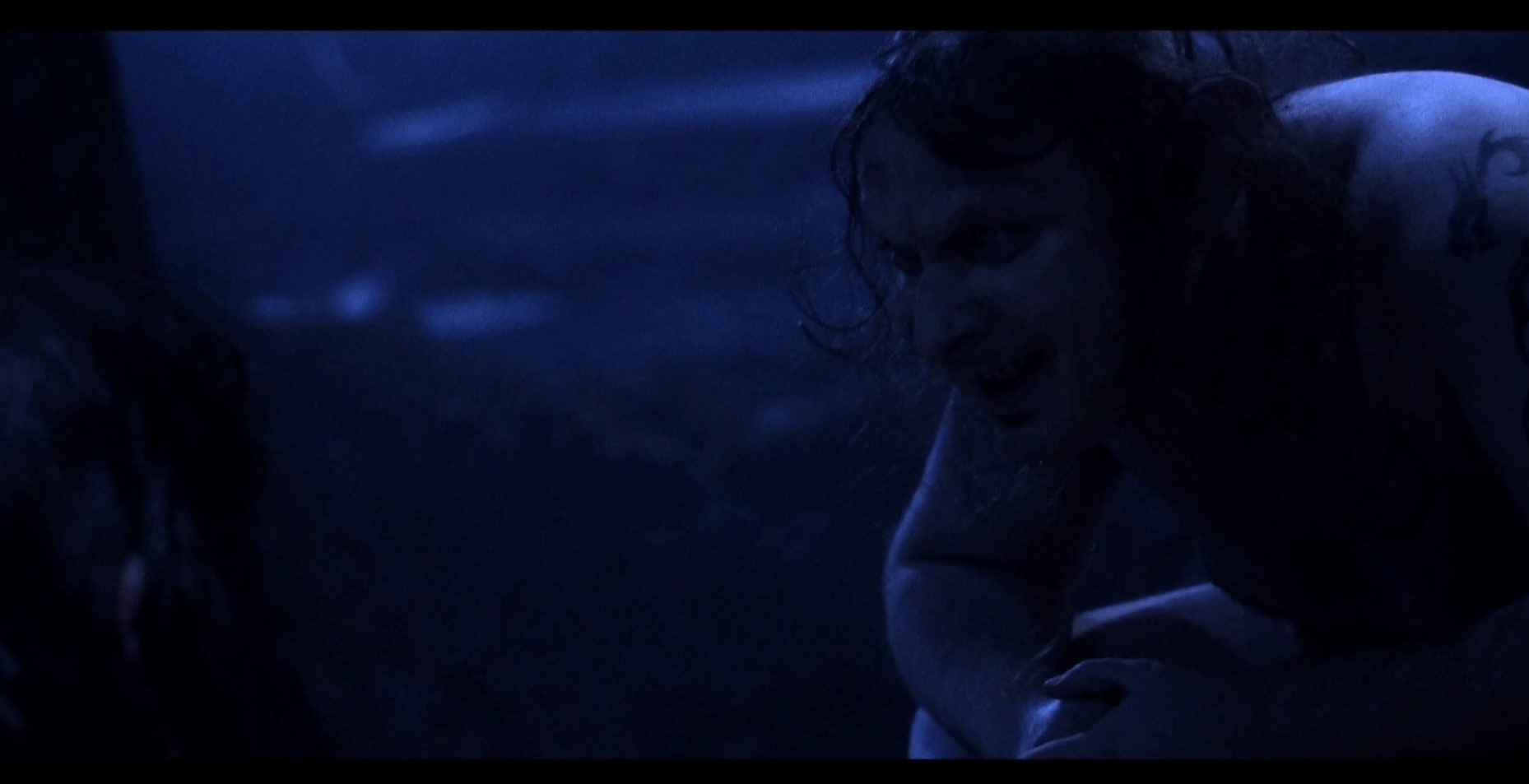
Ittenbach obviously brings the gore but the controversial director, who has sparked backlash for glorifying violence, brings a beaming arthouse allure to his “No Reason’s” gargantuan bloodletting. Layered with multi-colored conjectures point to the unhinged state of a mind, Jennifer endures unspeakable anguish in layers encoded with red, green, and blue, each specifically engineered by the masked man to trigger a response when testing Jennifer’s will; a will to what end is something you’ll need to watch the film to understand. What I can tell you is that each color stage bares a horrific theme – red is simply the spilling of innocent blood, green is feminine dominance symbolized by BDS&M (a running motif throughout) where uninhibited women urinate on men (explicitly shown), castrate by oral sex, and divulge themselves with lots of male body disfiguration through whips, chains, and other large dominatrix toys, and blue is filled with mutants who are just as ugly on the inside as they are on the out. Completing each stage costs Jennifer bodily harm as a reparation for staying on the path of enlightenment, the white layer. With a little money behind the project, Ittenbach’s able to accomplish some fantastically brutal scenes with fleshy prosthetics and I, personally found the intro credits to be insanely power in it’s composition despite the simplicity of it. Where “No Reason” buckles is the crux of Ittenbach’s artistry with the parable that borders nonsensical guff. I’m not going to lie, “No Reason” is difficult to follow from the pre-opening credit epilogue home movie montage of Jennifer and her parents frolicking on the grass, praising Jennifer’s smarts at such a young age, to the post-opening credit opening of a naked and bloody Jennifer holding a detective hostage, to the surreal cerebral journey through a timeless purgatory horror house Jennifer finds herself trapped, the segues, if any, often feel omitted and we’re left to assume the rest.
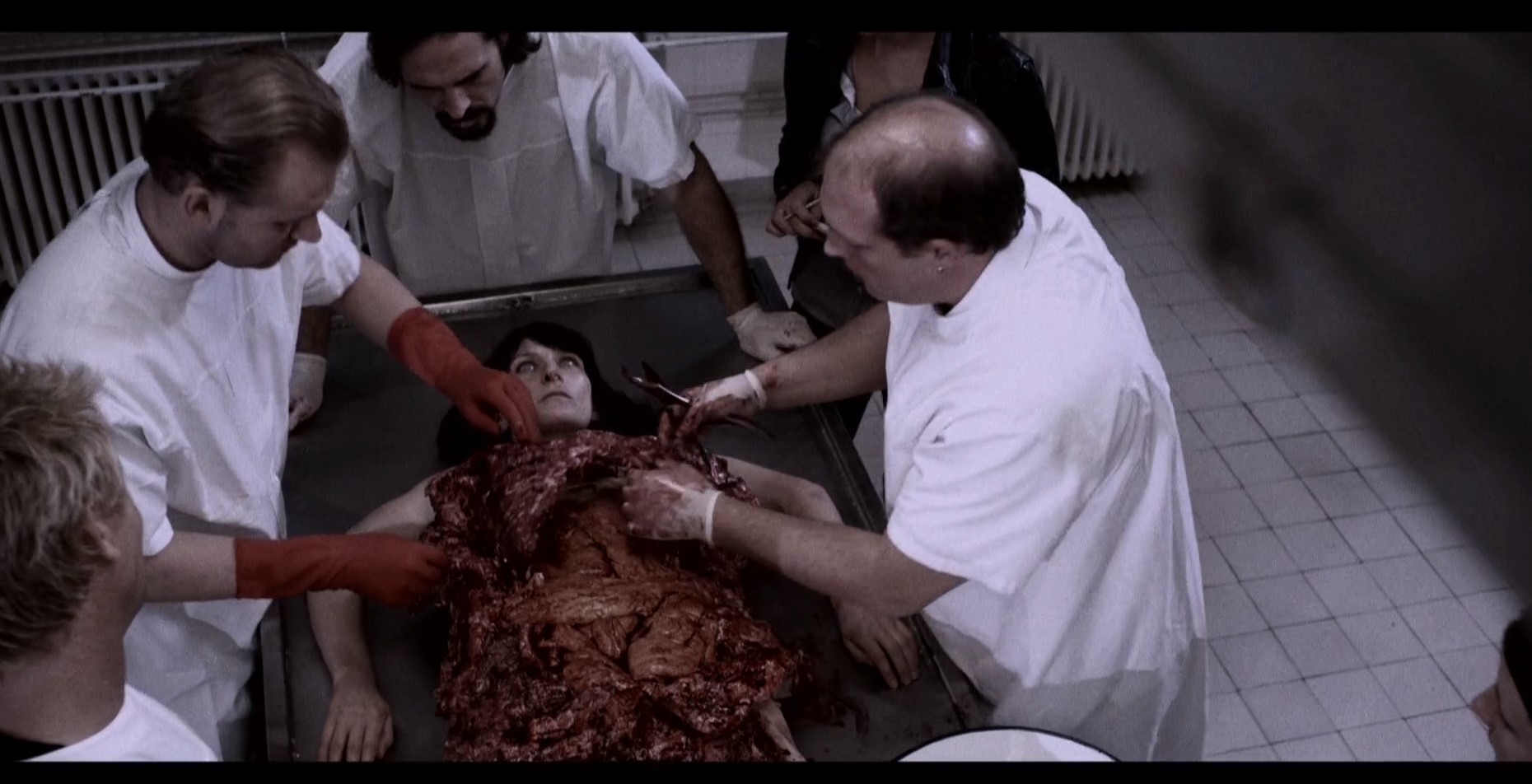
The brisk 76 minute runtime perfectly balances the right amount of abstract story and gore and, now, “No Reason” has a better reason for your attention with Unearthed Films’ new scan of an uncut Blu-ray release! The May release is presented in a high definition, 1080p, widescreen 1.76:1 aspect ratio. I can’t comment too much on the audio and visuals as a digital screener was only provided, which means there were no extras accompanied with the screener as well. “No Reason” is the first collaboration between Ittenbach and director of photography, Axel Rubbel. The pair went on to work on Ittenbach’s “Savage Love” two years later, but Rubbel has more of an imprint with Ittenbach’s candy-coated eye-popper gorefest with a kaleidoscope of blushes a tinged aberrant from the normal blacks, reds, and browns that blotted onto gore and shock films. The release will include two German language audio track options, a 5.1 surround sound and a stereo 2.0. Both should include English subtitles and, if the Blu-ray is anything like the digital screener, the subtitles are synched well with the dialogue and, from what I can tell, are grammatically error free. My abnormal brain can choke down the free-for-all soul-damaging ultra-violence and gore charcuterie board and Olaf Ittenbach’s “No Reason” fits that bill with a wide berth of exhibited atrocities while also coming up for air by attaching a misdirection substance behind the graphically lurid details of skin ripping from the muscular tissue and flesh lacerated to shreds by a cat-o-nine tails to ease us into the tumultuous mind of a psycho’s path.
The years following the third World War, America has been overrun by the Governments very own super soldier weapons project involving splicing the human genome with pig DNA. The creatures, dubbed Muzzles, have occupied the country 25 years later and have turned the tables on the human species, capturing, breeding, slaughtering, and eating their packaged to serve meat. When humanity created a toxin to combat the Muzzles, they inadvertently released a gas that sterilized the entire human population and the last of the human survivors have formed a resistance who aim to seek out and destroy The Mother, the continuous Muzzle breeder no man has ever seen, but is supplied large volumes of man meat in order to maintain Muzzle production. The task to root out the mother’s trough of carnage falls upon Rob, a human bounty hunter working for the resistance, and his mustache sporting Raksha, who never loses a fight. Together, Rob and Rahska butcher their way through a pigsty to locate and kill The Mother, but not every human shares their hope for mankind.
“Bullets of Justice” is a hog wild, Bulgarian-made, bulldozing bloodbath of a post-apocalyptic exploitation may-ham from the warped (or genius?) minds of co-writers Timur Turisbekov and Valeri Milev with the latter sitting in the director’s chair. Milev, who directed the 6th installment, “Last Resort,” of the “Wrong Turn” franchise, collaborates with first time filmmaker Turisbekov and pulled out all the stops in this outrageously funny, insanely gross, and eyebrow raising delicatessen of deprave cold cuts. Initially considered as a pilot for a television series and later tossed around as a potential short film, “Bullets of Justice” found invigoration and traction as a feature length film from premise’ author Timur Turisbekov that led to a crowdfunding campaign on Indigogo to cover the remaining post-production costs of all the material shot by Turisbekov and his friends. Zenit TT serves as the production company.
Blasting away sounders of swine, graced with the visual effects washboard abs, and is able to score tail of every single last human woman he comes across in this dog-eat-dog world, even his sister’s, is Timur Turisbekov as humanity’s last hope, Rob Justice – hence, “Bullets of Justice.” Rob’s a stone-faced and skilled Muzzle gravedigger with a penchant for being one step ahead of everyone else and Turisbekov can act out the part of an untouchable 80’s action hero with relative ease complete with fancy fighting choreography and a thousand yard stare and though the dubbing track is undesirable, it satirically plays into the black comedic satire of the man versus pig post-war consequence conflict narrative and there’s a score of characters with all sorts of dialect dubbing that doesn’t single out just Turibekov. Rob’s sister, Raksha, stuns even with a stache on the upper lip of the darker attributes of Doroteya Toleva in what is perhaps her most memorable, if not most bizarre, performance that adds more of an aggressive balance to Rob’s stoic demeanor. “Bullets of Justice” freely offers up plenty of nudity to go around from male full frontal to female full frontal though neither Turisbekov or Toleva bare them true selves as body doubles and movie making magic fill in the private parts, but there’s plenty of dirty, glistening in sweat, real skin from actresses, such as stuntwoman and actress Yana Marinova (“Lake Placid 2”) and the introduction of Ester Chardaklieva, to fill that authenticity void plus a few heftier and plump extras in the roles of slaughterhouse pig fodder. What’s most frustrating about these quintessential apocalypse and ostentatious characters is that their development and arcs never, ever come to term of a poorly knitted post-production. I wanted to learn more about the antagonist with “the most beautiful ass,” Rafeal, played by male belly dancer Semir Akadi, I wanted to understand Askar Turisbekov’s General Askar betrayal, and even dive into what drove “Machete’s” Danny Trejo’s Godless dogma as a single parent to young Rob and Raksha in his small bit role. “Bullets of Justice” rounds out with Dumisani Karamanski, Alexander Ralfietta, Neli Andonova, Gregana Arolska, Svetlio Chernev, Dessy Slavova, and Doroteya’s twin sister, Emanuela Toleva, in a small dream role.
Being spurred as a potential television series or a short film, “Bullets of Justice” barely formulates a step-by-step story as the genesis of a surreally articulated full length embattlement with pre-scripted, pre-funded, and pre-shot scenes full of head turning high cost stunts, explosions, and with World War II replica weaponry (50 caliber, MP 40, STEN, etc) of already completed shots for a particular medium in mind, which was unfortunately not a feature. This is where post-production needed to step up to fill in the gaps, to muster visual segues, in order to piece the unsystematic scenes into a single unit of thought, but the second act inevitably goes off the rails as taut tangents snap like over tightened cable cords when Rob and Raksha team up to flush out The Mother and then one of the next scenes has Rob smack dab in the middle of being teleported, his future has developed the mode of travel through time and space, and while the viewer tries to interpret whether this is a dream or a style of the director’s auteur expression, Rob is actually teleporting to, well, we don’t really know where initially. Crucial backstory elements come whirling in to explain Rob trying to go back to the year just after the third world war to unearth where the mother might be hiding, but keeps missing the exact date. How Rob gets back to his own time is not known; Yet, these series of unexplained inconsistencies reap the benefits of such a gory good time that includes midgets firing submachine guns and dropping grenades out of the jetpack of a flying pig-man wielding a minigun on each arm – an entirely insane concept. Is “Bullets of Justice” a well-made, well-rounded film that would make your film professor proud? Probably not. Yet, here’s the kicker, a theory of mine that might explain everything. Rob Justice is actually daydreaming the entire degrading society where he is the lone savior of mankind, never missing a target, bedding all the women, idolizing a villain, and that end shot ties those concepts all together. Again, just a theory but it’s a damn good one.
A highly-recommended blood, sex, and pigs with machine guns exploitative romp and ruckus, “Bullets of Justice” overindulges with vice transfixing visual and imaginative dexterity that can now be experiences on multiple VOD platforms such Amazon Prime, Apple TV/iTunes, Google Play, Xbox, and Vimeo distributed courtesy of The Horror Collective (“Blood Vessel”). Orlin Ruevski’s cinematography is impressively expensive without actually costing an arm and leg with a well stocked cache of wide shots that capture the simulated war-torn world and girth of rural landscapes while simultaneously, through the use of low contrast and darker color tones, harness shots of grime and graveness of the Turisbekov’s pig-utter chaos that ensues. Combine Ruesvki’s expeditiously confident totalitarian style with the campy visual sfx from the Bulgarian based Cinemotion LTD, same visual effects company on “Tremors 5,” a rare and beautiful species of film emerges from the edge of rotoscoping to the go-big-or-go-home ludicrous-speed composites. Since this is a digital release, there were no accompanying bonus materials or scenes. With non-stop melees and a flavor for the tasteless, “Bullets of Justice” rattles along as a pure, uncut dystopian fantasy big on the pig and galore on the gore.
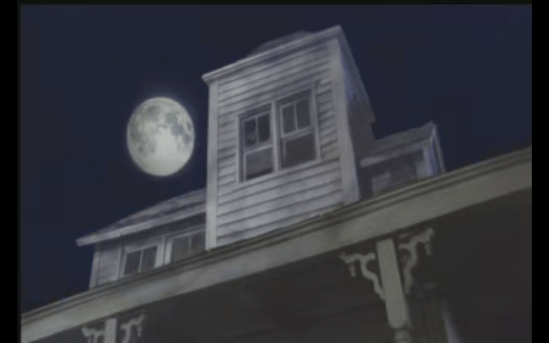
Julie, troubled by her mother’s suicide one year ago, is forced by her deadbeat dad to accompanying him in cleaning up an old house he purchased for renovation and resale. As he takes off to attend to “important business” at the local watering hole, Julie is stuck alone with the mop and bucket inside a mysterious, rundown house she’s suspicious of being haunted after strange occurrences and horrifying visions transpire during her isolation. Lurking beneath the house and seeping through inside the rusted pipes, a figureless water demon’s presence persists with malicious intentions and things become worse when Julie’s friends check in on her. Drowning in the supernatural seepage amplified by Julie’s trauma, they become trapped on the property that won’t allow them to escape, draining them of hope against a bodiless, hell-bent entity until a certifiable exorcist shows up at the door arrogantly confident of ridding the flood of evil from this house for good.
Back in the year 2000, Brett Piper’s written and directed volatile ghost house feature, “Drainiac,” saw the light of day for the first time on DVD home video. Unfortunately, through the dismal proceedings of post-production funding and a less than enthusiastic distribution company, that version of the film is undercooked and unfinished in the artistic eyes of Piper who worked with a slim budget of $10,000, making every detail crucial and required to flavor the dull taste of anemic financial support. Luckily for the “Queen Crab” director, his collaborations with Shock-O-Rama Cinema, a sublabel to the indie film doting POPCinema, gave the 20+ year indie filmmaker access to digitally remaster to ultimately finish “Drainiac,” leaving the issues with the previous version water under the bridge, water related pun intended. “Drainiac,” believe it or not, has extraordinary relate-ability to today Americans who are frightened from the mistrust of confidence in their local water treatment systems and drainage pipes for the fear of lead poison and other harmful contaminants, which, in these affected citizen’s circumstances, is a “Drainiac” monster of sorts, hidden from sight with an uncertainty of product quality that drips from their faucets and into the bathtubs their kids play in and into their water drinking glasses.
Another amazing aspect of “Drainiac” is the fresh-face, young cast in their humble beginnings that flourished into solid careers and feels absolutely energetic and stimulating to know their roots reach far back to a cellular grindhouse organism becoming their vocation life. Georgia Hatzis debuts as the beleaguered Julie, a resilient survivor of her mother’s suicide with an oil and water dynamic with her estranged live-in father. Maintaining Julie’s sanity while still fronting a stable façade couldn’t be easy, but Hatzis builds upon Julie’s strength and owning the character’s self-doubt. Hatzi extended her career into television, but Julie is her most memorably performance, especially braving bathing full front to be attacked by a drain’s quasi tentacle erotica sequence. Perhaps the most recognizable face in the film co-starring in the film in her mid-teens, Alexandra Boylan is conscripted to be Julie’s best friend, Lisa. Boylan, who went on to have roles in “The Hitchhiker” remake and the invasive thriller “Home Sweet Home” as well as branching out into life behind the camera as a producer and writer, plays consistently a rationally steady bestie that grounds Julie when needed and is the firm leader of their group of friends that also includes a shaky and nearly spineless Jake (Ethan Krasnoo) and a shallow beauty Tayna (Samara Doucette). As the black sheep in the group, perhaps not even a friend at all, was Wade, a hog riding, wisecracking jerk who didn’t have sense of personal space, especially when the rapey urge washes over him. Wade is an abhorrent human being that came to life due in part of Robert Gorden’s performance. Soon to be seen in the television comedy entitled “My Wife Divorced Me Because I’m a Zombie” that is taglined “The Walking Dead Meets Modern Family,” Gorden will make you hate his guts and despise his obnoxious 90’s haircut and wardrobe and the overall package is enjoyably cathartic to have him pitted against a conventional set of friends. Other colorful talent includes roles by Philip Barbour as an exorcist who reassembles the fisherman Gordon from the frozen fish stick packaging, Steven Bornstein as the despicable dad of the year, Todd Poudrier as a melting derelict, “Sgt. Kabukiman N.Y.P.D.’s” Andrew Osbourne as the melting derelict’s friend, and Elizabeth Hurley! No, not the Austin Powers’ Elizabeth Hurley, but an Elizabeth Hurley nonetheless!
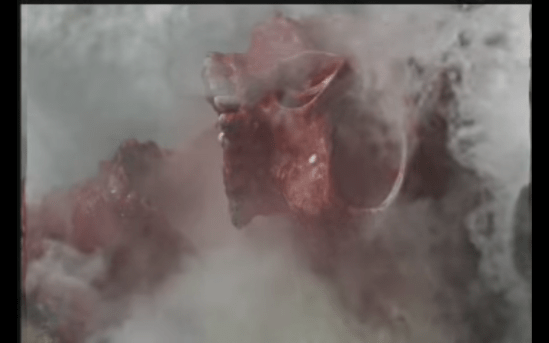
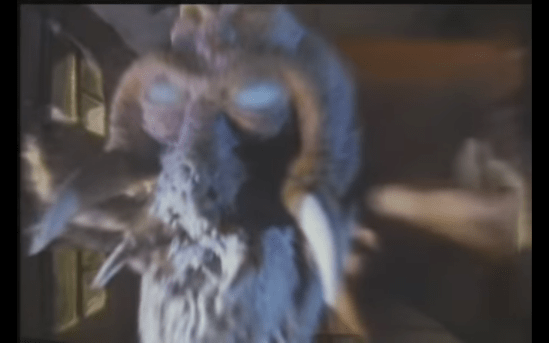
“Drainiac” is Brett Piper’s finest work. Copiously laced with assorted practical effects now completed with a coloring touch up and enhancement by Penn State grad colorist Dave Northrop, “Drainiac” is now has a definitive package that includes Piper hyper-psychedelic matte effects, creepily good stop motion clay creatures, and an abundance of well-crafted gag effects to give the drain presence a slimy drain-protuberance without exposing a tangible thing in the pipes. “Drainiac,” in every category, has a vibrant late 80’s, early 90’s epoch authority even though clearly set and stated at the turn of the century and this is partially because of how the film was shot in 16mm, giving the feature a grindhouse texture. Along with the turn of the century, CGI becomes a huge factor no matter the budget of the film as long as portioned appropriately, but Piper sticks with a practical craft which, in a sense, is a large piece of his filmmaking passion and so “Drainiac’s” is the essence of Brett Piper.
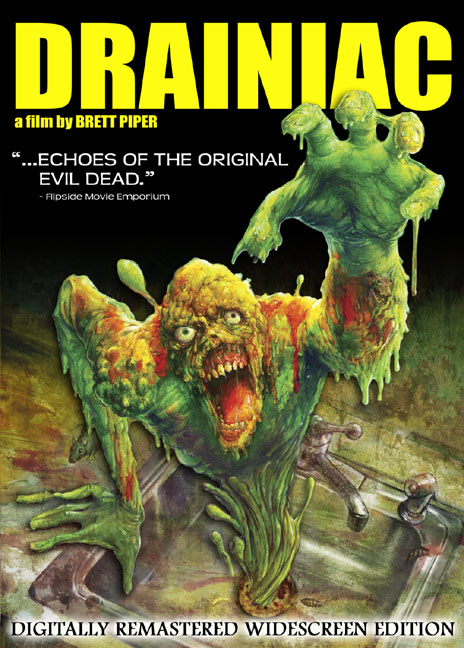
Courtesy of POPCinema’s Shock-O-Rama Cinema horror banner comes Brett Piper’s “Drainiac” onto a special edition with a 24 progressive segmented frame, high definition DVD from the original camera negative and presented in a widescreen, 1.78:1 aspect ratio. Having never experienced the original, unfinished cut of the previous release, watching this present cut will forever be seared into my soul as the best possible rendition in the past, present, and future. The 16mm film stock quality has a lot of natural grain upon a semi-washed look over a gradient-lenient color range sanctioned around the natural lighting that then explodes into a varying vividness of hues when the FX-enhanced scenes spark an immense saturation of color schemes…in a good way. No sign of damage to the original print nor any other signs regarding frame or edge enhancing and cropping. The English language 2.o stereo track, with a re-edited mix as part of the remastered package, is free of distortions, prominent dialogue, and a classic chilling piano soundtrack that pays homage to notable horror films before it’s time. The only issue to mention is some synchronization with the dialogue track and the picture seem to be off early on in the presentation where actors move their mouths to vocalize the lines, but nothing comes out. Special features are a little anemic considering the painstaking involvement and time gap in remastering “Drainiac,” but they include an audio commentary by writer-director Brett Piper and a read worthy tidbit of an inner-lining booklet written by commentary moderator, Greg Conley. THe DVD cover art is very snazzy (or snotty-like) similar to of another POPCinema release, Greg Lamberson’s “Slime City.” Reminiscent of “Evil Dead” or even some inklings of early Peter Jackson, Brett Piper has a knack for proving low-budget horror’s misconceptions are nothing more than that, misconceptions, by keenly tinkering to perfection a story that’s made is seemingly funded from a pot of unlimited gold from nifty, traditional effects and a narrative that works wonders on the imagination, keeping you glued to guessing from start to finish.
Special Edition “Drainiac” available on DVD! Click the DVD cover!









 It's Bloggin Evil!