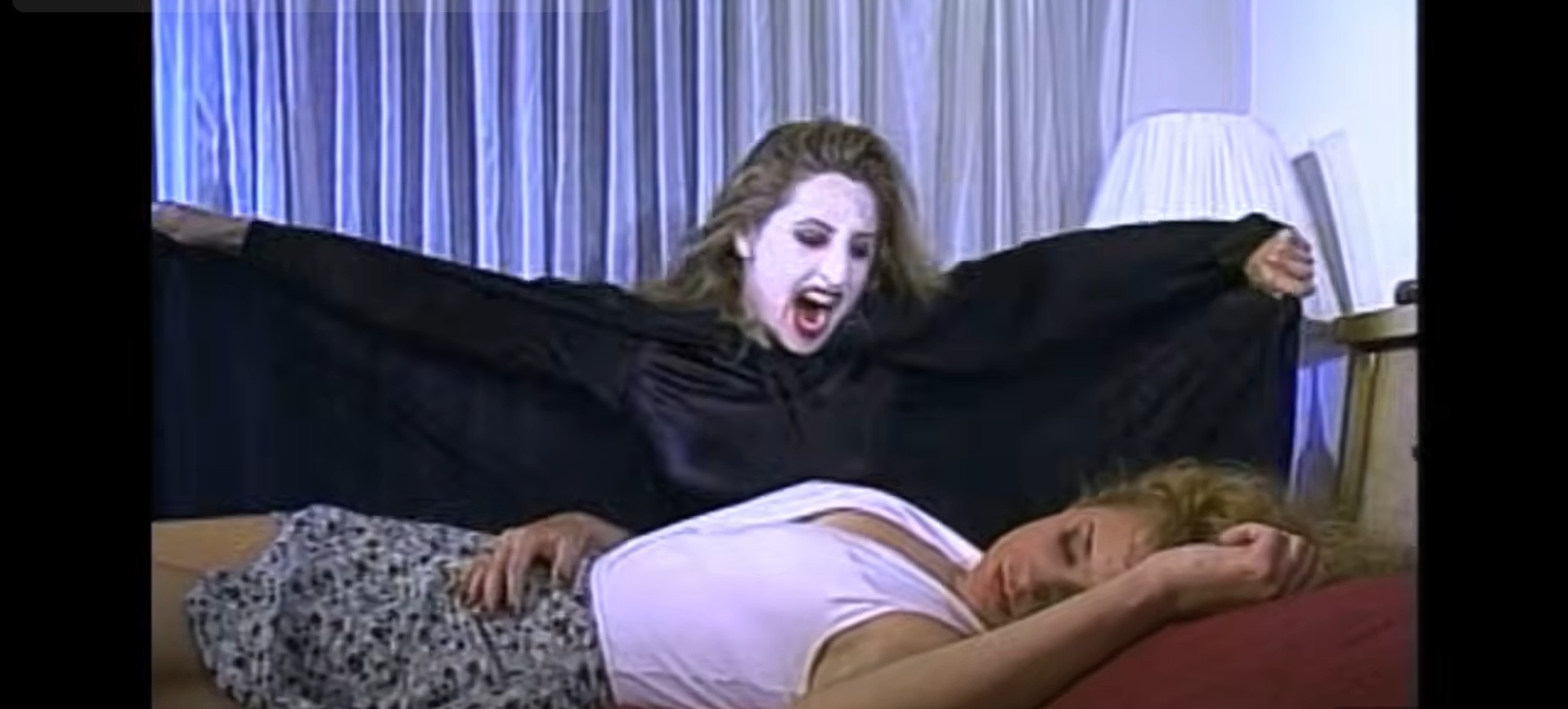
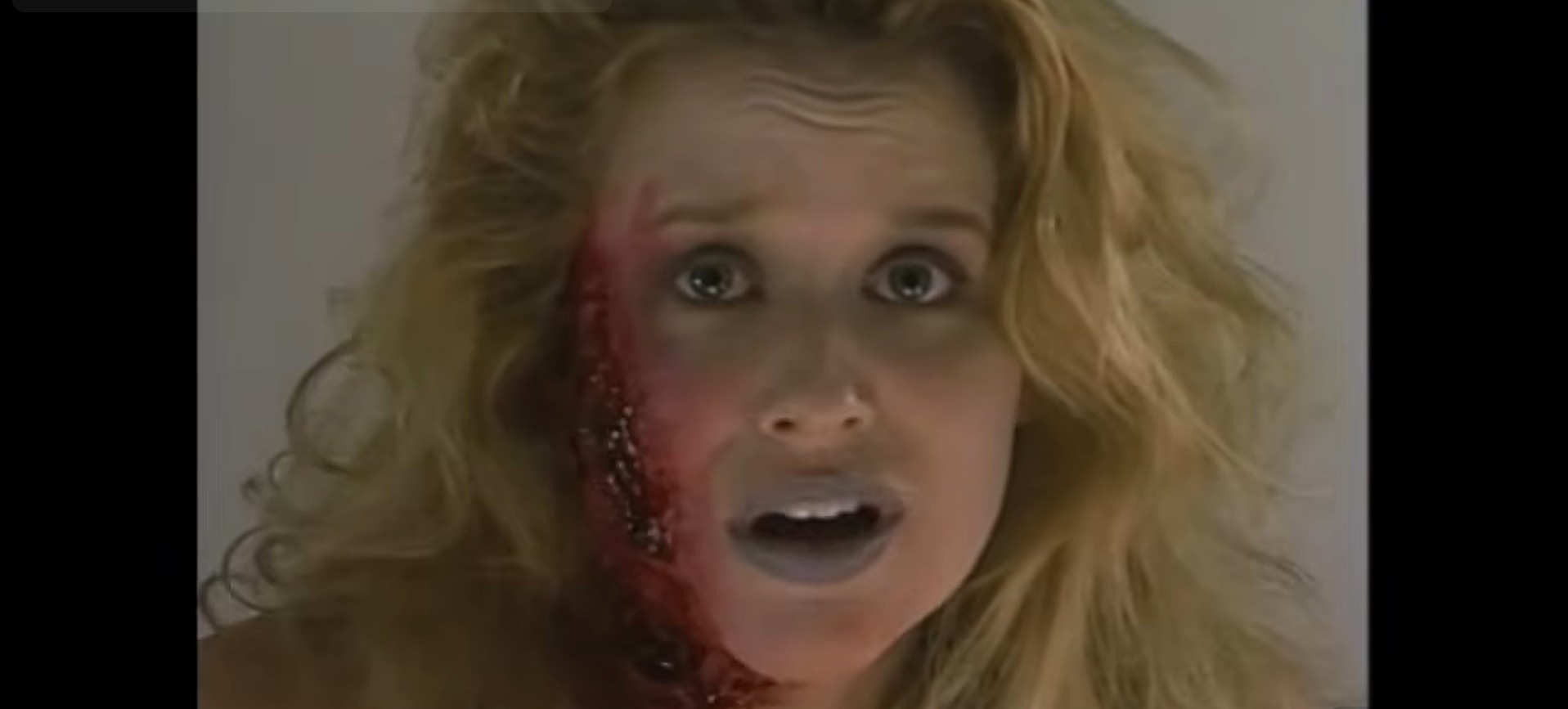
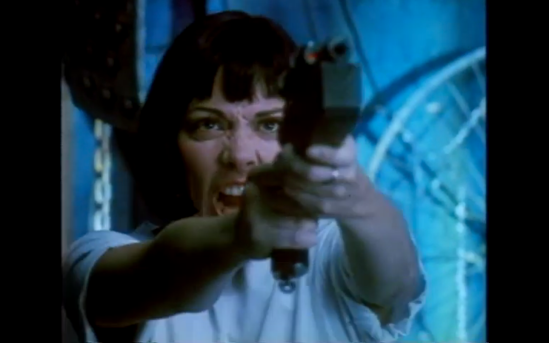
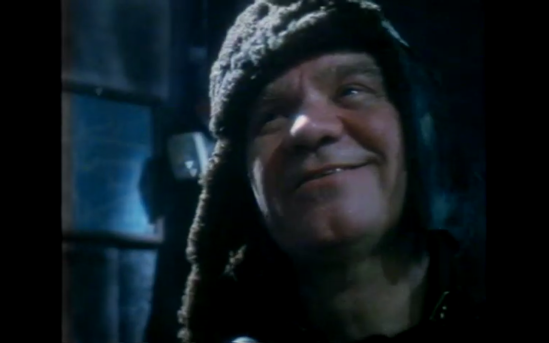
Sue Anne Marie hopes to live up to her big sister’s time as a sorority sister of Alpha Omega but first she must go through an initiation with three other pledges, a test of revenge, key, fulfillment, and overcoming conducted by gothic-cladded sister Vaughn who provides strange, cryptic hints that befuddle the pledges. Simultaneously, Lorilei also pledges but this awakened vampire, imprisoned inside a coffin for years, pledges a more vindictive path, seeking retribution for the death of her big sister Natalia at the hand of Buffy, Sue Anne’s big sister. Weak from her captivity, the only way to become strong enough against the blood of a vampire killer is to drink the blood others but her feeble state can’t withstand a neck bite. Instead, Lorilei must fang the softest parts of the butt to turn Sue Anne’s fellow pledges into doing her vampiric bidding. As Sue Anne unravels the mystery surrounding her initiation test, she must evade her fellow pledges, Lorilei, a secret order of werewolves and evoke a time alternating spell in order to becomes an Alpha Omega sister!
What a romp of the night! “Vampire Time Travelers” is as zany as it sounds! The SOV horror-comedy from 1998 with “Buffy the Vampire Slayer” gags and a spoof material is absurd, frenzied fun from writer-director Les Sekely (“I Know What You Did in English Class,” “The No-So-Grim Reaper”) and was originally intended to be a direct sequel to another 1998 vampire comedy, the discounted “Sorority House Vampire” by director Geoffrey De Valois. Instead, Sekely took the reigns and steered in another direction in an attempt for a more standalone narrative that only brings back a couple of characters in mostly a spirit sense, fashioning a tale that retains the “Sorority House Vampire” plot but blossoms a follow up to be its own entity in Sekely’s own style and comedic tastes. “Sorority House Vampire” producers Raymond Storti and Steve Jarvis develop the not-so-sequel under the coproduction of Scarborough Films and Secret’s Out Productions.
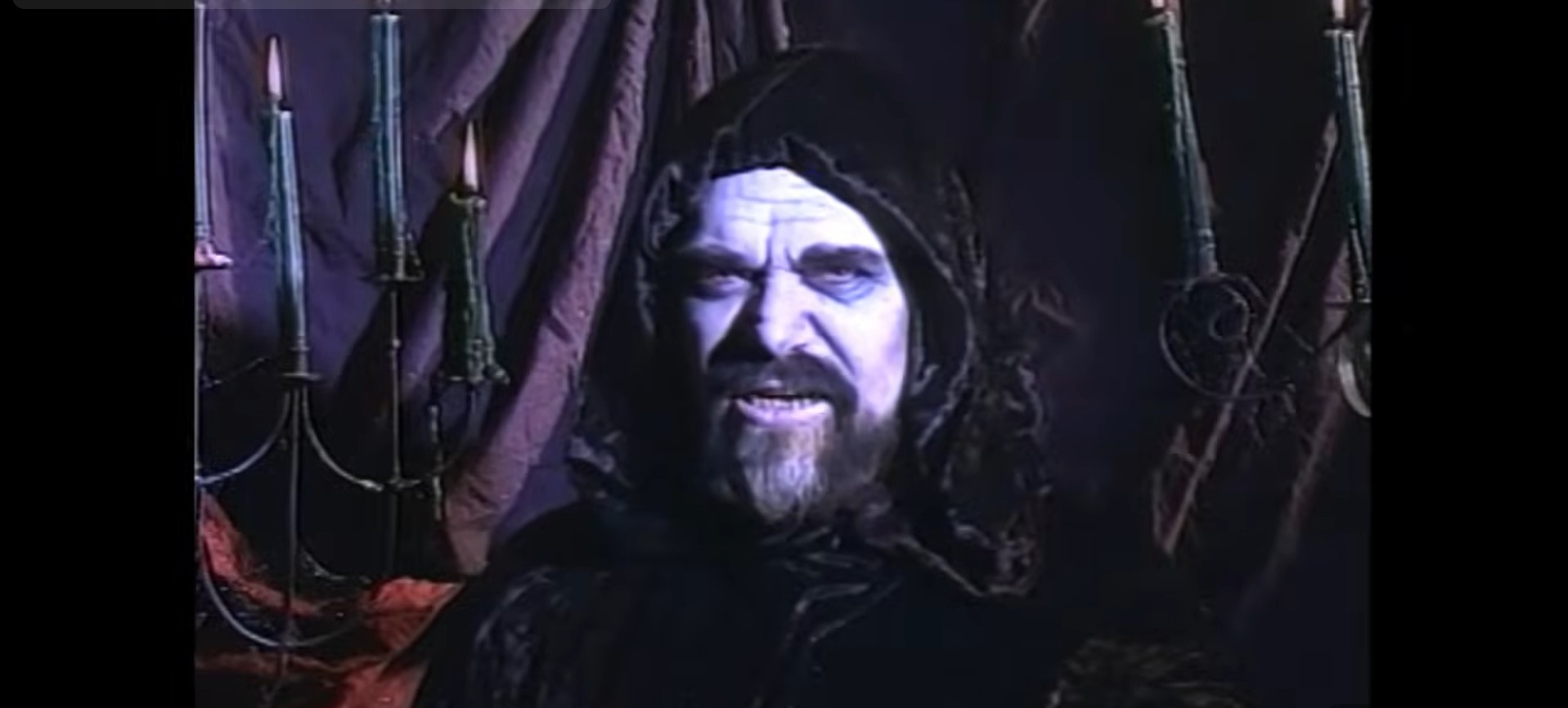
Considering miniscule budget, the inexperienced director, and the unheard-of cast, for the final product to be this cheeky-fun and hilariously bizarre is criminal. “Vampire Time Travelers” is that type of film, although through farce means, that caters to the hot, cheerleader girl vampire slayer narrative made popular by the 1992 film with Kristy Swanson, Rutger Hauer, Donald Sutherland and Paul Reubens and then revamped for television in 1997 with Sarah Michelle Gellar. By 1998, “Vampire Time Travelers” piggybacks onto the gravy train with J.J. Rodgers (“Sisters of Sin”) in the blonde babe role who’s thrusted into danger and has battle dark forces to survive. As a pledge looking to get in by legacy, surrounding the urban legend of her sister Buffy, nonetheless, who destroyed a vampire coven attacking the Alpha Omegas, she’s joined by three co-pledges who are well defined characters in their own personality right with individualized stereotypes in the nerdy (Ali Elk, “I Know What You Did in English Class”), the aspiring musician Zoe (Kat Facchino, “Vampire Night”), and the beautiful but aggressive lesbian Michele (Lori Morrissey, “Emmanuelle in Space”). Vaughn (Lynn Baker) has a sinister mien about her while also being darkly beautiful as the Sorority’s pledge task master, popping in and out of each character’s provided pledge undertaking with ambiguous and mysterious hints to test them. Another darkly beautiful character, but more bumbling in nature, is the vindictive vampire Lorilei (Jillien Weisz) as she tries to figure out how to be a vampire again before pursuing vengeance on Buffy. “Vampire Time Travelers” rounds out the cast with hilarious characters with JC Grigg (“The Not-So-Grim Reaper”) as the man in the closet, J. Adam Young (“Legal Briefs”) as the Lord of Darkness who instructs Lorilei to bite the butt, and Jimmy Jerman (“Merchants of Death”) as 90’s porn-esque repair man known as The Light Man.
Any film with a music video titled Bite Her in the Butt in the middle of story should find its way on on a must-see list for everybody with a broad sense of humor. There’s nothing quite like Les Sekely’s film with it’s fast-pace editing and pacing, cross-cutting with character concordant interactions, and plenty of gags to be had inside tributing horror tropes. With a story revolving around college girls versus sexy female vampires and remarks about Biting her in the Butt are essentially the film’s prominent tagline, one would think this partly horror, mostly comedy romp would be laced with nudity galore and sexual themes up the wazoo but the nudity is zero and the sexual themes are reduced to a tasteful moment to keep the film more of a comedy than a sidebar of distraction, a sexploitation with fangs. Yet, nudity isn’t required for “Vampire Time Travelers’” story, though there’s suggestion there may have been nudity with evidence in the film and has been censored or omitted from the final cut, as the story is entertaining, mischievous, and light at times while Sekely’s niche humor is bred out of dad jokes and are from the parodical storage locker of “Nake Gun’s” David Zucker.
Visual Vengeance releases a new, director approved SD master from the original tape elements for a new Blu-ray with an AVC encoded BD50 displaying a1080p resolution that makes this interlacing SOV picture look the best it’s ever been. Presented in a pillar box 1.33:1 aspect ratio, there are all the hallmarks for a SOV video, such as interlacing lines and warm color coding and magnetic tape oxidation, and exhibits in a 480i detail that’s about as enhanced as it can be. It’s rumored that Visual Vengeance copy is actually censored with nudity removed and replaced with crude sketches and while I can’t confirm if there is an uncensored release, I will say there are scenes involving the possibility of nudity that look blown up in order to edit out the private skin. There’s plenty of complicated edits markers without visual effects that make this film really impressive to behold, especially with director of photography Dennis Devines’ swift camera movements mixed with odd angles. The English dual channel stereo offers distinct dialgoue and ambient/action tracks. Dialogue’s not as robust but meets the standard of being perceived and has plenty of clarity without concern. The ambient/action meet the same standard with on cue and in synchresis quality, never disjointed. Optional English subtitles are available. There is no shortage of special features with any Visual Vengeance release and “Vampire Time Travelers” contains commentary with director Les Sekely, a director interview with Sekely, an interview with actress JJ Rodgers, an interview with Angelia Scott, interviews with director of photography Dennis Devine and assistant director Steve Jarvis, Sekely short film “No-So-Grim Reaper,” and bonus Sekely feature film “I Know What You Did In English Class” from 2000 which comes with it’s own set of special features, including a Les Sekely commentary track, a Sekely interview, cinematographer Russ Lindsay interview, direct of photography and assistant director interview with Dennis Devine and Steve Jarvis, actor interview with Russell Towne, and trailers for each feature plus other Visual Vengeance release previews. Joylon Yates gloriously sexy illustration of two half naked women showcasing the Bite the Butt mantra turns up the thirst volume on this release. Primary sleeve art on the clear Amaray case also features additional Yates artwork that’s more fun it’s in cosmic composition. The reverse side has new artwork for the second feature “I Know What You Did in English Class.” A one-sided mini folded poster and retro sticker sheet are stuck in the interior insert. The region free, 70-minute horror-comedy is unrated.
Last Rites: “Vampire Time Travelers” is a tongue-and-cheeky horror too good to pass up. Visual Vengeance sweetens the deal with a superb, bonus-laden Blu-ray release. There’s no way to lose with this total package.
Sylvia Kristel. A name that is synonymous to eroticism. Kristel paved the way in mainstreaming seductive romances of softcore exploits, helping to elevate the provocative genre out of the depths of sleaze and into a more exotic trashy novel for the big screen. In her titular role in the “Emmanuelle” franchise coursed an arousing path of sexual freedom, uninhibition, and became the sumptuous and worldly window in private fantasies. Playing the role for nearly two decades didn’t stop Kristel from other high profile and lucrative projects with an array of filmmakers as well as her roles pre-“Emmanuelle” that molded the Netherlands actress into a sexual icon rather than object of male fantasies. Cult Epics acquires four films – “Playing with Fire,” “Pastorale 1943,” “Mysteries,” and “Julia” – that even though didn’t have Kristel set as a principal lead still showcased her range within the constraints of a minor, but certainly not insignificant, performance.
“Playing With Fire”
In a madcap Paris where sex trafficking is something of a sport, a wealthy French banker learns his daughter has been kidnap and threatened to be tricked out or burned alive if the kidnappers’ ransom isn’t paid. Quickly learning that another woman has been mistaken for his daughter, a wave of relief bestows him to be cautious about future attempts on his daughter’s safety. The banker hires a private detective to protect his loveliest of assets, offering to escort her to a local safehouse with the promise of sanctuary, but the P.I. is operating incognito being really one of the leaders of a surreal and lavish brothel who now has the banker’s beautiful daughter in his possession. Or is it her who possesses him?
Unlike any other exploitation-comedy you’ve likely ever seen, the 1975 released “Playing with Fire,” aka “Le jeu avec le feu,” is a wacky deep-dive of surrealistic sex trafficking from French writer-director Alain Robbe-Grillet whose obsession with prostitution rings and other filmic eroticism pursuits extends back within a decade later with “L’Immortelle,” aka “The Immortal One,” and “Successive Slidings of Pleasure.” A French production of Arcadie Productions, Madeleine Films, and Cinecompany, “Playing with Fire” masters the avant-garde art of making light of a grim topic that results in a pull of emotions. Robbe-Grillet draws out the shocking aspects of sex slavery while also encouraging a smirk or a chuckle at the whimsical characters and shooting techniques weaved throughout a burlesque narrative. Robbe-Grillet also plays with the theme of dualities with a number of the principal characters having two or more versions of themselves: Philippe Noriet plays not only the banker father Georges de Saxe but also a voiceless sleaze erotically interacting with the banker’s daughter in a very Freudian concept between father-daughter relations. His daughter, Carolina (Anicée Alvina), disguises herself as the thin-mustached private detective to thwart future any attempt at an abduction and there’s also the identity mishap with the similar looking woman mistakenly kidnapped by the ringleader. Leading us into Jean-Louis Trintignant as the ringleader Franz constantly in a revolving door switch-a-roo façade into the private detective. The presence of duality doesn’t stop being a present throughout, continuing with the banker’s butler who is also a whorehouse patron without affirmation that they’re the one and same person. Before their illegal banishment in the mid-20th century, Brothels were widely dispersed throughout Paris, but not until the Nazi occupation absorbed the houses of ill-repute that seared a bad taste of deviant humiliation and sordid disgust into the mouths’ of the French populace and Robbe-Grillet taps into that once time of unrest by splicing in a pair of isolating scenes of goose-stepping Nazi soldiers with one of the moments garmenting Anicée Alvina in uniform and marching in the ranks, suggesting a more sinister subplot afoot in the storyline. Kristel plays one of the women snatched by Trintignant’s efficiently devious Franz with virtual a voiceless performance in what’s only a symbol of strength and beauty that sets perversion ablaze as she’s taken through the motions of essentially onboarding her into slavery whoredom. “Playing With Fire” can be at times difficult to keep up with the Alice in Wonderland-like surrealism and the character dualism but persists unwaveringly with a multi-faceted narration of deceit, eroticism, and comedy full of perversions and random outbursts akin to satirical skits that make this film unpredictable yet enjoyable to behold.
Pastorale 1943
During the Nazi occupation of the Netherlands, a quaint Dutch farming village lives day-to-day alongside soldiers and German sympathizers known as National Socialists (NSB) to the Nazis, traitors to their fellow Dutch countrymen. When the Nazis learn of and round up all the dissidents and Jewish heritage people living in hiding on an adjacent, ferryboat island, a small band of unorganized resistant fighters determine the local pharmacist, a NSB member, to be the Nazi collaborator responsible for the treacherous leaking of information because his son impregnates an island village girl, teetering toward the fascist movement when mocked by her peers for her involvement with the pharmacist’s son. Inexperienced in the execution of traitors, the bungling resistance fighters learn just how difficult planning a murder can be when their scheme falls apart in a small village where everybody knows everybody.
On this second of four Sylvia Kristel features is the Spieghel Filmproductiemaatschaappij of “Pastorale 1943” which makes more prominent the Nazi regime, is set with a backdrop of a Nazi occupied Netherland town and has a cameo role of young and dashing Rutger Hauer (“Blind Fury,” “The Hitcher”). Netherland writer-director Wim Verstappen, whose had a few titles released previously from Cult Epics, such as “Obsessions” and “Blue Movie,” develops a script out of the World War II drama novel from author Simon Vestdijk with black comedic undertones and a tinge of corrosive sexuality and released the film in 1978. Pastorale, or Pastoral, refers to the typically calm and idyllic country life which the complete opposite in 1943 Netherlands with all of Europe and East Asia engulfed in war; however, this story takes place in its own corner of the world with a mini, damn near microscopic, war waged between the Nazis occupation along with domestic NSB collaborators and the inhabitants resisting against the encroaching fascism that has plagued revenue crops and instilled an authoritarian culture, such as mandating the teaching of the German language to students in Dutch schools. Kristel’s involvement with Verstappen’s “Pastorale 1943” is about as much as her involvement in “Playing With Fire” with a minor role that’s still a keystone piece to the narrative. She plays Miep Algera, a local schoolteacher disparaged by her neighbors and colleagues for having romantic relations with a Nazi officer, but has she really fallen for the officer or is she secretly conducting counterintelligence for the resistance? “Pastorale 1943’s” two-part story plays heavily embroiling and embroidering characters in the first half to the point of instituting a cornerstone character but when the narrative pivots, to the darker side of implied Nazi exterminations and the fumbling through the execution of a rightfully innocent man, Verstappen homes in on Frederik de Groot as the artist Johan Schults whose Germanic surname causes him much strife amongst his Dutch brethren but to prove himself, Schults takes charge, along with an equally green execution squad of resistance politicians, to murder the NSB collaborator, a local pharmacist Poerstamper (Bernard Droog). The Academy Award submitted “Pastorale 1943” can be light and funny then turn quickly on a dime into wartime darkness and director Wim Verstappen’s vision pops with epic World War II fascism atrocities, confined to one part of the world and without the explicit voyeurism of genocide.
“Mysteries”
After the strange suicidal death of a man named Karlson, Johan Nagel arrives to the coastal town where the death occurred. Immediately, Nagel stands out from the supercilious eccentric residents with his mustard yellow suit and fur coat, dispensing small cigars and money to everyone and every service as if they were infinite, and exhibits his own brand of strange behavior, especially with amorous feelings between two women and an unlikely friendship with a dwarf who has accepted his neighbors’ belittling jabs for humorous pleasure. As his behavior declines, Nagel’s presence unravels the coiled, seemingly impenetrable, barriers around his friends, his enemies, and his romantic pursuits that reshape their properties for the better at the dangers of his own sanity and life.
Finally, we’re at a point in the Sylvia Kristel collection where the titular star is in a lead role with this demolition of concrete idiosyncratic personalities melodrama entitled “Mysteries” from Dutch filmmaker Paul de Lussanet, based off a novel “Mysterier” by Knut Hamsun, with Sigma Film Productions as the production company. Kristel plays the steely Dany Kielland who becomes the infatuation of Nagel in an oppositional performance beautifully deranged and conducted by Rutger Hauer. The hot-and-cold and on the brink of frustration relationship between Kielland and Nagel is as resolved as an unfinished breakfast left to waste and void of complete nutrition as both characters digest morsels of desire only to explode in a frenzy of loathsome disgust in an unsavory, brittle dynamic only Hauer and Kristel could produce on screen. The other love interest involved, yet hardly feels as such until the last half hour, is an aged and more humble Martha Gude portrayed by “Last Night in Soho” British actress Rita Tushingham complete with a poor-looking frosty-colored wig. Kielland and Gude represent the two-side of society – rich and poor respectively – stuck mastering a stanch stance of an indeterminate state that Nagel barrels into and knocks down the status quo, like a bowling ball to ten pins, for the better of the coastal town. None of what Nagel does seemingly makes any sense and that’s very true to Hamsun’s novel in the unconventional, and probably unintentional, methods of Nagel’s erratic influence. “Time Bandit’s” David Rappaport debuts in his first feature film as Grogard, an achondroplasia character bulled by most of the town’s residents due to his disorder. Grogard anecdotally tells the story as “Mysteries” narrator, as if reading straight from Hamsun’s novel, the recollection of Nagel’s dichotomic behavior and, at the same time, Nagel also being a mentor, protector, and a friend that pained Grogard to watch his friend whither to death in fit of emotional exhaustion. “Mysteries” borders arthouse cinema, adaptive faithfulness, and pristine melodramatic performance that sound good in theory but not always translate well to the screen, leaving more of a perplexing impression on the whole purpose of rendering Knut Hamsun’s novel into film in the first place.
“Julia”
Every year, Patrick departs his boarding school for a short holiday with his father and relatives at his grandmother’s idyllic lakeside house. While riding the train en route to his grandmother’s, he encounters an older, yet beautiful, blonde woman inside the passenger carriage car and before he can firm up courage to act upon his sexual brimming hormones, the blonde is swept up by an older gentleman right from under his nose. Come to find out, the blonde woman is actually his father’s girlfriend in a completely open relationship when it boils down to sex. Anxious about his own insecure sexual appetite, Patrick finds himself surrounded by the perversions of his family and friends, leaving the young man hesitant and nearly impotent in bedding the woman he actually cares about, a longtime friend Julia who lives next door to his grandmother.
On the heels of “Emmanuelle,” Sylvia Kristel follows up with another licentious freedom film in Sigi Rothemund’s “Julia.” Also known as “Summer Girl” or “Die Nichte der O,” the German production from the Lisa-Film company is the earliest film on the 1970s collection with a release in 1974 and is the only other screenplay on the collection next to “Playing with Fire” that is not adapted from literature. Instead, “Julia” is a wild romp ride of young sexual exploration and the anxieties that accompany it from an outlandish and witty script by Wolfgang Bauer. “Julia” might not be based off a book, but the story is certainly an unapologetically open book about the insignificance of virginity, polyamorous affairs, lesbianism, voyeurism, and the sexual rite of passage into adulthood with the young and naive principal Patrick, or Pauli as credited, played by the late Ekkehardt Belle who passed away in January of this year. Opposite Belle, Sylvia Kristel obviously dons the titular role of Julia. Inexplicably voluptuously different from the other three films on the collection, Kristel radiates a sexual aurora perhaps infected by proxy of its release soon after “Emmanuelle” as Kristel obvious branches out to more sensible dramatic roles rather than the decor of a German sex comedy such as “Julia” that galvanized by its free-for-all eccentric caricatures including an operatic, overweight, and perverse uncle Uncle Alex (Peter Berling, “When Women Were Called Virgins”), a highly aggressive lesbian in Aunt Myriam (Gisela Hahn, “Devil Hunter”), the house maid Silvana who Myrian seduces with whipped cream and has piano-top sex (Christine Glasner), and his polyamorous father Ralph (Jean-Claude Bouillion, “The Sextorvert”) and girlfriend Yvonne (Teri Tordai, “She Lost Her…You Know What”). Comparatively flimsy next to “Emmanuelle” as a sexual journey and coming of age film but “Julia” is a hot-to-trot sex comedy with funny bits as well as sultry naught bits too.
Beautifully curated for the first time ever release in the United States of all four films is Cult Epics’ “Sylvia Kristel: 1970s Collection” on Blu-ray and DVD. The 4-disc, uncut Blu-ray, which was provided for coverage, is region free, limited to 2500 copies, and perfectly packaging to extol praise upon the robust early career of Sylvia Kristel. Presented in European widescreen 1:66:1 (with the exception of “Playing with Fire” which is displayed in an anamorphic 2:35:1), each film is newly scanned in 2K from the original 35mm elements as well as been restored. Transfers for the most part are exquisitely pristine, each harboring their own mise-en-scene mélange, but some are better than others with “Mysteries” sitting at the bottom rung of showing slightly a few more scratches and one-or-two single frame damages that flame up through the reel briefly. “Julia” also has minor scratches, but that’s really the extent of the issues with the image quality on this restored visual released with a rich color palette and textures redefined for a better palpability. Compression issues are virtually non-existent and there are no tinkering enhancements or cropping used to skirt transfer limitations. I am in awe of the audio output of the 1920kps bitrate, transmitting the highest audio quality possible for each release through either DTS-HD Master Audio 2.0 or a LCPM 2.0. Dialogue clarity comes through cleanly with French in “Playing with Fire,” Dutch and German in “Pastorale 1943,” and German in “Julia.” “Mysteries” sounds a bit muddle sometimes due to the consistently background popping interference, but the Dutch language still pulls through strongly and discernibly. Each film comes with optional English subtitles. Special features are aplenty with audio commentaries by Tim Lucas, Jeremy Richey, and Peter W. Verstraten, new and vintage interviews and promotional footage with cast and crew on ‘Playing with Fire,” “Pastorale 1943,” and “Mysteries,” a poster and still gallery on each release, and original theatrical trailers. Outside the disc contents, the collection’s rugged cardboard boxset housing unit consists of a 4-disc snapper case with vintage-still collage cover art, a 40-page illustrated booklet with color pictures and an essay on all four films written by Jeremy Richey, and a cover art poster by Gilles Vranckx. Total runtime is 429 minutes, enough to get your Syliva Kristel fill and then want more…much more. The “Sylvia Kristel: 1970s Collection” lauds the actress’s versatility of performances and ability to work with any director from any country and fans who love “Emmanuelle,” or of just Kristel, will undoubtedly fall in love with this Cult Epics comprehensive look at the Dutch icon’s outermost filmography.
Global warming has taken a toll on the Earth’s polar ice caps in 2008 with cascading amounts of water flooding around the world bringing knee high waters to coastal cities. London is hit hard with drenching sewer overflows and coastal run overs that result in an over infestation of rats to storm the streets, back alleys, and even resident homes, carrying a harmful disease in their occupation. However, something else compounds the rat plague that slashes at random victims, tearing their hearts out violently from their chests without ever leaving a witness except for one, a rogue and paranoid detective Harley Stone whose partner was slain in one of the deadly attacks and himself marred by the killer. Partnered with a new hot shot know-it-all detective following the murders, an obsessed Stone confronts his haunting traumas as he continues to pursue the inhuman perpetrator who has a psychic connection to Stone, personally toying with the on-edge officer, and has kidnapped his girlfriend as bait.
Even though 2008 has come and gone now almost 12 years ago, Tony Maylam’s 1992 actionized-creature feature “Split Second” still holds water just like the rising tide pools on the streets of London. “The Burning” director, Maylam, helms, with the finishing touches of the final sequences directed by Ian Sharp after Maylam’s sudden departure, a fast paced and snarky script penned by Gary Scott Thompson as one of the writer’s very first big budget outputs from nearly 30 years ago that was followed up with major studio films, including a little project you may or may not have heard of, “The Fast and The Furious” mega franchise. Before nitrous suped-up cars hot-rodding on asphalt, jumping high speed trains, and flying off cliffs in a lap strap of criminal activity luxury, Thompson created a formidable, heart-devouring beast that became the trap-setting, trophy-hunting predator and the teeth-snapping, chest-bursting xenomorph all in one package to symbolize the irreversible and ignored effects of an overpopulated, warming planet. “Split Second” is a production of Challenge Film Corporation and produced by Muse Productions with Chris Hanley, Laura Gregory, and Keith Cavele serving in a producer role.
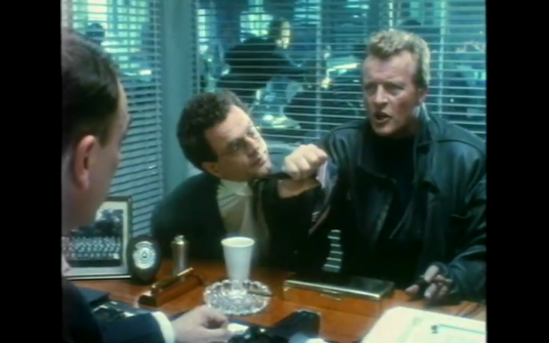
The Netherlands’ very own Rutger Hauer sheds his nice guy exterior for Harley Stone’s shell-shocked, rough and tough outer shell. The late “Blade Runner” and “The Hitcher” actor brings a certain cinematic coolant to “Split Second’s” overheating fringe of disproportionate action and science fiction horror, a lop-sidedness typical of a Rutger Hauer production, by being larger than life in the little aspects that add to the dimensions of the scene, making every moment famished for Stone’s next eccentric and animated move. Stone is partnered with an equally vigorous Detective Dick Durkin who starts out as a cultured drip of criminal activity and an astronomical proficient before quickly blooming into the same gritty mirror image of Stone. Credited as Neil Duncan, the current vocational voice actor Alastair Duncan has a natural dynamic with Hauer despite their asymmetrical careers and endures an incredible character arc successfully turning Durkins’ relatively square image – though debatable with smart, good looking, and gets sex every day swagger – into a Stone acolyte after witnessing the human threatening existence of an unnatural ferocious monster. The female love interest didn’t seem to fit the “Split Second’s” gentle steampunk lace and zany character scheme with Kim Cattrall as Stone’s estranged girlfriend, Michelle McLaine. As much as love the “Big Trouble in Little China” actress’s late 80’s to early 90’s career, the girlfriend role feels sorely plopped into the film for the sake of having a love interest as much of the character is illuminated through exposition with McLaine being the wife of Stone’s former partner stemmed from her and Stone’s affair and then lingers her subsequent alienation from the rogue cop despite an inextinguishable flame between them. As Cattrall provides the sexiness in the city of London, McLanie iss aesthetically airy without tangible substance other than kick in the pants motivation for saving. “Split Second” rounds out with the late Pete Postlethwaite (“The Lost World: Jurassic Park”), Alun Armstrong (“Van Helsing”), Stewart Harvey-Wilson and “Scoorged’s” Michael J. Pollard as London’s the rat catcher.
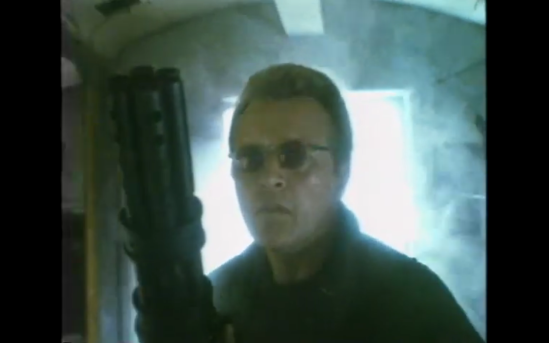
“Split Second” is an early nineties junket spiraling with flashy facets of easily digestible, entertaining chewables that continuously hits all the right flavor sensations in terms of acting, dialogue, production design, creature design, and cinematography. The bonkers script and equally as bonkers visual concept inserts an extremely likable brazen world of the future in the form of a dank, or danker, London under one or two feet of water; in every moment Stone or Durkin hit the streets, they’re essentially swimming in brown street liquid and the overall effect places a blanket of filth glazing over my eyes and secreting out of my captivated body is a cold spine-shivering chill that’s immersive to Stone and Durkin’s slushing around. Stephen Norrington, who went on to direct “Death Machine” and “Blade,” slapped together a fairly effective creature design despite the creature rarely being in full exhibition and for very good reason. A brief flash of razor sharp fingers, a quick dash of unearthly skin, and the gruesome aftermath in it’s wake evolved a better rendition of the creature in our minds than perhaps the actual resulting appearance with result that tacked on one big mysterious allure that doubled down coinciding with the principle characters who also has never seen the killer before. “Split Second” is constantly suspended in action with little down time to reflect on the theme of global warming and it’s life-changing choking effects that not only rushes thousands of gallons of water onto the streets and increase the survivalist rat population up to nearly impossible control levels, but also tampers with the balance of astrometric forces, bringing evil to the world in the form of a heart-eating devil to the surface when astrology deemed the moon in position for such an event and that’s also perhaps the downside to Tony Maylam’s film. The monster bares little backstory to sink one’s teeth into and raises an immeasurable amount of unanswered questions relating to the fate that intertwined Stone into the creature’s inner sphere of extrasensory perception, the origins of the creature and it’s genetic makeup, and the relationship between it and the cult correlations.
A melting pot of feculent and bloodshed pother, “Split Second” arrives onto a high definition Blu-ray courtesy of 101 Films and on MVDVisual’s MVD Rewind Collection banner. The region free, R-rated feature is presented in 1080p with a widescreen, 1.85:1 aspect ratio with a newly 4K scan complete with restoration and coloring grading from the original 35mm negative. The inviting image, with adequate grain and a cigarette burn here and there, basks mainly in a steely blue among other primary colors rearing up while thick with a brightly contrasted neo-noir shadow wrung through. Skin textures are consistently and continuously glistening with sweat setting on top of the natural coloring and the facial follicules present a rather sharp image, making this release the best looking transfer to date. The English language 2.0 LPCM stereo mix doesn’t let up with a robust mix of forefront dialogue, a balance of range and depth, and a pulsating cheesy-action soundtrack Stephen Parsons and Francis Haines. English subtitles are optionally included. The heft bonus features package includes exclusive content such as an audio commentary by action film history Mike Leeder and filmmaker Arne Venerma, a new conversation entitled “Great Big Bloody Guns!” between actor Alastair Duncan and producer Laura Gregory, a “Call Me Mr. Snips!” interview with composer Stephen Parsons, a “Stay in Line!” interview with line producer Laura Borg, a “More Blood!” interview with creature effects designer Cliff Wallace, and a “Shoot Everything!” interview with cinematographer Clive Tickner. But, wait, there’s more! Also included is the original making of feature with stars Rutger Hauer, Kim Cattrall, Alastair Duncan, Michael J. Pollard, writer Gary Scott Thompson, original behind the scenes feature with effects creator Stephen Norrington and other cast and crew, the “Second Split” Japanese cut includes the deleted scenes and built in Japanese subtitles, 7 promotional TV clips, U.S. VHS home video promo, theatrical trailer, and a MVD exclusive reversible sleeve with artwork from The Dude Designs, cardboard slipcover, and mini-poster insert. The difficult decision to determine Rutger Hauer’s best work can be daunting as the man is King Midas with every project he touches, but “Split Second” reveals now more than just being pure gold with this MVD Rewind Collection Blu-ray release that’s a must own, must have, must see, and a must collect physical release of the rundown of a monster-run amok, neo-noir, steampunk, action-comedy-horror….in a nutshell.
Own this Rutger Hauer classic “Split Second” on Blu-ray!
In 1933, the heart of prohibition-era regulation, a corrupt Southampton, New Jersey police department shakedown the illegal alcohol distilleries and bootleggers, forcing establishments to cough up payment for police protection. Chesterfields, the hip new brass club in the sleepy town, falls into the sights of enforcement officers, an alcoholic with post-war issues, Jack Malone and his partner Sam, who want the club owner, a ruthless black bandleader named Chester, to pay for his establishment’s booze sales and bootlegging, but Chester, and his conspicuously strange henchmen, are more than just bootlegging booze runners. The nightclub is a front for a vampire den that’s draining, bottling, and shipping the blood of Southampton residents and master vampire, Chester, operates the business with his human associate, Victor Renfield. An invasion of bloodsucking gangsters seep into the affairs of not only Jack Malone’s baffled police department, but also into the resident brothel that homes Jack’s longtime beloved lover, Rosie. Only Jack, the deranged town priest, and Willie, a boy caught in the middle, stand in between the corrupt, yet still innocent, souls of Southampton and the terrorizing dark forces that scratch at the town’s door.
Hybrid genre film “Bloodrunners” blends a spin of classic tale vampirism with early 20th-century gangsters that concocts a bad batch of cinematic bamboozlement. Filmed in West Chester and Marcus Hook, Pennsylvania, director Dan Lantz, who helmed adult film star Alexis Texas in “Bloodlust Zombies,” does construct a marvelous speakeasy, prohibition-era world out of the greater Philadelphia region’s most popular and historical locations. From the period piece costuming to the acquisition of an antique 1921 Ford Model A car, Lantz’s ability to build a story around such facets on pocket-sized finances that help bring 80 years past back to the present can certainly compete with settings of many big-budgeted Hollywood productions. Being a previous recent resident of West Chester, the landscape was convincingly alien to this reviewer. Co-star Michael McFadden co-wrote the script with Lantz and, together, they input a girth of 1920s to 1930s terminology and slang into a script that can’t quite coherently string along a narrative that works under cut and dry filmmaking involving anemic mains characters.
Alongside McFadden, the “Law & Order: SVU,” or rather from one of my personal favorite films from 1994 entitled “Surviving the Game” co-starring Gary Busey and Rutger Hauer, star Ice-T takes on being a master, bootlegging vampire when he’s not busting heads of pedophiles on the streets of New York City. Ice-T maintains a hip hop persona that doesn’t translate well toward the 1930’s, but the legendary gangsta rapper has kept the hip hop schtick throughout this career and never in a hundred roles, eighty-seven credited roles to be exact, would I imagine Ice-T to break from a moneymaking image. Like his co-star, McFadden comforts himself in familiar roles that pigeonholes his career made up of authoritative figures such as cops or gangsters with examples including being a gangster in Fox’s hit television series, the Batman spinoff “Gotham” and also portraying the notorious real life gangster, Jimmy Hoffa, in the upcoming Tigre Hill film “American Zealot.” Then, there’s Philadelphia native Peter Patrikios. Patrikios’ phenomenal take on the iconic Renfield character is a break in the monotony highlight, reviving Renfield back to a sophisticated right hand man instead of a relapsing bumbling aid for his master’s whims of daylight chores and being more memorable than the “Bloodrunners'” main headliners. Airen DelaMater, Chris James Boylan, Julie Elk, Kerry McGann, Jack Hoffman, John Groody, and Dan McGlaughlin round up “Bloodrunners'” roster.
When attempting to examine “Bloondrunners'” vampiric special effects, only this descriptive phrase comes to the forefront of my mind: “Bloodrunners” pits vampire gangsters against crooked cops in a “Matrix” styled, slow-motion action-horror. While that sounds rather exciting, selling these particular creatures of the night didn’t enlighten a firm stance that the modern vampire is alive (well, technically undead) and well. Instead, the Dan Lantz and Michael McFadden story stays the routine course that fills the overstuffed and out of control vampire barrel that desperately requires genre damage control from the first moment a scofflaw vamp enters the scene. Vampire action films haven’t been popular since “Blade,” unless adapted to television as in the case of FX’s “The Strain,” and “Bloodrunners” doesn’t fit the bill, boozing in as a blasphemous contemporary day vampire film.
Paoli, PA based production company Impulse-FX delivers Dan Lantz’s latest schlock horror “Bloodrunners” with Speakeasy Films releasing the film out to the world and landing on retail shelves March 7th. The trailer held promise with vigorous action stamina, but, in the end, just turned out to be a well-edited trailer for an action-horror-thriller that needed a touch of stability in the story. Portions of the story are deemed absolutely unnecessary to motivate the characters or are place mats interjected to connect characters, such as Jack Malone’s encounter with a specific German vampire who just coincidently happens to be one of the henchmen in Ice-T’s vampire gang. The Speakeasy Films dual format 2-disc, Blu-ray and DVD combo, presents the film 1080p widescreen 1.85:1 aspect ratio in which the Blu-ray is on a AVC 26Mps disc. The image was a bit shaky under the compression, fizzing at times, more so during darker scenes, that outlined compression artifacts that remarked upon lighter shades of grey and black. The English Dolby Digital 5.1 track is fine through the 95 minute runtime. Jack Malone’s raspy gangster voice doesn’t become muddled and Ice-T’s epic hip hop swag comes through without even a hitch. The soundtracks fades in and out quite a bit over the LFE, during the “Matrix” slow-motion, that leaves much unbalanced when the soundtrack becomes warranted. Bonus features are nice, including a gag reel, deleted and extended scenes, filmmakers commentary, and an official trailer. In conclusion, “Bloodrunners” teeters on the edge of being a full bodied beverage that never really carbonates into a high-alcoholic contestant in being a good, modern day vampire thriller.
Masters of horror. You know. Those legendary filmmakers that become iconic in our beloved genre. The monumental men who made history by evolving the monsters, killers, and madmen to the very monsters, killers, and madmen we see today on the big and small screen. These giants of horror are household names to ordinary film fans and Gods to those who dedicate their lives just to live in a moment in a very small portion of their foot heel shadow. You, reading this op-ed, know the very names of these directors without even me mentioning their names. For those who are virgin to horror, however,…
George A. Romero
John Carpenter
Wes Craven
Stuart Gordon
Tobe Hooper
Joe Dante
Clive Barker
The list could go on with more familiar names. Familiar. That seems like a term for old people now, like myself, the thirty-years of living on this planet. Why is ‘familiar’ now for the old fogies? For one, I don’t think much of the younger generation are aware, or even respect, the above list of names. And why should they? Because, secondly, those listed about have done squat in, I don’t know, how many years? Think about. The Masters of Horror are no longer producing any great horror films and there seems to be no clear cut answer to why. A couple of theories swirl in my clustered little mind.
Theory one
They’re old. Getting elderly is tough and when you’re youth runs dry, you’re energy goes right along with it. Take Romero for example. The man is 74 years old. Wes Craven is even older than Romero by one year. Could their old school imaginations keep a generation, doped up on ADD medication, entertained for more than 10 minutes. Much of today’s horror is about the blood and the tits and the “how scary you can make a CGI monster.” Creativity has gone out the window and I think that “Saw 7” and the soon to be fifth sequel to “Paranormal Activity” have proven just that.
Theory two
Old school horror has run out of ideas. Can you remember the last time Romero, Carpenter, Stuart has made a good movie? Romero’s last film was “Survival of the Dead” back in 2009 which flopped. Before that “Diary of the dead” and that was another flop. Since the turn of the century, the king of the zombies has only directed four films with Land of the Dead being the more successful. Take a look at “Halloween” director John Carpenter. “Halloween” is the highest grossing independent film ever, yet also in the last decade, nothing spectacular from Carpenter. His vision of “The Thing” is classic, his character Snake Plissken is iconic in “Escape from New York”, “Big Trouble in Little China” is timeless cut, but “The Ward” and “Ghost of Mars” have been absolute below the bar with audiences. This theory doesn’t exclude international directors because we can also examine, point in case, Italian director Dario Argento. Argento famous for his colorful, psychedelic intense films such as “Suspiria”, “Phenomena”, and “Don’t Torture the Duckling”, has been reduced to direct a “Dracula 3D” movie starring Rutger Hauer. Freaking RUTGER HAUER!?!? Don’t get me wrong, I love Rutger Hauer – “Blind Fury” and “The Hitcher” are some favorites – but you can’t have a strawberry haired Van Helsing. Maybe you can – I don’t know. Let’s not forget poor Wes Craven who can’t seem to get off the “Scream” franchise train and everything else he touches turns into a limp, floppy mess.
Now that we’ve gone over my theories, there lies another question to be discussed. Who are the NEW masters of horror? Today’s films rely on blood and guts and not so much suspense and story. Would Eli Roth be my first example of a more current master? His films seemed to be well criticized – “Cabin Fever” with a fresh 63% and “Hostel” with a fresh 61% respectively on Rotten tomatoes. Also, his latest project “The Green Inferno” held promise until it’s untimely indefinite on hold status declared a few weeks ago. Who else? Alexandre Aja? More shock than schlock but hasn’t really produced anything original as he’s banked on remakes – “The Hills Have Eyes”, “Piranha 2” – but with his breakthrough hit “High Tension” and his upcoming release “Horns” starring Daniel Radcliffe, we could be watching a master in the making.
I want to hear from you. Who do you think will step in the shoes of a master? Lucky McKee? Adam Wingard? Let me hear your choices and your thoughts on these!