

Southold, New York, 1843. A young, once-proper, daughter, Mary, of a puritanical family sits before an investigator as suspect of the brutal massacre of her family. Her eyes having been gouged and plucked from her skull, Mary can’t see the musket rifles pointed straight at her as she’s assumed to be practicing dark dealings being the sole survivor. She must recount the exact details of story that begins with the family’s severe punishments imposed upon her and the house maid whose practically publicized intimate relationship was seen as wicked, sinful, and embarrassing. Unable to be discouraged by disapproval and cruel corrections, Mary and the maid continue to sneak their forbidden affair but did she and her lover commit the heinous crime or was there more behind the veil involving an infinite evil, bound by a mysterious book, pulling at the marionette strings that has cursed Mary and her bigoted family?

Tackling themes of homosexuality in the 1800s in the time of itchy-trigger-finger heresy pointing and dogmatic ideologies comes the debut horror film of writer-direct Edoardo Vitaletti entitled “The Last Thing Mary Saw.” The Northeastern Americana thriller is a fermenting tale of a remote extended family, of some wealth and stature, trying to remedy the eldest daughter’s uninhibited rendezvous with an equal in age young house maid by subjecting them both to torturous corrections aka kneeling on uncooked rice while reciting a specific passage regarding sin from scripture. Vitaletti’s first feature length film is from executive producers Joseph Michael Lagana (“Actress Apocalypse”), Mike Nichols (Eli Roth’s “Fin”), Keryn Redstone, and Scoop Wasserstein and from New York based production companies Arachnid Films and Intrinsic Value Films.

“The Last Thing Mary Saw” has an intriguing cast as well as a cast, at least I think, everyone should love. When this Washington, D.C. born actress is not pretending to be a creepy psychotic child, “Orphan’s” Isabelle Fuhrman finds other ways to slip into tightknit family structures. The now 24-year old Fuhrman plays house maid Eleanor who continues to fight for Mary’s affection despite Mary’s closed minded and religiously persecuting large, all-in-one-house family. Mary, the titular character played by “Insidious: The Last Key’s” Stefanie Scott, has stars in her eyes as she’s hot for the maid, but I couldn’t find that deeper connection between Fuhrman and Scott whose characters even further themselves from each other by being more intent on beating the system rather than being romantically and consummately intimate. It’s almost as if Vitaletti starts beyond the point of building up the relationship, having prefabricated Eleanor and Mary’s love, and is only thirsty for the consequences that follow. The lovers become embroiled into the family’s personal problem with their daughter’s relationship and at the helm of it all is the matriarch at the hands of Judith Roberts. The “Dead Silence” and “Orange is the New Black” actress embodies coldly an unyielding crone that eager wants to keep the so-called troublesome maid with the family, even if that means passing her skillset to uncle Eustace (Tommy Black) and his wife and adolescent child (Dawn McGee and “Starry Eyes’” Shane Coffey). The crux of the problem starts with the father (Michael Laurence) who brings a book filled of peculiar, teratology-related storiettes that might not be odd today, but were damn near witchcraft in the mid-19th century, and that’s when things begin to spiral bleakly with manipulation and suffering in various ways. “The Last Thing Mary Saw” rounds out the cast with Carolyn McCormick, P.J. Sosko, Daniel Pearce, Stephen Lee Anderson, and “Scream 4’s” Rory Culkin as credited “The Intruder.”

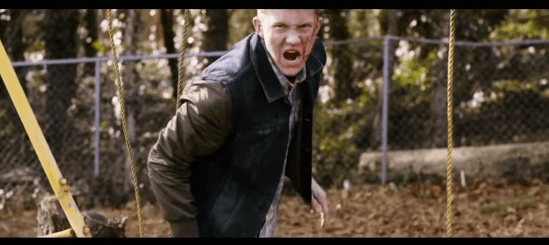
What intrigues most about Vitaletti’s script is no character is inherently labeled as a conventional genre trope. The chapter-storied narrative plays out in three parts with the title paralleling the contents of the mysterious red book as well as the action in each plotted chapter. What seems orthodox for the film’s set period in punishing those in same-sex relations alluded “The Last Thing Mary saw” to be a tale of sordid, Godless misconceptions and yearning attraction between two young women, but then the catalyst happens, a supernatural being is revealed, and then the tide turns from the sinister misguided to the sinister malevolent. Another Vitaletti explores another theme: hate. Mary hates her own family to the point of setting out revenge upon them; she would do anything to not separated from Eleanor, but yet Eleanor remains in the house, not dismissed, or reassigned to another house. Hate festers into everything, boils closely at the edge, not just for Mary and Eleanor but for the family who hates secular unions, hate embitters in the grounds security guard after his leg was purposefully crippled for running away, and hate also tears are Rory Culkin’s The Intruder whose monstrous birth has left him with no family or respect amongst his peers so he must take away from others. Without production designer Charlie Chaspooley and costume designer Sofija Mesicek, there wouldn’t be this resurrection of early 1800s resemblance that’s essential for the story’s period and the acting also smooths out the dialogue of a yonder-forgotten dialect of a lingering British-English set in area of Long Island. Though I like where the story progresses and how climactically ends, following along with Vitaletti’s script falls nearly deaf on a coherent understanding. Plot points do come out of nowhere at times that don’t segue neatly enough for comfort and we’re left with a mountain of enigma that somehow ties Mary, the book, and an unconventional Matriarch together into a dysfunctional family affair; yet, the sullen atmosphere makes for good unbenevolent folkloric horror coupled with Vitaletti’s incredible patience the scenes with immense anticipation and dread.

Premiering worldwide at the virtual rendition of the Fantasia Film Festival, “The Last Thing Mary Saw” will be a part of the festival’s first wave of films for attendees. No digital, on demand, or physical release dates have been set for this occult horror drama from first time feature director Edoardo Vitaletti, so you will have something to look forward to in the coming days of new releases! Director of photography, David Kruta, has come along way since the unfinished mess with the discarded survival-slasher “Old 37” by maintaining Vitaletti’s natural rustic scheme of the early 1800s and then toil with the phantasmal occult in one or two scenes with an airy, dreamy, and, if not, an ethereally beauty in it’s parlous context. Situational context is also key when a scene with a long stretch of no dialogue becomes the means to an end and Kruta has to capture culmination of storytelling through the facial emotions and body gestures coordinating in light charade as well as a more hefty depressed language. “The Last Thing Mary Saw” is unpretentious horror done right with a melancholic reflection of a bygone past mixed with obscure occult elements wresting life from already blinded grips consumed by hate and arrogance is pure bread and butter for a director just getting warmed up.




 It's Bloggin Evil!