Michelle Yeoh Versus the EVIL Japanese Imperial Army! “Magnificent Warriors” reviewed! (88 Films / Blu-ray)

“Magnificent Warriors” Now on an Amazing Blu-ray from 88 Films!   Click The Poster to Purchase!

Ming-Ming is an adventurous, mercenary pilot unafraid to herself mixed up in the worst of trouble and against the tremendous odds.  When her patriotic grandfather and military uncle present Ming-Ming a mission of resistance against the Japanese Imperial Army during World War II, the odds, again, will be stacked up against her as she must track down China’s top-secret agent to extract the City Lord of Kayi City, a fortified Chinese city on the outskirts under Japanese control with ambitions to build a strategic, poisonous gas plant.  When Ming-Ming’s is shot down by a Japanese fighter pilot and the mission proves to be more difficult than expected, a small band of unlikely heroes become resistance fighters that inspire Kayi City to rise up against an oppressive, super nation threat to take back their home.  The city of spears and arrows must defend its people from an overwhelming army of rifles, mortars, and tanks in a fight to the death.
Michelle Yeoh is so hot right now.  The Malaysian-born, long-time actress has been under the U.S. mainstream radar for decades up until recently.  Before now, she was well enough for her roles in Ang Lee’s four-time Academy Award winner “Crouching Tiger, Hidden Dragon” without Yeoh receiving a nomination.  Twenty-two years later, Yeoh receives her first Academy Award nomination for “Everything Everywhere All at Once,” but we all knew she deserved the coveted U.S. award well before now.  U.S. audience never got to experience Yeoh earlier in her career as an Asian action star that rivals the likes of male counterparts Jackie Chan and Chow Yun-Fat.  In “Magnificent Warriors,” Yeoh’s diligence to the demanding workload foretells a superstar in the making.  The David Chung directed Hong Kong picture is relentless and action-packed with stunning and intense choreographed martial arts and having a large-scale showmanship of numerous grand explosions and a vast production pocket that include countless background actors.  The script is penned by frequent Stephen Chow collaborator Kan-Cheung Tsang who has wrote many of Chow’s directorial films, such as “Kung Fu Hustle,” “Shaolin Soccer,” and “The Mermaid.”  “Munificent Warriors,” also known as “Dynamite Warriors” is produced by Linda Kuk (“Hard Boiled”) and David Chung’s “Royal Warriors” producer John Sham and executive producer Dickson Poon under the D&B Films banner.
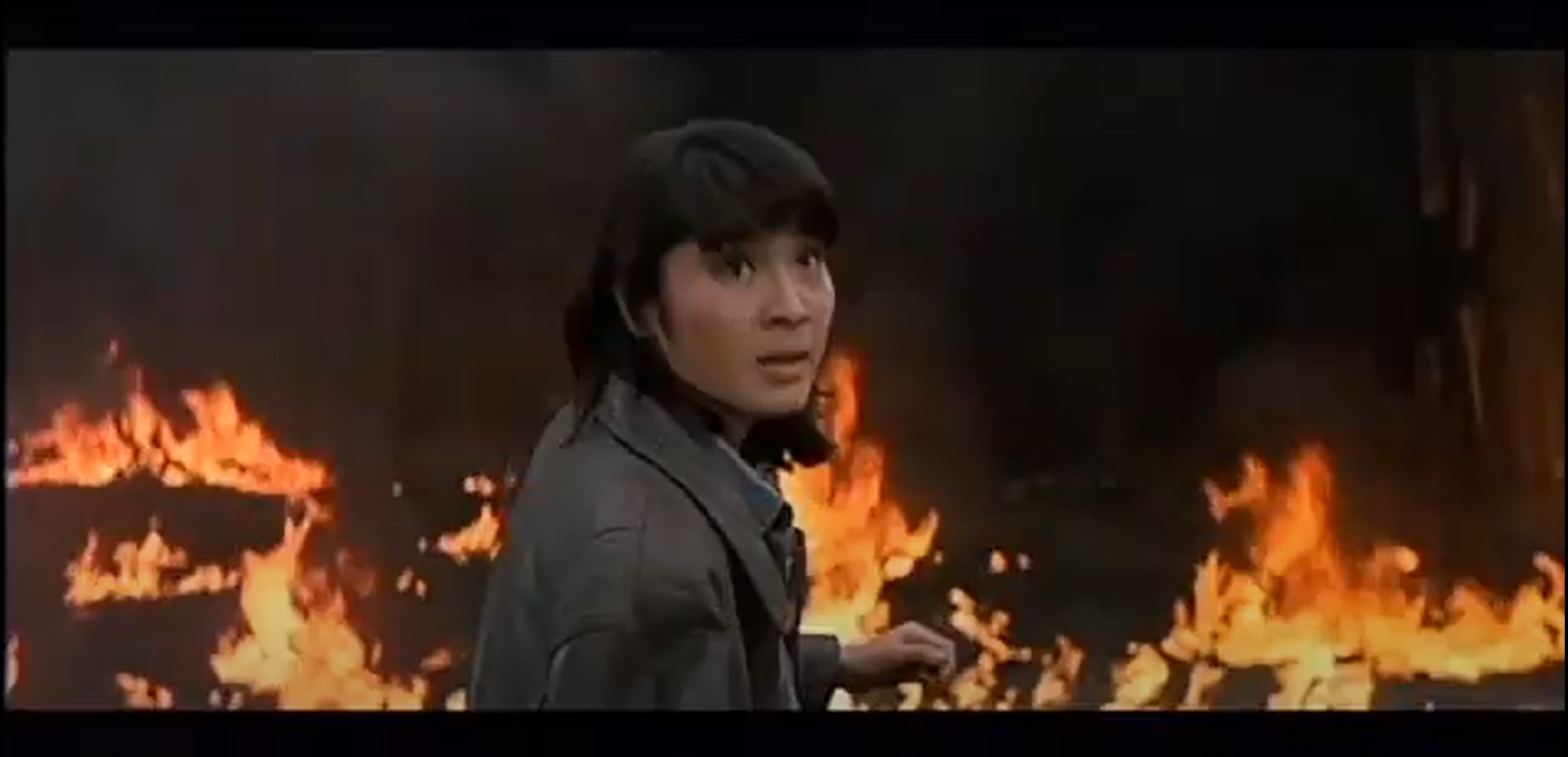
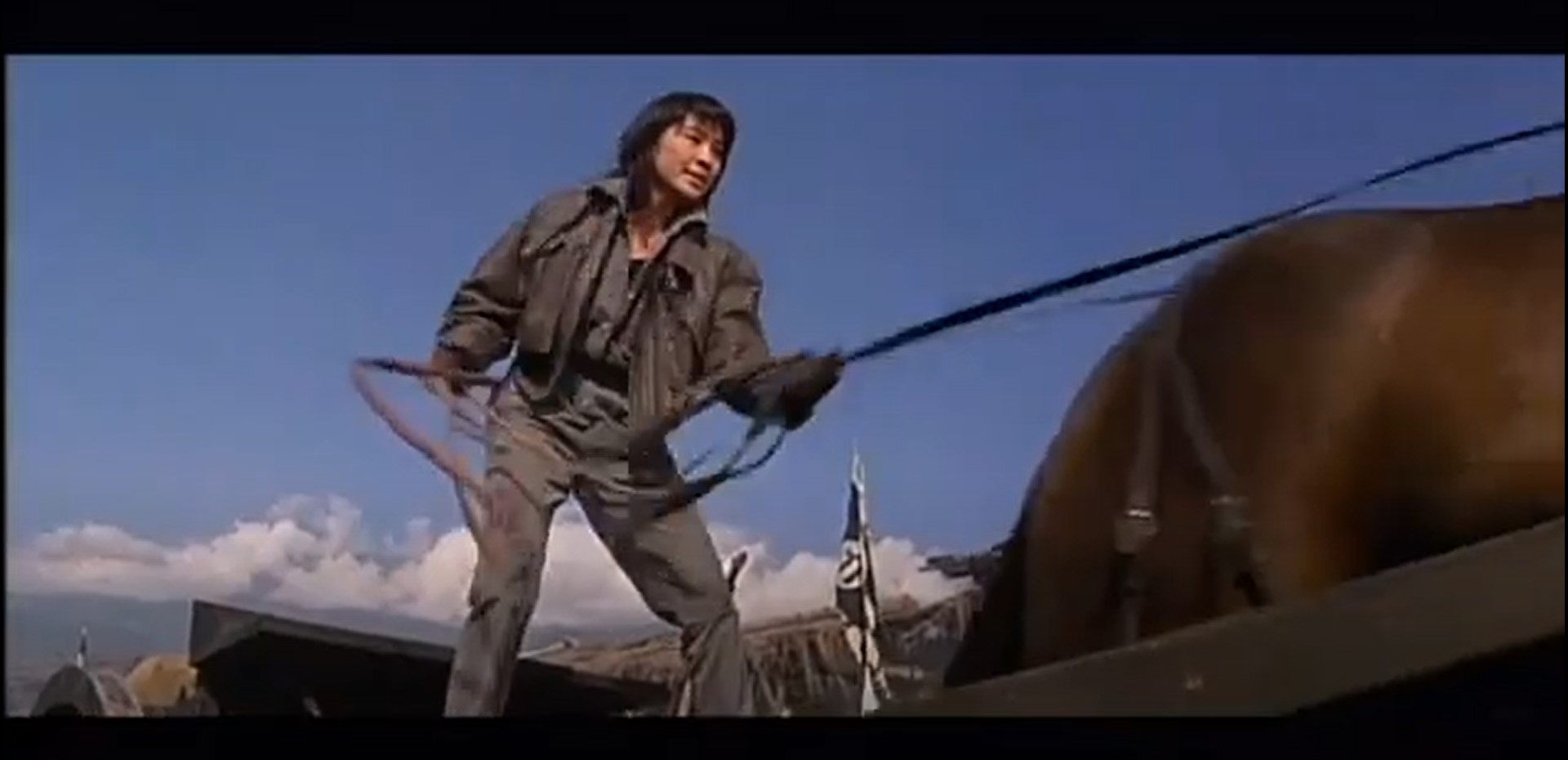
In a career that spans decades plotted by a number of strong female characters, Michelle Yeoh has embodied strength, intelligence, and beauty for this generation.  Under her early credited name of Michelle Kahn, the actress, who in the last five years has entered the Marvel Universe, the Star Trek Universe, and is slated to be in the upcoming James Cameron “Avatar” sequels,” is the driving force behind what makes “Magnificent Warriors” so engrossingly magnetic.  Trained to use a bullwhip and able to accomplish major stunts, unsafely I might add, on her own, Yeoh pulls off the demanding role with sheer confidence radiating from her performance.  So much confidence that the quality beams from her eyes to the point that her gaze nearly appears to be a sadistic grin of her own masochism.  Yeoh seizes Ming-Ming’s adventurous spirit, fully embraces it even, and stands out, but meshes well, amongst the mix of characters, including a hapless and bumbling drifter played by Richard Ng.  The “Mr. Vampire Part 3” star has a recognizable and distinguishable face as a well-known Hong Kong actor from China.  In “Magnificent Warriors,” Ng’s character is clearly the odd man out with zero ambitions and zero fighting skills, providing roughhouse comedic relief with lucky escapes with his life, but as far as character arcs go, the drifter, who cheats and scams gamblers for money and thinks about saving his own skin, succumbs to the resistance call of helping China and becomes one of the leaders of the core Kayi City defenders.  There are three others in this band of five with the City Lord (Lowell Lo, “Spider Woman”) who has a similar character arc as the drifter in being a bit of a scaredy-cat as a traitor against the Japanese Imperial Army but sees the light of his people needing his boiled down bravery and leadership, and his involvement with Shin-Shin (Cindy Lau), a daughter of a Japan loyalist who is obsessed romantically with the City Lord and can kick ass as well that surmises a feminism theme that women are just as strong as men and can have a better moral compass, especially compared to the bumbling man in power, the City Lord, and the drifter con artist.   The weakest fifth character, with an equally weak performance, in the group is Secret Agent No.1, as he’s described in the subtitles, played by Derek Yee (“Black Lizard”).  Though pivotal to the resistance operations to succeed, Secret Agent No. 1 fails to make his impact like the others, character divulging a vague history of his climbing to be China’s best secret agent and also teetering on the supposedly feelings for Ming-Ming that doesn’t ever come despite blatant suggestions to the contrary.    Matsui Tetsuya, Hwang Jan Lee (“The Drunken Master”), Meng Lo, Fung Hak-on, Jing Chen, and Ku Feng round out the “Magnificent Warrior’s” cast.
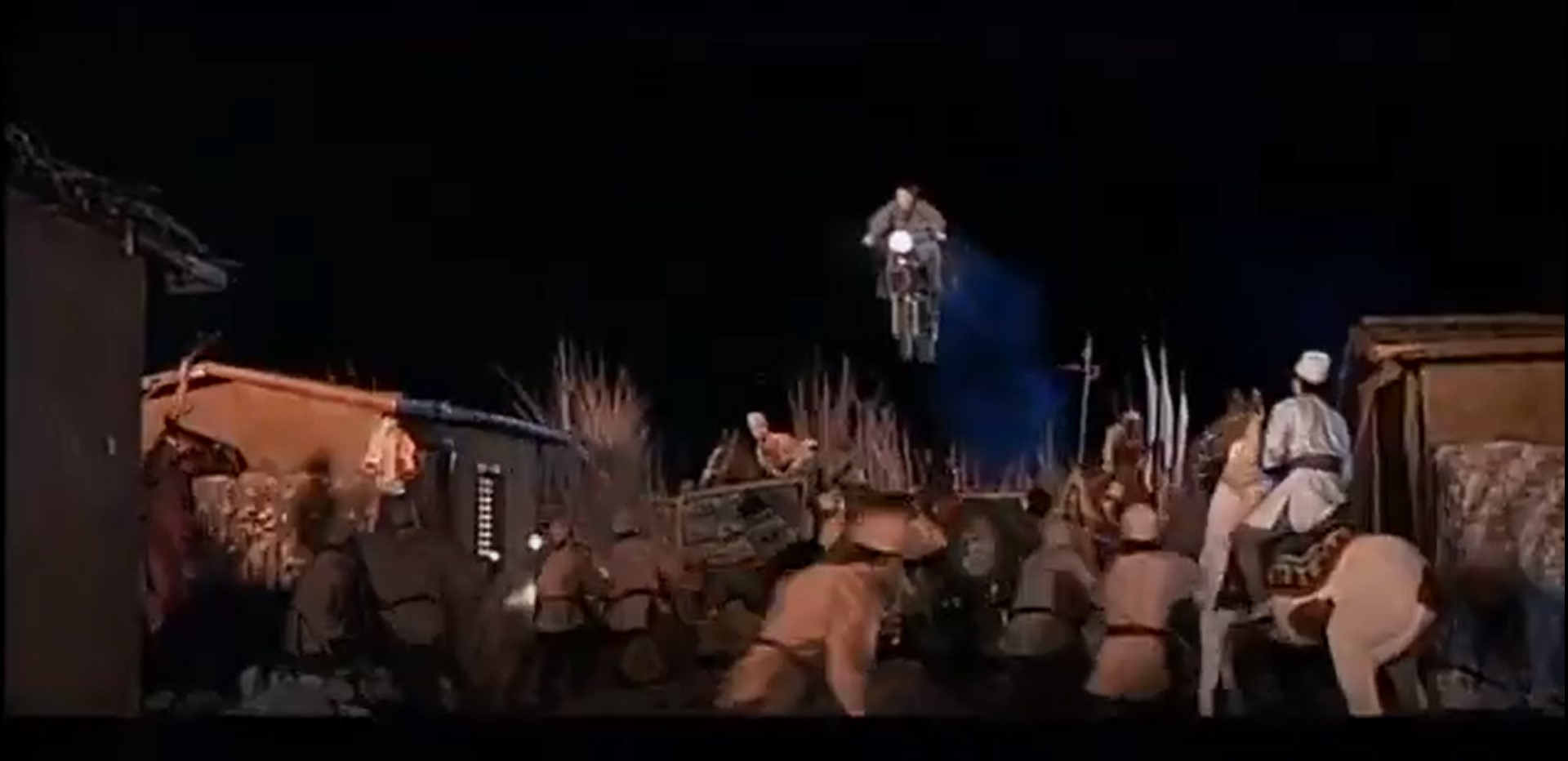
With extraordinary martial arts choreography, the impossible become possible in what can be experienced as an epic ballet of fists, kicks, and dueling weapons.  Every battling moment translates perfectly on screen without the flinch of error, though I’m sure many takes were took.  Back when outside Hollywood film studios relied on their determination and skill, with a pinch of luck, to get them through tough and rigorous stunts without the aid of wire, pads, or any union approved safety measures for that matter in what feels remarkably alien, like being on a whole other world where the rules of physics and safety do not apply.  “Magnificent Warriors” is truly a magnificent stunt-driven, wartime story revolving around revolutionism, a contemplation of the relationship between a home and its people, and a principled life of standing up for what’s right.  Director David Chung manages to massage out the numerous themes under the façade of a great thrust of nonstop action.  The set pieces, locations, and wardrobe are all fitting for the late 1930s-1940s era, especially with the Japanese uniforms that extend into their armored vehicles, such as in the brief, for show, scenes of its war plane and handful of Type 95 Ha-Go tanks. It’s refreshing to see an older film have a different angle on the overplayed World War II narrative; instead of the typical European or Asian Pacific campaigns involving American troops, “Magnificent Warriors” goes granular into The Second Sino-Japanese War during the Second Great War the world has ever experienced. Japanese implemented chemical warfare into their strategy of expanding their dominating military advances and establishing a footprint in China. “Magnificent Warriors” embellishes the poisonous gas narrative with the imperial army seeking to use Kayi City as a chemical producing plant, steering the film’s epic grapple over the city from out of underlying truth of the actual conflict. Every stage of story progresses into a larger scale of the previous skirmish which bottles up the grossing pressure between the imperial army, the resistance fighters, and the collateral damaged city folk caught in the middle. Sprinkled with comedy and charisma, and an ever so delicate dark tone, “Magnificent Warriors” is impeccable Hong Kong cinema and exposes the world to an underrated performance by Michelle Yeoh who kicked ass then in this film and still kicks ass today.

UK distributor 88 Films releases the “Magnificent Warriors” onto an AVE encoded, 1080p, high-definition Blu-ray, presented in a 2K restored transfer of the original theatrical cut on the company’s USA line. Exhibited in the original 2.39:1 aspect ratio, the anamorphic picture can appear globular at times, resulting in a packed image but more on so on pan shots than anything else. The overall picture quality suggests a pristine original print of the theatrical cut with a clean presentation from start-to-finish. Mostly warm with a flaxen degree of a desert background within a Mongolian Mountain valley, when the story does transition to a night shot or to interiors, the grain roughly sustains the change to keep a unified picture consistency that lives in a low contrast field without any deep shadow work or hard lined delineation. Compression issues are non-existent and there’s not obvious, unwanted touchups here to note. The release comes with two audio options: A Cantonese DTS-HD Mono and an English dub DTS-HD Mono. Preferrable choice is always the original intended language; however, this film’s audio options are both dubs but the Cantonese synchs better with grammatically suitable English subtitles albeit their breakneck speed to keep pace. Dialogue is clean, clear, and the action sound design is audibly potent with pinpoint precision on the homogenous strike. There are moments I thought the quick editing, especially during the plane chase, would hinder the ambient effects to keep up but I was pleasantly surprised, and the prop and gunfire intensity presents a nice exchange of open aired depth, range, and dynamisms. Software bonus features an archive interview with Michelle Yeoh (circa early 2000s), an archive interview with stunt coordinator Tung Wai, an English credits opener, the Hong Kong and International trailer, and still gallery. The hardware features are a tad better with a double-sided A3 poster, a 35-page color picture booklet with historical and filmic essay by Matthew Edwards, a limited cardboard slipcase featuring new art by Sean Longmore, and a reversible cover art in which shares its illustration with the booklet. The case isn’t the traditional slim Blu-ray snapper as it’s thicker to handle the booklet and poster. The release comes not rated, region A coded, and has a runtime of 92 minutes. Drawn into a big war shieled and overlooked by a bigger war, “Magnificent Warriors” not only time capsules a piece of Asian history but does it with fantastical fight and character that delivers one Hell of a timeless film with Michelle Yeoh at the helm.

“Magnificent Warriors” Now on an Amazing Blu-ray from 88 Films!   Click The Poster to Purchase!

An Interpretation of Charlie’s EVIL in “Manson Family Movies” reviewed!


Charles Milles Manson was a notorious criminal and cult leader living a commune lifestyle in the peace and love era of the 1960’s. The Mason Family was his communal cult following that squatted in the outskirts of Californian desserts and self indulged in hallucinogens. Radicalized and dangerous, Manson exploited their unwavering loyalty to his radicalizing behavior of a hippie way of life. Filmmaker John Aes-Nihil, a collector and lionizer of all things Charles Manson, shoots a recreation of the daily activities of Mason’s cult members, filmed at infamous Manson locations that gave a taste of commune life while also providing shuddering atmospheric insights of kill spots. To Aes-Nihil, Charles Manson lived and breathed through interpretation of their, so called, home movies.

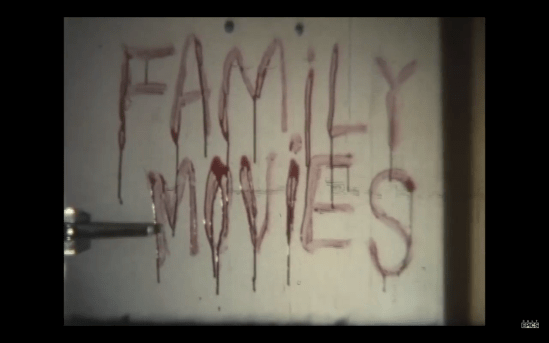
Filmed between 1974 to 1979, three years after Charles Manson was convicted of first degree murder, director John Aes-Nihil filmed his rather homage-life rendition of what he calls the “Manson Family Movies.” Not released until 1984, Aes-Nihil also brings legend to fruition of a rumor that Manson and his followers filmed much of their daily rituals and societal deviancies, giving “Manson Family Movies” more stigma to the already controversial obsession the filmmaker already made mania in such a short turnaround from Manson’s conviction finale. “Manson Family Movies” is also a silent film, a rarity for a late 70’s, early 80’s that was just in an industrial transitional point of visual special effects and larger than life performances; yet Aes-Nihil’s remains silent and crudely finesses his interpretative documentary with stage play performances and badly scrawled title cards that instill an engrossing affect of internal sliminess toward the already visceral nature.

The cast consists of many unknown faces who have come and gone even before “Manson Family Movies” was first viewed by the public. Their involvement begs the question of their pride for subject matter involving the brutal stabbing murder of a pregnant woman with the senseless and, almost, toying deaths of couple as their listed names are more than likely pseudonyms, credited as if themselves were a part of a hippie commune with names like Rick the Precious Dove as Charles Manson, Krista Meth (Crystal Meth?), Porn Michael, Miss Sheila Star, and Sister Audress just to name some of the more eye-catching credits. As aforesaid, performances are choreographed indiscriminately that much of the violence goes by the waist side, but as characters go, more than most look the part with the exception of some transvestism as some actors and actresses don multiple roles in the bottom of the money barrel feature. Other dime actors included Katie Lazarus, Knarly Dana, Mr. Jacquetta, Judy, Ms Mule, Danny, Lori, Miss Head, Ms Brad, Moka, Chucky, Rusty, King Mama, and The Cosmic Ray. Seriously…

Not much is first-rate about the “Manson Family Movies” aside from a couple of exceptions: 1) Cult Epics amazing two-disc re-release that’ll be covered later and 2) the fact that Aes-Nihil constructed home like movies using what looks like 8mm negative film complete with deterioration and defects, providing a desensitizing and demoralizing halo around the heavy material. “Manson Family Movies” won’t be many audiences cup of historical tea and many folks will probably point out that this is only an interpretation of events, but was the raid on “Pearl Harbor” accurately depicted by Jerry Bruckheimer or did James Cameron give every minute detail correct in “Titanic?” I think not. Not to compare apples to oranges to blue berries, but as base observation, Aes-Nihil did what any director would have more than likely done with an influential historical moment, a little embellished reenactment no different from the stud Hollywood filmmakers.

Cult Epics’ re-release of the “Manson Family Movies” is now presented in a region free, two-disc set complete with a slip illustrated with the same composited Charlie Manson head cover art by Brian Viveros and the same disc art by Charles Manson himself from the 2005 release. The film is presented in a 4:3 aspect ratio with the black bars on either side of the frame and, as previously mentioned, the image clarity is marked by scratches, flares, and dirt. Surely, for visual stimulation. Billed a silent film, the dual channel mix of the redux and remastered score is resoundingly poignant and strangely vibrant with Charlie Manson and his Manson Family recorded music as the soundtrack. Plus, there are actually less aesthetically audio tracks from Sloppy Titty Freaks, Beyond Joy and Evil, Glen Meadmore, and some sampling of the Beatles from, you guessed it, Helter Skelter. Special features include John Aes-Nihil commentary track, outtakes with director’s commentary, last interviews with Charles Manson, the original LADP crime and morgue photos, and the second disc contains Sharon Tate’s home movies without an audio track. After watching “Manson Family Movies,” John Aes-Nihil comes to suspicion as perhaps one of Charlie’s commune followers as he depicts a chilling look into the past, through a window of ghastly sovereignty over impressionable young people, and champions a real home movie approach that makes the entire package, along with a invigoratingly haunting score, a black gem.

Evil Is Only Skin Deep. “The Wax Mask” review!


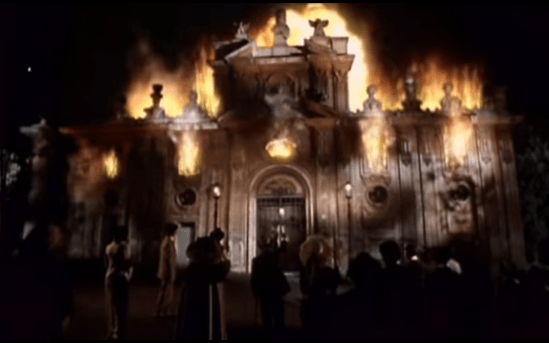
Set in Rome of 1912, a newly constructed wax museum, under a mysterious alchemy artist known as Boris Volkoff, stirs controversy with the showcasing of the world’s most grisly and notorious murder scenes. Two brothel customers’ debate result in the one challenging the other to spend the night at the curated museum of horror without having an ounce of fleeting fear. The next morning, the man has been found, apparently keeling over in fright, and the police are baffled, but something more sinister is afoot when Sonia, a young costume designer with a horrific past as the sole witness in the gruesome death of her mother and father in Paris 1900, becomes employed at the museum to costume the wax figures and faints when the scene of her parents’ brutal death is recreated as the museum’s new showpiece. Sonia and a reporter closely examine the museum when more people begin disappearing off the street, people who have ties with the beautiful costume designer, and learn the waxed creations are much more underneath their plastic-lifelike skin.

Before his untimely death, the Godfather of (Italian) Gore, Lucio Fulci, had been cooperating on a semi-quasi remake of Vincent Price’s 1953 thriller “House of Wax,” based on the Gaston Leroux’s novel, alongside fellow iconic Italian horror director Dario Argento (“Suspiria”) in a comeback collaboration for Fulci, but the entitled “The Wax Mask” film was evidently delayed partly in because of Fulci’s death. “The Wax Mask” was handed over by Argento, who was producing, to special effects guru Sergio Stivaletti (“Cemetery Man,” “The Church”) and months after Fulci’s death, a finished product shared very similar traits to the Godfather of Gore’s style craftily blended with more modern approaches to filmmaking was released to the public. Though tailored more toward the interests of gory special effects, Stivaletti’s 1997 film is dedicated to Fulci with the implementation of many of the director’s popular trademarks, including closeups on various eye expressions and zoom-ins on gore and the weapons before their fateful strikes, while also basking in strong bright colors in the midst of shadowy cinematography that’s typical of the giallo genre.

In such a crimson world, an elegant performance by Romina Mondello, who stars as the orphaned Sonia, has the Rome born actress bring beauty, innocence, and charm to the macabre that harbors contrasting arguments against undermining marred antagonists and she provides a breath of aesthetic liveliness amongst a narrative that surrounds itself in capturing beauty in inanimate wax figures. “Cemetery Without Crosses'” Robert Hossein embraces the enigmatic museum curator, Boris Volkoff, with struggling internal black aspirations that involve his recently acquired employee, Sonia, and Houssein is able to turn off and on that switch of longing and menacing, playing the hand of the character superbly to keep audiences guessing his true intent. Volkoff’s faithful assistant and exhibit creator, Alex, embodies creepy and morbid attributes wonderfully contributed by a relatively unknown Umberto Balli. The trifecta cast sells the ghastly science fiction that slowly builds toward the transformation of “The Wax Mask” from classic giallo to sensational mad science Gothicism with a boost of euro trashiness that’s more relative to the work of Jesús Franco or Joe D’Amato. Riccardo Serventi Longhi (“Symphony in Blood Red”), Valery Valmond, Gabriella Giorgelli (“The Grim Reaper”), and Gianni Franco (Dario Argento’s “The Phantom of the Opera”) round out the cast.

Stivaletti’s toolbox of special effects celebrate in the practicality that escalates when the cloaked killer’s metal claw literally rips terror through the hearts and souls of characters, but the glossy composite imagery thwarts realism and cheapens the already cheesy Euro horror with a laughable fire set ablaze and a slew of lampoon electricity while half naked women are strapped to a barbaric mechanized chair. The cut-rate composite won’t ruin a guilty pleasure viewing and won’t blast apart an arguably respectable adaptation of Gaston Leroux’s novel, but the script, co-written between Argento, Fulci, and “The House of Clocks'” penning collaborator Daniele Stroppa, does pull from other, interestingly enough, inspirations that one wouldn’t think would be genre compatible. The action-packed finale of James Cameron’s 1984 pre-apocalyptic, time-traveling cyborg blockbuster, “The Terminator,” makes an unexpected appearance with an endoskeleton villain donning some familiar and memorable moments from one of the greatest sci-fi films of all time.

“The Wax Mask” greatly resembles Italian horror cinema from the 1970s and 1980s spawned in the late 90s, a superb feat for a director more aligned in vocational special effects, but the jaded historical background accompanying the film places a stain on whether Lucio Fulci had much to do with the project at all. Much is speculated that Argento and Stroppa re-wrote Fulci’s original script after his death, removing much of Fulci’s atmospheric flair and adding more gore, but in the end, “The Wax Mask” instabilities are overshadowed by great practical effects, an engaging storyline, and a roster of flavorful characters. The One 7 Movies and CAV Distributing Blu-ray release is presented in 1080p. The widescreen 1.78:1 aspect ratio is the not the original 1.85:1 aspect ratio, but doesn’t constrain the image. The MPEG-4 AVC codec emits a bit of shakiness under the compression, suggesting a lower bitrate, but the One 7 Movies’ release is the best, sharpest looking transfer of the original source material with natural coloring on skin tones, vibrant shades of various colors, and shadows being exquisitely black. Four audio options are available from the English and Italian Surround 5.1 tracks to the English and Italian Stereo tracks with no accessible English or Italian subtitles in the static setup menu. Extras are slim with a handheld camera behind-the-scenes that’s solely in Italian. “The Wax MasK” is an ambitious Gothic hybrid horror that cements the memory of Lucio Fulci, pleases the gore of Dario Argento, and showcases the talents of debut director Sergio Stivaletti.

Purchasing One 7 Movies’ “The Wax Mask” at Amazon!

Reading Evil! Starship Troopers book review!

starshiptroopersbookLike Paul Verhoeven’s intergalactic warfare movie Starship Troopers where mankind battles an arachnid army known as “Bugs?” Did you know that Starship Troopers is based off a novel of the same title and was published in the late 1950s? Well if you did not know, now you do! Written by a former naval lieutenant Robert Heinlein Starship Troopers bares little action similarities to the novel’s more recent movie counterpart.

Juan Rico decides to join the service against his parents’ wishes and embarks from a private in boot camp to non-commissioned office to finally commissioned officer. Rico’s backdrop is war; an intergalactic war with a nasty enemy known as the “Bugs,” an arachnid species that can calculate and that can strategize with the help of a brain caste pulling all the strings.

Johnny Rico getting slapped...on the ass.

Johnny Rico getting slapped…on the ass.

If you’ve seen the movie, the plot pretty much describes the movie, right? Most of the Heinlein’s novel follow’s Juan “Johnnie” Rico’s career through the trials and tribulations of Service, from boot camp to being a lieutenant, in becoming a citizen, but the action and bloody mess that was experiences on the big screen was not translated from the book as most of the Mobile Infantries whom were killed in action were described as “buying the farm.” You can’t blame Heinlein as this book was written in 1959 mentally constructed as a totally different mind set than from our generation. The words on page are seriously outdated and can be technical for the most of the novel due to Heinlein’s military background.

The novel touches more upon the power suits which make an appearance in Starship Troopers: Marauder (“Marauder” is a name of one of the many power suits). These suits give Rico and the other M.I.s a superhuman ability and give them an even playing ground with the Bugs. I rather prefer no power suits as like in Verhoeven’s film that make the bugs seem like an unstoppable force. The novel does delve a bit more into the Bug society and hierarchy as well as how the Bugs reproduce endlessly. Much of James Cameron Aliens was inspired of Heinlein’s novel in the aspects of “Bugs” and their being a Queen to produce the “warrior Bugs.”

Brain Bug and Carmen

Brain Bug and Carmen

Heinlein touches mainly on civic duty and the social norms of a military lifestyle through the confines of war. We live through Juan Rico much like we live through Johnny Rico in the movie, but don’t expect to read much about Johnny Rico’s companions. Ace, Carl, Carmen, Dizzy Flores, Sargent Zim are a few characters that you might remember from the film that are in the book, but Ace, Carl, Carmen and Dizzy are brief mentions that probably span no more than a page and half out of 260 plus pages. Zim is all through bootcamp and near the end of the novel. Instead, Juan Rico encounter various people and ranks that stem from privates to cadets to sergeants to generals.

Starship Troopers can be an interesting read for anybody with a military frame of mind or a curiosity for it. But don’t expect the chaos of battle scenes or the gore of the arachnid M.I. slaughter. Robert Heinlein’s novel will not be everyone, but a good read none-the-less.