
Return Home to Discover Dad’s An EVIL SOB! “The Abandoned” reviewed! (Unearthed Films / Limited-Edition Blu-ray)

Don’t Be Left Behind. Get Your LE Blu-ray Copy of “The Abandoned” from Unearthed Films

Marie Jones never knew her parents.  Born in Russian, raised in the London, and now lives in the U.S., the low-budget movie producer receives news from a Russian estate notary providing her details on her murdered mother back in 1966 and her existence entitles her to the isolated family farm.  Unable to resist the urge to find out about her mysterious past, Marie travels to her parents’ dilapidated farm settled on an island encircled by a river.  There she meets Nicolai claiming to be her twin brother and that he also, after a similar call from the notary, felt pulled to their family home on the verge of their upcoming birthday, but they’re not totally alone.  Trapped on land that won’t allow them to leave, Marie and Nicolai run into their undead doppelgangers that impel them to dig into their family history and uncover the gruesome truth to what happened to their mother.  All the while, the house around them rewinds back in time before age and weather have taken a toll and the souls living in what was once a home return to bring the family back together again.

A past drawing near story stretching from 1966 and 2008, “The Abandoned” is a haunted house, supernatural, and circular tale that bears down a forlorn ancestry nightmare onto ensnared curious lineage wanderers, bringing them back into a vicious cycle of a family history that should have been left alone.  “Aftermath” and “Genesis” short film director Nacho Cerdá tries his hand at less necrophilia and gore for more daring, open-to-interpretation horror with the Karim Hussain (“Subconscious Cruelty”) original script with some rewrites and sprucing done by “Dust Devil” and “Hardware’s” Richard Stanley.  Filmed in Bulgaria to double as the scenic landscapes and to use the country’s looming, enveloping trees as another margining aspect of being trapped, “The Abandoned,” initially title as “The Bleeding Compass” on Hussain’s original script, is produced by Julio and Carlols Fernández, Kwesi Dickson, Stephen Margolis, and Alexander Metodiev under Castelao Producciones, Filmax International, and Filmstudio Bojana with Future Films’ Carola Ash and Albert Martinez Martin serving as associate producers.
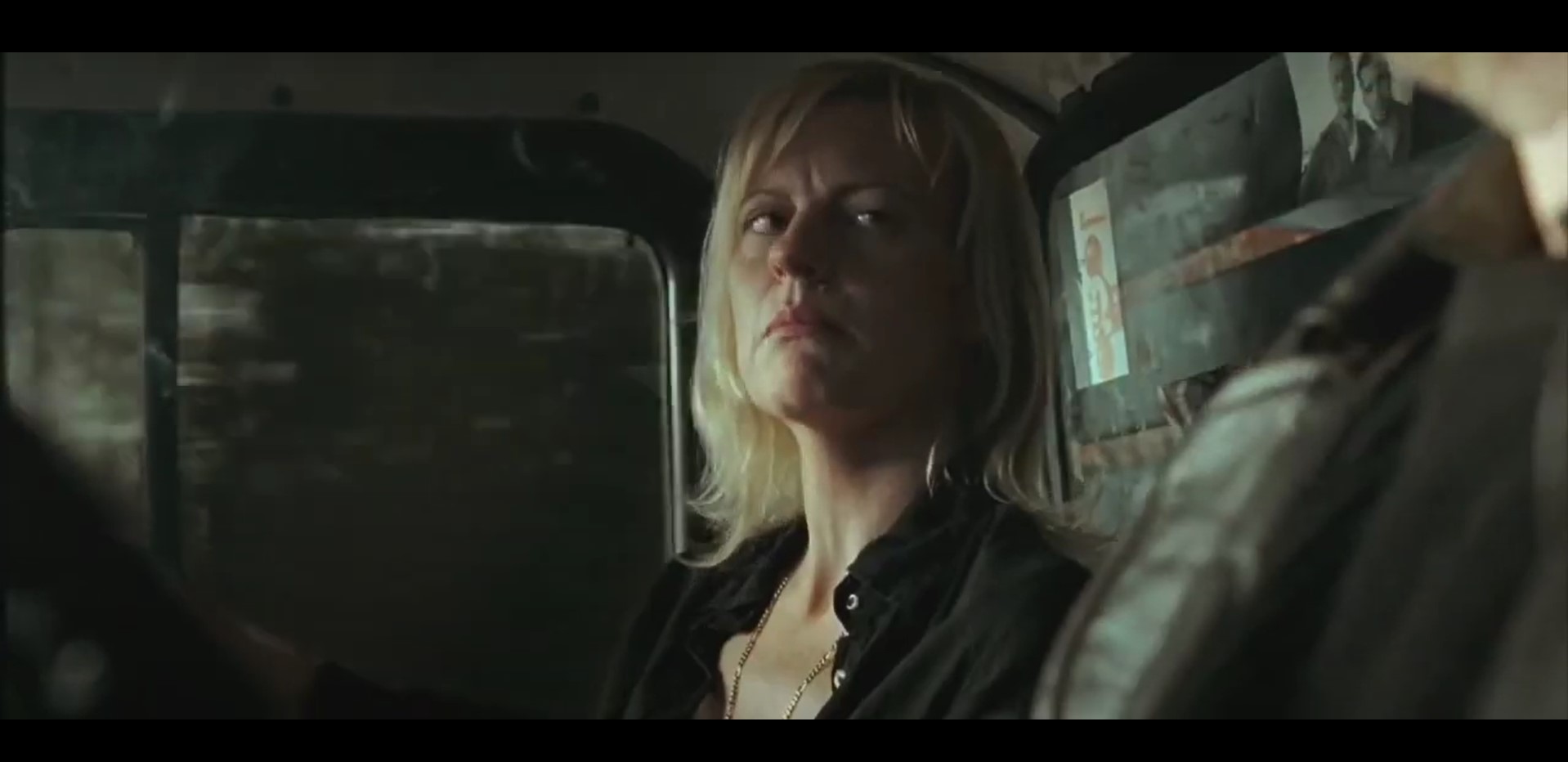
“The Abandoned’s” modest budget regulates casting to, at that time, relative unknowns for the U.S. market but certainly not an experienced lot between English actress Anastasia Hille (“Snow White and the Huntsman,” “Martyrs Lane”) and Karel Roden (“Orphan,” “Hellboy’) playing reunited brother and sister Marie and Nicolai who have not been together since infancy.  Separated at the demise of their mother, Marie and Nicolai have undoubted hesitation to their relation, especially both are met by grisly versions of themselves in the old family homestead.  The double versions of themselves represent a dual life, one connected to their current path, and one connected to their past, and Hille and Roden play into that theme with fortitude and fear in how the past haunts their characters connected to a shadow world in a very “Silent Hill” way.   Hille brings complexity to Marie’s own troubled relation with her daughter, a character we don’t necessarily see physically on screen, but we understand through phone conversations and brief interactions with Uncle Nicolai that the foundation the mother-daughter relationship stands on is shaky and that pushes Marie to pursue the truth about her own mother to avoid that disconnection with her daughter.  For Nicolai, Roden instills a more tragically inclined façade without overcompensating with tremendous evidence in the loss of a woman he loved, aside from their matching tattoos, and his melancholic state is staid by the newfound opportunity to discover his past until unless it also becomes his downfall.  Again, we’re back to the past should stay dead, or in the past.  Hille and Roden underpin “The Abandoned” and its ghostly enigma with brief interjections of supporting ancillaries in Valentin Ganev, Carlos Reig-Plaza, Paraskeva Djukelova, and Marta Yaneva. 

“The Abandoned” is one of those circular narrative stories working toward a revelational end, one that likely won’t be pleasant.  An endless loop of trying to leave Marie and Nicolai’s childhood home only for them to be brought right back into the same room from which they started lend into a couple of preconceived notions of their ringlet wretchedness, both in circumstance and in life, and that being either they’re already dead and in a purgatory or their grieved existence has warped them into a psychological break when returning to a decaying land left in the memories of the heinous death of their mother.  Both theories incorporate a supernatural element where time reverses and, coinciding with the twins’ upcoming birthday, a clock ticks down that will bring the family whole again, this time in the afterlife if the unnatural powers to be have anything to say about it.  That’s the definitive beauty of “The Abandoned’s” open air forbidding allegories with the more than one interpretational rivulets spreading in different directions, shaped idiosyncratically by Marie or Nicolai’s life.  What helps the impervious fate outcome of the principals is that “The Abandoned” also has strong, poignant visuals as a foothold into keeping audiences intrigued on what could be a slippery slope of symbolism.  A mix of practical and composite effects, done amazingly through the editing process, sell duality on every layer as if we’re experiencing two worlds during a collision and waiting with anticipation for one to engulf the other. 

Unearthed Films brings “The Abandoned” home on a limited-edition Blu-ray home video. The AVC encoded, 1080p high-definition, BD50 capacity houses plenty of breathing room for the claustrophobia details to writhe within. Middle-to-higher contrast levels that throw out good shadows without being extremely inky, there’s spectrum discoloration from blotchy-banding, suggesting a good encoded transfer that deciphers more details rather than squeezing everything in under a lossy codec. Range of the darker graded feature does favor a generous bluish green for the interiors while natural light swarms and illuminates into the exteriors, brighten up Anatasia Hille’s already blonde enough hair to almost pure yellow. Fine details pervade over much of the duration, only relinquishing details for dark, cavernous moments to scare up apprehension levels. The English DTS-HD 5.1 and the PCM 2.0 give viewers lossless fidelity and flexibility with audio setups. I preferred the stereo with robust dual channel dialogue; however, the 5.1 showed signs of directional awareness – rustling of leaves, ghostly voices, etc. – through the back and side channels. Dialogue is prominent and clear on both audio options and free of intrusion and interference. English and Spanish subtitles are optionally available. Special features include an abundant of new material exclusively produced by and curated from Unearthed Films, including new, individual interviews with director Nacho Cerdá, screenwriter Karim Hussain, and screenwriter Richard Stanley; there are also new furnished for this release alternate endings that more so involve Marie’s daughter, deleted and extended scenes cut for timing and flow, and outtakes. Archived bonus content has a Making of featurette, location vision in “The Abandoned’s” den, a featurette of Nacho Cerdá: The Trail of Death that looks at the director’s earlier horror inspirations of his trilogy of death shorts, The Little Secrets of Nacho Cerdá goes further into the director’s insights for his varied take on “The Abandoned” story, Nacho Cerdá has a conversational horror discussion with friend Douglas Buck, director of 2006’s “Sisters,” promotional and storyboards gallery, trailers, and a BD-ROM storyboard collection. The limited-edition release has a lissome cardboard slipcover with original poster art of the blood-crying doll from “The Abandoned” on the front. Inside, a standard Blu-ray Amary case has the same cover art image that’s also pressed on the disc. There are no inserts included. The rated-R release has region A playback only and a runtime of 99 minutes.

Last Rites: A step back from the gore and revulsion, Nacho Cerdá is able to scare stiff with “The Abandoned,” a dead and buried family abstrusity squaring the score for lost time by reversing time to welcome back those left living, and Unearthed Films’ limited-edition release is the best version to date that deserves a warm homecoming for its icy, taciturn atmosphere.

Don’t Be Left Behind. Get Your LE Blu-ray Copy of “The Abandoned” from Unearthed Films

An Elite, EVIL Assassin Loses Herself as the “Possessor” reviewed! (Neon / Digital Screener)

Tasya Vos is the top professional assassin employed by a hire-for-murder agency who uses surgically implanted brain transceivers to insert agents’ consciousness into a person’s body who can get close to their intended kill target. The no contact procedure has been successful with some severe drawbacks, such as the potential for slipping out of your own identity in being, in one way, a part of many distinct personalities. When Vos’s next assignment is to insert herself into the mind of the soon-to-be son-in-law of a powerful tech CEO, her individuality begins to crumble, losing her grip as the primary inhabitant of the body. The commingled souls share thoughts and memories and when Vos takes a backseat in a body that’s no longer under her control, her life becomes vulnerable to a confused and unhinged man seeking vindictive measures to evict the assassin from his mind.

Like an existential extension of his father’s career, writer-director Brandon Cronenberg’s foothold within sci-fi horror is anchored by functional practicality, substantial social commentary, and a knack for exhibiting cynical undertones in his sophomore film, “Possessor,” a gripping tech-thriller avowing the soft-pedaled ambiguous identity and corporate invasiveness. “Possessor” is the blood soaked corrosion of individualism that strips morality and replaces it with unapologetic nihilism in a film that feels very much David Cronenberg’s “eXistenZ” merged with Paul Veerhoven’s “Total Recall” with that plug-and-play dystopian coat of paint that’s being brushed over the quickly disappearing free will. Studios involved in the making of “Possessor” include Rhombus Media (“Hobo with a Shotgun”) and Rook Films (“The Greasy Strangler”) in association with a WarnerMedia division company, Particular Crowd.

“Possessor’s” leading lady, Andrea Riseborough, is no stranger to idiosyncratic roles in equally atypical films having starred in “The Duffer Brothers'” “The Hidden” and played the titular character in the avant-garde horror, “Mandy,” across from Nicholas Cage; yet, from her experience with big-budget studio films, such as “Oblivion” starring Tom Cruise, the English actress felt the uneasy atmospherics to be pressurizing and uncomfortable Riseborough has thus exceled with films such as Cronenberg’s “Possessor” that’s pivots into an alcove just off the main halls of horror and science fiction. Riseborough looks nothing like herself from “Oblivion” by sporting a stark white hair on top of a thin frame, which could be said to be the very counter-opposite of what a typical, bug-budget assassin should look like, but Riseborough delivers stoic and uncharitable traits of a character on the brink of losing herself. Christopher Abbot delivers something a little more chaotic when his conscious retreats back into the depths of his psyche only to then seep back into his mind where he stumbles to catch up on current events. The “It Comes At Night” Abbott disembodies himself not once, but twice, becoming an avatar for Tasya Vos to play, picking up where Abbot’s Colin left off, and then Abbot has to regain control, splicing Colin back into the cockpit where Tasya commands the yoke. The dueling dispositions cease being unique as one attempts to control the other in a mental and corporeal game of chess, confounding audiences of who is in control during certain scenes, especially when Colin goes into a blackout murdering spree of people Colin himself knows and trusts. As a puppeteer moving a marionette, pulling as an influential strings behind company lines, is Girder, a poker-faced agent head seeking the absolute best in the company’s interest, who finds her thimblerigger in Jennifer Jason Leigh. Leigh, whose experience with David Cronenberg’s “eXistenZ” brought a high level of cognizance to “Possessor” having been an cerebral deep virtual reality trouper previously, folds in the nerve of any level of management that would guilt someone else into doing the work necessary to get the job done. Girder opposes Tasya’s external humanity in a silent, but deadly manner by appealing to the killer instinct in Taysa, letting red flags of the out of body experience fly by the waist side that ultimately wears away at her star pupils moral conscious and turn her into a stone cold killer. “Possessor” cast fills out with Tuppence Middleton (“Tormented”), Kaniehtiio Horn (“Mohawk”), Rossif Sutherland (“Dead Before Dawn 3D”), Raoul Bhaneja, Gage-Graham Arbuthnot, and “Silent Hill’s” Sean Bean in a worthwhile role just to see if his role will succumb to a typical doomed Sean Bean character as the undesirable tech CEO.

Its safe and sufficient to say that Cronenberg’s “Possessor” is not a feel good story; the amount of tooth-chipping, eye-gouging, and throat stabbing gore takes care of any hope and ebullient energy that one could misperceive. Yet, while the disgorged grisliness stands on it’s own, Cronenberg possesses a factor of tropes that multiply the film’s bleak, icy landscape inhabited by unpleasant characters that ultimately seek and destroy the little good exhibited. The obvious theme is the disconnect from one’s own identity. Tasya Vos mental capacity nears the breaking point being an inhabitant of numerous bodies and with each callous, bloodletting assignment, Vos’ indifference for the things she should hold dear strengthens immensely drowns in the persona of another person and the psyche breaking acts of violence. Her latest assassination attempt even blurs the lines of her sexuality as her feminine body parts merge with Colin’s masculinity in one of the craziest sex scenes to date. Colin’s individuality is too threatened but from Vos’ intrusion, equating the quiet, strange behavior to a sudden vagary toward a person’s dejection, being estranged from their own life, on the outside of “Possessor’s” alternate reality of science fiction’s hijacking of one’s brain. On the subject of intrusion, a not-so obvious theme, but certainly has a strong motif, is the severe invasion of privacy. Vos’ spying on Colin and his lover for personality intel, Vos’ inspection of the entire Colin body while inside inhabiting him, and the data mining of Sean Bean’s character’s tech company, which pries itself through the optics of people’s computer cameras to garner information, such as the fabric of window curtains in this case, divulge an uncomfortable message that privacy is a luxury we are unable to ever grasp. There’s even a scene where Vos, in Colin, becomes a voyeuristic participant of a couple’s explicit sexual intercourse during data mining work hours. Despite the breadth of technology that are brimming near our fingertips today, “Possessor” has a very analog approach with dials and switches of seemingly antiquated electronic circuits, thus rendering the story grounded in nuts and bolts rather than being lost in the overly saturated and stimulated advanced tech. Beguiling with a somber serenade, “Possessor’s” a highly-intelligent work of diverse, topical qualms seeded by years of body horror and existentialism and is released into a world that’s perhaps not ready to come to terms with much of the themes it will present.

Come October 2nd* to select drive-ins and theaters, “Possessor” will be distributed uncut by Neon, implanted in the midst of horror’s biggest month of the year. Since not a physical release as of yet, the A/V attributes will not be critiques, but the film is presented in 1.78:1 aspect ratio and is under the cinematography direction of Karim Hussain, who has previously worked with Brandon Cronenberg on his debut film, “Antiviral.” Hussain adds rich two-tone coloring for a symmetry of sterilization that is, essentially, white and black with every shade of both in between tinted slightly with a dull hue on the spectrum and with the blood being that much more graphically illuminated against the backdrop. There are moments of composites that could render a person disabled with epilepsy, so be warned. The audio is a smorgasbord of a jarring ambience and soundtrack, adding to “Possessor’s” fluxing turmoil, but the dialogue discerns a little less sharply across; there was difficulty in understanding characters’ monologues or discourse who came across mumbling through scenes of fuzzy earshot. There were no bonus materials to mention nor were there bonus scenes during or after the credits. Perhaps the best movie you won’t see this year, “Possessor’s” an impressive follow up feature that reaches out beyond the outlining border of a vast and prolific filmic shadow looming over the filmmaker, but Brandon Cronenberg contrives new vitiated wonderments and is capable of casting his own umbra that would eclipse to throw light onto his soon to be seen cathartic body of work.


* Release date correction (9/29/20)