

When Ben and Charlotte declare a decision to move from the English countryside to Australia, Ben’s ardent mother, Margaret, refuses to let her son move away from his family and responsibility in overseeing the massive manor property that’s been in his family for generations. Despite friction between mother and son, even after the unsuspected announcement of Charlotte with child, the young couple are eager to start their new lives abroad. An accident causes the sudden death of Ben that takes a psychological toll on Charlotte. Margaret, and Ben’s aim-to-please brother-in-law, abruptly move Charlotte into the grand manor home as she floats through grief, but their overwhelming generosity turns into obsession with her every move, corralling her to do what’s best for the unborn child with undue stress based off her own family’s mental history. As Charlotte resists more against the family’s insistence she stay, the stronger their grip on her tightens.
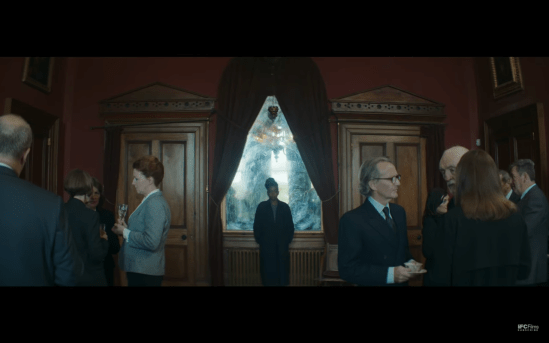
Sometimes, meeting your partner’s family can be uncomfortably standoffish. In Joe Marcantonio’s psychological thriller “Kindred,” reticent of personal gain and admission of truth becomes a thick, abrasive wall of tension that crimps the fringes of family relations and mental instability. The writer-director’s debut feature film hailing from the United Kingdom, releasing this November 6th, tampers with the control over one’s own body through the traumatized perception of a pregnant woman with predispositions on having children in the first place and on her dead boyfriend’s unusual family, coursing with unsettling mental and emotional warfare that’s already tipped in one side’s favor. The 101 minute, English-made thriller is a co-production of Reiver Pictures and Serotonin Films in association with the makers of “Pride, Prejudice, and Zombies,” Phil Hunt and Tom Harberd of Head Gear Films and Compton and Elliot Ross of UK based Kreo Films.

The players in this tumbling mix of disturbing cat and mouse antics are more or less confined to a skewed variation of an immediate family though none of characters are exactly blood relatives. Neither Charlotte, Margaret, or Thomas share an smidgen of the same DNA, but have become entangled, in one way or another, into Margaret’s hampering incubator that shelter’s their distinct and varied, sometimes uncooperative, personalities. Margaret is beholden to memory to her late son, Ben, and exposing Margaret’s egotistic manipulations so wonderfully subtle and true is Fiona Shaw of the “Harry Potter” saga in a role that isn’t so dissimilar to the blunt nastiness of her Aunt Petunia character, but renders a more fierce, enshrouding malice that’s less caricature. The Irish born Shaw and “DunKirk’s” Jack Lowdon dance a beguiling routine of mother and son as Lowdon plays Margaret’s step-son, Thomas. Thomas tends to Margaret’s every snippy whim, being a charming and gleaming host, and an overall nice guy, but deep in the recesses of our minds we know something is just not right with Thomas’s polished veneer that soon will explode with true intentions out of dormancy. Yet, things might not be okay with our seeming heroine either in Charlotte. Charlotte is very weary of Margaret and Thomas who indirectly, through her eyes, hold hostage the mother-to-be from fleeing the family now that the connection is broken with Ben’s death. In her debut principle feature film performance, Tamara Lawrance’s Charlotte scribbles outside the lines that smudges the contours of perception reality, adding a complexity component to her character that may or may not being suffering from parental depression commingled with external stress that treats Charlotte like a child in herself. Chloe Pirrie, Anton Lesser (“Game of Thrones”), and Edward Holcroft (“Vampire Academy”) round out “Kindred’s” strong supporting cast.

Marcantonio’s “Kindred” splits the focal point of isolating tension, dividing the source into two distinct paths from the point of a view of the self-protective besieged. In one hand, the pregnant and mentally vulnerable Charlotte experiences apprehension of being forcibly, and manipulatively, instructed by Margaret and Thomas to do what’s best for the baby…Ben’s baby. Having never seen eye-to-eye or felt comfortable around Ben’s instable mother and peculiar brother-in-law, Charlotte has no Ben as a buffer against their coarse personas, overpowering her as a tag-team of self-interest, but most of everything Charlotte experiences is filtered by past judgements about them. Alternatively, Margaret, Thomas, and even her boyfriend Ben, note directly to Charlotte her mother’s history with postpartum depression. The undercurrent theory that it produces brings an under the table perception of how audiences will then try to solve Charlotte’s predicamental puzzle. On the surface level, Charlotte is being held captive and drugged by her late boyfriend’s estranged family; obscurely, Charlotte’s terror is manifested by a loathed family lineage of mental illness and when your observations goes in one direction per the mind’s pre-wired setup, but all the evidence points to the contradiction, audiences will begin to empathize more closely to the harrowing experiences, through childlike control, of an unstable mind on the brink of a break. Marcantionio very clearly makes things unclear of an in-between reality that challenges not only audiences, but also Charlotte, on what’s real and not real of the mind’s emphasis. However, not everything is teed up perfectly as some of the abstract visuals, i.e. Charlotte’s dreams of ravens and horses, fall more into the rigors of psychological concepts that become lost in the affect of either pathway toward what could be considered a Schrodinger’s Cat finale as Charlotte, stuck inside a manor house that’s symbolically a box, could be both sane and insane.
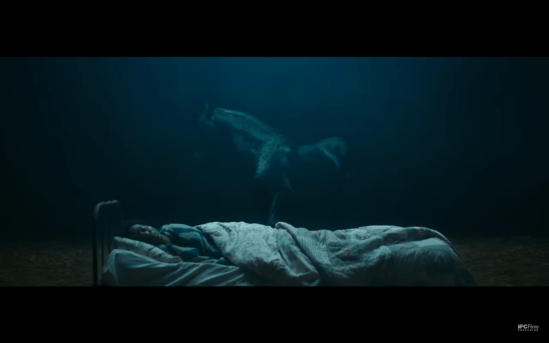
Family can be a finicky thing and “Kindred” is a fastidious look at the instability of family and mental illness which can be, in filmmaker Joe Marcantonio’s eye, interchangeable. Setting up shop before families get together for the impending holiday season, IFC Midnight will release “Kindred” in select theaters, on digital platforms, and on VOD November 6th. In regards to the look of the film, director of photography, Carlos Catalan, hones in on a series of medium to medium-closeup shots while grasping very little toward widescreen shots, especially being shot mostly in a grand manor house in Scotland. When Catalan has symmetrical framing, the allusion is gesturing grand with loneliness, but the cinematographer rarely has the frame centered, often creating an unnerving amount of space in the depth when juxtaposed with an uncentered character in the closeup all the while in natural light to not feign cynicism through use of color or filter. The only time filters are used are in the purple hued airy dream sequences with the raven and horses that become a metaphorical motif of Charlotte’s embattled dreams. The score is composed by a UK collaboration of multi-instrumental composers in Natalie Holt and Jack Halama. Holt’s harsh violin chords with Halama’s drama-fueling classical style produced hints of Mark Korven’s “The Witch” in similar tones, but explode with targeted dissensions that spur equally emotional dissensions amongst the characters. There were no bonus features included with the digital screener nor were there any bonus scenes during or after the credits. “Kindred” is relationally disjointing, disturbingly psychological, and textbook taut with tension as one of the best familiar thrillers to come out of the United Kingdom in the last quarter of the year.


 It's Bloggin Evil!