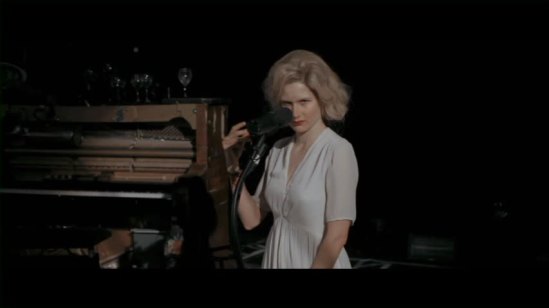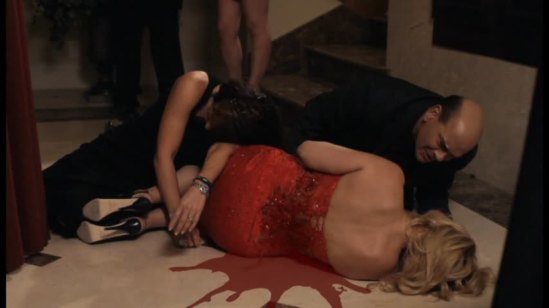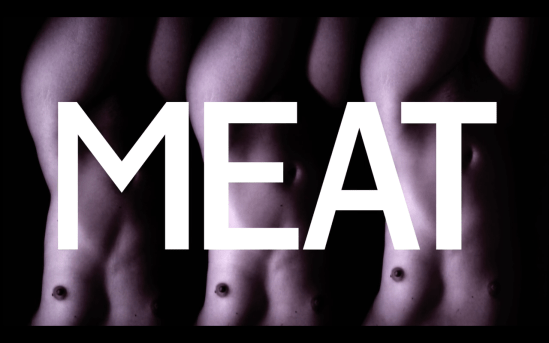
A young and beautiful butcher shop assistant succumbs to the middle-aged butcher’s sexual advancements and fantasies at the workplace after she catches glimpses his sorrow, but when the butcher ends up naked on the shop’s floor with his throat cut, the assistant becomes the number one murder suspect for an inspector who coincidently looks almost identical to the deceased butcher. As the investigation deepens into the assistant, the inspector’s solemn, solitary life blurs to an assimilation into the butcher’s and his suspect turns from being a prime target to being a crucial part of the his physical and mental altering integration into the dead butcher.

“Meat” is a powerful transcending film seismically barreling through a Lynchian structure consigned to provoke the consequences of unhappiness and the consequences of poor choices during unhappiness. Directors Victor Nieuwenhuijs and Maartje Seyferth have orchestrated a moderately expressionistic arthouse Dutch drama told in a spiraling sexual context. The meat in “Meat” and the sex in “Meat” clearly share a correlation, peppered as motifs from start to end, and the positive and negative dimensions of the two are so obscured that pinpointing the differences between them are impossible, but both are for sure the last hope for the butcher and his assistant Roxy to embody the essence of sex and meat for opposite reasons. Whereas Inspector Mann simply drags wholeheartedly through his existence, expressing his numbness toward his mundane job and harshly breaking up with his lover without an ounce of compassion. Its until the butcher’s case lands in his lap does the Inspector shows signs of life again.

If you notice that lead actor Titus Muizelaar’s dual roles have purposefully generic labels. The butcher is credited as just the butcher while the Inspector has a proper name, but the name Mann is just as indistinguishable as if the character was christened Guy. The synonym character was intended for blending, to blur their personas, and to transform one into another. To explore the transformation, “Meat” begins a parallel between the butcher who, in a metaphorical sense, has his cake and eats it too and the inspector painstakingly limps from one spot to another. A contrasting experience between the two firmly establish their individualities. Then, the film shifts gears midst a catalyst with the butcher’s mysterious death, forcing the female assistant, an uninhibited role performed uninhibitedly by Nellie Benner, to be the resilient gateway for the inspector. Third gear shifts into the inspector being more and more intrigued, if not extremely envious shown very subtly, by the butcher’s seemingly unchained facade. Each character emits an expressionless stature with a deep-rooted ugliness burrowed inside and each desire a change in their turmoiled lives, whether it’s sustaining love, seeking love, or able to love in order to battle every aspect of oppressive depression.

The uncomfortable open and intimate relationship between the butcher, Wilma Bakker’s Tiny, and the shop owner and the psychosexual workplace harassment involving the enthusiastic, video-documenting assistant filets the juicy bits from the bone with numerous innuendoes and explicit carnal exhibitions taking brazen residence within the animal blood stained walls of the butcher’s small meat market. You’ll never look at steak, pork chops, and leg of lamb the same way again! Only when “Meat” transitions into that second gear does the erotica becomes less erotic and more forced and horrifically exploitive. Scenes of undisclosed rape and of blatant genitalia speak upon that aforementioned correlation of raw meat and sex; no choice is given to the cow when the cow is killed and slaughtered for the cow’s delicious beef and the same can be said in sex as it’s taken without much consent and it’s being reaped for the benefit of others.
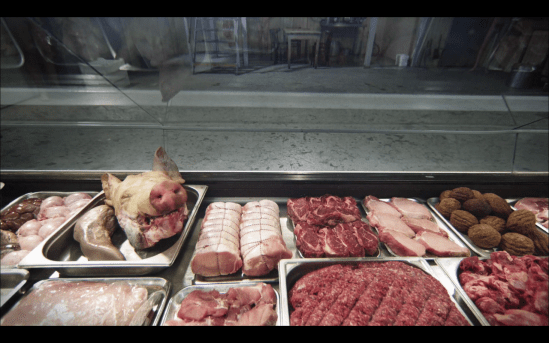
Graphically infrasexual and skewed beyond simplicity, “Meat’s” refreshingly loaded with unpleasantries and basted moistly with an outer layer of perversion that drips into an oven of thriller surreality. The Artsploitation team lives up to the moniker by, after being long overdue, crafting a home video release of 2013’s “Meat” aka “Vlees” onto DVD and on digital home video. The digital screener provided for review doesn’t give much insight into the audio and video qualities or speak to the testament of the special features. However, “Meat” is a phenomenal film that’s well-aged and ready to be rubbed, tenderized, devoured in all senses of the meaning.
Tag Archives: murder
Internal Evil is Subtle. “Fever” review!

High school classmates Pierre and Damien have just murdered a street woman inside her own apartment days before their French placement examinations. After hearing of the gruesome news, Zoe, a young optician working on the same street, recalls the two boys bumping into her, dropping a black glove on the sidewalk, and she begins to formulate her own radical theory, putting two-and-two together that the teens could be the very culprits fleeing calmly from the scene. Meanwhile, Pierre and Damien continue on with their examination studies over the Easter holiday, believing their heinous crime was not personal but of chance, making the offense not a crime at all. Zoe continues her pursuit of curiosity toward the murderers by not informing the authorities of her suspicions; instead, Zoe uses the crime to become self-aware of her fragile and stagnant relationship with her long time boyfriend while the two teens perverse over the concept of committing another murder.

Leave it to the French to make a bloodless and non-violent crime drama that’s more arthouse than conventional. Based on the Leslie Kaplan 2005 novel, “Fever” is the 2014 freshman film from writer-director Raphael Neal that dives sharply from the murderous act and into the internal struggles that lead Damien, Pierre, and Zoe into a turmoil path. Pierre and Damien think they both won’t be affected by their crime and that their moral conscious will remain clean on the philosophical notion that chance doesn’t warrant being unethical, immoral, or lawfully wrong. Damien basks in this belief more than Pierre, but still succumbs to the inevitable intrinsic battle. Yet, the two boys face separate inner warfare: Pierre’s frightened he’ll be caught by Damien’s nonchalant cockiness, looking over his shoulder constantly and fretting the off chance a witness has already spilled their dastardly secret to authorities whereas Damien fears that his chance theory is being blown to smithereens due in part of his ancestral legacy where his grandfather had cooperatively slain hundreds, if not thousands, of Jews during World War II because the Nazi’s ordered him.

Neal’s envisioning, as a director and a writer, flounders with a wishy-washy, by the waste side, telling when trying to convey the character centric story. From the beginning, Pierre and Damien’s sociopathic nature weakens from time to time with an invading moral conscience, like with in Pierre, but Damien’s difference lies with him questioning his justification of murder, but Pierre and Damien’s quiescent state about their family’s issues spots the story like a dirty window unable to view through clearly, leaving a vague and murky background and present state of mind for both characters. The twosomes’ up-and-down state of minds displays no consistence in their behaviors as they’re friends one instance, squabbling and bickering the next, then back to friends shortly after. Issues with angry and abandoning fathers, lustful mothers, and, apparently, genocidal grandfathers have deeply rooted themselves into the boys’ psyche like poisonous mushrooms kept in the dark to thrive to be eaten by mistake. Neal never relays that sense of foreboding wickedness. The same goes with Zoe as a character with really no background whose starting to go through a metamorphous, reforming her position in an unexciting relationship and developing, through subtle hints, a strangling desire after learning about to incident across from her shop. Yet, her full transformation never completes itself, placing her character, and the teens, into a volatile decline of shortcomings.

Though not too familiar with the actors themselves, their performances overshadow the film’s overall divergent plots. I was very struck by Martin Loizillon’s portrayal of Damien with the cold-heartedness that completely blankets his façade and his exerting of unorthodox spontaneity that doesn’t shy away from creating an uncomfortable scene. Pierre Moure contrasts Loizillon appropriately with a shyly frigidity, secretly yearning for more blood, Pierre Simonet. The red-headed Julie-Marie Parmentier displays the same kind of coldness reflected by the Pierre and Damien, but in actress’s own style of curiosity and intrigue with a minuscule hankering for sexual fetishes or self-morbidity. Then there’s duo lingo French singer Camille playing a role of non-fictional popular song artist Alice Snow whose hit English single, “Fever,” serves not only as the title of Neal’s film, but also symbolizes the foundation of the characters’ conflicts.

Artsploitation Films courteously distributes the Strutt Films’ production of “Fever” onto an unrated DVD with a sleek widescreen presentation with a 2.35:1 aspect ratio. The video’s clean with bright, Spring-like colors opposite the more customary, French influenced film noir that’s more common toward crime thrillers. The French 5.1 surround sound mix comes with English subtitles. While the soundtracks and the dialogue tracks are distinct and lively, there’s a slight error involving omitted subtitles, but the flaw only affects a petite portion of the dialogue, if you’re not tuned into French dialogues. “Fever” displays a mixture of psychological drama that mirrors the infamous Chicago crime of Leopold and Loeb of 1920 and Fyodor Dostoyevsky’s pathologic philosophical novel “Crime and Punishment.”
All Evil Breaks Loose! “Mansion of Blood” review!

Pretentious millionaire Mason Murphy hosts the largest and sexiest lunar eclipse party in the close knit community of River Ridge. Murphy renovates the old Mayhew estate, home to the mysterious disappearance of the wealthy Mr. Mayhew in 1926, as the party’s extravagant setting. One of the young party goers is also a practicing partaker of witchcraft and when she attempts to summon upon the spirit of her dead boyfriend to ask about whether he bought a winning lottery ticket or not just before his death, she accidentally aligns all things evil right as the eclipse takes place, trapping the oblivious guests in a nightmarish twilight zone that includes black bat demons, Civil War ghosts, lawn ornament zombies, bar tending vampires, and a slew of maniacal murderers.

Director Mike Donahue’s “Mansion of Blood” is a horror-comedy of an ambitious narrative that was doomed during the middle of production, resulting in a shameless, mishmash heap of a film. From what I’ve read from various article sources, “Mansion of Blood” came to a screeching production halt due in part of a sexual assault claim from an actress or two. The complaint was against the film’s headlining star, Gary “Lethal Weapon” Busey. Are we really surprised here? Busey, who suffered permanent brain damage in 1988 after a motorcycle accident, has sustained from his wild and crazy, sometimes delusional, antics that raises many eyebrows through almost the last three decades. The film’s crew was so fed up with Busey that he was actually fired and massive re-cuts and re-edits caused the story’s downward slope. Aside from the Busey debacle, executive producer and one of the film’s stars Tom Tangen is rumored to have screwed over the film’s investors, leaving director Mike Donahue high and dry.

Honestly, I strongly feel “Mansion of Blood” never came an inch off the ground. I get that the film is a horror-comedy in a slapstick sub-genre, but the story is in total shambles. Numerous characters and their individual stories are diluted to the point of being a suffering and aggravated attention deficit disorder. The severely choppy editing, the unbalanced dialogue and ambient audio tracks, and the oafish acting throughout only piles on top of an already high mountain of sadness. And even though I have a soft place in my heart for Busey and his sheer lunacy, in life and on film, his performance as the malicious party host Zachariah was, dare I say it, surprisingly stale. Only a few handful of scenes of Busey’s floating, grinning head faintly superimposed as a ghost or a spirit or as a something are uniquely guilty pleasurable. Not all has failed as the film’s other star, “Star Trek: Voyager’s” and “Innerspace’s” Robert Picardo, attempts and succeeds at a good performance as the party’s caterer who ends up almost being poisoned by his chef wife, played by Lorraine Ziff.

Again, I’m well aware that “Mansion of Blood” is a horror-comedy, but the no budget special effects couldn’t be any more offensive to our intelligence. The “demons” were extras in black face and black leotards with a dark cape and plastered with exuberantly adhesive bat ears. The computer generated lunar eclipse was near 1950’s animated cartoonish. These effects bog down the quality of the film, turning a potential Sci-Fi channel movie spoof to a more of an obsolete, outdated, and cheesy and campy schlock that could be deemed worthy of being presented on Mystery Science Theater 3000. Instead of solidly funded practical and computer generated special effects, Donahue leans firmly on the hard bodies of young (and some slightly older such as Lorraine Ziff) actors and actresses. The naked bodies of upcoming scream queen Mindy Robinson and the industry versatile Dustin Quick are two to name just a few who pair up with the rock hard abs of Kyle Clarke and Frank Mora Jr. One would think Jennifer Tapiero, Sarah Alami, and Tegan Webster would be the group of main characters that would develop and expand throughout the duration since they’re stories begin in a diner, but their characters become junk roles that fizzle into into oblivion and tangents are created for non-setup characters.

“Mansion of Blood’s plethora of characters is too much to handle, especially when the film tries to go in numerous directions that doesn’t give Donahue’s motion picture any direction. The story and script flounders as the legs are cut right from underneath both of them. I empathize that the Gary Busey and the rumored Tom Tangen issues might have derailed this project that categorizes this film into the scrap-to-salvage scenario similar to prior films like “Bad Meat” and “Old 37.” Tom Cat Films and MVD bring “Mansion of Blood” to retail shelves and I encourage those brave enough to venture into the film to remember this particular review because when the credits begin to roll and the popcorn is down to the last few underdeveloped kernels, you will know somewhere in the sands of time and space that I’ll be whispering in the ears of your mind, “I told you so.”
Movie Magic Evil Waters Down Real Evil. “House on the Hill” review!

Based on the true story of serial killers Leonard Lake and Charlie Ng, director Jeffery Frentzen (Black Dahlia) chronicles the speculated portions of Lake’s and Ng’s homicidal and psychopathic murders. Their murderous spree involved kidnapping young women, enslaving them, and eventually murdering them while also targeting their own relatives and friends, and even seizing the opportunities to abduct whole families. After Lake served in the Marine Corps, he met Charlie Ng and by the 1980s, the two men had constructed an isolated house where innocent people were brought to be tortured, ransomed, and eventually their demise at the hands of their materialistic and deviant captors.

“House on the Hill” is the Jeffery Frentzen directed and co-written with Nicole Marie Polec film that semi-documents the tragic events of Leonard Lake’s and Charlie Ng’s serial killing spree of the 1980s and incorporates actual footage of Leonard Lake speaking about his disturbing views on the world such as enslaving women and being prepared for the inevitable world apocalypse. Most of Frentzen’s movie is embellished as, like the majority of serial killer documentaries, most of what is unknown of Lake will never see the light of truth of what really happened on his ranch. The legend behind Lake and Ng states that there could have been as few as 11 murders or as high as 25; Frentzen attempts to showcase the latter by adding many fictional victims into his film to be representatives to those unknown victims who were never discovered or whose bones were severely untraceable.

However, some of the facts that are true, that we do know about Lake, didn’t quite make the cut because of Frentzen’s x, y, or z reasons. In the film, Lake’s wife is named Cat played by Rachel Devlin (Zombie Nation), but in reality Lake’s wife name was Claralyn Balazs aka “Cricket.” If Lake’s wife name is clear, why go with “Cat?” Also, Lake had constructed a bunker in the backyard of his ranch, but “House on the Hill” has a separate, well-locked shed in the backyard. Simultaneously, Frentzen’s movie has consistent filming errors that even the untrained eye can catch. Continuity glitches that are obvious (Naidra Dawn Thomson’s bra strap is in various positions between takes on a particular scene) and obvious props that are in more need of a convincing sell from the actors and to be well edited to not give the impression of false intentions. Lastly, the overly generic title doesn’t specifically speak much upon Leonard Lake and his accomplice Charlie Ng. “House on the Hill” title has no curb appeal and no real bite to entice viewership.

What I did find pleasurable about “House on the Hill” was the leads’ acting. Canadian actor Stephen A.F. Day and first feature film actor Sam Leung do an above mediocre performance of Leonard Lake and Charlie Ng. They manage to show and sell having no empathy when committing terrible acts, managing the ability to embody the evil within a killer on screen. Barring Frentzen’s epileptic editing and use of tints, lenses, and over exposers, I still was able to see the good in Day’s and Leung’s performances without the editing hoopla that attempted to make the events more dramatic, shocking, and traumatizing.

I’m a little disappointed in the distribution of this film. Not only does the jejune title leave a bleak taste, but the DVD cover doesn’t quite represent what is being sold here. On the cover, there is a dirt pathway leading up to a two story, mansion-like structure sitting on top of a hill and seemingly decayed and abandoned. On the DVD backside, a meathook pops right out at you along with a female victim strung up by her arms, screaming toward to the sky. Meathook does not make a credited or on screen appearance nor does the house in the film look like the mansion on the DVD cover. What is even more disappointing, and what I have to comes to term with every now and then, is the heavily edited cut in which “House on the Hill” was released. The DVD cover states, “Warning Explicit Content,” and does show some intense moments containing blood and torture with implied rape. ‘Some’ being the key word because I’ve seen more explicit content on the local evening news. This might be due in part of the post-production censorship which most noticeably focuses on covering up any and all nude scenes. Olivia Parrish’s topless scene was crudely censored by being blurred out and awkwardly cropped to show a low-resolution image, a forced zoom in, of her neck up as she’s being molested. The same cropping censorship goes against Laura Hofritcher’s topless scene as well during her torturous scene.

The North 40 Production film and MVD and ITN distribution DVD release doesn’t score to well for this reviewer. I’m able to look past the editing techniques, post-production effects, and unbalanced audio, but being a writer and a firm patron of freedom of speech, the censorship of the nudity and potentially the bloodletting has my blood boiling. However, even though Leonard Lake and Charlie Ng may have not been extensively covered on the silver screen or on entertainment television, I am glad Frentzen told partial of the notorious story and was able to tell his rendition of the unknown accounts.
Based On Real Life Evil? “My Name is ‘A’ By Anonymous” review!
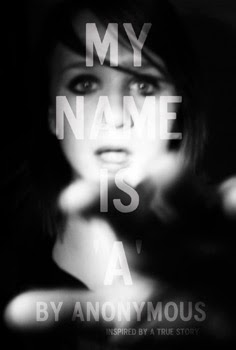
Based on the real life teenage ‘thrill killer’ Alyssa Bustamente, Shame Ryan (“Amateur Porn Star Killer”) directs “My Name is ‘A’ By Anonymous” to tell what may or may not have happened to murdered Elizabeth Olten by her neighbor Alyssa Bustamente. The story tells the story of a group of teenagers left to their own emotional devices and left to their own parentless neglect manifesting a dark world that sparks angst leading to murder.

Shane Ryan mixes real life with an art film and the result doesn’t and won’t translate to most audiences. The non-linear story creates more confusion than clarity and being that this is one possible scenario on the murder of Elizabeth Olten, the scenario leaves more questions that perhaps vivid answers. One quality the film does do is color Alyssa Bustamente to be a thrill killer with self cutting tendencies, a dry attitude toward life, and the possibility of having a multiple personality disorder. Does this revolution around Alyssa paint a portrait that the film is more about a killer than about the victim?

The expectation bar was set high for director/writer Shane Ryan. With the exploitations of his earlier work such as “Amateur Porn Star Killer” movies and “Warning!!! Pedophile Released,” there were hopes that this film would be more intense and graphic. Since Ryan decided to take a cheap and artistic route, the outcome will confuse, bore, and shred any bit of entertaining qualities to itty-bitty pieces.

Marketed as being in the same vein of more infamous teen angst films such as “Kids” and “Ken Park” is very deceiving. Besides the killing, which was mostly described in sub context art form, and the implied incest-rape, also in sub context, there is really no comparison to “Kids” or “Ken Park.” Very few moments in the movie where the scene feels powerful and telling but these scenes are overpowered by lack of story telling and more of just teenage girls scenes of them brutalizing themselves and dealing with parental issue.

I’m not a fan of this Wild Eye Release. I’m encouraging you, however, to try to have an open mind and give it a whirl. Ryan’s film is not for everybody and won’t be a stellar hit. “My Name Is ‘A’ By Anonymous” teases mostly in the same likes as “The Life: What’s Your Please?” teases the possibility of Denise Richards and Daryl Hannah, a pair of escorts, getting their freak on but leave the view limp all the way to the end. This film harks on that same flaws. Don’t get your hopes maxed out, but instead go into the movie, being released this Tuesday September 23rd, with a backup plan just in case of severe boredom.