A Romantic Getaway Turns Evil! “The Perfect Husband” review!

Screen shot 2016-08-11 at 9.34.11 PM
Nicola and Viola attempt to escape their dismal past involving losing their child at birth, traveling to an isolated cabin in the woods to rekindle and reconcile their bitter relationship. Once there, Viola feels a menacing presence lurking amongst the trees ever since arriving. As the strain on their past and present union becomes nearly too much to bare, tensions overflow with jealously and bewilderment that turn the delicate situation into an explosion of violent behavior. A cat and mouse game of carnage and death follows the couple through the dark woods toward a bizarre and psychological ending that reveals the true nature of their disturbing affliction.
Screen shot 2016-08-11 at 9.31.07 PM
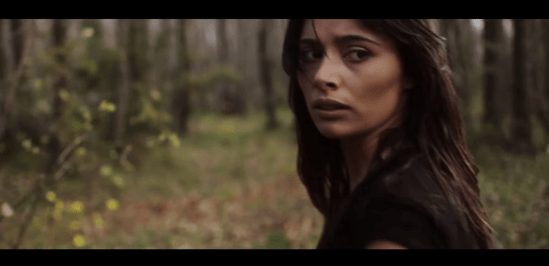
Director Lucas Pavetto’s “The Perfect Husband” is an Italian psychological horror film from 2014 starring “Nightmare Code’s” Bret Roberts and Gabriella Wright and based off Pavetto’s short film of the same title. Even though “The Perfect Husband” is an Italian birthed film from Italian production company DEA Films, “Il Marito Perfecto,” the Italian title of “The Perfect Husband, has a crew, aside from Pavetto hailing from Argentina, that maintains the country’s native ethnicity. London born Gabriella Wright, who masks her English accent very well, co-stars alongside the Alaskan-American Bret Roberts; both actors could certainly pass having Italian heritage with their olive skin tone and dark features elsewhere and with filming location set in Catania, Sicily, the actors fit right amongst the rugged and mountainous Sicilian landscape. Roberts has a low-raspy articulation that makes him seem always out of breath that transitions beyond the catalyst, but Roberts plays villainy insanely well. Wright maintains a cryptic temperament from start to near finish. However, the duo’s dynamic is quirky at best as the couple treat themselves more a boyfriend and girlfriend than husband and wife, which might be a product of the writing.
Screen shot 2016-08-11 at 9.36.10 PM
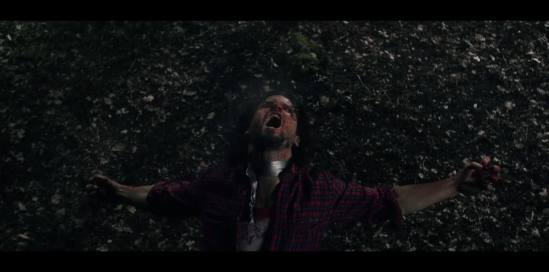
Lucas Pavetto and Massimo Vavassori go fairly formulaic with their script, writing about strife-stricken couple working out their marital issues alone in a remote cabin surrounded by a dense forest. The setup screams horror premise clockwork and attempts to shift gears after lengthy character development that takes some time to build into something concrete, or at least halfway tangible. The shift in disposition is, however, so rapid and so sudden with unwarranted ferocity, that the effect goes from a scale of a tense filled two to a run-for-your-life ten in a matter of microseconds. The series of events portray Bret Robert’s character Nicola as a jealous misogynistic ready to snap at any given moment while Viola’s mysteriousness and her unconscious readiness to break with reality puts an undisclosed strain on her psyche that what she experiences may or may not be real. A twist ending tries to fill in the Nicola and Viola omissions, but misses the mark that still leaves gaps here and there, especially conveying more about the events that took place at the refugee station between Viola and the Ranger, played by “Apocalypse Z’s” Carl Wharton. Perspective becomes surreal; a fantastic journey that terminates toward a twisted unveiling, leaves more questions than answers about Viola and Nicola prior to their weekend getaway.
Screen shot 2016-08-11 at 9.33.39 PM
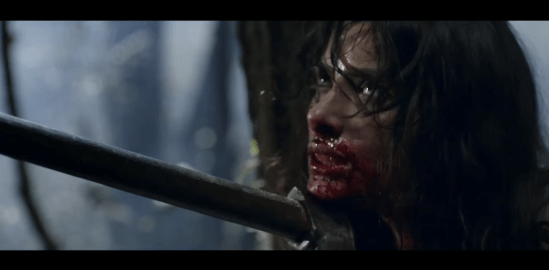
Plausibility. Probably “The Perfect Husband’s” fiercest enemy as the story tries to turn itself upside to throw the audience for a loop. The disillusion feels cheaply thrown together to try and wrap up, what could have been, a thoughtful psychological thriller and that’s where plausibility doesn’t formulate, frustratingly feeling like an square box with only three sides and a gap left carelessly open. I wanted to like “The Perfect Husband” because I thought the mayhem was present at the beginning moment of the snowball effect. Everything went down, fast and furious style, with unforgiving brutality that was surprisingly gory at times.
Screen shot 2016-08-11 at 9.33.16 PM
“The Perfect Husband” has been honored an unrated Blu-ray release in a 1030p transfer presented in a 2.35:1 aspect ratio from the ever bold Artsploitation Films. The video has a slight grayscale imbalance that contrasts scenes a bit heavily, but other than that minor issue, the image looks solid. The English 5.1 surround with optional English subtitles is also solid with a balancing the appropriate tracks. Bonus features include a behind the scenes segment that exhibits the takes of scenes in and outside of the cabin. The original short “Il Marito Perfecto” is included along with trailers for upcoming films from Artsploitation Films. Turns out “The Perfect Husband” wasn’t perfect, but raw, exploitive barbarity is a must see for any violent hound in need of a good scratch.

Own “The Perfect Husband” on Blu-ray. Available at Amazon.com!

#Programming_Evil. “Nightmare_Code” review!

output_CIyNHS
Brilliant programmer Brett Desmond has been hired at a tech start-up to quickly complete the groundbreaking coding of a previous programmer Foster Cotten who went on a murderous rampage at the start-up’s tenth floor office right before killing himself. Desmond, struggling with the federal government breathing down his and his family’s necks due in part of him leaking sensitive classified material, works night and day and around the clock to crack Cotten’s code for ROPER, a behavior recognition program. A small work group remains with Desmond during the day, but at night, Desmond sleeps at the office, working aggressively to make the deadline and get his life back in order. The further Desmond or anyone else becomes familiar with the code, the code starts to modify their behavior, twisting their thoughts, and succumbing them to it’s will of the dead programmer.
vlcsnap-2016-01-17-20h28m17s239
From time to time again, the film industry on the subject of pioneer technology relays information upon the fears and consequences of intertwining arrogant brilliancy and controversial technology. From the genres of cyber punk to Sci-Fi horror, decades old films such as the virtual reality plotted “The Lawnmower Man” and “Virtuosity” to the more recent “Transcendence,” transferring consciousness into the machine, have been outspoken against the use of behavior modification and recognition programs. The idea behind the notion can said that the person envisioning the possibilities of such software will become obsessed, power hungry, or vengeful if the creation is taken away from them to which all three can be attributed to director Mark Netter’s 2014 film “Nightmare Code.”
vlcsnap-2016-01-17-20h24m11s79
Shot entirely through a surveillance-like setup and notebook web cams, “Nightmare Code,” for most of the duration, is viewed through four screens as like security footage. Netter and cinematographer Robert Fernandez designed this structure not for the sole purpose of a novelty exhibition, but to also confine characters in a small box coded by technology, as explained in an DVD’s bonus featurette, and creating a sense of isolation and distant connections that make the life of a programmer very lonely and depressing which develops in the characters very thoroughly. The story is told through the virtual eyes of ROPER, using it’s self-awareness and advanced modules to voyeuristically watch the small group of programmers and manically motivate their actions by use of altered video projections. ROPER also accesses the past, filling in the gaps that only the infamous story of the genius Foster Cotton can fill, and by accessing the past, the dead programmer’s coding can be understood for it’s malevolent behavior modification.
vlcsnap-2016-01-17-20h28m42s232
“Nightmare Code” is complimented by an underrated cast whom work well together through the smaller ROPER displays in the small screen film industry. Andrew J. West, better known for his role as the Terminus cannibal Gareth on “The Walking Dead,” takes on the protagonist role of Brett Desmond who battles legal and family trouble and West epitomizes isolation by effectively taking a man with a moral conscious in leaking immoral government information and leading him down a path of legal morality, but at the same time, being unfaithful, deceitful, and prone to corruption. He becomes pitted against antagonist Foster Cotton, played by veteran actor and long time supporting actor Googy Gress, notably recognized as a NASA mission controller from Ron Howard’s “Apollo 13.” The two foes never have screen time together as their stories live separate lives, tangled by their connection to ROPER, and so without that nourishment from the other actor, West and Gress use their talents to virtually interact with one another, developing a realistic struggling relationship that isn’t really there. The characters that surround Desmond and Cotton are negatively affected by both main characters and Mei Melançon’s supporting character Nora Huntsman figures into that coded nightmare as she becomes affectionate with Desmond. Even though he’s married, Nora feels the urge to fulfill her needs after separating herself from addictions: gaming, abusive boyfriend, and drugs. Melançon, who had portrayed a minor role as a major character, Psylocke, in the mutant world of “X-Men: The Last Stand,” had another hugely important role as a side dish techie lover, but her role doesn’t seem very present and that might because of the editing technique to create the dooming cyber vision.
vlcsnap-2016-01-17-20h27m50s226
Netter’s resulting editing style inefficiently told the story, I thought. We’re well aware that ROPER can mislead the performance buggy human race, but ROPER, in my mind, wasn’t responsible for some of the delayed or fast forwarded actions of the characters seen through the security footage as it stylishly seemed unimportantly and pointless. Luckily, these particular editing moments are far and few in between and don’t exactly hinder the narrative. What does hinder the narrative are the quick, considerably choppy, edited scenes. Netter creates long, sometimes drawn out, scenes to convey the office solitude, but then transitions to the numerous and quickly implemented scenes that spawn a constant stop and go narrative that loses the ominous factor. The longer scenes tend to generate gloom, dread, and despair. Supporting characters become underdeveloped in the quickly edited in scenes, affecting not only life recovering Nora, but also the rest of Desmond’s team – Louis, Kevin, and Ray – who become the underdeveloped characters and they are worthless to the viewer, essentially. Still, check out the Tonya Kay scenes as you might care about hers.
vlcsnap-2016-01-17-20h37m45s27
The Indie Rights Inc. produced film and MVD distributed release has a clean and sleek 1.78:1 anamorphic widescreen presentation. Colors seem balanced and bright. There lies some minor noise, but that only adds to the security cam charm. The Dolby Digital 5.1 audio is clean and balanced in all channels and douses with Ari Balouzian’s synth soundtrack that embarks to terrorize. Balouzian’s score reminds me of Ennio Morricone’s “The Thing” theme, developing a soundtrack character that contributes to the intensity of “Nightmare Code.” Extras includes the film with commentary and a handful of featurettes explaining briefly the characters, the production, and the fear on the technology horizon. Mark Netter, along with the cast and crew, has good source material here and though this sort of tech horror isn’t exactly novel, “Nightmare Code” is fiercely entertaining and forebodingly frightening on a low-budget, startup scale.