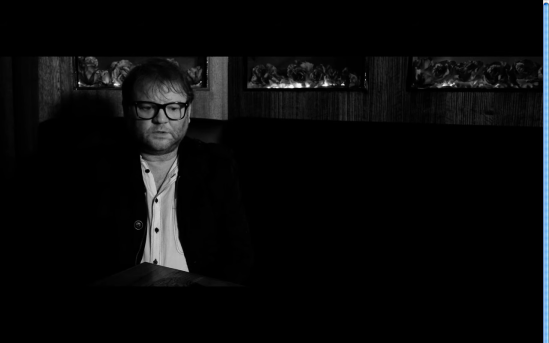
Making a Horror Movie can be EVIL on the Health! “Stoker Hills” reviewed! (101 Films / Digital Screener)

Three film studies college students are eager to win their class’s short film contest with story idea Street Walkers, a genre blending horror movie that crosses “Pretty Woman” with “The Walking Dead.” On their first night of shooting, isolated on the empty streets of Stoker Hills, their actress and friend is suddenly abducted right before their camera lens and instantly give chase without a second to call the authorities, falling right into the maniac’s nightmarish world. Left behind for two detectives is the students’ tell-all camera, leaving behind the recording as the only clue into tracking down their undisclosed whereabouts and stopping the kidnapping-killer. As the detectives home in on the killer’s lair, only hours are left before a determined and desperate madman drains every single drop of their youthful blood for a deadly selfish cause.

Director Benjamin Louis and “Stoker Hills” want you to believe in their compelling and bloody slasher narrative of periled college students fighting for their lives against a formidable, resilient killer while two resolute detectives sniff out the mystery of their disappearance before it’s too late. However, in “Stoker Hills,” nothing is as it appears to be. As the first feature script penned and produced by Jonah Kuehner, the “State’s Evidence” director, Benjamin Louis, coproduces the sheeny cinematic slasher that hits upon almost every known trope in the book by incorporating a backwoods nook, a torturous rec room, and foggy night underneath a vividly complete full moon into a story that’s one part found footage and one part cop thriller. Benjamin and cinematographer John Orphan (“The Black String”) do a phenomenal job crafting away from a Los Angeles look and into an unrecognizable, any-town-America by shooting at the dead of night in L.A.’s low-lit surrounding areas of Griffith Park and the Angeles National Forrest without focusing in on or revealing well-known landmarks. “Wildling’s” Rab Butler and Timothy Christian coproduces the 2020 teen-mystery slasher.

“Stoker Hills” begins very much in the same way as my last review of Seth Landau’s “Bryan Loves You” with a deep-in-character production by the great Tony Todd (“Candyman”) as a film studies professor. Instead of warning audiences to look away if frightened or to be ushered out of the theater when shocked beyond just stomaching the content, Todd’s professor of cinema is passionate and enthusiastic about what great filmmaking and the auteurs who wield their work upon the world. However, much like “Bryan Loves You,” Tony Todd only dabbles into the narrative with a superficial house role that opens the doors for Ryan (David Gridley, “The Unhealer”), Jake (Vince Hill-Bedford, “Sorority Slaughterhouse”), and Erica (Steffani Brass, “Ted Bundy”), three slackjaw, maybe even indolent, students eager to take “The Walking Dead” and turn it into a “Pretty Woman” romance comedy known as “Street Walkers.” The concept is no Guillermo del Toro or Martin Scorsese, but nonetheless barely sates the professor’s threadbare faith in the three’s semester-ending grade. Along the way, we’re introduced laterally to character who will eventually be integrated into the story later and at a state of prominence to the mystery, such as with fellow star student Dani Brooks (television actress Tyler Clark) and her university benefacting donor Dr. Jonathan Brooks (John Beasley, “The Purge: Anarchy”). “Stoker Hills” also isn’t entirely linear as the footage soon appears to be corrupted only to be on pause by two officers investigating the case and analyzing the video. William Lee Scott (“Identity”) and Eric Etebari (“Scream at the Devil”) play the high-blood pressure, blue collar, family-man Detective Bill Stafford and a sophisticated bachelor and quasi-Rain man Detective Adams respectively. The Scott and Etebari cop drama show entertains as less CSI and more NYPD Blue or Law & Order with a conspicuous partner correlation only to be separated by adding snippets of out of context humanity, such as why Adam’s is a loner and Stafford hates changing baby diapers. Powerful stuff. Each character is connected to “Stoker Hills'” antagonist, Charles Muyer (Jason Sweat), who’s been abducting young, healthy people off the streets and into his vacant buildings of intravenous drips of blood into a milk crate-based cylinder beaker tube. Thomas R. Martin, Joy McElveen, Maya Nucci, Michael Faulkner, and “Eraser’s” Danny Nucci round out the cast.

Director Benjamin Louis cherry picks the best traits from a triad of genres to smush together into one trope-tastic “Stoker Hills”  A lumbering mute killer bred to annihilate in his nihilism from the slasher genre, two dedicated detectives determined to catch a killer and able to snoop out clues out of nothing that’s familiar toward the cop drama genre, and a pair of brosefs, who dude each other in every other line of dialogue no matter if it’s joshing in film studies class or being chased harrowingly through the woods and having their foot snagged in the teeth of a beartrap, pulling from the pot-smoking and arrogant hijinks of two immature college aged guys usually hovering around the teen comedy category.  All the actors really get into their parts to the point of a fault in creating a bogus, simulated environment as if a knockoff matrix, coded by naive aliens who know nothing of the human race other than watching “American Pie,” “Law & Order,” and every Renaissance era slasher film, is being pulled over the eyes. The whole ordeal that has a context surrounding Charles Muyer’s bad pig heart is also grossly under kneaded and bordering nonsensical until the ending. That game changing ending spooled by meta wiring puts in perspective every last minute of the well-paced 91-minute film, and when the narrative quickly closes upon itself and fades to black into the credits, every scene previously pondered and examined, crisscrossed into a mental algorithm that breaks down character arcs and progression devices, and spits out answers like an Amazon Alexa has suddenly last all its calculated determination in a snap of a flash. Kudos to “Stoker Hills'” screenwriter Jonah Kuehner for conceiving an overtreated trope decoy story and kudos to director Benjamin Louis in pulling the wool over our eyes without flinching or showing his cards too early.

Everybody run for “Stoker Hills” and become caught up in a diabolical twist that’ll deflate the suspense out of you but also leave you pleasantly surprised. 101 Films released this film last month, March 28th, on digital platforms. Since “Stoker Hills” is solely a digital release from UK distributor, there are no audio or video specs to note or review. Aforementioned, John Orphan helms the “Stoker Hills” noir and no-nonsense veneer which is and also the minor league Jigsaw traps are very “Saw”-like, even down to peppering certain scenes with over illuminating primary color gels if by spotlight. Roc Chen, a profound composer for China over the last decade, notes a less than impactful score in what could be considered more run of the mill material, but that also could play into the whole narrative twist. There were no bonus features available with the film nor were there any bonus scenes during or after the credits. At first glance, “Stoker Hills” treads over the same worn trodden path of slasher predecessors, but then the finale hits like a five-finger slap in the face from Will Smith and, suddenly, everybody could be, should be, and will be talking about “Stoker Hills'” gripping gambit.

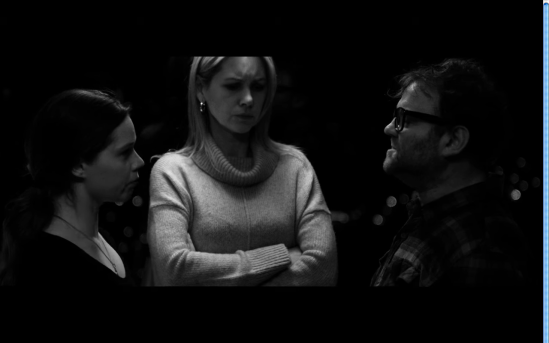
When EVIL Isn’t That Black & White. “Choir Girl” reviewed! (Nexus Production Group / Digital Screener)

Eugene lives a lonely, pitiable existence.  Residing with his ailing father in a slum neighborhood, his photography background captures the crime and the desolation that surrounds him, snapping pictures without ever interceding with his crime-riddled subjects, in an attempt to hold an exhibition or sell his work to a high profile magazine, Slipstream, as his ticket out of the despair that engulfs him.  When Eugene stumbles upon young teenage girls being drugged and held for prostitution, he becomes fixated on Josephine when a low-level editor, seeing her as a professional stepping stone, prods him for more pictures that evoke hope out of her situation, but when he finally intervenes, helping her escape, Eugene falls into a world of a massive prostitution ring with doctors, cops, and major organizations on the payroll and a kingpin named Daddy at the helm.  The deeper the debt placed upon him for showing compassion to Josephine, the more the lines blur on whether he’s become his muse’s lone savior or just his meal ticket out his current life.

How far will your moral principles take you to save a teenage girl when you’re locked into a no-win situation?  That’s the theme explored to a shocking sexual assault conclusion in John Fraser’s 2019 unscrupulous Australian thriller, “Choir Girl.”  Introducing Fraser’s first credited written and directed full length feature film, shot entirely in black and white, the Melbourne arthouse and a goose egg-fairytale version of “Pretty Woman” speaks volumes toward the perceived illegality of immigration, the horrors of sex-trade, and the touch-and-go balance act between doing what’s right and self-serving opportunities with a 15-year old girl’s fate dangling at the end of a line.  “Choir Girl” is produced by Ivan Malekin under his Melbourne based label, Nexus Production Group, along with Lucinda Bruce serving as co-producer.

To carry “Choir Girl” through the muck of it all, a strong performance must arduously burden the gravity of the content and Peter Flaherty astounds with an ingloriously flawed and unlikely hero, Eugene.  “The Butcher Possessions” and “KIllervision” actor masts a greasily haggard with bordering neurodevelopment issues, disheveled in his attire, and walks with a noticeable limp, made intentionally noticeable when as he walks away from characters and situations.  Though Eugene seems meek, the shutterbug aches to improve himself by seemingly exploiting others as a freelance photographer and being persistent in that pursuit until becoming engrossed into a 15-year-old prostitute’s life struggle blossoming before our eyes a rather unsettling grown man and teenage girl relationship that assumes a pedophilia ideology of adoring the child to the extent of protection, but also falls in to grooming and sexual exploitation.  The film introduces audiences to Sarah Timm, playing Eugene’s muse, Josephine, an Eastern European illegal immigrant who literally has nothing left that is her own, this including her body, when forced into sex slavery so when Eugene and other characters call her diminutively by Jo, she immediately corrects them to call her Josephine in order to keep the one thing left that is still hers, her name.  In her first feature role, and a mightily demanding role it is with the amount of discomfiture of playing essentially an abused child, the German native will have audiences overlooking the fact that she’s portraying a teenager in the sordid sultriness of sex-trafficking with crafting Josephine’s war-torn history and pre-adolescent childhood stories as always the girl in the background, the unpretty forgotten girl that blended in and no one noticed, until she’s a part of a much larger, more ferocious, uncompromising system that Daddy (Jack Campbell) dictates with CCTV live feeds of every sleazy, scummy hotel bedroom in his syndicated footprint.  The cruelty that Jack Campbell reins savors every facet of Daddy’s being on screen with an intent to be a immovable roadblock in Eugene’s advanced for progress and for John Fraser’s “Choir Girl,” the character development and personalities find justification from the cast with the exception of one, the low on the totem pole and self-absorbed Slipstream magazine editor, Polly.  Krista Vendy imposes on Polly’s rabid  narcissism with an incredibility that becomes the underbelly amongst a bloc of solid performances.  Andy McPhee (“Wolf Creek”), Lee Mason (“The Caretaker”), Jillian Murray (“Body Melt”), and Kym Valentine fill out supporting roles. 

I love the juxtaposition opening of Eugene in his dark room in the middle of photographic processing his oblivious subjects, including a drug abusing child with a hypodermic heroine needle sticking out of his arm, a blowjob being serviced between a wall and bushes, or the aftermath of man being beaten with his assailants walking away from his leveled body, and then the title fades in from black and the next scene is of a framed magazine cover with the cover title “It’s All Back and White.”  The sequence sets up perfectly the entire premise driving “Choir Girl’s” gray area circumstances that nothing substantial, meaningful, or controversial can be black and white. Plus, the entire film is shot in black and white furthering the contrivance of the theme. The gray area challenging Eugene is a tightrope walk when squeezed for payment for snatching Josephine by the amoral organization claiming property theft, making him submit to the idiom of pulling his strings like a marionette or shooting at his feet to make him dance for insatiable perverse satisfaction. Eugene rarely displays remorse in his demeanor, face, or actions for the things he does and doesn’t do when faced with adversity in a slither of sociopathic idiosyncrasy, but when outright criticized for his inaction, he’s able to right wrongs with deplorable methods like a toddler trying to mop up a grape juice spill with mother’s expensive, white dress. There’s a bit of innocence or naivety in Eugene’s mind as you can almost see the gears slowly spinning when confronted but in the defense of the man who no really gave the time of day, those gyrating mice wheels of delicate thought snuck past every contingency against Eugene surviving Daddy’s deadly game, leading to an unsavory solution that puts the viewer in an awkward spot to either avert the eyes or remained captivated to see it through.


I, for one, remained seated, steadfast to the end, hypnotized by audacity of John Fraser in his feature film directorial, “Choir Girl,” that has arrived onto Apple’s iTunes. The unrated film is presented in it’s original aspect ratio of a widescreen format and will have an English language Dolby Digital 5.1 surround sound availability. Though derided as kitschy at times, the black and white veneer works here inside “Choir Girl’s” vascular system of catch-22s and director of photography, Mark Kenfield, rides a consistent straighten arrow style with steady cam shots, decent framing, and some tracking shots without pushing the envelope in regards to angles or oscillation. There were no bonus content or additional scenes during or after the credits. “Choir Girl” sings no praises of hallelujah. Offers no solace in time of hardship. If you’re looking for a movie that touches you, then you’re in for a rude awakening as “Choir Girl” obliterates the moral standards, leaving faith outside, with a severe penance in abetting the Devil’s work, selling their soul to do what’s right.