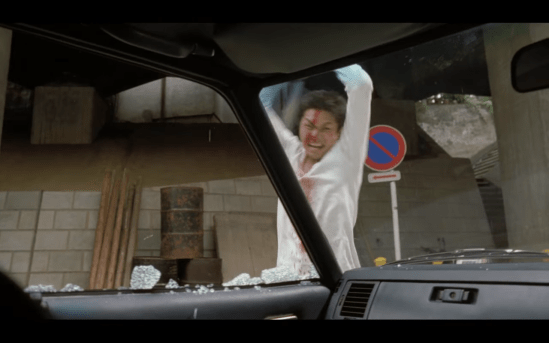
When EVIL Messes with a Family of Blue, There’s No Other Choice Than Street Justice. “She Shoots Straight” reviewed! (88 Films / Blu-ray)

“She Shoots Straights” and She Never Misses! On Blu-ray Today!

A widowed mother has four daughters and one son whom all work for the Honk Kong national police, more specifically called the CID, Criminal Investigation Division.  Her only son, Huang Tsung-pao, marries another cop, a promising officer named Mina Kao who is quickly rising up the ranks between her supervisor husband and the superintendent.  One could say the Huang family bleeds a brotherhood and sisterhood of blue, but none of Tsung Pao’s sisters approve of Mina despite her being a colleague in arms with the belief she’s stealing their brother away from them and receiving special treatment and recognition from a flirting superintendent who has eyes for her.  When the investigation team tracks down a dangerous, transgressing gang of Vietnamese refugees planning on robbing a night club at gunpoint, Tsung Pao is tragically killed in the one of the tussles, leaving Tsung-pao’s sisters, wife, and mother to seek revenge-seeking justice before the killers flee the country.
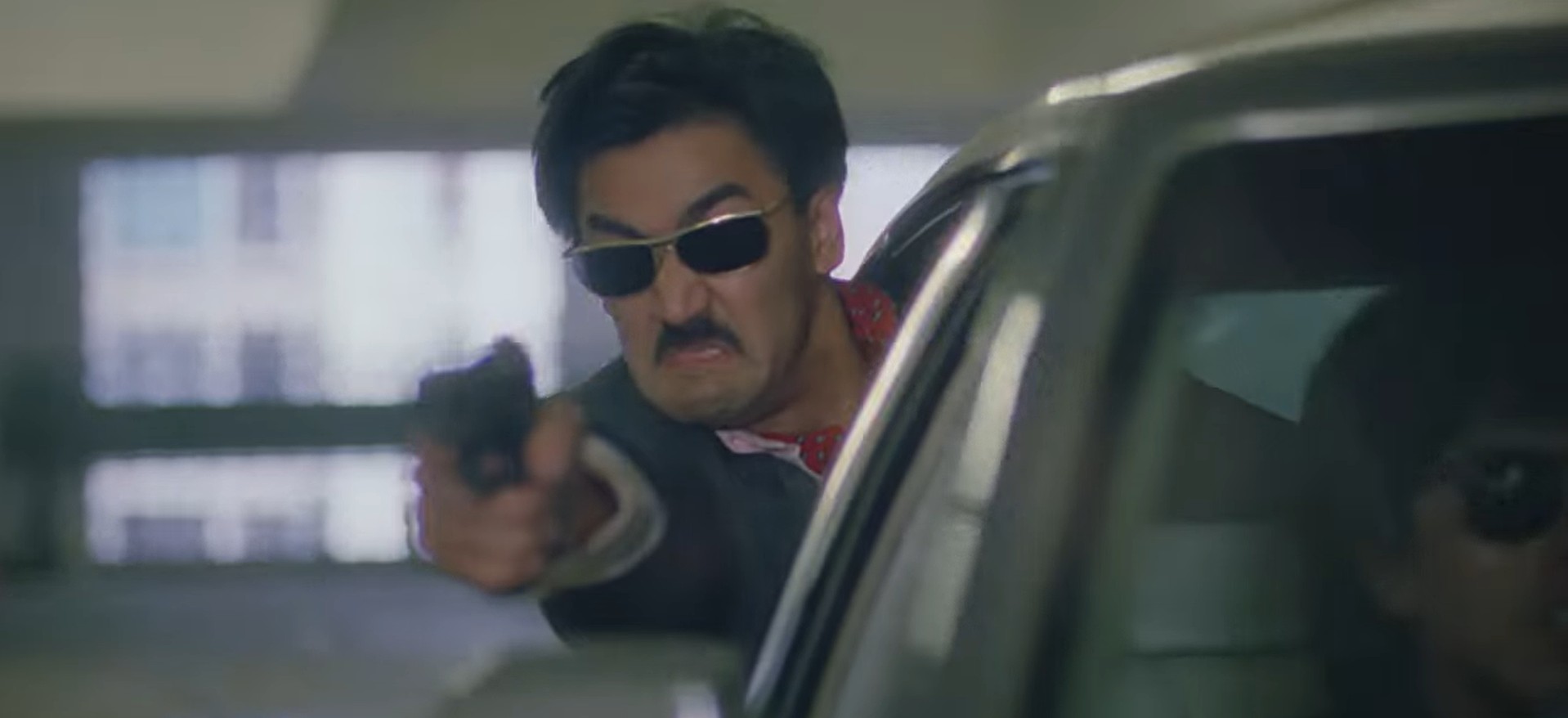
If you thought female-driven action films weren’t prevalent enough in the 1990s, 皇家女将,aka “She Shoots Straight,” aimed to prove that theory incorrect.  The Hong Kong production by “Yes, Madam!”) director Corey Yuen is nothing but women-in-action in this gun-fu actioner penned by Yuen, Kai-Chi Yuen (“Once Upon a Time in China”) and Barry Wong (“Mr. Vampire,” “Hard Boiled”).  The action dares with high wire acts that are kept grounded in reality but there’s plenty of intense hand-to-hand skirmishes made to be not only appear feasible on screen but awesomely cool while doing it.  Sunt coordinator and filmmaker Sammo Kam-Bo Hung, who we just covered as the stunt coordinator and second unit director in our review of Jean-Claude Van Damme’s “Knock Off,” produces the 1990 released venture to ensure palpable contact fighting with Pui-Wah Chan serving as co-producer and Leonard Ho serving as executive producer under the Sammo Kam-Bo Hung and Leonard Ho studio, Bo Ho Film Company.
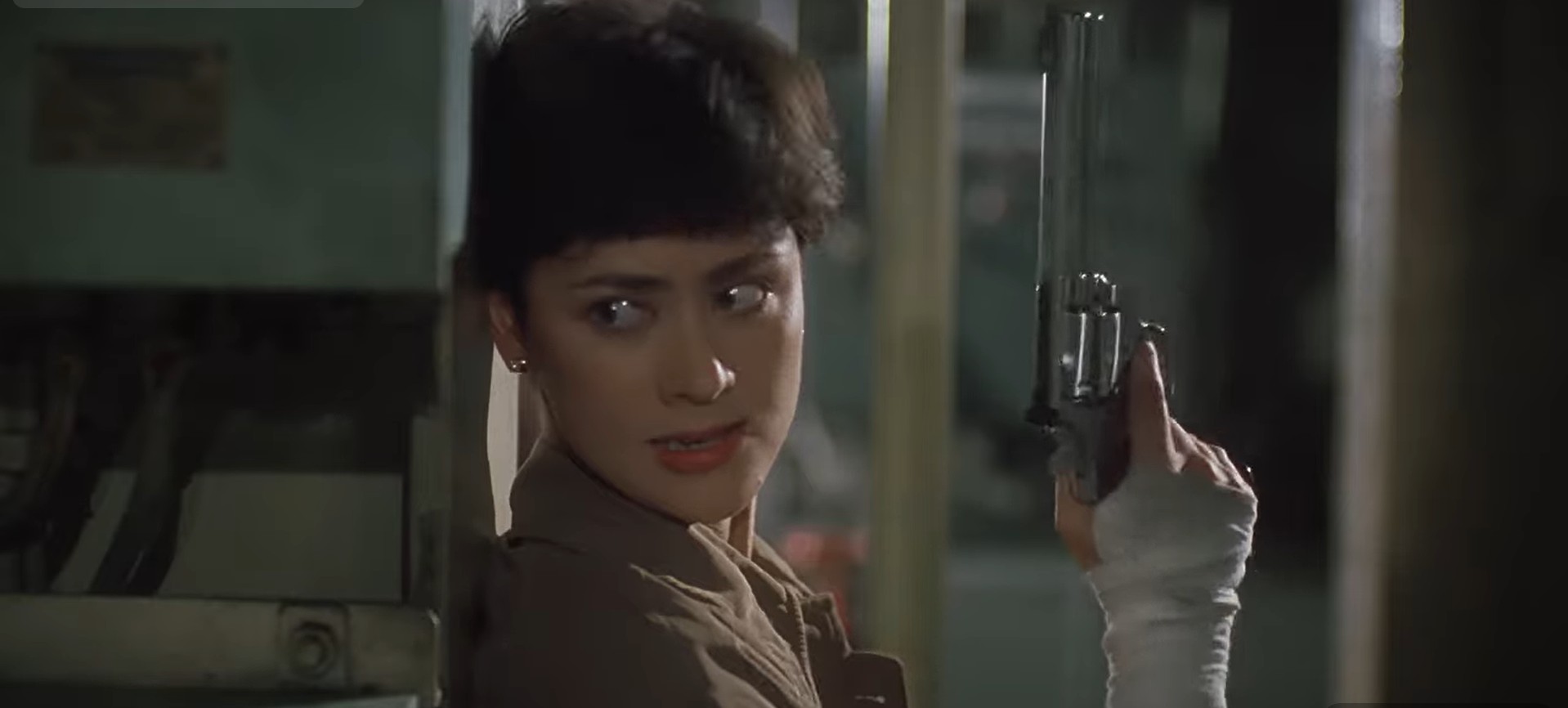
Men certainly take a backseat to “She Shoot Straight’s” policewomen with a vendetta, removing all the substantial and good out of the few male roles assigned, and spearheading the task to Joyce Godenzi.  “The Ghost Snatchers” actress finds herself lead aggrieved party, the widow Mina, in grief and out for revenge her way.  She’s joined by her late husband’s closest sister Huang Chia-Ling whose character arc began loathing Mina’s acute entry into their large law enforcement family.  Played by “2046’s” Carina Lau, the two women compliment their initial oppositions while solidifying their bond over a tragic commonality that shows being an officer is more than just a pageantry rise to the top, it’s, as Dominic Terretto would say in “Fast and the Furious,” family.  Even the on the villain side of characters, the main Vietnamese agitator and all-around bad guy Nguyan Hwa (Wah Yuen, “Kungfu Hustle”) is overshadowed by his sister Nguyen Ying, a peak physical specimen of physical strength, courage, and loyalty to her brothers.  Agnes Aurelio is a pure picture of strength as Ying who is not only a presence on screen with her muscular look and large curly hair, she also takes the final one-versus-one showdown with Mina in a dusty exhibition of martial arts skill but it’s Hwa’s sister who also breaks him out of refugee camp, sets up his escape plan, and gives more a fight with physicality than her gun-reliant brother.  The other male parts are equally as overshadowed with the superintendent (Chi-Wing Lau, “Police Story”) a horndog for the married Mina, Sammo Kam-Bo Hung in perhaps the least as the dismissed Huang relative on the force who’s continued to be mocked for his in-law status, and even Mina’s husband (Tony Ka Fai Leung, “Flying Dagger”) is killed in the most transfixing way right in front of Mina and Chia-Ling to harden their character story’s broken relationship.  Pik-Wan Tang rounds out the chief cast as the respected matriarch Mother Huang honors her late husband with five children who follow his footsteps and as a mother hyper aware of her family dynamic-suspended micro drama between the women.  Anglie Leung (“Vampire Buster”), Lai-Yui Lee (“School on Fire”) and Sandra Ng (“Ghostly Vixen”) found out the sister siblings. 
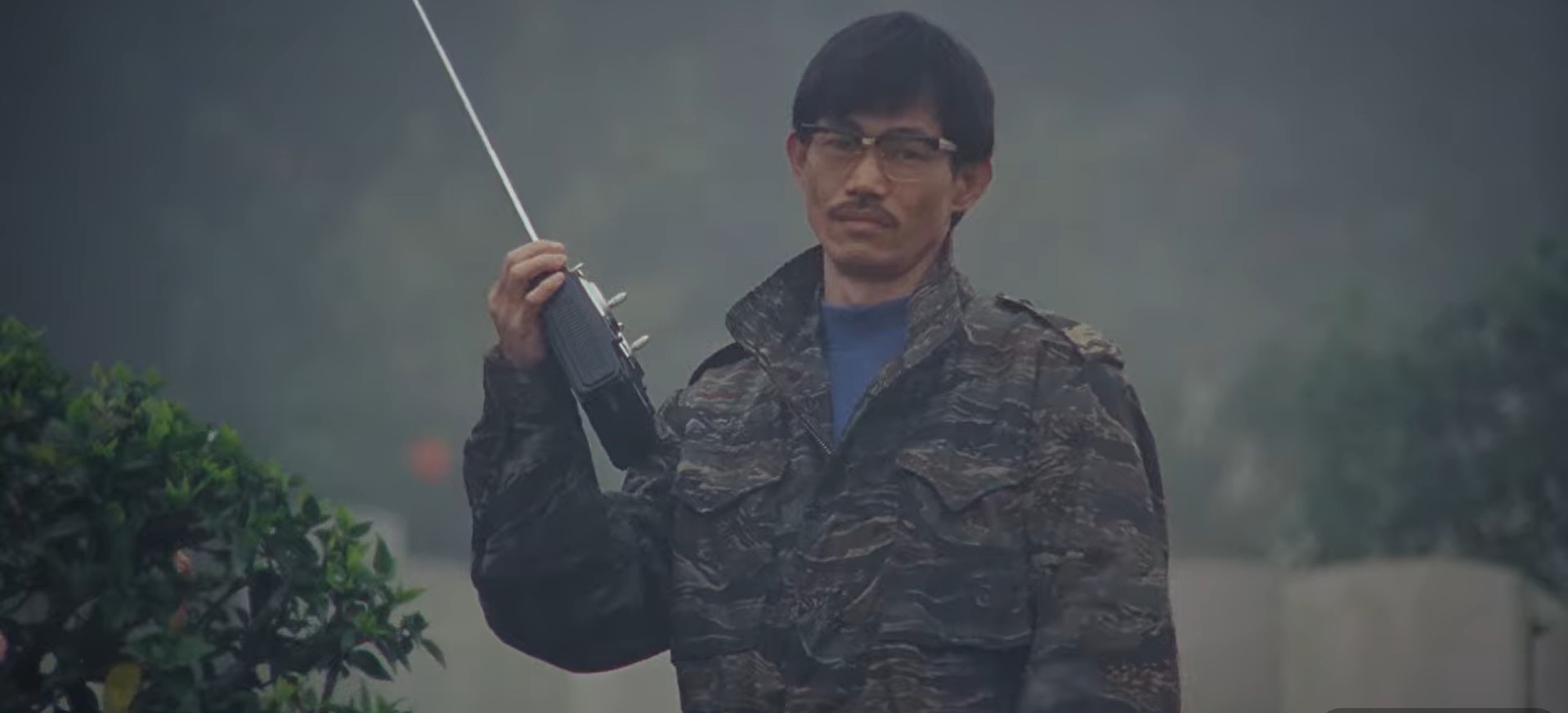
This Yuen entry of heroic bloodshed has deeper shades of comedy that wade around the waters of slapstick rather than be an abyss of tenebrous noir.  While the comedy is apparent and can be considered outrageous in the action-comedy framework, there’s an underlining serious tone with the demonstration of violence with blood squibs and even a body being impaled multiple times.  There’s no skirting around the violence that shows little result from the martial arts portion of the action, leaving flying projectiles to be the ill-fitting, carnage-laden lifetaker.  Yet, the sibling squabbling, the flirtatious foreplay, and the snarky remarks tone down the severity, cleaving the intensity in two for the film’s bifold persona that makes “She Shoots Straight” an interesting little film aside from the strong heroine aspect in a male dominated era of martial art films that began to incline with the likes of Michelle Yeoh, Cynthia Rothrock, and Cynthia Khan to name a few.  Joyce Godenzi’s name is definitely on that list with her performance in “She Shoot Straights” that deliveries a diversity of fast and hard moves with a beauty and grace in tandem.  The story’s lose approach with the unlawful Vietnamese refugees keeps plot pliable to change on a moment’s notice, such as an undercover operation turning into a deadly consequence that pivots from the lighthearted antics with slivers of action to a grittier payback overreaching the law with vigilantism, that results and retains a positive and fresh narrative progression.
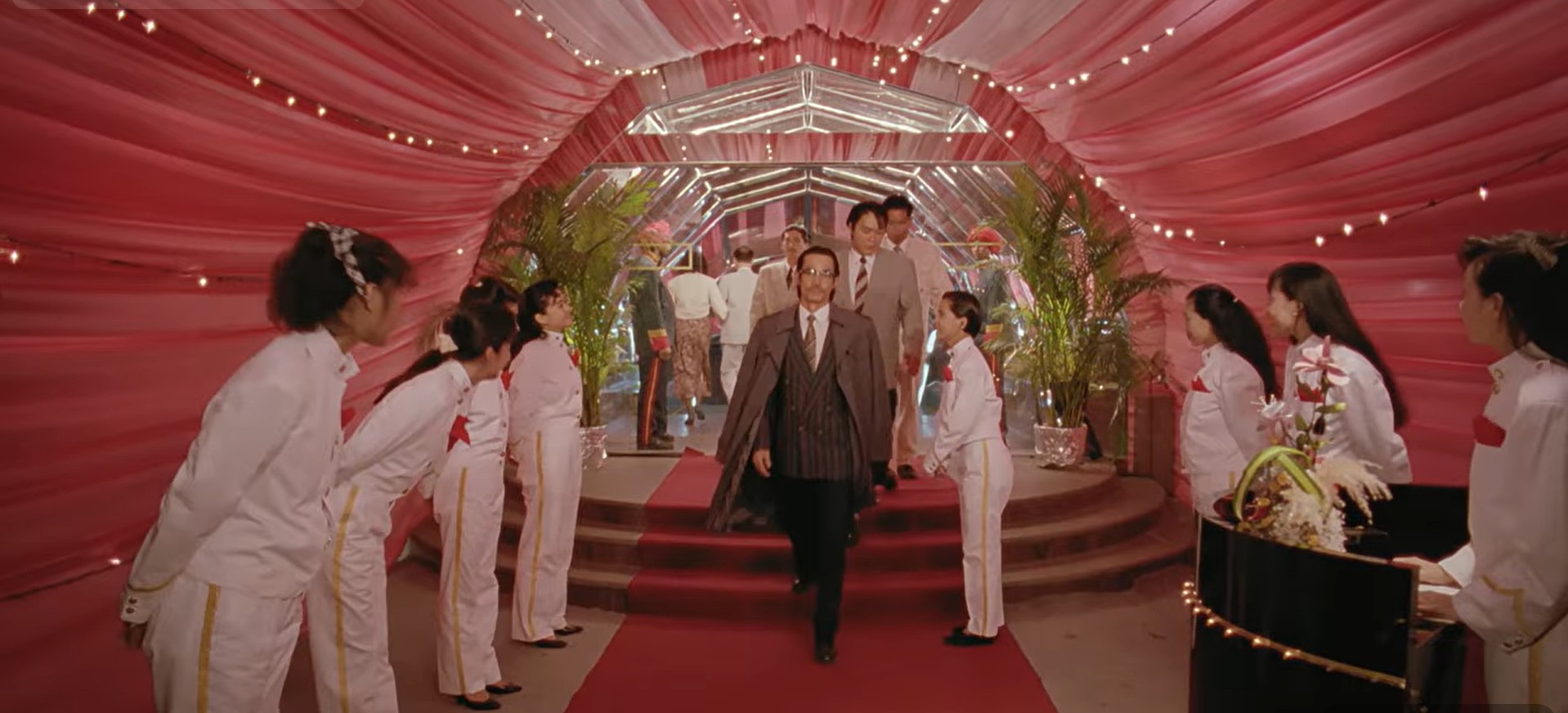
“She Shoots Straight” has a brand new 2K restoration Blu-ray from UK label 88 Films for the North America market.  The AVC encoded, 1080p high definition transfer is scanned from the original 35mm negative and stored on a BD50.  In a nutshell, 88 Film’s transfer is impeccable and flawless to present the naturally graded cinematography.  Colors are balanced in a diffused saturation, details are highly visible and charted with precision for the best-looking image, and the print restoration is one of the better products I’ve seen lately from a pristine original print from the Fortune Star Asian film archive.  The freshened image could even rival most shot-on-film movies of today, if not exceed it. The film is presented in the original aspect ratio of 1.85:1 widescreen.  The language ADR track is the original Cantonese mono with English subtitles.  The post-production audio hits all the necessary markers between action, environment, and dialogue, capturing with balance a crisp and clean dialogue that syncs very well with the subtitle pacing and is error free in t’s King’s English.  The fight hits have palpable impact with low muffled effects rather than the traditional chop-socky slappy whacks that all sounds alike in kicks and punches.  There’s never a time the action doesn’t synch with the audio and this create an authentic product rather than an evident post-production track that can be off-putting and feel disingenuous for viewers.  If subtitles are not your thing, there is an English dub available in 5.1 DTS-HD Master Audio and a LPCM 2.0 mono.  Special features include an in tandem commentary by Asian film expert Frank Djeng, an interview with scriptwriter Yuen Kai-Chi, alternate English credits, an image gallery, and the original Hong Kong trailer.  An impressive characteristic of the 88 Films’ Blu-ray is their ever color, ever stylized, and ever showcasing slipcover with a rigid O-ring that has some great artwork by graphic artist Sean Langmore that is also as the primary art on the reversible inner sleeve of the Amaray case.  The reverse side has the original Hong Kong compositional design that shows off more of Agnes Aurelio muscular definition and badassery.  The not rated film is region A locked, which is surprising only the North American rights are acquired because it’s a UK-based company, and clocks in at 92-minutes.

Last Rites: 88 Film’s 2K restoration of “She Shoots Straight” looks astonishing that elevates this police action comedy with a violent edge from Hong Kong. With a perfect blend of humor, gun-fu, and emotional weight, director Corey Yuen’s fortunately legacy lives on, now in Hi-Def, for future generation moviegoers.

“She Shoots Straights” and She Never Misses! On Blu-ray Today!

Making a Horror Movie can be EVIL on the Health! “Stoker Hills” reviewed! (101 Films / Digital Screener)

Three film studies college students are eager to win their class’s short film contest with story idea Street Walkers, a genre blending horror movie that crosses “Pretty Woman” with “The Walking Dead.” On their first night of shooting, isolated on the empty streets of Stoker Hills, their actress and friend is suddenly abducted right before their camera lens and instantly give chase without a second to call the authorities, falling right into the maniac’s nightmarish world. Left behind for two detectives is the students’ tell-all camera, leaving behind the recording as the only clue into tracking down their undisclosed whereabouts and stopping the kidnapping-killer. As the detectives home in on the killer’s lair, only hours are left before a determined and desperate madman drains every single drop of their youthful blood for a deadly selfish cause.

Director Benjamin Louis and “Stoker Hills” want you to believe in their compelling and bloody slasher narrative of periled college students fighting for their lives against a formidable, resilient killer while two resolute detectives sniff out the mystery of their disappearance before it’s too late. However, in “Stoker Hills,” nothing is as it appears to be. As the first feature script penned and produced by Jonah Kuehner, the “State’s Evidence” director, Benjamin Louis, coproduces the sheeny cinematic slasher that hits upon almost every known trope in the book by incorporating a backwoods nook, a torturous rec room, and foggy night underneath a vividly complete full moon into a story that’s one part found footage and one part cop thriller. Benjamin and cinematographer John Orphan (“The Black String”) do a phenomenal job crafting away from a Los Angeles look and into an unrecognizable, any-town-America by shooting at the dead of night in L.A.’s low-lit surrounding areas of Griffith Park and the Angeles National Forrest without focusing in on or revealing well-known landmarks. “Wildling’s” Rab Butler and Timothy Christian coproduces the 2020 teen-mystery slasher.

“Stoker Hills” begins very much in the same way as my last review of Seth Landau’s “Bryan Loves You” with a deep-in-character production by the great Tony Todd (“Candyman”) as a film studies professor. Instead of warning audiences to look away if frightened or to be ushered out of the theater when shocked beyond just stomaching the content, Todd’s professor of cinema is passionate and enthusiastic about what great filmmaking and the auteurs who wield their work upon the world. However, much like “Bryan Loves You,” Tony Todd only dabbles into the narrative with a superficial house role that opens the doors for Ryan (David Gridley, “The Unhealer”), Jake (Vince Hill-Bedford, “Sorority Slaughterhouse”), and Erica (Steffani Brass, “Ted Bundy”), three slackjaw, maybe even indolent, students eager to take “The Walking Dead” and turn it into a “Pretty Woman” romance comedy known as “Street Walkers.” The concept is no Guillermo del Toro or Martin Scorsese, but nonetheless barely sates the professor’s threadbare faith in the three’s semester-ending grade. Along the way, we’re introduced laterally to character who will eventually be integrated into the story later and at a state of prominence to the mystery, such as with fellow star student Dani Brooks (television actress Tyler Clark) and her university benefacting donor Dr. Jonathan Brooks (John Beasley, “The Purge: Anarchy”). “Stoker Hills” also isn’t entirely linear as the footage soon appears to be corrupted only to be on pause by two officers investigating the case and analyzing the video. William Lee Scott (“Identity”) and Eric Etebari (“Scream at the Devil”) play the high-blood pressure, blue collar, family-man Detective Bill Stafford and a sophisticated bachelor and quasi-Rain man Detective Adams respectively. The Scott and Etebari cop drama show entertains as less CSI and more NYPD Blue or Law & Order with a conspicuous partner correlation only to be separated by adding snippets of out of context humanity, such as why Adam’s is a loner and Stafford hates changing baby diapers. Powerful stuff. Each character is connected to “Stoker Hills'” antagonist, Charles Muyer (Jason Sweat), who’s been abducting young, healthy people off the streets and into his vacant buildings of intravenous drips of blood into a milk crate-based cylinder beaker tube. Thomas R. Martin, Joy McElveen, Maya Nucci, Michael Faulkner, and “Eraser’s” Danny Nucci round out the cast.

Director Benjamin Louis cherry picks the best traits from a triad of genres to smush together into one trope-tastic “Stoker Hills”  A lumbering mute killer bred to annihilate in his nihilism from the slasher genre, two dedicated detectives determined to catch a killer and able to snoop out clues out of nothing that’s familiar toward the cop drama genre, and a pair of brosefs, who dude each other in every other line of dialogue no matter if it’s joshing in film studies class or being chased harrowingly through the woods and having their foot snagged in the teeth of a beartrap, pulling from the pot-smoking and arrogant hijinks of two immature college aged guys usually hovering around the teen comedy category.  All the actors really get into their parts to the point of a fault in creating a bogus, simulated environment as if a knockoff matrix, coded by naive aliens who know nothing of the human race other than watching “American Pie,” “Law & Order,” and every Renaissance era slasher film, is being pulled over the eyes. The whole ordeal that has a context surrounding Charles Muyer’s bad pig heart is also grossly under kneaded and bordering nonsensical until the ending. That game changing ending spooled by meta wiring puts in perspective every last minute of the well-paced 91-minute film, and when the narrative quickly closes upon itself and fades to black into the credits, every scene previously pondered and examined, crisscrossed into a mental algorithm that breaks down character arcs and progression devices, and spits out answers like an Amazon Alexa has suddenly last all its calculated determination in a snap of a flash. Kudos to “Stoker Hills'” screenwriter Jonah Kuehner for conceiving an overtreated trope decoy story and kudos to director Benjamin Louis in pulling the wool over our eyes without flinching or showing his cards too early.

Everybody run for “Stoker Hills” and become caught up in a diabolical twist that’ll deflate the suspense out of you but also leave you pleasantly surprised. 101 Films released this film last month, March 28th, on digital platforms. Since “Stoker Hills” is solely a digital release from UK distributor, there are no audio or video specs to note or review. Aforementioned, John Orphan helms the “Stoker Hills” noir and no-nonsense veneer which is and also the minor league Jigsaw traps are very “Saw”-like, even down to peppering certain scenes with over illuminating primary color gels if by spotlight. Roc Chen, a profound composer for China over the last decade, notes a less than impactful score in what could be considered more run of the mill material, but that also could play into the whole narrative twist. There were no bonus features available with the film nor were there any bonus scenes during or after the credits. At first glance, “Stoker Hills” treads over the same worn trodden path of slasher predecessors, but then the finale hits like a five-finger slap in the face from Will Smith and, suddenly, everybody could be, should be, and will be talking about “Stoker Hills'” gripping gambit.

Dope Dealing Evil Doers Meet Their Match! “Violent Cop” review!

screen-shot-2016-12-02-at-9-39-01-pm
In a city fueled by constant drug trafficking and violence, a weak and corrupt police department has revolving leadership, but one good cop, detective Azuma, of the vice squad doesn’t have the taste for dope. Azuma’s wild card police tactics stir much controversy in his department, placing him on extremely thin ice, but he manages to get the job done no matter the destructive, if yet effective, trail left behind. When the detective learns that his long time colleague and best friend, detective Iwaki, has been involved with trafficking drugs, Iwaki ends up dead in apparent suicide and Azuma will stop at nothing to discover the truth behind his friend’s sudden death. Azuma’s Dirty Harry-style methods catch the attention of a powerful yakuza henchman who kidnaps her and lets his entourage gang rape his mentally unstable sister and with nothing else to lose, the rogue officer shoots first and never asks questions later.
screen-shot-2016-12-02-at-9-39-51-pm
“Violent Cop” is the breakout 1989 directorial film from Takeshi Kitano, one of the most recognizable names and faces in the revival of Japan’s film industry and a staple amongst other mediums including stage performance, television, and other various liberal arts. Kitano also headlines the yakuza genre film as the lead character, the ungovernable detective Azuma, in this unforgiving cop drama under his pseudonym ‘Beat’ Takeshi. Kitano’s harden plastered mug and short, stocky stature caters to the era of lone wolf. rogue cops, providing a hearty performance familiar to that of Clint Eastwood or Charles Bronson. “Violent Cop” quietly packs a punch, patiently waiting to seize the opportunity to display explicitly graphic violence while also being sleek in it’s construction, charmingly odd in it’s humor, and basking more in the parameters of performance than in it’s exposition of dialogue, which is kitano is known more for in his acting.
screen-shot-2016-12-02-at-9-38-30-pm
Much of the film revolves around Azuma’s cavalier and stoic personality. In the opening, three teenage boys unjustifiably harass and assault an elder homeless man. Azuma, who happened to witness the assault, follows one of the boys to his home, knocks on the door, identifies himself as a police offer to the boy’s mother, walks up the stairs alone, and slaps the boy around in his own room until the boy confesses and agrees to turn himself in at the station the following day. This introduction not only showcases Azuma’s descriptive title character as the violent cop, but also informs that the work alone Azuma has a vigilante moral principle that even isolates him from his unstable sister. Once a student of comedy, Kitano re-wrote the Hisashi Nozawa original comedic script into a brutal police drama, wanting to exhibit a serious side, but left alone some of the script’s initial comedy elements that blend the spirited yakuza film to being just inside the genre. Kitano’s progressive camera work includes deep long shots along with tight quarter setups, extensive and angled crane shots, slow motion sequences, and long track work that pinpoints Kitano’s diverse style.
screen-shot-2016-12-03-at-8-27-59-pm
“Violent Cop” lives up to the title. Heads being bashed with an aluminum bat, multiple gory-soaked stabbings, and a sadistic, punishing maltreatments are just a few examples of “Violent Cops” barbaric qualities. The violent scenes feel almost peppered throughout, but they’re really strategically placed between character building segments that only support the necessity of brutality. Did detective Azuma really need to run over a suspect, who just murdered a colleague, down twice with the squad car? Yes, because the suspect desperately and dangerously wielded a baseball bat as a weapon and attacked them numerous time. The actions of the criminal warranted Azuma’s unethical position of bulldozing him over, twice. Only when Azuma is pushed beyond his limits does he lose what was left of any shred of restraints that were holding him back. Azuma meets an antagonistic match, a blood thirsty foe equally resistant and, at the same time, loyal with his boss, creating a villainous mirror image whose just as a loose canon as himself.
screen-shot-2016-12-03-at-8-28-23-pm
Film Movement, the New York based award-winning and foreign cinema distributor, presents a specialized hi-definition Blu-ray treatment of “Violent Cop” in a sharply detailed 1.85:1 aspect ratio stored on a single disc BD-50. The region A disc provides the best transfer quality of this 1989 film to date with stunning, natural coloring, balanced hues, and defined edges with no signs of compression artefacts. Darker scene noise is present, but to affect the experience, the noise would need to be more extensive. With Film Movement’s release, the noise is minimal and shouldn’t be considered a factor. The Japanese LCPM 2.0 audio track is quality with no hiss or pops. Dialogue is evident in the forefront, all other tracks seem level with an accompaniment range of ambiance, and, like aforementioned, all tracks are clean and clear of distortions. Extras include a featurette entitled “That Man is Dangerous: The Birth of Takeshi Kitano” and an booklet essay with the topic of Takehsi Kitano, written by Asian film expert and film curator Tom Vick. “Violent Cop” offers no sympathy, but provides an abundance of rich, dedicated filmmaking in a raw format that seems almost archaic in the present. Film Movement and “Violent Cop” go hand-in-hand, a foreign yakuza melodrama that saw the beginning stages of rebirth in the last days of a struggling Japanese cinema market and Kitano’s face is at the forefront of that movement.

“Violent Cop” on Blu-ray at Amazon.com!