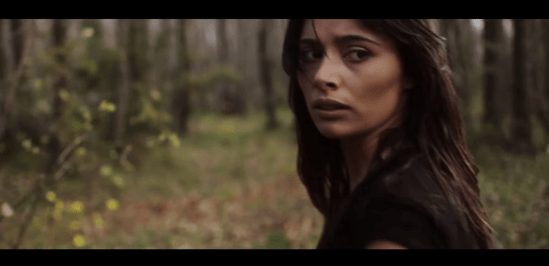
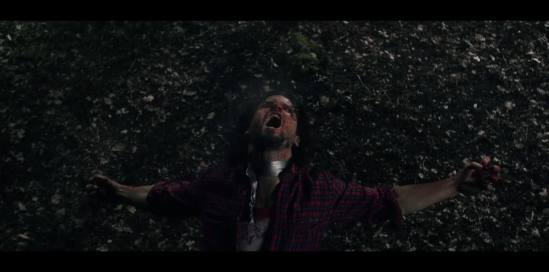
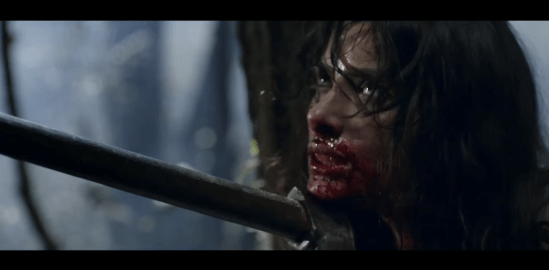
Ever since he was a small child, Marco has been haunted by a malevolent presence inside his family home. The nighttime darkness has become Marco’s most feared adversary, staying up late and sleeping with the lights on has been molded into the normalcy of his life. While recollecting his childhood, a happy and tragic period in his life, Marco tracks downs and locates a Curandero, a Witch doctor of sorts, named Luis Ortiz, hoping for a resolution to the spirit’s relentless torture before Marco’s son becomes the spirit’s next target. The unorthodox Ortiz discloses a self-exorcising ritual that only Marco can perform to ultimately rid Marco’s family’s curse. Armed with ritualistic candles, a barrier of salt, the holiness of water, and a slither of courage, Marco transforms his childhood home into an evil eviction dwelling that will be the last stand.

Director Jon Garcia’s first step into the horror genre with “The Hours of Daylight,” a ghost film through-and-through, starring Quinn Allen as Marco. Set within the confines and on the outskirts of Corpus Christi, Texas, Garcia’s uses the industrial and river-ridden backdrop to contrast a stark outline between the metal and the nature qualities of the coastal city, a demarcation dividing the otherworldly evil versus the organic man. However, the diverse landscape is only a embellished blanket over a lingering underdeveloped story written by Garcia. Marco spends much of the time wandering the land, pondering the what ifs of his past, and doing a lot of soul searching in order to build courage against a lifelong and unknown force, but the story goes stagnant for a good portion of the first two acts doing nothing to motivate and build upon an established character from early into “The Hours Till Daylight.”

Interesting aspects of the film such as Curandero Luis Ortiz and the stricken girlfriend of Marco left a befuddled teaser in a Quinn-centered story. Dan Braverman (Dylan Dog: Dead of Night) portrayed the Curandero, a character whose disability, threatening protection, and greedy candor made a highlight when Marco comes calling for unconventional assistance. Braverman’s “gangster” charisma overpowers Quinn Allen’s timid and drab performance of a desperate man on a mission to do and try anything to end his family’s suffering. Marco’s girlfriend, credited to Sarah Jannett Parish, begin to experience the affects of Marco’s torment as the apparition clings onto her and their unborn son, pursuing a legacy of spirit attachment. Again, the scenes are brief and unexplored; these scene would heighten a clear and present danger that provokes Marco.

I previously read that the slow pace of “The Hours Till Daylight” was well worth the wait at the finale. I disagree. The finale was better with a blue tinted, “not-of-this-Earth” force, naming itself Hate, makes a confrontal appearance when Marco challenges it and though the ghost effect does the job, final bout lets the air whoosh out, deflating any kind of tension and excitement right out of moment. Technical details crash Garcia’s initial horror achievement and its the little things that create an atmosphere. Garcia has an eye for horror, but not the eye it needs to be more defined in it’s training to capture the tiniest of details that makes a scene, or a movie, truly scary. Whether or not Garcia’s intentions we’re to display a blatant ghost thriller or to exhibit Marco’s severe mental distress stemming from the tragic loss of his sister and his emotionless father doesn’t matter if the film isn’t technically and emotionally sound. Garcia’s film isn’t technically sound and borderlines being emotionally there, but falters through the inconsistencies.
Breaking Glass Pictures distributes the 84 minute not rated DVD of the Jon Garcia’s Lake Productions feature film presented in a widescreen 16:9 aspect ratio on a singer-layered disc and the video quality is solid sans some compression artefacts. The Dolby Digital 5.1 audio mix could you some work leveling out of the LFE with the audio tracks. The special features include an in-depth look into the behind the scenes of “The Hours Till Daylight,” the film’s theatrical trailer, photo stills, and other BGP promotional trailers. Overall, “The Hours Till Daylight” atmospheric creepiness bleeds in the conformity of filmmaking, offering nothing new and unique to the psychological horror thrillers. Director Jon Garcia has talent and ambition that needs tweaking and more experience in order to accomplish horror at it’s scariest.
Tag Archives: psychological thriller
A Romantic Getaway Turns Evil! “The Perfect Husband” review!

Nicola and Viola attempt to escape their dismal past involving losing their child at birth, traveling to an isolated cabin in the woods to rekindle and reconcile their bitter relationship. Once there, Viola feels a menacing presence lurking amongst the trees ever since arriving. As the strain on their past and present union becomes nearly too much to bare, tensions overflow with jealously and bewilderment that turn the delicate situation into an explosion of violent behavior. A cat and mouse game of carnage and death follows the couple through the dark woods toward a bizarre and psychological ending that reveals the true nature of their disturbing affliction.

Director Lucas Pavetto’s “The Perfect Husband” is an Italian psychological horror film from 2014 starring “Nightmare Code’s” Bret Roberts and Gabriella Wright and based off Pavetto’s short film of the same title. Even though “The Perfect Husband” is an Italian birthed film from Italian production company DEA Films, “Il Marito Perfecto,” the Italian title of “The Perfect Husband, has a crew, aside from Pavetto hailing from Argentina, that maintains the country’s native ethnicity. London born Gabriella Wright, who masks her English accent very well, co-stars alongside the Alaskan-American Bret Roberts; both actors could certainly pass having Italian heritage with their olive skin tone and dark features elsewhere and with filming location set in Catania, Sicily, the actors fit right amongst the rugged and mountainous Sicilian landscape. Roberts has a low-raspy articulation that makes him seem always out of breath that transitions beyond the catalyst, but Roberts plays villainy insanely well. Wright maintains a cryptic temperament from start to near finish. However, the duo’s dynamic is quirky at best as the couple treat themselves more a boyfriend and girlfriend than husband and wife, which might be a product of the writing.

Lucas Pavetto and Massimo Vavassori go fairly formulaic with their script, writing about strife-stricken couple working out their marital issues alone in a remote cabin surrounded by a dense forest. The setup screams horror premise clockwork and attempts to shift gears after lengthy character development that takes some time to build into something concrete, or at least halfway tangible. The shift in disposition is, however, so rapid and so sudden with unwarranted ferocity, that the effect goes from a scale of a tense filled two to a run-for-your-life ten in a matter of microseconds. The series of events portray Bret Robert’s character Nicola as a jealous misogynistic ready to snap at any given moment while Viola’s mysteriousness and her unconscious readiness to break with reality puts an undisclosed strain on her psyche that what she experiences may or may not be real. A twist ending tries to fill in the Nicola and Viola omissions, but misses the mark that still leaves gaps here and there, especially conveying more about the events that took place at the refugee station between Viola and the Ranger, played by “Apocalypse Z’s” Carl Wharton. Perspective becomes surreal; a fantastic journey that terminates toward a twisted unveiling, leaves more questions than answers about Viola and Nicola prior to their weekend getaway.

Plausibility. Probably “The Perfect Husband’s” fiercest enemy as the story tries to turn itself upside to throw the audience for a loop. The disillusion feels cheaply thrown together to try and wrap up, what could have been, a thoughtful psychological thriller and that’s where plausibility doesn’t formulate, frustratingly feeling like an square box with only three sides and a gap left carelessly open. I wanted to like “The Perfect Husband” because I thought the mayhem was present at the beginning moment of the snowball effect. Everything went down, fast and furious style, with unforgiving brutality that was surprisingly gory at times.

“The Perfect Husband” has been honored an unrated Blu-ray release in a 1030p transfer presented in a 2.35:1 aspect ratio from the ever bold Artsploitation Films. The video has a slight grayscale imbalance that contrasts scenes a bit heavily, but other than that minor issue, the image looks solid. The English 5.1 surround with optional English subtitles is also solid with a balancing the appropriate tracks. Bonus features include a behind the scenes segment that exhibits the takes of scenes in and outside of the cabin. The original short “Il Marito Perfecto” is included along with trailers for upcoming films from Artsploitation Films. Turns out “The Perfect Husband” wasn’t perfect, but raw, exploitive barbarity is a must see for any violent hound in need of a good scratch.
Internal Evil is Subtle. “Fever” review!

High school classmates Pierre and Damien have just murdered a street woman inside her own apartment days before their French placement examinations. After hearing of the gruesome news, Zoe, a young optician working on the same street, recalls the two boys bumping into her, dropping a black glove on the sidewalk, and she begins to formulate her own radical theory, putting two-and-two together that the teens could be the very culprits fleeing calmly from the scene. Meanwhile, Pierre and Damien continue on with their examination studies over the Easter holiday, believing their heinous crime was not personal but of chance, making the offense not a crime at all. Zoe continues her pursuit of curiosity toward the murderers by not informing the authorities of her suspicions; instead, Zoe uses the crime to become self-aware of her fragile and stagnant relationship with her long time boyfriend while the two teens perverse over the concept of committing another murder.

Leave it to the French to make a bloodless and non-violent crime drama that’s more arthouse than conventional. Based on the Leslie Kaplan 2005 novel, “Fever” is the 2014 freshman film from writer-director Raphael Neal that dives sharply from the murderous act and into the internal struggles that lead Damien, Pierre, and Zoe into a turmoil path. Pierre and Damien think they both won’t be affected by their crime and that their moral conscious will remain clean on the philosophical notion that chance doesn’t warrant being unethical, immoral, or lawfully wrong. Damien basks in this belief more than Pierre, but still succumbs to the inevitable intrinsic battle. Yet, the two boys face separate inner warfare: Pierre’s frightened he’ll be caught by Damien’s nonchalant cockiness, looking over his shoulder constantly and fretting the off chance a witness has already spilled their dastardly secret to authorities whereas Damien fears that his chance theory is being blown to smithereens due in part of his ancestral legacy where his grandfather had cooperatively slain hundreds, if not thousands, of Jews during World War II because the Nazi’s ordered him.

Neal’s envisioning, as a director and a writer, flounders with a wishy-washy, by the waste side, telling when trying to convey the character centric story. From the beginning, Pierre and Damien’s sociopathic nature weakens from time to time with an invading moral conscience, like with in Pierre, but Damien’s difference lies with him questioning his justification of murder, but Pierre and Damien’s quiescent state about their family’s issues spots the story like a dirty window unable to view through clearly, leaving a vague and murky background and present state of mind for both characters. The twosomes’ up-and-down state of minds displays no consistence in their behaviors as they’re friends one instance, squabbling and bickering the next, then back to friends shortly after. Issues with angry and abandoning fathers, lustful mothers, and, apparently, genocidal grandfathers have deeply rooted themselves into the boys’ psyche like poisonous mushrooms kept in the dark to thrive to be eaten by mistake. Neal never relays that sense of foreboding wickedness. The same goes with Zoe as a character with really no background whose starting to go through a metamorphous, reforming her position in an unexciting relationship and developing, through subtle hints, a strangling desire after learning about to incident across from her shop. Yet, her full transformation never completes itself, placing her character, and the teens, into a volatile decline of shortcomings.

Though not too familiar with the actors themselves, their performances overshadow the film’s overall divergent plots. I was very struck by Martin Loizillon’s portrayal of Damien with the cold-heartedness that completely blankets his façade and his exerting of unorthodox spontaneity that doesn’t shy away from creating an uncomfortable scene. Pierre Moure contrasts Loizillon appropriately with a shyly frigidity, secretly yearning for more blood, Pierre Simonet. The red-headed Julie-Marie Parmentier displays the same kind of coldness reflected by the Pierre and Damien, but in actress’s own style of curiosity and intrigue with a minuscule hankering for sexual fetishes or self-morbidity. Then there’s duo lingo French singer Camille playing a role of non-fictional popular song artist Alice Snow whose hit English single, “Fever,” serves not only as the title of Neal’s film, but also symbolizes the foundation of the characters’ conflicts.

Artsploitation Films courteously distributes the Strutt Films’ production of “Fever” onto an unrated DVD with a sleek widescreen presentation with a 2.35:1 aspect ratio. The video’s clean with bright, Spring-like colors opposite the more customary, French influenced film noir that’s more common toward crime thrillers. The French 5.1 surround sound mix comes with English subtitles. While the soundtracks and the dialogue tracks are distinct and lively, there’s a slight error involving omitted subtitles, but the flaw only affects a petite portion of the dialogue, if you’re not tuned into French dialogues. “Fever” displays a mixture of psychological drama that mirrors the infamous Chicago crime of Leopold and Loeb of 1920 and Fyodor Dostoyevsky’s pathologic philosophical novel “Crime and Punishment.”
Evil Wants You to Be a Better Father! “In the House of Flies” review!
Heather and Steve take a trip into the city in June of ’88. Adversely, their romantic holiday turns into a nightmare of claustrophobia, torture, and a fear when a maniac abducts the couple and holds them in small, enclosed basement of a middle of nowhere house in a undisclosed location. Using a broken rotary phone that only receives inbound calls, the abductor plays a horrifying psychological game that will test the bounds of Heather and Steve’s strong relationship.

Director Gabriel Carrer and screenwriter Angus McLellan have proven that their diabolical host lives up to being the epitome of unsympathetic, unreasonable, and sadistic in “In the House of Flies”. The captor leaves no room for wiggle and makes the outlook for our hero and heroine look tragically bleak and sorrowful. The method on how Steve and Heather manage to overcome their host doesn’t jive well with me. Surely a smart and methodical person would not be so careless agains’t two individuals who have to be delirious and weak after weeks of isolation and starvation. Yet, somehow in a matter of a few minutes, the delirious and weak couple hardly break a sweat and barely struggle for victory. I hoped for a better ending, but I shouldn’t take away from the devilish qualities of their capture who lives up to other iconic insane captors such as John Kramer.

The subject matter is obviously dark and realistic. Heather and Steve are put into a position where their love for each other is tested to the brink of it’s limit. Will Steve kill himself to save Heather? Will Steve kill himself to save Heather and their unborn two-month term baby? Will Heather kill Steve to save herself? The couple reach breaking points and question their adoration. The host is firmly behind the wheel of his own sadistic game and wants only one thing and that is the destruction of Steve; his will knowns no limits when dealing with women or unborn children. Though the plot reeks of sinister events, the dialogue and the characters actions don’t reflect the film’s blunt storyline. Heather and Steve are a bit too comfortable in their newly dim basement home and kind of accept being kidnapped or give up far too quickly. Rated as unrated, “In the House of Flies” has a tame dialogue. The rap between Steve and Heather and the host doesn’t convey the aggression one may convey if frightened and angry. Graphic scenes are another tame portion of the film that I feel a movie of this caliber could have heightened, but I admire filmmakers that can provoke without having to visually exploit and that is what “In the House of Flies” does here.

The cast of three is fairly solid. Much can’t go wrong if you have a limit number of actors and actresses and other films have proven this such as Ryan Reyonlds in “Buried” or even the Sandra Bullock lost in space film “Gravity.” Surrounded by unbreakable nothing can be more unsettling than the most vicious and ruthless of villains and can bring out the greatness in most actors and actresses. While I believe Ryan Kotack (Steve) and Lindsay Smith (Heather) do an amazing job as struggling survivors, the characters are a bit overly dramatic very early in the film showing signs of weakness and lethargy too early for effect. Punk rocker legend Henry Rollins is the voice of the caller and I must say I couldn’t even tell it was the punk rock icon. Rollins delivers a monotone sardonic voice that could scare the shit out of anybody.

“In the House of Flies” shows that independent exploitation horror is not yet dead. This film will burn right into your brain leaving you scarred and scared of the cruelty in the world. Though still very Worthy of all the film festival nominations and wins, this thriller was given an 80’s retrofitted treatment that doesn’t quite live up to the video nasty era, but does invoke questions about love in dire situations and who would you save: Your unborn baby? The love of your life? Or yourself? Check out the Parade Deck Films feature distributed on DVD January 20th, 2015 by my pals at MVD!
Nudity Report
No Nudity 😦