Every nine months, the vengeful spirit of an atrocity dealing plantation slave owner, known as the Honey Baron, seeps from a cursed slumber to reclaim his once profitable Brazilian manor home. Also, every nine months, caretakers of the manor home resurrect Bento, the once voodoo practicing slave to the malicious Honey Baron, to fortify the longstanding damnation. Until four friends gather to invoke the myth in jest, lightly treading over the forsaken manor home, and getting themselves unwittingly involved in the releasing of Hell on Earth. Caught in the middle between the Honey Baron and Bento, there’s nowhere to escape, nowhere to hide, and noway to distant themselves from an ancient wickedness.

Directors Dante Vescio and Rodrigo Gasparini’s “The Devil Lives Here” is sorely what the horror community needs and desires, an original vision of spine-tingling Brazilian folklore horror. It’s a damn good story that’s engrossingly rich with captivating characters, virtuous and villainous, simultaneously breeding a delectable devil in São Paulo actor Ivo Müller. From the opening scenes of Müller’s sadist applications upon a humble whimpering slave to the highly climactic and unforgettable shocking end, Vescio and Gasparini details every inch of reel with patience, organization, realism, and a sense of admiration for one of a kind antecedent horror films and concocts a molotov cocktail spiced with numerous Brazilian folklore.

Folklore envelopes “The Devil Lives Here.” Ivo Müller portrays a blend of two distinctive mythological beings, the Anhangüera and an Encantado. Anhangüera, basically, is a version of the devil while Encantado paints a more vivid image of the Honey Baron as a man, whose so ruthlessly evil, that he becomes ensnared in limbo by voodoo, in this case the voodoo of African slaves during the colonial era, and lives a vain life for his atrocities. On the other end of the spectrum, Bento, once a young slave boy, seeks to endure the curse, reestablishing it’s constraints around the Honey Baron’s Anhangüera ways. Bento resembles more closely to the story of Negrinho, a slave boy fatally punished for his loose bindings on responsibilities to his master. Negrinho died on an anthill, in which ants later feasted on his flesh, and returns to help others. In the 2015 film, ants and bees are clear motif before Bento’s horrible demise and Bento also returns from the grave like an original African or Caribbean dirty working zombie, the kind of mindless zombie before George A. Romero took the undead head to new flesh eating heights. “The Devil Lives Here” embellishes upon each lore to up the ante and deliver a shock to the system.

Alongside Ivo Müller is a young, but a formidable cast. Pedro Carvalho, Mariana Cortines, Diego Goullart, and Clara Verdier have performance that are simply enjoyable to absorb and are just wonderful being the unexpected catalyst. With a slight twist in one of the four’s well-kept motivations, the brilliancy of Rafael Baliú’s script, based off the story by co-writers Guilherme Aranha and M.M. Izidoro, comes to a head by not following the conventional tropes of hapless pranksters unwittingly hitting the bees nest. Instead, the characters are grossly flawed by one of their own; however, I did hope there was a little more exposition toward Mariana Cortines’ Alexandra clairvoyant ability between the world of the living and the spirit realm as I thought the relevancy was too important to leave open. Pedro Caetano and Felipe Frazão master their roles of being caretaker descendants to Bento. Caetano and Frazão tackle multiple personas with a well armed cache of emotional ranges that split their dutiful commonality and define their positions amongst the story. The cast couldn’t have worked well enough any better making “The Devil Lives Here” a film adorned with God-mode proportions.

Artsploitation Films has become a prominent label in providing provocative and outstanding domestic and global cinema and “The Devil Lives Here” only solidifies their true power amongst other home entertainment distributors. The film is presented in a widescreen 1.85:1 aspect ratio with slight blotchiness in darker tones, but the image is still very sharp with a filter blanket of a warm yellowish glaze. The stereo 2.0 audio with optional English and English SDH subtitles is fine coming through the dual channels. The subtitles are a bit quick, but so is the portuguese language. The DVD cover art is nightmarishly inviting, just like the film itself. “The Devil Lives Here” will completely suck you into the original narrative and curse you with screen glued eyeballs to deliver an inspired and indigenous film that shouldn’t be missed by any horror fan.

Tag Archives: sex
Decadent Evil Takes the Form of Two Blood-Sucking Lesbians! “Vampyres” review!

A dense English forest surrounding a decaying manor house sets as the hunting playground for a pair of seductive female vampires, Fran and Miriam, who have reigned a disconcerting terror through the area’s local inhabitants. When Fran lures and imprisons a touristing male as her bloodletting sexual hostage, Miriam believes Fran is diverging into a dangerous game of simply playing with her food for too long. Miriam proves to be right when a trio of campers stumble upon the vampires’ manor lair, causing a fair amount of distraction when the three friends attempt to uncover the secrets of the area and the myths of the house that will expose the true and terrifying nature of the two vampires. A mistake the three may wish they never would have made.

“Vampyres” is a Victor Matellano 2015 rendition of the 1974 José Ramón Larraz directed abundantly sensual, over sadomasochistic vampire film of the same title but also known as “Vampyres: Daughters of Darkness.” Matellano’s remake faithfully follows the original storyline and with the assistance of Larraz himself tacked on as a credited writer, Matellano was able to keenly hone in on the ambient tone and the graphic slaughtering display the story necessarily requires to quench it’s own thirst for blood. Let’s also not forget the sex, the sex, and the sex that absolutely sinks it’s teeth into of most scenes. Long time has passed since the rebirth of an erotic creature of the night; a plague of mindless ferocity has been the modern vampire. From “Blade” to “The Strain” to one of the more recent reviews of an independent film in “Black Water Vampire,” a dark cloud of a deformed and mutated species of bloodsuckers have been more popular with the masses. Matellano’s “Vampyres” is a love song to the erotic European vampire that’s powerfully seductive, classically gothic, and simply pure blooded with two fantastic femme fatales.

Underneath the dark and ominous cloaks are the beautifully succulent Marta Flich and Almudena León as blood fiend lovers Fran and Miriam. Flich and León have a combined total of 5 feature length films between them, including “Vampyres,” but where the duo lack in experience, Flich and León thrive with their onscreen chemistry that delivers an piercing intensity with a dynamic blend of softcore porn and tantalizing terror as if they’re real life lovers with a real life knack for killing. León has previously worked with Victor Matellano under the Spanish director’s prior horror film, 2014’s “Wax,” and their relationship growth comes whole with the addition of Marta Flich, a buxom brunette willing to savor every moment and put forth every effort into some extremely difficult scenes. No two women can make gore sexier than Flich and León.

Vampires Fran and Mirian heavily overshadow the remaining characters consisting of actors such as Verónica Polo, Anothony Rotsa, Victor Vidal, Christian Stamm, and Fele Martinez who, as a whole, do a fine job performing in this rekindled niche of horror. To add a bit of flare and to help “Vampyres” stick out from above other remakes involving an slew of unknown faces, “Dracula A.D. 1972” and Captain Kronos – Vampire Hunter’s” Caroline Munro and “Tombs of the Blind Dead’s” Lone Fleming have more than cameo appearances, providing familiar genre faces fans know and are attached to when riding along the reminiscing train from the era of which this film’s story is birthed. Munro and Fleming are also accompanied by other genre vets including “Zombie Lake’s” Antonio Mayans, Concrado San Martín from “The Awful Dr. Orlof,” and Hilda Fuchs and the late May Heatherly from 1980’s “Pieces.”

Visually, “Vampyres” dotes as cinematography worthiness in being a European inspired film from a Spanish production by not being flashy but rather grim and simple. Using elementary special effect techniques, “Matellano” doesn’t cheapen an already intentional trashy vampire schlock film with story stiffening CGI; instead, buckets of blood and practical effects elevate the aspiration toward the resemblance of a 1970’s inspired story complete with broken English performances. Set locations are purposefully vanilla, including a plain small bedroom with white sheets overtop a simple bed frame, a bleak forest inhabited with thin trees, and an isolated manor with middle life bones standing lifeless in the woods, and with key shots staged with vivid conventional colors, such as the bathtub scene that’s feels very clean even with the amount of blood used, and the cellar finale that’s very subtle in it’s background even if it’s the root motivation for the vampires.

“Vampyres” is one of the best remakes there is, there ever was, and there ever will be by staying faithful to the Larraz’s original film and Artsploitation Films should be basking in the fresh, warm blood of their latest and greatest release. José Ignacio Arrufat’s brooding score seizes to snare the soul from the well balanced Dolby Digital English 5.1 Surround Sound mix laid over a 2.35:1 anamorphic widescreen presentation. With a slight tilt toward a darker variation on the grayscale, the overall picture is clean and unhindered and even though stark colors don’t run throughout, the bland coloring provides richer qualities toward a excellent homage. One thing is for sure, blood red is the only vivid hue here. Bonus features include an Interview with Caroline Munro, a making of the “Vampyres,” and trailer reels of Artsploitation Films films. The modern masses can have their disease-ridden vampire genres for the very fact that director Victor Matellano’s “Vampyres” entices with an alluring butchery based on fundamental foundations of European horror values and endearment, resurrecting the erotic vampire once again!
Dutch Avant-garde is the Next Evil on the Butcher’s Slab! “Meat” review!
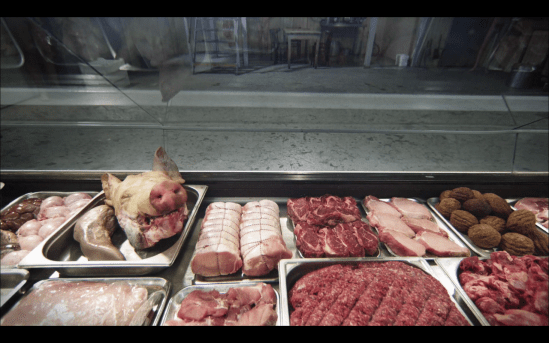
A young and beautiful butcher shop assistant succumbs to the middle-aged butcher’s sexual advancements and fantasies at the workplace after she catches glimpses his sorrow, but when the butcher ends up naked on the shop’s floor with his throat cut, the assistant becomes the number one murder suspect for an inspector who coincidently looks almost identical to the deceased butcher. As the investigation deepens into the assistant, the inspector’s solemn, solitary life blurs to an assimilation into the butcher’s and his suspect turns from being a prime target to being a crucial part of the his physical and mental altering integration into the dead butcher.

“Meat” is a powerful transcending film seismically barreling through a Lynchian structure consigned to provoke the consequences of unhappiness and the consequences of poor choices during unhappiness. Directors Victor Nieuwenhuijs and Maartje Seyferth have orchestrated a moderately expressionistic arthouse Dutch drama told in a spiraling sexual context. The meat in “Meat” and the sex in “Meat” clearly share a correlation, peppered as motifs from start to end, and the positive and negative dimensions of the two are so obscured that pinpointing the differences between them are impossible, but both are for sure the last hope for the butcher and his assistant Roxy to embody the essence of sex and meat for opposite reasons. Whereas Inspector Mann simply drags wholeheartedly through his existence, expressing his numbness toward his mundane job and harshly breaking up with his lover without an ounce of compassion. Its until the butcher’s case lands in his lap does the Inspector shows signs of life again.

If you notice that lead actor Titus Muizelaar’s dual roles have purposefully generic labels. The butcher is credited as just the butcher while the Inspector has a proper name, but the name Mann is just as indistinguishable as if the character was christened Guy. The synonym character was intended for blending, to blur their personas, and to transform one into another. To explore the transformation, “Meat” begins a parallel between the butcher who, in a metaphorical sense, has his cake and eats it too and the inspector painstakingly limps from one spot to another. A contrasting experience between the two firmly establish their individualities. Then, the film shifts gears midst a catalyst with the butcher’s mysterious death, forcing the female assistant, an uninhibited role performed uninhibitedly by Nellie Benner, to be the resilient gateway for the inspector. Third gear shifts into the inspector being more and more intrigued, if not extremely envious shown very subtly, by the butcher’s seemingly unchained facade. Each character emits an expressionless stature with a deep-rooted ugliness burrowed inside and each desire a change in their turmoiled lives, whether it’s sustaining love, seeking love, or able to love in order to battle every aspect of oppressive depression.

The uncomfortable open and intimate relationship between the butcher, Wilma Bakker’s Tiny, and the shop owner and the psychosexual workplace harassment involving the enthusiastic, video-documenting assistant filets the juicy bits from the bone with numerous innuendoes and explicit carnal exhibitions taking brazen residence within the animal blood stained walls of the butcher’s small meat market. You’ll never look at steak, pork chops, and leg of lamb the same way again! Only when “Meat” transitions into that second gear does the erotica becomes less erotic and more forced and horrifically exploitive. Scenes of undisclosed rape and of blatant genitalia speak upon that aforementioned correlation of raw meat and sex; no choice is given to the cow when the cow is killed and slaughtered for the cow’s delicious beef and the same can be said in sex as it’s taken without much consent and it’s being reaped for the benefit of others.

Graphically infrasexual and skewed beyond simplicity, “Meat’s” refreshingly loaded with unpleasantries and basted moistly with an outer layer of perversion that drips into an oven of thriller surreality. The Artsploitation team lives up to the moniker by, after being long overdue, crafting a home video release of 2013’s “Meat” aka “Vlees” onto DVD and on digital home video. The digital screener provided for review doesn’t give much insight into the audio and video qualities or speak to the testament of the special features. However, “Meat” is a phenomenal film that’s well-aged and ready to be rubbed, tenderized, devoured in all senses of the meaning.
Mexico’s Stomach-Turning Evil is Here! “Atroz” review!

In a wake of fatally striking down a young woman with their vehicle, two errant and drunk men, Goyo and Gordo, are arrested for the gruesome crime at the scene of the accident While handcuffed in the back of a squad car, an unorthodox police chief named Juarez discovers a video tape recorder in the front of their mangled car with a tape revealing the violent torture and killing of a young transvestite hooker. One tape leads to another, and then another, individually exhibiting a trail of cascading blood and merciless torture in the deaths caused by Goyo and his unstable and dysfunctional life. Juarez digs further into Goyo’s ghastly cases going through each horrific tape setting up Goyo for a shocking conclusion from his past he long thought was dead.

“Atroz” will make you never want to tour Mexico! I can fully understand why “Cannibal Holocaust” director Ruggero Deadato fully backs Lex Ortega’s graphic horror film an associate producer and presenter as the two films, separated by decades, are much alike with the majority of their likeness in found footage techniques, frighteningly realistic imitations of murder, and their artistic and austere grandeur of filmmaking narration. Ortega also sustains an effective horror feature through the confines of a problematic ultra micro-budget. Along with aid from a talented roster of actors and crew, no way was Ortega’s film was not being made. “Atroz,” translated to “Atrocious,” opens with the unsavory side of Mexico’s impoverishment that contributes to much of the Central American nation’s disturbing amount of unsolved murders. The montage opening is so powerful and moving that what precedes shocks as a gritty insight of what everyday Mexican residents might experience one way or another in their lifetime and though Ortega goes that extra mile to be obscene and disgusting in every way possible, the director supports his work with seeding a traditionally patriarchal society with gender identity afflictions that evolves organically and is purposefully displayed in reverse order to add more, if it wasn’t possible already, to the shock value of “Atroz.”

The outer story involving Goyo’s interrogation about his stash of tapes is only the tip of the iceberg, sheltering three background influencing stories about Goyo that set up more familiarly in an anthology manner. Inked with intricate arm sleeve tattoos and perforated with metal facial piercings, Goyo and his larger friend Gordo, which means large man in Spanish fittingly enough, seem nothing more than your typical lowlife gangbangers. However, Goyo and Gordo are more disturbed than any Mexican cholos from the first torture tape of a transvestite prostitute, a punished, bit-part role awarded to actress/singer Dana Karvelas. The next two tapes are just as hard to swallow and stomach from the assorted fluid being consumed, to the explicit varying degrees of rape, to the vivd genitalia multination, and to just the sheer ultra violence depicted makes “Atroz” the gorehound’s holy grail of horror. Never have I’ve witness a film so graphic to come out of Mexico and, by golly, I thought the world needed this Lex Ortega film. In most cases, extreme gore and shock features run a course shortly after hitting the play button on your home entertainment device, but with “Atroz,” a drive to learn more about what motivates Goyo’s unholy acts unravel little-by-little and that quality is usually omitted and uncharacteristic of explicit gore horror.

Performances are firmly established all around with Carlos Valencia and Lex Ortega himself leading the charge as Juarez and Goyo. While Ortega doesn’t necessary have much of dialogue role with Juarez during interrogations, the undiluted carnage he lays down on the tape recordings are a rare and twisted characterization hardly visited by the indie circuit and certainly not given the light of day from Hollywood, being mostly sidelined to an underground context. Rare is it to have one actor who can impersonate malice upon others that when a doppleganger appears in Goyo’s younger years video tape, “Atroz” becomes that much of brighter highlight as a dark film birthed from Mexico. Carlos Padilla truly frightens as the younger version of Goyo staged in an abusive household with an unsympathetic father, an naive mother, and lots of physical and verbal mistreatment. Goyo’s a psychoanalytical unicorn, an epitome of the mind’s deranged wealth, and a testament that his surroundings molded the very fibers of his intentions do commit evil. The sight of blood is all it takes arouse Goyo and “Atroz” provides the character an ocean of sangre ready for lapping.

Practical effects wizards Jamie Lopez and Alfredo Olguín produced unrivaled effects on a budget that didn’t provide a second chance if the effect didn’t spin right the first round. Absolutely flawless did the duo’s work gleam in the blood it was soaked in and firmly how I held on for dear life my testicles when seeing a set being cleaved graphically severed. Lopez and Olguín have a combined 23-years of experience in the special effects game and that surfaced buoyantly at the top of “Atroz’s” shocking content. In the nature versus nurture debate, “Atroz” sides with nurture putting Goyo in the impoverished and traditional meat grinder that is Mexico and spat him out where wades in a chrysalis until bursting out into a state of lust for an endless stream of revenge and blood. Ortega accomplishes nurture’s wickedness by tenfold and Lopez and Olguín exemplifies it even more.

Unearthed Films and MVDVisual’s limited edition 3-disc Blu-ray and DVD set includes a JH5 & Eggun soundtrack. Presented in a widescreen 1.85:1 aspect ratio, the 79 minute runtime feature sports no blemishes and falters on any flaws, baring and setting a fitting desolate tone through a number of camera options. There’s also and English and Spanish language Dolby Digital 5.1 with optional English subtitles intent on properly channeling every port of your surround sound system. A pair of issue lie with the subtitles involving quite a few typos in English and some synchronization problems delaying captioning a full second or two after dialogue has proceeded. Bonus material includes the short film of “Atroz,” a crowd funding video, behind the scenes: music and sound design, behind the scenes: practical effects, behind the scenes: production, Unearthed trailers, a behind the scenes image gallery, and, of course, the aforementioned soundtrack. Whatever you do, don’t consume any food before and during experiencing the gore charged “Atroz,” Mexico’s most deranged cinematic delicacy to date!
Being Tailored to be President of the United States ist sehr Böse! “Der Bunker” review!

Seeking the luxuries of peace and quiet in order to fulfill the work of an important academic theory, a young student rents out the basement of an old bunker converted into a family home. Surrounded by the solitude of snow and trees, the bunker is the perfect place for the student to concentrate on his work. Until the couple renting the bunker basement decides the student must continue the unorthodox home-schooling of their eight-year-old son to put him on the path of becoming the President of the United States. The student becomes mixed up in a peculiar family’s ambitious affair twisted far from normalcy and teetering on the borderline on insanity.

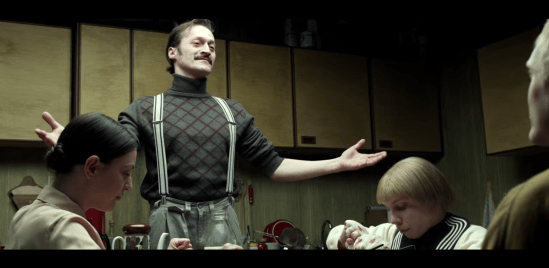
“Der Bunker” is the first feature film from writer-director Nikias Chryssos and Chryssos delivers an artistically abstract film about the modernistic conventional ways of growing up through childhood told through an obsolete perspective. Produced in Germany, the film makes light of how parents raise and shelter their children, especially their sole child. The home setting is literally a bunker, a fallout shelter from the age of war. “Der Bunker” particularly points out the American child raising culture with Klaus, the eight-year-old son of mother and father, going through semi-strict tutoring of memorizing the every nation’s capitals in efforts of becoming, one day, the President of the United States. Chryssos overkills the symbolism column with continuously displaying the staleness of a stuck-in-routine in over-parenting from the outdated 1950’s style of the clothes and retrofitted bunker to the eight-year-old Klaus being depicted by a 30-something actor Daniel Fripan.

Fripan is one of four cast members to star in Chryssos film and the only actor portraying a named character with Klaus, leaving all others generically labeled with father, mother, and the student; however, Klaus and the Student are essentially the same person, a dual presence who start off polar opposites that are trapped inside the bunker and looking to break free from it’s buried confines when their individual identities begin to blur. Fripan’s key to “Der Bunker” working conceptually as the ‘man-child’ with Fripan’s attributed short stature, innocently mature face, and a well-performed immature persona that solidifies the Klaus role as nothing more than child forced to grow externally, but not internally. Pit Bukowski’s more of an automaton when we first meet him wondering through the snowy terrain in search of the bunker. His Student character starts to dwindle as he literally becomes a fixture of the bunker as Klaus starts to shine and thrive in not only his studies but in his maturity, confronting his Mother’s will. Bukowski’s internal switch goes dynamically well with Fripan even though their physical façades remains intact. Mother and Father are portrayed by Oona von Maydell, daughter of “Das Boot’s” Claude-Oliver Rudolph, and David Scheller and both compliment each other by donning an opposite reversal of roles where Mother is the stern, firm hand of the family and Father stays home to clean and be a teacher for Klaus.

Chryssos’ telling of the family and the Student’s psychosexual relationship between the story’s bookends goes above and beyond the Oedipus complex. Oona von Maydell’s Mother has a power fastening all the male characters in an intriguing way despite her minor, yet undesirable, physical deformity plaguing as a patch on her right leg and also despite that her rational stemming from a grave voice, connected to her deformity, comes from beyond their world. As if destined to play the part, Maydell acts the lead as the family’s matriarch while also being subtly coy and provocative to bluntly upfront about her sexuality as a means of control; Maydell seemed very comfortable with her onscreen upper torso nudity in some awkward and uncomfortable scenes. Her onscreen husband, David Scheller, deems himself an academic, an educated man with knowledge more vast than that of the outside world because of this thirst for literature. Yet, Scheller plays a scattered Father whose torn between being a literal mentor, the punisher, and the glue to keep the bunker from being engulfed by giving into Mother’s symbiotic celestial being. Father copes with heavy medication that literally warps his mind when he can’t seem to control everything from the Student’s appetite to his convincing of the Student to take on the tutoring role for Klaus, even if it’s not plainly displayed. Scheller does a remarkable performance breaking down his character to a crumbling lame duck.

“Der Bunker” and the bizarre go hand-in-hand. Only a unique mindset with skewed vision could have pulled together such a twisted dark comedy tale of the mortal coil in holding your children to your hopes and dreams for them. Colorfully unapologetic, “Der Bunker” canisters another world sluggishly revolving through multiple levels of layers of psychosexual and frustrating concepts that flaunts a conventional cinema defiance attitude to establish bold filmmaking possibilities. In short, director Nikias Chryssos shoots high and doesn’t miss with his first run. The Artsploitation Blu-ray release features a vividly clear anamorphic widescreen 2.35:1 presentation of the Kataskop Film Production. Audio options include a Dolby Digital German 5.1 Surround sound with very detailed optional English subtitles. An abundant of bonus material is hard to pass up, especially with a director’s commentary and deleted scenes that expand more about the character’s traits and backgrounds. Rounding the extras are outtakes and trailers from Artsploitation film arsenal. This Blu-ray release is meticulously thought out to deliver a high caliber video and sound quality for such as odd German film concerning one youngish boy’s progressional path of self-reliance from a sheltered life style.