

Under an Urban Club Scene, EVIL Horrors Connect Us All. “Flesh City” reviewed! (Wild Eye Releasing / DVD)

“Flesh City” Yearns for Connection on DVD!

An insomnious city pulsates with an industrial soundtrack and claws cantankerously at denizens without pity. Under one of the raging night club scenes, enamored raver Vyren follows the beautifully alluring Loquette, an inspiring electronic DJ, down into the club’s labyrinth of old stone corridors. Their coquettish play becomes the monitored study of Professor Yagov, a glowingly cadent and mad experimenter of anthropology. The two lovers are drugged and abducted by the Yogav with the intent of genetic mutating the couple’s anatomy that renders Vyren’s hand displaced with a bulbous nub and Loquette impregnated with an ingestible sludge. What becomes of their affliction insidiously infects the entire city population with a flesh tentacle curling through the city’s underground sewer and drainpipe infrastructure in what amasses to a single connection of brain-invading techno-horror.
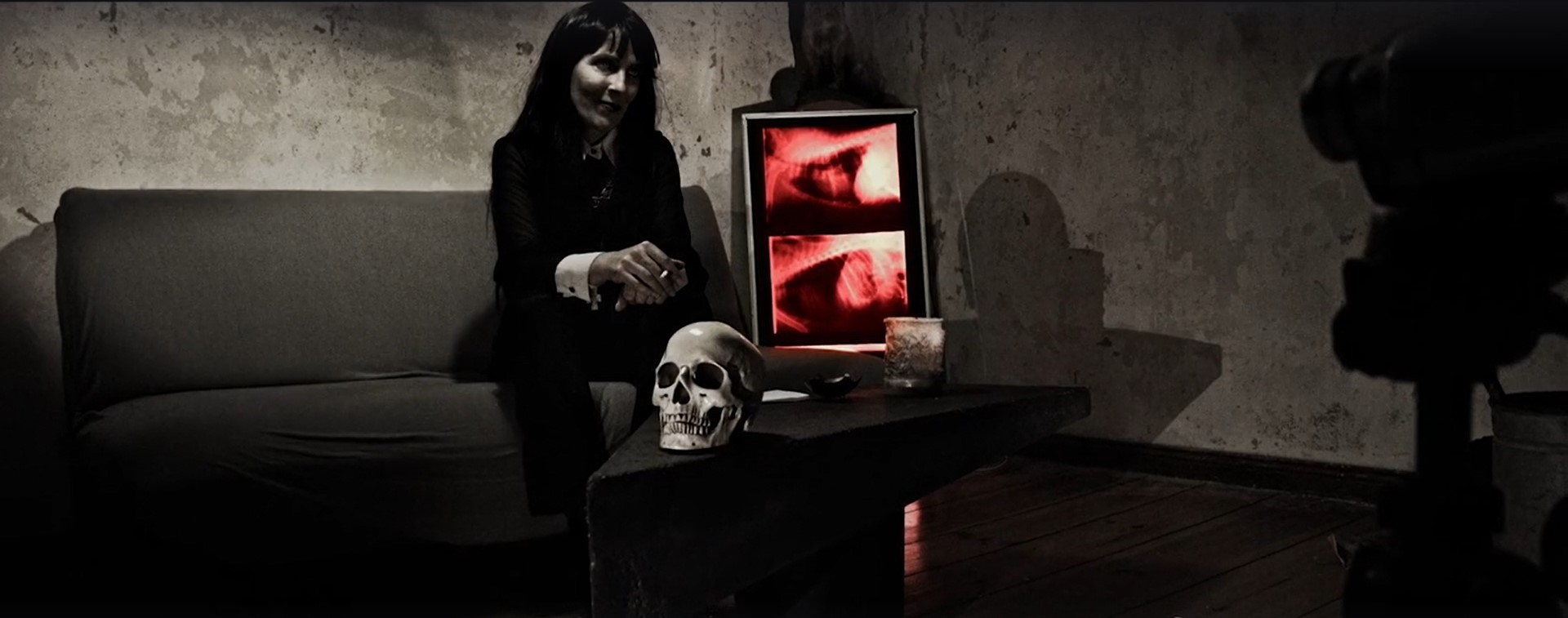
“Flesh City” annexes our individuality for the sake of connective solidarity conveyed in an electronically infused and alternatively aesthetic experimental film from Germany’s own jack of all independent media and artistic trades, Thorsten Fleisch. The 2019 released feature is Fleisch’s first and only written-and-directed full-length film depicting his feverish analog avant-garde, reflecting the filmmaker’s menagerie of orthodox-shredding short films, video art, and written and produced music. Overseeing “Flesh City’s” cinematography and special effects, Fleisch has complete and utter autonomy of the visuals to obtain a harshly discordant image melody edited together, which Fleisch also manages, into an agglomerate of acetic aesthetics to shock and stress the audio and visual cortexes. Once under the working titles of “Berlin Blood” and “Zyntrax: Symphony of Flesh,” “Flesh City” is entirely shot in Berlin, Germany, produced by the director and United Kingdom producers Arthur Patching and Christian Serritiello, and is a feature of Fleischfilm and Tropical Grey Features.

One of the film’s coproducers and musical artists, Christian Serritiello (“Streets of East L.A.”), is at the front lines of “Flesh City’s” afterthought cast of characters with Vryen as essentially the naïve and lured-in Alice chasing the white rabbit Loquette, played by Eva Ferox (“Love Songs for Scumbags”), down the twisted rabbit hole of a cellar dwelling doctor.  I say afterthought because the characters take a backseat to Fleisch’s contortion of reality and the analogical subtext generated by Fleisch’s love for analog anomalies, using them as supporting pawns to carry out his visceral vision of vitality.  Music videos, psychedelic montages, and grotesques images of beetles absorb screen time like formless or arthropodal principals.  Even Professor Yagov (Arthur Patching”) is obscured by a rainbow shimmer, never visually seeing his face as an individual seemingly between two dimensions.  “Flesh City” is a very multiverse, multidimensional nightmare-scape of unconventional color that has culminated from Fleisch’s imaginative idiosyncrasies over the years and that’s what being intently showcased here with more evident display of a less-character driven, shapeless story within the technical aspects of the DVD release where the soundtrack drowns the dialogue into a muffled deaf tone, like any good loud music venue would subdue.  “Flesh City’s” urbanites fill out with Marilena Netzker (“Love Songs for Scumbags”), Shaun Lawton (“Possession”), Denis Lyons (“German Angst”), Anthony Straeger (“Call of the Hunter”), Maria Hengge (“Love Songs for Scumbags”), Helena Prince (“12 Theses”), and Thorsten Fleisch in a Max Headroom meets Total Request Live-like host role of Quantum 1337.

“Flesh City” will not be everyone’s approx. 90 minutes of how to spend their time choice.  The experimental film will only speak to a few select souls with a filmic affinity for Lynchian peculiarities, Terry Gilliam’s bold fantasy, David Cronenberg’s body horror, and a hellish capriccio along with an eclectic music palate for noise rock, henpecking alternative, and strident industrial bass.  I wouldn’t go as far as saying Fleisch’s film is akin to nails on a chalkboard but can be boisterously unpleasant to the ears at times while, in the same breadth, be stimulating visually, even if that stimulation may induce a photosensitive epileptic seizure.  Fleisch’s non-traditional narrative design splices in music videos from various underground and indie artists with him providing introduction as an illusionary host in a virtual world, breaking up the Vyren and Loquette’s post-punk-adelic core quandary with a teetering melodic cacophony of feedback rock electronic, a hostile rhythm, and bizarre lyrics and visuals.  Fleisch pushes the taboo envelope with not only liberal nudity, to which Germans are very at ease with their body image, but also within the unconfined stylistic creativity of multi-formats that razzle-dazzles like the innards of radiant plasma globe; the Tesla coil electrons that’s drawn to your conductive flesh won’t hurt you but provide a feeling of captivated wonder.  Yet, don’t expect to be thrilled in a traditional predator-and-prey sense as “Flesh City” appeals more to our disconnect from each other and how to reconnect must be through some kind of inclemency. 

Likely to transmit under the radar, “Flesh City’s” biomorphic body horror arrives onto unrated director’s cut DVD home video courtesy of cult and independent distributing label Wild Eye Releasing in association with Tomcat Films.  The DVD5 presents the transfer in a widescreen 2.35:1 aspect ratio with varying levels of image quality due to different types of equipment and methods used to create Fleisch’s tripped out vision that contains, but isn’t limited to, black and white, color, stylistic lighting, analog equipment, digital equipment, stock footage, and so forth.  This mishmash movie makes for divisible degrees of signal quality that can be look crystal clear in one scene and then heavy noise interference the next, but the overall clarity is remains stable without any scenes being rifted because of visual vagueness.  The audio comes in two formats:  a English Dolby Digital 5.1 surround sound and a English Dolby Digital 2.0.  Frankly, the original English dialogue track is feeble under the tremendously potent soundtrack and sound design that makes comprehending Vyren and Loquette subterranean exchanges under the industrial rumble of the score virtually impossible to discern.  Even Quantum 1337’s cyber-stutter chat softly introduces us into his world, essentially leading the blind into a mound of musical mania. Bonus features only include other Wild Eye Releasing trailers with the physical aspects of the DVD come with a misconception cover art that has a terrifying gaunt and fleshy, humanoid creature front and center, but that creature doesn’t exist in the film until maybe at the climax that’s nebulously discernible at best what viewers are supposed to see. Inside the standard DVD snapper, the disc art is pressed with the same front cover image but with no accompanying insert. The region free disc features the unrated film with a runtime of 84 minutes. “Flesh City” is a delicacy of distortion, but the Thorsten Fleisch film is an acquired taste that general audiences won’t have taste for but, then again, general audiences are not Wild Eye Releasing’s target audience, now are they?

“Flesh City” Yearns for Connection on DVD!

When Marriage Sours, EVIL From Within Manifests. “Possession” reviewed (Umbrella Entertainment / Blu-ray)

After his return from a lengthy time abroad, Mark finds himself in a contentious and spiteful relationship with his skittish wife Anna unveils her infidelity.  Unable to pry any kind of information from her before her sudden disappearance, Mark results to all the stages of grief and heartache:  denial, isolation, anger, bargaining, depression and, finally, acceptance.   Anna comes-and-goes from Mark and their son’s life, but their spats continue, increasing in anger and violence which each encounter.  Mark hires private investigators to track down Anna’s whereabouts.  He evens confronts her flamboyant and Zen-mastering lover.  But when Mark comes face-to-face with Anna’s sinister secret, a sub rosa affair unlike anything Mark has ever seen, he will go to unimaginable lengths to protect the wife he obsessively loves. 

Polish filmmaker Andrzej Zulawski’s “Possession” spans over a number of parallels that, in abstract theory, reflect social political matters of a post-war, Berlin wall divided Germany and the personal matters of Zulawski as a mirror of his ugly and bitter divorce from actress Malgorzata Braunek.  The 1981, Berlin shot, inimitable horror is a speeding melodramatic bullet train racing down a tracklayer of surreal rails and planks, ripping toward destruction with two turbulent people who about to slam, engine first, into an unforeseen mountain façade of towering despondency. That unforeseen mountain takes form from the tug-a-war of within, materializing duplicity, in every sense of the word, unnaturally. Frederic Tuten cowrote the emotionally florid and easily post-grad thesis dissecting film with Zulawski that was French mounted by Gaumont Film Company under producer Marie-Laure Reyre. Two other French companies, Oliane Productions and Soma Films, co-produced.

Watching Mark (“Jurassic Park” and “Event Horizon’s” Sam Neill), and Anna (“The Tenant” and “Diabolique’s” Isabelle Adjani) go at each other’s throat in a vicious cycle of matrimony madness can be in itself, maddening. Neill and Adjani radiate such loathing and desperation that’s seeing the two interact could possibly ignite World War III right there in the heart of Germany. What makes the contentious and hyperventilating scenes more interesting and alluring are the actors’ stage-like, full of hyperbolic melodrama, performances that somehow don’t quite register as the feisty interactions playout in what can only be concluded being pinpoint precision. Even Heinrich (“A Young Emmanuelle’s” Heinz Bennent”) is blatantly over-the-top with erratically wild movements of his body during scenes of emotional and physical struggle. Zulawski and “Possession” embraces the international cast with individual methodology on acting from Britain, France, Germany, and with even Zulawski who’s Polish and though you know the film is set in a divided Berlin between East and West Germany, there’s never this sense that “Possession” is strictly locked down to be anything but German. Aside from the Berlin Wall and some signage, maybe even the architecture, the multinational cast thins out the inklings of thinking, “oh yeah, this is filed in Germany!” “Possession” cast concludes with Margit Carstensen, Shaun Lawton, Johanna Hofner, Michael Hogben and Carl Duering.

Being that this was my second sit down with Andrzej Zulaski’s “Possession,” the first being Second Sight Films’ DVD release over 10 years ago, you begin to fathom the pattern of surrealism Zulaski aims to bombard viewers with through incessant bickering and an unspoken love-and-hate undertone. The doppelganger theory that’s attached itself to “Possession” from over the years warrants merit because those in a relationship on the precipice of implosion always wish the other person to be a better version of themselves, of who they want them to be, or of who they fell in love with in the first place. One can’t go deep into the doppelganger theory without totally exposing all of “Possession’s” secrets, surreal or not, and that infestation of preference takes shape for Zulaski as, ironically enough, a shapeless creature. The desire is tremendously powerful for Anna she can’t avoid being away from it for long stretches of a time, popping in to her and Mark’s old apartment for just enough time to have Mark stir the pot with his own manifested infernal creature, himself. Anna, an extremely passive woman, rarely confronts Mark about her infidelity and is always Mark who has to extract that information with every tooth and nail. “Possession” will forever be hailed a film that can analyzed over and over again without ever finding a concrete interpretation and, you know what, we can live with that.

As I said, last time “Possession” was visited by these aging eyes was over a decade ago on a UK DVD. Now, I had the fortunate opportunity to sit down with a new Blu-ray release from Australia. Umbrella Entertainment, in conjunction with The Film Institute (TFI) Films Production, releases a single disc, full 1080p Blu-ray, registered as their volume #11 on the spine, as part of the banner’s Beyond Genres collection. Presented in European widescreen 1.66:1 aspect ratio, this “Possession” release has a giant leap of negative exposure in comparison to Second Sight’s DVD, retreating away from a more natural and textural palpable transfer, full of detail and good amount of grain, to a blue-tinged headscratcher with a higher contrast that renders details and shadows nearly wiped out. The transfer is also conveyed with slight damage seen in approx. minute 14 with a vertical scratch and some image destabilization that makes discernability dematerialize right before your eyes near minute 44 and 57. The English language DTS-HD 2.0 master audio renders better with cleaner tracks seeing little-to-none hissing or static. The dialogue’s apparent and unobstructed thought slightly isolating without much depth. Despite some limited capacity with the dual channels, “Possession’s” more adrenalized scenes/ranges – i.e., speeding car flip, shoot outs, apartment explosion – sound effective and robust. Special features include an archival audio commentary with director Andrzej Zulawski and co-writer Frederic Tuten, an archival interview with the late Zulawski The Other Side of the Wall: The Making of Possession from 2011, a U.S. Cut of the film with a following featurette Repossessed, a location featurette A Divided City, the musical compositions in an interview with composer Andrej Korzynski The Sounds of Possession, an interview with producer Christian Ferry Our Friend in the West, a poster analysis, and the international and U.S. theatrical trailer. What’s presented by Umbrella is the fully uncut 123-minute version in a region B-code format though, weirdly enough, rated 18. Another weird note about the release is the back cover credits are displayed in French on the cardboard slipcover housing the reversible DVD artwork featuring a new illustrated snapcase cover art by Simon Sherry. I’m a clear fan of “Possession’s” clear ambiguity despite being not sure positive about the new Blu-ray release. Zulawski’s tale of corrosive dissolving of wedlock definitely fits the Beyond Genres banner and is a fine edition to Umbrella’s celebratory bank of classic horror.


Possess Your Own Copy of Umbrella Entertainment’s Blu-ray Release of “Possession” Today!