
EVIL Inspires a New Concert. “Nightmare Symphony” reviewed! (Reel Gore Releasing / Blu-ray)

“Nightmare Symphony” is a Falsetto of Praise for Lucio Fulci.  Purchase the Blu-ray Below!

Unable to cope with another large box-office failure, the American indie horror director, Frank LaLoggia, is in the travails of a make-or-break psychological thriller overseas in Kosovo.  With an executive producer forcibly pulling LaLoggia’s creative marionette strings and the film’s screenwriter displeased and disapproving LaLoggia’s arm-twisted version of the story, the struggling director finds himself frantic and in the middle of a breakdown caught between a rock and a hard place with a postproduction from Hell.  Those around him, the conceited producer, the upset screenwriter, the pushy wannabe actor, and more, are being hunted down and brutally murdered by a masked killer and the imaginary line between Frank’s reality and paranoia grows in intensity coming down the wire of completing his career-saving, or rather lifesaving, film.

Long time since I’ve heard the name Frank LaLoggia enter the dark corners of my brain as it relates to the horror genre.  The director of 1981’s “Fear No Evil” and 1995’s “Mother” had seemingly vanished from the director’s chair spotlight and more-or-less, or rather more so than less so, vanished from the broader film industry altogether.  Then, Domiziano Cristopharo’s “Nightmare Symphony” suddenly drops on the doorstep and there’s Frank LaLoggia, starring in the lead role of an Italian horror production.  Domiziano, known from his entries of extreme horror, such as with “Red Krokodil,” “Doll Syndrome,” and “Xpiation,” engages LaLoggia to act in an unusual role, as himself, and turns away from the acuteness depths of uber-violence and acrid allegories to a toned down, more conventionally structured, narrative inspired by the Lucio Fulci psychological slasher “Nightmare Concert,” aka “A Cat in the Brain.” Co-directed with first time feature director Daniele Trani, who also edited and provided the cinematography, and penned by the original screenwriter of “A Cat in the Brain,” Antonio Tentori, “Nightmare Sympathy” plays into questioning reality, the external pressures that drive sanities, and weaves it with a meta thread and needle. The 2020 release is produced by Coulson Rutter (“Your Flesh, Your Curse”) and is an Italian film from Cristopharo’s The Enchanted Architect production company as well as companies Ulkûrzu (“Cold Ground”) and HH Kosova (“The Mad MacBeth”).

Much like “A Cat in the Brain,” Frank LaLoggia depicts his best Lucio Fulci representation as a horror filmmaker whose storyline production mirrors the individual slayings surrounding him. As a character, LaLoggia is not entirely aware of the murders as the peacock headed slasher’s string of sadism runs parallel to LaLoggia’s post-productional workload. Cristopharo pays a simultaneous tribute to not only Fulci but also LaLoggia with a built-in brief, off-plot moment of the editor, Isabella, a good friend and longtime partner of LaLoggia, running a reel of “Fear No Evil” to reminisce over his debut picture. Antonella Salvucci (“Dark Waves,” “The Torturer”) plays Isabella but also LaLoggia’s pseudo film lead actress Catherine in a dual role performance with the latter marking Salvucci’s topless kill scene that hits and sets up the giallo notes. Isabella denotes the director’s only real friend with everyone else, from the screenwriter to the executive producer, push their own self-gratifying wants onto the American filmmaker from all angles. A vulgar herd of personalities descend upon LaLoggia to exact their strong-willed ideas on how the film should appear and be marketed. From the screenwriter Antonio (Antonio Tentori, ‘Symphony in Blood Red”), the imposing desperate actor David (Halil Budakova, “Virus: Extreme Contamination”), to the uncultured and pushy executive producer Fernando Lola (Lumi Budakova) and his aspiring actress Debbie (Poison Rouge, “House of the Flesh Mannequins”), they all look to exploit LaLoggia’s modest career for their own benefit. Performances vary with a range of experience, and we receive more noticeably rigid recites and acts from the Kosovo cast in a clashing pattern with the Italy cast that has worked with Cristopharo previously. Ilmi Hajzeri (“Reaction Killers”), Pietro Cinieri, and Merita Budakova as a chain-smoking lady stalker that has glaring eyes for Frank LaLoggia.
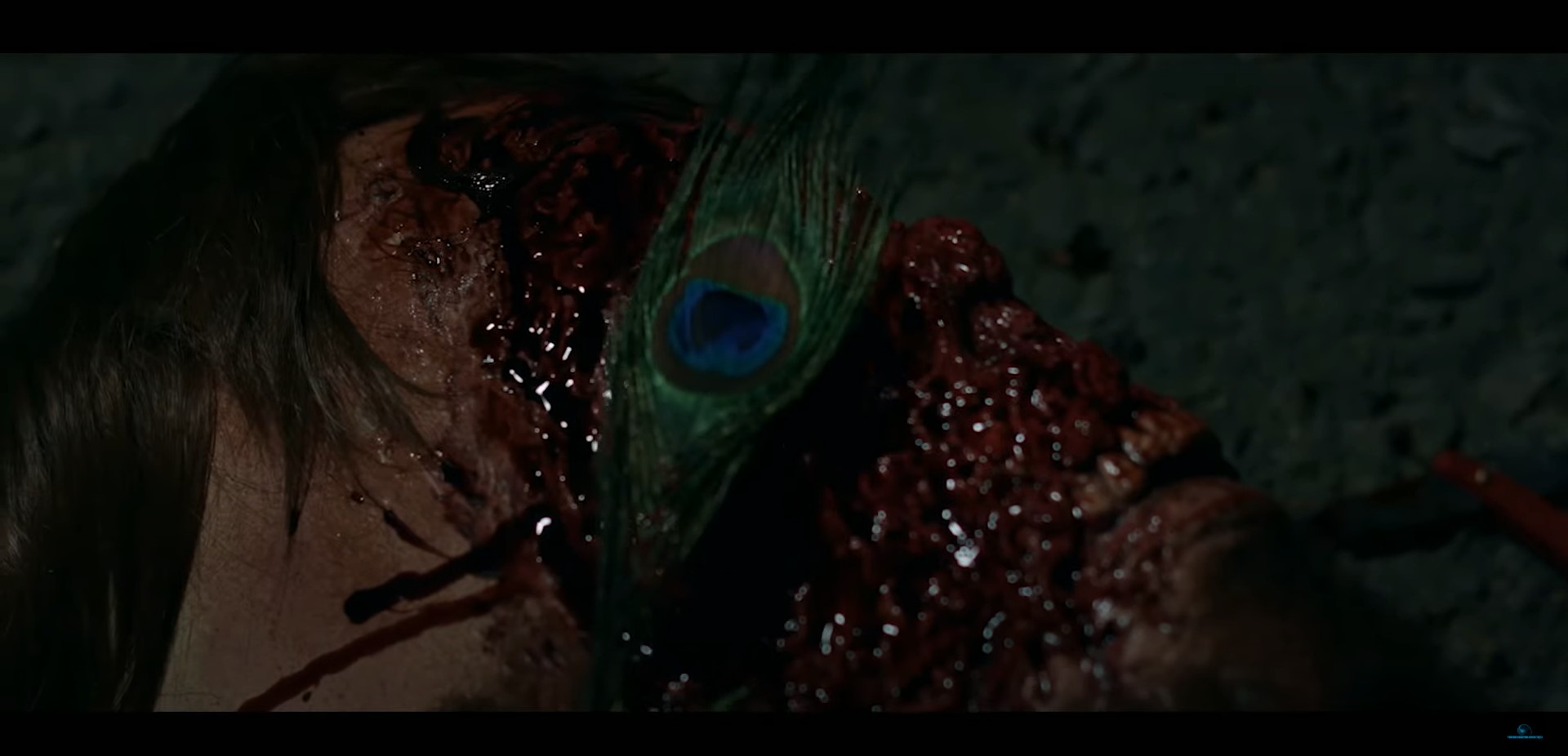
While not necessarily thought of as a remake, “Nightmare Symphony” is certainly a re-envision of the Fulci’s “Cat in the Brain.” What Cristapharo and Trani don’t quite well connect on is connecting all the pieces of the psychotronic puzzle together into what is meant to be expressed. The giallo imagery is quite good, a praise of the golden era period in itself, with a mask and glove killer, the closeup of gratuitous violence, most of the score, and the stylistic visuals imparted with ominous shadow work, foggy and violent dream sequences, and with congruous cinematography and editing of earlier giallo. Plus, audiences are treated to not only the aforementioned Antonio Tentori, screenwriter of “Cat in the Brain,” but also have composer Fabio Frizzi score the opening title. Frizzi, who has orchestrated a score of Lucio Fulci films, such as “Zombie,” “The Beyond,” “Manhattan Baby,” and even “Cat in the Brain” just to select a few notable titles, adds that proverbial cherry on top to evoke Fulci directing “Nightmare Symphony” vicariously through Cristapharo and Trani. There are some questionable portions to reimagining’s take on the original work that are more the brand of the contemporary filmmakers. The presence of death metal prior to one of the kill moments puts the overall giallo at odds with itself in a fish out of water aspectual scene composition. Another out of place component are the external characters that are not directly involved with LaLoggia’s peacock-head themed slasher; the ironical venatic of an animal hunting down people is the reversal of a Darwinism theory that instead of sexual selection, the beautiful and elegant peacock forgoes using grace to attract and aims to survive by natural selection and thus the killer kills to remain alive. However, the story and the directors never reach that summit of summation and with the oddball characters adrift from the core story – such as the stalking woman and the eager actor – “Nightmare Symphony” flounders at the revealing end with its severe case of blinding mental delirium.

With a cover art of an upside skull overfilled with film reels and unfurling celluloid through the soft tissue cavities, “Cat in the Brain” continues to be reflected in “Nightmare Symphony” up to the release’s physical attributes on the Reel Gore Releasing’s Blu-ray. Presented in on a AVC encoded BD25, with a high definition 1080p resolution, and in a widescreen 2.35:1 aspect ratio, the Reel Gore Releasing espouses the Germany 8-Films’ Blu-ray transfer for a North American emanation, which might explain some of the complications with the bonus features that’ll I’ll cover in a bit. Situated in a low contrast and often set in a softer detail light, “Nightmare Symphony” doesn’t pop in any sense of term with a hazy air appearance and a muted color grading that goes against the giallo characteristics, especially when the clothing and set designs have the same desaturation or are colors inherent of low light intensity. Despite appearing like a slightly degraded transfer on a lower BD storage format, compression issues are slim-to-none with artefacts, banding, or blocking and this results in no tampering edge enhancements or digital noise reduction. The release comes with three audio options: A German DTS-HD 5.1, German DTS-HD 2.0 Master Audio and an English and Italian DTS-HD Stereo 2.0 all of which are Master Audio. The German audio tracks are a dub from the 8-Film Blu-ray and the 5.1 offers an amplified dynamics of the eclectic soundtrack and limited environment ambience. Dialogue remains outside the dynamics on a monotone course but is clean and clear with good mic placement and a neat, fidelity fine, digital recording. The German dub has a distinct detachment from the video because of its own layer environment, sounding a little sterile than the natural English or Italian, but works well enough as expected with the supplement multi-channel surround sound. English SDH and German subtitles are optional. Bonus contents feature a behind-the-scenes which is entirely just a blooper reel, an English language interview with co-director Domiziano Cristopharo whose secondary language is English, the original soundtrack playlist, and the teaser and theatrical trailer. I mentioned an 8-Films’ transfer complication with the bonus content because there’s is also an interview with Italian screenwriter Antonio Tentori that’s only in German dubbed and subtitled with no option for English subtitles or dub. When you insert “Nightmare Symphony” into your player, an introductory option displays to either pick German or English and I considered this to be the issue for the German only interview with Tentori; however, that is not the case as both country options are encoded in German for the interview, so at the beginning option display, I would recommend the German selection because the setup will have contain all audio options for the feature whereas the English selection will only contain the English 2.0. Reel Gore Releasing’s Blu-ray comes housed in a red snapper case, the same as the company’s release of “Maniac Driver,” and has a less tributing reversible cover art with more revealing and illustrated aspects of the narrative. The release is region free, unrated, and has a runtime of 78 minutes. Another little fun fact about the release is the incorrect spelling of the director’s name on the back cover that credits his surname as Christopharo instead of Cristopharo. Influenced by Lucio Fulci beyond a shadow of a doubt, “Nightmare Symphony” proffers the Horror Maestro’s less notable credit with a companion piece that punctuates both films love for the giallo genre, love for the violence, and love for the morbidly unhinged human condition.

“Nightmare Symphony” is a Falsetto of Praise for Lucio Fulci.  Purchase the Blu-ray Below!

When Grief Strikes, Evil Gets Insane! “Beyond the Darkness” review!


The fiance of an orphaned villa owner named Frank dies in within their last loving embrace. Struck with immense grief, Frank digs up his fiance’s freshly packed corpse, injects her with embalming fluid, discards her major organs, installs glass eyes into her eye sockets, and processes her to be with him forever as a taxidermal doll laying in the bed next to him. Presumably behind Frank’s fiance’s untimely death is Iris, the family housekeeper who has an unhealthy obsession with Frank and his wealth, and when Frank instability goes beyond the means of all reason, an ill-tempered and mentally paralleled Iris swoops in to be Frank’s comfort, voice of guidance, and abetting culprit to Frank’s crimes as he can’t seem to stop killing young women in order to either replace or protect his adored doll and when a nosey mortician snoops around his residence, turmoil between Frank and Iris boil over in a heap of violence turned into a showdown of ill-fated and gruesome death.

“Beyond the Darkness” is by far beyond sick. Director Joe D’Amato (Aristide Massaccesi), one of Italy’s legendary video nasty filmmakers, reaches far into the darkest crevices of the criminally insane and exhibits every aspect of cold and brutal murder when the small window of opportunity and hope goes horribly wrong. The 1979 film shot in the Bressanone area of Italy exudes breathtaking countryside hills; so serene and peaceful that when Frank’s mind breaks and he crosses into an irreversible dark state, his frigid and murderous emotions make him a monolith that shadows the expansively green landscape. Tack on an equally demented housekeeper with a penchant for diabolical motives and the juxtaposition is no where near being level, creating this idyllic nightmare of taxidermy slaughter, a rancid deterioration of the mind, body, and soul, and a perversive obsession of inhuman replacement.

A baby faced Kieran Canter stars as the orphaned villa owner Frank Wyler who can’t handle one more tragic death of a loved one and Canter provides the blank stare, the outer shell of a spent and lost lover, despite his attractive attributes just like his the inner bones of his villa manor and speaking of juxtapositions, “The Other Hell’s” Franca Stoppi over achieves Iris’s internal and external ugliness. Iris, a seeming fixture of a puritanical matriarch in her dress and stature worn magnificently by Stoppi, uses manipulation and supernatural forces to gain power right under Frank’s already malfunctioning mentality. In the light, Frank and Iris are polar opposites, but they break bread together in the dark, feasting off each other’s malice. “The Beyond’s” Cinzia Monreale dons a dual performance as the corpse of Frank’s fiance and of her living sister. Monreale’s amazing performance in being such a still carcass struck a recall chord in me thinking of Olwen Kelly’s eerie portrayal of a slab table stiff in “The Autopsy of Jane Doe.”

Speaking of autopsies, when Frank begins his taxidermal procedures, surgically slicing down Cinzia Monreale’s freshly demised midsection, the attention to detail rapes the spine with chilling ferocity and though dated within the confines of the practical special effects from nearly forty-years ago, D’Amato’s controversial and unquenchable need for violence doesn’t hold back the gore, the guts, and the glory of chopping a British slag into pieces with a butcher’s knife and tossing her overweight remains into a cast iron tub-cauldron of skin-eating acidity only to have her partial face float up to the surface in a display of how far these vile characters are willing to entertain their pure evil. “Beyond the Darkness” lives up the title with the barbaric nature of the characters who clamp down their teeth and rip out the flesh of their, burn alive joggers in an industrial grade furnace, and store corpses like valuable baseball cards of your favorite major league players. Yes, “Beyond the Darkness’s” gold is worth it’s cinematic weight in gore.

Severin’s 2-disc Blu-ray and CD Soundtrack release of Joe D’Amato’s “Beyond the Darkness” is presented in HD 1080p 1.67:1 aspect ratio. The image quality is strong, unmolested, and rich with a vibrant color palette that gets ickier with every organ removed, every body part dismembered, and every shocking event unraveled. A dubbed English DTS-HD master and an Italian Dolby Digital dual channel mix are quite good, spanning out a brazen fidelity of leveled ranges and the Goblin soundtrack enriches every scene with gothic notes of progressive rock. Check out the CD Soundtrack “Buio Omega” (“Beyond the Darkness”): The Original Motion Picture Soundtrack to get an isolated experience of one of horror’s most fascinating scoring groups known worldwide. Bonus material is aplenty with a retrospect interview on the late Joe D’Amato entitled “The Horro Experience,” an interview with Actress Franca Stoppi entitled “The Omega Woman,” an interview with Cinzia Monreale entitled “Sick Love,” a live performance of “Buio Omega by Goblin, a visit to set locations, and the theatrical trailer. Severin completes a snazzy package and includes an plethora of auxiliary material for this ultra-violent video nasty that’s delivers the uncut and uncensored blood and nudity in a twisted 94 minutes of “Beyond the Darkness.”

“Beyond the Darkness” + Goblin on Blu-ray!

Evil Dwells in Your Nightmares! “Horsehead” review!

Screen shot 2015-06-26 at 12.27.32 PM

Jessica is plagued by recurring horrific and lucid nightmares of a horse-headed figure that brings death to her dreams. When she has a nightmare about her grandmother being impaled to death by the horsehead monster, she’s immediately phoned by her mother Catelyn informing Jessica that her grandmother has passed away. Jessica travels to the family’s countryside estate for the funeral and is welcomed by her stern mother. Jessica’s nightmares worsen the first night and she becomes trapped in her own dreams as she can feel the haunt of the horse-head figure in the corner’s of her mind. When Jessica soon realizes that her’s grandmother’s death and her mother’s cruelty might be more involved and connected with the horse-head creature, she attempts to stay in a semi-conscious sleep state to puzzle together the mysterious pieces and to control her nightmares once and for all.
Screen shot 2015-06-26 at 12.26.56 PM
The freshman feature film from Romain Basset contains such promise and maturity and Basset shows daring courage to create a horror-fantasy of this caliber thats very aesthetically symbolic and worthy of being awarded qualities of early Dario Argento’s films with intensive surreal and haunting facets. “Horsehead” embodies the character Jessica’s head in creating and blending an atmospheric jigsaw and visceral puzzle of a world while being a mirror in which you can glance back into time, far back beyond your own existence. “Horsehead’s” unique tribute blend contains the bizarre and frightening worlds of Tarsem Singh’s 2000 film “Cell” intertwined with one’s life story similar to the past and present tales of “A Christmas Carol” with Ebenezer Scrooge. However, Jessica’s past is much more dark and grim than Scrooge’s will ever be and her future won’t end in her being generous and kind to a crippled poor boy named Tiny Tim.
Screen shot 2015-06-26 at 12.26.22 PM
Certainly a visually stunning film, “Horsehead” tries turn the mind on it’s end, leaving the suspended muscle dangling near the edge of insanity. Jessica’s reality becomes no more real than her nightmares as the horse-headed monster is has comparable dream-bending qualities to the the same effect as Freddy Krueger of “A Nightmare on Elm Street” but “Horesehead” is a lot more gothic and whole lot less sarcastic than the fedora sporting child murderer. The creature has haunted Jessica’s lineage for at least three generations, presumably starting with her late grandmother and is a symbol of Jessica’s strict-bible-following grandfather who becomes the epicenter of all the family’s issues. Her dreams hold a dark mystery to her family’s continuous cycle of troubles and use horrific symbolism to express, in stages, the truth behind their ancestral secrets.
Screen shot 2015-06-25 at 10.50.48 PM
As much as I love the symbolism in this film, I’m worried about the psycho-sexual portion the film markets, splashed as a tagline right on the Blu-ray cover. Yes, the once little girl from Robert De Niro’s “Ronin” actress Lilly-Fleur Pointeaux does become involved briefly in highly sexual situations in her electric dance music soundtrack nightmares in a down the rabbit hole type of situation, but really serve no purpose to Pointeaux’s character in reality because no much is conveyed except for her profession as a dream psychologist and she has quarrels with her mother, especially on why her mother refuses to informer on the identity of her father. Gala Besson, who plays a younger version of Jessica’s grandmother, also briefly bares skin for a more gruesome and twisted scene that would make Pinhead smile with such pleasure. Perhaps the psycho-sexual scenes stem from the heavily implied incest relationships in the story between father and daughter, sister and sister, and mother and daughter. If incest is the answer to my question on why the film blatantly markets psycho-sexual, than the taboo subject matter makes “Horsehead” that much more risque and that more interestingly ambitious, creating a film that’s hard to swallow and shocking to behold when put into that perspective. Some dream interpreters believe that being chased by a white horse, in which case the horse-headed creature is of off-white color, may represent chaste or having issues with intimacy. This might explain some of Jessica’s unusual sexual scenes in her dream sequences involving relatives.
Screen shot 2015-06-26 at 12.26.50 PM
You might recognize a name from the past in the Italian horror genre: Catriona MacColl, an United Kingdom actress who portrays Jessica’s uptight mother Catelyn. MacColl is best known for her early 1980’s rolls in the Lucio Fulci films “The Beyond,” “City of the Living Dead,” and “House by the Cemetery.” With MacColl and Pointeaux’s as the overpowering female characters, “Horsehead” rounds out with weak male characters such as Jessica’s stepfather Jim, played by Murray Head, and an estate servant George, played by French acting vet Vernon Dobtcheff.
Screen shot 2015-06-26 at 12.27.12 PM
Overall, “Horsehead” delivers solid acting, dons great editing, and has better than average makeup and effects making “Horsehead” a winning release, yet again, for Artsploitation Films. The Blu-ray release is perfectly graced with a stunning 2.35:1 widescreen transfer with a 5.1 Dolby Digital mix, evenly balanced with appropriate LFE during the EDM nightmares. The picture is quite clear with some digital noise interference but only on some minor facial closeup scenes and no damage on the prints. Even though “Horsehead” is a French film and most of the cast is French, the movie is in English and it’s not dubbed English either. Bonus features also include “Inside Horsehead Making of” and four short films that have a total runtime of 81 minutes – a movie in itself.