Under Hypnosis, You’ll Do Anything For EVIL! “Vampire at Midnight” reviewed! (MVD Visual / DVD)

“Vampire at Midnight” is now on DVD!

Gripped by a serial killer dubbed the Vampire Killer, Los Angeles is on high alert as not one single piece evidence could be recovered from the more than a dozen crime scenes where women’s’ necks are ripped to shreds, their bodies are drained of blood, and their corpses dumped for police to discover.  With detectives baffled, cowboy cop Roger Sutter is ordered by the reckless antics-frustrated Captain to stay away from case but when Roger follows a lead that lands in his lap, two people wind up dead and the killer slips through his grasp, the captain suspends him from the force.  Focusing all his energy into a newfound romance with apartment complex neighbor and aspiring pianist Jenny Carleton, Roger finds himself back onto the killer’s trail when his time with Jenny goes from special and exciting to acutely avoiding his every advance.  Roger suspects the Vampire Killer behind Jenny’s sudden change in behavior.  Unofficially back on the case, the off-duty Los Angeles homicide detective finds himself in the middle of the Vampire Killer’s ritual to seduce Jenny into his coven as one of his blood brides. 

The maverick cop versus the serial killer narrative “Vampire at Midnight” is the 1988 investigative thriller with a horror edge from editor-producer Gregory McClatchy (“The Great American Girl Robbery,” “Terror in the Aisles”) in his first, and only horror credited, feature length directorial.  Also, lesser known as “L.A. Midnight, “Hypnos” or “Murder at Midnight,” the entrancing, modern vampire script is penned by “Danger Zone II:  Reaper’s Revenge” writer Dulany Ross Clements from a story by fellow “Danger Zone II” collaborators Jason William (actor in “The Great American Girl Robbery” and “Flesh Gordon”) and Tom Friedman (“Time Walker”).  Skouras Pictures served as the production company and the theatrical distributor with Friedman and Williams also in a producing capacity.

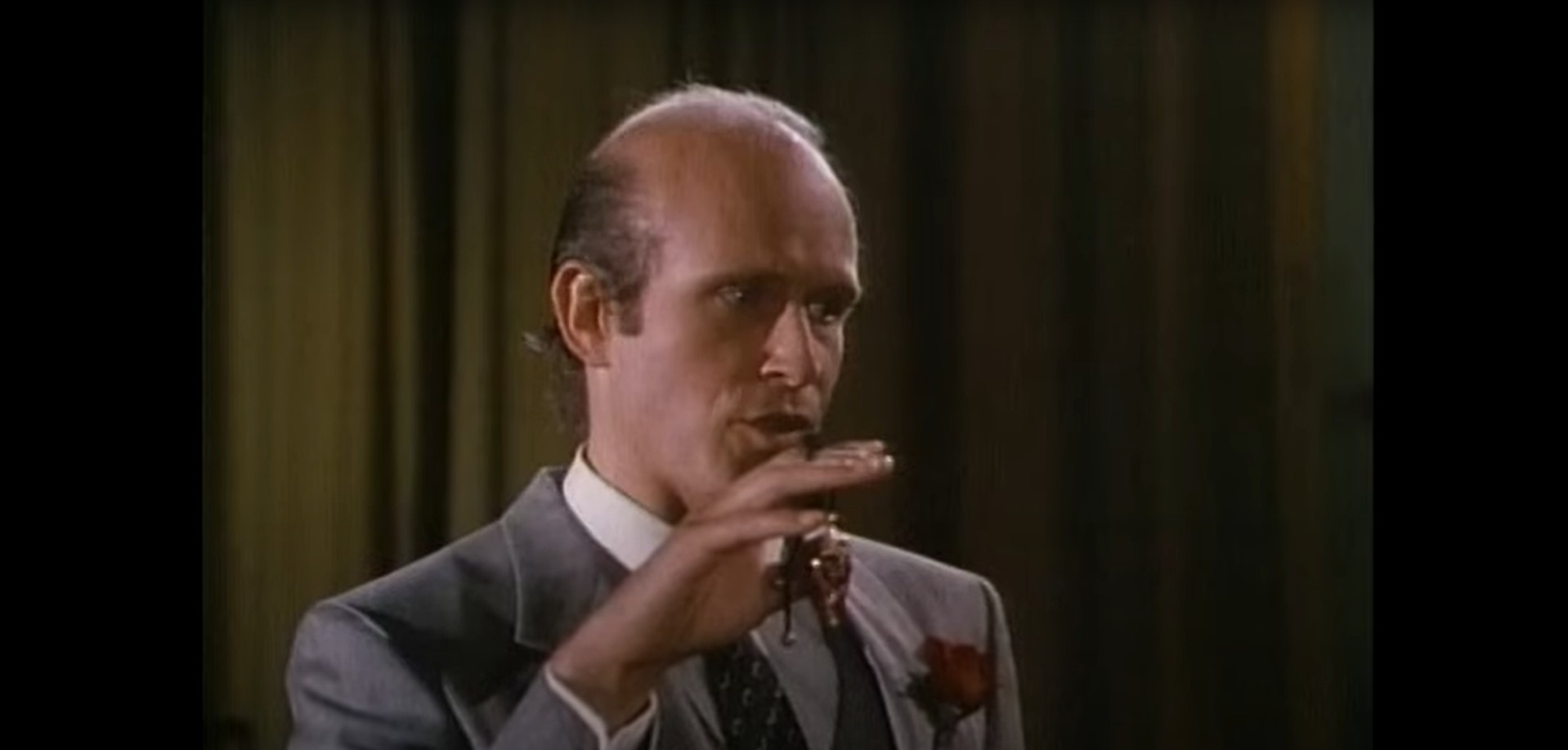
Much like with his lead kidnapper role in “The Great American Girl Robbery,” as well as other skin-a-matic films like “Alice in Wonderland:  An X-Rated Musical” or “Flesh Gordon,” producer, conceptual storyteller, and principal star Jason Williams puts himself into the rough-and-rugged hero to get the girl, or girls, half naked in his arms.  As unorthodox method cop bending procedure to get results, Williams molds handsome homicide detective Roger Sutter to the quintessential trope of a good cop doing everything he can to get the job done, even if that means skirting around lawlessness.  Roger is pitted up against pure vampiric evil who welcomes the lawlessness under the façade of a doctor of hypnotism specializing in unleashing clients’ frustrating mental blockages in their careers and goals.  Argentine-born Gustav Vintas has the physical look of a sophisticated villain (see “Lethal Weapon,” “Verne Miller,” and “Midnight”) with his stage 6 receding hairline and foreign accent and “Vampire at Midnight” also fits the bill with Dr. Victor Radikoff, a smooth talking and charming manipulator who can literally hypnotize his clients into anything, such as serving their necks up to his fangs or be beguiled assassins.  Caught in the middle is aspiring pianist Jenny Carlton, Roger’s beautiful blonde neighbor turned girlfriend turned slave to Radikoff’s hypnosis powers.  Jenny is played by the one-and-done feature film credited Lesley Milne in a rigid performance that’s critically subsided by her well-defined figure, one of several to go topless alongside “Saturday the 14th Strikes Back’s” Jeanie Moore, “Hollywood Chainsaw Hookers’” Esther Elise, and “Angel III:  The Final Chapter” Barbara Hammond.  The film rounds out with Christopher Nee, Robert Random (“Toke”), Jonny Solomon (“Peephole”), Ted Hamaguchi, Richmond Shepard (“Simon, King of the Witches”), and Ceclia Kaye (“Don’t Be Afraid of the Dark”).

“Vampire at Midnight” is the modern vampire film that tries to blend the old tropes with the new folds.  The malevolent Dr. Victor Radikoff has the menacingly creepy charm and suavity of Bram Stoker’s tale of Count Dracula flirting up against Max Schreck’s appearance as the horribly grotesque Count Orlok in the F.W. Murnau’s bastard film, “Nosferatu:  The Symphony of Horror.”  While the latter may just be an opinionated statement or judgement on Gustav Vintas’s physical naturality, not to say Vintas is grotesque or horrible looking at all, but rather his physical characteristics are atypical of the master vampire, resembling more closely to the baseline Nosferatu with a receding hairline, slender stature, and a uniquely contoured face. Being set in Los Angeles, the gothic qualities that instill fear, dread, and medieval facets from Dracula origins are all but lost, but you must remember, this isn’t Dracula.  This is Dr. Victor Radikoff, the prestigious hypnotist of the affluent, and that speaks true to the hip city of angels setting full of funky-sexualized interpretative dancing and late-night comedy standups as well as fitting into the budget to keep the indie film costs low for the sleek new take of the vampire trope to freshly entertain late 80s audiences.  However, “Vampire at Midnight” doesn’t go plot unscathed with the first act leaning heavily into L.A. paralyzed with Vampire Killer fear and the cops nervously on edge and disheartened by the lack of evidence and leads; the atmosphere felt more despairing and darker with the killer staying one step ahead and a body count slowly rises upward.  Then, the tone shifts slowly from a tough terrorizing case to crack to Roger’s incessant hard-on for a rather focused and naïve pianist.  The case only becomes interested in again when Roger receives a happenstance call in and he’s back in the saddle of his cowboy cop antics until he’s not again, being, in my opinion, unjustifiably suspended for shooting down a suspect trying to kill him and the suspected Killer getting away.  It’s as if the police, as well as the media and the public perception, left the case to fizzle out while the relationship between Roger and Jenny builds up for the sole purpose of being broken by, again, happenstance in Radikoff’s chance meeting with Jenny at a socialite party where she’s hired to play piano.
Arriving onto a MVDVisual DVD, this obscure hypno-vampire gem is entranced with new life.  Unfortunately, however, the new release is not a technically impressive one with its 720p resolution and pillar box 1.33:1 aspect ratio in regard to video.  The MPEG2 DVD5 handles the compression without a substantial hitch.  Other than the lower resolution that creates some blurry/fuzziness, here are no seemingly other issues in the codec, such as macroblocking, or banding.  Blacks retain its void inkiness even inside the confines of a lower contrast, but the grading is nonexistent that results in flat coloring and little life in the range spectrum.  The film has a shot-on-video look, but the transfer is rendered from a 35mm print digitized with little touchup for DVD.  The original print has only minor imperfections, a brief scratch here and there, but no major damage to note.  The English language Dolby Digital 2.0 Mono doesn’t elevate the new release either.  Dialogue isn’t terribly feeble, but it definitely isn’t robust through the single channel where depth doesn’t have an influence.  The overall quality of the recording is not bad with a clean presentation that’s layered in an expertly designed arrangement; big kudos should go to editor Kaye Davis and sound mixer Vic Carpenter who enrich “Vampire at Midnight’s” filmic posture as the two do competently dance together between the audio and video editing.  English subtitles are optionally available.  MVD’s standard release is bare bones without special features.  The standard DVD Amaray sports the beautiful gothic and blood dripping poster as the front cover; however, the backside contains three out of the five stills of Ester Alise, one involving Robert Random, and one with Random and Gustav Vintas and what makes the backside a curiously funny duck is the four blocked together stills are not from the film and were plucked directly from IMDB.com.  Instead, they are from different cult films starring Random and Alise, such as Alise’s “Hollywood Chainsaw Hookers.”  The disc is pressed with the same cover art image.  The rated R release is region free and has a runtime of 93 minutes.

Last Rites: Gregory McClatchy keeps this L.A. vampire picture in constant postulation with an unconscious red herring that’s stable until the very end, but the story pivot strains too far from its gritty and dark cop-chase-killer opening by focusing more on a love polygon of sex, deception, and true devotion, a swivel that puts a stake right in the heart of this 80’s exuberant story.

“Vampire at Midnight” is now on DVD!

Gimme an E. Gimme a V. Gimme an I. Gimme a L. What’s that Spell? EVIL! “Cheerleaders’ Wild Weekend” reviewed! (MVD Rewind Collection / Blu-ray)

“Cheerleader’s Wild Weekend” Now Back Available on Blu-ray!

Three rival school’s cheerleader squads board a school bus heading to Sacramento to face off in an annual cheer competition.  Detoured to an isolated, less-traveled road late at night, the bus is hijacked by members of the National American Army of Freedom, a group of ex-football players given the shaft for their individualized reasons.  The play caller leading the group is Wayne Mathews, former star quarterback cut loose from his team because of a bum arm, kidnaps the bus full of teenage girls to extort a handsome ransom to get him and four of his terroristic teammates back into the game of life.  Not looking to harm one hair on girls’ heads, Wayne attempts to keep his colleagues from exploiting their bargaining chips while also keeping to the well-designed plan to evade capture and still obtain the cash prize, but when Wayne’s away, it’s up to the cheerleaders to put their differences aside, come together with their own plan, and give the kidnapper a school spirited taste of their own devious medicine.

An odd hybrid of a sexualized teen comedy, blackmail crime thriller, and sleazy exploitation, “Cheerleaders’ Wild Weekend,” also known as “The Great American Girl Robbery,” hails as a full out filching and fleshy feature from Jeff Werner as his debut feature before helming the dark comedy surrounding the atomic bomb formula-carrying monkey of “Die Laughing,” starring Charles Durning and Peter Coyote, and his subsequent move from fictional film to documentary for the remainder of his career.  The 1979 film is cowritten between D.W. Gilbert and costar and cult actor Jason Williams, “Flesh Gordon” himself.   Adult film executive producer Bill Osco (“Tijuana Blue,” “The Incredible Body Snatchers”) finances the lesser explicit skin flick after the success of “Flesh Gordon” and intense crime spree thriller “Cop Killers,” both films of which have Jason Williams in significant roles in their long time collaboration, and is produced by an onset Chuck Russell who would later go on to write and direct “The Blob” remake and “A Nightmare on Elm Street 3:  Dream Warriors.”

On the cusp adult film actor Jason Williams who didn’t mind showing some skin for “Flesh Gordon” or the parodical tune of the Lewis Carroll kid’s story with “Alice in Wonderland:  An X-Rated Musical Fantasy,” but “Cheerleaders’ Wild Weekend” was different for Williams who not only kept his clothes on for most of the picture but also tried to keep others from taking their clothes off as well.  As quarterback gone quintessential eyes-on-the-prize kidnapper Wayne Mathews, Williams co-drives the narrative from the perspective of the heist in a focused attention on staying one step ahead of the bumbling and birdbrain detectives (Marc Isaacs and Hugh Brennenman).  Kristine DeBell, who co-starred with Williams as the titular character Alice in “Alice in Wonderland:  An X-Rated Musical Fantasy, copiloted as Debbie Williams who became the representative portion of the defenseless, scared, and quite cheeky cheerleaders held captive in a rural cabin as Matthews hones in on the $2 million in ransom money.  While the black and white plan for Mathews is just that, crime comes in many shades of color, and sexuality, and in intelligence within his accomplice network of failed football teammates, a sexually pent-up buxom chaperone, and even the fleeting desires of his younger brother, Billy (Robert Houston, 77’s “The Hills Have Eyes”).  Mathews right hand man George Henderson (Anthony Lewis), Big John Hunsacker (John Albert), and Frankie (Courtney Sands) become the ultimate problem that buries the original crux of the kidnapping with sordid inclinations for physical abuse toward the girls than what Mathews has in mind and becomes the spur for the cheerleaders, including LaSalle (Tracy King, “Mansion of the Doomed”), Wally Ann Wharton (“Up In Smoke”), Deslyn Bernet, and others, to fight back against their deviant, hornier captors. 

Werner’s debut is literally a wavy rollercoaster of pulled back levity with good-time voluptuousness and a strong browbeating back-and-forth rivalry amongst of a few honkytonk barrels of laughs while, in the same breath, can be deeply troubling with its side dishes of attempted rape, verbal abuse, and sexual grooming of what’s supposed to be high school cheerleaders (or maybe College cheerleaders…it’s not very clear in the narrative).  You don’t know whether to laugh in relief or be tense with the unsettling advances.  Plenty of gratuitous nudity doesn’t help the matter as a handful of select leaders of the school packs are willing to bare skin albeit being held at gunpoint in this twofaced tale.  With lead principals Wayne Mathews and Debbie Williams, a firm position is held, a genuine felt love interest is formed, and their unspoken body language is clear to the end, providing much needed release from the grip of ebb-and-flow emotions.  Another push toward the accolades of comedy are the two detectives and a blatennt archetype of undercover cops who, in football terms, fumble their way through a sting operation to catch the crooks while the crooks, meaning the Mathews brothers, find reward and redemption, such as Wayne’s bum arm comes through tossing a bag full of $2 million through the air and into the getaway car, with their indifferent yet simultaneous compassion for the held cheerleaders.  $2 Million in $20 dollar notes is about 220lbs per my calculations so that’s one heck of a throwing arm! 

Rewind back to 1979 with MVD’s Rewind Collection label and check out “Cheerleaders’ Wild Weekend” on their new Blu-ray release.  The 1080p high-definition presentation comes onto an AVC encoded, BD25 with the widescreen aspect ratio of 1.78:1, cropped slightly from the original 1.85:1.  The print used for the transfer looks to be print from the now defunct label, Scorpion Releasing, for the company’s 2009 Blu-ray that’s been out of print for some time now.  Print care helps define a broader color palette with the occasional pop of red or yellow moments of higher contrast moments and details, such as glass speckling, groove shadows and textures of a varietal of hair color and consistencies, and other miniscule points of the milieu that emerge through, or pork through according to Courtney Sands’ large white shirt pokies, but leading into lesser light lends to a crushed blacks that swallow object definition and shape.  However, there is some print damage in the form of dust and dirt, a few instances of vertical scratching, and what looks to be cutting damage during a scene transition.  Unlike the Scorpion Releasing Blu-ray that encoded the DTS-HD MA audio codec, the MVD release uses an uncompressed English LPCM mono that sizes up fidelity of the original track.  Surprising being a 25Gig capacity, the uncompressed files appear to maximize the audio without compromising quality.  The verbose dialogue has elevated appeal without steeping to an imbalance, making every individual voice seem like they’re on the same plane of existence in the clean and clear rendition.  Ambience noise is inlaid with consideration for medium range and depth that’s required of this production, mostly close-range gunfire, tire screeches, engine noise, and chases through the brush, that are within arm’s length or a stone’s throw from the camera.  English subtitles are available for selection.  Special features are from the Scorpion Releasing’s archive with an audio commentary with director Jess Werner, actress Tracey King, and editor Gregory McClatchy, a second audio commentary with principal actress Kristine DeBell, an interview with Debell, an interview with principal actor Jason Williams, an interview with Tracey King aka Marilyn Joi, an interview with Leon Isaac Kennedy, an alternate title card sequence with “The Great American Girl Robbery,” a photo gallery, and the original theatrical trailer.  The primarily white and red colored, O-slip cover art has a retrograde façade of a VHS rental complete with mock peeling stickers and dirty edges overtop the film’s marketing of a half-naked cheerleader covered just in pom-poms.  Blu-ray Amaray case sports same image but cleaner without the faux VHS trappings. Inside is a folded mini poster of said art in the insert field and the disc is labeled pressed with the textured grooves of a VHS cassette.  The region free release comes not rated and has a runtime of 96 minutes.

Last Rites: Jeff Werner’s first feature is full of spirit and shapely misguided youth and frustrated former football players in this light sex comedy concealing darker, predatory behavior beneath the surface. “Cheerleaders’ Wild Weekend” will cause snickering and titillating excitement while also tense your gut in what’s an amalgamation of a jest and jostling, bare-chested, good-old-fashion American heist film.

“Cheerleader’s Wild Weekend” Now Back Available on Blu-ray!

If Highschool Didn’t Already Have Enough EVIL In It! “Homework” reviewed! (Unearthed Films / Blu-ray)

Purchase “Homework” Blu-ray Here!

Highschooler Tommy can’t take it anymore.  His friends all talk about their sexual experiences and he’s still a virgin.  Talking to a therapist to help redirect his sexual energy into something else, Tommy becomes inspired with the idea to form a rock band with best friend Ralph.  The eager students secure three classmates from the student body to round out the band, one not being the obsessed competitive swimmer Sheila whom Tommy has strong feelings.  Each band member’s lives revolve around their own sexual activities from sneaking around from their God-fearing, prudent parents, embellishing fantasy from late night tutoring sessions gestured by a hot, young French teacher, or contracting a venereal disease from a rockstar idol.  As Tommy continues to plead with Sheila to attend just playing session, he becomes sorely frustrated by not only her lack of reciprocated affection but also lack of friendship towards the rest of the group, resulting in him finding his sexual prowess in the arms of a classmate’s mother who also recounts fondly her sexualized youth. 

Not just another teen sex comedy from the 1980s, “Homework” is the provocative, controversial, and obscure teenage comedy-drama from James Beshears, his one-and-only director credit behind his day jobs of being a film sound editor on such a range of films from “True Lies,” to “Day of the Dead,” to “Porky’s Revenge.”  The script is the debut feature from cowriters Maurice Peterson and Don Safran that carves out story subdivisions from Tommy’s friend and denotes Tommy as the as the epicenter of sexual hangups.  The late, legendary producer Max Rosenberg, producer of many B-reels such as “Dr. Terror’s House of Horrors,” “And Now the Screaming Starts!,” and “Perdita Durango,” secured funding for the feature alongside Robert Fenton (“The Incredible Melting Man”) with Beshears and Safran producing under the production and distribution label of Jensen Farley Pictures. 

The top bill was denominated to actress Joan Collins of the television series “Dynasty” fame, but the once voluptuous English brunette, who starred in “Fear of the Night” and “Sharon’s Baby,” sizzles in a more mature role in early 80s production with a screen time of about a third of “Homework’s” runtime.  Much of the story focuses on Tommy, played by the late Michael Morgan (“Midnight Offerings”), who succumbs to Collins’ character’s subtly and sudden sultry desires for her daughter’s school friend when helping her hang a picture.  The building up to this moment isn’t as plain on it’s face as it would seem with audiences subjugated to teenage fantasy and mature women’s reminiscence that doesn’t even hint cougar encounters.  Collins, unfortunately for you sleazoids out there, had a body double for the character’s topless scene and romantic entanglements but the then late 40s actress had plenty of curves and sex appeal to make any man, no matter than carbon-date, sweat with arousal anticipation.  “Homework” spreads the love, literally, as each band member goes through a totality of teenage sexcapades, individualized and customized to their own story’s arc, and there’s not a path of sexual conquest to be had but rather a variety situational scenarios where teens either learn the hard way, face the consequences, or leave their hearts at the door to avoid disappointment because at that age, the youth are the most impressionable and angsty with mixed up emotions.  A young cast of Lanny Horn (“Tarantulas:  The Deadly Cargo”), Erin Donovan (“Mack the Knife”), Renee Harris, Shell Kepler (“The Great American Girl Robbery”), Mark Brown, and John Romano (“Dandy”) act toe-to-toe with Lee Purcell (“Necromancy”), Carrie Snodgress (“The Attic”), Ernestine Jackson (“Aaron Loves Angela”), Bill Knight, Rosemary Alexander (“Madhouse”), Howard Storm, and Wings Hauser (“Vice Squad”) in this eclectic casting. 

What’s most memorable about the little-known production is not the sex-driven antics and mischievousness of high school boys but rather the day-in-a-life of touch choices and toucher consequences interlaced with regular adolescent customs, such as missing the cut for the swim team and beating yourself up for it, smoking dope in the school locker room, have the fantastical hots for the new young teacher, starting a garage band, etc.  “Homework” has comparable, lighter traits to the 1995, Larry Clark coming-of-age film “Kids.”  While not as crass or violent, “Homework” has high-impact themes like sexual transmitted diseases accompanied with visits to the women’s health clinic, a misunderstanding of sexual education, and, even to go as far as, the exploitation of minors to an extent and a spiral of obsession as we see with Shelia is won’t leave the pool in order to shave time off her laps, neglecting friendships, and even romantic relationship with Tommy whom ends up in the arms of her equally emotionally irresolute mother reminiscing a past of first time and exciting sexual encounters.  While the story manages to stay afloat with multiple sub-stories, technically, “Homework” falls below the conventional quality standard of the period with visible boom mics, a deficient picture quality, and lack of artistical knowhow from a new director in James Beshears.  Luckily for viewers of obscurity, lovers of the long-forgotten, and retro-adventurers, there are boutique labels salivating for the chance to revive and resuscitate these titles back into our field of vision. 

That boutique label is for those who are in the know wouldn’t expect “Homework” to be released on.  Unearthed Films brings the James Beshears film to Special Edition Blu-ray, the first time on the format, with a new 2K scan a part of their Unearthed Classics banner, numbered at 15.  The AVC encoded, 1080p high definition, BD25 presents to date the best image quality possible from the original 35mm negative shot on an Arriflex camera.  There’s slightly more grain presented on this transfer that stems from Paul Goldsmiths’ cinematography and with that there’s a loss of detail in darker scenes that become victims of black crush where delineation bleeds into the environment and darker clothing no longer renders outstanding with the proper shades.  Better lit scenes have more distinction coherency, but the color diffusion is limited and the original image retains a lower resolution akin to 720p and seldomly increases an upscaled 1080p in the 1.85:1 widescreen aspect ratio.  What’s notable about this release, and despite the visible equipment gaffs, is the uncompressed LPCM 2.0 mono audio mix that doesn’t reflect any kind of hissing, popping, or damage to the track.  There’s not a ton of range or depth representation with mostly interior shots containing dialogue, which is prominent and clear under the lossless compression.  English subtitles are available.  With the obscure nature of “Homework” comes with it not a lot of special features but what’s included is an archived interview producer Max Rosenberg going into detail of the film’s genesis and controversies, a promotional gallery, and the trailer along with other Unearthed Classic prevues.  Unearthed Classics’s illustrated, cardboard O-slipcover of the prefacing sex scene between boy and woman covers the same image on the standard Amaray’s front cover.  There are no inserts or other physical contents.  The rated R release has a runtime of 89 minutes and is listed as region A for playback; however, I did have my player set to region B during play and so the release is tested for A and B regions.

Last Rites:  Plenty of nudity and surrounding controversy keeps “Homework” relevant in today’s every-stimulating, ever-producing retro-release market but it’s the film’s pertinent application of teenage troubles that tips the scales to seeking this unconventional Unearthed Film’s Blu-ray release.

Get an A on this “Homework” Blu-ray Release!