EVIL’s Duality May Be More Than What Meets the Eye. “The Ugly” reviewed! (Unearthed Classics / Blu-ray)

“The Ugly” Limited Edition Blu-ray Now Available!

A famed female psychologist is requested to work the possible acquittal case of a serial killer named Simon Cartwright and understand his possible motive for slashing his victim’s throats at seemingly random.  Unscrupulously tormented by a pair of odd orderlies, Simon Cartwright calmly carries himself as a humble, articulate, and friendly conversationalist and confessed killer with a darker side, an ugly side that drives him to kill at will.  Cartwright gives her the anecdotal trappings of his kills that prove to be unprovoked and unsystematic from a side of him he can’t ignore.  Confounded by this, the psychologist pushes him to brink for an exact reason, one Cartwright keeps buried deep inside his subconscious that may or may not be supernaturally driven.  As Cartwright’s past continues to haunt him and with the psychologist assertive herself into his psyche, the dangerous method of analyzing criminal behavior won’t stop a plagued killer from killing again as his next victim might just be sitting across from him in the cross-examination room.  
Themes of split personality, past abuse and trauma, and the limited authority of control course through “The Ugly’s” veins like acid, sweltering with tension and ready to burn a hole through the safety of custody and storytelling once the twisted truth is told.  New Zealand filmmaker Scott Reynolds debuted with his feature length film back in 1997. Reynolds also wrote the script that kept an intimate approach between killer and doctor, kept audiences guessing the supernatural aspect, and made taut the lead-up moments filled with human tenderness that went into subsequent violence that painted a portrait of a conflicted killer afflicted by derangement that might not be his own.  Shot in Auckland, New Zealand, “The Ugly” is a production of Essential Films with funds from the New Zealand Film Commission and is produced by “Jack be Nimble” producer Jonathan Dowling.
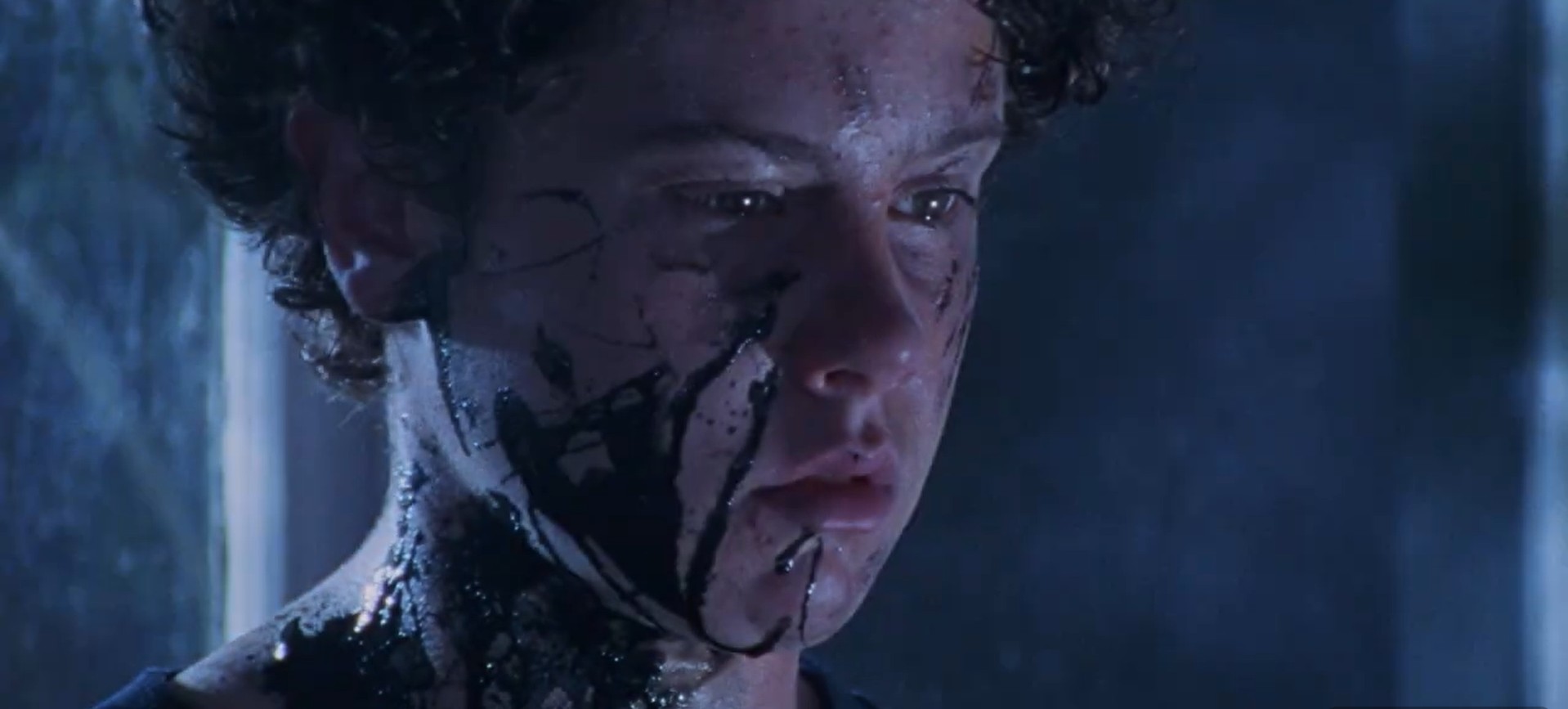
In a vague mirroring of Dr. Hannibal Lector and FBI Clarice Starling from “Silence of the Lambs,” there’s still the intention to understand the mind of a serial killer.  In the Clarice-like role is a civilian, a psychologist to be more precise, one that has received recognition to get the most dangerous criminals released from incarceration, is Dr. Karen Schumaker, played by Rebecca Hobbs (“Lost Souls”) that would be her biggest lead role in the New Zealand film market.  Opposite her, across the table mostly and chained to a chair, is Paolo Rotondo with a cold stare and a handsome face that doesn’t exactly say I’m a serial killer.  When graced with a prosthetic that makes half his face appear melted or scared in fleeting glimmers or reflections, scenes that often felt needed more attention or a longer say, that’s when Rotondo could exact his intimidation upon the viewer as the true monster, as Cartwright has referred to himself in more words.  Instead, Cartwright’s a clean shaven, well-dressed, and respectable Patrick Batman type without the three-piece suit and the Huey Lewis and the News obsession and not as King’s British and as quirky in his demeanor as Anthony Hopkins as Lector.  Both characters fall and fail hard to the supporting case of the two orderlies and their employing resident psychologist.  Sporting dreads and walking with confidence like a WWE wrestling being introduced, Paul Glover (“The Locals”) has more flavor in his mostly stoic intimidating orderly performance alongside his more animated and ragdoll movement buddy in Chris Graham (“Moby Dick”) as the two mistreat the Cartwright with disdain.  Their employer, Dr. Marlowe, has a snooty creepiness about him that’s akin to being a mad scientist-type that’s fits into the goon orderly dynamic with Roy Ward (“Perfect Creature”) at the helm.  Darien Takle and Vanessa Byrnes costar as chief supports. 
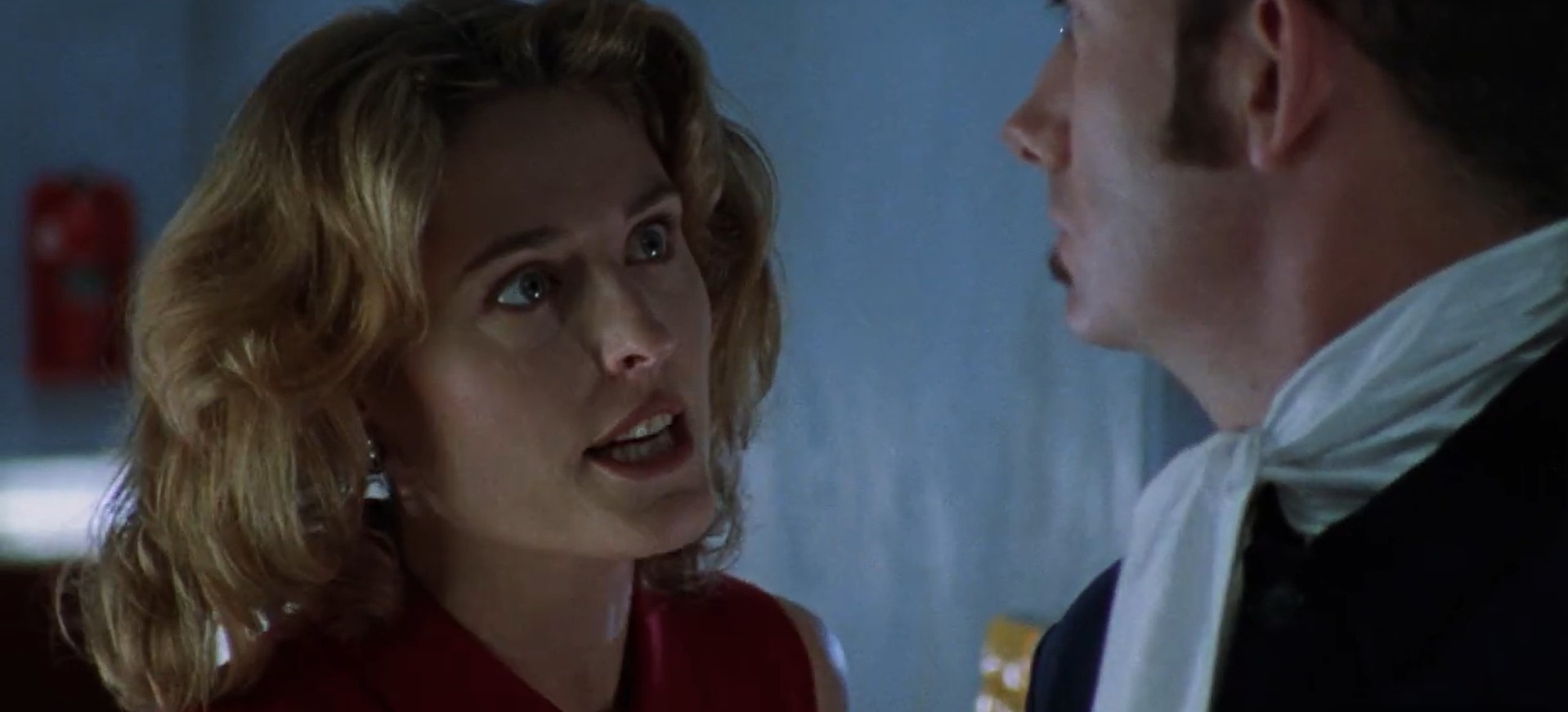
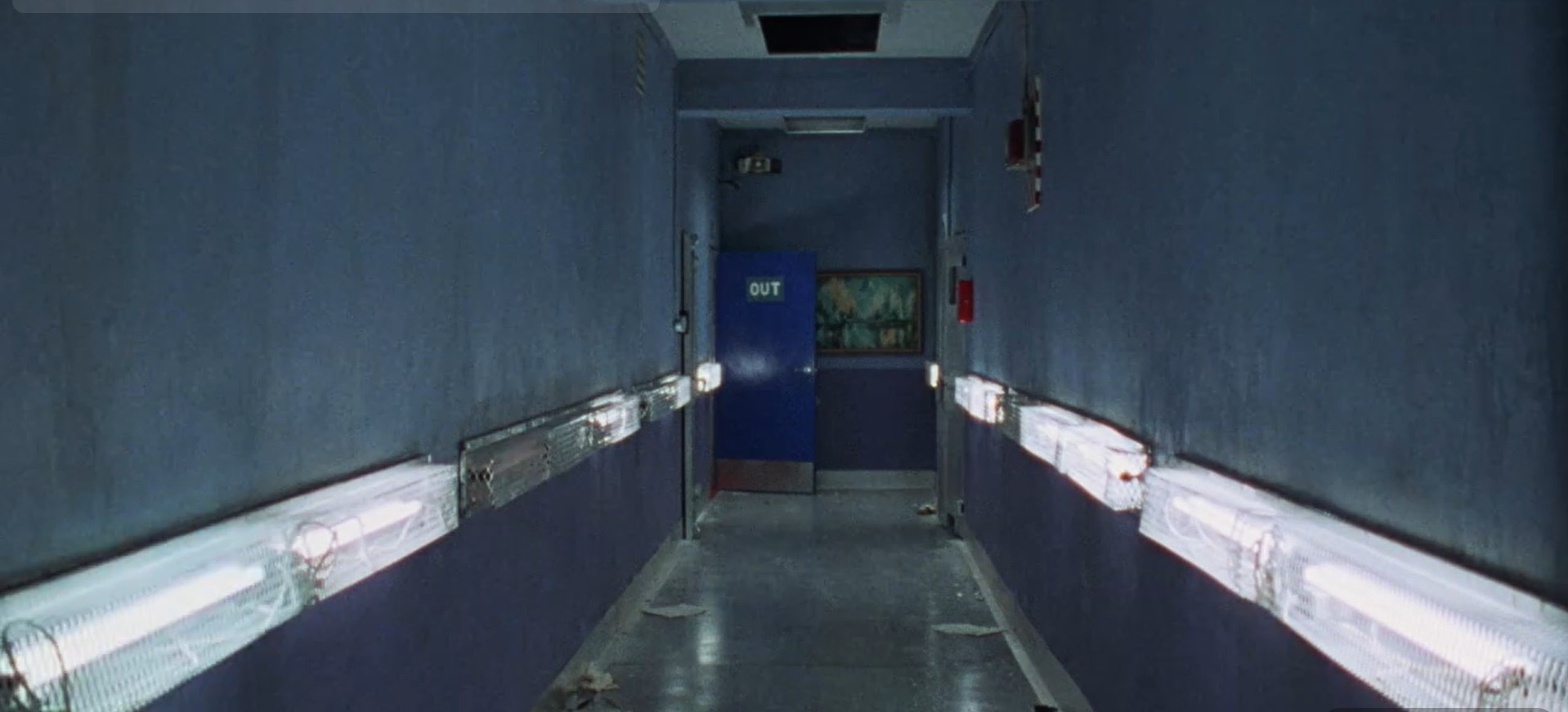
‘The Ugly” is certainly a child of the 1990s with that glossy gleam without it a lens flare spark of digital anamorphic.  The aesthetic matches the subject matter with dreary, cold, and gloomy nu metal nuisances, teetering on the edge of being also grungy.  Editor Wayne Cook’s transitions and cuts are indicative of the era in filmmaking with whooshing transitions and flashes of disorienting cuts, such as white outs or seamless segues.  This techniques also translates into Simon Cartwright’s headspace with acute and fleeting glimpses of his mental state visualized into the real word, or it’s the real world sheathed by a layer from beyond the grave, but either way his perspective quickly provides a glimpse into his reason for killing, his duplicitous degradation into insanity, and that it can be projected to others outside the exclusive rights of his person.  Most of the story is told anecdotally through Cartwright’s perspective and as storyteller, his events are muddled by his own struggle with killing that becomes more evident as the story progresses.  What’s most interesting about Reynold’s film is it’s reality bending to keep the audience engaged as he puts the psychologist character, Dr. Karen Schumaker for those who forgot, right into the frame of his story as a third party speaking directly to Cartwright and only Cartwright can see and hear, but she’s implemented naturally as if sitting at the table with the storied characters or being a part of a three-way conversation that but not truly.  Between these style characteristics and the narrative’s odd macabre, along with the deep black, sour crude oil shaded blood, “The Ugly” is grimly beautiful with visuals and stimulating to watch. 
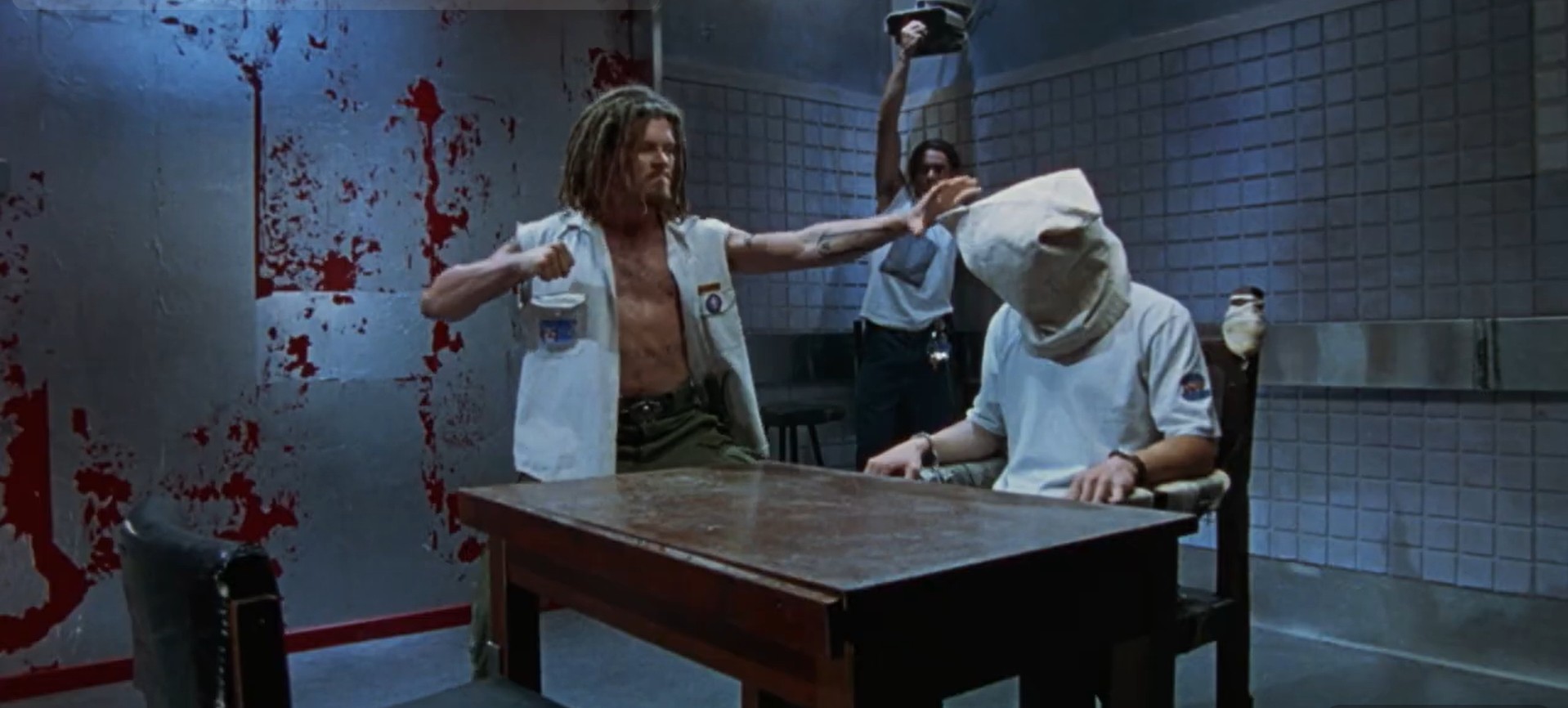
Unearthed Films, under their Unearthed Classics sublabel, provide a new Collector’s Edition Blu-ray release to the table.  The AVC encoded, 1080p high-definition resolution, BD50 has stored on it a 4K restoration from the film’s original 35mm interpositive and looks neat as a pin presented in it’s 1.77:1 widescreen aspect ratio, rendered with a well-diffused color palette of a lighter blues and grays that contrast starkly with the deeper black blood in a semblance of a dystopian or alternate reality in circa late 90s to early 2000s films.  Saturation is copious with all colors and the details are sharp mostly in the peripheral setting with the focal objects having be defined nicely but there is some textural loss on the skin and clothing under its higher contrast.  The audio formats within are an uncompressed LPCM 2.0 Stereo of the original theatrical audio and a relatively uncommon 4.0 DTS-HD MA that caters to the side and back channels rather than a central output and a LFE subwoofer, so the track is not as deep and resonating and it discerns as such with more range and less punchy impact that encompasses at the dialogue, ambience, Foley, and soundtrack excellently considering.  Dialogue is clean and clear without obstruction or touchups to the original audio files.  English SHD and Subtitles are available for selection.  The collector’s edition contents include an isolated score from composer Victoria Kelly (“Black Sheep,” “The Locals”), a 1997 radio interview from New Zealand with writer-director Scott Reynolds, an audio commentary with chief principal actors Paolo Rotondo and Rebecca Hobbs, Reynolds’ early 90’s short films “A Game With No Rules” and “The M1nute,” “The Ugly Visual Essay” compares “The Ugly” to true crime serial killers of reality, a photo gallery, and the original theatrical trailer.  The physical presence of “The Ugly” is anything but with it’s beautiful packaged design, beginning with the commissioned Slipcover cover art that wholly embodies the essence of the story, rather than being an exploitative mislead, by Scott Jackson of Monsterman Graphic.  The clear Blu-ray Amaray case has a reversible sleeve with the same Jackson art with the reverse containing the film’s original one-sheet artwork.  Inside is a 6-page booklet a pair of essays by Jason Jenkins along with monochrome and colored stills.  The disc is also pressed with a tense hunting scene as well.  The 18th Blu-ray title for the Unearthed Films’ sublabel is region A locked, not rated, and has a runtime of 93 minutes.

Last Rites: As far as understanding the mind of a New Zealand serial killer, Scott Reynold’s “The Ugly” depth charges reality with not only a promising supernatural layer but also a strange world these characters live and act against that invigorates a rather talkative and anecdotal story with eccentric and uncomfortable personalities that rival the killer himself.

“The Ugly” Limited Edition Blu-ray Now Available!

EVIL Doesn’t Take Rejection Well. “Village of Doom” reviewed! (Unearthed Films / Collector’s Edition Blu-ray)

“Village of Doom” now on Unearthed Film’s Collector’s Edition Blu-ray!

Tsugio Inumaru is considered the smartest young man in his village.  Illness took the life of his parents, and he raised by his grandmother and lives off her land’s income, looking after him and dreading the day Tsugio becomes drafted as a soldier in war service, which bestows great honor from the villagers.  While husbands are away serving their country, bored and lonely housewives and bachelorettes desire the carnal company of the men remaining and with Tsugio’s youth and his own sexual yearnings bubbling to the surface, he’s prime Kobe beef for the hungry village women.  When Tsugio’s health examination reveals a tuberculosis diagnosis, he’s acutely shunned by the villagers, drying up his sexual escapades, as well as potential betrotheds.  Rejection by his village, and even his country, sends the young man into plotting a massive killing spree, targeting all of those who’ve forsaken or scorned him to a life not worth living. 

In the Tsuyama outskirt village of Kamo of 1938, 21-year-old Mutsuo Toi cut the village’s electricity, strapped flashlights to the side of his head, and took a mini arsenal that included a Browning shotgun, a katana, and an axe to 30 villagers, including his grandmother, in an act to revenge killing for being rejected socially and sexually because of his tuberculosis diagnosis.  What is known as the Tsuyama Massacre, Mutsuo Toi’s cold and merciless act of carnage was the basis for Noboru Tanaka’s “Village of Doom.”  The pinkupsloitation director of “Rape and Death of a Housewife” and “Angel Guts:  Nami” helms the Japanese, semi-biographical tale, penned by Takuya Nishioka (“Tattoo,” “Female Teacher:  Chain and Bondage”), that follows closely the bullet point events of Mustuo Toi but with different named characters and a strong pink eiga touch.  “Village of Doom” is one of Kazuyoshi Okuyama’s (“R100,” “Self-Bondage:  All Tied Up with My Own Rope”) first produced ventures and is a production of the Fuji Eiga and Shochiku Eizo Companies. 

While Mutsuo Toi is not directly portrayed, his downward spiraling steps are indirectly followed by Tsugio Inumaru, played by the late Nikkatsu actor Masato Furuoya.  Furuoya’s relationship with director Noboru Tanaka is well established within their director-actor collaborating context with Furuoya having roles in Tanaka’s previous credits of “Rape and Death of a Housewife” and “Angel Guts:  Nami.”  There’s a blanket of comfortability within Furuoya who must treat his character as one-part pink paramour and one-part biographical massacrer, seducing with a tantamount tease of fantasy and authenticity.  Furuoya’s beleaguered performance is a jagged mountainous range of emotions from confidence and compassion to hormonal desires, to the stressed misgivings from cold shoulders and bad fortune mishandled by Tsugio’s own sense of worth to his himself and the village that has turned its back on him.  In keeping with the simulated practice of Yobai, the night crawling sexual escapades amongst young men and women, typically unmarried men and women, Tanaka portions heavily toward Tsugio’s internal grievances with the suddenly thrusted into the primitive and stimulated needs of a young man’s novice sex drive awaken with a morsel nude photograph.  Furuoya’s costars are the collective antagonist from the perspective of Tsugio with their geniality turned hostility of the TB diagnosis.  Sexualized warmth and freedom run rampant, peppered in between with subdued duty to village and country, that cradles an shy Tsugio’s into his manhood but when his manhood is threatened and the village neglects and rejects his contributions, Tsugio’s acute ostracization from within the only community circle he’s ever known disfigures his rationality into revenge.  The cast is surprisingly pink vet lite with the actors coming from other Japanese oriented popular subgenres like samurai films, erotic but tasteful comedies and romance, and horror with Misako Tanaka, Isao Natsuyagi (“Female Prisoner #701: Scorpion,” Kumiko Ôba (“Hausu”), Shino Ikenami (“Evil Dead Trap 2”), Midori Satsuki, Yashiro Arai, Renji Ishibashi, and Izumi Hara (“Island of the Evil Spirits”).

“Village of the Doom” is a two-toned down spiral to build up only to crash down the hopes of an impressionable young person.  Similarly seen in later works like Gus Van Sant’s “Elephant” where the visually intense, raw, and viscerally slicing culmination of enough-is-enough points back to the series of occurrences that significantly mile mark every step lead to the slaughter.  Set inside a valley surrounded by green mountains, the idyllic and rural riverside village impresses more backdrop tranquility than doom with slower pace and dutiful lifestyles but like most cutoff societies, the slow, insidious corruption of morality courses with infectious infidelity under the guise of Yobai, upends rightful justice and trades in for lynch mobs, and wanes promises for easy streets and exploitation run out dates that run its course for one but not the other.  All these aspects have relevant translatability to today’s cliques and inner circles that oust the unusual to where a sense of belonging feels hopelessly frustrating.  The isolation is so engrained that it highlights, in a very matter-of-fact way but does speak to it quite a bit, is the incestuous relationships between related villagers with the instances of Tsugio and cousin Kazuko’s flirtatious meetups and talk of marriage as well as Tsugio accidental arousal around his cousin’s aunt.  This adds to the tension and the corruption of that old idiom of don’t shit where you eat and the evident sourness spoils relationship ties when family is important to lessen the blows of life’s subsidiary problems.  For Tsugio, who is already dealt a bad hand with both parents deceased and his illness, the whole village rots what’s left of his innocence and ambitions and, in turn, aims to exterminate those who’ve foiled his purity.

A wicked, notorious true crime story now for the rest of the world to visual in “Village of Doom” on Blu-ray, courtesy of Unearthed Films on their Unearthed Classics sublabel.  The new Collector’s Edition Blu-ray is format encoded onto an AVC encoded, 1080p high-definition, BD50.  The picture is tempered with the muted colors, or rather the scaled grays, of an archaic Japanese village coupled by the browns and straw hued housing set amongst in and surrounded by a sea of green foliaged valley, and while objects are delineated nicely without any saturation bleeding or compression issues, the colors don’t necessary pop.  What does pop are the textures of the same articles mentioned above.  The groves of thatched wooden abodes are remarkable deep, the greens, though seamless, are nicely touched upon in the foreground, and skin consistencies vary person-be-person within idiosyncratic personal brackets with dynamic sweatiness and emotion-delivery contouring to accentuate.  The Japanese LPCM 1.0 mono has no problem discerning elements.  Though all funneling through a single channel, the dialogue and ambience works together thanks to the clean, more immersive ADR.  Mashanori Sasaji’s tests the soundscapes of traditional Japanese drum rhythms of Oo-daiko with then modernized synthesized notes to create a forebodingly, entrancing composition.  With any post-production voiceover work, dialogue is very robust, and the synchronized English subtitles offer an error-free and organic translation.  The original audio file is compressed cleanly with no issues with crackling, hissing, or any other damage for noting. Unearthed Film’s 17th spined Classics title supplements with an audio commentary by Asian film experts Arne Venema and Mike Leeder, a look at the Tsuyama Massacre in Dark Asia with Megan: Case #57 Japan’s Darkest Night, a promotional gallery, and the theatrical trailer. The Amary Blu-ray case is housed in a cardboard O-slipcover featuring Mutsuo’s iconic night-crawlin’ getup on Masato Furuoya’s Tsugio in colorless black-and-white. The case has the same image used for the cover with no reversible sleeve and the inside does not contain any tangible inserts or materials. The disc is pressed with not the same image but the same head flashlight Tsugio, this time looking right at you in unison with his shotgun barrel. The not rated feature has a runtime of 106 minutes and is region A locked.

Last Rites: “Village of Doom” depicts the same sad story that strikes the hearts of today’s mass shootings, spurred by the dispel from those in proximity, intimate, and friendly. “Village of Doom” is a true classic of casted out carnage relit by Unearthed Films to retell the notorious narrative of Japan’s deadliest mass killing ever.

“Village of Doom” now on Unearthed Film’s Collector’s Edition Blu-ray!

If Highschool Didn’t Already Have Enough EVIL In It! “Homework” reviewed! (Unearthed Films / Blu-ray)

Purchase “Homework” Blu-ray Here!

Highschooler Tommy can’t take it anymore.  His friends all talk about their sexual experiences and he’s still a virgin.  Talking to a therapist to help redirect his sexual energy into something else, Tommy becomes inspired with the idea to form a rock band with best friend Ralph.  The eager students secure three classmates from the student body to round out the band, one not being the obsessed competitive swimmer Sheila whom Tommy has strong feelings.  Each band member’s lives revolve around their own sexual activities from sneaking around from their God-fearing, prudent parents, embellishing fantasy from late night tutoring sessions gestured by a hot, young French teacher, or contracting a venereal disease from a rockstar idol.  As Tommy continues to plead with Sheila to attend just playing session, he becomes sorely frustrated by not only her lack of reciprocated affection but also lack of friendship towards the rest of the group, resulting in him finding his sexual prowess in the arms of a classmate’s mother who also recounts fondly her sexualized youth. 

Not just another teen sex comedy from the 1980s, “Homework” is the provocative, controversial, and obscure teenage comedy-drama from James Beshears, his one-and-only director credit behind his day jobs of being a film sound editor on such a range of films from “True Lies,” to “Day of the Dead,” to “Porky’s Revenge.”  The script is the debut feature from cowriters Maurice Peterson and Don Safran that carves out story subdivisions from Tommy’s friend and denotes Tommy as the as the epicenter of sexual hangups.  The late, legendary producer Max Rosenberg, producer of many B-reels such as “Dr. Terror’s House of Horrors,” “And Now the Screaming Starts!,” and “Perdita Durango,” secured funding for the feature alongside Robert Fenton (“The Incredible Melting Man”) with Beshears and Safran producing under the production and distribution label of Jensen Farley Pictures. 

The top bill was denominated to actress Joan Collins of the television series “Dynasty” fame, but the once voluptuous English brunette, who starred in “Fear of the Night” and “Sharon’s Baby,” sizzles in a more mature role in early 80s production with a screen time of about a third of “Homework’s” runtime.  Much of the story focuses on Tommy, played by the late Michael Morgan (“Midnight Offerings”), who succumbs to Collins’ character’s subtly and sudden sultry desires for her daughter’s school friend when helping her hang a picture.  The building up to this moment isn’t as plain on it’s face as it would seem with audiences subjugated to teenage fantasy and mature women’s reminiscence that doesn’t even hint cougar encounters.  Collins, unfortunately for you sleazoids out there, had a body double for the character’s topless scene and romantic entanglements but the then late 40s actress had plenty of curves and sex appeal to make any man, no matter than carbon-date, sweat with arousal anticipation.  “Homework” spreads the love, literally, as each band member goes through a totality of teenage sexcapades, individualized and customized to their own story’s arc, and there’s not a path of sexual conquest to be had but rather a variety situational scenarios where teens either learn the hard way, face the consequences, or leave their hearts at the door to avoid disappointment because at that age, the youth are the most impressionable and angsty with mixed up emotions.  A young cast of Lanny Horn (“Tarantulas:  The Deadly Cargo”), Erin Donovan (“Mack the Knife”), Renee Harris, Shell Kepler (“The Great American Girl Robbery”), Mark Brown, and John Romano (“Dandy”) act toe-to-toe with Lee Purcell (“Necromancy”), Carrie Snodgress (“The Attic”), Ernestine Jackson (“Aaron Loves Angela”), Bill Knight, Rosemary Alexander (“Madhouse”), Howard Storm, and Wings Hauser (“Vice Squad”) in this eclectic casting. 

What’s most memorable about the little-known production is not the sex-driven antics and mischievousness of high school boys but rather the day-in-a-life of touch choices and toucher consequences interlaced with regular adolescent customs, such as missing the cut for the swim team and beating yourself up for it, smoking dope in the school locker room, have the fantastical hots for the new young teacher, starting a garage band, etc.  “Homework” has comparable, lighter traits to the 1995, Larry Clark coming-of-age film “Kids.”  While not as crass or violent, “Homework” has high-impact themes like sexual transmitted diseases accompanied with visits to the women’s health clinic, a misunderstanding of sexual education, and, even to go as far as, the exploitation of minors to an extent and a spiral of obsession as we see with Shelia is won’t leave the pool in order to shave time off her laps, neglecting friendships, and even romantic relationship with Tommy whom ends up in the arms of her equally emotionally irresolute mother reminiscing a past of first time and exciting sexual encounters.  While the story manages to stay afloat with multiple sub-stories, technically, “Homework” falls below the conventional quality standard of the period with visible boom mics, a deficient picture quality, and lack of artistical knowhow from a new director in James Beshears.  Luckily for viewers of obscurity, lovers of the long-forgotten, and retro-adventurers, there are boutique labels salivating for the chance to revive and resuscitate these titles back into our field of vision. 

That boutique label is for those who are in the know wouldn’t expect “Homework” to be released on.  Unearthed Films brings the James Beshears film to Special Edition Blu-ray, the first time on the format, with a new 2K scan a part of their Unearthed Classics banner, numbered at 15.  The AVC encoded, 1080p high definition, BD25 presents to date the best image quality possible from the original 35mm negative shot on an Arriflex camera.  There’s slightly more grain presented on this transfer that stems from Paul Goldsmiths’ cinematography and with that there’s a loss of detail in darker scenes that become victims of black crush where delineation bleeds into the environment and darker clothing no longer renders outstanding with the proper shades.  Better lit scenes have more distinction coherency, but the color diffusion is limited and the original image retains a lower resolution akin to 720p and seldomly increases an upscaled 1080p in the 1.85:1 widescreen aspect ratio.  What’s notable about this release, and despite the visible equipment gaffs, is the uncompressed LPCM 2.0 mono audio mix that doesn’t reflect any kind of hissing, popping, or damage to the track.  There’s not a ton of range or depth representation with mostly interior shots containing dialogue, which is prominent and clear under the lossless compression.  English subtitles are available.  With the obscure nature of “Homework” comes with it not a lot of special features but what’s included is an archived interview producer Max Rosenberg going into detail of the film’s genesis and controversies, a promotional gallery, and the trailer along with other Unearthed Classic prevues.  Unearthed Classics’s illustrated, cardboard O-slipcover of the prefacing sex scene between boy and woman covers the same image on the standard Amaray’s front cover.  There are no inserts or other physical contents.  The rated R release has a runtime of 89 minutes and is listed as region A for playback; however, I did have my player set to region B during play and so the release is tested for A and B regions.

Last Rites:  Plenty of nudity and surrounding controversy keeps “Homework” relevant in today’s every-stimulating, ever-producing retro-release market but it’s the film’s pertinent application of teenage troubles that tips the scales to seeking this unconventional Unearthed Film’s Blu-ray release.

Get an A on this “Homework” Blu-ray Release!

Interrogating EVIL Mounts to Hundreds of Deaths. “Confessions of a Serial Killer” reviewed! (Unearthed Films / Blu-ray)

An Unearthed Classic Now Available on Blu-ray! “Confessions of a Serial Killer”

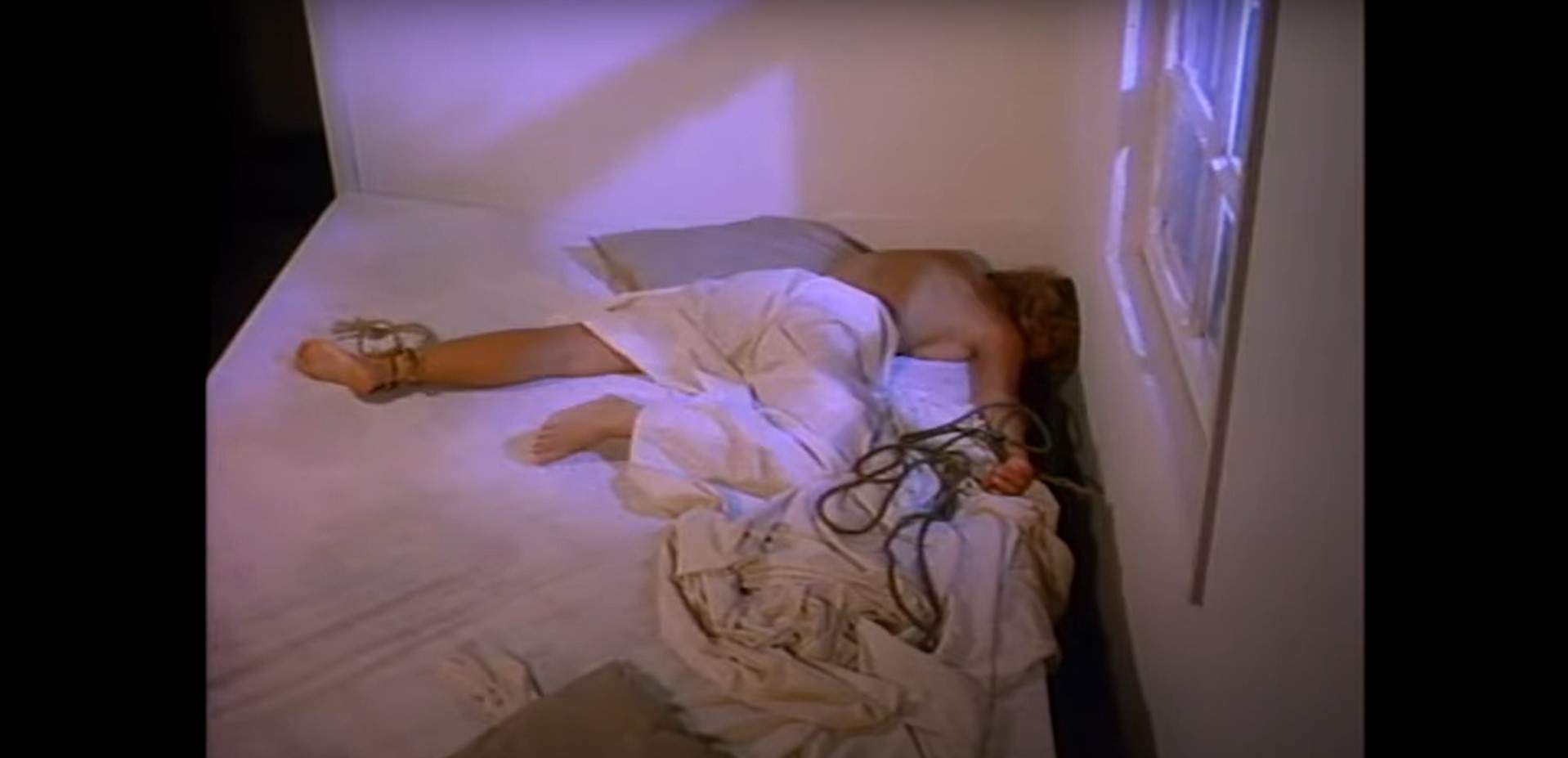
Daniel Ray Hawkins drives an unsettling, nomadic lifestyle as he travels across different parts of the country.  With no money, no place to call home, and little friends, Hawkins lives a life of mostly solitude, odd jobs, and equally as strange as him acquaintances spurred from his childhood, shaped by his promiscuously prostitute mother and a war veteran disabled father who gruesomely took his own life, both of which displaying their iniquities right in front of him.  Hawkins also lives a life of torture and murder, being one of the most prolific American serial killers ever of mostly young women.  When caught by authorities, Hawkins is willing to confess to everything and help unearth bodies from over decades on the road to ensure families he’s stolen from receive some sliver of solace.  His anecdotal accounts of individual disappearances and murders shock authorities to the core, so much so that Hawkins may just be unstable and not telling the truth.  That is until he informs them of and leads them to the cached polaroids and decaying corpses. 

Based on the American serial killer Henry Lee Lucas, who notoriously claims killing over 200 people has earned him a trio of film adaptations, at least, with “Henry:  Portrait of a Serial Killer,” directed by John McNaughton and starring Michael Rooker in the titular role, the subsequent lesser part II, and the more obscurely known Mark Blair written and directed production, “Confession of a Serial Killer.”  Much like “Armageddon” and “Deep Impact,” or “End of Days” and “Stigmata,” both movies fall into the paradoxical twin film phenomena of sharing the same them and having both been released approx. within a year of each other.  While “Henry:  Portrait of a Serial Killer” may have taken the top spot with a bigger budget played in more widespread venues, Blair’s rendition was released prior and closer to Lucas’s active killing spree that saw an end in 1983, just didn’t get released in America until a few years later to not duel with McNaughton’s film and thus didn’t succeed as much.  The Cedarwood Productions film was produced by Cecyle Osgood Rexrode, distributed by Roger Corman and his company, Concorde Pictures. 

While he was not the first choice for the titular character of Daniel Ray Hawkins, production designer, the late Robert A. Burns, filled in the sociopathic shoes with great monotonic conviction.  Burns, who has ties as Art Director and makeup effects on some of the most iconic and seminal genre films, such as “The Texas Chain Saw Massacre,” “The Hills Have Eyes,” and “Tourist Trap,” matches the makings of an unempathetic, unsympathetic, natural born killer with a glazed deadpan austere and matter-a-fact knowledge and every evil committed.  “Confessions of a Serial Killer” would not be as laced with depravity if Burns didn’t push the demented drugs to keep audiences hooked on overdosed deviancy.  Not a tall or broadly muscular stature, curly outstretched and receding hair, scruffily unshaven with a consistent 5 o’clock shadow, and wide rimmed glasses, Daniel Ray Hawkins epitomizes the very essence of a creep and accentuates the behavior even further with his leisurely composure and straight-faced simplicity.  Other side characters exist around Hawkins’ maniacal run with the bisexual Moon Lewton (Dennis Hill) and his sister Molly (Sidney Brammer), who marries the pansexual Hawkins out of necessity rather than sexual desire, and while Moon and Molly share Hawkins deranged apathy, they are completely overshadowed by the more controlling and interesting lead principal character due to half the murderous anecdotes are solo ran and all of the perception in the stories is through Hawkins’ recollection, giving him more power in the trio in perceptional self-interest, if Hawkins is capable of such consciousness.  The cast fleshes out with lawmen and victims in Berkley Garrett, Ollie Handley, DeeDee Norton, Demp Toney, Eleese Lester, Colom L. Keating, and Lainie Frasier in the opening stranded motorist scene that sets up Hawkins diabolical reach in turning a car into a trap. 

Bathed in realism, “Confessions of a Serial Killer” does not embellish with surrealistic temperament.  The story never dives into Hawkins’ head to show any indication or any kind of visual mental degradation or reality breakage toward being a coldblooded killer.  His violence is spartan, acidic, and raw to the bone, leaving a gritty taste in your mouth, with only a bleak childhood to blame for his adult obsessions to kill that he describes as necessary as breathing.  Blair distills the story to a “Mindhunter’” episode in trying to understand the killer and recover skeletons from his past, literally, through rational and respect ways rather than boiler room beatings and power-tripping threats.   Blair’s concept humanizes the inhuman and having Hawkins’s reminiscence each account is like recalling childhood memories with a smirk and fond remembrance splayed across his face adds another layer of iciness.  Grounded by pedestrian scenarios, “Confessions of a Serial Killer” disrupts the routine, the familiar, and the unscripted ways we live our lives unconsciously to the fiends living among us that look like you or me.  It’s a very palpable fear Blair conveys under the semi-biopic film.  The director does eventually let loose the reigns in the final third act with a finale account of Hawkins, Moon, and Molly shacking up with an amiable doctor, his suspicious assistant, and his shapely young daughter that boils to a head when one bad decision leas to another. 

For the first time on Blu-ray anywhere as a part of Unearthed Films’ Unearthed Classics sub-banner, “Confessions of a Serial Killer” receives a high-definition, 1080p release on an AVC encoded, single ring BD25.  Higher contrast and a lesser diffusion to create a harsher, flatter color scheme, the intention is to fully base the story in reality as much as possible, to structure an abrasive look of grain and low lighting that parallels the seediness the tale touts. inspired from the facts of an American serial killer without having to fully give recognition to the actual killer.  Shadows are key to Hawkins nightly runs, adding back-alley value to his viciousness, and the more lighter scenes, such as brighter-by-color interiors or day exteriors, are ample with natural grain that cut into the details but don’t necessarily knock them out entirely.  With the lesser capacity disc, compression doesn’t appear to be an issue with no sign of macroblocking, banding, or posterization. The English language LCPM 2.0 mono possesses lo-fi aspects kept true to the original audio master. The dual-channel conduit amasses the layers mostly in the forefront without ascendancy in the environment, creating a flat approach, rendering the audio mostly fixed and depthless with the action creeping onto the dialogue, but this also adds the realism of a real world chaos where cacophony reigns. William Penn’s effectively, inlaid soundtrack has hallmarks of Wayne Bell and Tobe Hooper’s “Texas Chain Saw Massacre in the minor key with added notes of an otherworldly tune fork keyboard and lingering bass elements that’s just infests with the sounds of deceit and death, reminding me also a lot of a George A. Romero’s “Night of the Living Dead’s” atmospheric arrangement. English SDH are an available option. The collector’s edition contents include a commentary with director Mark Blair, aka John Dwyer, director of photography Layton Blacklock, and actor Sidney Brammer (Molly), The Henry Lee Lucas Story by author and former TV news reporter James Moore, and a full-lengthy documentary Rondo and Bob examines Robert Burns being the foremost expert on uniquely deformed actor Rondo Hatton as well as examines Burns’ own career, a polaroid gallery, promotional gallery, and the trailer. Displaying the iconic poster, a profit from rip of Hannibal Lector with a devilishly masked killer behind bars, Unearthed Films’ releases the stark image onto a planar cardboard slipcover. Same image is used from the standard Blu-ray Amaray case with no reverse side. Disc is pressed with a memorable and anxiety-filled chase scenes. There are no inserts material included. The region A encoded Blu-ray has a runtime of 107 minutes and is unrated.

Last Rites: One of the better biopics on U.S. serial killers even if a little bit of speculation and sensationalism increases the already verbose notoriety of one Henry Lee Lucas. Scary and bleak, “Confessions of a Serial Killer” continues to remind us that no one is safe from the everyday sociopath.

An Unearthed Classic Now Available on Blu-ray! “Confessions of a Serial Killer”

EVIL Relaxes in the Serenity of a “Full Body Massage” reviewed! (Unearthed Films / Blu-ray)

Lube Up and Get Ready for “Full Body Massage” on Blu-ray!

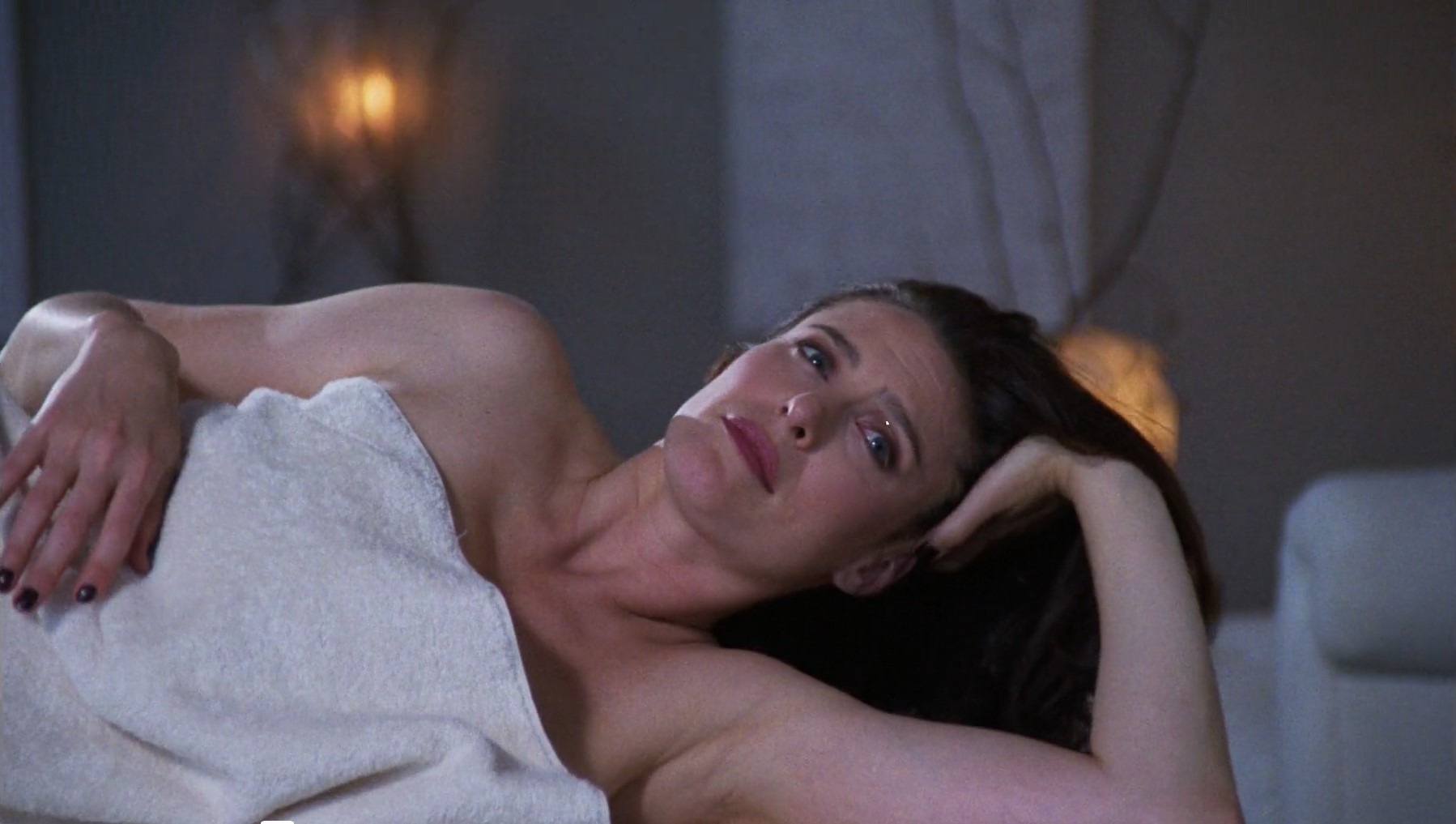
Nina, a middle-aged affluent art dealer, has just returned from a long business trip.  Settling back down into her own nature morte decked home, Nina pampers herself with a hot shower, a glass of wine, elegant music, and a soak in her open aired, backyard hot tub as she relaxes before for her masseur, Doug, a handsome young man she finds herself comfortably attracted to outside their professional relationship, arrives to put his oiled up hands up and down her naked body but when Fitch arrives, Doug’s more seasoned stand-in, Nina finds herself blindsided by the change and slightly disappointed in her sudden erotic deflation.  Fitch’s worldly approach to life conflicts against Nina’s narrow perspective on various topics, including art, happiness, and love.  Willing to be fully open with each other during the intimate and unorthodox massage, Nina and Fitch debate deep into their session without holding anything back with flashbacks on their experiences that led them to this very moment of unexpected connection.

Director Nicholas Roeg, the late acclaimed English director, is known for his in-depth humanizing of flawed or downcast protagonists, often times surrounded by desire and obstacles, having helmed such renowned features as “Walkabout,” “Bad Timing,” and “The Man Who Fell From Earth.”  Roeg has also dipped his directional toes in horror with films like “Don’t Look Now” and “The Witches,” running the gamut between adult and children thrills.  Later in his career, Roeg slowly moved away from theatrical features and into the realm of television, shorts, and TV movies with one of those made-for-TV films being “Full Body Massage” for the premium cable network Showtime.  Penned by “The Stranger’s” Dan Gurskis, “Full Body Massage” trades in a problematic mystery or obstacle for more of the unravelling of philosophical viewpoints of two strangers wounded in their own obvious way only to have the air purified each other’s different life paths and mere presence of mind.  The 1995 released U.S. network movie is produced by erotic thriller operators Julie Ahlberg and Michael Nolin of “The Pornorgrapher” under the LLC of Full Body Productions and Showtime.

Though a made-for-television movie likely marketed for and airing as a late night skin flick for the premium network channel in the cable box era of the 1990s, “Full Body Massage” was anything but your ordinary after dark tits up production with two well-known stars substantially casted and not just for the headline attraction.  “Ginger Snaps” and “Hider in the House” American actress Mimi Rogers is joined by Australian star and “F/X” leading man Bryan Brown who undertake the respective roles of world-weary Nina and worldly-candid Fitch.  While “Full Body Massage” has the hallmarks of softcore programming, an titillating title, sexy sax soothing tones, and a very naked Mimi Rogers, the machinating devices have more bark than bite as Rogers and Brown never engage into sexual intimacy albeit a lot of sensual massage manhandling by Fitch on Nina’s more than happy to be naked body with a stranger she just met.  The two mainstays are pundits for the story, verbally expelling their own viewpoints and experiences that have shaped their choices in life, molding them to who they are, and nearing the edge of gospel when in rhetoric with each other.  Their conspicuous dispute is nearly all narratively all consuming but not as nearly all argumentative in it’s very adult approach to discussion of just two people seeing the world through two very different eyes.   Other characters are told through mostly flashbacks and never interact in the same aortic piece with Rogers and Brown with Christopher Burgard (“Syngenor”), Elizabeth Barondes (“Night of the Scarecrow”), Gareth Williams (“Striking Distance”), Patrick Neil Quinn (“Swamp Thing” television series), Heather Gunn (“Ed Gein”), and Gabriella Hall (“The Erotic Adventures of the Invisible Man”) and Brian McLane playing younger versions of Nina and Fitch. 

“Full Body Massage” is not an intense, edge-of-your-seat nail biter bursting with action and suspense.  In fact, I struggle with film’s point and overall message to the world in what in essence boils down to a character study.  Fitch’s disapproving father no matter how perfection Fitch achieved, Nina’s continuous search for approvals in love, Fitch’s losing love that sends him on a spiritual journey, and Nina’s failed marriages between fast-and-loose husbands and hard to connect with ones make the two underlyingly wounded adults rigid and confidence in that unyielding measure until they meet each other and experience pliability out of a long-winded dialogue in not only a face-to-face manner, but also in the healing power of touch and massage that’s feels erotic per Roeg’s direction but also works out every kink in their twisted, knotted pasts to where they end in an uncertain but good place, a place they’ve never been before or have long forgotten.  By the course of two people talking, which most the world does every day, there had to be buzzier bright light to attract swarming audiences to the premium cable network’s thirst for viewership and that would be Mimi Rogers going nearly full-frontal for nearly the entire runtime and Roeg really plays into that erotic prance of unabashed confidence and comfortability while also, contrariwise, the dynamic progresses platonically. 

A newly scanned 2K transfer of 1995 film comes from an unlikely boutique distributor known mainly for extreme horror, gore and shock, and controversial material. Unearthed Films proudly presents “Full Body Massage” on Blu-ray as title lucky number 13 on their Unearthed Classics label. The AVC encoded, high-definition 1080p, BD50 exhibits cable vision veneer in a television widescreen 1.66:1 aspect ratio. Roeg’s choice to go virtually without style really hinges on the substance for success. The natural approach consumes any low-lit or candle-lit warm interiors exclusively for flashback sequences. The 35 mm print has been cared for and it shows with pristine HD transfer that keeps the natural grain and doesn’t need to really sugarcoat any sour patches. The English lossless PCM 2.0 stereo mix offers exact fidelity of the original discourse and milieu ambience of an innate digital sound capture. With the dialogue heavy story, the discourse is clean, clear, and prominent, comprehensible in every which way. Depth provides expansion and echo inside Nina’s vastly roomy mansion, but range is limited to talking and not the sensual, sexy, arousing kind. English subtitles and SDH subtitles are available on this release. Special features include the television version presented in 1.33:1 aspect ratio, a minute still image gallery that’s mostly Bryan Brown behind Mimi Rogers giving her the massage, and the original trailer. While not a great selection of bonus content, the physical exterior succeeds slightly favorable with a cardboard O-slipcover with flat, yet beautiful, illustration of, again, Bryan Brown and Mimi Rogers in massage therapy that could be misleading as sensuality. The Amaray Blu-ray cover sports the same image on the cover art and even compressed even further on the disc art. The Blu-ray is rated R, locked in region A playback, and has a runtime of 93 minutes. I’m not going to try and kid you with what is and will be “Full Body Massage’s” immediate appeal, a very well-endowed and nude Mimi Rogers, but this anomalous Unearthed Classic brings a different highbrow criterion class to the extreme horror label in what is a brazen change of pace. 

Lube Up and Get Ready for “Full Body Massage” on Blu-ray!