Sex-Crazed EVIL Goes to an All-Girl School! “Delinquent School Girls” reviewed! (VCI Entertainment / Dual Format Blu-ray)

“Delinquent School Girls” on Blu-ray and DVD from VCI Entertainment!

Three insane asylum inmates incarcerated for their perversive and deviant acts escape their small confines of a cell and the electroshock abuse.  On the run, the people they encounter to pillage what they need find themselves either enamored with them in drink and spirit as well as the initially force exploitative intercourse that becomes more pleasurable and desired.  When they invade the outskirts of an all-girls private school, they stumble upon an elder biology professor taking advantage of a roofied young admirer, two busty kitchen cooks giving them only minor trouble before having their way them, and two poolside lasses eager to be pleased.  When they encounter what remains of the student body left behind on holiday leave in the gymnasium, the group of voluptuous young women are subjected to the whims of the maniacs before they fight back with their learned karate lessons as they spill out of their karate uwagi jackets. 

There’s no decade genre that can more outrageous and controversial than the scantily-cladded, seventies exploitation and Greg Corarito’s 1975 “Delinquent School Girls” fits the bill with sexed-up prison escapees finding themselves fleeing into the sheltering arms of half-naked and promiscuously feisty schoolgirls.  Also known around the world as “Carnal Madness,” and more selectively, alternatively titled as “The Love Maniacs,” “The Sizzlers,” and “Bad Girls,” the film is a mix between sexploitation and crude comedy, penned by the American B-movie and pornographic director of “The Sadistic Hypnotist” and “Hard on the Trail” Corarito and alongside fellow adult oriented filmmaker John Lamb (“The Starlets”) and Maurice Smith (“The Joys of Jezebell,” “Love, Swedish Style”).  Riding the Russ Meyer gravy train of slapstick sleaze and high energy antics, Smith and Lamb also serve as producers of the film that was shot under by Alpha Productions in Santa Barbara, California. 
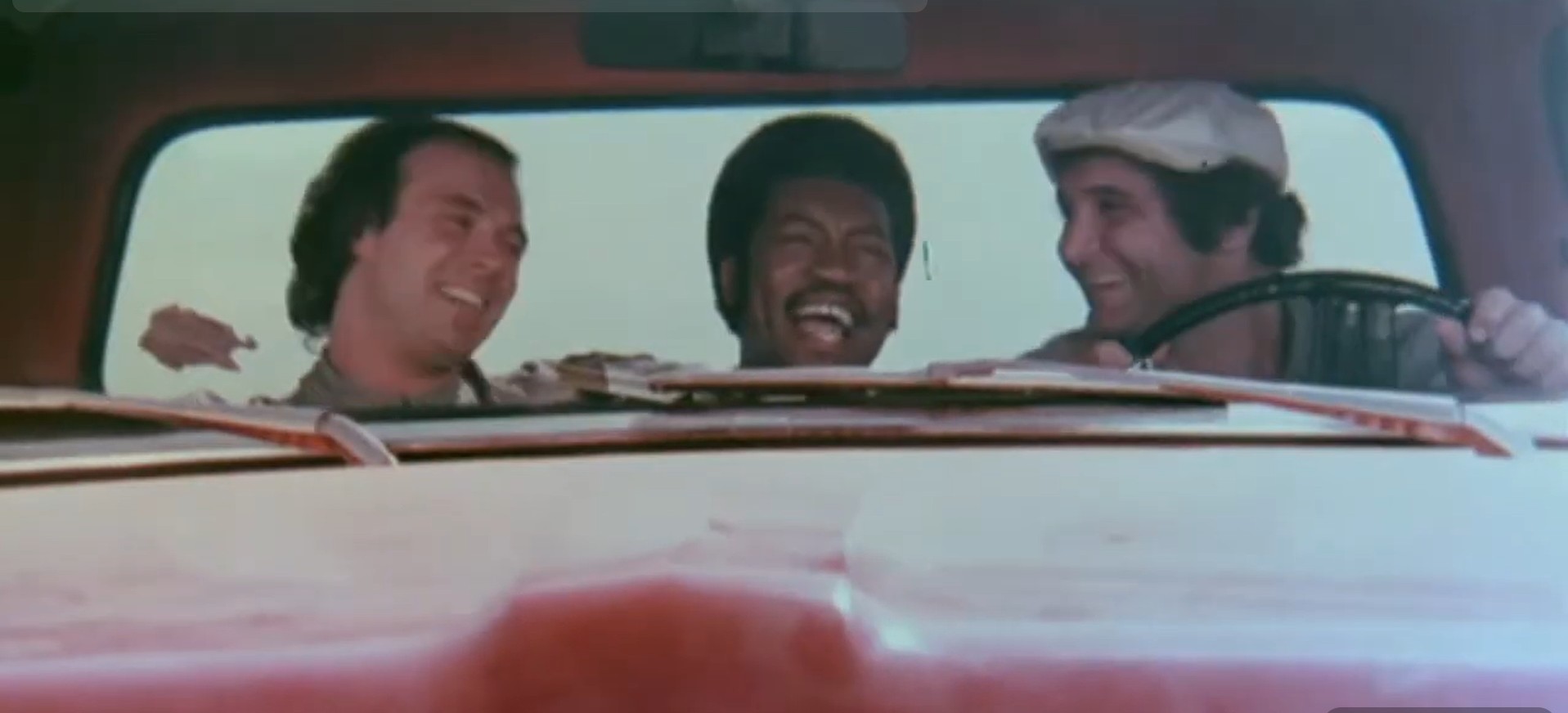
Not to be taken overly seriously, despite its licentious context of male prisoners holding hostage and raping women, “Delinquent School Girls” isn’t centrically focused on the schoolgirls although the title suggests as such.  The attention is mostly set on the three fugitives absconding from law enforcement and these are not just any prisoners; these are demented sex maniacs.  While the label is perversely provoking, only one of them is truly aberrant in his hunt for the opposite sex.  Being more of the muscle and the muscular brute of the group is Bob Minor (“Coffy,” “Foxy Brown”).  A regular actor in early blaxploitation, Minor indulges his character Dick Peters’ sexual deviancies by nearly bedding every woman he encounters and compares himself to being God’s sexual gift to women.  Of course, the women love it because they’re either sexually repressed by low libido men or just naïve and horny.  Peters is not however the leader of the pack, a position taken with great ostentation and theatrical direction by the demanding Carl C. Clooney who talks a good act of deviancy but never really follows through with any carnality.   Clooney is played by Michael Pataki who we just reviewed as a Marlon Brando impersonator in the “The Last Tango in Paris’ sex-spoof, “The Last Foxtrot in Burbank,” directed by debuting Charles Band.  Pataki does a fair share of impersonations but none really home in on a certain celeb, but he uses his farcical approach to be the pack leader that calls the shots and reins in a randy Peters with absurd choice considering their fugitive state.  The last of the trio is Stephen Stucker, who you might recognize from the “Airplane” spoof movies as the flamboyant air traffic controller with his trademark androgynous voice and mannerisms, playing the “gay man” of the group and has zilch sexual aggression or desires toward the women.  Considering the female cast there’s isn’t one that stands out as a full-fledged protagonist in what is more of a collective effort amongst the troupe, beginning with some slightly more principal leads in porn star Colleen Brennan, a busy and fiery redhead who takes no crap from a male dominated society.  Before full transitioning to the adult industry with such titles as “Daisy Chain,” “Maid in Manhattan,” and “Tower of Power,” Brennan was at the cusp of sexploitation with genre films like Russ Meyer’s “Supervixens” and Stu Segalls “The Dirty Dolls.”   Promiscuous women flow left-and-right through the entirety of “Delinquent Schoolgirls” with other notable performances from Zoe Grant, Debbie Raymond, Brenda Miller, Jane Steele, Betty Johnson, Valerie Anderson, Kay Lange, Doree Vega, and nude model with large bombshell breasts, Roberta Pedon.  Ralph Campbell (“Hollywood 90028”) and John Carpenter regular peripheral actor George ‘Buck’ Flower also co-star
“Delinquent School Girls” is pervy but not grossly over-the-top in its sexploitation subgenre.  To counter the depravity and objectification, there’s theatrical melodramatics and plenty of comedy to offset a lopsided licentiousness.  Dick Peters provides the perversion, Carl C. Clooney provides the excessive, madman performance, and Bruce Wilson, played by Stucker, is a riot of feminine mannerisms and one-liners without being an oversized caricature of a gay man on screen.  The trio is almost like a ruffian version of the Three Stooges without the eye-poking, forehead slapping, hair pulling slapstick.  Clooney and gang are also a traversal entity, meaning they travel from their escaped holding cells to the school for troubled girls in a when an unstoppable force meets an immovable object scenario as the escapees run-through and overcome all obstacles in their path – an old man and his sexually frustrated wife, a roofie slipping biology teacher and his unconscious pupil, two feisty kitchen maids – until they meet the school age women in the middle of nightly karate class nonetheless.  That’s where the buck stop and the rebellion against the convict’s joyride comes to halt and in the middle is all the sullied interactions that kind of wind up being turned onto a corrected head – the sexually frustrated wife gets her fill while the husband gets amiably drunk with the two holding him hostage, the roofied girl is saved from a snake stimulated biology teacher and rapist, and the two kitchen maids happily share meal around a card table after being ravaged with no complaints.  While contextually the subject matter can be dark and sharp, “Delinquent School Girls” has a good-natured attitude about the whole ordeal that makes this emotional calorie intake all the lighter. 
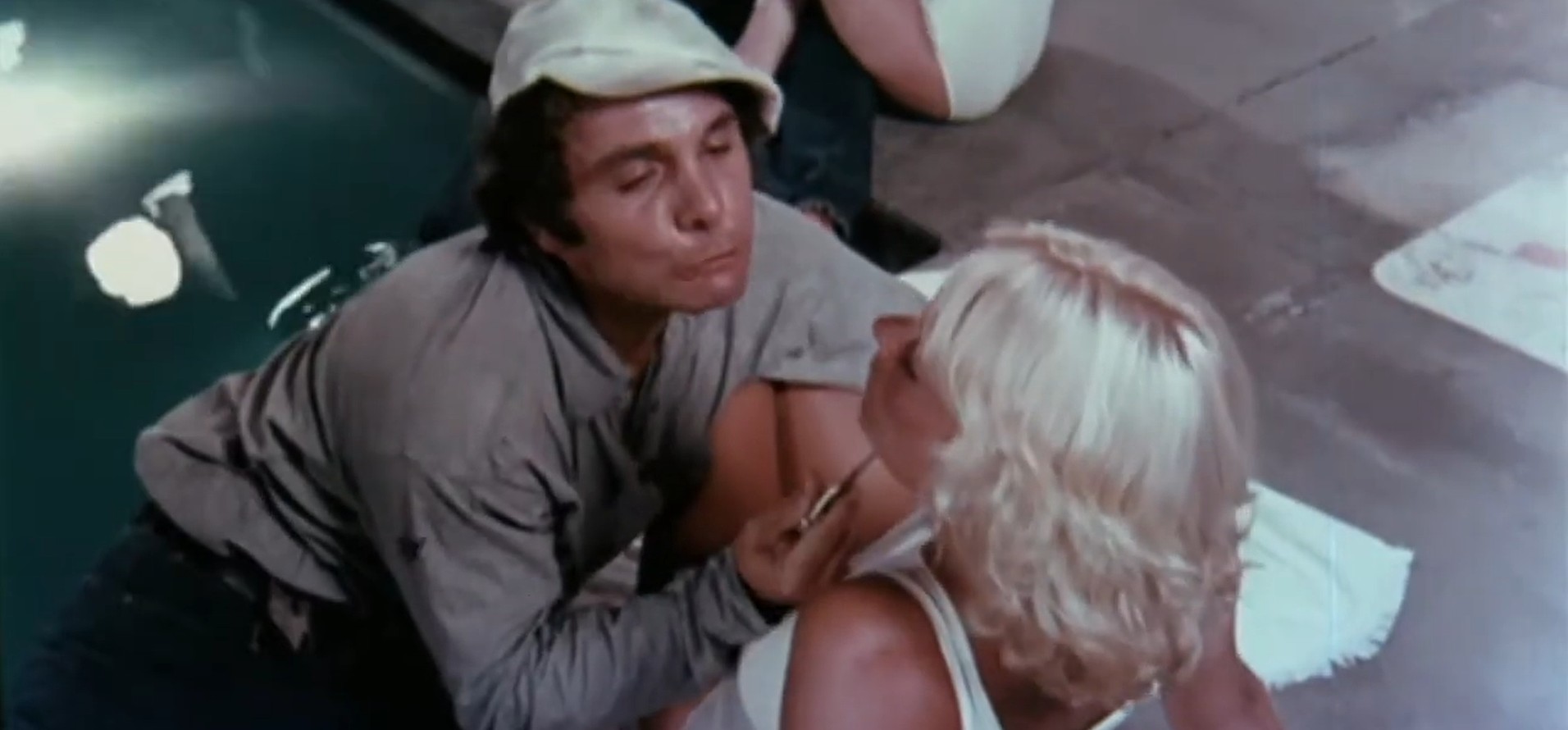
Jumping jack jugs that spill right out, upskirts of high school schoolgirl outfits, and plenty of long-legged, bare-chest exposure, “Delinquent School Girls” bares the mark of sexploitation with pride and caters to a comedy that neutralizes the often shame audiences that comes with bleak and hard to swallow the exploitation of a slew of sexpot ladies in the film.  The first film on the Psychotronica label from VCI Entertainment, “Delinquent School Girls” arrives on a 2-dsic, dual-formatted, DVD and Blu-ray set.  The AVC encoded BD25 has a 1080p, high-definition resolution and the DVD is MPEG2 encoded DVD5 with an upscaled 720p standard definition.  The Blu-ray edges out the DVD counterpart with better clarity around the often congested in variables and in the restored 4K scanned transfer of the original 35mm negative that never provides a consistent detail quality or color.  Some cells appear yellowish, others are often speckled by blow up, a few has lighter contrasts that bleed and meld objects, but there are more scenes of well-delineated and detailed-oriented scenes that granular specifics on skin and textures.  Night sequences are hit-or-miss with a chiaroscuro lighting of key areas, such as Roberta Pedon’s extremely large and oval shaped breasts.  VCI transfer does it’s best to refine the cheaply and does a good job reconditioning previous home video versions, retaining healthy grain, some speckling, and little-to-no damage or compression follies.  The uncompressed English track, a LPCM 2.0 mono, is centered inlaid and focused but discerns any ensuing chaos well enough to provide distinct entities without being a cacophony.  Dialogue comes over clear and distinct; we get some real nice clarity and vocal difference from the three very contrasting convicts with their personalities.  There’s not in the depth or range department as medium shots are often overlaid with voiceover dialogue and range is limited to the Foley wallops of kicks and punches.  English subtitles are optional available on each disc.  Special features are included on each disc as well and they include an archived commentary by actor Bob minor with Los Angeles-based documentarian Elijah Drenner hosting, Pscyhotronica:  Dive into Cult Cinema featurette, and original trailers for the film.  The release comes in a traditional Blu-ray Amaray with reversible sleeve artwork containing pieces of original artwork.  Both discs are region free for the rated R release that has a softcore runtime of 89 minutes.

Last Rites: A comedy first with perversities as a secondary, “Delinquent School Girls” is a gambol of a good time in its eccentric and wanton unprincipled behaviors, saturated with feminine succulence and dastardly deviance.
“Delinquent School Girls” on Blu-ray and DVD from VCI Entertainment!

Satan’s Evil Indestructible, Hairy Servant! “Beast of the Yellow Night” review!


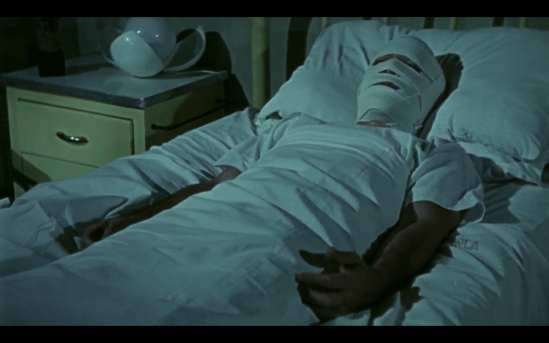
At the tail end of the second great war, Philippines based U.S. army deserter and Japanese sympathizer, Joseph Langdon, runs for his life as the Philippines police and guard track him down through the jungle for committed heinous acts that not only include treason, but also rape and murder. Exhausted and dying from his wounds, Langdon will do anything to stop the process of pain and death, including making a deal with Satan himself. In exchange for saving his life, Langdon commits himself to eternal servitude at the malevolent pleasures of Satan by inhabiting various souls and bodies through the decades and extracting the latent evil from his interactions with people, but Langdon finds himself again exhausted and exacts free thought and a rebellious stance against his master after inhabiting an American business man and given back his own face. The Dark Lord, as amusing as he wicked, bestows upon Langdon the ability to transform into a flesh hungry man-beast whenever his desires boil to the surface and he becomes the most wanted man in the Philippines, but how can they stop a monstrous fiend they can’t kill? The answer lies solely with the damned Langdon himself.

Rarely does a horror film birthed from the Philippines reach my critical virtual desk and, fortunately, “Beast of the Yellow Night” lands smack-dab in my lap as an absolute jewel from the early 1970’s from writer-director Eddie Romero. The 1969 “The Mad Doctor of Blood Island” director, who’s heritage is Pilipino, had visions of grandeur for his large scale features that stem from an infinitesimal budget, but with enthusiastic energy from former musician and beach party, teen heart throb John Ashley, the duo cofounded their theatrical finance company, Four Associates Ltd, to produce their very own horror feature films straight out of the Philippines which “Beast of the Yellow Night” was one of first to be released, if not the very first to be produced. Additional funding was provided by a little known distribution company, New World Pictures, jointly founded by the genre-setting Corman brothers, Roger and Gene, and thus forth “The Night of the Yellow Beast” was built upon a rich and solid cult foundation that began a Philipino-film circuit conversely well-known in the U.S. and put Eddie Romero on the proverbial map of relatively unknown and granular cult directors while providing a branching out of yet another successful credential façade for John Ashley that doesn’t involve country music or being just another pretty face in the beach party moviegoer crowd.

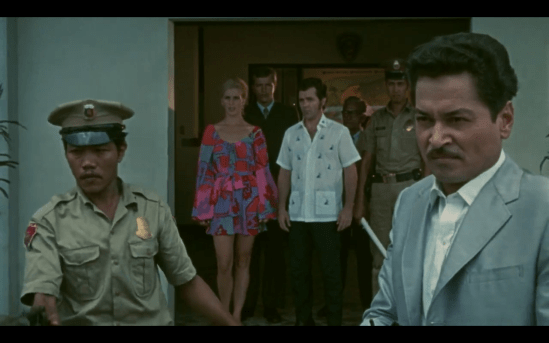
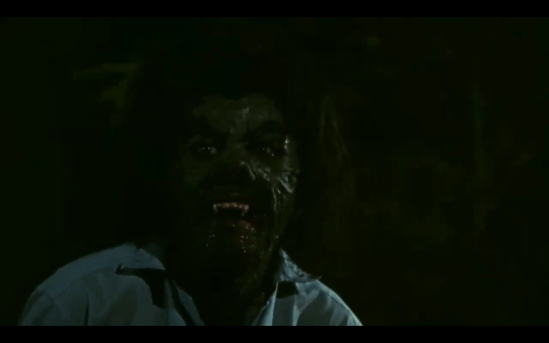
If you haven’t guessed by now or if you’re just as dense like myself, John Ashley also stars in his co-produced creature feature and Ashley, who goes without saying that he stands in his own rite, is also the Paul Naschy equivalent of the Philippine Islands with his all hands on deck attitude toward filmmaking and being the man behind the gnarly man-beast makeup that more than likely takes hours to apply. His performance as even tempered Joseph Langdon is a stark contrast from the wild and vicious beast with a flesh appetite and knack for mauling that herd this film into the werewolf category according many descriptive plots, summaries, and reviews, but “The Night of the Yellow Beast” actually resembles more of a Dr. Jekyll and Mr. Hyde familiarity as Langdon doesn’t transform when the full moon is high, but rather at the whims of his tormentor, in this case it’s Satan rather than an ill-fated elixir, and then he morphs more rapidly and explosively during exhilarating and endorphin stimulated moments like intimacy to further exacerbate his dreadful curse on Earth. Langdon and beast Langdon are befriended by a blind, long-tooth ex-con, Sabasas Nan, played by “The Big Bird Cage’s” Andreas Centenera and Centenera captures the gentle nature and extended wisdom of a man at the tail end of life and looking to right the wrong for his past mistakes. Sabasas Nan is similar to the blind man in the tale of Frankenstein that doesn’t judge, become frightened, or even shun the ugly shell of a monster, but though visionless, both blind men are able to clearly see into the soul of what used to be once a man. “Beast of the Yellow Night” also stars leading lady Mary Wilcox (“Love Me Deadly”), Leopoldo Salcedo, Eddie Garcia (“The Woman Hunt”), Ken Metcalfe (“TNT Jackson”), and labeled as the Filipino Peter Lorre, Vic Diaz (“Black Mama White Mama”) as the pot-belly Satan and Langdon’s mischievous master.

Eddie Romero’s deep and intellectual script sticks out amongst the fray of time lapse and post-skirmish makeup effects that teeters “Beast of the Yellow Night” on a B- to C- movie. Not that the special and makeup effects were completely awful or subpar by any means, but the directing filmmaker pushes the boundaries to scribe the pull strings of a man’s soul, really digging into the anguished flesh of redemption and mankind’s mortal coil, which puts a lightly coated dampening on Langdon’s transformations from man-to-beast that hasn’t yet reached the Paul Naschy level of editing and progressiveness toward his horror films. In fact, the “Yellow Beast’s” effects are merely one step below that aforementioned level. However, the beast is no wolf of any sorts, but nor it isn’t a man in a cheap leathery or latex rubber mask that materializes a rather mangled, mangy beheld fiend with razor sharp canine teeth shown through a ferociously hungry and breathy-snarling maw set below equally ravenous eyes that yearns for the blood of man. For 1971, the effects are exceptionally marvelous, but Romero’s script just blows the practicalities out of the water being ahead of its time and sorely overshadow the effects work.

MVDVisual and VCI Entertainment proudly gift to us “Beast of the Yellow Night” onto 2-disc all region DVD/Blu-ray home video. Produced from a 2K scan of the original 35mm negative, VCI Entertainment’s widescreen, 1.85:1 aspect ratio presentation in full Metrocolor is mondo cult cinema exhibited on a high level and despite some blotchy patches, the corrected coloring and cleaner picture are by far the best we’ll ever see while still sustaining a healthy amount of beneficial cinematic grain. The prologue has coloring issues with about 20% of the right side of the film strip in sepia harboring in sepia town, but becomes corrected after the title and credit sequence. The English and Tagalog, the national language of the Philippines, mono audio track has lossy bite that’s expected and yet, still maintains ample dialogue track and a solid and balanced in range ambient track. Optional English subtitles with SDH are also included. Bonus features include a 2018 commentary track by writer and filmmaker Howard S. Berger and the head of Mondo Digital, Nathaniel Thomspon, old and insightful video interviews about John Ashley and the Filipino films of the 19870’s with Eddie Romero, Sam Sherman, Patrick Wayne, Peter Tombs, Eddie Garcia, Gloria Hendry, Sig Haig, and Jan Martin, a Remembering John Ashley featurette that includes interviews with wife Jan Ashley, filmmaker Fred Olen Rey, Steve Stevens, and Andrew Stevens, original theatrical trailer and TV spots. Plus, a thorough inner liner essay from Howard S. Berger that goes examines “Beast of the Yellow Night” and the films of that era that are a metaphor for much, much more. “Beast of the Yellow Night” is a simple message cause and effect. If vileness becomes you, then villainy will forever run fluidly through your icy veins in this Eddie Romero and John Ashley monstrous picture that pulls at the tattered strings of a downtrodden soul.

Amazon has it on sale, now! Go Go Go!

The Evils After World War III! “The Aftermath” review!


On the space shuttle Nautilus, three astronauts are returning home after one year in deep space. Their outbound transmissions to Earth are not being returned nor are they being received and as their ship draws closer to Earth, the only option for reentry is to take a risky crash landing into the Pacific Ocean, just off the coast of California, hoping someone, anyone, would see their shuttle coursing downward from the sky. Only two survive the crash and swim to shore where no boats, no planes, nor onlookers were around to receive them. They soon find out why. World War III had engulfed much of the Earth during their time in space, reaping the land of the urban jungles and making food and living conditions scare. Germ warfare had mutated much of the population to cannibalistic creatures and when torrentially raining, acid rain pours from the war torn atmosphere from ferociously brilliant and deadly clouds. Only a small band of good people remain and the two astronauts seek to keep them safe from the harsh elements, even against a merciless gang of thugs.

In the early 1980s, an ambitious and visionary filmmaker sought to produce, write, direct, and star in his very own modest budget feature film that would rival Hollywood’s glamourous and expensive effects while still maintaining a down-to-Earth independent production. That filmmaker was none other than Steve Barkett, creating his debut film, the 1982 science fiction post-war catastrophe, “The Aftermath.” “The Aftermath” is like if the “Planet of the Apes” met “The Walking Dead,” a sheer blunt for trauma of returning to your home to discover the world in shambles with different factions of hard nose killers ready to plunder all that you own and all that you will ever have. Barkett, with assistance from the brothers Dennis and Robert Skotak, who’ve went on to work on major studio films such as “Aliens” and did the matte work for John Carpenter’s “Escape from New York,” create a destroyed Los Angeles landscape through the power of some serious movie magic considering the time period and the budget.

Steve Barkett is Newman, one of the three astronauts with no first name, and the tough hombre’s hard disposition comes from his background exposition where he lost his wife and child before going up into space. Newman’s cold, but not heartless, and Barkett taps into that fairly well despite some robotic and formulaic performances. However, Christopher Barkett, Steve’s son, was a complete first generation cyborg, a regular toaster oven with teeth and eyeballs that monotones through all the lines and actions. The most interesting casting here is Lynne Margulies, who at the time of this release, was or was not yet the late Andy Kaufman’s girlfriend. Margulies, who previous worked on an adult film entitled “Young, Hot ‘n Nasty Teenage Cruisers,” continued the racy trend with a shirt-pokey role in Sarah, Newman’s quick-to-sack love interest with a briefly, well-endowed nude scene. Yet, Sig Haig manages to steal the Barkett’s film from right under his nose. The young and ruggedly muscular “The Devil’s Rejects” star sports his trademark shaved head and thick, dark goatee, labeling him the perfect casting choice in gang leader Cutter. Alfie Martin, Forrest J. Ackerman (“Dead Alive”), Larry Latham, Linda Stiegler, and Steve’s young daughter, Laura Anne Barkett costar.

One aspect that’s really appreciated in Barkett’s enterprising venture through post-war commentary and morally righteous themes is the special effects matte work from the Skotak brothers. Detailed paintings, such as exampled in the war-ravaged metropolis that was formerly L.A. embodying the once towering buildings, are now destructively cut short in a mangled heap in a matte effect with live actors. Practical effects work wonders for Barkett’s large scale premise despite the small scale performances, except from Sid Haig. The detail in the violence dawns a newly restored faith in early 1980’s sci-fi films; violence that was more prevalent in the genre later in the decade, in such films as “Aliens” or “Robocop,” making Barkett’s film a trail blazer that paved the way to deliver more sensational savagery and lots of blood of a high body count to a already fantastic genre.

MVDVisual and VCI Entertainment release Steve Barkett’s “The Aftermath” onto a dual format, DVD and Blu-ray, combo pack. Presented in 1080p on a MPEG-4 AVC encoded BD-50, the post apocalypse never looked so good in a widescreen 1.78:1 aspect ratio from a 2K remastered transfer of the original 35mm negative. VCI has bested the rest with colorfully enriched scenes and untouched framing. Slight grain more so over the matte special effects that optically contrasts between the two different layers where a little touchup could have smoothed out the indifferences, but other than that, the details are quite stark. The clean and untarnished English LCPM 2.0 mono track is also vastly well constructed that contains minuscule hissing and the occasion pop, clearly making the dialogue a prevalent force. Composer John Morgan’s traumatically dramatic score is full-bodied and robust that coinciding renders well with the action sequences and tranquil moments. The extras offer the original laserdisc bonus material that provide snippets of interviews from cast and crew, Steve Barkett’s short film “Night Caller,” over an hours’ worth of John Morgan’s soundtrack complete with title information, VCI promo announcement for Barkett’s other director “Empire of the Dark, and the original theatrical trailer. A retrospective journey to the early 1980’s science fiction indie sector is also a visually stunning resurrection of “The Aftermath” courtesy of VCI Entertainment and with impressive effects and a bigger-than-life concept despite an underwhelming performance as an actor, director Steve Barkett’s legacy as a filmmaker remains stronger than ever with this prominent and well-deserved upgrade of the lazer-gun and mutant inhibiting world reckoning.

The Aftermath available at Amazon.com!