The Slammer is Full of Correctional Officer EVIL in “Lust for Freedom” reviewed!

The Jailed Chicks “Lust for Freedom” on Blu-ray!

Broken by the violent death of her partner, who she was also engaged to marry, after a drug bust goes south, undercover officer Gillian Kaites abandons law enforcement and drives across country in an internal turmoiled mess.  She’s pulled over by a Georgia County cop after she aids a frantic woman fleeing to escape two men in a black van.  Framed for narcotics possession by the corrupt officer, Gillian is drugged and locked away in the County’s women’s penitentiary overseen a strong-handed matron and an unscrupulous warden who dabbles in prostitution trafficking, drug smuggling, and even the occasional snuff filmmaking.  Back into a cellblock corner, Gillian must defend herself against the warden’s goons, protect other girls also falsely incarcerated, and lean into the sympathetic ear of the same corrupt cop that framed her after voicing his years of disgust with the warden’s malfeasance.

Part II of our bamboozled behind bars and following the 1986 examination of Eric Karson’s military simulation turned enslavement “Opposing Force,” is our next feature helmed by another director named Eric, notably Eric Louzil, with “Lust for Freedom.”  The debut film of Louzil, who went on to helm “Class of Nuke ‘Em High Part II and Part II” for Lloyd Kauman and Michael Herz of Troma Entertainment as well as slaving over standalone horror and sleazy schlockers in “Bikini Beach Race” and “Night of the Beast,” was also the first feature penned by the American-born, UCLA grad with a penchant for low-budget lewidies, cowritten alongside the “Shadows Run Black” writing duo, Craig Kusaba and Duke Howard.  With the working title of “Georgia County Lockup,” which in actuality the film was shot in various California and Nevada locations, such as Ely, Nevada, “Lust for Freedom” is an 8 x 8 cell of nudity, violence, and corruption under the co-production companies of Mesa Films and Troma Entertainment, with the latter reediting the original script and adding ADR adlibs to apply a sexed up and Troma-fied integration of product into their independent collection.  Louzil and Laurel A. Koernig produce the film with Troma bigwigs Lloyd Kaufman and Michael Herz as executive producers.

“Lust for Freedom” has many eccentric characters with many assorted plotlines in what is essentially an all women battle royal brawl in the cat-scratchin calaboose.  Stirring up trouble like a piece of scrap metal lodged in the gears of a well-oiled machine is tall and beautiful former cop, Gillian Kaites.  Played by Melanie Coll in her only known role, Kaites is only the bear in the bees’ nest, forced into confinement under false pretenses and to be subjugated by the likes of a wayward officialdom with lust in their eyes, greed in their pockets, and a disdain for disobedience.  Coll’s a bit flat footed with her performance and her Karate Kokutsu Dachi stance could use some improvement, but the tall, muscular, curly haired and light blonde actress can wield a multi-round popping automatic rifle with authority.  Stark against her Amazonian physique, not in a hard pressed and sexualized way, is main antagonist is the unbecoming Southern gentleman Warden Maxwell under the balding and overweight guise Howard Knight, but Kaites is more in tune against the procrustean penitentiary matron Ms. Pusker and Judi Trevor gives a Hell in a cell pastiche of early fascist women of Roger Corman produced WIP films, enforcing her will with prison muscle in the miscreant tough Vicky (Elizabeth Carlisle, “Evil Acts”) and the oversized guerilla (professional wrestler Dee “Matilda the Hun” Booher, “Spaceballs,” “DeathStalker II”).  Ultimately, Kaites sees her only path to escape through the very same person that wrongly confines her in the first place.  William J. Kulzer (“Class of Nuke ‘Em High Part II:  Subhumanoid Meltdown”) doesn’t quite fit the corrupted bill of Sheriff Coale, a mild manner and seemingly reasonable officer who goes with the despicable flow of sex trafficking amongst other indelicacies.  Yet, maybe that’s the purpose in Kulzer’s character, to be conflicted by the choices he and his callous cohort has made that made him stick out as the least repulsive individual behind the concreate and metal barred big house.  “Lust for Freedom” rounds out the cast with Donna Lederer, John Tallman, George Engelson, Rob Rosen, Shea Porter, Rich Crews, Raymond Oceans, Elizabeth Carroll, Lor Stickel, and Joan Tixei.

Gratuitous, full-frontal lesbian sex.  Yes, “Lust for Freedom” appeals to the very definition of its own title, like many other WIP productions and though a core element to the integrity of the subgenre, the creamy smoothness of two curvaceous, naked bodies getting it on shouldn’t always be the main selling point.  Luckily, Louzil ponies up more salacious material for his pinks in the clink caper.  An elaborate spiderweb of activity balloons and pulsates outward from the moment Kaites crosses path with an evening-dressed escapee being chased by a scary looking Native American and his sociopathic hooligan partner in a black van.  “Lust for Freedom” may be hammy and cheesy but what it’s definitely not is dull in its multifaceted approach to expose character layers.  Some characters grade more toward deviancy, such as Warden Maxwell and Ms. Pusker, while others are lifted toward a more redemptive means, such as with Sheriff Coale; that shepherd “Lust for Freedom” into a culminating jailbreak.  The narrative doesn’t necessarily focus around Kaites but she’s on a redemption arc to dig her out of a despair pit and into a fight worth fighting for purpose after the death of her finance, set up in the opening act.  As she evades the Vickey’s directed infringement to rough up the new girl, Kaites takes under her wing a fright clink chick named, another wrongly accused prisoner after being taken wandering the road, a theme that is a reoccurring motif from Kaites to Donna in thinking the young women can manage the world and their problems on their own accord but at a cost. However, whatever semblance is left of Louzil’s original script has likely been lost once Troma revamped it into the finished product you see today. Riddled with choppy cuts and incoherent segues, we have to wonder about Kaites’ role that may have been transmuted into a lesser core commodity in the final product.

Troma Entertainment releases a high-def, Blu-ray release of “Lust for Freedom.” The AVC encoded, 1080p resolution, widescreen release, in a 1.78:1 aspect ratio, compressed from its original aspect ratio of 1.85:1. Lloyd Kaufman mentions Louzil had shot the film on 16 mm and Troma subsequently blew up the negative to a 35 mm print that reframes the transfer for projection. Image-wise, the picture appears relatively clean albeit a plush grain and a few visible 16 mm cigarette burns with little-to-no age wear or exposure issue and the BD25 storage format has capacity aplenty to render an adequately compressed image with hardly any loss to the quality. Since the quality is heavily granulated, definitely no DNR implemented, the compression doesn’t suffer from a lack of a sharper, restored image. The audio is an English language Dolby Digital 2.0 Stereo can be echoey at times, as if the boom is catching warehouse reflection, but dialogue does topple in an appropriately laid out track mix that’s intertwined with hair metal band Grim Reaper’s titular “Lust for Freedom” single. We don’t get a ton of depth in the close quarters of the prison set but neither do we receive any depth in the exteriors either, sustaining most of the volume in a forefront stasis. Troma adds spotty ADR to kitschy up to Troma’s ludicrous level and its quite evident like a sore thumb that doesn’t quite match the ingrained audio mix. There are no subtitles available. Extras include the original DVD intro by Lloyd Kaufman, which also plays automatically at the startup of the feature, a directory’s commentary by Eric Louzil that is asynchronous with the feature in what is an approx. one-minute delay behind the Louzil’s retrospect, the original theatrical trailer, an interview with Lloyd Kaufman, a brief, brief clip of Eli Roth’s encouragement to just go and do a movie to the best of your ability, a Troma-themed showcase of one of their more modern Tromettes – Mercedes the Muse, the Radiation March, Gizzard Face 2: The Return of Gizzard Face, which has been on a slew of Troma’s releases over the past year, and coming attractions from the independent company. The Blu-ray comes in a tradition snapper with a guard tower, barbed wired, and Gillian Kaites with a semi-auto in her grip and barely cladded and torn clothes. No insert inside the case and the disc pressed art is the same as the cover illustration. This Troma release comes unrated, is region free, and has a runtime of 94 minutes. Plenty of desire for “Lust for Freedom,” busty babes behind bars barely bores and this vintage Troma keeps the WIP lacquer wet with self-satisfactory sadism and sexual spiciness.

The Jailed Chicks “Lust for Freedom” on Blu-ray!

Giving EVIL the Electric Chair Only Gives EVIL a Buzz! “Destroyer” reviewed! (Cheezy Movies/DVD)


The unspeakable 23 rape and murder crimes of psychopath Ivan Moser grant him a seat of honor at the electric chair. As soon as the switch is thrown, a massive prison riot ensues and what happens next becomes unexplainable, confusing, and indeterminable. One thing is clear, the prison’s Warden Kash loses his position as the trashed penitentiary is forced to shut down. Eighteen months later, a film crew acquire permits to shoot a women-in-prison exploitation film inside the prison with the help of it’s one time custodial employee, Russell, who is just as creepy as the abandoned maximum security penitentiary that housed the infamous Ivan Moser. As production grapples with townsfolk opposition, electrician’s timing miscues, and some seriously bad acting, there’s one unexpected obstacles not accounted for…a living, breathing Ivan Moser still living inside the iron cladded prison.

Horror fans from all walks of life to the age gaps of multiple generations can all agree on one thing, that the 1980’s is the gilded age of horror to which inspired and/or captivated us all. The decade was also an industrious change for political climates that saw the fall of the Berlin and saw musical artists like Michael Jackson break the conventional molds of how music was orchestrated, sung, and danced too. For movies, the change came with technical innovation in elaborate special effects, such as in John Carpenter’s “The Thing,” and undogmatic view of how we perceive plots which opened the flood gates to a slew of unexplored ideas no matter how far-fetched they may seems. One plot such as this would be from the 1988 prison massacre film, “Destroyer,” directed by Robert Kirk as is one and only non-fictional feature before an extreme career solidifying shift to historical movie and television documentaries. Written by Peter Garrity (“The Forgotten One”), Rex Hauck, and Mark W. Rosenbaum, “Destroyer’s” a gritty tale of endless, black obsession fueled by insanity, revved up with inexplicable half-alive malice, and juiced with strength of an indestructible force without being overtly supernatural.

With an 80’s movie comes an 80’s cast and the popular reteaming of Clayton Rohner and Deborah Foreman from 1986’s holiday themed horror, “April Fool’s Day.” “Destroyer” isn’t based on a certain holiday, but converges more toward meta approach where Clayton Rohner and Deborah Foreman play the romantic couple, grindhouse screenwriter David Harris and stuntwoman Susan Malone, on film set of their women in prison movie – Death House Dollies. A typecast switcheroo is engaged as the physicality falls upon the female role while Rohner takes a reserved backseat as a writer and that entails Foreman to face off against Lyle Alzado as the unspoken titular character Ivan “Destroyer” Moser. Alazdo’s crazy eyes and muscular football build provides the suitable basic elements of a crazed killer; probably doesn’t hurt that Alzado was also juiced up on steroids throughout his career in the NFL and beyond his exit from sports entertainment. Alzado has been quoted in Sports Illustrated having uncontrollable anger from roid-rage and that pressurized anger seethed, one could assumed, in the eyes of Ivan Moser, forging a superhuman monster under the parental guardianship of Richard Brake lookalike, Tobias Anderson (“Harvest of Fear”). “Psycho’s” late Anthony Perkins co-stars a the director of the WIP film as an unusual placemat only to serve as a hot moniker in horror to be contextual candy for one big scene and not providing much else. Lannie Garrett, Jim Turner (“Pogrammed to Kill”), Pat Mahoney (“Strangeland”), and four Death House Dollies in a gratuitous shower fight scene co-star!

A purebred American slasher of eccentric electrifying devices, “Destroyer” chooses punitive measures against the concept of capital punishment, sending the cryptic message that the dead will haunt you and those that you touch forever in some warped guilt trip nexus. The message is only further hammered in by the embossed haunting atmosphere of Robert Kirk’s opening sequence of a priest walking down the hazy cellblocks toward Moser’s cell, sitting with twitchy Moser while he madly raves and rambles about the game show that plays on a television set in front of his cell, and going through the steps of a chaired electrocution echoes a utilitarian dystopia that fathers in the cold, ungenial tone of the prison and Moser’s psychotically feral thirst to kill. Ivan Moser’s vitality is infectious, a hail-mary shot you’ll be rooting toward the finale, as the serial killer undertakes undertaker duties with extreme perversity while chocking up his body count with unsystematic eliminations, such as with a conveniently placed jackhammer in the prison basement. The jackhammer’s scene is “Destroyer’s” bread and butter, the showpiece of the whole film, but Moser only snag a couple of some real good on screen kills. All the rest are off screen or channeled through another device, such as an electric chair, and that softens and stiffens Moser’s, if not also Alzado’s, ultimate larger-than-life presence. Still, “Destroyer” rocks Lyle Alzado’s short-lived indelible monster making movie talent and confines the space to a breathless solitary confinement death house ready to devour more victims.

“Destroyer” shocks onto DVD home video release distributed from Cheezy Movies, MVDVisual, and Trionic Entertainment, LLC. If you’re not willing to shell out big bucks for “Destroyer” on Blu-ray from Scream Factory, check out Cheezy Movies’ economy region free DVD presented in an academy ratio, full frame 4:3. A beginning title card mentions that Cheezy Movies attempts to find the best transfer available when searching out titles and I believe that was done here with this release, but unlike Scream Factory, funds were not poured into an expensive upscale as moments of banding start right at the title credits. The transfer instances of dirt and cigarette burns are immaterial enough to not falter viewing, but there’s a bit of hefty color posterization in the basement scene that nearly blends the entire white scheme together and causing difficulties defining individual objects. The English language single channel mono mix maintains a lossy connatural sell topping out at the it’s as good as it gets ceiling with an economy release, but the dialogue is surprising clear, soundtrack sounds good, and the ambience, though needing a fine tuning, shapes out depth and range nice enough. With this release, no special features are available. Much like “Destroyer’s” tagline, Robert Kirk’s feature won’t shock you, but will give a great buzz with a nightmare coiling around your brain performance from Lyle Alzado and a super 80’s execution-from-the-grave slasher that’s just a guilty pleasure to behold.

Buy “Destroyer” on DVD! Or Watch on PRIME VIDEO!

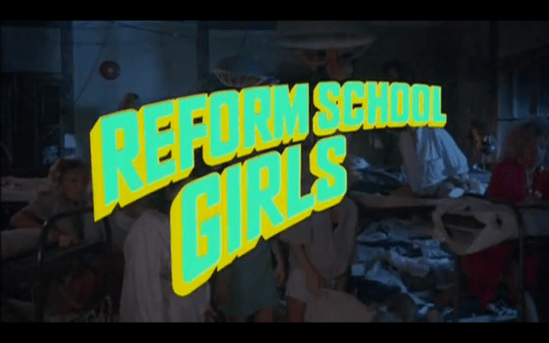
Edna is EVIL According to the “Reform School Girls!” Reviewed!


After being apprehended for robbery, underage Jenny is sentenced to 3 years at Pridemore reform school where she immediately clashes with an iron fisted dorm administrator named Edna and her intimate inmate enforcer Charlie Chambliss. With a few friends on the inside, Jenny’s group becomes the target of Edna’s biased infraction system and Charlie sets her domineering sights on breaking the girls’ wills into submissive followers. The school is controlled by an equally sadistic, evangelically abusive Warden Sutter and Jenny’s multiple attempts at reforming the reform school with the assistance of a sympathetic psychologist staff member, and even her attempt to escape, have failed with torturous consequences. As Edna tightens her grip, Jenny and the girls seethe more violently as the weeks pass up to an inevitable uprising, snapping the young girls’ spirits when enough is enough.

Wet, wild, and womanizing, Tom DeSimone’s 1986 satirically women in prison film, “Reform School Girls,” is a cavity invasive good time all around! DeSimone, who also penned the script, has a revolutionary background as a male gay porn filmmaker, but made the crossover into cult genre films after his successful runs with “Chatterbox” featuring exploitation starlet Candice Rialson and “Hell Night,” starring “Exorcist’s” Linda Blair. Yet, “Reform School Girls” is hardly separation from the director’s once moonlit experiences other than the cast is almost entirely made up of beautiful, naked women showering together and when they’re not fully nude and wet, they might as well be wearing nothing while cladded in skimpy outfits and lingerie as a few characters copulate insinuatingly instead of explicitly. The only thing DeSimone was probably uncomfortable with was his last two WIP features, “Concrete Jungle” and “Prison Girls,” as they struggled to find an appreciative audience and thus “Reform School Girls” was constructed to be a mockery of the whole WIP market, exploding it violently, and sensationally, with the genre tropes that, ironically, skyrockets this film’s cult success.

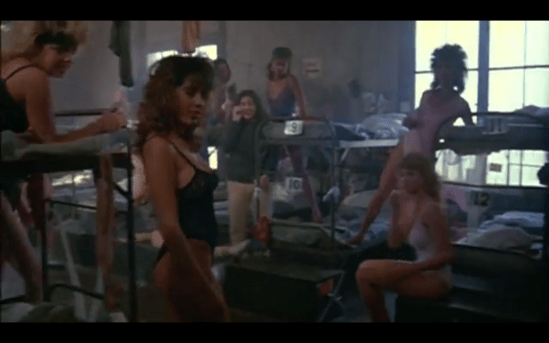
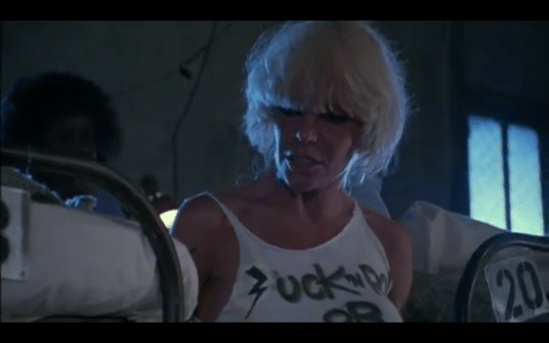
The incarcerated characters offer a wide variety of individualities that are ultimately filled by big personalities themselves. Sometimes, those personalities come with a little head scratching questions. Such is the case with lead actress Linda Carol who isn’t the headliner of the “Reform School Girls,” but she’s certainly one of the main leaders, Jenny, of an imprisoned pack. Born in 1970, Carol had to be no more than 14 to 16 years of age at filming and was cleared for a number of nude scenes, especially around other nude women, but Carol had fire in her performance; in fact, the cast from specified roles to the undesignated titled roles were all highly stimulating in their presence and demeanor. When first entering dorm 14, teased hair and underwear was the unofficial name of the scene that spoke about the genre of the decade in a matter of a few minutes. This is where we meet Charlie Chambliss, a buff, scantily-cladded, totalitarian gang leader of dormitory 14, played fluorescently by rocker Wendy O. Williams. The then mid-30-year-old Williams was a bit of a duck out of water in a role that was for a teenage girl, but the front woman of The Plasmatics was awfully charismatic, brash, and a real illustrated performer who exaggerated dramatics to the next welcoming level in her knee high platform boots. While Williams had sexy hot-to-trot flair, Pat Ast leisurewear offered nothing more than a dull white coat over matron garb, but Ast punctures through anything matriarchal and goes full blown maniacal as dorm keeper Edna. Ast goes over the top and beyond with a love to hate – scratch that – kill character. If you think the evil that embodies Charlie and Edna ends there, you’re wrong! “The Howling II: Your Sister is a Werewolf’s” Sybil Danning’s apex of evil, Warden Sutter, struts around the school like a German commandant with a soapbox of vile and wretched women in a perverted Biblical sense and mastermind behind the abusive culture at Pridemore. The cast concludes with Charlotte McGinnis, Sheri Stoner, Denise Gordy, Laurie Schwartz, Tiffany Helm (“Friday the 13th: A New Beginning”), Darcy DeMoss (“Friday the 13th Part VI: Jason Lives”), and Winnifred Freedman.

Shooting from the hip on first viewing impressions, “Reform School Girls” is nothing like we’ve ever seen before. Sure, we’ve all see women in prison films, from “Big Bird Cage” to even making an argument on Netflix’s “Orange is the New Black,” and we’ve also see cheeky 1980’s comedy that if made today would be grossly lambasted with politically incorrect protestors. Yet, DeSimone’s satire take undercuts the stern nature of the WIP genre with great flamboyancy toward institutional exploitation and the ugly invasive issue of sodomy and rape that the themes can be easily pushed aside without so much of an inkling of consideration. Explosions, gunfire, skimpily dressed women, shower sequences, bitter tongue and cheek, and anything and everything that was omitted from grindhouse market place in this film constructs a smoke and mirrors effect that pivots sharply before getting ankle deep into the issues, no matter the severity just as long as Pat Ast crunches her face into a luffa shape and appoints a barely clothed inmate to a mandatory cavity search and the viewers would be just as captivated.

Umbrella Entertainment and Lakeshore Entertainment release the International Cinevision and New World Pictures production of “Reform School Girls” on a PAL 4 region DVD, presented in a widescreen, 1.77:1 aspect ratio; a slightly cropped version of the original film format. Whatever is cropped out is too trivial and the image picture supplies a palatable presentation with bold hues and bare, but naturally colored, skin tones, despite some fake tanning. One noticeable fleeting moment of an 35mm stock cigarette burn in the upper left corner of a scene, but in-and-out in a blink of an eye. The stereo 2.0 Dolby Audio mono track has balance that singles out the robust dialogue against a leveled down ambient and score recording. The range is good amongst all the reform girl chatter in the dorm rooms. A handful of shower and bathroom scenes have some muffled echoed moments, but the discord in these moments is still extremely low. Surprisingly, there isn’t one single bonus material on this disc, not even a static menu as the film goes right into play feature mode. “Reform School Girls” makes light of wretchedness, revels in the fun of unsavory fraternizing, and is unapologetic of a carnal and wicked tone on and off the screen, harboring one hell of a women in prison cinematic guilty pleasure.

Umbrella’s DVD is available for purchase at Amazon.com!

The Evil Behind the Bars! “Prison Girl” review!

PGcover

The Japanese exploitation distributor Pink Eiga is back in the DVD home entertainment and they’re hitting their audiences hard in the face with the overly raunchy, sensationally sleazy exploitive women in prison film “Prison Girl” starring the beautiful Asami of “The Machine Girl” and “Rape Zombie: Lust of the Dead.” Pink Eiga over the last couple of years had their focus more on the Video on Demand market to satisfy the upcoming thirst for instant video pleasure and the company provided an excellent service. However, the demand sky rocketed for the distributor to release DVDs again and Prison Girl made the first cut after numerous years of DVD celibacy.
prisongirl1
Asami plays a bored housewife named Ayaka. Her lifeless, sexless marriage leaves more guilt than anger when dreams of being an inmate at an all women prison plague her nightmares and she becomes the toy of the warden and his guards’ sexual perversions. When Ayaka reaches for outside help from a shrink, her world fantasy world and real world become intertwine. Is she really a bored housewife fantasizing about being sexually taken advantage of or is she an constantly raped inmate dreaming of being a bored housewife? This surreal look into a conflicted mind of escape is certainly interesting as well as being highly erotic.
vlcsnap-2014-12-16-18h39m47s158
I’ve seen my fair share of pinku eiga films and “Prison Girl” has taken a top spot as one of my favorites to date. This gem for 2008 not only stars a young and upcoming Asami, but “Prison Girl” does more than just shrink your pants. The Osaka born director Naoyuki Tomomatsu has a slew of trashy-horror that are much more weird and wacky in a cultural-sensitive Japanese style than as truly frightening art as we may see here in the States (or anywhere else for that matter). “Prison Girl” is different. Its disturbing and surely mental with Ayaka unable to differentiate between her worlds because before she can figure out what’s going on inside her head, her worlds start to collide.
vlcsnap-2014-12-16-18h37m42s194
the sleazy portion of the film is too great for typed words. Asami is degraded in every possible way, her holes are filled tightly accompanied by over-the-top foley effects like squishing, popping, and tearing. She’s probed, she’s double-penetrated, she’s golden showered, she’s tortured, and the list could go on and on. Asami is superfine as always and their is a natural look about her that fits her roll her as Ayaka; being a bored housewife doens’t make you a dolled up Barbie looking flawless. I want to see the dimples in Asami’s ass as those dimples, the very little imperfections in her round, kind of flat rear-end make “Prison Girl” just that more real for me.
vlcsnap-2014-12-19-11h05m35s22
With “Prison Girl” being a must have as Pink Eiga’s first release in 3 years, the company spares no expense in also giving out more features such as an interview with Asami herself. Catch the film in it’s entire glory now on DVD. You’ll be turned on and psychologically disturbed at the same time and you’ll like every minute of it.