EVIL Inspires a New Concert. “Nightmare Symphony” reviewed! (Reel Gore Releasing / Blu-ray)

“Nightmare Symphony” is a Falsetto of Praise for Lucio Fulci.  Purchase the Blu-ray Below!

Unable to cope with another large box-office failure, the American indie horror director, Frank LaLoggia, is in the travails of a make-or-break psychological thriller overseas in Kosovo.  With an executive producer forcibly pulling LaLoggia’s creative marionette strings and the film’s screenwriter displeased and disapproving LaLoggia’s arm-twisted version of the story, the struggling director finds himself frantic and in the middle of a breakdown caught between a rock and a hard place with a postproduction from Hell.  Those around him, the conceited producer, the upset screenwriter, the pushy wannabe actor, and more, are being hunted down and brutally murdered by a masked killer and the imaginary line between Frank’s reality and paranoia grows in intensity coming down the wire of completing his career-saving, or rather lifesaving, film.

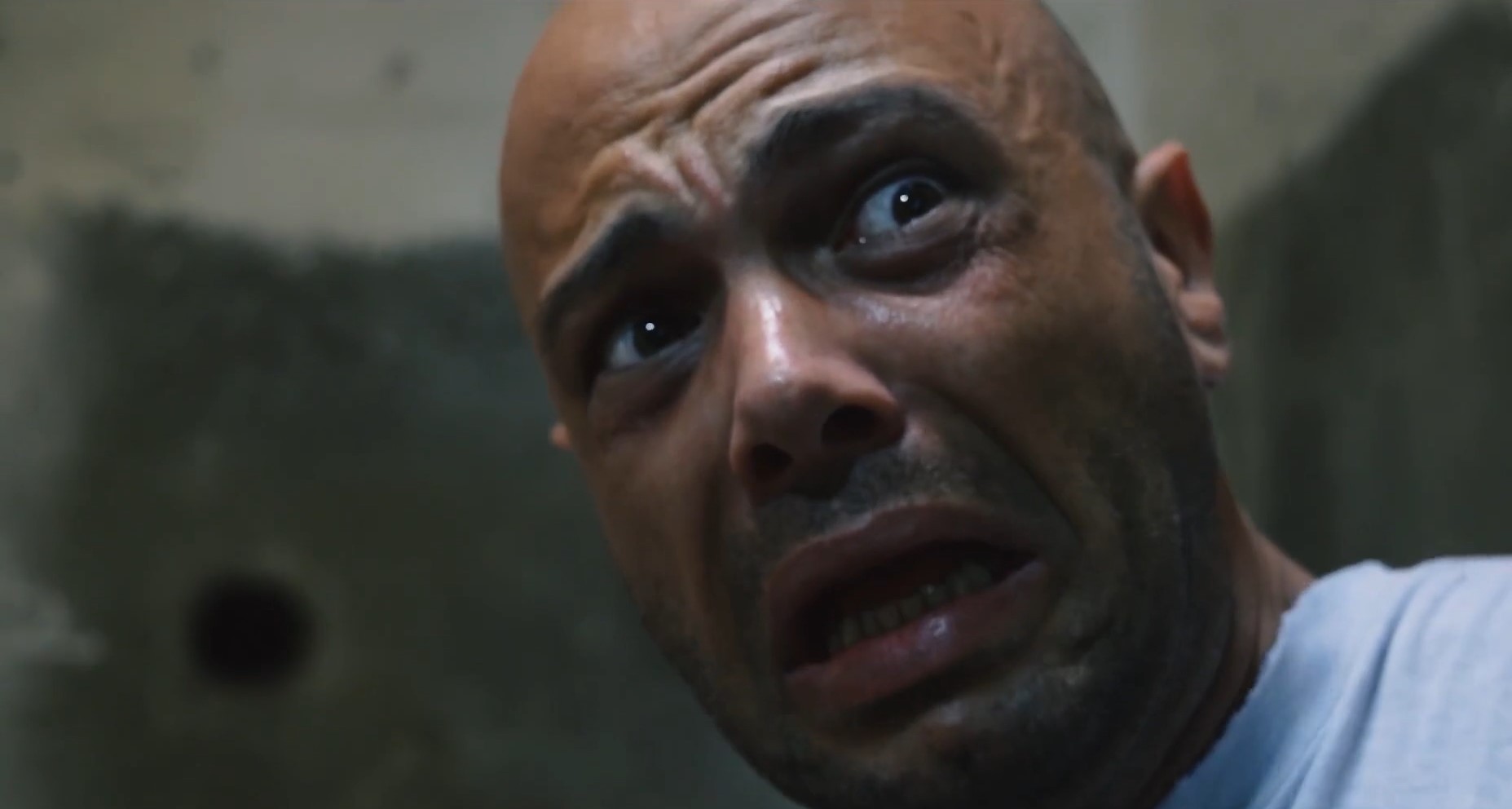
Long time since I’ve heard the name Frank LaLoggia enter the dark corners of my brain as it relates to the horror genre.  The director of 1981’s “Fear No Evil” and 1995’s “Mother” had seemingly vanished from the director’s chair spotlight and more-or-less, or rather more so than less so, vanished from the broader film industry altogether.  Then, Domiziano Cristopharo’s “Nightmare Symphony” suddenly drops on the doorstep and there’s Frank LaLoggia, starring in the lead role of an Italian horror production.  Domiziano, known from his entries of extreme horror, such as with “Red Krokodil,” “Doll Syndrome,” and “Xpiation,” engages LaLoggia to act in an unusual role, as himself, and turns away from the acuteness depths of uber-violence and acrid allegories to a toned down, more conventionally structured, narrative inspired by the Lucio Fulci psychological slasher “Nightmare Concert,” aka “A Cat in the Brain.” Co-directed with first time feature director Daniele Trani, who also edited and provided the cinematography, and penned by the original screenwriter of “A Cat in the Brain,” Antonio Tentori, “Nightmare Sympathy” plays into questioning reality, the external pressures that drive sanities, and weaves it with a meta thread and needle. The 2020 release is produced by Coulson Rutter (“Your Flesh, Your Curse”) and is an Italian film from Cristopharo’s The Enchanted Architect production company as well as companies Ulkûrzu (“Cold Ground”) and HH Kosova (“The Mad MacBeth”).

Much like “A Cat in the Brain,” Frank LaLoggia depicts his best Lucio Fulci representation as a horror filmmaker whose storyline production mirrors the individual slayings surrounding him. As a character, LaLoggia is not entirely aware of the murders as the peacock headed slasher’s string of sadism runs parallel to LaLoggia’s post-productional workload. Cristopharo pays a simultaneous tribute to not only Fulci but also LaLoggia with a built-in brief, off-plot moment of the editor, Isabella, a good friend and longtime partner of LaLoggia, running a reel of “Fear No Evil” to reminisce over his debut picture. Antonella Salvucci (“Dark Waves,” “The Torturer”) plays Isabella but also LaLoggia’s pseudo film lead actress Catherine in a dual role performance with the latter marking Salvucci’s topless kill scene that hits and sets up the giallo notes. Isabella denotes the director’s only real friend with everyone else, from the screenwriter to the executive producer, push their own self-gratifying wants onto the American filmmaker from all angles. A vulgar herd of personalities descend upon LaLoggia to exact their strong-willed ideas on how the film should appear and be marketed. From the screenwriter Antonio (Antonio Tentori, ‘Symphony in Blood Red”), the imposing desperate actor David (Halil Budakova, “Virus: Extreme Contamination”), to the uncultured and pushy executive producer Fernando Lola (Lumi Budakova) and his aspiring actress Debbie (Poison Rouge, “House of the Flesh Mannequins”), they all look to exploit LaLoggia’s modest career for their own benefit. Performances vary with a range of experience, and we receive more noticeably rigid recites and acts from the Kosovo cast in a clashing pattern with the Italy cast that has worked with Cristopharo previously. Ilmi Hajzeri (“Reaction Killers”), Pietro Cinieri, and Merita Budakova as a chain-smoking lady stalker that has glaring eyes for Frank LaLoggia.
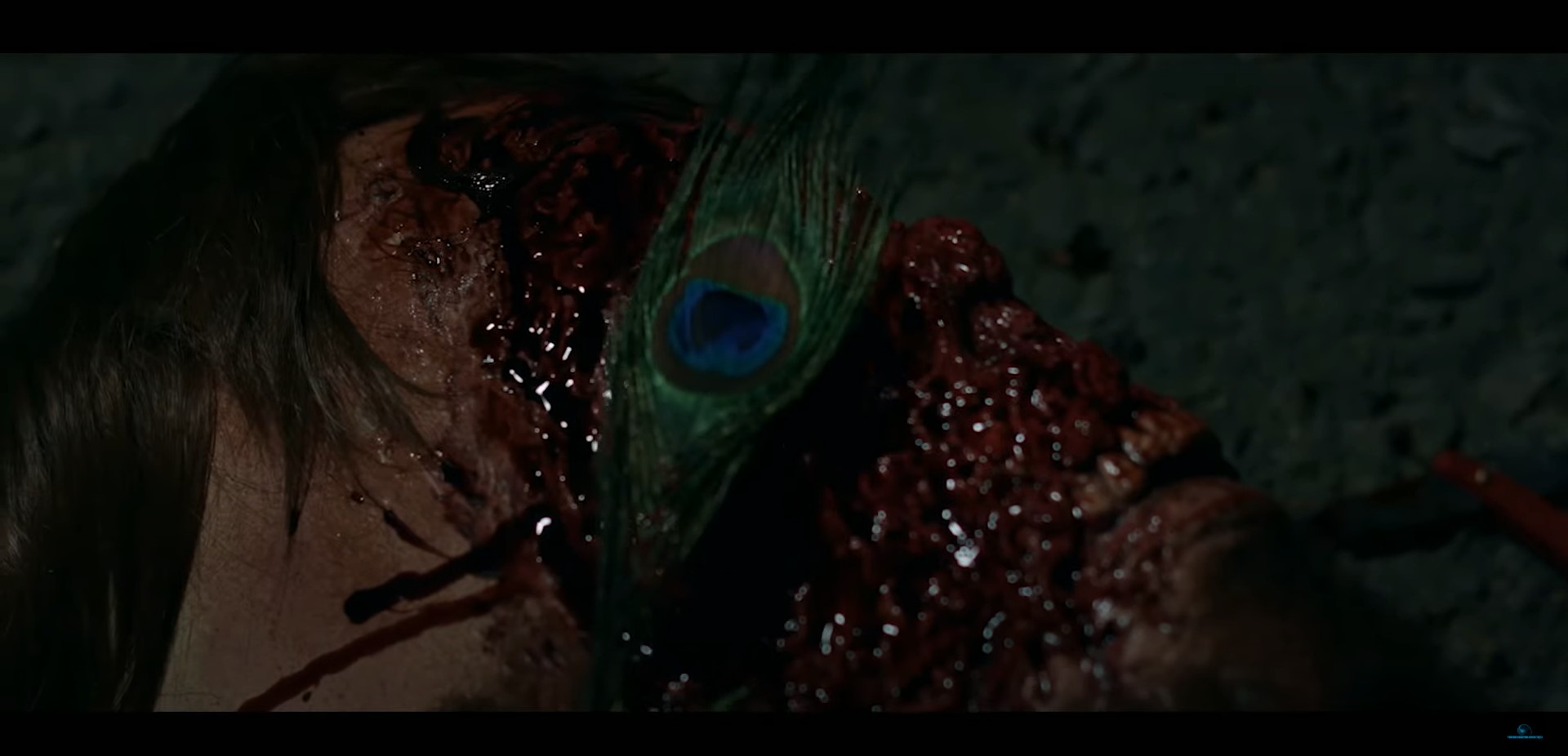
While not necessarily thought of as a remake, “Nightmare Symphony” is certainly a re-envision of the Fulci’s “Cat in the Brain.” What Cristapharo and Trani don’t quite well connect on is connecting all the pieces of the psychotronic puzzle together into what is meant to be expressed. The giallo imagery is quite good, a praise of the golden era period in itself, with a mask and glove killer, the closeup of gratuitous violence, most of the score, and the stylistic visuals imparted with ominous shadow work, foggy and violent dream sequences, and with congruous cinematography and editing of earlier giallo. Plus, audiences are treated to not only the aforementioned Antonio Tentori, screenwriter of “Cat in the Brain,” but also have composer Fabio Frizzi score the opening title. Frizzi, who has orchestrated a score of Lucio Fulci films, such as “Zombie,” “The Beyond,” “Manhattan Baby,” and even “Cat in the Brain” just to select a few notable titles, adds that proverbial cherry on top to evoke Fulci directing “Nightmare Symphony” vicariously through Cristapharo and Trani. There are some questionable portions to reimagining’s take on the original work that are more the brand of the contemporary filmmakers. The presence of death metal prior to one of the kill moments puts the overall giallo at odds with itself in a fish out of water aspectual scene composition. Another out of place component are the external characters that are not directly involved with LaLoggia’s peacock-head themed slasher; the ironical venatic of an animal hunting down people is the reversal of a Darwinism theory that instead of sexual selection, the beautiful and elegant peacock forgoes using grace to attract and aims to survive by natural selection and thus the killer kills to remain alive. However, the story and the directors never reach that summit of summation and with the oddball characters adrift from the core story – such as the stalking woman and the eager actor – “Nightmare Symphony” flounders at the revealing end with its severe case of blinding mental delirium.

With a cover art of an upside skull overfilled with film reels and unfurling celluloid through the soft tissue cavities, “Cat in the Brain” continues to be reflected in “Nightmare Symphony” up to the release’s physical attributes on the Reel Gore Releasing’s Blu-ray. Presented in on a AVC encoded BD25, with a high definition 1080p resolution, and in a widescreen 2.35:1 aspect ratio, the Reel Gore Releasing espouses the Germany 8-Films’ Blu-ray transfer for a North American emanation, which might explain some of the complications with the bonus features that’ll I’ll cover in a bit. Situated in a low contrast and often set in a softer detail light, “Nightmare Symphony” doesn’t pop in any sense of term with a hazy air appearance and a muted color grading that goes against the giallo characteristics, especially when the clothing and set designs have the same desaturation or are colors inherent of low light intensity. Despite appearing like a slightly degraded transfer on a lower BD storage format, compression issues are slim-to-none with artefacts, banding, or blocking and this results in no tampering edge enhancements or digital noise reduction. The release comes with three audio options: A German DTS-HD 5.1, German DTS-HD 2.0 Master Audio and an English and Italian DTS-HD Stereo 2.0 all of which are Master Audio. The German audio tracks are a dub from the 8-Film Blu-ray and the 5.1 offers an amplified dynamics of the eclectic soundtrack and limited environment ambience. Dialogue remains outside the dynamics on a monotone course but is clean and clear with good mic placement and a neat, fidelity fine, digital recording. The German dub has a distinct detachment from the video because of its own layer environment, sounding a little sterile than the natural English or Italian, but works well enough as expected with the supplement multi-channel surround sound. English SDH and German subtitles are optional. Bonus contents feature a behind-the-scenes which is entirely just a blooper reel, an English language interview with co-director Domiziano Cristopharo whose secondary language is English, the original soundtrack playlist, and the teaser and theatrical trailer. I mentioned an 8-Films’ transfer complication with the bonus content because there’s is also an interview with Italian screenwriter Antonio Tentori that’s only in German dubbed and subtitled with no option for English subtitles or dub. When you insert “Nightmare Symphony” into your player, an introductory option displays to either pick German or English and I considered this to be the issue for the German only interview with Tentori; however, that is not the case as both country options are encoded in German for the interview, so at the beginning option display, I would recommend the German selection because the setup will have contain all audio options for the feature whereas the English selection will only contain the English 2.0. Reel Gore Releasing’s Blu-ray comes housed in a red snapper case, the same as the company’s release of “Maniac Driver,” and has a less tributing reversible cover art with more revealing and illustrated aspects of the narrative. The release is region free, unrated, and has a runtime of 78 minutes. Another little fun fact about the release is the incorrect spelling of the director’s name on the back cover that credits his surname as Christopharo instead of Cristopharo. Influenced by Lucio Fulci beyond a shadow of a doubt, “Nightmare Symphony” proffers the Horror Maestro’s less notable credit with a companion piece that punctuates both films love for the giallo genre, love for the violence, and love for the morbidly unhinged human condition.

“Nightmare Symphony” is a Falsetto of Praise for Lucio Fulci.  Purchase the Blu-ray Below!

Become Wrapped Up in EVIL with “The Shroud” reviewed! (SRS Cinema / DVD)

“The Shroud” now available on DVD from SRS Cinema!

Centuries before, an evil witch is brutally tortured and killed while covered in a white shroud. In present day, a nun, part of a special sect vowed to never let the unholiness of the shroud deviltries be unearthed from the forgotten rubble of a divine stupa, is raped by two men wearing masks. With the help of a hired obtainer, the nun will stop at nothing to get her hands on, even at the defiance of her brother’s advice, but the shroud’s a bewitching mistress and its power are intoxicating. Breaking her piety pact with God and her sworn duty to protect man from wickedness, the nun succumbs to the sin that drips from the shroud’s blood-soaked fabric and exploits its personification powers of evil doings by not only exacting revenge on her attackers, sending the shroud to assassinate her attackers without an ounce of mercy, but also converting her devout habit to a shameless, promiscuous one of immorality.

A made-in-Italia possession film about a killer burial garment and a nun with big guns giving out the last rites. What could go wrong? The immediate impression arises a lot of interest in this 2022 released inanimate killer object flick from writer-director Fabrizio Spurio. As Spurio’s third feature in the horror genre, “The Shroud” envelopes the 50-year-old, Rome-born director’s first ambitious single story length venture behind the more episodic anthology, “Innesti,” and the more obscure “Vanity,” that taps into the willingness participation to do anything for stardom. “The Shroud” embarks into a more religious and supernatural discourse that clashes the sin and the sinner with a blurry line of empowerment. Made with pennies, or rather made on the Italian centismos on the Euro, “The Shroud,” or “Sindome,” is a production of the Dario Argento and Lucio Fulci inspired Goreproduction company, cofounded by Spurio with Francesco Lagonigro tacked on as a fulltime collaborator in shooting low-budget, independent, free-thinking cinema of underground horror.

The last time I saw the sultry lead Italian actress and extreme indie horror luminary, Chiara Pavoni, was in the avant garde “Xpiation” helmed by one of, if not the dominant, underground horror filmmaker, Domiziano Cristopharo.  In her motherly-voyeuristic role, Pavoni radiated with dark, sphinxlike desire in her well-dressed, pin-up sex-symbol performance of longing and control.  Pavoni doesn’t stray far from that archetype with her latest role in Spurio’s “The Shroud” as she plays a woman of virtue, a nun to be more exact, who has quickly turned lubricious and vindictive after her being raped.  Pavoni is certainly bodacious on screen as she adorns tight-fitting outfits that barely contain her snugly-packed large chest, exposing a Mariana Trench deep cleavage in a Spirit Halloween sexy nun getup for much of her role’s sordid side.  As a thespian performer, Pavoni has the subtle moves of a temptress who knows what she wants but dialogue deliveries are something left to be desired as the “Demonium” actress goes through the motions of plain speak as does much of the other cast, including the Goreproduction producer costar Francesco Lagonigro. Lagonigro plays her object obtainer who, by the seducing forces of the shroud, turns into her sex-slave or gothic lackey as visions of death please feed him the sensation of guilty pleasures. Lagonigro’s version of a factotum is about as cheesy as they come with a glaring lowered brow and white and black face paint to embellish something that looks nowhere near sinisterism. If we’re supposed to take Lagonigro’s maniacal manservant role seriously than Spurio, and Lagonigro for that matter, misses the mark badly in a poorly sized up rendition of a Renfield like stooge. “The Shroud” rounds out the cast with many miniscule, nearly nonspeaking roles with Paolo Di Gialluca (“7 Sins”), Andrea Pucci, Allesandro Massari, Giuseppe Andreozzi, Sara Lagonigro, Monica Rondino, and Andrea Pacilli and Samuele Lagonigro who composed the score for the film under the moniker, Sam and Andy.

As you can see, “The Shroud” is a family production for the Lagonigros who won’t hesitate to pitch in to make Francesco’s lewd and crude extreme horror on a bar tab’s worth. Conceptually, “The Shroud’s” an appealing idea of religious hypocrisy and the natural human desire to be immoral. Rules are meant to be broken as Spurio seizes control the very one thing a woman should have control over – her body. By introducing rape by two masked men, Spurio rips away that control and for a nun who whole schtick is to abide by God by maintaining purity in keeping her holy temple intact, she must seethe with humiliation in front of her Lord and inevitable turn away from him because there is nothing left unadulterated to give. She has sinned, whether intentional or not, and so the tainted nun must keep on sinning in various ways: lust, revenge, and murder. Despite being on a budget, Spurio’s ability to liven up a plain white tablecloth is what making movies is all about as the shroud lives and breathes on screen, moving in an agile manner, and becomes a physical presence that can gore a man through. Sleight of hand scene reversals bestows the shroud with a life of its own, creating a slithering dolman of death that looks great in the humble presentation. That kind of DIY special effects translates the same across the slender 76-minute with practical gore gags that rest above mediocracy, and I can say that with a straight face. “The Shroud” will have very few claims to cult fame with a slew of sloppiness that takes the zero-dollar expenditure and makes it appear even cheaper than pocket change. There’s even a scene where the director is clearly reflected into the frame, not even an attempt to hide or review for need to reshoot.

“The Shroud” is warm and cozy when it’s not trying to kill you! SRS Cinema, a leading purveying of underground cinema, releases Fabrizio Spurio’s “The Shroud” on DVD as part of the company’s extreme and unrated nightmare fuel label. Distributed through MVD Visual, the region free DVD5 is presented in an unmatted widescreen 1.85:1 aspect ratio with a commercial grade quality of a standard definition camcorder that maxes out on the higher side of output of a 720p resolution and so the final result looks fairly okay for DVD. For much of the natural lighting, the high contrast works extremely well, creating deep shadows that make the film feel richer than its actual value, but the details and textures are often soft and bleary, washing out any kind of tactile material. Luminescence of green and blue gels as well as double overlays are used to symbolize nightmares and shroud vision are more headache inducing than a stylish solution when mingled with an industrial engine rumble or high-pitched and stretched vocal score with some piano keys tossed in to mix it up. The Italian language dual-channel stereo is a lossy, unbridled catchall. As much as the audio is purely soundtrack, there is still an insurmountable of sounds being captured by the camcorder mic that softens the desired prominent audiles, such as dialogue which becomes trapped in a cavernous state of echos and various levels of pitch inconsistences. The subtitles on the SRS DVD appear to be translated by a person with English as not their primary language as a tone of grammatical errors, punctuation mistakes, and absolutely zero capitalization tarnish an already low-rent feature. If you can work your way through the strangely designed menu options to the bonus features, you’ll find included raw take bloopers, photo gallery, music videos starring Chiara Povani and Francesco Lagonigro, and SRS trailers. The physical package is perhaps the best part of “The Shroud” with a true-to-form beautifully dark illustration of the most memorable character faces to exhibit in the film, crafted and designed by Avery Guerro. “The Shroud” is an estimable underground piece of the extreme horror art pie but slacks in unnecessary places and becomes an exemplar of a shoddy and careless production that ultimately hurts the overall value of its genus.

“The Shroud” now available on DVD from SRS Cinema!

Cannibals’ EVIL Break a Family’s Bond. “Blood for Flesh” reviewed! (SRS Cinema / DVD)


“Blood for Flesh” has a healthy amount of both!

Primitive cannibals sexually violate a brother and sister by a campfire ritual while feasting on entrails.  A family in the throes of hatred and forbidden incest is torn apart between death and mercy.  When these two powerful moments spur friction amongst the family, blood and betrayal runs like an unstoppable torrent.  Animalistic urges take over and neither brother, sister, or father are safe from the cannibals or each other in a landscape of barren and sociopathic madness.  Who will survive and come out on top of the internal upheaval when bloodlust is at its highest?

“Sangre Para la Carne,” or for the single-lingual, English-comprehending audiences, “Blood for Flesh,” is the 2019 ultraviolent and in your face gore-and-shock short-feature film from Mexican director Alex Hernández.  Though completed in 2019, “Blood for Flesh” gains traction into the at-home market three years later, finding distribution on multiple independent physical media distributors as well as video streaming services.  In his debut directorial, which doesn’t list the filmmaker as the screenwriter but is likely the architect of its abstract, Hernández caught the eye of another extreme auteur in “House of the Flesh Mannequins” and “Xpiation” director Domiziano Cristopharo and Italian-based TetroVideo to lift “Blood for Flesh,” fitting right into TetroVideo’s cache of erotic and extreme horror, into production and home video distribution. Shot in the arid depths of Tlaxcala, Mexico, labeled the epicenter in internationally trafficking female sex slaves to the United States, “Blood for Flesh” deluges itself with more unsavoriness, produced by Porfirio Hernández and Rodrigo Tellez Pérez.

To put it simply, “Blood for Flesh” is madness of unchecked immorality and to make something this deranged, Hernández would have needed a likeminded cast small enough to pull off callous scenes of rape, torture, and merciless death as well as aberrant scenes of incest surrounding three members of a truly messed up family. Beginning with the patriarch who is only know as the Father, played by Juan Manuel Martínez, whose subsequently becomes the violently persecuted by his own spawn after groveling at his daughter’s feet in a moment of bawling seeking forgiveness. Bound and gagged, beaten, and hung upside, the Father receives no mercy from his children and there’s no real revelation to why he’s become a subject of torture. Brother (Luis Navarro) and Sister (Erika López) fashion a complex relationship of courtship and collusion. As the Brother notes more than once in a divulging of truth the longing for his sister and his regretful reluctance in continuing the mistreatment of his father, its the Sister who seemingly has the upper hand, the hypnotic spell, over her love stricken brother and as Hernández dives into Sister’s unhinged scenes, especially where she marks her face and body with makeup, we come to realize that Sister just might not be right in the old cabeza. Now, how the cannibals – played by Christian Camara, Daniel Cruz, Enrique Diaz Duran, Aldo Palacios, and Marisela Plaza – fold into the family’s unraveling is a bit of a mystery but I’d like to think their naked savagery represents the rupture and hate between family and the cannibalism is kind of this dog-eat-dog mentality to come out on top by exploiting the other.

No matter which way you slice it, no matter how sharp the blade divides the skin, the muscle, the meat, or the bone, making sense of “Blood for Flesh” will never, ever happen as the almost an hour runtime feature, setup into chapters, is a bundle of biting brutality possibly representing a wide variety of real-world complications. The non-linear structure formulates no sensical path from beginning to end as you’re plopped right into the family’s madness from minute one and though I’m no stranger to undisguised abstract art in indie film, I can usually piece together to symbolic impressions or the weave a clear justification for most scenes in arthouse horror. With “Blood for Flesh,” I’m about as lost as a 5-year-old in a mall whose wander off from his inattentive shopaholic mother perusing the hot deal clothes racks at JCPenney’s the day after Christmas. I watch as Erika López strip away her clothes and her character’s mortality in every scene, I ponder and consider Juan Manuel Martínez’s Father’s compulsive reactions to seek forgiveness as well as to be vindictive toward his off-color and off-their-rocker offspring, and I am beguiled by Luis Navarro’s need to be inside his sister and, yet I feel nowhere near grounded to “Blood for Flesh’s” message if there is even one to be grounded to. Maybe we’re not supposed to connect with such corrosive content in what’s supposed to be just purely unabated shock content to rock the core of typicality. The cannibal scenes seem to be just an object of the director’s fascination with the ugly side of tribal horrors in a stereotyped rendition that depict them as nothing more than basal beasts that take what they want without an out of compassion and my mind continues to lean toward that high degree of barbarism to equate to a family built upon by hate, loathing, and individual interests.

“Blood for Flesh” could have easily fit in the catalogue of other extreme and underground horror labels, but this experimental purge of images and sins has found a home at SRS Cinema on the company’s Nightmare Fuel banner DVD distributed by MVD Visual. The single layer, region free, and unrated DVD is presented in a widescreen 1.85:1 aspect ratio that decompresses content around 5-6 Mbps, hovering around par for the course when considering DVD picture quality. Generally, the cinematography is bleak, like it’s content, with muted coloring or shot in the dark to avoid any colorful hues. Only when stark red filters are used, which is only one or two scenes, is when color unloads in every inch and corner of the frame. There’s some aliasing and banding in certain scenes that cause momentary distortion that make it hard to delineate exactly what you’re looking act – is it an open and bloody slit or gash or is a cheeseburger? That’s always a fun game to play. The Spanish language audio tracks come in two formats – a PCM Stereo 2.0 and a Dolby Digital 2.0. The PCM is, again, muted with a lack of robust quality the Dolby Digital has much more vigor in all the sub-tracks. Unfortunately, the pieced together soundbites lack creativity and are poorly spliced together that continuously drop off in an instant on the backend. The forced English subtitles synch okay and are captioned well. Bonus features include a filmmaker’s commentary track, interviews with the cast that come with awful Spanglish translations, and the film’s trailer. If Domiziano Cristopharo saw something unique in Alex Hernández, I have yet to see it as I’m not sold on the director’s fringe horror film that aims to just be randomize acts of violence for 59 minutes.

“Blood for Flesh” has a healthy amount of both!

EVIL Atones with Drugs and Torture! “Xpiation” reviewed! (Unearthed Films / Blu-ray)

Atone for Your Sins By Buying “Xpiation” on Blu-ray from Amazon!

An elegantly dressed woman thrones herself into the middle of a grungy corridor, pointing a video camera toward two unconscious men. One man lies face down on the floor while the other is gagged and bound naked to a chair. When both men awake from their slumber, the man from the floor continuously tortures the man confined the chair by beating him, slicing his face open with a knife, scraping his skin open with steel wool, bludgeoning him with a clothes iron, and hammering his scrotum all the while the mysterious woman videotapes. The woman coddles her delusional torturous goon with powerful narcotics and motherly affection to do her bidding. She also participates in a few pain inflicting activities that adds more insult to injury to the beaten to a pulp and humiliated young man hanging onto his life by a thread.

Italian gore and shock filmmaker Domiziano Cristopharo wanted to emulate the notoriously extreme and underground horror series Guinea Pig that originated in Japan and was westernized for North American audiences with their own version of American panorama of sadism. For Italy, Cristopharo set out to create his own compendium of starkly violent and gory films Cristopharo dubs the Trilogy of Death. All three films dealing with a theme of punitive suffering were produced in 2017, beginning with “Sacrifice” that written by Samuel Marolla and directed by Poison Rouge (“A Taste of Phobia”). “Sacrifice” was actually turn Cristopharo’s aspiration into reality when it was picked up by the American Guinea Pig series. The next film, “Torment,” was cowritten by Cristopharo and Likov Milotoskih and directed by Adam Ford (“XXX Dark Web”) that pulled inspiration from the infamous John Wayne Gacy murders. The third and last segment, “Xpiation, was helmed by Cristopharo himself from an Andrea Cavaletto (“Dark Waves”) script that finally placed Cristopharo personal touch upon the series he fully endorsed as creator and producer under his production company, Enchanted Architect.

The principal cast is tightly coiled around just the three individuals in the isolated corridor of a vacant, graffiti painted building.   Right away, we’re intrigued by the opening scene of a sophisticatedly dressed woman with blond hair draped over her left eye.  She’s sitting in an armchair with her exposed legs to the side.  She has forearm length black gloves, lushes red lipstick, a tightfitting low cut short skirt black dress slightly exposed by her short sleeve steel gray jacket with a matching pin hat with a clear veil over her face, a purse around her left forearm resting on her thigh, and a camera clutched in her right hand for viewing the spectacle before her.  The provocative Italian actress Chiara Pavoni is the sharply eye-catching center figure amongst the rumble she sits and the two disheveled men she videotapes. Having had roles in previous obscure horror, such as “Demonium,” “Bad Brains,” and VelvetMorgue,” Pavoni established herself as an Italian scream queen that suited her more domicile, yet underhandedly authoritative, role as the Lady in “Xpiation” that has since been a springboard for her career working with Cristopharo on a number of future projects.  We see what Cristopharo sees in the mature in age actress:  a commanding presence with range and willingness to absorb extreme content for the sake of art.  As the Lady, Pavoni orchestrates the drug-fueled violence of Simone Tolu’s character, the drug addict.   Tolu’s crazed approach to a hallucinating and aggressive, substance abusive druggie is more childlike that crosses the line into overzealous disability.  The addict is supposed to be under the Lady’s narcotic spell, bewitched by her motherly presence in feeding love to him by way of various powders, pills, and penetrating needles of unknown liquid matter and while that is certainly what’s on screen, Tolu oversteps his swiss-cheese child mind into more of just maniacal horseplay that cheapens the desired effect.  One of the easier performances in the film is from Emanuele Delia who has to sit naked in a chair, bound and gagged, and take Tolu’s manhandling beatings for most of the duration.  Delia has a handful of scenes where he’s engaged with the Lady in flashback and an existential representation finish but neither one of his three-sided role squeezes out a smidgen of dialogue, reducing his inked and pierced body to be a model of crime and punishment, or in this theme, sin and atonement.

Sin and atonement.  “Xpiation” is simply that.  A minor reconstructing toward a more panache play on the word expiation, the act of making right for wrongdoing, to home in on concluding Cristapharo’s Trilogy of Death.  “Xpiation” expresses this message in the form of vengeance in an exploitation playground of brutality where eye-for-an-eye is a steep slide toward grinding a sinner into the rubber mulch of penitence.  Cristpharo directs a straight up torture film that aims to avoid a fanciful apathetic and really divulges itself into humanizing the torturer with flashbacks of far-from-comfortable life.  Multitudes of abuse fester in the Lady’s past until it suppurates outward after one final act of transgression pushes the Lady beyond the point of enough-is-enough and every ounce of anger and hate that’s been bottled up tightly all the years is shook so hard the cap finally explodes into a meticulously premeditated plan for revenge and relief. Non-linear avant garde is Cristpharo’s go-to storytelling weapon, one that provides “Xpiation” with more layers than just surface level brutality as the director spoon feeds the audience with little bits and pieces of the Lady’s background. As he accomplished with his breakout film, “House of Flesh Mannequins,” the filmmaker is a master at commanding the pace, a maestro del ritmo!

You can now own a piece of the trinity or conclude Domiziano Cristopharo’s trilogy of death with a Blu-ray release of the last installment, “Xpiation,” as the director attempts to revive erotic-horror and institute extreme horror in his home country of Italy. Unearthed Films, a leading distributor in gore, arthouse, and horror films, releases an AVC encode full high definition, 1080p, Blu-ray in a standard widescreen 1.85:1 aspect ratio. Distributed by MVD Visual, I tested the Region A release on a Region B setting and was able to play the not rated film in its 73-minute entirety. Image looks consistently good and more gruesome with the closeup mauling of skin. Colors are vivid enough in the blood and in the contrast, through good lighting, of the lady’s aristocratically lush and starkly colored outfits compared to the bleak rubble that surrounds her. Often, during the flashbacks, does the coloring dull or reduce to indicate flashback. The English dubbed PCM 2.0 stereo is where most of the inconsistencies lie with an uneven dialogue track due to the forced English upon English dub, as the actors are basically whispering their lines in English, and “Sick Sock Monsters from Outer Space’s” Antony Cola’s industrial hum and brood soundtrack masks the dialogue to a muddled intelligibility. I wonder why if the plan was to always dub the film in English, why even bother with dense accents? The bonus features include a decent blooper reel that showcases a lot of the dubbed dialogue, an interview with director Domiziano Cristopharo as he goes into the construction and issues of his seeing his trilogy to fruition, a still gallery of the film, and trailers. With “Xpiation,” Cristopharo continues to amaze and impress with small bubble stories that seldomly traipse to new locations, sticking to a confinement and cruelty disposition, and still be able to build interesting, layered characters trounced in pain and dripping with blood.

Atone for Your Sins By Buying “Xpiation” on Blu-ray from Amazon!