Satan’s Evil Indestructible, Hairy Servant! “Beast of the Yellow Night” review!


At the tail end of the second great war, Philippines based U.S. army deserter and Japanese sympathizer, Joseph Langdon, runs for his life as the Philippines police and guard track him down through the jungle for committed heinous acts that not only include treason, but also rape and murder. Exhausted and dying from his wounds, Langdon will do anything to stop the process of pain and death, including making a deal with Satan himself. In exchange for saving his life, Langdon commits himself to eternal servitude at the malevolent pleasures of Satan by inhabiting various souls and bodies through the decades and extracting the latent evil from his interactions with people, but Langdon finds himself again exhausted and exacts free thought and a rebellious stance against his master after inhabiting an American business man and given back his own face. The Dark Lord, as amusing as he wicked, bestows upon Langdon the ability to transform into a flesh hungry man-beast whenever his desires boil to the surface and he becomes the most wanted man in the Philippines, but how can they stop a monstrous fiend they can’t kill? The answer lies solely with the damned Langdon himself.

Rarely does a horror film birthed from the Philippines reach my critical virtual desk and, fortunately, “Beast of the Yellow Night” lands smack-dab in my lap as an absolute jewel from the early 1970’s from writer-director Eddie Romero. The 1969 “The Mad Doctor of Blood Island” director, who’s heritage is Pilipino, had visions of grandeur for his large scale features that stem from an infinitesimal budget, but with enthusiastic energy from former musician and beach party, teen heart throb John Ashley, the duo cofounded their theatrical finance company, Four Associates Ltd, to produce their very own horror feature films straight out of the Philippines which “Beast of the Yellow Night” was one of first to be released, if not the very first to be produced. Additional funding was provided by a little known distribution company, New World Pictures, jointly founded by the genre-setting Corman brothers, Roger and Gene, and thus forth “The Night of the Yellow Beast” was built upon a rich and solid cult foundation that began a Philipino-film circuit conversely well-known in the U.S. and put Eddie Romero on the proverbial map of relatively unknown and granular cult directors while providing a branching out of yet another successful credential façade for John Ashley that doesn’t involve country music or being just another pretty face in the beach party moviegoer crowd.

If you haven’t guessed by now or if you’re just as dense like myself, John Ashley also stars in his co-produced creature feature and Ashley, who goes without saying that he stands in his own rite, is also the Paul Naschy equivalent of the Philippine Islands with his all hands on deck attitude toward filmmaking and being the man behind the gnarly man-beast makeup that more than likely takes hours to apply. His performance as even tempered Joseph Langdon is a stark contrast from the wild and vicious beast with a flesh appetite and knack for mauling that herd this film into the werewolf category according many descriptive plots, summaries, and reviews, but “The Night of the Yellow Beast” actually resembles more of a Dr. Jekyll and Mr. Hyde familiarity as Langdon doesn’t transform when the full moon is high, but rather at the whims of his tormentor, in this case it’s Satan rather than an ill-fated elixir, and then he morphs more rapidly and explosively during exhilarating and endorphin stimulated moments like intimacy to further exacerbate his dreadful curse on Earth. Langdon and beast Langdon are befriended by a blind, long-tooth ex-con, Sabasas Nan, played by “The Big Bird Cage’s” Andreas Centenera and Centenera captures the gentle nature and extended wisdom of a man at the tail end of life and looking to right the wrong for his past mistakes. Sabasas Nan is similar to the blind man in the tale of Frankenstein that doesn’t judge, become frightened, or even shun the ugly shell of a monster, but though visionless, both blind men are able to clearly see into the soul of what used to be once a man. “Beast of the Yellow Night” also stars leading lady Mary Wilcox (“Love Me Deadly”), Leopoldo Salcedo, Eddie Garcia (“The Woman Hunt”), Ken Metcalfe (“TNT Jackson”), and labeled as the Filipino Peter Lorre, Vic Diaz (“Black Mama White Mama”) as the pot-belly Satan and Langdon’s mischievous master.

Eddie Romero’s deep and intellectual script sticks out amongst the fray of time lapse and post-skirmish makeup effects that teeters “Beast of the Yellow Night” on a B- to C- movie. Not that the special and makeup effects were completely awful or subpar by any means, but the directing filmmaker pushes the boundaries to scribe the pull strings of a man’s soul, really digging into the anguished flesh of redemption and mankind’s mortal coil, which puts a lightly coated dampening on Langdon’s transformations from man-to-beast that hasn’t yet reached the Paul Naschy level of editing and progressiveness toward his horror films. In fact, the “Yellow Beast’s” effects are merely one step below that aforementioned level. However, the beast is no wolf of any sorts, but nor it isn’t a man in a cheap leathery or latex rubber mask that materializes a rather mangled, mangy beheld fiend with razor sharp canine teeth shown through a ferociously hungry and breathy-snarling maw set below equally ravenous eyes that yearns for the blood of man. For 1971, the effects are exceptionally marvelous, but Romero’s script just blows the practicalities out of the water being ahead of its time and sorely overshadow the effects work.

MVDVisual and VCI Entertainment proudly gift to us “Beast of the Yellow Night” onto 2-disc all region DVD/Blu-ray home video. Produced from a 2K scan of the original 35mm negative, VCI Entertainment’s widescreen, 1.85:1 aspect ratio presentation in full Metrocolor is mondo cult cinema exhibited on a high level and despite some blotchy patches, the corrected coloring and cleaner picture are by far the best we’ll ever see while still sustaining a healthy amount of beneficial cinematic grain. The prologue has coloring issues with about 20% of the right side of the film strip in sepia harboring in sepia town, but becomes corrected after the title and credit sequence. The English and Tagalog, the national language of the Philippines, mono audio track has lossy bite that’s expected and yet, still maintains ample dialogue track and a solid and balanced in range ambient track. Optional English subtitles with SDH are also included. Bonus features include a 2018 commentary track by writer and filmmaker Howard S. Berger and the head of Mondo Digital, Nathaniel Thomspon, old and insightful video interviews about John Ashley and the Filipino films of the 19870’s with Eddie Romero, Sam Sherman, Patrick Wayne, Peter Tombs, Eddie Garcia, Gloria Hendry, Sig Haig, and Jan Martin, a Remembering John Ashley featurette that includes interviews with wife Jan Ashley, filmmaker Fred Olen Rey, Steve Stevens, and Andrew Stevens, original theatrical trailer and TV spots. Plus, a thorough inner liner essay from Howard S. Berger that goes examines “Beast of the Yellow Night” and the films of that era that are a metaphor for much, much more. “Beast of the Yellow Night” is a simple message cause and effect. If vileness becomes you, then villainy will forever run fluidly through your icy veins in this Eddie Romero and John Ashley monstrous picture that pulls at the tattered strings of a downtrodden soul.

Amazon has it on sale, now! Go Go Go!

The Great White Evil Hexad! “6-Headed Shark Attack” review!


In 1984, a floating marine biological station near Baja, Mexico becomes the target of an unnatural, genetically modified creature – a massive six-headed great white shark! The attack leaves the station afloat, but all the scientists fall victim the six, serrated jaws. Twenty-five years later, William, a couple’s therapy boot camp instructor hones in on assisting estranged lovers rekindling the romantic fire by having the couples journey to a remote, rocky island just off the Baja coast. Struggling to cope with his own divorce turbulence, William takes the reigns of the camp therapy business that was cofounded with his ex-wife, hoping for comfort through the program’s reconciliation message, but when the six-headed shark kills two of his colleagues, William’s new mission is for the safe harbor of his customers. However, every time one brains of the shark is damaged or destroy, the head is ripped off by another head and new one regenerates in it’s place and the beast can also hunt on land, fathoming as turf and surf’s most deadliest unstoppable creature known to mankind.

A SyFy Channel original premiere from The Asylum Home Entertainment group has astonishingly struck pure chaotic shark gold yet again with “6-Headed Shark Attack,” the latest monstrous sequel that follows that same flamboyant titular tradition. Director Mark Atkins, who is no stranger to b-movie shark horror with “Planet of the Sharks” and “Empire of the Sharks,” dives right into the water with his first multi-headed shark attack film that’s penned by Atkins along with Koichi Petetsky, a recognizable name from his scribe work on the recently reviewed “Megalodon,” another The Asylum and SyFy love child. To be honest, “6-Headed Shark Attack” is also this reviewers first venture into the multi-headed shark attack universe and, to be truthful to my audiences again, the absurdity of Atkin’s monster shark roister is reminiscent of the classic monster films that include giant ants and killer shrews!

William’s disheveled intangibility is being held together loosely by the wiry binds of his marriage counseling profession and though the painstaking process of divorce rattles his soul, the potentiality of being eaten by a 6-headed shark doesn’t phase his determination in saving survivors trapped on the remote island. Brandon Auret slips into the William’s embattled shoes and the actor, who been a steady Neill Blomkamp favorite South African for the steampunk-laden director’s films such as “Chappie,” “District 9,” and “Elysium,” finds himself as lead man versus mutant shark, but the multi-lingual and rugged Auret fails to sell the performance that falls flat with tremendous eyeshot quality of awkward hesitations and unsavory emotions. Blomkamp’s high concept science fiction doesn’t quite parallel Atkins’ budget flair that spotlit around great white shark country’s South African filming location that seems unfitting for Auret’s usual Hollywood wheelhouse. The female lead is bestowed upon fellow “Empire of the Shark” vet Thandi Sebe as Mary, one half of one of the four flailing couples, and Mary’s strength and common sense separates her from the pack and even her husband played by a very bushy haired stunt coordinator Cord Newman. The malaise between James and Mary push to a general distressing love triangle that’s been fabricated by a violent and vindictive James; Sebe and Newman aren’t the quintessential unhappy power couple, but they do make a stain that stands out. The remaining shark victims includes Naima Sebe, Tapiwa Musvosvi (also “Empire of the Sharks”), Chris Fisher, Meghan Oberholzer, Jonathan Pienaar (again, “Empire of the Sharks”), and Nikita Faber.

Like most of The Asylum productions, “6-Headed Shark Attack” is made on the extreme cheap. That isn’t to say that the extreme cheap and is extreme garbage as each film that is churned out as a SyFy original has some sort of redeeming quality to it. For “Megalodon,” the shark had characteristic features, like scarring, even if the Megalodon was two dimensional. “6-Headed Shark Attack” also saves itself from full outright embarrassment with schlocky, barmy charm such as a shark walking on land like a scorpion shark, using four of the heads as legs to charge toward steeplechased landlubbers, but the 6-headed shark has no definition from the visual effects team, losing some of the realism much need, or rather desired, in the computer generated leviathan.

MVDVisual and The Asylum Home Entertainment chum the water with “6-Headed Shark Attack” presented the digitally shot film in the original widescreen format, an 1.78:1 aspect ration. The shark was already touched upon that the visual effects lacked the creases, the scarring, and the overall personality a mutant shark should possess, but the look of the rest of the film needs to be questioned as well. The South African shoreline is exquisite and serene that’s beautifully captured by director Mark Atkins who also has an equal hand in being a cinematographer. Yet, the sunny, rocky island favors a washed look (no pun intended) that stems from an overexposure during the digital recording and loses some of the details in obvious portions such as large jagged rocks seemingly smooth or the granules of sand blending together to be one tan blanket on the beach. The English language 5.1 surround sound has no qualms for the most part other than The Asylum go-to stock score tracks by Christopher Cano and Chris Ridenhour, the musical duo behind “Megalodon.” Trailers to the film are the only extras available on a static menu. Having never seen 2, 3, 4 (is there a 4?), “5-Headed Shark Attack,” “6-Headed Shark Attack” seems to not be anchored down by series continuity despite reuniting the cast and crew of “Empire of the Sharks” and “Megalodon” and is a standalone creature feature constrained to being a run of the mill exploitation of man-eater mania.

Buy 6-Headed Shark Attack at Amazon.com!

Evil Takes Form in the “Terror 5” review!


In the wake of a tragedy that resulted in the loss of life, a small Argentinian funeral procession progresses in tandem with the court hearings of a supposedly corrupt politician, the governmental figurehead indirectly responsible for the deaths of innocents. When the verdict of not guilty surfaces over the news media waves, the grief-stricken family and friends, praying at a cemetery memorial, shrill in anguish their displeasure that becomes a calling for the undead to rise up and exact revenge toward the capital. In the midst of the resurrecting chaos, others simultaneously face terror in other forms such as exacting sadistic punishments in a backwards universe of role reversals, the elaborately ill-fated plan of swapping girlfriends on the streets of the city, a night of sordid carnalities at a hotel becomes a night of horrendous violence, and a group of candid friends indulge in a snuff film comfortably and safe inside an apartment, but an evil is slowly boiling to ahead right before their very unsuspecting eyes.

“Terror 5,” a title that one would assume on first thought that five horror icons team together for utter slaughter of hapless cheerleaders or, perhaps, clash in one epic villainous mêlée of monumental proportions, but the film is actually an Argentinian anthology of urges and terror and for the record, if “Terror 5” was a collection of the top five horror icons, this reviewer’s enlistment would include Michael Myers, Freddy Krueger, Pinhead, Predator, and Charles Lee Ray aka Chucky. Jason Voorhees is a bit of a mama’s boy, if you ask me! Let’s get back on the topic of the brothers Sebastian and Federico Rotstein’s helming of an interweaving, anthological horror film from 2016. The Buenos Aires born siblings collaborate with the “The Vampire Spider” writer, Nicholas Gueilburt, to construct five tales that plant the seed of danger from the sordid impulses that motivate impure, and sometimes supernatural, malevolencies. The five tales digs into the depths of quivering human interaction and the immorality of their choices that inevitably leads them toward their own gruesome destruction.

The complete South American cast will be more than likely unknown faces to audiences of the United States, unless broadening your film library is a must-do compulsion. In which case, Gaston Cocchiarate is a familiar face who had a supporting role in Gonzalo Calzada’s devilishly feministic empowering thriller, “Luciferina.” Cocchiarate’s character goes from being a naïve college kid in “Luciferina” to a bullied simpleton that gets pushed too far by his peers in “Terror 5.” Nicknamed Cherry for his plump figure and, more likely, his untapped virginity, Cocchiarate’s character seems like a nice enough guy, but powerful when provoked and Cocchiarate embraces the oppression punishment-to-maniacal psychosis well. Another fascinating actor to look for is Walter Cornas as the KISS-cladded Juan Carlos on a night of costumes, drugs, and booze during a small get-together. The dirt-bike riding jokester has a hard on for it all: booze, women, Cherry, and even snuff porn. The character is brutally charming like that one asshole guy who always manages to get with the girls no matter how much of a douchebag they are and the character is very relatable to us all because we all know someone like Juan Carlos. Under the black and white makeup and reckless cruelty is Walter Cornas whose versatile demo reel on IMDB.com and performance in “Terror 5” gives a great insight into his vibrant character performances that make him so enjoyable to behold. Cocchiarate and Cornas stand out with the better and most chilling performances amongst the remaining cast that includes Augusto Alvarez, Juan Barberini, Nai Awada, Magdalena Capobianco, Cecilia Cartasegna, Rafael Ferror, Lu Grasso, Flavia Marco, Jorge Prado, and Marcos Woinsky,.

As far as anthologies are concerned, “Terror 5” favors a string of scary stories to be strung together being each a cataclysm spun from the negativity produced by the outer story that includes blazingly blue-eyed revenge zombies and the result is, on the surface, quite convoluted. What doesn’t help “Terror 5’s” case either is that the Rosenstein brothers decided to interwoven all but one of the stories together, creating a multi-narrative mesh. Instead of individual chapters or title card introductions, the stories have a lattice blueprint and the audiences are forced to go back and forth between the dissimilar story lines that, on initial viewing, would be assumed that one story is a fraction to the other. The stories also didn’t have that killer kick in the pants that makes you go , “WTF!” Each tale ends rather abruptly, leaving morsels of the carnage to be further imagined rather than be digested in full and I’m sure, though couldn’t locate any background about it, that these tales are based in part of an Argentinian, or even in a broader South American sense, contemporary urban legends that are unfortunately not explored in detail. If approached positively, the human thirst for flesh, morbid curiosity, and unflinching corruption is well laced throughout and that’s the real terror behind the surface level macabre.

Artsploitatoin Films and Reel Suspects introduces Sebastian and Federico Rotstein’s “Terror 5” onto DVD home video presented in an anamorphic widescreen, 2.39:1 aspect ratio. Director of photography Marcelo Lavintman works in the shadows with a very cloaked and dark alleyway approach. Some minor digital jumping in the blacks that’s underwhelming at best and in more lit scenes, clarity reigns with promising detail and natural coloring, despite not being variably hue heavy. The Spanish language 5.1 Dolby Digital surround sound has prominent dialogue and a balanced, foreboding score by Pablo Borghi, but the tracks lack a range and a depth magnitude and, essentially, all the sound is right in front of you without the bulk of the surround sound too enhance the effect. English subtitles are available and though generally translated well, there were some slight typos. The only bonus material included is the trailer. As far as Argentinian horror anthologies go, “Terror 5” leads the pack with directors, Sebastian and Federico Rotstein, pulling from familiar filmic influences and gutter cravings with turnaround consequences and mortal coil tussles. Schematically, “Terror 5” has profound leap frogging narratives that challenge the conventional way we view anthologies or overall films, creating a bit of havoc on the tale or tales at hand.

Argentinian horror anthology available to purchase at Amazon.com

Evil is an Oily Bullshit Artist! “The Greasy Strangler” review!


Ronnie, the owner of a Disco walking tour, works and lives alongside his hectored son, Big Brayden. Their disheveled and bigoted relationship becomes upended by the enticing Janet. With big eyes and an endless amount of sexual drive, Janet swoons the virginal Big Brayden that urges him to become his own man against a criticizing father, but when Ronnie sees an opportunity to swoop in and steal Janet under his son’s nose, the proclaimed disco king of Los Angeles ups the charm and bed’s Janet with little resistance. A back-and-forth ensues between a hopeless, if not hapless, romantic and his sexually aggressive, A-typical personality father for top dog. Meanwhile, those who even cross Ronnie in the faintest ends up brutally murdered by an inhuman killer lathered completely in grease, dubbed The Greasy Strangler, and the aberrant love triangle just might be related to the recent spike in deaths at the hands of the oleaginous murderer!

Just one big corn ball of engrossing black comedy horror, “The Greasy Strangler” is a one of a kind Jim Hosking directed film of abnormal quality and sensational crude storytelling of a father and son rivalry to rekindling with a greased up suited killer in between to connect them. Co-written with Toby Harvard, “The Greasy Strangler” marks the fourth project between Harvard and Hosking and the turnout is laugh out loud funny. The penning and pair filmmakers write scintillating characters with socially disapproving norms accepted in a cinematic universe that can only be imagined by the disturbed. “The Greasy Strangler” is the Tim Heidecker and Eric Wareheim version of a Wes Anderson film that can only be described as grotesque in content with an unflattering dry, if not something bathroom, humor and will not likely be accepted by the majority of popcorn audiences as their typical brand or cup of lard lavished tea. The horror element to all of this is a greased up manic strangling tourists and shearing the heads off blind car wash owners, but very much has a backseat the dynamic between Ronnie, Brayden, and Janet.

“The Greasy Strangler” revolves around the special relationship between father and son, Big Ronnie and Big Brayden. The disco passionate and pathological storytelling-embellisher Ronnie has an immensely rock solid hard on for any and all things that are greasy, oilier the better, and cathartically browbeats his adult aged son to the point of nowhere being near the parent of the year for years to come. “The Video Dead’s” Michael St. Michaels has an absolute screen presence. The Doc Brown hair and a wiry frame complete the compiled shell of a man to which a flaming ball of disgruntled and disillusioned kinetic and emotional energy calls home. Michaels’ oozing and brazen confidence equals Ronnie’s slimy thirst for internal and external grease addiction. Ronnie supports his 40-year-old something son, Brayden, ever since his wife parted ways for a fellow with ripped abdominal muscles, as Brayden would frequently state. Brayden’s the epitome of what a 40-year-old virgin should look like and not how Hollywood depicted the persona with Steve Carell. The stringy, greasy hair, unkempt physique, and a personality that’s stagnant with naïve humility, Sky Elobar (actor in the upcoming Tony Todd starring film “Candy Corn”) envelops himself as the big man child that is Big Brayden who doesn’t have much self-worth in life until a forward young woman, on one of Ronnie’s Disco Walking Tours, enchants Brayden with flirtatious eyes. Those eye below to Elizabeth De Razzo, the actress who portrayed the subjugated Stevie’s baby mama on Danny McBride’s “Eastbound & Down,” as Janet, the Rootie-Tootie Disco Cutie that causes an upheaval between Ronnie and Brayden’s already ragged relationship. From the HBO comedy series to the “The Greasy Strangler,” Razza has a knack for off-color comedy, exploiting routinely awkward circumstances to Janet’s advantage that wedge the father and son apart and amusing herself as a selfishly sexual and shameless monkey wrench. The remaining cast of colorful character actors include Gil Gex (“Dangerous Men”), Abdoulaye MGom, Holland MacFallister, Sam Dissanayake, and Joe David Walters.

Distasteful visuals enfilade the eyeballs that include one head-to-toe greased up strangler, two half naked speedo-sporting father and son duo, and three overly grotesque, if not a toon like whimsicality of genitals, but don’t worry, Ronnie’s mongoose-sized penis, Brayden’s shrimpy penis, and Janet’s afro-tastic bush are 100% prosthetics. The trade is with that is the actors are practically half nude for about half the film with Big Ronnie dangling his artificial junk from the spinning brushes of the drive-in car wash to the antiquated funky disco dance floor. In all honesty, the prosthetic take a backseat to the ingenious quirky comedy from Hosking and Harvard and with all the oddball body language, the bizarro back and forth banter, and witnessing Michael St. Michaels in a crude suit of grease is special enough.

MVDVisual and FilmRise present “The Greasy Strangler” onto a full HD, 1808p, special director’s edition Blu-ray in a widescreen, 1.85:1 aspect ratio format. Shot with an Arri Alexa camera, the digital image is super crisp and benevolently engrossing despite the explicit content of the narrative. Hardly any digital noise and colors pop with full flavor. The English 5.1 Dolby Digital track is prime steak, utterly tender when chewing and overly filling when done. Dialogue is balanced at the forefront while ambient tracks are equally subdued in tandem. Andrew Hung’s complete “The Greasy Strangler” score, a genetic makeup of nerdy synthesizing discordance, could be rendered as an upstaging character in itself. Extras on the release include an audio commentary with director Jim Hoskins and stars Michael St. Michaels and Sky Elobar, cast and crew interviews about the zany narrative and their opinions on the the zany characters, and the theatrical trailer. Kooky, full frontal, and the most unique best film I’ve ever seen, Jim Hoskins’ “The Greasy Strangler” has a bold and uninhibited cast full of character and full of oldfangled taste that dovetails with a too cool for school attitude and doesn’t give a horse shit about its unconventional cinematic discourse and anatomy. A must, must see cult classic!

Check Out and Own One of the Best Films of 2016! Seriously!

One Tough Cop Takes Out the Failing System’s Trash! “Vengeance: A Love Story” review!


Fourth of July. A holiday that celebrates the birth of the United States of America becomes the physical and psychological dismantling of a widowed mother named Teena who is viciously attacked while taking a woodsy shortcut home with her young daughter, Bethie. Beaten nearly to the end of her life and dragged to a vacant boathouse, Teena is gang raped by each of her four assailants and while Bethie managed to free herself from her attackers, the child is helpless as she witnesses her mother’s near-death assault. Bethie’s testimony and positive ID of the rapist is a seemingly slam dunk win for prosecutors that will hopeful open a slither of recovering hope for Teena, but when the accused parents hire an expensively sharp attorney that spins and attacks Teena’s character that night, the case quivers on the edge that leans more toward a non-guilty verdict. Detective John Dromoor, who found Teena unresponsive after the assault, had previously met with Teen and was familiar as a humble, energetic, and friendly acquaintance, but now seeing the single mother struggling to cope not only from her rape, but through a justice system that’s feasibly flawed, the Desert Storm, Purple Heart veteran embarks onto a covert, vigilante path to rid the world of justice elusive scum.

“Vengeance: A Love Story,” inspired by the novel with an edgier, yet more shocking title, “Rape: A Love Story,” written by Joyce Carol Oates, provides the foundational narrative for the Nicholas Cage produced and Johnny Martin directed 2017 dramatic thriller that’s quintessentially an alternate model of rape-revenge of inherent brutality and toxic judicial bureaucracy challenged by moral renegades defending the decency with lethal force. Penned by John Mankiewicz as his only non-TV related project, “Vengeance: A Love Story” is not like “Live Free or Die Hard” or an “Independence Day” in the sense that’s not a 4th of July type film, granted those two aforementioned films are plump with large scale action and though Johnny Martin is a stunt man turned director, his third feature film, set in upstate New York near the Niagara Falls, doesn’t regale tales from his previous trade that includes stunt work in “Zombieland” to “Se7en” and many, many more.

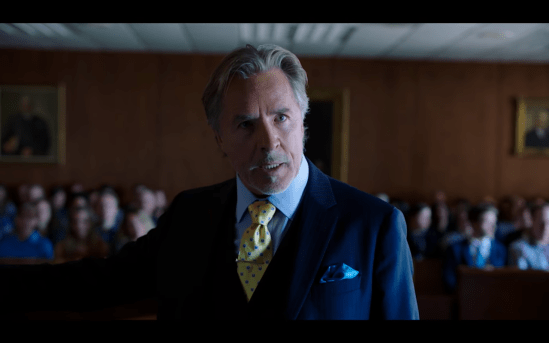
The introduction of detective John Dromoor staked out in his undercover squad car with a partner whose planning to pop the question to his girlfriend with a diamond ring. As his partner proudly displays the marital finger token, Dromoor is all business; in fact, Dromoor is all business, all the time. Reserved like Catholic deacon and deadly with firearms, Dromoor doesn’t have time to crack a smile and shows little emotion even when being a proxy of vigilante justice for an friendly acquaintance. “Mandy” star Nicholas Cage doesn’t rightly fit this role. The charismatic and eccentric actor runs through John Dromoor sedated with horse tranquilizer symptoms of stultified sluggishness, but when the moment strikes, like a rattlesnake latching on in a blank of an eye, the killer charisma of rugged resilience comes to the forefront, a quality Cage portrays well, and with vengeance in the title, should have reared up and lasted more often to let the very fervid fiber of the word sink in. When Dromoor meets Teena for the first time in the bar, prior to attack, romance seemed to beguile them between Dromoors lack of personality and Teena’s giddy, if not superfluous flirty radiance as she provides him her call me digits, but there was no romance, or at least no more romance provided, afterwards. Straying not so far from her cheerleader pepped character in “The Cabin in the Woods,” Anna Hutchison douses herself in a familiar upbeat tempo that quickly burns out when her character becomes the victim of gang rape scene. The wake of that scene challenges Hutchison to be more than just a pretty face, but an emotionally and physically battered woman suffering from traumatic stress and slut shaming. Hutchison’s goes through the various stages of trauma and the powerful relevancy has more staying power than the whole Dromoor vengeance byproduct, sending Nicholas Cage’s retribution into more of a subplot gray area. The remaining cast includes Talitha Eliana Batemen (“Annabelle: Creation”), Deborah Kara Unger (“Silent Hill”), Joshua Mikel (“Last Shift”), Rocco Nugent (“Dracula: The Impaler”), Joe Ochterbeck, Carter Burch, and “Miami Vice’s” very own Don Johnson as the hot shot prick lawyer, Jay Kirkpatrick.

Having coursed through the film’s various themes of rape, shaming, and the malfunctioning legal system, one more important theme inherently stands out with real pertinent clout issues. While two suspects, who are brothers, are arrested by Dromoor and his public servant colleagues, their venomous mother pursues hellfire guidance from a priest of the Catholic faith and as the father offers his spiritual insights, which is harmlessly conventional within the priest’s parameters, he also provides contact information for an expensive lawyer who represents the ill repute. Layers upon layers of thick symbolize can be extracted from the brief allegory, like an onion being unraveled toward a rotten core, unveiling the lengths and means of religious impurities. The fact that this priest knows of and has contact information for a powerful defensive attorney really speaks to Joyce Carol Oates’ deep-seated opinions rolled up in a single brilliant scene, but that’s where the momentum unfortunately ceases. There’s a schlepped through court hearing that’s entertaining enough and Dromoor’s barbaric rogue undertaking of the law that dishes out cold-hearted kills, but aspiration to convey more substance loses steam, the editing is systematically chunky, and Dromoor has this weird dynamic with Teena and her daughter that feels unintentionally stalker-ish and predatory. Yes, Dromoor protects and serves with unauthorized capital punishment, but without providing a deeper context of his purpose to what really motivates him to do what he’s doing, the act of retribution impressions another pressed upon imposition toward a mother and daughter’s prolonged anguish and feels more gross than justified.

FilmRise and MVDVisual distributes “Vengeance: A Love Story” on a full HD, 1080p Blu-ray presented in a widescreen, 1.85:1 aspect ratio, and the digitally shot video remains untarnished by nature or, lack of, age. No compression issues with the image quality and colors are super vibrant with a wide range of hues to take absorb. Skin tones, night scenes, and even the minimal visual effects address pinpoint consistency throughout. The English DTS-HD 5.1 surround audio track favors a strong, upfront dialogue track leveled with score and ambiance. The surround sound quality, when suitable, explodes through the channels with evidently solid range and depth. Runtime is 100 minutes and there are no other bonus features other than the film’s trailer, which has been consistent with FilmRise distributed releases. Nicholas Cage’s usual droll is riding the pine in “Vengeance: A Love Story” as if the Academy Award Winner wasn’t being paid enough to speak or act madly so he mentally sat this vendetta thriller out; however, the story has meaningful aspirations and the violence, though fleeting, is spiteful and merciless, framed around with tactless pacing, gratuitous macho shots, and circumstantial, at best, motivational retribution.

Click Above to Purchase the Blu-ray!