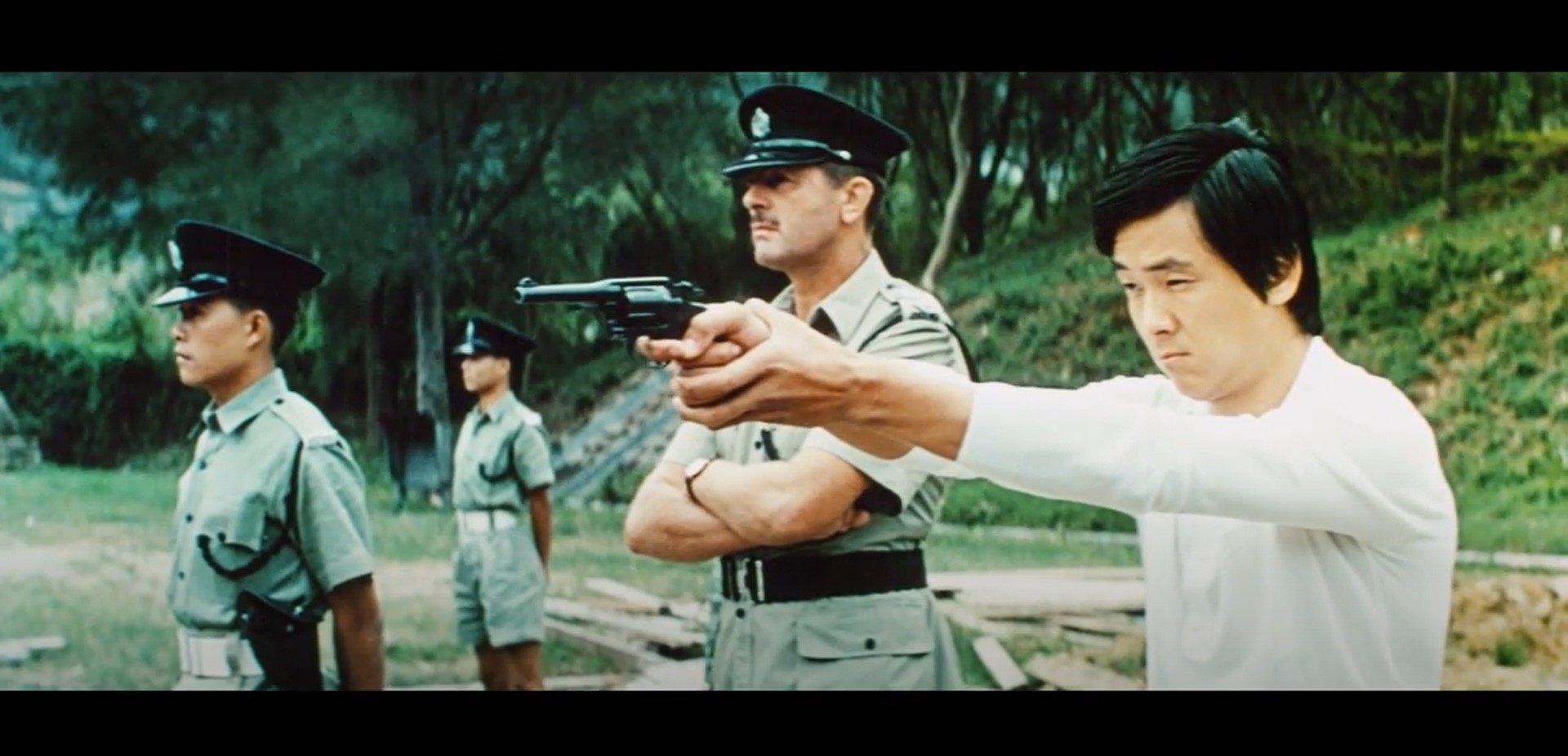
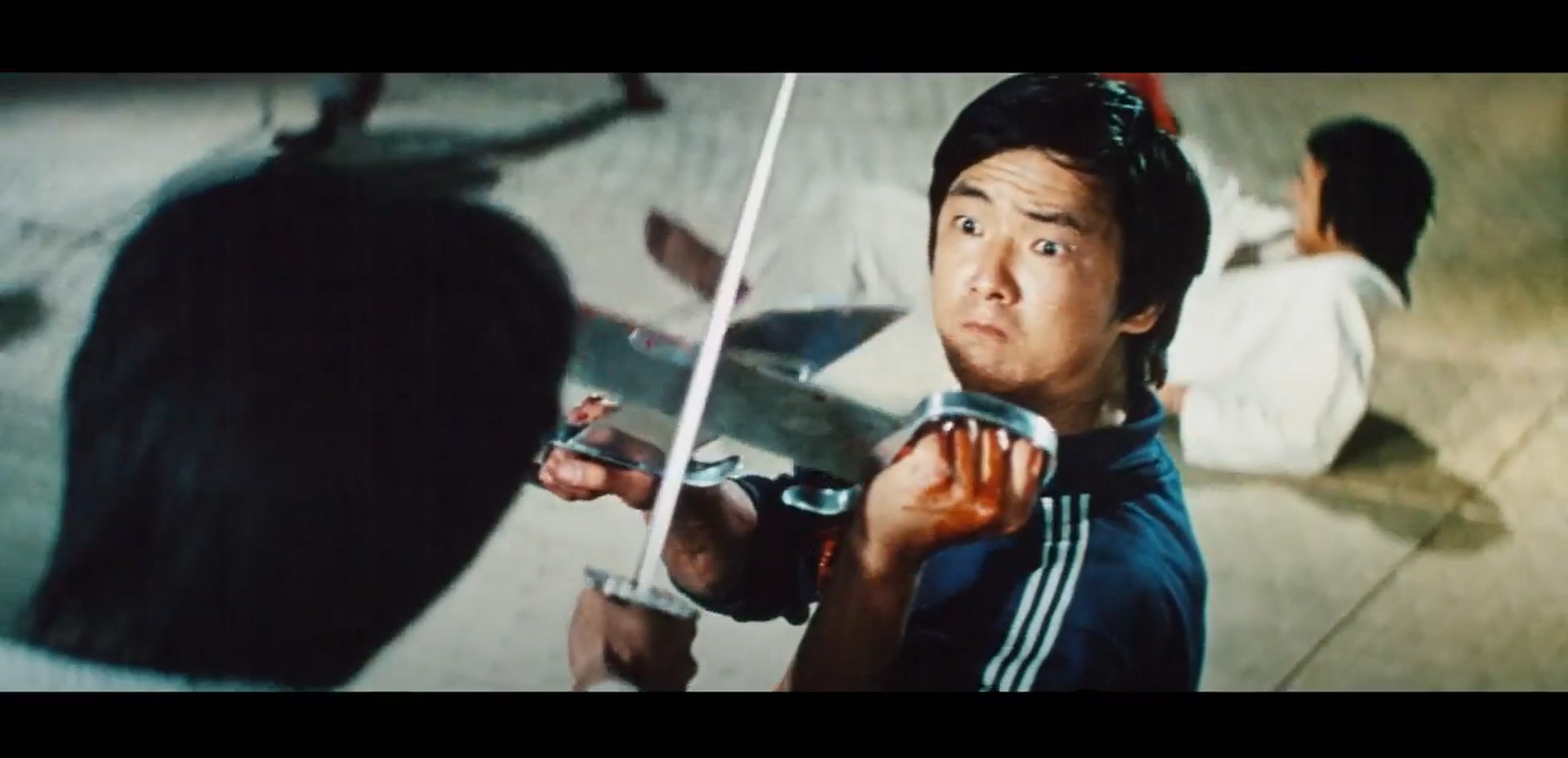
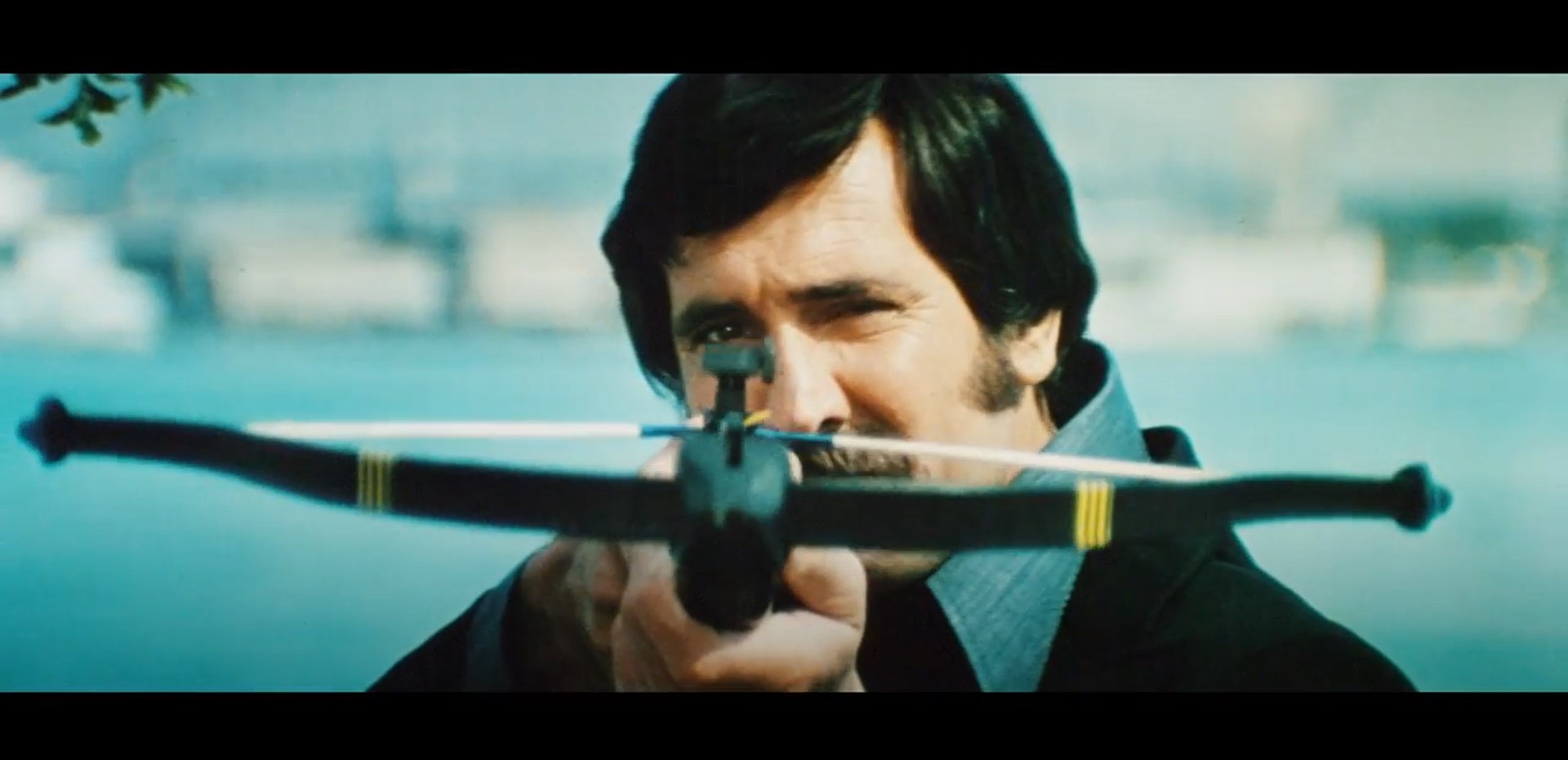
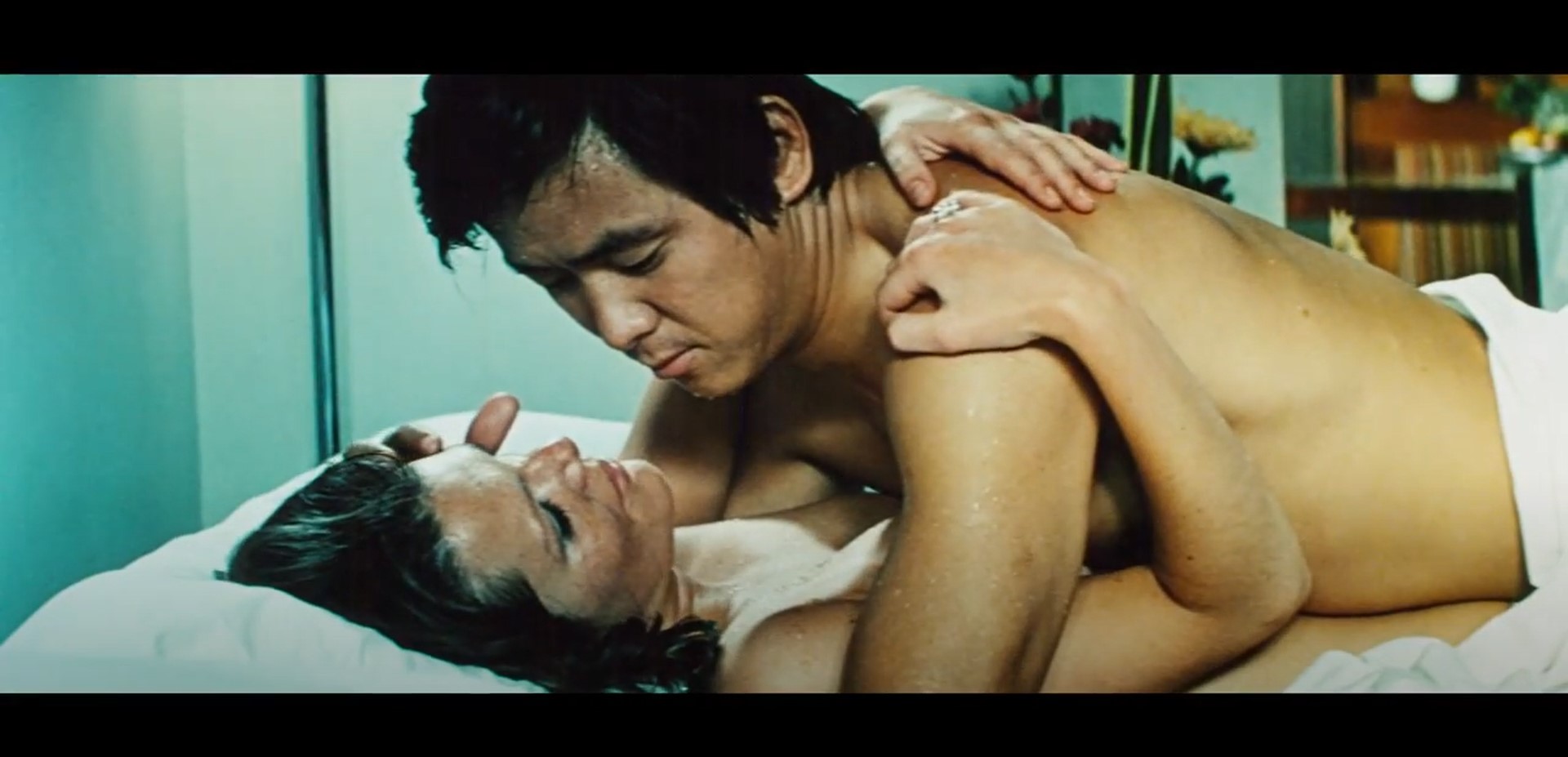
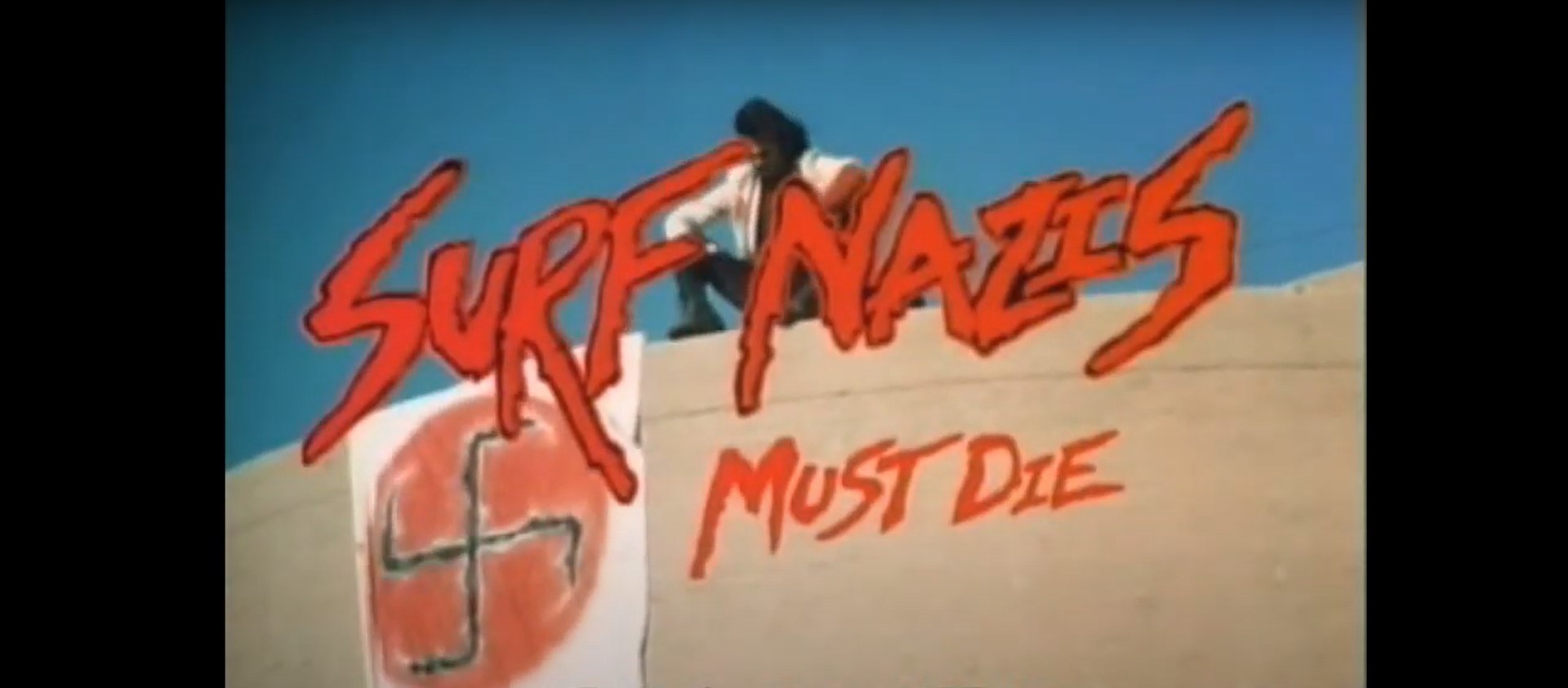
The waves of Power Beach wash ashore red with the blood of territorial gang war. Wiping out is not an option for the Nazis, the largest and strongest wave riders consisting of new age Neo-Nazis led by Adolf, his lady Eva, and ingenious welding right hand Mengele. As they surf for turf, the Nazis strong arm the rival gangs into a no choice option of calling a truce amongst themselves to attack and take down the Krauts and regain control over the towering waves and lucrative scores of Power Beach. Caught in the middle is Leroy, a young black man who becomes gang war collateral damage on the unsafe beaches. When Eleanor “Mama” Washington gets wind of those responsible for her son’s death, she’s blitzkriegs the surf Nazi’s of Power Beach with her own brand of grenade throwing justice.
Ever since being highly promoted at random on Alex Powers’ wannabe Troma film “Sadistic Eroticism” starring adult film actress Sophie Dee, perhaps as Powers’ favorite Troma release, seeing “Surf Nazis Must Die” tickled the curiosity of the olfactory snout and became one of those must watch titles canonized with outrageous, off-color content that’s routine for the Lloyd Kaufman and Michael Herz independent shock-and-comedy distributor, Troma Films. Peter George directed his semi-serious, mostly satirical-toned debut film from a Jon Ayre script based off George’s original story idea of incorporating the territorial surfer scene of California with a laying siege, post-apocalyptic, gang and revenge narrative that’s a delectable smorgasbord buffet of low-budget subgenres. Perfectly situated in front of deep-water oil rigs and the towering smokestacks of power plants and other various manufactories along California’s graffiti-cladded Huntington Beach, “Surf Nazis Must Die” is a production of Peter George’s The Institute alongside company co-owners in editor Craig A. Colton and producer Robert Tinnell (“Frankenstein and Me”).
Tennessee born actress Gail Neely receives her big break in a lead role of a feature film. Lamentably, that film was full of bad taste and full of punk surfers with red painted swastikas on their black wetsuits who also paralleled nefariously notorious figures of bigotry and war crimes against anyone not white Anglo-Saxon. Yes, Neely is a black actress pitted against and taking revenge on a group of racist thugs, a narrative we’ve seen before, but the “Naked Gun 2 ½: The Smell of Fear” actress took an unjust backseat (an unfortunate and unintended Rosa Parks pun) in sharing the lead with the very Nazis she ruthless takes head on. Trying to understand why Peter George and Jon Ayre decided to focus more on the strategic overthrows of gangland rather than to journey Mama Washington’s revenge in her death wish arch is beyond comprehension in a lopsided narrative that gives more screen time to Nazis and gangs than it does a grieving, nursing home-residing, mother hellbent on avenging her slain son with vigilantism. The latter is a much better story that breaks up the stagnant gang mentality unwavering throughout. Neely does her best to pull audiences back into the revenge fold with a grit and attitude that takes us back to 1970’s blaxploitation films of yore, but ultimately, “Maniac Cop’s” Barry Brenner and “Star Slammers’” Dawn Wildsmith and Michael Sonye inadvertently bleed out Neely’s full potential with their respective Nazi counterparts – Adolf, Eva, and Mengele – and their intercompany squabbles and beach brawls against rival gangs. “Surf Nazis Must Die’s” cast rounds out with Robert Harden (“Dead Girls”) as Leroy, Joel Hile (“Deadly Friend”) as Hook, Gene Mitchell as Brutus, and Tom Shell (“Hard Rock Nightmare”) as Smeg.
With a title like “Surf Nazis Must Die,” the expectation bar was high to bequeath audiences guaranteed politically incorrect exploitation and sizable good versus bad mayhem crashing like a cacophonic wave on the surf. “Surf Nazis Must Die” does meet that brazen bar that associates surf territorialism to the likes of Nazism by way of excluding outsiders from their surf turf and be nasty about it as well. Would I compare it to Nazism? Probably not, but in the heat of control and power over others less fortunate in riding waves might draw a vague resemblance. In a bit of satire and irony, 1940s Nazi Germany was ruled by an extremely authoritarian people running a tight ship in every facet from the meticulous armed ranks to innovative engineering to the ostentatious decorated halls and buildings of propaganda and flag hoisting pageantry, but Peter George’s Nazis, granted the new age variety, plague themselves about the beach, living off stolen goods while driving around in a makeshift shark modified van, tanning their mostly exposed bodies, or dressed in graffiti stylized wetsuits and trench coats with glitter-face painted swastikas. The characters are cuter in caricatures than they are in terrorizing tyrants of the beach. What’s even more interesting about “Surf Nazis Must Die” is that none of the gangs carry firearms despite one of the popular Troma cover arts displaying an archetypal lampooned Nazi riding a wave and wielding an Uzi. The “Clockwork Orange” gangs meandering about with unprovoked violence carry traditional switchblades, nontraditional switchblade surfboards, nunchakus, staffs, a hook for an arm, and there’s even one guy with a speargun. Only Mama Washington is armed to the teeth with conventional weaponry of grenades and a handgun that makes this film even more unfathomable at times.
Thirty-five years later, “Surf Nazis Must Die” continues to make waves a war zone with a new Blu-ray released from Troma Films and distributed by MVD Visual. The newly restored, newly remastered, high-definition region free Blu-ray is presented in a widescreen 16×9 aspect ratio from the original 35mm negative and is not quite the fully uncut version, running two minutes short at 83 minutes from the director’s cut that circulates overseas. The color matte lacks bounteous vision that fails to give range to the graffiti art amongst other aspects. The transfer has little-to-no blights with some transparent vertical scratches in a single frame but nothing else more to note. George and editor Craig A. Colton work their magic on a remarkable cutting room performance with splicing in Hawaiian surfing footage with the Huntington Beach narrative in a near seamless manner. The English language lossy LPCM 2.0 track doesn’t hook into you with a linear fidelity with no range or depth but does provide fair dialogue clarity and no impeding audible damage. “Terror Eyes” and “Future Shock’s” Jon McCallum has a fantastic synth score that pulsates life into the overabundance of stagnant moments and the film is worth a watch just for McCallum’s soundtrack alone. Gnarly special features include a new introduction by a locked down stricken Lloyd Kaufman diving into his pool to take a bath, a circa late 80s/early 90s interview with Peter Geoge conducted by the enthusiastic Lloyd Kaufman, another circa late 80s/early 90s snippet interview with producer Robin Tinell, a pair of deleted scenes with Peter George commentary, scenes from the Tromaville Cafe, Radiation March Promo against pollution, a pair of archived Troma NOW PSA announcements that are as sexually titillating as they are meaningful in their message, a Soul of Troma promo trailer,” “Latched” short, and various other Troma promos: Indie artists vs cartels, Lloyd Kaufman gets “fucked” by the Hollywood system, and Lloyd Kaufman’s Audiobiography. There’s also mention of a “Gizzard Face” promo, but I did not see it as an option in the bonus content. “Surf Nazis Must Die” inches along and loses a lot of key momentum along the way building around the striking title. Eventually, the undercutting of gang machoism crumbles away to leave an open path for Mama Washington’s full-blown assault as a true cinematic Nazi hunter extraordinaire.
Sylvia Kristel. A name that is synonymous to eroticism. Kristel paved the way in mainstreaming seductive romances of softcore exploits, helping to elevate the provocative genre out of the depths of sleaze and into a more exotic trashy novel for the big screen. In her titular role in the “Emmanuelle” franchise coursed an arousing path of sexual freedom, uninhibition, and became the sumptuous and worldly window in private fantasies. Playing the role for nearly two decades didn’t stop Kristel from other high profile and lucrative projects with an array of filmmakers as well as her roles pre-“Emmanuelle” that molded the Netherlands actress into a sexual icon rather than object of male fantasies. Cult Epics acquires four films – “Playing with Fire,” “Pastorale 1943,” “Mysteries,” and “Julia” – that even though didn’t have Kristel set as a principal lead still showcased her range within the constraints of a minor, but certainly not insignificant, performance.
“Playing With Fire”
In a madcap Paris where sex trafficking is something of a sport, a wealthy French banker learns his daughter has been kidnap and threatened to be tricked out or burned alive if the kidnappers’ ransom isn’t paid. Quickly learning that another woman has been mistaken for his daughter, a wave of relief bestows him to be cautious about future attempts on his daughter’s safety. The banker hires a private detective to protect his loveliest of assets, offering to escort her to a local safehouse with the promise of sanctuary, but the P.I. is operating incognito being really one of the leaders of a surreal and lavish brothel who now has the banker’s beautiful daughter in his possession. Or is it her who possesses him?
Unlike any other exploitation-comedy you’ve likely ever seen, the 1975 released “Playing with Fire,” aka “Le jeu avec le feu,” is a wacky deep-dive of surrealistic sex trafficking from French writer-director Alain Robbe-Grillet whose obsession with prostitution rings and other filmic eroticism pursuits extends back within a decade later with “L’Immortelle,” aka “The Immortal One,” and “Successive Slidings of Pleasure.” A French production of Arcadie Productions, Madeleine Films, and Cinecompany, “Playing with Fire” masters the avant-garde art of making light of a grim topic that results in a pull of emotions. Robbe-Grillet draws out the shocking aspects of sex slavery while also encouraging a smirk or a chuckle at the whimsical characters and shooting techniques weaved throughout a burlesque narrative. Robbe-Grillet also plays with the theme of dualities with a number of the principal characters having two or more versions of themselves: Philippe Noriet plays not only the banker father Georges de Saxe but also a voiceless sleaze erotically interacting with the banker’s daughter in a very Freudian concept between father-daughter relations. His daughter, Carolina (Anicée Alvina), disguises herself as the thin-mustached private detective to thwart future any attempt at an abduction and there’s also the identity mishap with the similar looking woman mistakenly kidnapped by the ringleader. Leading us into Jean-Louis Trintignant as the ringleader Franz constantly in a revolving door switch-a-roo façade into the private detective. The presence of duality doesn’t stop being a present throughout, continuing with the banker’s butler who is also a whorehouse patron without affirmation that they’re the one and same person. Before their illegal banishment in the mid-20th century, Brothels were widely dispersed throughout Paris, but not until the Nazi occupation absorbed the houses of ill-repute that seared a bad taste of deviant humiliation and sordid disgust into the mouths’ of the French populace and Robbe-Grillet taps into that once time of unrest by splicing in a pair of isolating scenes of goose-stepping Nazi soldiers with one of the moments garmenting Anicée Alvina in uniform and marching in the ranks, suggesting a more sinister subplot afoot in the storyline. Kristel plays one of the women snatched by Trintignant’s efficiently devious Franz with virtual a voiceless performance in what’s only a symbol of strength and beauty that sets perversion ablaze as she’s taken through the motions of essentially onboarding her into slavery whoredom. “Playing With Fire” can be at times difficult to keep up with the Alice in Wonderland-like surrealism and the character dualism but persists unwaveringly with a multi-faceted narration of deceit, eroticism, and comedy full of perversions and random outbursts akin to satirical skits that make this film unpredictable yet enjoyable to behold.
Pastorale 1943
During the Nazi occupation of the Netherlands, a quaint Dutch farming village lives day-to-day alongside soldiers and German sympathizers known as National Socialists (NSB) to the Nazis, traitors to their fellow Dutch countrymen. When the Nazis learn of and round up all the dissidents and Jewish heritage people living in hiding on an adjacent, ferryboat island, a small band of unorganized resistant fighters determine the local pharmacist, a NSB member, to be the Nazi collaborator responsible for the treacherous leaking of information because his son impregnates an island village girl, teetering toward the fascist movement when mocked by her peers for her involvement with the pharmacist’s son. Inexperienced in the execution of traitors, the bungling resistance fighters learn just how difficult planning a murder can be when their scheme falls apart in a small village where everybody knows everybody.
On this second of four Sylvia Kristel features is the Spieghel Filmproductiemaatschaappij of “Pastorale 1943” which makes more prominent the Nazi regime, is set with a backdrop of a Nazi occupied Netherland town and has a cameo role of young and dashing Rutger Hauer (“Blind Fury,” “The Hitcher”). Netherland writer-director Wim Verstappen, whose had a few titles released previously from Cult Epics, such as “Obsessions” and “Blue Movie,” develops a script out of the World War II drama novel from author Simon Vestdijk with black comedic undertones and a tinge of corrosive sexuality and released the film in 1978. Pastorale, or Pastoral, refers to the typically calm and idyllic country life which the complete opposite in 1943 Netherlands with all of Europe and East Asia engulfed in war; however, this story takes place in its own corner of the world with a mini, damn near microscopic, war waged between the Nazis occupation along with domestic NSB collaborators and the inhabitants resisting against the encroaching fascism that has plagued revenue crops and instilled an authoritarian culture, such as mandating the teaching of the German language to students in Dutch schools. Kristel’s involvement with Verstappen’s “Pastorale 1943” is about as much as her involvement in “Playing With Fire” with a minor role that’s still a keystone piece to the narrative. She plays Miep Algera, a local schoolteacher disparaged by her neighbors and colleagues for having romantic relations with a Nazi officer, but has she really fallen for the officer or is she secretly conducting counterintelligence for the resistance? “Pastorale 1943’s” two-part story plays heavily embroiling and embroidering characters in the first half to the point of instituting a cornerstone character but when the narrative pivots, to the darker side of implied Nazi exterminations and the fumbling through the execution of a rightfully innocent man, Verstappen homes in on Frederik de Groot as the artist Johan Schults whose Germanic surname causes him much strife amongst his Dutch brethren but to prove himself, Schults takes charge, along with an equally green execution squad of resistance politicians, to murder the NSB collaborator, a local pharmacist Poerstamper (Bernard Droog). The Academy Award submitted “Pastorale 1943” can be light and funny then turn quickly on a dime into wartime darkness and director Wim Verstappen’s vision pops with epic World War II fascism atrocities, confined to one part of the world and without the explicit voyeurism of genocide.
“Mysteries”
After the strange suicidal death of a man named Karlson, Johan Nagel arrives to the coastal town where the death occurred. Immediately, Nagel stands out from the supercilious eccentric residents with his mustard yellow suit and fur coat, dispensing small cigars and money to everyone and every service as if they were infinite, and exhibits his own brand of strange behavior, especially with amorous feelings between two women and an unlikely friendship with a dwarf who has accepted his neighbors’ belittling jabs for humorous pleasure. As his behavior declines, Nagel’s presence unravels the coiled, seemingly impenetrable, barriers around his friends, his enemies, and his romantic pursuits that reshape their properties for the better at the dangers of his own sanity and life.
Finally, we’re at a point in the Sylvia Kristel collection where the titular star is in a lead role with this demolition of concrete idiosyncratic personalities melodrama entitled “Mysteries” from Dutch filmmaker Paul de Lussanet, based off a novel “Mysterier” by Knut Hamsun, with Sigma Film Productions as the production company. Kristel plays the steely Dany Kielland who becomes the infatuation of Nagel in an oppositional performance beautifully deranged and conducted by Rutger Hauer. The hot-and-cold and on the brink of frustration relationship between Kielland and Nagel is as resolved as an unfinished breakfast left to waste and void of complete nutrition as both characters digest morsels of desire only to explode in a frenzy of loathsome disgust in an unsavory, brittle dynamic only Hauer and Kristel could produce on screen. The other love interest involved, yet hardly feels as such until the last half hour, is an aged and more humble Martha Gude portrayed by “Last Night in Soho” British actress Rita Tushingham complete with a poor-looking frosty-colored wig. Kielland and Gude represent the two-side of society – rich and poor respectively – stuck mastering a stanch stance of an indeterminate state that Nagel barrels into and knocks down the status quo, like a bowling ball to ten pins, for the better of the coastal town. None of what Nagel does seemingly makes any sense and that’s very true to Hamsun’s novel in the unconventional, and probably unintentional, methods of Nagel’s erratic influence. “Time Bandit’s” David Rappaport debuts in his first feature film as Grogard, an achondroplasia character bulled by most of the town’s residents due to his disorder. Grogard anecdotally tells the story as “Mysteries” narrator, as if reading straight from Hamsun’s novel, the recollection of Nagel’s dichotomic behavior and, at the same time, Nagel also being a mentor, protector, and a friend that pained Grogard to watch his friend whither to death in fit of emotional exhaustion. “Mysteries” borders arthouse cinema, adaptive faithfulness, and pristine melodramatic performance that sound good in theory but not always translate well to the screen, leaving more of a perplexing impression on the whole purpose of rendering Knut Hamsun’s novel into film in the first place.
“Julia”
Every year, Patrick departs his boarding school for a short holiday with his father and relatives at his grandmother’s idyllic lakeside house. While riding the train en route to his grandmother’s, he encounters an older, yet beautiful, blonde woman inside the passenger carriage car and before he can firm up courage to act upon his sexual brimming hormones, the blonde is swept up by an older gentleman right from under his nose. Come to find out, the blonde woman is actually his father’s girlfriend in a completely open relationship when it boils down to sex. Anxious about his own insecure sexual appetite, Patrick finds himself surrounded by the perversions of his family and friends, leaving the young man hesitant and nearly impotent in bedding the woman he actually cares about, a longtime friend Julia who lives next door to his grandmother.
On the heels of “Emmanuelle,” Sylvia Kristel follows up with another licentious freedom film in Sigi Rothemund’s “Julia.” Also known as “Summer Girl” or “Die Nichte der O,” the German production from the Lisa-Film company is the earliest film on the 1970s collection with a release in 1974 and is the only other screenplay on the collection next to “Playing with Fire” that is not adapted from literature. Instead, “Julia” is a wild romp ride of young sexual exploration and the anxieties that accompany it from an outlandish and witty script by Wolfgang Bauer. “Julia” might not be based off a book, but the story is certainly an unapologetically open book about the insignificance of virginity, polyamorous affairs, lesbianism, voyeurism, and the sexual rite of passage into adulthood with the young and naive principal Patrick, or Pauli as credited, played by the late Ekkehardt Belle who passed away in January of this year. Opposite Belle, Sylvia Kristel obviously dons the titular role of Julia. Inexplicably voluptuously different from the other three films on the collection, Kristel radiates a sexual aurora perhaps infected by proxy of its release soon after “Emmanuelle” as Kristel obvious branches out to more sensible dramatic roles rather than the decor of a German sex comedy such as “Julia” that galvanized by its free-for-all eccentric caricatures including an operatic, overweight, and perverse uncle Uncle Alex (Peter Berling, “When Women Were Called Virgins”), a highly aggressive lesbian in Aunt Myriam (Gisela Hahn, “Devil Hunter”), the house maid Silvana who Myrian seduces with whipped cream and has piano-top sex (Christine Glasner), and his polyamorous father Ralph (Jean-Claude Bouillion, “The Sextorvert”) and girlfriend Yvonne (Teri Tordai, “She Lost Her…You Know What”). Comparatively flimsy next to “Emmanuelle” as a sexual journey and coming of age film but “Julia” is a hot-to-trot sex comedy with funny bits as well as sultry naught bits too.
Beautifully curated for the first time ever release in the United States of all four films is Cult Epics’ “Sylvia Kristel: 1970s Collection” on Blu-ray and DVD. The 4-disc, uncut Blu-ray, which was provided for coverage, is region free, limited to 2500 copies, and perfectly packaging to extol praise upon the robust early career of Sylvia Kristel. Presented in European widescreen 1:66:1 (with the exception of “Playing with Fire” which is displayed in an anamorphic 2:35:1), each film is newly scanned in 2K from the original 35mm elements as well as been restored. Transfers for the most part are exquisitely pristine, each harboring their own mise-en-scene mélange, but some are better than others with “Mysteries” sitting at the bottom rung of showing slightly a few more scratches and one-or-two single frame damages that flame up through the reel briefly. “Julia” also has minor scratches, but that’s really the extent of the issues with the image quality on this restored visual released with a rich color palette and textures redefined for a better palpability. Compression issues are virtually non-existent and there are no tinkering enhancements or cropping used to skirt transfer limitations. I am in awe of the audio output of the 1920kps bitrate, transmitting the highest audio quality possible for each release through either DTS-HD Master Audio 2.0 or a LCPM 2.0. Dialogue clarity comes through cleanly with French in “Playing with Fire,” Dutch and German in “Pastorale 1943,” and German in “Julia.” “Mysteries” sounds a bit muddle sometimes due to the consistently background popping interference, but the Dutch language still pulls through strongly and discernibly. Each film comes with optional English subtitles. Special features are aplenty with audio commentaries by Tim Lucas, Jeremy Richey, and Peter W. Verstraten, new and vintage interviews and promotional footage with cast and crew on ‘Playing with Fire,” “Pastorale 1943,” and “Mysteries,” a poster and still gallery on each release, and original theatrical trailers. Outside the disc contents, the collection’s rugged cardboard boxset housing unit consists of a 4-disc snapper case with vintage-still collage cover art, a 40-page illustrated booklet with color pictures and an essay on all four films written by Jeremy Richey, and a cover art poster by Gilles Vranckx. Total runtime is 429 minutes, enough to get your Syliva Kristel fill and then want more…much more. The “Sylvia Kristel: 1970s Collection” lauds the actress’s versatility of performances and ability to work with any director from any country and fans who love “Emmanuelle,” or of just Kristel, will undoubtedly fall in love with this Cult Epics comprehensive look at the Dutch icon’s outermost filmography.
Grant Page is a world-famous veteran stunt man from Australia and his new big project, a high octane, thrilling action move feature packed with car chases, fire sequences, and death-defying falls set in Hollywood, California. When he arrives, his cousin Curtis picks up from the airport and shows him around, ending up at the recording studio where Curtis’s band Sorcery is lays down tracks for their upcoming album. Between Grant’s thrilling high flying, quick burning stuntman work and the band’s theatrical heavy rock and magic trick performances, a showcase of entertainment energizes the soul as well as entertains it. Before long, a column journalist Lois Willis aims to get Grant’s story on occupational health and lifestyles. They’re joined by Grant’s costar of the film, leading lady Monique van de Ven, and together they rock out and enjoy the daredevil antics like one big life party.
Unique in format and content, “Stunt Rock” reflects upon the ostentatious career of director Brian Trenchard-Smith. Before immersing himself in straight-to-video sequels of “The Omega Code,” “Night of the Demons,” and “Leprechaun,” Trenchard-Smith had a talent for being unabashed and taking risks in making something different. Thus, an 86-minute one-part showcasing demo reel, one-part fictional story, and one-part heavy rock music video was born from a slew of Trenchard-Smith shot achieve footage highlighting the impressive physicality resume of the one and only Grant Page. In 1978, “Stunt Rock’s” short theatrical run assumed the picture too radical for the general public with a motley crew of characters and a get-to-know Grant Page storyline that interjected the heavy rock, or borderline glam rock, of Sorcery, a five-piece band accompanied by two magicians whose illusions and pyrotechnics were performed live on stage as the musicians rocked out. Only recently has “Stunt Rock” re-emerged onto home video due in part to the advocating acolytes of the now defunct by not forgotten band and has become a wonderous and enriching blast from the past of reliving decades old history, contrasting artistry cooperating under one umbrella, and a deluge of rock and master class stunts. Also known as “Crash” or “Sorcery,” Martin Fink produces the quasi-action docu-musical with Trenchard filming under his own banner, Trenchard Films.
Grant Page, a man you may never recognize in name or face but probably have seen his broad list of service work at least a dozen times or more. “Mad Dog Morgan.” Yup, Page did the stunts. “No Escape.” Yup, that too. “Mad Max.” That as well! Between performing the stunts and a stunt coordinator, Grant Page has achieved over 100 credits to his name, but not until receiving the lead role in “Stunt Rock” is where he actually got to be himself…literally. Trenchard-Smith’s goal was to put Grant Page on a platform having worked with the stuntman on previous films, such as “Deathcheaters” and “The Man from Hong Kong,” putting his career, and life, on the line numerous times. Page is charming and collected under his rugged facial hair and glasses atop a muscular physique as he’s paired to cohabitate with the latter half of two-word title. Grant Page is stunt whereas Sorcery is rock. Consisting of, at the time, members of the Americna rock group were front man Greg Magie, bass Ritchie King, guitarist Smokey Huff, drummer Perry Morris, and Keyboardist Doug Loch who always wore a glitzy or colorful stocking mask with had his vocals adjusted to a higher pitch. There were also two highly skillful stage performing magicians in Paul Haynes as the bearded King of all Wizards, Merlin, and Curtis James Hyde as Haynes on stage villainous counterpart, the Prince of Darkness aka Satan. In between the two rip-and-roaring personas is a reporter working on a column piece and Grant becomes her angled subject. Brian Trenchard-Smith’s wife of 40+ years is Margaret Gerard in the role of Lois Wills, a love interest who doesn’t quite understand Grant’s obsession with intentional self-destruction as a profession but quickly falls for the big hunk despite any real tangible flirtation. Across the aisle at the other end of female perspective is Monique van de Ven playing as herself. The Netherlands actress, who mastered the art being in a catch-22 love triangle between her longtime husband and her adventurous and new female lover in “A Woman Like Eve,” is positioned in “Stunt Rock” as certifier of the fake movie Grant is there to stunt for being the leading actress eager to do what Grant does, the stunt work, at the chagrin of her asset protecting agent.
“Stunt Rock” may not be our bread-and-butter material for review, containing a severe lack of ghastly horror, creature horror, sleazy exploitation, gore and shock, phantasmagoria schlock, etc. Instead, what “Stunt Rock” is is a pure, 100%, grade A cult classic title that goes beyond the baseline criteria for critique, as if the film even needed our insignificant stamp of world cinema approval. Absolutely not, as “Stunt Rock” speaks for itself, literally so in the very title, delivering essentially what the film is selling, documenting, exhibiting, and entertaining along with the caveat to be a career booster and an endearing tribute for director Trenchard-Smith’s much adored and highly respected Grant Page. The way Trenchard-Smith fashions his own shot stock footage of Page’s exhilarating and adrenaline junky spectacles into flashbacks, split screens, and just a reel of collected examples whenever Page goes into specific memories of stunts, a montage of similar acts, or even how he feels before or during the performance never bogs down into arrogant gray area on the part of feature’s star. Only the director behind the one-two punch “Day of the Panther” and “Strike of the Panther” could pull of “Stunt Rock’s” insanity on celluloid, rock on reel, and a cloud nine high on a combination of both.
“Stunt Rock” is more than just assemblage of electrifying stunts as it also brings down, as well as breaks down, stunt work as not this grandiloquent behavior but more about precision, planning, and self-care with some mild levels of egomania to do things bigger, better, and more dangerous. All of this great content is now on coming at you on a Blu-ray home video from Umbrella Entertainment as the 8th spine on their Ozploitation Classics label. Presented in a widescreen 2.35:1 in full high definition, 1080p, the region free Australian release is a fury of packed goodness, in all sense of the term. Rated PG, “Stunt Rock” is about as wholesome as a PG film came come that even comes with an opening disclaimer about not trying these stunts at home, so parents open your children’s eyes to “Stunt Rock!” As far as image quality is concerned, Umbrella’s release perfects the natural-looking colorization by adding a pop of robust color, unintrusive grain, and baring miniscule blemishes. Most of the film is shot in 35mm, but some of the older footage Trenchard-Smith shot on Grant Page is in 16mm and the varying levels of difference in the details can play tricks on the mind with the stark contrast. The English language DTS-HD Master Audio 2.0 is a solid track. Dubbing can tilt an audio imbalance in the depth around certain dialogued moments, but for the most part, no compression issues leave a clean and clear outcome with even an array of well-recording Sorcery tracks and capturing all the fine details in their pyrotechnic and smoke and mirror shows in front of a live high school audience. This Blu-ray is packed with special features beginning with an exclusive virtual interview with Brian Trenchard-Smith and his wife/leading lady Margaret Gerard at their home in Oregon going over every facet in the genesis and aftermath of “Stunt Rock,” plus 2008 interviews with Grant Page and the director from Not Quite Hollywood segment, 2008 audio commentary from Page and Trenchard-Smith, 2009 audio commentary from the director, producer Marty Fink, and actor Richard Blackburn, a 2009 introduction to the film, extended interviews with Sorcery guitarist Smokey Huff and Marty Fink, 2009 audio interview with the band’s drummer Perry Morris, Brian Trenchard-Smith’s Alamo Drafthouse Appearance, Cannes Promo Reel, a HD theatrical trailer, an exclusive new Trenchard-Smith approved trailer reel, and more audio commentary from the director in Trailers from Hell. And that’s not all! Beyond the colorfully retro-esque slipcover and snapper cast with reversible cover art with the film’s posters on the inside is a 14-page collectible comic book with the abridged illustrated version of the film. “Stunt Rock” is an amazing, one-of-a-kind film with now a one-of-a-kind Blu-ray release from Umbrella Entertainment sure to be a must-own for any fans of Brian Trenchard-Smith, Grant Page, or Sorcery!
A degenerate heavy metal rock band and their pressurized manager are cast off on their very first ever music tour by their financing dictatorial mogul eager to recoup his investment as quickly as possible. While en route, their van breaks down at the edge of a small town who welcome them with open armed hospitality, warm accommodations, and a hot meal with the promise of a day turnaround on fixing their van for free. The next day proves to be a joyous occasion for the villagers celebrating their patron saint and little does the band know they’re an unwittingly big part of the ceremony as every villager is a ruthless cannibal ready to devour to the bone their haplessly stranded guests.
About as vile and gross as they come, “The Spanish Chainsaw Massacre” is a Spanish-bred, slop-house, comedy-horror that plucked from the horror history timeline an unfaithful and a stretch comparison to a portion of the iconic title from the 1974 “The Texas Chain Saw Massacre.” Writer-director Manolito Motosierra helms nothing remotely familiar to the Tobe Hooper classic, there’s barely the sweet exhaust coughing sound of a chainsaw ripping and shredding through Motosierra’s actual film, but “The Corpse Grinders 3” director has brought one well-known component to his film, lots of crazy long pig action! Originally titled more appropriately as “Carnivoros” – Carnivores – in Spain, the 2013 release only saw a U.S. release date merely 5 years ago in 2017 with supplementary prologue footage from Scorpio Film Releasing’s Richard Griffin and his entourage that bares big breasts as well as the only big chainsaw under its unaffiliated storyline of a woman double-double crossing two men to get away with $30K only to find herself inside a seedy hotel room and the unsuspecting starlet of her very own snuff film. Though I usually adore Griffin and Michael Thurber, who usually has a role in a Griffin release in some random capacity, the opening fits like a square peg being jammed into triangle hole, accumulating confusion more than making sense. “The Spanish Chainsaw Massacre” is a Fantastika Team and Olga Underground production presented by Tyrannosaurus Entertainment.
If you can get past all the fart and poop jokes, the band known as “The Metal Cocks” are the epitome of well-received degeneracy in their unromantic, polyamorous pansexual quickies, blatant addictive vices, and an overall uncouth behavior and appearances in a mockery of hair metal bands from the 80s. Dani Mesado as Rasputin, Óscar Gilbert Escarabajal as Petete, Torete playing himself as Torete, El Capitan Almendra as Bull, and Nereida López Vilaplana as Penny Pussy are Las Pollas del Metal – The Metal Cocks – taking on a rocking tour de force against insatiable backwoods cannibals of Spain. If you think the band is depraved, wait until you see the villagers’ madness for meat foul up the screen with a mangled dick scene (someone call the expert Felissa Rose!), an intestine eating contest straight from the gut, and the recipe with baking instructions for a popular diarrhea shake. With viciously varicolored characters like the Spanish whore (“Vampire: Hounds of Horror’s” Yolanda Berneguer), the unsanitary naked food prepping cook known as The Chef (“Fucking Bastard’s Tam Sempere Miro), and the murderous simpleton Guti (Michael Rodriguez) among others, a motley macabre bunch of crazed cannibals have systematic knowledge of separating and conquering their dinner, each involved in a role important to the façade that plays to the prey’s vulnerability before digging into their food with both hands clawing. Everything and everyone are over-the-top and that really defines the line between the cold simmering terror family of Texas massacre and the wild family of maniacs of the Spanish massacre; though the idiom says everything is bigger in Texas, Spain certainly has the most peculiar of películas between the two territories. “The Spanish Chainsaw Massacre” rounds out with Hilario Blas, Miriam Larragay, Ezequiel Campos-Zeta, Raul Dario Gandoy, Richardo Pastor, José Luís Tolosa, Mayama Lia, and Yolanda Diaz Dengra.
Gore aplenty! “The Spanish Chainsaw Massacre” bathes in troughs of blood as well as other human body fluids that make your eyes sink deeper into the back of your head while your eyes lids slowly act like shutters trying to protect the vision and mind pure of only the blood and not anything else. That task is a lost cause of impossibility as Motosierra lathers a thick, slick of sick onto every frame, leaving no grotesque rock unturned before and after the victims’ final curtain call. Yet, in the end, what Motorsierra constructs is the Looney-Toons of descendental cannibalism that’s full of maniacal laughter and delusional actions with no rhyme or reason to determine causality. The celebrated patron saint seems to require the villagers, or strongly encourages them, to act a fool, to put on a show, and to treat human meat as a delicacy to plunder. Neither The Metal Cocks nor the villagers receive a proper introduction, backstory, or arc in what is basically a show up and be present for gratuitous slaughter in a variety of random pockets that not all necessarily have to do with the band. In some scenes, an old military man is tied to a tree, sitting down, and being tossed firecrackers at this crotch while a clown eggs on the kids with frenzied laughter and, in another scene, two adolescent boys are tied to a tree standing and sliced across the belly so they’re intestines can be used for a food race. Where these characters came from is never touched upon or explained but understood that they’re a part of the festivities toward the patron saint. Like what AC/DC once said – if you want blood, you’ve got it! – with “The Spanish Chainsaw Massacre” having gallons of it.
“The Spanish Chainsaw Massacre” is a DVD re-release for the indie distributor, Wild Eye Releasing, as spine number 54 on the company’s Raw & Extreme sublabel. The DVD, distributed by MVD Visual, presents the 70 minute, 56 minutes of actual feature with 14 minutes of Richard Griffin’s snuff film preface, unrated film in a widescreen 1.78:1 aspect ratio. I really like this transfer from Wild Eye because of the sole fact of virtually no compressions issues obviously present and that’s not just because of the lack of bonus feature, which is common amongst most of Wild Eye’s library, on the DVD’s limited capacity. Previous studies on other single feature releases proved Wild Eye to be a mixed bag regarding quality. With “The Spanish Chainsaw Massacre,” the image quality is highly detailed and lush in black areas and in texture that makes Motosierra’s stomach-churning content that much more stomach-churning. The warm color palette of yellows and reds provides an exaggerated tint of a rural Spanish village. In contrary to the DVD back cover, the feature’s native language is not English but rather a Spanish 2.0 stereo track. Much of the dialogue track is all yelling synched well with the English subtitles that are not entirely accurate. The subtitles are extremely abridged and loosely translated. A robust metal soundtrack plays into the whole metal brand, but the other tracks lack depth as all outputs, much like the characters on screen, are upfront and loud; yet the compression handling sustains an agreeable fidelity with little no popping or screeching within or on the tail end. Bonus features include promo videos and the official trailer with a stretch into a credits gag reel of sorts with candid and shooting mistakes in crediting the cast and there’s also an end credit scene that setups the cannibal family’s return with a Christmas themed sequel. However, 9 years has passed and don’t think Motorsierra is working on any drafts at the moment. The snap case comes with reversible DVD cover art with a touched up-front cover not pulled from the film itself while the inside has a blown-up bloody aftermath still of the narrative’s first victim with a dislodged lower jaw and a hunk missing from her face. Ultra-indulgent with biofluid glop, “The Spanish Chainsaw Massacre” is a ruthless, toothless puta de madre of a film if you can get past the stink of butt humor.
Eccentric horror novelist Raymond Castle mysteriously dies alone in his New York City apartment. His daughter Jasmin, who never had a loving relationship with her father, returns to her childhood home, self-negative reminiscing about the strenuous verbal arguments between father and daughter with usual themes surrounding her playing with his valuable horror collectibles and her continuous use of the Spanish language despite his desires for an English only language household, but instead of finding the contents of his will or answers to who he really was a person, as a father, Jasmin discovers her father’s latest novel, an anthology collection based off the black magic spells of a 17th century that brings his short stories to life right there in the apartment with her.
I said it once and I’ll say it again until the day I die: horror anthologies are not my cup of tea. Sure, there are excellent oldies, aka classics, out there, like “Creepshow” and “Body Bags,” from the masters of horror and a handful of more modern, done-right, anthologies from filmmakers on their way to such a grandiose title within the “V/H/S” series, but the majority of micro-narratives nowadays are collected from the scrapings of the low-budget trash barrel due in part to the cost-efficiency of short films, shot over a lengthy stretch of time, brought together into a single feature and the types of slim budget stories can sustain a better reception in a shorter format instead of full-length one. Now, I’m not saying Zack and Spencer Snygg collaborated “Monsters in the Closet” falls into the latter category but as one of the first released films of 2022 to come across our ever-critical desk, the indie horror-comedy anthology needed to punch the living daylights out of use to begin the year and whether the Snyggs’ 4-episode, plus wraparound story, anthology slammed dunk or airballed will be covered below. “Monsters in the Closet” is a kickstarter project and a self-produced venture funded by a pair of sub-Hollywood filmmakers in Spencer Snygg, who has worked behind the scenes in the lighting department on some major films over the recent year, and a veteran indie softcore-horror director Zack whose has involvement with indie production companies like Troma and the New Jersey based E.I. Cinema, as you’ll see with a large, splayed display of E.I and Alternative Cinema posters strategically arranged as background fodder. It’s like a Misty Mundae poster celebration on exhibition.
The outer shell narrative that encompasses and unites each separate story entities begins with a frantic Tom C. Niksson as the diehard believer in his own success horror writer Raymond Castle, covered in blood, manically talking to himself, and in the throes of typing away before a cloaked stalker wielding a knife closes in on him. Niksson, who worked under Zack Snygg’s pseudonym, John Bacchus, in that Easter holiday E.I. Cinema favorite, “Beaster Day: Here Comes Peter Cottonhell,” steps into that looming, ever-present figurehead from the grave, delivering random dad joke dialogue while cozying up the audiences for an audiobook rendition of Castle’s latest bestseller, a black magic spell anthology of horror stories that come to fruition when read aloud. Other than his talking head role, Niksson’s involved in some contentious flashbacks with Jasmin as a child, but we never see Niksson and the adult Jasmin Flores (Jasmin) ever in the same scene together as the flashbacks are Jasmin voiceovers. Nikkson’s theatrical behavior perfectly suits the stagecraft atmospherics in erecting the gameshow-esque of a horror host whereas Flores is often stiff as a dry plank of wood. Limitations drawn from her lack of experience keep the actress’s timing and delivery often subdued in an obtuse and ungraceful character when escaping the ever-changing fiction-to-non-fiction villain of the minute. Jasmin, the character, is already inherently underwhelming in a role that has no purpose or buildup to understand her headspace surrounding the sudden death of her father. What do those flashbacks mean to her or are they just melancholic gibberish? And why isn’t she more interested in his death or even showing a lack of care for it? Throughout “Monsters in the Closet,” a fair amount of pleasantly surprising performances from the anthological works pull the overall project together better than those in the wraparound story. Along with a first person view zombie tale as the first short, Luke Couzens and Carmilla Crawford play newlywed new homeowners going through the frustrations of DIY Hell until they off each other with tools, the silver spoon Jordan Flippo becomes tarnished when a camping accident turns this rich daddy’s girl into an unstoppable killing machine to protect her immaculate image, and side-splitting John Fedele (“The Vampire’s Seduction”) as the humbly polite mad scientist Frankenstein who can’t get over the death of Mrs. Frankenstein (Valerie Bitner) and keeps resurrecting her despite her wishes to stay dead.
What I like and thought interesting about the “Monsters in the Closet” corpora is that they’re written in-house by at least one of the Snygg brothers, sometimes both. This extends style and control over the entire body of work boundless to the ideas and the panache of other filmmakers and showrunners without having to associate themselves. The Snyggs’ balanced anthology comes with equal levels of comedy and horror that unearths the humor in humorless scenarios sans the sometimes tired gags that can devalue a project into tedium and, ultimately, into worthlessness and since we’re already being beholden to more than one narrative that jumbles the mind, the mental capacity is too low to withstand different numerous tales in one sitting as well as to try and struggle with the bad unfunny bits. “Monsters in the Closet” at least has a whimsical darkness about it, a sinister playful attitude, and isn’t afraid to get gory from time to time beginning with the Spency Snygg directed zombie existentialistic “Please Kill Me Again” that takes the viewpoint of a recently turned woman with normal inner thoughts and intentions, but the cravings begin to take over. The Snygg brothers follow up with darkly satiric “Home Improvement” involving a new couple’s adversary journey to fix up their rundown new home to the point where they can’t take any more of the repairs or of each other and the overflowing sardonic banter starts to spill blood; this bit is fun, more than you know it relatable, and gets real nasty at the end. The weakest short is “The One Percenters” with a nob’s daughter eager to mingle amongst the common folk during a seemingly harmless camping trip that turns deadly after she accidently kills her boyfriend. Conceptually, the message is sound with the wealthiest subverting the law theme and Jordan Flippo is stunning as a plutocrat’s high expectations daddy’s girl, but the story lacks enough obstacle and tension-filled stuffing for an interesting enough short. “Frankenstein’s Wife” spotlights John Fedele’s equable, light-hearted humor in affectionately reconstructing and resurrecting the wife he accidently kills and with each attempt at bring her back from the dead, her corporeal temple becomes less and less of herself through Frankenstein’s botched cosmetic surgeries. The lovesick cycle is both deranged and full of laughs from Fedele’s riotous desperation take of a classic character.
Gravitas Ventures unchains all the creatures loose in their digital distribution of The Snygg Brothers’ “Monsters in the Closet” anthology now available on-demand and digital platforms this January. None of the audio or visual aspects will be covered since the feature is not a digital release, but when I say The Snygg Brothers self-produced the film, I mean they literally wore nearly every single departmental hat, including director of photography and visual effects that impresses with a wide range of shots from drone, to hand-held, and to tracking done with depth and various levels of focus. There is no one trick pony behind the camera. Some of the digital effects, such as the bullet holes that riddle the basement floor and walls, cheapen the already cheap production and, for the most part, the practical effects reach the passing bar with the obvious lay figure body parts and crude masks/getups. There are no special features or bonus scenes with this release that runs unrated at 88 minutes. Anthology bias be damned, “Monsters in the Closet” is a rarity in a dying breed subgenre with a jocular sense of sinister, social commentary humor braided into a tenebrous fray between man versus man and man versus monster.