EVIL Rides Murderously on the “Highway to Hell” reviewed! (Visual Vengeance / Blu-ray)

“Highway to Hell” on Blu-ray from Visual Vengeance!

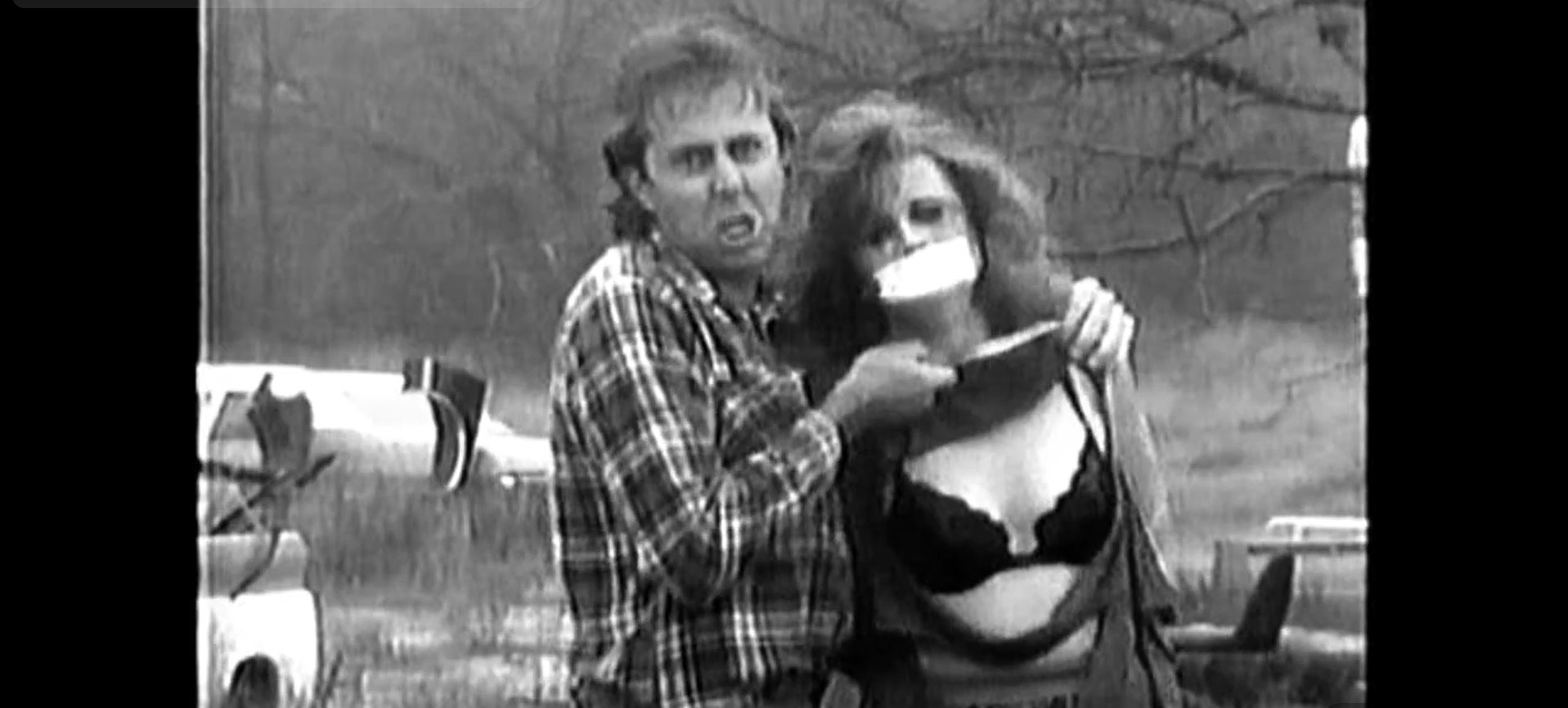
Prison escaped, serial killer Toby Gilmore treks across the Midwestern terrain killing innocent people to take what he needs to retain his freedom.  City photographer Fran Tucker travels to the countryside to visit her family.  When the two collide, Fran is taken hostage after Gilmore shoots a man down on a road rage whim and he keeps her alive because of his loneliness inside a jail cell for years.  As the bodies pile up on Gilmore’s path toward freedom, the keen photographer will use ever clever trick in her repertoire to get away from a maniacal, yet steely, murderer with no sympathy, no remorse.  Sheriff Earl Dent stopped Gilmore once before and regrets not finishing the killer off when he had the chance.  Now, Dent won’t make the same mistake twice as he’s hellbent on stopping Gilmore once and for all before anyone else falls victim to Gilmore deranged acts of violence. 
“The Abomination” and “Ozone:  The Attack of the Redneck Mutants” filmmaker Bret McCormick strays outside the supernatural confines of horror and into a different kind of terror with an escaped prison and serial killer on the loose, titled “Highway to Hell.”  McCormick helms the 1990 release thriller under the pseudonym of B.A. Jenkins with writer Gary Kennamer penning his debut screenplay.  The story was set on the same near by set locations as “The Abomination” and “Ozone:  The Attack of the Redneck Mutants,” such as in the Poolville, Texas area as well as Dallas, Texas.  If you’ve seen all three of McCormick’s films, you may recognize some of the locations in the same shot angle.  McCormick also produces the film but also in a pseudonym of Max Raven, a regular alias used the aforenoted productions.  Mars Film serves as the production studio for the low budget, regional thriller.
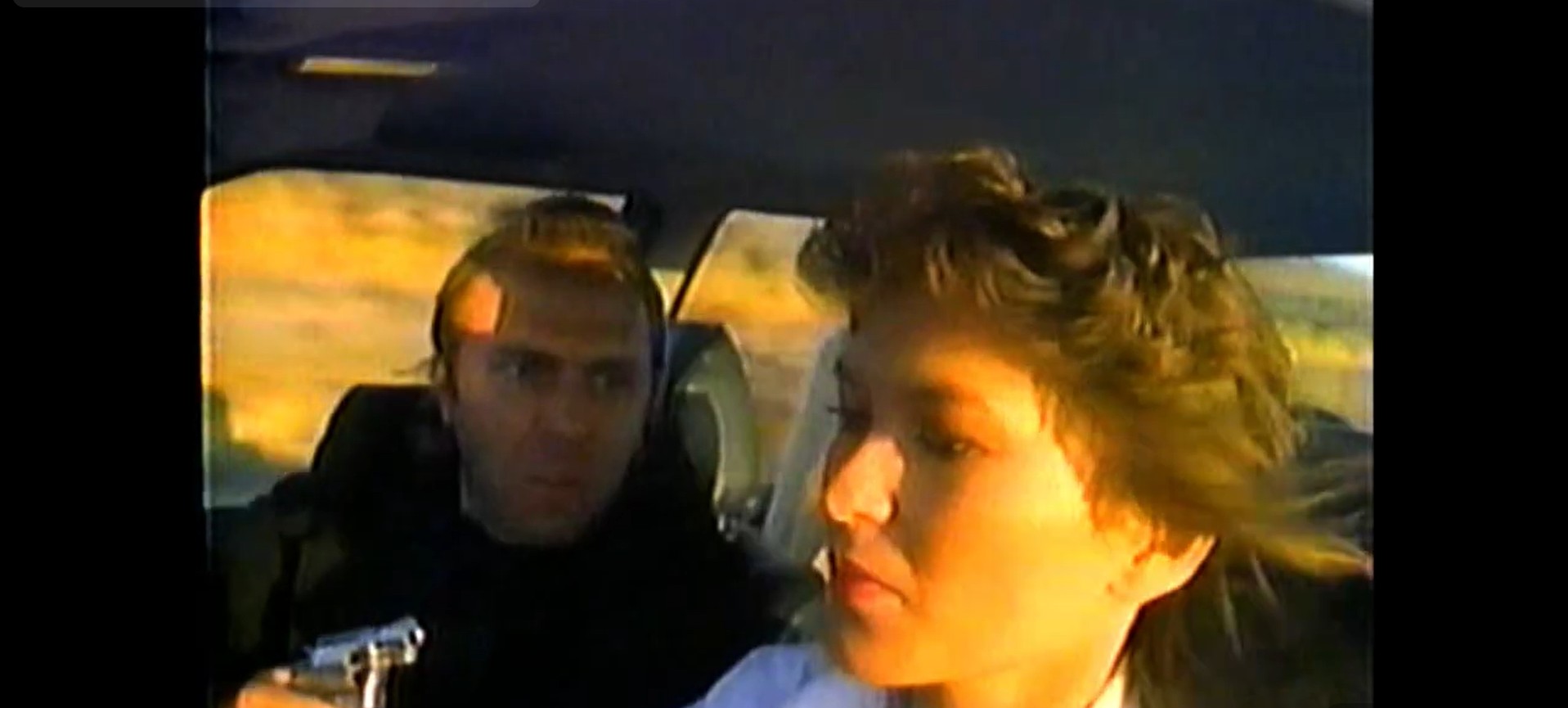
Aside from a large supporting cast of Gilmore whim fodder, a murder spree that’s shows no discrimination, “Highway to Hell’s” cast is chiefly three principal characters, all beginning with Toby Gilmore’s escape from prison involving using stolen jail keys, killing a guard, pilfering the guard’s gun, and absconding on foot through the western landscape.  “Reanimator Academy’s” Benton Jennings, who has since “Highway to Hell” has found success as working up through the minor roles of eclectic of projects, had free reign to mold serial killer Toby Gilmore and the result is a generously entertaining dose of controlled chaos as Gilmore quirks and tics as he runs across the parched Texas land provide insight to his mental mindset but Gilmore is no dummy when he’s calculating next steps with hostages that ultimately benefit his survival.  His guard corpse looted snub-nosed pistol becomes an extension of his madness as he uses it to takeout anyone who puts a pinky toe in his path.  Up against him, his main arch nemesis, is Sheriff Earl Dent, played by an American action star mostly notable for his roles in Italian cinema, such as “Ninja Commando” and “Orgasmo Nero” to name a couple plus with a major role in U.S. “Evil Spawn” with John Carradine.  Harris and Jennings share very little scenes together and the ones they do share are in flashback of Gilmore’s apprehension, one that the Sheriff regrets not putting a bullet in between the killer’s eyes instead.  The other Gilmore antagonist Fran Tucker, an unfortunate photographer on her way to see her family caught in the middle of Gilmore’s escape.  Blue Thompson (“The Abomination,” “Ozone:  The Attack of the Redneck Mutants”) provides Fran’s beauty that strikes Gilmore’s perverse chord after his long jail time stint, providing him the only reason to keep her alive, but Fran isn’t one to backdown and give up her life so easily as she is involuntary thrusted into a misadventure of carnage and death  with no one coming to save her. 
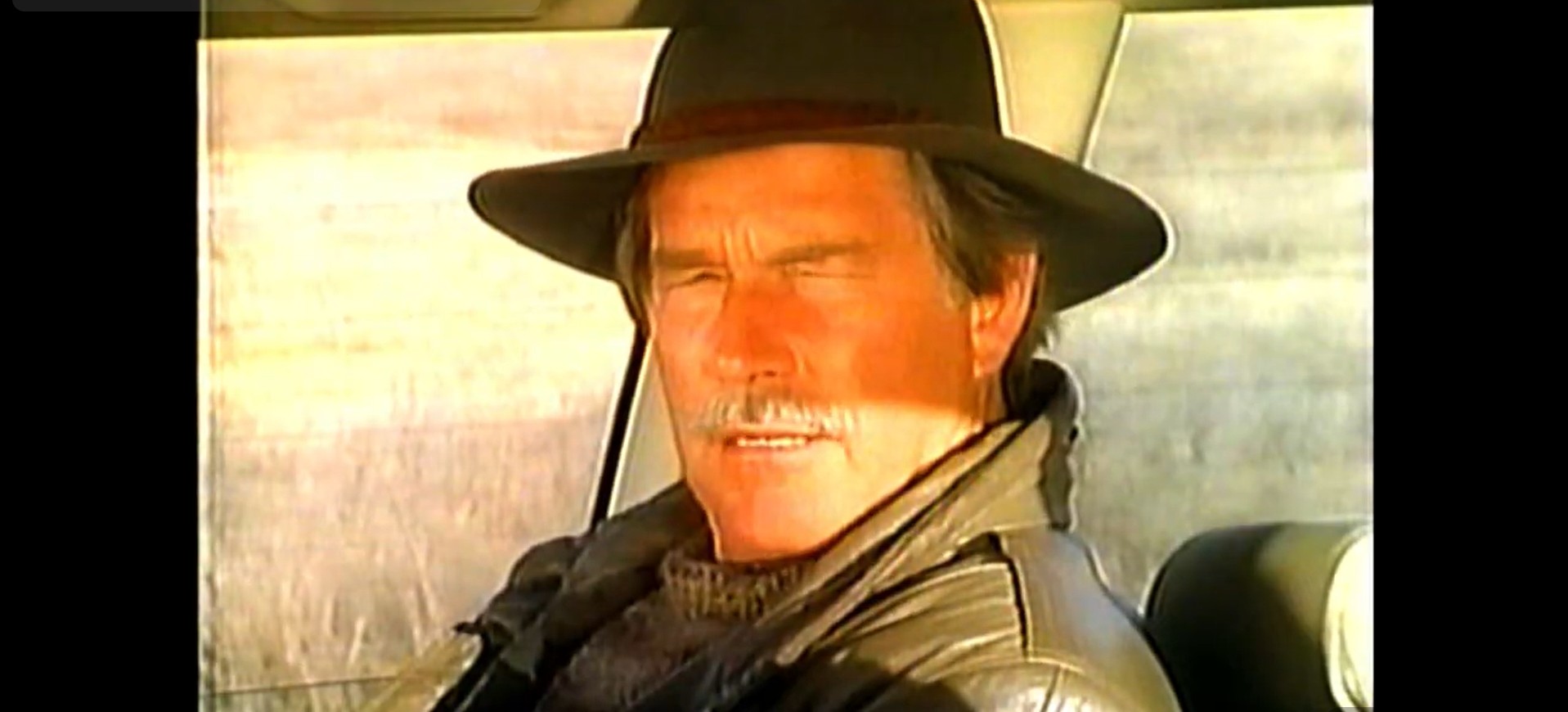
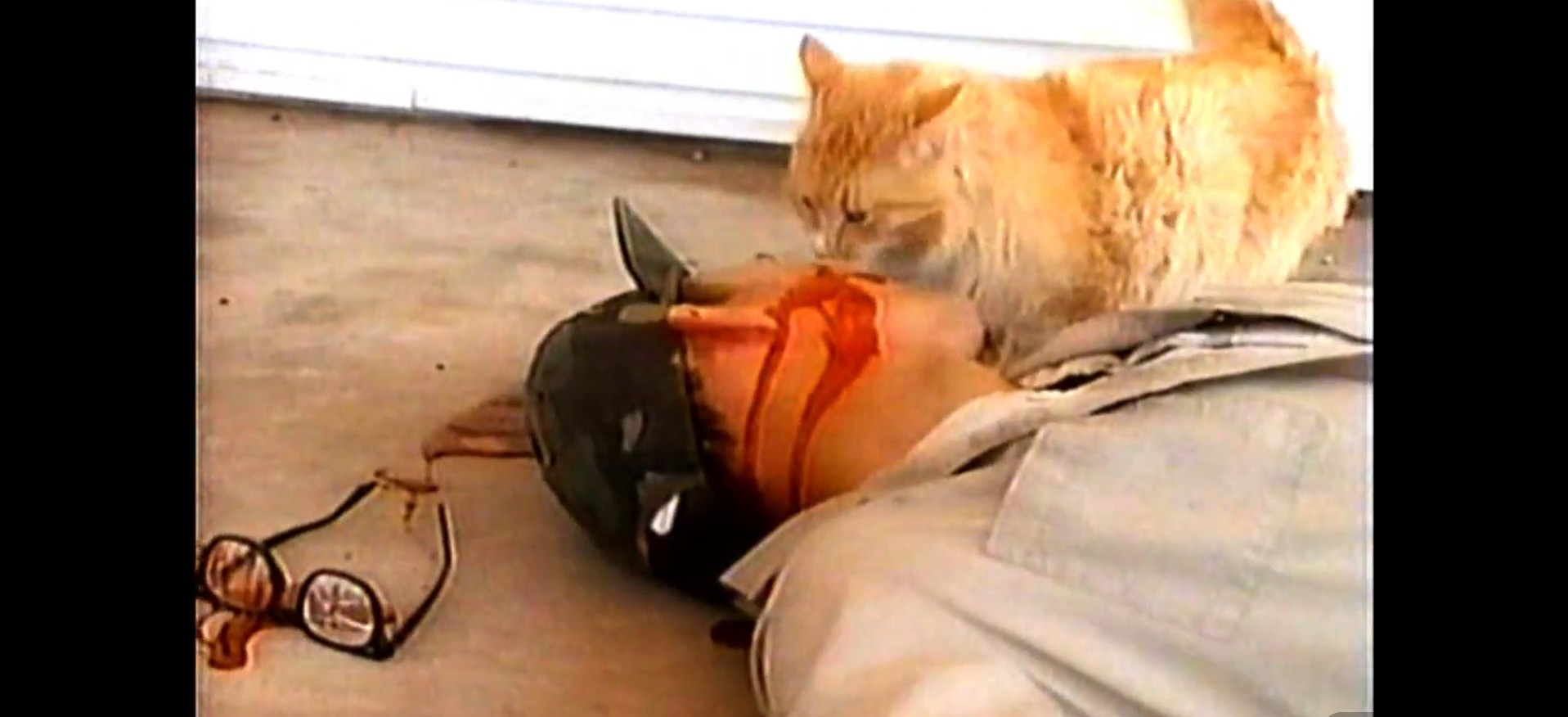
Anchor by Benton Jennings horridness and traversal storyline, “Highway to Hell” doesn’t become stagnant because of its independent and minute budget.  The editing, performances, locations, effects, and overall story are more coherent than not without mostly any confounding measure. There are a couple of plot holes that could have been addressed to sate the quizzical audience, such as how did Toby Gilmore end up with jailhouse keys?  Or how he was able to explode motor vehicles with one shot of his puny revolver handgun?  Gilmore must have been one crack shot.  Yet, the sensationalized key points and action add mystery and cult film nodes to McCormick’s ambitious westernized highway thriller that pits good versus bad, morality versus justice, and insanity versus sanity.  Crackerjack editing from Gregg Phillips and stylistic measures by McCormick salvage any misgivings about the budget or special effects in what is a competent and coherent, yet strangely fascinating, terrain and terror tensioner that has little representational or metaphorical value but high on entertaining merit. 
Visual Vengeance highlights another Bret McCormick Texas hoedown of horror and exploitation with “Highway to Hell” on a new Blu-ray transfer.  The AVC encoded, 1080p resolution, BD50 uses the original SOV tape master and what it lacks in saturation, as tapes usually do, makes up for in quality with a near flawless image quality for a magnetic tape.  Details are not terrible defined, typical of a tape, but there is great delineation and discernibility with all objects in screen.  As mentioned, hues are muted because of analog limitations and the inability to touchup the tape itself.  If a digital transfer was made, doesn’t look like much was done to touch up the color, and perhaps has purposefully retained its analog aesthetic, presented in a full frame 1.33:1 aspect ratio.  The LPCM stereo 2.0 English track offers a dual channel ranged output that has clean and clear dialogue with no issues of hissing, crackling, or any other vocal obstructions.  Overall truck lacks vigorous opportunity within the action context, such as gunshots and explosions, but, again, keeps with the original presented elements of a retro SOV exploitation.  Optional English subtitles are available.  Visual Vengeance delivers another jampacked Blu-ray full of special features that include an audio commentary by Bret McCormick, an interview with McCormick, interview with actor Richard Harrison Red Hot Asphalt, interview with Blue Thompson Road Trip, interview with screenwriter Gary Kennamer Writing a Road Map to Hell, interview with actor Tom Fegan, an image gallery, Gary Kennamer directed movie “Redneck County Fever” from 1992, Bret McCormick interview on Kennamer’s “Redneck County Fever” film, an interview with Kennamer on his movie, a commentary rack with McCormick and Kennamer on “Redneck County Fever,” Kennamer interview on his film, and other Visual Vengeance trailer previews.  Inside the Blu-ray, there’s a stick-your-own, retro VHS sticker sheet, a folded mini-poster with original art, and a reversible cover sheet with new art from Jolyon Yates as well as the original VHS artwork on the reverse side.  The Blu-ray comes in a clear Amaray case sheathed inside a limited-edition O-ring slipcover with more new illustrated artwork almost in a Ghana style fashion.  The 90-minute film is unrated and has region free playback. 

Last Rites: My personal favorite of the Bret McCormick catalogue, “Highway to Hell” is a SOV that’s simple yet effective with its western veneered thrills and a maniac making his will to ride-or-die freedom.
“Highway to Hell” on Blu-ray from Visual Vengeance!

Everything is EVILLER in Texas. “The Hoot Owl” reviewed! (Brink Vision / Blu-ray)

“The Hoot Owl” on Blu-ray is Slasher-iffic! Available at Amazon.com!

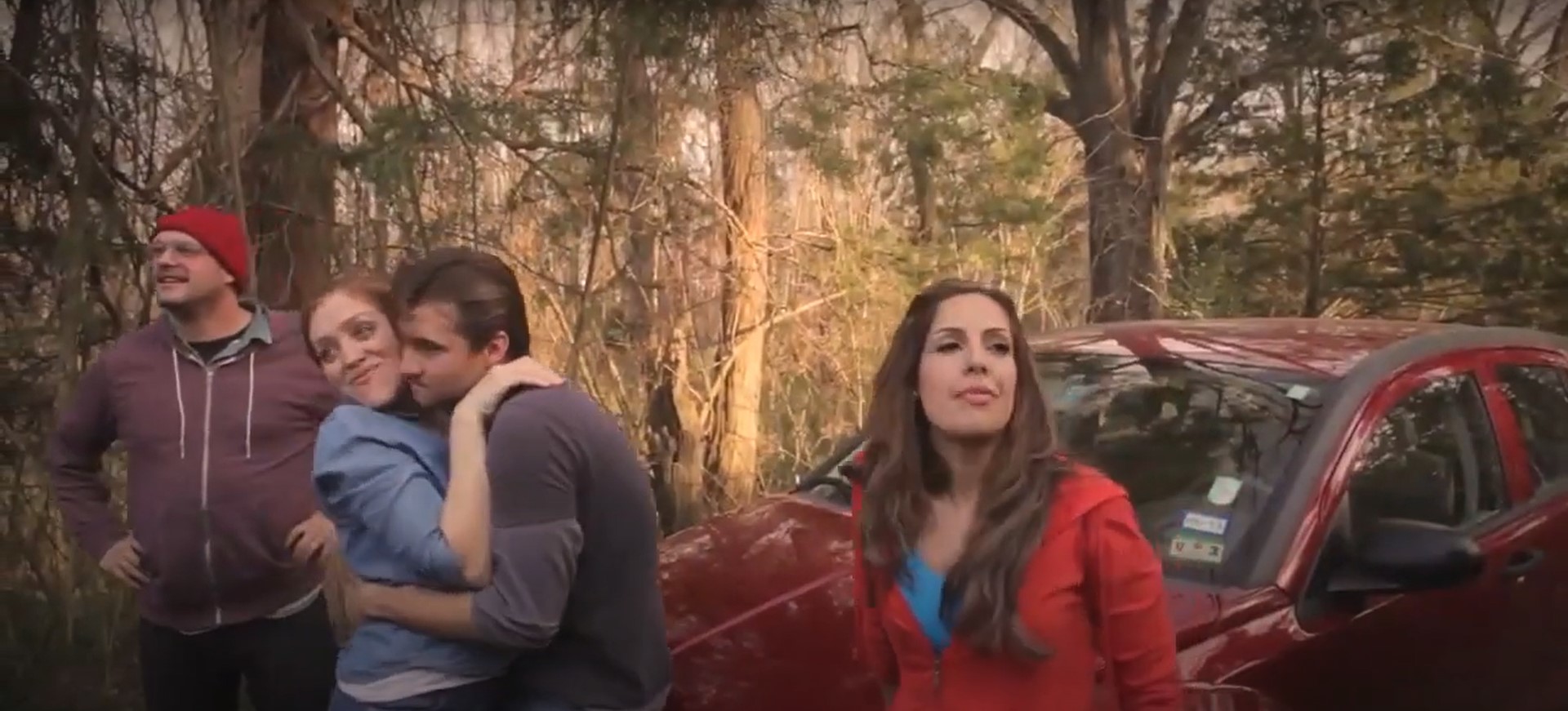
Blind buying a house is never good idea.  Blind buying a murder house in the middle of nowhere should be on the list of if you bought it, you deserve what’s coming to you.  Scott and April do just that as the recently troubled couple start afresh with a purchase of a fixer upper after suffering a late term miscarriage.  Deciding to not have Chip and Joanna Gains to rehab the dilapidated new residence set deep in the woods, the couple invite a small group of friends and family to assist in the much-needed repair and cleanup.  Interrupting their pass-the-doobie high and their positive high spirits while renewing an old house into a home, death and destruction erupts as a pair of demented squatters don’t take too kindly to the new homeowners. 

As far as debut feature films go, “The Hoot Owl” is a gory practical effect driven, true-to-form independent slasher film born and bred out of the great state of Texas.  The co-directing, co-writing Jasons, Jason Rader and Jason Von Godi, are the masterminds behind the cow head-boned masked killer and the very pregnant and very inbred wild woman lying in wait for the naive trespassers to drop their guard and thin out before the slaughter.  Having worked together for years making short films together, the 2022 released slasher was setup by Rader and Godi as a crowdfunding campaign on Indiegogo, but out of the filmmakers’ flexible 20K goal, “The Howl Owl” concept received a measly $275 from four backers.  That roadblock was only temporary and didn’t stop the aspiring retro-slasher artists to complete their foot-in to the passion project that took over 9 years to complete from pre-production-to-post-production under their co-created company banner, Vanishing Twin Productions, in association with Rise Above Productions and producer Raymond Carter Cantrell.

If you’re going all out to make a slasher film, then you’re going to need victims to slash! Most indie slashers nowadays have a synopsis that begins something like this, “a group of teens go into the woods…,” and just by those few key introductory words, we know perfectly well what to expect as the drinking, smoking, and sex-crazed youth meet the homicidal maniac with a bloody machete in one hand and a decapitated head in the other. There’s a rhythmic comfort in that classic symbiosis. The downside to the structure always boils down to the shot in the dark cast and cast of characters that can make or break a slasher film’s success. Scott (Jason Skeen, “By the Devil’s Hands”) and wife April (Augustine Frizzell) bring along Scott’s longtime good friend Drew (J.D. Brown, “Cross Bearer”) and April’s estranged sister Suzy (Katharine Franco, “The Inflicted”) offer a little bit of everything in a hodgepodge of backstories that don’t quite become reinforced in the end with the exception of April whose miscarriage and loss transcends into twisted maternal madness. Frizzell’s glow for the first two acts doesn’t really yell grief but when the ardency takes over, stemmed by her vivid gruesome dreams of her miscarriage, the Texas-born actress steps up to the plate of a psychotic break. Suzy’s also interesting enough character to spark curiosity with the enigmatic contentiousness in a heartfelt scene of two sisters rekindling their bond while actually actioning those same emotions on screen; instead, Franco enjoys the blithe nature of Suzy’s indecisiveness about school and about her family but discovers a quick and sudden fascination with Drew, the least interesting principal that hires two colorful buddies: Hank (Carl Bailey, “A Ship of Human Skin”), a father of two who a penchant for sexual harassment, and an obvious long hair wig-wearing oddball Bugs (Roger Schwermer Jr.). Bailey resembles pure Texan posture but is stiff as a board in his sleazy contractor role. “The Hoot Owl” rounds out the cast with Joshua Ian Steinburg playing the boned-face killer and Johnny Wright reaching inside to extract his inner Neanderthal-like wild woman ready to emulate a putridly picturesque birth.

“The Hoot Owl” is a by-the-numbers man-in-a-mask slasher riddled with familiar tropes and conventional clichés.  Baseline fact is that the film is not breaking any molds here and won’t be a contender for horror picture of the year.  With that said, and as harsh as that may sound, what “The Hoot Owl” represents is pure spirit and appreciation for what the film ultimately represents – a love for the heyday horror. Rader and Godi firmly believe in their film with a sincere attempt at a feature and pulling all the material together during a near decade-long process to get the film released out into the world. Far from perfect, “The Hoot Owl” relies heavily on the gruesome practical effects and there are some good gory terminations with a piledriving beartrap, a split-head decapitation with a large chain, and a long, rusty drill bit through the eye socket that ends in a spurting splatter of blood. The expo is an impressive effort from Allan David Caroll in his first go-round with the effects trade that could rival the early works of Tom Savini or Greg Nicotero. What breaks up the story most of all are the secondary shoots used to swell and cut into the first-round material shots to beef up a feature production. For instance, the opening credit chase sequence of a maniac cop (at least I think it was a cop) hunting down a man and his pregnant wife is a moment that is never clearly referred backed to, but the assumption is that the pregnant woman is the encountered savage later on in the unveiling climatic and the bone-head killer is her child from the rundown who then impregnates his own heathenized mother…? Connectively, it’s all unclear in unfused ends, causing a break in the signal from the lead-in to the trunk of the story, and that underdevelopment pursues throughout with loops never coming to a close.

In my first brush with Brink Vision since reviewing their DVD release of the 2008 alien transmitted dead-resurrecting bacteria film, “Evilution,” a tinge of satisfaction embraces my little heart to see Brink Vision come back across with a Blu-ray release of their latest “The Hoot Owl,” distributed by MVD Visual. The quick-paced 72-minute film is presented in a widescreen 1.78:1 aspect ratio, is not rated and is region free. Video quality doesn’t represent the best-of-the-best of the 1080p high-def resolution with a commercial standard definition equipment and know this mainly because compression that doesn’t display a myriad of issues. Details are not as sharp and there is banding more obvious in one scene of negative space, but the picture is otherwise free of artefacts and other data loss issues. The English Language 5.1 surround mix fairs much of the same albeit the electrostatic noise. While not overwhelming the dialogue to a point of murkiness, the steady shushing combined with the poor audio recordings can vary the quality and depth with a blunt flatness. Bonus features includes a commentary with directors Jason Rader and Jason Von Godi, a second commentary with Creepy Peepy Podcast, a featurette of Rader and Godi looking back at their 9-year pilgrimage to completion, Godi’s short film ‘The Voyeur,” trailer and still gallery. The physical release has beautiful artwork of the Hoot Owl killer in a throwback, almost Scream Factory-esque, illustration. The back cover is a little wonky with a composite that’s hard to read with deep purple lettering on the credits and bonus material listing almost invisible amongst the black background. “The Hoot Owl” endears the slasher fandom with a callback to the brute strength of a wanton villain and if only the script was smoothed over, this little indie film from Texas could have better laid a stronger foundation.

“The Hoot Owl” on Blu-ray is Slasher-iffic! Available at Amazon.com!

Enter the Patron Saint of EVIL Cannibalism! “The Spanish Chainsaw Massacre” reviewed! (Wild Eye Releasing / DVD)

“The Spanish Chainsaw Massacre” now on DVD!  

A degenerate heavy metal rock band and their pressurized manager are cast off on their very first ever music tour by their financing dictatorial mogul eager to recoup his investment as quickly as possible.  While en route, their van breaks down at the edge of a small town who welcome them with open armed hospitality, warm accommodations, and a hot meal with the promise of a day turnaround on fixing their van for free.  The next day proves to be a joyous occasion for the villagers celebrating their patron saint and little does the band know they’re an unwittingly big part of the ceremony as every villager is a ruthless cannibal ready to devour to the bone their haplessly stranded guests. 

About as vile and gross as they come, “The Spanish Chainsaw Massacre” is a Spanish-bred, slop-house, comedy-horror that plucked from the horror history timeline an unfaithful and a stretch comparison to a portion of the iconic title from the 1974 “The Texas Chain Saw Massacre.”  Writer-director Manolito Motosierra helms nothing remotely familiar to the Tobe Hooper classic, there’s barely the sweet exhaust coughing sound of a chainsaw ripping and shredding through Motosierra’s actual film, but “The Corpse Grinders 3” director has brought one well-known component to his film, lots of crazy long pig action!  Originally titled more appropriately as “Carnivoros” – Carnivores –  in Spain, the 2013 release only saw a U.S. release date merely 5 years ago in 2017 with supplementary prologue footage from Scorpio Film Releasing’s Richard Griffin and his entourage that bares big breasts as well as the only big chainsaw under its unaffiliated storyline of a woman double-double crossing two men to get away with $30K only to find herself inside a seedy hotel room and the unsuspecting starlet of her very own snuff film.  Though I usually adore Griffin and Michael Thurber, who usually has a role in a Griffin release in some random capacity, the opening fits like a square peg being jammed into triangle hole, accumulating confusion more than making sense.  “The Spanish Chainsaw Massacre” is a Fantastika Team and Olga Underground production presented by Tyrannosaurus Entertainment. 

If you can get past all the fart and poop jokes, the band known as “The Metal Cocks” are the epitome of well-received degeneracy in their unromantic, polyamorous pansexual quickies, blatant addictive vices, and an overall uncouth behavior and appearances in a mockery of hair metal bands from the 80s.  Dani Mesado as Rasputin, Óscar Gilbert Escarabajal as Petete, Torete playing himself as Torete, El Capitan Almendra as Bull, and Nereida López Vilaplana as Penny Pussy are Las Pollas del Metal – The Metal Cocks – taking on a rocking tour de force against insatiable backwoods cannibals of Spain.  If you think the band is depraved, wait until you see the villagers’ madness for meat foul up the screen with a mangled dick scene (someone call the expert Felissa Rose!), an intestine eating contest straight from the gut, and the recipe with baking instructions for a popular diarrhea shake.  With viciously varicolored characters like the Spanish whore (“Vampire:  Hounds of Horror’s” Yolanda Berneguer), the unsanitary naked food prepping cook known as The Chef (“Fucking Bastard’s Tam Sempere Miro), and the murderous simpleton Guti (Michael Rodriguez) among others, a motley macabre bunch of crazed cannibals have systematic knowledge of separating and conquering their dinner, each involved in a role important to the façade that plays to the prey’s vulnerability before digging into their food with both hands clawing.  Everything and everyone are over-the-top and that really defines the line between the cold simmering terror family of Texas massacre and the wild family of maniacs of the Spanish massacre; though the idiom says everything is bigger in Texas, Spain certainly has the most peculiar of películas between the two territories.  “The Spanish Chainsaw Massacre” rounds out with Hilario Blas, Miriam Larragay, Ezequiel Campos-Zeta, Raul Dario Gandoy, Richardo Pastor, José Luís Tolosa, Mayama Lia, and Yolanda Diaz Dengra.

Gore aplenty!  “The Spanish Chainsaw Massacre” bathes in troughs of blood as well as other human body fluids that make your eyes sink deeper into the back of your head while your eyes lids slowly act like shutters trying to protect the vision and mind pure of only the blood and not anything else.  That task is a lost cause of impossibility as Motosierra lathers a thick, slick of sick onto every frame, leaving no grotesque rock unturned before and after the victims’ final curtain call.  Yet, in the end, what Motorsierra constructs is the Looney-Toons of descendental cannibalism that’s full of maniacal laughter and delusional actions with no rhyme or reason to determine causality.  The celebrated patron saint seems to require the villagers, or strongly encourages them, to act a fool, to put on a show, and to treat human meat as a delicacy to plunder.  Neither The Metal Cocks nor the villagers receive a proper introduction, backstory, or arc in what is basically a show up and be present for gratuitous slaughter in a variety of random pockets that not all necessarily have to do with the band.  In some scenes, an old military man is tied to a tree, sitting down, and being tossed firecrackers at this crotch while a clown eggs on the kids with frenzied laughter and, in another scene, two adolescent boys are tied to a tree standing and sliced across the belly so they’re intestines can be used for a food race.  Where these characters came from is never touched upon or explained but understood that they’re a part of the festivities toward the patron saint.  Like what AC/DC once said – if you want blood, you’ve got it! – with “The Spanish Chainsaw Massacre” having gallons of it. 

“The Spanish Chainsaw Massacre” is a DVD re-release for the indie distributor, Wild Eye Releasing, as spine number 54 on the company’s Raw & Extreme sublabel.  The DVD, distributed by MVD Visual, presents the 70 minute, 56 minutes of actual feature with 14 minutes of Richard Griffin’s snuff film preface, unrated film in a widescreen 1.78:1 aspect ratio.  I really like this transfer from Wild Eye because of the sole fact of virtually no compressions issues obviously present and that’s not just because of the lack of bonus feature, which is common amongst most of Wild Eye’s library, on the DVD’s limited capacity.  Previous studies on other single feature releases proved Wild Eye to be a mixed bag regarding quality.  With “The Spanish Chainsaw Massacre,” the image quality is highly detailed and lush in black areas and in texture that makes Motosierra’s stomach-churning content that much more stomach-churning. The warm color palette of yellows and reds provides an exaggerated tint of a rural Spanish village.  In contrary to the DVD back cover, the feature’s native language is not English but rather a Spanish 2.0 stereo track.  Much of the dialogue track is all yelling synched well with the English subtitles that are not entirely accurate.  The subtitles are extremely abridged and loosely translated.  A robust metal soundtrack plays into the whole metal brand, but the other tracks lack depth as all outputs, much like the characters on screen, are upfront and loud; yet the compression handling sustains an agreeable fidelity with little no popping or screeching within or on the tail end.  Bonus features include promo videos and the official trailer with a stretch into a credits gag reel of sorts with candid and shooting mistakes in crediting the cast and there’s also an end credit scene that setups the cannibal family’s return with a Christmas themed sequel.  However, 9 years has passed and don’t think Motorsierra is working on any drafts at the moment.  The snap case comes with reversible DVD cover art with a touched up-front cover not pulled from the film itself while the inside has a blown-up bloody aftermath still of the narrative’s first victim with a dislodged lower jaw and a hunk missing from her face.  Ultra-indulgent with biofluid glop, “The Spanish Chainsaw Massacre” is a ruthless, toothless puta de madre of a film if you can get past the stink of butt humor.

“The Spanish Chainsaw Massacre” now on DVD!  

Curse EVIL Curses! “Baphomet” reviewed! (Blu-ray / Cleopatra Entertainment)


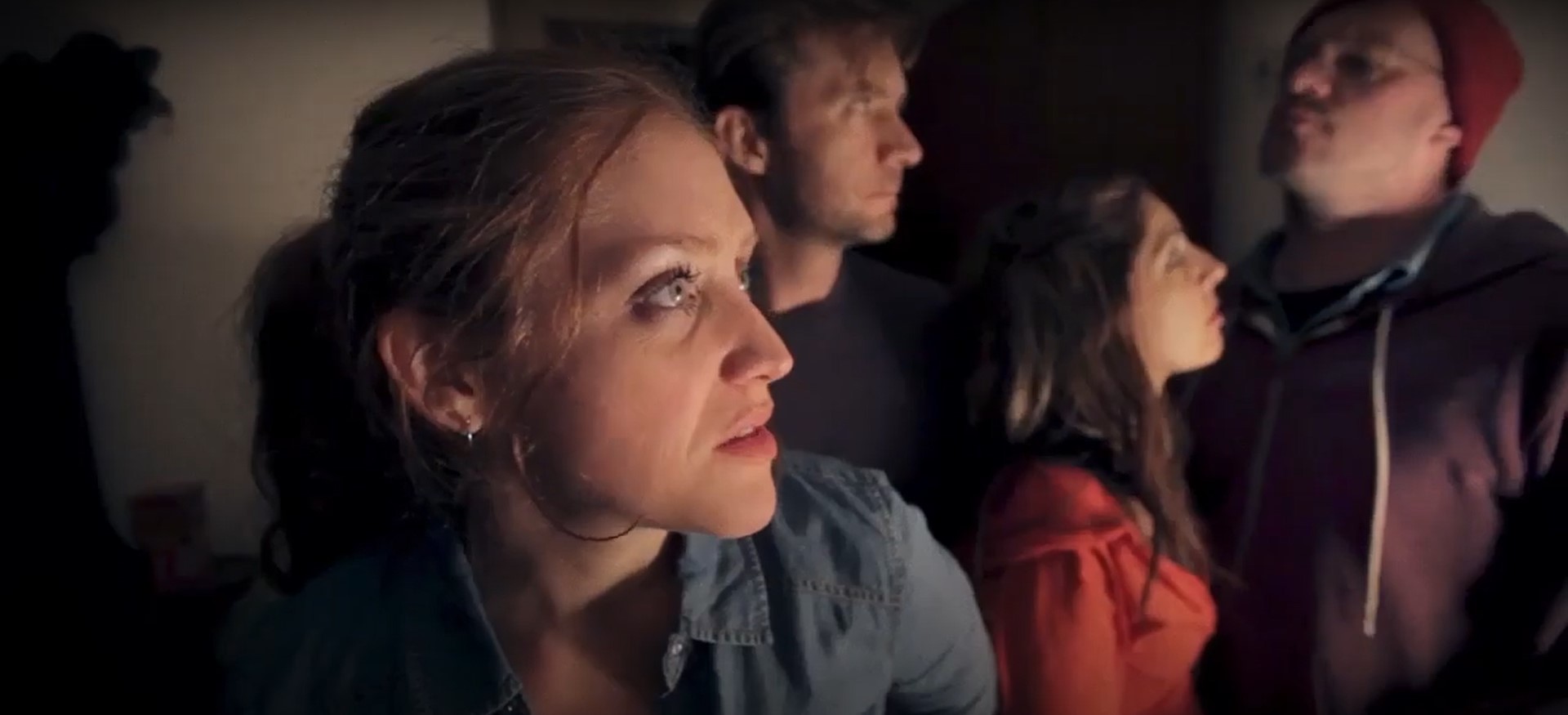
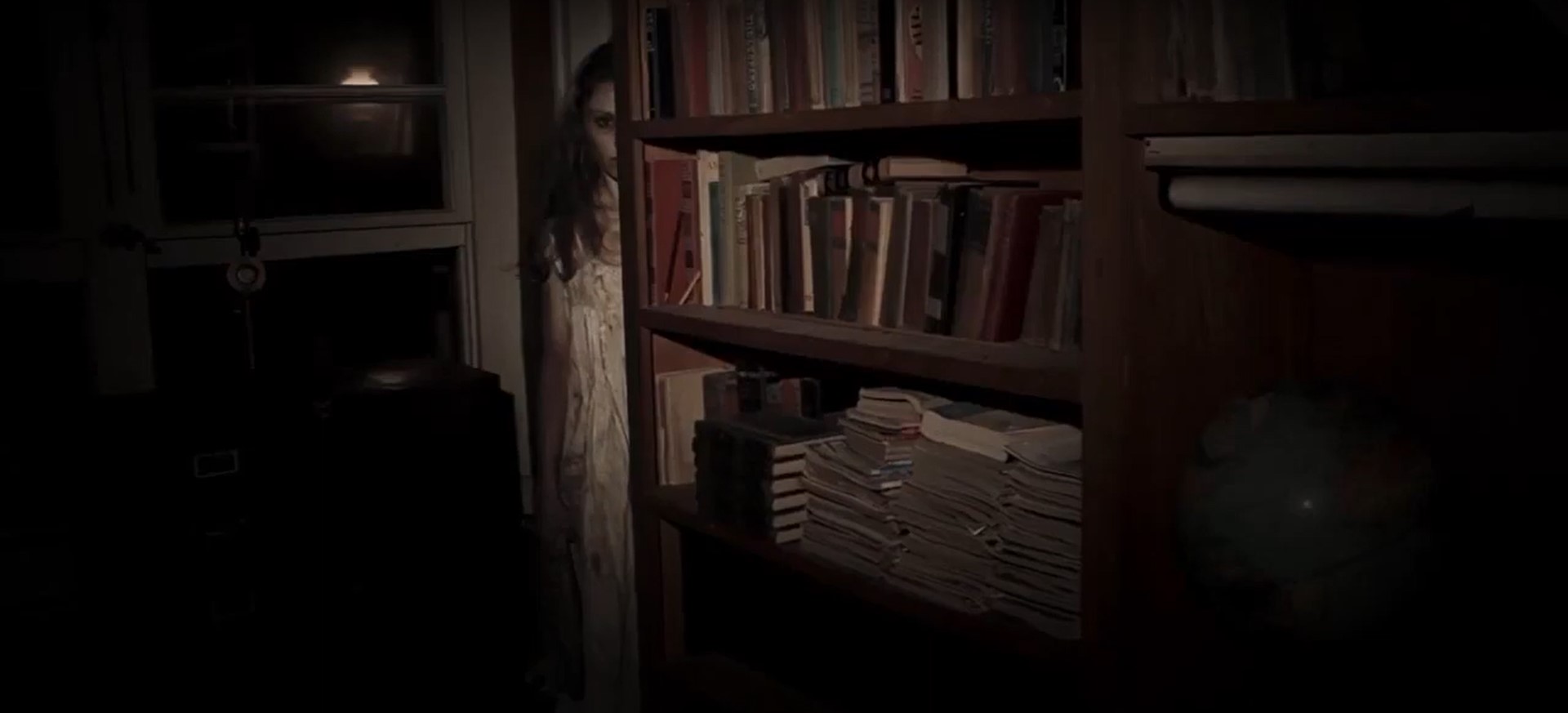
Jacob Richardson, a Napa Valley landowner, and his wife are jubilantly excited about becoming grandparents with the eager arrival of their daughter’s child.  Still months before the actual delivery date, their daughter vacations with him while her husband works a few more days in Malibu before joining her but gruesomely dies in an apparent shark attack.  His sudden death isn’t just a stroke of horrible luck, but a devil worshipping cult’s curse bestowed upon the unsuspecting family after the rightfully stubborn Richardson refuses to sell his vast property to a shady businessman the day before.  One-by-one members of his family fall victim to a series of accidental and unexpected tragedies that leave his daughter, having dreamt the cult responsible for the black cloud that has been afflicting her family, desperate to try anything, even if that means making contact with a benevolent white witch to resurrect her shark bait dead husband.  The cult still wants their land and for the Richardson family, only Jacob, his daughter, her resurrected husband, and the white witch stand against an army of Satanists besieging upon the family home to awake a slumbering dark force. 

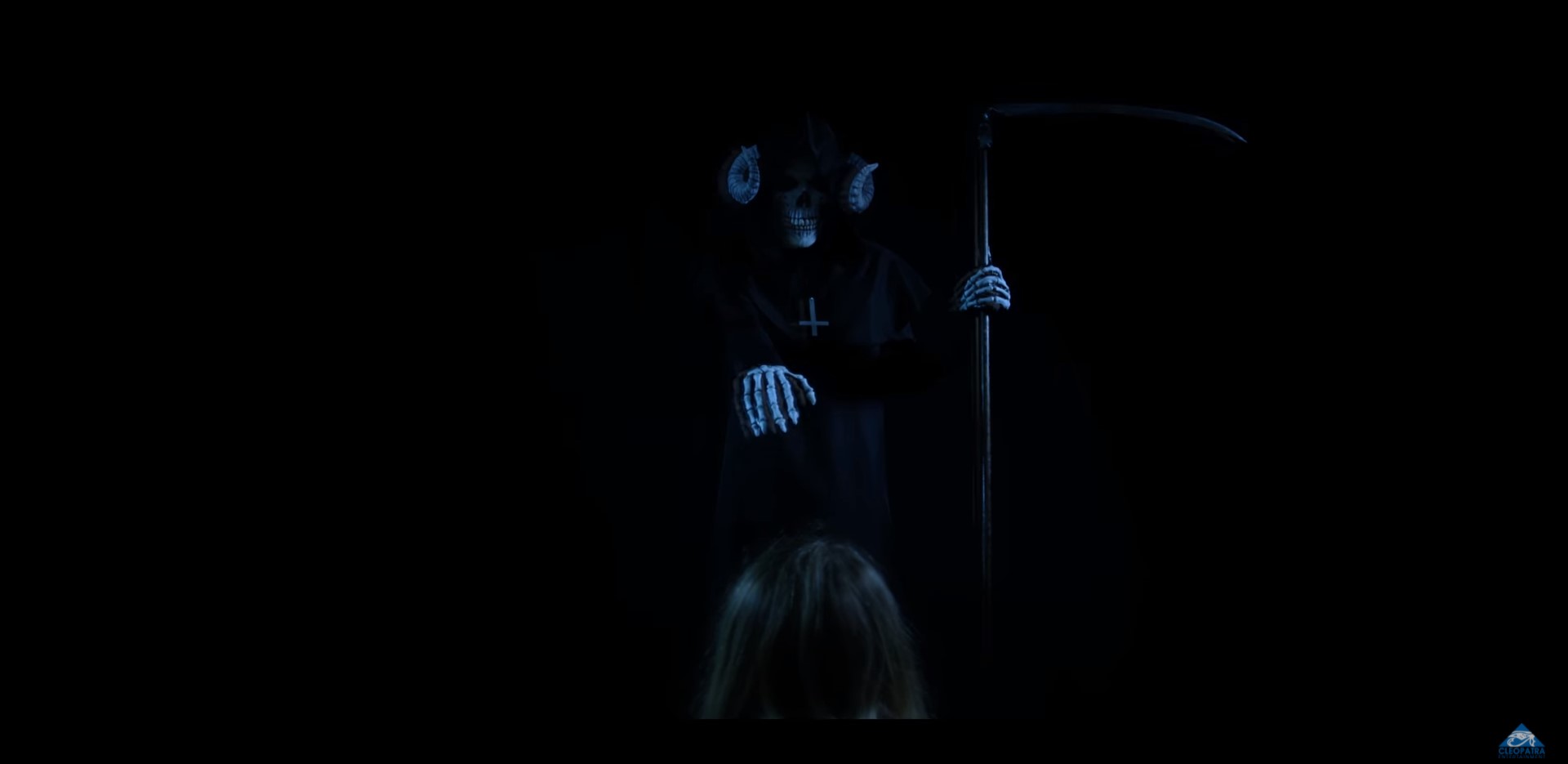
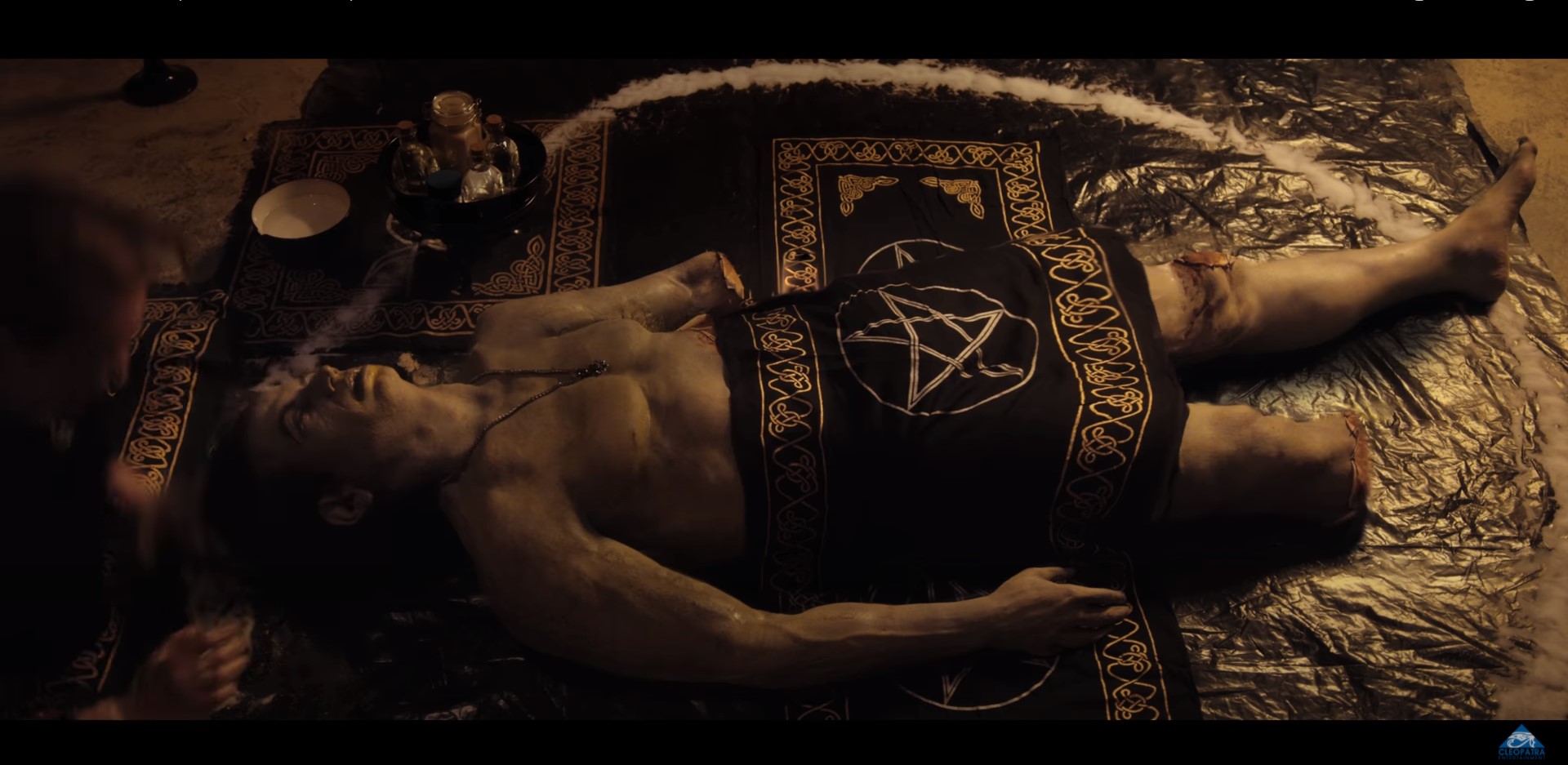
You know you’re watching a Cleopatra Entertainment distributed release when the plot revolves around a Satanic or demonic annihilator, as such with “The 27 Club,” “The Black Room,” “Devil’s Domain,” “Devil’s Revenge,” and maybe even a tiny bit from Glenn Danzig’s strange comic book adapted anthological tapestry, “Verotika.”  Matthan Harris’s 2021 released “Baphomet” walks along the same lines with the titled gnostic and pagan deity made infamous by the worshipped practices of The Knights of Templar acolytes.  “Baphomet” is “The Inflicted” director’s sophomore feature in which he’s written to remain in the horror ranks as an aggressive occult summoning of an evil presence to walk the Earth.  Shot in various California and Texas locations, the moneybag company behind “The Velicpastor” and “Don’t Fuck In the Woods,” Cyfuno Films L.L.C., collaborates supportively Matthan Harris’s formed Incisive Pictures production company to deliver a trackless, unmapped, and unholy “Baphomet” to the home video market with Harris producing alongside executive producers Grant Gilmore, John Lepper, and Cyfuno Films’ Adam and Chase Whitton.

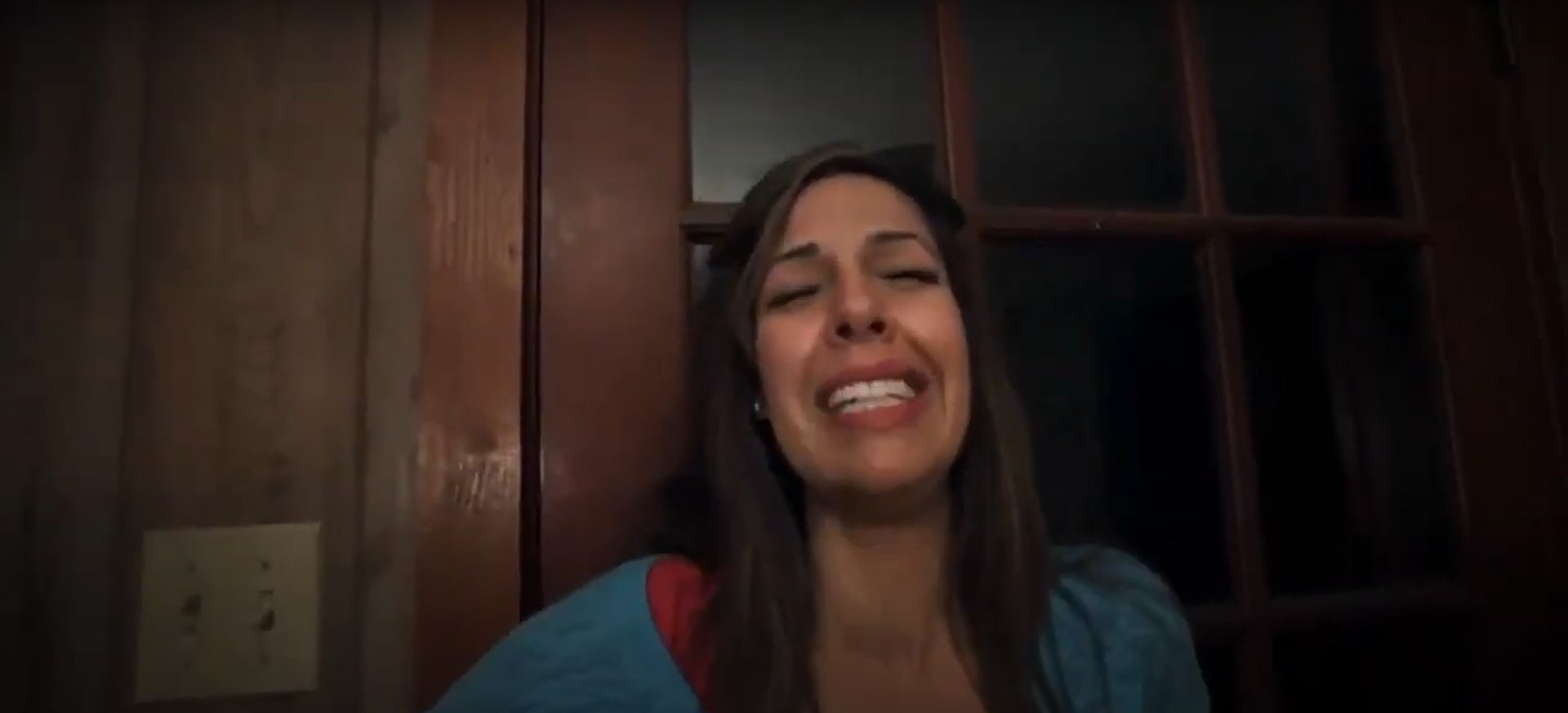
We’re initially introduced to Giovanni Lombardo Radice sermonizing as the paganized pastor and cult leader Henrik Brandr before they slice open a naked woman wrists and drink her blood from a single chalice.  Right from the get-go, “Baphomet” hits us with the 80’s circa Italian star power of the “Cannibal Ferox” and “StageFright” actor.  The blood trickles down from there once we’re introduced to the Richardson family, headed by the patriarchal Jacob Richardson in “Mother’s Boys” Colin Ward.  Ward’s a convincing father figure, rugged and surly in showing off his rough and tough cowboy swagger, yet also sensitively compassionate in a broad range of acting experience.   However, that’s about as far as Jacob Richardson impresses as the character levels out, sulking over the loss of his son-in-law Mark Neville (Matthan Harris), wife Elena (Ivy Opdyke) and daughter’s unborn baby after his force to be reckoned with verbal encounter with one of the cult leaders offering him a lump sum of moolah for his land; instead, Richardson’s daughter, Rebecca Neville (Rebecca Weaver) takes a family first lead by engine searching and watching video tutorials on the nature of black and white witches.  After easily tracking down and skyping with witch expert played by Dani Filth, lead vocalist of metal band Cradle of Filth, a obsessed Rebecca becomes hellbent on resurrecting her Great White shark masticated husband, Mark, with the help of good witch Marybeth (Charlotte Bjornbk, “Cannibal Corpse Killers”) and this is where things go awry for the narrative.  Only a self-absorbed director would kill himself off extravagantly in character, saw fit to be resurrected for the sole purpose of love, and then become the ultimate hero of the story that leaves his wife and father-in-law in glory’s dust trail. “Baphomet” supporting roles from Gerardo Davila (“Ticked Off Trannies With Knives”), Stephen Brodie (“Puppet Master: The Littlest Reich”), and Nick Perry as the cult-sought demon.

Filled with blood sacrifices, family curses, killer sharks, and a pitiless grey demon, certain viewpoints embody that very black magic archetype of the historical devil dealings engrained into “Baphomet, but what specifically the Harris brings to the obscure budget horror smorgasbord is a platter of tasteless derivativity and bland storytelling, flavored with peppered gore granules and a pinch of pop culture icons. “The film opens engagingly enough with spilling the blood of a fully naked woman so everyone can play pass the cup of virgin blood in order to appease their dark lord and then we’re firmly segued into the happiness of the Richardson family until Jacob Richardson declines a money offer for his land. Spilling blood into the ocean and leaving dead, crucified birds on the porch enacts a deadly curse that sends sharks and snakes into a murderous rage. Up to this point, Harris has control of the story with some decent editing work and effective bitesize prosthetics to actually descend hell’s wrath upon an ingenious family. I could even look past the wild and impetuous decision to resurrect the dead boyfriend after his fatal encounter with a Great White, but when the third act’s last stand against cult comes knocking at the door, the script chokes on a grotesque amount of happenstance and exposition. For example, when the sheriff and deputies arrive at the Richardson house on Jacob Richardson’s whim that the cult might be outside their doorstep, one of his deputies randomly pulls out of a bag of large scale dynamite his cousin uses on at a jobsite, thinking the ACME-sized TNT would come in handy. Mark also decides to blow his undead cover, exposing himself to the officers in a screw-it moment of “yeah, I don’t care.” Soon after, a “Harry Potter and the Deathly Hallows Part II” battle ensues between the deluging cult and the defending Richardsons/Officers and many main characters parish during the skirmish fruitlessly and effortlessly to the point where they might as well have been non-essential to the story supporting parts. Also – the lack of considerable screen time of Baphomet and the demon child lays waste to a perfectly good title, in my humble opinion.

Perhaps one of the few Cleopatra Entertainment, a subsidiary banner of Cleopatra Records, to not be accompanied with a soundtrack compact disc with the Blu-ray, distributed by MVD Visual. The single disc BD-25 release is perhaps one of the few trimmer releases from Cleopatra Entertainment and is presented in HD 1080p in a widescreen 2.37:1 aspect ratio. Generally speaking, the music mogul company has continuously be consistent on their video and audio Blu-ray releases. The details are rather defined looking and sharp with blacks, and there are many black scenes, noticeably inky without that dim lit tinge of gray. Some of the underwater sequences and the video chat calls with Dani Filth are murky and at a lower rate than due to Filth filming his scenes literally from the UK on a video call for most of film. Two English language audio options are available – a Dolby Digital 5.1 surround sound mix and a Stereo 2.0. Flipping back and forth between the two option, the devil is in the file track details but both mixes sound frightfully the same down to the climatic explosions. Bravo on the depth and range that captures rightfully the echoes of high vaulted ceilings and the positioning of characters. Dialogue is clearly present and mostly natural with aside from Gerardo Davila, the Sheriff in the film, in what discerns to be a soundstage track layover of his dialogue. When he speaks, Gerardo doesn’t seem to be sharing the same dialogue space with his costars in an unnatural vocal delivery of his role. While there is no soundtrack disc to rock to, the hefty bonus material is a shocker with deleted and extended scenes, outtakes, a music video ‘Shellshock” from Tank featuring Dani Filth, behind the scenes pictures, Dani Filth backstage interview, Jason Millet’s storyboards, and a teaser trailer. Tickled me unimpressed by Matthan Harris’ “Baphomet” that hinges on uninspired cult creed. For me, special effects wins top prize and a giant handful of bonus material is the only thing that arises out of “Baphomet” from the wells of damnation.

“Baphomet” is on Blu-ray at Amazon.com

A Major Book Deal Isn’t Worth This EVIL. “Writer’s Block” reviewed! (Gravitas Ventures / Digital Screener)

Skip Larson has become a one hit wonder in the literary field.  The aftermath of his initial work, a best seller success, has never again been duplicated as Larson’s wretched and dispassionate heart and mind hit an unscalable writer’s block that can’t afford to pay the ever mounting bills.  When a stranger approaches him at one of his dismal book signings, an opportunity presents itself to meet serial best-selling novelist, Chester Everett McGraw, at his private ranch where Larson has to decide whether to sign McGraw’s rigorously partisan and severe contract for wealth, prestige, and a chance to co-author McGraw’s next big novel after being cut off from the outside world for six months or walk away from everything without penalty and return to his mundane life struggle.  Larson agrees to McGraw’s extreme terms and begins working chapter after chapter on McGraw’s next literary masterpiece, but as the days turn to weeks and each draft is ridiculed and critically trashed, an irritated Larson itches to leave but the snake-tongued McGraw, his brutish bodyguard, and even the beautiful maid, who has suddenly taken a liken to him, keep tortuously motivating him back to novel drawing board whether he likes it or not. 

Putting pen to paperwork with a looming deadline on the horizon is already stressfully hair pulling, but when the cold steel of a gun muzzle is pressed against your sweaty temple, the pressure grows tenfold to get the creative juices flowing before the contract is up in Jeff Kerr and Ray Spivey’s co-written and directed 2019 exploitation thriller, “Writer’s Block.”  The independent feature is the second collaborated project between Kerr and Spivey following their 2016 documentary, “The Last of the Moonlight Towers,” about the obsolete street illumination system, the last of its kind, of electric light towers in Austin, Texas.  Continuing the trend of holding their filmmaking shop in their home state but not exploring non-fictional antiquated monolithic engineering marvels, the directing duo concentrate their Texas-based shot film toward being a cinematic turn-pager saturated with perfidious suspicion and crackpot characters that keep the road toward a clandestine endgame alluring and mysterious, unfolding in a similar regard to that of its general context of an exceedingly multifarious murder mystery novel.  Kerr and Spivey’s Sharp Town Productions serve as the attached production company.

Kerr and Spivey shop locally when choosing their downtrodden literary hero, Skip Larson, plagued with a wretched past and the desirable callings of the bottle.  The filmmakers settle on “Fear the Walking Dead’s” Craig Nigh who can sell smartass with the best of them and be as tough as nails when push comes to shove.  On paper, Larson’s a forlorn gambler risking his chance at life by accepting a seemingly glamorous, one-in-a-life, game-changing deal by a fellow writer he admires, but with a number of fishy, tall-tail signs of deception and corruption by McGraw and his goon, Digger, Larson can come off naïve, especially when he sticks around still after his free will fractures under physical violence and threatened to be shot.  The oppressive McGraw obviously has an ace up his sleeve in his proposed partnership with Larson and, never once, feels sincere in building Larson’s library with his dreams.  I found Mike Gassaway’s performance as McGraw to be one-note.  “The Next Kill” Gassaway tussles with sly intentions of a manipulative best-seller author, devolving into an unintentional weaker ranch obstacle that dwindles down McGraw to be more of a façade behind the true game being played against an unwary Larson.  Though McGraw as the brains, the cowboy hat wearing former oil rig worker, Digger, provided much of the muscle whose anxious temperament kept him from seeing the final stages of McGraw’s malevolent game.  Chris Warner finally lands a principle role that isn’t a short lived bit part that’s labeled Flatbed Driver or Prison Guard.  Instead, Digger Haskell seems like a teddy bear good old boy that Warner can inherently step into without having to get lost in a new persona and Warner fleshes out Digger’s hasty disdain in how the slow progression keeps him for enjoying what he loves to do best – being a hired goon – but the character rarely established a definitive connection of servitude toward McGraw other than the notable writer taking the oil rig injured man under his wing, causing some unresolved character development.  Cataline is perhaps the most underwhelming character as the immigrant house cleaner who falls in love with Skip Larson.  Played by Jeannie Carter-Cruz (“Sasquatch!  Curse of the Tree Guardian”), Catalina bashfully wills herself around the house, not really cleaning much in the audiences scope of her profession, and becomes discreetly entangled with the struggle writer for unknown reasons she herself couldn’t explain, leaving her, and Carter-Cruz, exposed in an under-seasoned character course. Katusha Robert, Avery Lewis, and Natasha Buffington rounds out of the cast.

“Writer’s Block” shoves an easily relatable theme of success never comes easy right into audiences’ laps as Skip Larson’s humiliation exhibits as much through literary famed Chester McGraw’s browbeating tactics ranging from verbal assaults to unwanted sexual persuasions. Not by McGraw. That would be gross. Yet, in essence, the actual frustration condition of writer’s block for an author in any facet is akin to the sensation of conquering in what seems the impossible. Once Skip Larson tips the odds into his favor, the woebegone writer’s line graph to success skyrockets off the chart after a bit of tough love motivation stemmed by McGraw and his boot camp, side-hustling ranch. However, “Writer’s Block” suffers from the titular misgiving in the form of pacing irregularities, a loitering third act, and a paper thin Skip Larson backstory that only dabbles into his post-family tragedy alcoholic stupors and his peradventure subversive dealings with his gangster cousin. The gangster cousin tangent is by far the most offshoot subplot underlined only in flashbacks and at the finale that introduces a character that has seemingly never been a functional part of the story but is pivotal in Skip Larson’s corner. The crux of the story’s issues is that it tries to incorporate too much whereas the basic building blocks, the pure premise, would have sufficed and have been modestly more successful if stuck to instead of throwing a curve ball of horror into the macabre construction of McGraw’s collective work of best sellers as trophies that becomes synonymous with his obsession for hunting, if not more so conquering, the wild game he annihilates.

When a wordsmith’s mental typewriter stalls and the hands hang still with fingers dangling above the alphanumeric keys, waiting for inspiration to flow through the very fingertips that provide financial stability and creative vigor, use the Gravitas Ventures released “Writer’s Block” as a tool to unstick the tacky words, pry open the oppressive blockade of the expression dam, and let the flood of literature be unbridled. Released earlier this month on November 3rd, “Writer’s Block” is now available on VOD and streaming platforms, such as Amazon Prime Video, Apple TV, Fandango Now, and Google Play as well as all major cable and satellite platforms. The 98 minute film is shot in the capable hands of Alex Walker who stays put mostly in natural lighting, swerving almost unnoticeably at times into various colored lighting (mostly blue or purple) and utilizes the story’s drone to capture effective aerial shots. There were no bonus features included with the screener nor were any bonus scenes during or after the credits. “Writer’s Block” is a tousle survival-thriller careening toward a grisly surprise that requires a little more spick and span shaping for a grittier exploitation.

Own “Writer’s Block” on Prime Video!