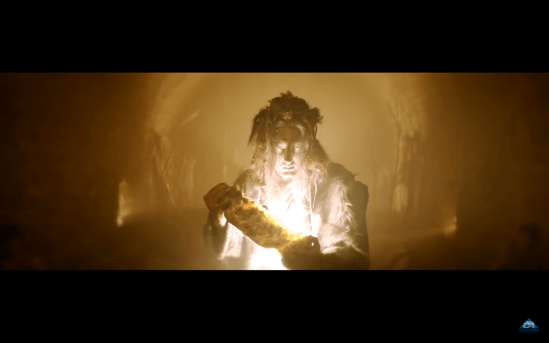
In Medieval times of Sussex, England, a powerful English king, who has kept the seething Viking savages at bay for decades, has died, vacating the throne to his son, Rollo. The Vikings seize the opportunity during this time of transition and storm the Saxon Castle, nearly killing the monarchy and all of throne’s subjects left to oppose them. With their daughter Avery kidnapped and themselves on the brink of death, King Rollo and Queen Silvia are revived by two women of the woods, a pair of witch sisters known as Constance and Millicent, who use their mystical healing powers and offer the king retribution by summoning the Yuletide monster, Krampus. In return for slaughtering the Viking usurpers, the Krampus will collect his debt in exactly 10 years, taking whatever is precious and dear as payment from the vengeful King Rollo.

Krampus has become a major media trend over the last decade, popping up in all forms of popular culture that compounded lore inside the leafy pages of books and magazines to the beast’s frighteningly half-goat, half-man exterior making for great big screen monster entertainment. The inverse icon of jolly Saint Nicholas offers punitive measures for bad little girls and boys and is sometimes referred as a companion to Saint Nicholas who probably turned a decisive blind eye to little brat Johnny’s enjoyably thievery and torture of chickens from a neighboring farm. “Pagan Warrior” is yet another narrative of the Christmas creature spun with different fabric and woven into a bitter feud of two contending enemies told modestly by director Louisa Warren (“Tooth Fairy”), produced by Warren’s London, UK based production company, ChampDog Films, a creative outlet for independent film ventures that are mostly in the horror genre and are sometimes inferior versions of bigger budget films, in the same vein as Asylum Entertainment. The script comes from Shannon Holiday (“Bride of Scarecrow”) that conveys an ageless theme of beware of what you wish for and the price of blind vengeance.

“Pagan Warrior” hones in on numerous character stories, never clearly defining a single perspective. King Rollo, played by “Escape from Cannibal Farm’s Peter Cosgrove, becomes the royal fate sealer as what he deems necessary and right is, in fact, the worst possible scenario a mad king could bestow upon himself by calling upon the supernatural death dealers for revenge. Cosgrove cleans up nicely as an English blue blood whose bequest incorporates a lineage of fighting kings with Cosgrove taking his role with due importance despite a humbling filmmaking production. King Rollo’s counterpart, the merciless Viking Ubbe fitted for Carey Thring (“Scarecrow’s Revenge”), combats a war on two fronts – the contentious bout with King Rollo and an internal family squabble that beleaguer the bond between him and his wife (Kate Milner Evans, “Pet Graveyard”) and child (Adam Sugawara, “Virtual Death Match”) as he tries to court princess Avery with a crude sexual advances. Thring’s vision of Ubbe is a classically depicted villain whose stronger with allies and a whimpering coward when alone in a fight, especially when the Krampus comes calling for his head. Darrell Griggs dons the makeup, prosthetics, and wardrobe of the horned beast, becoming the folklore of a cursed death who not only pursues the 12 month progression of horrible children, but also the appointed damned when conjured for a hit. Krampus’ outward appearance is pleasing and Griggs provides the lumbering and slight preternatural motions that give Krampus that dreaded paranormal mysticism. “Pagan Warrior” rounds out with Sarah T. Cohen (“ClownDoll”), Jessica O’Toole (“Pet Graveyard”), Mike Kelson (“Scarecrow’s Revenge”), Hattie Willow (“The Mermaid’s Curse”), Will Todd (“Mummy Reborn”), and Tara MacGowran (“Mother Krampus”) and director Louisa Warren as the women of the woods.

ChampDog Films uses a tightknit group of actors and filmmakers to sell archaic swordplay action fastened against demonic folklore and despite the underwhelming band of Vikings versus an equally small English contingent squaring off in front of a historic English castle with virtually no ample practical or CGI era enhanced presentations, the production just barely eeks by with Feudal times. Wisely, Warren shoots a number of character closeup shots, avoiding much of the surrounding modern elements and forcing audiences to focus just on the characters who are dolled up for Medieval times roleplay. Where the battle scenes and smart camera work flourish, the Shannon Holiday script becomes the ultimate weak link in the chain with a predictable plot storied with terribly cliched and uninteresting characters that couldn’t grip a sword let alone one’s attention. The story begins with its most shocking ending scene, thwarting any possibility of surprise for even the most dense and cinematically uneducated individual for the ruse play out. There is also this millennium goof in the opening backstory credits indicating events take place in 812 AD and in the same breath, mentioned also is the three days of December 1812 that this episode occurs. Since 1812 England was all about redcoats, guns, and war with America colonies, I would assume 812 AD would be the correct time period against a Viking invasion.
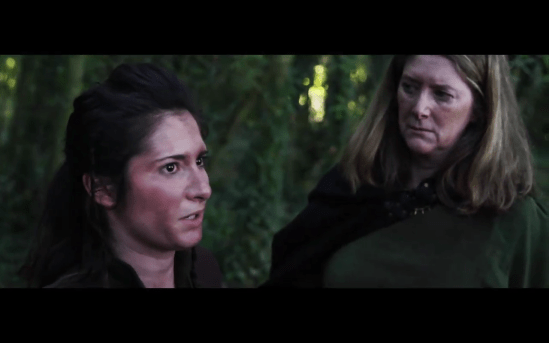
In what is not exactly a Christmas holiday horror movie, the malediction of the “Pagan Warrior” spread little holiday cheer and more yesterday fear onto an ITN Distribution and Mill Creek Entertainment DVD. Presented in a widescreen, 2.35:1 aspect ration, on a single layer DVD, sheathed inside a DVD cover that looks cooler than the actual movie itself, the lower end production avoids stylizing a historical based feature with tinted mattes, computer imagery, or any other miscellaneous camera effects seeking more toward a naturalistic cinematography that utilizes the hues at hand. Pastel blacks jump with noise and posterization from the electronic interference whereas the existing hues exhibit a less than rich approach of a more vapid green, brown, and stonewall beige. The English language Dolby Digital 2.0 stereo audio mix maintains a level of consistency. Sometimes, Krampus’ dialogue is murky because of the extra gnarling effect parroting an LFE emitting voice; however, dialogue is mainly clear and prominent. English SDH is an available option. For a time period action-horror, the lack of rudimentary range and depth troubles with little sense into the effort of adding skirmishing swords and Krampus’ reverberating growls always seem to be right next to the camera. The only bonus feature available is the trailer. With conventional means of dispatching people, “Pagan Warrior” shadows more of the slasher concept conjured by the breath of the desperate who misfires judgment rather than being an omnipotent being summoned like a djinn for total annihilation in exchange for a debt in this good faith effort by Louisa Warren of Krampus diabolism.
Category Archives: Demonology
Watch William Shatner Shell EVIL With Explosive Munition! “Devil’s Revenge” reviewed!

Obsessed in locating a relic that has cursed his family for generations, archeologist John Brock desperately searches the cave his difficult father’s dispatches him to to locate and destroy the artifact that has plagued his lineage. His last expedition kills a man and John begins to question his father’s ranting and whether a curse actually exists, but when a mysterious accident sends him to the hospital, horrifyingly devilish visions nearly kills him in the unconscious state. As he snaps back to reality, John is hellbent on ridding the relic’s clinging evil and his family joins him for one last expedition to the cave that’s also a portal to hell and the Devil is waiting for him.

The above synopsis sounds terribly convoluted for such a rectilinear plot of the William Shatner story of demonic spelunking entitled, “Devil’s Revenge,” from 2019. The “Devil’s Domain” and “Halloween Pussy Trap Kill! Kill!” director, Jared Cohn, tackles the position’s obstacle of frustrations working with a rumored overly difficult Shatner as well as flushing out a cohesive story suited strappingly as can be on establishing a hell bound narrative with little backstory mythology from a script by Maurice Hurley, a writer on “Star Trek: The Next Generation.” What’s unusual is Hurley isn’t credited at the end or on the backcover of the Blu-ray and it’s a project he supposedly collaborated with Shatner up until his death in 2014 at the age of 75. Luckily, Cohn’s on the record saying Shatner was professional and precise, a true credit to his skill. “Star Trek” does become a constant motif not inside the frames, but more behind the camera with the cast, including Shatner, and Hurley who is the creative parent of one of outer space’s biggest nemesis, The Borg. “Devil’s Revenge” is a far cry from the final frontier, seizing on the border fringes of the underworld that seeps above ground.

Trekkie fans will appreciate the Captain Kirk star’s uncharacteristic doomsday pessimism and grand finale grenade launching that turns demons into canon fodder. Shatner is a savage as John’s fanatical father, bombarding his grown, near middle-aged, son with constant disappointment and disparagement that becomes one source of John’s (“Blood Lake: Attack of the Killer Lamprey’s” Jason Brooks) dire motivations to risk his family inside the gaping mouth of the netherworld, a questionable and ill-advised move especially when death is evident. Brooks is a career television and TV movie actor who can settle right into a third rate production with ease without batting a condemnatory eye lash. While Shatner and Brooks’ one-sided family role quibbles over languishing curses and John’s inability to man-up for the situation goes into the hilariously bad category, the second “Star Trek” star, Jeri Ryan from the “Voyager” series, lands a subdued role as John’s foot mat wife who just goes with the punches without making too much of a wake serving as John’s better half and reasonable conscious. Ryan and Brooks’ on-screen relationship is a supposed marital one, but the chemistry just isn’t present and wanders into questionability with their relationship status. The script’s backstory on John and wife is obliquely exposed through exposition without any of the visual depth and discharge of fleshing out a better dynamic for Ryan and Brooks to work with in building their characters. The remainder of the cast list includes Ciara Hanna (also from “Blood Lake: Attack of the Killer Lamprey”) and Robert Scott Wilson (“American Fright Fest”) as John’s college(?) aged kids who add little substance to the narrative.

Without a better way of putting this, there’s much to demerit against “Devil’s Revenge.” The concept is sound: a disarrayed and browbeaten archeologist must locate an evil transmitting relic from destroying his family with a everlasting demonic curse. Sounds good, right? Combine that with Shatner blasting demons to smithereens with a multi-barrel grenade launcher, the potential for a solid and fun viewing experience would be a no-brainer. However, what’s sold is the made in China version of what’s being marketed. Hard to imagine Maurice Hurley’s, the man who helped re-pioneered space exploration and developed The Borg adversaries, script was so out of whack and had gone into various limp curvatures that I don’t expect all blame should point to him for the posthumous misstep as the direction is emphatically coarse and incoherent of too many ideas without any connective tissue much unlike boldly going where no man has gone before. In fact, many filmmakers have gone this route before by taking all sense of a rounded script and dissolving it the way Cohn does. The path Cohn ultimately takes is to splice loads of unnecessary and repetitive flash backs into the story to try and retain into viewers over and over again the events that conjured hell’s minions to surface. I’m sure we saw the same scenes at least five or six times from beginning to end, even during the opening credits. There’s also a looseness about how this curse attaches itself to John’s family from long ago that inexplicably goes without being conveyed and we find ourselves asking, why these people? What have they’ve been suffering through all these years? What makes them important? The curse seems rather recent rather than historic and for John’s family legacy to go uncharted just poses too many unanswered questions. What’s fundamentally right is Inan, the head demon, who represents the best parts of the “Devil’s Revenge’s” netherworld rock and roll presence with a large and ghastly humanoid with blank, fiery eyes and a protruding clasping mouth and the visual effects surrounding Inan are pretty good despite their some minuscule glossy bad aftertaste. An aftertastes that extends into Shatner using the grenade launcher with the goofiest of detonations in an unrealistic distance between him and his targets without so much of a single piece of shrapnel grazing his well postured gun-toting stance.

MVDVisual distributes “Devil’s Revenge,” a Cleopatra Entertainment production, onto a region free, special edition Blu-ray and soundtrack CD combo. The Blu-ray is presented in a widescreen, 2.78:1 aspect ratio, in a BD-25 with a 1080p transfer. “Devil’s Revenge” implores more than the natural lighting used through much of the 98 minute runtime and while natural lighting isn’t a flaw in any sense, Ryan Broomberg’s cinematography falls flat, uninspired that doesn’t represent well the presentiment eventualities past, present, or future. Technically, “Devil’s Revenge” isn’t soft around the details albeit minor banding in closer quarters of the cave. Practicality versus the computer imagery really do go head-to-head between Vincent Guastini’s (“Art of the Dead”) special effects and the visual effects team of Eric Chase (“The Black Room”) and Mike Rotella (“The Predator”). The detailed rubber body suits and the composited explosions akin to the military hellfire creatures were bombarded with in monsters movies from the 50’s are of the campy independent film culture and purgative of any expectations of the Devil actually making good on revenge. The English language Dolby Digital 5.1 surround sound audio is not as lossy as the usual Cleopatra Entertainment Blu-ray releases and certainly regales with the theatrics of a William Shatner monologue (can’t you tell I love me some Shatner). Range and depth are concurrent appropriate with each other and dialogue is clean and clear. Surprisingly and rarely does a Cleopatra Entertainment releases goes without a soundtrack intertwined with the score that contracts their signed artists from parent company Cleopatra Records; instead, we receive a brooding industrial score composed by Jürgen Engler, co-founder of German punk band “Male” and “Die Krupps,” which can be gorged on as the film’s coveted silver-lining. Luckily and conventionally for a Cleopatra special edition release, an un-cursed 13-track CD of Jürgen Engler’s score accompanies the feature Blu-ray. That being the height of the special features, other bonus material includes a picture slideshow and theatrical trailer. “Devil’s Revenge” won’t shudder your bones to milky pigments of sawdusts and will likely strikeout with fans, as perhaps the Devil’s actual revenge for portraying him so ill-conceived. Still, I suggest checking out the Jürgen Engler’s gnawing and insidious industrial score, a gleaming highlight for sure.
EVIL’s Brush Stroke of Genius in “Art of the Dead” reviewed!

The Wilsons’ are the perfect portrait of a nice family; they’re wealthy but charitable and kind without exploiting the humility of others. However, when Dylan and Gina Wilson bid and win on the SinSational art collection at auction and hang the enchanted paintings strewn through their mansion estate, a strange succumbing to sin overwhelms their moral fiber. The paintings of Dorian Wilde, an eccentric and obsessive 1890’s painter who achieved eternal soul longevity by making a pact with the devil, created the art, depicting primal animals symbolic of the seven deadly sins, by using canvas and paint out of flesh and blood of his victims. The Wilsons’ become corrupted and carry out the sins of Pride, Lust, Gluttony, Sloth, Greed, Envy, and Wrath and the only way to save the family from damnation lies in the hands of a former priest, Father Mendale, and a girlfriend, Kim, of the oldest Wilson boy engulfed by Wrath.

“Art of the Dead” is what people call when art comes to life, or in this case, death. From the selective “Emmanuelle” film series and “There’s Nothing Out There” writer-director, Rolfe Kanefsky comes a story woven with the seven deadly sins theme as a foundation that approximates a 90’s grade thriller of epically gory proportions. With a catchy, yet dead horse beaten “of the Dead” title, “Art of the Dead” uses the seven deadly sin theme and blends it with an obvious homage to the gothic literary novel, “The Picture of Dorian Gray,” by Oscar Wilde. The main antagonist, Dorian Wilde, is the merging of the author and his fictional creation. Oscar Wilde wrote the novel in 1891, the same era the story enlightens in which Dorian Wilde makes a pact with the devil. Unlike another notable film, “Se7en,” where a practical killer exploits the capital vices to thwart a pair of detectives, “Art of the Dead” introduces dark, supernatural forces of Oscar Wilde’s work into the fold that are not only abject in what makes us human, but also biblically condemning, spearheaded by a satanic maniac who will do everything and anything to maintain his precious work and eternal soul, Produced by Michael and Sonny Mahal of Mahal Empire productions, the financial investors have also backed a previous Kanefsky film, another occult gone astray thriller entitled “Party Bus to Hell,” and in association with Nicholas George Productions and Slaughtercore Presentations.

Another pair of producers are also a couple of headlining actors who are household names – “Sharknado’s” Tara Reid and “21 Jump Street” actor and avid painter, Richard Grieco. Reid plays a snooty and shallow art gallery curator who sells willingly the Dorian Wilde set knowing well enough of their malignant history, but Grieco has a personal connection toward a film regarding art more so than the dolled up Reid because of his nearly 20 year passion as an painter of Abstract Emotionalism. His character, Douglas Winter, is obsessed with the SinSational collection to the point where it uses him as an instrument to kill his artistically unappreciative family; a sensation washed over as parallel and broad among all artists alike fore sure. Jessica Morris (“Evil Bong 666”) and Lukas Hassel (“The Black Room”) also headline. Morris provides the sultry and lustful-influenced mother, Gina, and her golden hair and blue eyes has a fitting innocence that’s is tainted and provocatively shields the cruel intentions of lust and power while Hassel, a giant of a man, immediately becomes capitulated to greeds’ warty influence. Each actor renders a version of their paintings and each dons the sinful presence gorgeously with individual personalties and traits; those other actors include Cynthia Aileen Strahan (“Dead End”), Sheila Krause, Jonah Gilkerson, and Zachary Chyz as well as “The Black Room’s” Alex Rinehart and Robert Donovan along with Danny Tesla playing the demonic proxy of Dorian Wilde.

“Art of the Dead” embodies an innovated spin on a classic tale of self-absorption and deferring one’s own detrimental sins upon others to carry the burden. Kanefsky grasps the concept well and visually sustains a contextualized 98 minute feature that carries a straightforward connection to the Gothicism of Oscar Wilde while cascading a family tree (pun intended) of problems that pinpoint each sin’s affecting destruction upon the soul through a wide burst of dispersive poison. While the idea is sound enough, the script and narrative channelling hardly carries the equivalent weight of the idea and comes off clunky, cheap, and sometimes uncharismatic. “The Black Room” was the last Kanefsky film critiqued at ItsBlogginEvil.com and the script was noted with the characters that hardly progress up toward and out of the despondent and deviant muck and it was the filmmaker’s softcore cinema background that attributed to the characters over-saturated girth of lust, which elevated and hindered “The Black Room’s” incubus storyline. With “Art of the Dead,” Kanefsky redresses the lust to quench just the respective sin with the right amount of perversion, represented by the mythical, sex driven Satyr that was created beyond being a nice touch of storytelling, disturbance, and meta kinkiness. Kanefsky continues to proportionally feed each sin the same manner with the exception of Pride that lures in a specific victim; however, the paintings’ insidious nature wonders to a circumstantial level at best with Kanefsky’s tongue-and-cheek dialogue and uncouth playfulness of Dorian Wilde while possessing the flesh of a black-laced, Fredrick’s of Hollywood-cladded Gina.

Umbrella Entertainment and ITN distribution release “Art of the Dead” onto a region 4 DVD home video and is presented in a widescreen, 2.35:1 aspect ratio. The sterile and polished look of the image renders doesn’t invite stimuli to visual senses, but is superbly clean and free of blotchiness that can routinely be a contrast issues with darker, indie productions; however, the digital source is nicely maintained and the darker scenes and colorfully deep portions of the paintings, the viscous blood, the modernized Wilson house, and the anywhere else have quality caliber. Visual and practical effects are necessarily key for “Art of the Dead” to be successful and the film scores a combination of talent to enhance the ho-hum photography with renaissance man Clint Carney, whose visual effects work on his own written and starred in film “Dry Blood” was flawless and who also painted Dorian Wilde’s works of art, and some solid practical and Satyr creature effects work by “Child Play’s 3” Victor Guastini and the VGP Effects team. The English language Dolby 5.1 surround sound audio is clear, precise, and no inkling of issues with the range and depth of ambient sound. Like most standard DVD releases from Umbrella Entertainment, this release comes with no bonus material or even a static menu. To observe his work as a whole, filmmaker Rolfe Kanefsky has nothing to prove with a body of work spanning over nearly three decades, but in reducing “Art of the Dead as a singular film, there in lies a double edged sword. A true sin is to headline a film with actors with brief roles just to draw in investors and an audience, yet “Art of the Dead” also finds innovated modernism out of classical creativity, giving new life by homage, and displaying some maximum carnage fun with plenty oil and water color.
God Hatin’ MMA Fighter Still Has The Power in Him to Fight EVIL! “The Divine Fury” reviewed!

After the sudden and violent death of his police officer father, mixed martial arts champion, Yong-hoo, has a complete disdain for God from a young age now that both his parents have perished. Growing up angry and swarmed with negative thoughts, Yong-hoo goes through life without much of a purpose until he awakes from vivid dream with the wound of stigmata on his hand. Unable to stop the bleeding by means of conventional medicine, he resorts to a shaman who convinces him to seek out Father Ahn, an elder priest experienced at practicing the rite of exorcism, and learns that the wound and Father’s once unwavering benevolence provide a divine weapon against a growing covenant of demons under the black magic of a Dark Bishop. Together, Yong-hoo and Father Ahn combat the forces of evil before the possession runs rampant in the city.

South Korea packs a punch with an action-packed take on possession and exorcism with Kim Joo-hwan’s “The Divine Fury.” The 2019 released film that blends horror with the cinematic formulas of the comic book universe films is written and directed by Joo-hwan and produced by Studio 706, KeyEast, and Lotte Entertainment, the latter being a subsidiary of one of the largest Asia conglomerates and a leader in the Asian film industry. “The Divine Fury” isn’t low-rent horror, providing fans with salt of the earth martial arts, a range of diverse set locations, and a decent grade of special effects that range from stunt men quality to visual monstrosities, including a giant hell worm bristled with millions of arms and hands, and also gives a chance for Joo-hwan to showcase his junior horror-action that succeeds a 2017 buddy-comedy in “Midnight Runners” and a coming to terms drama in his 2013 film, Koala. One motif, and perhaps trademark, that runs through all of Joo-hwan’s written and directed films is the coupling of protagonists element and “The Divine Fury” is not an exception and follows the same coupling, if not slightly altered, mechanism.

A pair of actors from Bong Joon-ho’s award nomination buzzing “Parasite” also have a role “The Divine Fury,” one of them, Seo-joon Park, being the lead star of the Joo-hwan film as the MMA Godsend, Yong-hoo, with hate in his heart for the Lord Almighty. Yong-hoo’s a joy to watch on the screen as a character with an arch’s beginning as a young man, a mindless fighter, being verbally influenced over his shoulders by demon puppeteers to finding his lost father figure in a man who has an unflinching amount of faith. Seo-joon captures the defined struggle Yong-hoo has with God even in the face of pure demonic evil before him. An evil battled by Father Ahn, dolefully portrayed by “Sector 7’s” Sung-Ki Ahn. Sung-Ki fatherly performance places Yong-hoo into a role of humility, not only as a mentor, but with experience and patiences that resigns to trust rather than action. However, the dynamic goes both ways. Seo-joon shows lot of physical strength becoming unwittingly the “divine” warrior to thwart an insidious malevolency when Father Ahn is taken out of action due to Yong-hoo’s haste. Seo-joon had to quickly and naturally grow up his character to be the leading, brute force of experience and physicality and did just that as character faces off with the Dark Bishop, Ji-sin. Ji-sin invokes demons to inhabit those in a weak state of mind. This devilishness wouldn’t have been made possible without Do-Hwan Woo’s stoically sly and slimy confidence behind the character. The remaining cast rounds out with another “Parasite” actor, Woo-sik Choi, and Seung-Joon Lee.

“The Divine Fury” is fundamentally an essential oil extracted from the widely popular comic book universe money-making machines, that are sometimes also called movies from time-to-time, but “The Divine Fury” doesn’t have that monstrous platform of a narrative pulled directly from the illustrated pages of comic book franchise. Yet, the story builds a downtrodden, seeking-answers Seo-Joon with a tragic past and an ability to pulverize people – a winningly similar combination to any pre-defined hero in the Marvel character evolution. There’s also this theme of fatherhood and mentorship, like seen in “X-Men” with Professor X or “Blade” with Abraham Whistler. The latter of those two examples perhaps more closely resembles Father Ahn as the relation to the horror-action genre is similar in nature, but instead of abstaining from blood thirst, Seo-Joon is abstaining from letting God into his heart. Of course, “Blade” was ultra-violent and bloody and “The Divine Fury” is grossly more toned down with the exception of a few key moments of blood regurgitation. Speaking of effects, the visual effects waned from expectation and teetered more toward a rushed and unpolished look. They weren’t terrible, but not the best looking visual effects demons in the industry.

Well Go USA Entertainment brings the action of exorcism to Blu-ray and DVD home video with a dual format, two-disc release of “The Divine Fury.” Presented in a 1080p widescreen, 16:9 aspect ratio and sheathed in a slipcover, “The Divine Fury” feels necessarily gritty in comparison to the subject material with a clean, almost sterile image that defines the blacks and colors, despite a short range of vivid hues the hues that are dominant are profoundly thick and dark. The limited color palette won’t be a problem as demons hide in the shadows and that’s where the story takes domain in scaffolding-laden churches, orphanage basements, and even a swanky neon-glowing club with a well of damnation beneath in the dungeon. The skin tones have a natural feel about them, but going against the grain of naturalism is the visual effects as aforementioned as they don’t render properly to exude the right viewer reaction. The Korean language 5.1 DTS-HD Master Audio has ample weight. Whispering shadows of slithering speak and the bubbling of the, again, well of damnation emit the right kind of range and depth needed to descent into doom and gloom atmospherics. Dialogue is crystal clear and in prominent. An English dub is available, as well as English subtitles that errorless and well synced to the Korean dialogue track. There is some English during a MMA fight on the Korean track. Bonus material includes a rather generally spiced together making of featurette that includes mini segments such as prop commentary, special effects, behind-the-scenes look, and the construction of the antagonist world in “The Divine Fury. There are also a couple of trailer variants and a U.S. trailer for the film. Ultimately, “The Divine Fury” intrigues on the fray, desiring more into the backstory of Father Ahn and delving further into Seo-Joon’s weaponized stigmata and director Joo-hwan Kim teases just that with a taste of things to come with a short pre-credit scene that sets up “The Divine Fury” for more themes, perhaps, on a love-hate relationship with God, more, perhaps, finding suitable father figures, but, of course, there will be for sure more exorcizing ass-kicking of demons.
There’s Not a Big Enough Pipe Cleaner to Exorcise this EVIL! “Drainiac” reviewed!

Julie, troubled by her mother’s suicide one year ago, is forced by her deadbeat dad to accompanying him in cleaning up an old house he purchased for renovation and resale. As he takes off to attend to “important business” at the local watering hole, Julie is stuck alone with the mop and bucket inside a mysterious, rundown house she’s suspicious of being haunted after strange occurrences and horrifying visions transpire during her isolation. Lurking beneath the house and seeping through inside the rusted pipes, a figureless water demon’s presence persists with malicious intentions and things become worse when Julie’s friends check in on her. Drowning in the supernatural seepage amplified by Julie’s trauma, they become trapped on the property that won’t allow them to escape, draining them of hope against a bodiless, hell-bent entity until a certifiable exorcist shows up at the door arrogantly confident of ridding the flood of evil from this house for good.

Back in the year 2000, Brett Piper’s written and directed volatile ghost house feature, “Drainiac,” saw the light of day for the first time on DVD home video. Unfortunately, through the dismal proceedings of post-production funding and a less than enthusiastic distribution company, that version of the film is undercooked and unfinished in the artistic eyes of Piper who worked with a slim budget of $10,000, making every detail crucial and required to flavor the dull taste of anemic financial support. Luckily for the “Queen Crab” director, his collaborations with Shock-O-Rama Cinema, a sublabel to the indie film doting POPCinema, gave the 20+ year indie filmmaker access to digitally remaster to ultimately finish “Drainiac,” leaving the issues with the previous version water under the bridge, water related pun intended. “Drainiac,” believe it or not, has extraordinary relate-ability to today Americans who are frightened from the mistrust of confidence in their local water treatment systems and drainage pipes for the fear of lead poison and other harmful contaminants, which, in these affected citizen’s circumstances, is a “Drainiac” monster of sorts, hidden from sight with an uncertainty of product quality that drips from their faucets and into the bathtubs their kids play in and into their water drinking glasses.

Another amazing aspect of “Drainiac” is the fresh-face, young cast in their humble beginnings that flourished into solid careers and feels absolutely energetic and stimulating to know their roots reach far back to a cellular grindhouse organism becoming their vocation life. Georgia Hatzis debuts as the beleaguered Julie, a resilient survivor of her mother’s suicide with an oil and water dynamic with her estranged live-in father. Maintaining Julie’s sanity while still fronting a stable façade couldn’t be easy, but Hatzis builds upon Julie’s strength and owning the character’s self-doubt. Hatzi extended her career into television, but Julie is her most memorably performance, especially braving bathing full front to be attacked by a drain’s quasi tentacle erotica sequence. Perhaps the most recognizable face in the film co-starring in the film in her mid-teens, Alexandra Boylan is conscripted to be Julie’s best friend, Lisa. Boylan, who went on to have roles in “The Hitchhiker” remake and the invasive thriller “Home Sweet Home” as well as branching out into life behind the camera as a producer and writer, plays consistently a rationally steady bestie that grounds Julie when needed and is the firm leader of their group of friends that also includes a shaky and nearly spineless Jake (Ethan Krasnoo) and a shallow beauty Tayna (Samara Doucette). As the black sheep in the group, perhaps not even a friend at all, was Wade, a hog riding, wisecracking jerk who didn’t have sense of personal space, especially when the rapey urge washes over him. Wade is an abhorrent human being that came to life due in part of Robert Gorden’s performance. Soon to be seen in the television comedy entitled “My Wife Divorced Me Because I’m a Zombie” that is taglined “The Walking Dead Meets Modern Family,” Gorden will make you hate his guts and despise his obnoxious 90’s haircut and wardrobe and the overall package is enjoyably cathartic to have him pitted against a conventional set of friends. Other colorful talent includes roles by Philip Barbour as an exorcist who reassembles the fisherman Gordon from the frozen fish stick packaging, Steven Bornstein as the despicable dad of the year, Todd Poudrier as a melting derelict, “Sgt. Kabukiman N.Y.P.D.’s” Andrew Osbourne as the melting derelict’s friend, and Elizabeth Hurley! No, not the Austin Powers’ Elizabeth Hurley, but an Elizabeth Hurley nonetheless!

“Drainiac” is Brett Piper’s finest work. Copiously laced with assorted practical effects now completed with a coloring touch up and enhancement by Penn State grad colorist Dave Northrop, “Drainiac” is now has a definitive package that includes Piper hyper-psychedelic matte effects, creepily good stop motion clay creatures, and an abundance of well-crafted gag effects to give the drain presence a slimy drain-protuberance without exposing a tangible thing in the pipes. “Drainiac,” in every category, has a vibrant late 80’s, early 90’s epoch authority even though clearly set and stated at the turn of the century and this is partially because of how the film was shot in 16mm, giving the feature a grindhouse texture. Along with the turn of the century, CGI becomes a huge factor no matter the budget of the film as long as portioned appropriately, but Piper sticks with a practical craft which, in a sense, is a large piece of his filmmaking passion and so “Drainiac’s” is the essence of Brett Piper.

Courtesy of POPCinema’s Shock-O-Rama Cinema horror banner comes Brett Piper’s “Drainiac” onto a special edition with a 24 progressive segmented frame, high definition DVD from the original camera negative and presented in a widescreen, 1.78:1 aspect ratio. Having never experienced the original, unfinished cut of the previous release, watching this present cut will forever be seared into my soul as the best possible rendition in the past, present, and future. The 16mm film stock quality has a lot of natural grain upon a semi-washed look over a gradient-lenient color range sanctioned around the natural lighting that then explodes into a varying vividness of hues when the FX-enhanced scenes spark an immense saturation of color schemes…in a good way. No sign of damage to the original print nor any other signs regarding frame or edge enhancing and cropping. The English language 2.o stereo track, with a re-edited mix as part of the remastered package, is free of distortions, prominent dialogue, and a classic chilling piano soundtrack that pays homage to notable horror films before it’s time. The only issue to mention is some synchronization with the dialogue track and the picture seem to be off early on in the presentation where actors move their mouths to vocalize the lines, but nothing comes out. Special features are a little anemic considering the painstaking involvement and time gap in remastering “Drainiac,” but they include an audio commentary by writer-director Brett Piper and a read worthy tidbit of an inner-lining booklet written by commentary moderator, Greg Conley. THe DVD cover art is very snazzy (or snotty-like) similar to of another POPCinema release, Greg Lamberson’s “Slime City.” Reminiscent of “Evil Dead” or even some inklings of early Peter Jackson, Brett Piper has a knack for proving low-budget horror’s misconceptions are nothing more than that, misconceptions, by keenly tinkering to perfection a story that’s made is seemingly funded from a pot of unlimited gold from nifty, traditional effects and a narrative that works wonders on the imagination, keeping you glued to guessing from start to finish.