Nurses’ Put Up With All Kinds of EVIL in a “12 Hour Shift” reviewed! (Magnet Releasing / Digital Screener)

In the dwindling days leading up to the turn of the century, Mandy is about to start a 12 hour nursing shift at an Arkansas Hospital.  As a side gig, Mandy must supply fresh internal organs to her dimwitted cousin and organ mule, Regina, to earn a little extra cash to pay for her narcotic habit, a condition prolonged and sustained by a front desk colleague.  When Regina misplaces the bag full of internal organs and doesn’t deliver them to her ignoble black market boss, she returns to the hospital desperate and corners Mandy into coughing up more, even if that means killing a patient or two.   When Mandy profusely refuses, but reluctantly complies, Regina still takes matters into her own reckless hands and as the bodies begin to pile, Mandy has to stave off police interrogation and suspicion long enough to get through the long night shift of twisted circumstances and peculiar characters.

As if nurses didn’t already work tediously long hours on normal circumstances as it is, Brea Grant’s pitch black comedy, “12 Hour Shift,” is a cardiac inflamed melee of drug users, a convicted cop killer, and black market goons slaughtering it out with hapless patients caught in the middle.  “12 Hour Shift” is the sophomore film written and directed by Grant, released 7 years following her feature debut of the apocalyptic drama, “Best Friends Forever,” in 2013 as Grant also costars alongside Vera Miao as a pair of BFF journeywomen.  Now, Grant steps fully behind the camera, cherry picks real life headlines, and blends them with urban myths to inject cynicism right into our plump veins with pulpy anti-heroes and a graphic violence backdropped with a Y2K hyperbole.  Shot on location in Jonesboro, Arkansas, the film is produced by Matt Glass and Jordan Wayne of HCT Media and alongside actors, Tara Perry and David Arquette, and David’s wife, Christina McLarty Arquette. 

“May” star Angela Bettis jumps into scrubs as the steely junkie, Mandy, who teeters on benevolence after a streak of merciful killings of terminally ill patients for vital organs in exchange for addiction withdrawal averting cash. Mandy is stuck between a motley nursing staff, unpredictable cops, and a pair of bad guys as the coupling link scrambling to tread above water.  Bettis brings her harried eyed fortitude as a sarcastic and solitude-immersed nurse who is a jack of all trades contending internally with paper thin sympathetic motivations paralleling her self-preserving abilities.  Mandy’s calculating, on-the-fly smarts comes under threat by Regina’s halfwit, caution to the wind, sociopathy, housed under blonde teased hair sitting upon a model’s thin frame from the build of Chloe Farnsworth (“Crying Wolf 3D”) who dons crazy like a dunce cheerleader of a Renaissance slasher of an 80’s throw back, but instead of being the chest-baring victim killed while having prematernal sex in the woods, Regina is a scrappy and determined go-getter with more Cheeto dust on her fingers than braincells in her brain.  Grant paints a hefty list of colorful characters, written to ooze their own sanctimonious nature or Podunk refinement, a pair of inglorious splendor fallacies of small Southern townsfolk.  Dusty Warren plays one of those roles in the tactless ponytail wearing Mikey, the right hand muscle of the organ trafficker, and Mikey has nerveless feelings toward those that surround him except for his boss and, then, there’s Tara Perry’s Dorothy, a religious chatty-Cathy nurse who is essentially the most good, but less influential character of the whole rotten bunch.  “12 Hour Shift” cast rounds out with Kit Williamson as the cute, but hopelessly funny beat cop, Nikea Gamby-Turner as Mandy’s side hustling quasi-employer/colleague of drugs and organ, Brooke Seguin as the tireless nurse shift supervisor, and a pair of wrestlers, the only and only Mankind, Mick Foley, and the actor-turned-wrestler, David Arquette (“Scream”), who I must note is perhaps in the best shape of his life for this film.

“12 Hour Shift” comes off as like a big, crass joke on Southerners with a bloody knuckle one-two punch domino effect of disaster after disaster mayhem.  Grant satirically captures the hackneyed perceptions of a small Arkansas town from the late 1990s, complete with tube televisions and really bad hairstyles, that doesn’t the support the age old Southern mantra that is Southern Hospitality.  Every character touts an awful version of themselves.  Even Mandy, a junkie who commits unauthorized euthanasians with bleach in exchange for cash, crowns being perhaps the absolute worst of the entire character pool, but endeavors through the chaos as an anti-heroine we want to cheer for but is nowhere on the brink of amiability.  A strong point for Grant is giving every character, from scarce to principle, a once over and also touching on them periodically throughout to keep the minor parts existing in the back of the mind  Only David Arquette’s convicted death row inmate, emitted into the hospital due to self-harm, is the only role that feels half-heartedly fleshed out as a small story outlier or maverick whose dynamic is to only add another layer of obstacle fear without becoming too involved with the heart of the organ trafficking plotline.  The comedic air is dry, bloody, and not egregiously over the top in savoring enough plausibility of the abstracted truths to be told in a verse narrative that relies much on Matt Glass’ cymbal, bass, and snare drum soundtrack to provide an unique rhythm for a feminist story.  The two female leads absorb, react, and solve the issues on their own without male assistance; Mandy’s very own half-brother lies comatose for all of the duration and he’s even the reason for Mandy’s pounding addiction, but she still exhibits compassion for family, as we also see with her cousin by marriage, Regina, in the last act, and will do anything to guarantee his safety.  The attributes of the male characters are inversely heroic with qualities like whining, coquettish, uncouth, and gullible running rampant amongst the behaviors; ergo, female characters Mandy, Regina, and even Nikea Gamby-Turner’s Karen have room to grow in the timespan of Brea Grant’s “12 Hour Shift.”


Magnet Releasing and HCT Media in association with One Last Run presents “12 Hour Shift,” stat, releasing this Friday, October 2nd in theaters and video on demand.  The black comedy from the United States clocks in at 87 minutes of a shift from hell.  Since the screener provided was of a new theatrical release, there will be no A/V specs listed and critiqued.  The only bonus feature outside the any kind of physical release is an extended last scene after the principle credits role that encourages more hospital mayhem, but will alas leave open ended about the destruction that would ensue.   Aforesaid, Matt Glass serves as the composer on the film, but the multi-hatted filmmaker also serves as the director of photography, producing tactile scenes with a lot of rich, natural lighting on a slightly higher contrast scale and with pockets of brilliant, soft hues to exude more dastardly situations. “12 Hour Shift” goes to show you, in extreme measures and unpredictable circumstances, much like real life hospital scenarios, the rigors and pressures of nursing can be unfathomably taxing, but under the gun (literally in the movie), the nursing staff can overcome all obstacles and filmmaker Brea Grant, in her own style, honors with a gritty, black comedy for the profession that, in many instances, goes unappreciated and thankless.

An Elite, EVIL Assassin Loses Herself as the “Possessor” reviewed! (Neon / Digital Screener)

Tasya Vos is the top professional assassin employed by a hire-for-murder agency who uses surgically implanted brain transceivers to insert agents’ consciousness into a person’s body who can get close to their intended kill target. The no contact procedure has been successful with some severe drawbacks, such as the potential for slipping out of your own identity in being, in one way, a part of many distinct personalities. When Vos’s next assignment is to insert herself into the mind of the soon-to-be son-in-law of a powerful tech CEO, her individuality begins to crumble, losing her grip as the primary inhabitant of the body. The commingled souls share thoughts and memories and when Vos takes a backseat in a body that’s no longer under her control, her life becomes vulnerable to a confused and unhinged man seeking vindictive measures to evict the assassin from his mind.

Like an existential extension of his father’s career, writer-director Brandon Cronenberg’s foothold within sci-fi horror is anchored by functional practicality, substantial social commentary, and a knack for exhibiting cynical undertones in his sophomore film, “Possessor,” a gripping tech-thriller avowing the soft-pedaled ambiguous identity and corporate invasiveness. “Possessor” is the blood soaked corrosion of individualism that strips morality and replaces it with unapologetic nihilism in a film that feels very much David Cronenberg’s “eXistenZ” merged with Paul Veerhoven’s “Total Recall” with that plug-and-play dystopian coat of paint that’s being brushed over the quickly disappearing free will. Studios involved in the making of “Possessor” include Rhombus Media (“Hobo with a Shotgun”) and Rook Films (“The Greasy Strangler”) in association with a WarnerMedia division company, Particular Crowd.

“Possessor’s” leading lady, Andrea Riseborough, is no stranger to idiosyncratic roles in equally atypical films having starred in “The Duffer Brothers'” “The Hidden” and played the titular character in the avant-garde horror, “Mandy,” across from Nicholas Cage; yet, from her experience with big-budget studio films, such as “Oblivion” starring Tom Cruise, the English actress felt the uneasy atmospherics to be pressurizing and uncomfortable Riseborough has thus exceled with films such as Cronenberg’s “Possessor” that’s pivots into an alcove just off the main halls of horror and science fiction. Riseborough looks nothing like herself from “Oblivion” by sporting a stark white hair on top of a thin frame, which could be said to be the very counter-opposite of what a typical, bug-budget assassin should look like, but Riseborough delivers stoic and uncharitable traits of a character on the brink of losing herself. Christopher Abbot delivers something a little more chaotic when his conscious retreats back into the depths of his psyche only to then seep back into his mind where he stumbles to catch up on current events. The “It Comes At Night” Abbott disembodies himself not once, but twice, becoming an avatar for Tasya Vos to play, picking up where Abbot’s Colin left off, and then Abbot has to regain control, splicing Colin back into the cockpit where Tasya commands the yoke. The dueling dispositions cease being unique as one attempts to control the other in a mental and corporeal game of chess, confounding audiences of who is in control during certain scenes, especially when Colin goes into a blackout murdering spree of people Colin himself knows and trusts. As a puppeteer moving a marionette, pulling as an influential strings behind company lines, is Girder, a poker-faced agent head seeking the absolute best in the company’s interest, who finds her thimblerigger in Jennifer Jason Leigh. Leigh, whose experience with David Cronenberg’s “eXistenZ” brought a high level of cognizance to “Possessor” having been an cerebral deep virtual reality trouper previously, folds in the nerve of any level of management that would guilt someone else into doing the work necessary to get the job done. Girder opposes Tasya’s external humanity in a silent, but deadly manner by appealing to the killer instinct in Taysa, letting red flags of the out of body experience fly by the waist side that ultimately wears away at her star pupils moral conscious and turn her into a stone cold killer. “Possessor” cast fills out with Tuppence Middleton (“Tormented”), Kaniehtiio Horn (“Mohawk”), Rossif Sutherland (“Dead Before Dawn 3D”), Raoul Bhaneja, Gage-Graham Arbuthnot, and “Silent Hill’s” Sean Bean in a worthwhile role just to see if his role will succumb to a typical doomed Sean Bean character as the undesirable tech CEO.

Its safe and sufficient to say that Cronenberg’s “Possessor” is not a feel good story; the amount of tooth-chipping, eye-gouging, and throat stabbing gore takes care of any hope and ebullient energy that one could misperceive. Yet, while the disgorged grisliness stands on it’s own, Cronenberg possesses a factor of tropes that multiply the film’s bleak, icy landscape inhabited by unpleasant characters that ultimately seek and destroy the little good exhibited. The obvious theme is the disconnect from one’s own identity. Tasya Vos mental capacity nears the breaking point being an inhabitant of numerous bodies and with each callous, bloodletting assignment, Vos’ indifference for the things she should hold dear strengthens immensely drowns in the persona of another person and the psyche breaking acts of violence. Her latest assassination attempt even blurs the lines of her sexuality as her feminine body parts merge with Colin’s masculinity in one of the craziest sex scenes to date. Colin’s individuality is too threatened but from Vos’ intrusion, equating the quiet, strange behavior to a sudden vagary toward a person’s dejection, being estranged from their own life, on the outside of “Possessor’s” alternate reality of science fiction’s hijacking of one’s brain. On the subject of intrusion, a not-so obvious theme, but certainly has a strong motif, is the severe invasion of privacy. Vos’ spying on Colin and his lover for personality intel, Vos’ inspection of the entire Colin body while inside inhabiting him, and the data mining of Sean Bean’s character’s tech company, which pries itself through the optics of people’s computer cameras to garner information, such as the fabric of window curtains in this case, divulge an uncomfortable message that privacy is a luxury we are unable to ever grasp. There’s even a scene where Vos, in Colin, becomes a voyeuristic participant of a couple’s explicit sexual intercourse during data mining work hours. Despite the breadth of technology that are brimming near our fingertips today, “Possessor” has a very analog approach with dials and switches of seemingly antiquated electronic circuits, thus rendering the story grounded in nuts and bolts rather than being lost in the overly saturated and stimulated advanced tech. Beguiling with a somber serenade, “Possessor’s” a highly-intelligent work of diverse, topical qualms seeded by years of body horror and existentialism and is released into a world that’s perhaps not ready to come to terms with much of the themes it will present.

Come October 2nd* to select drive-ins and theaters, “Possessor” will be distributed uncut by Neon, implanted in the midst of horror’s biggest month of the year. Since not a physical release as of yet, the A/V attributes will not be critiques, but the film is presented in 1.78:1 aspect ratio and is under the cinematography direction of Karim Hussain, who has previously worked with Brandon Cronenberg on his debut film, “Antiviral.” Hussain adds rich two-tone coloring for a symmetry of sterilization that is, essentially, white and black with every shade of both in between tinted slightly with a dull hue on the spectrum and with the blood being that much more graphically illuminated against the backdrop. There are moments of composites that could render a person disabled with epilepsy, so be warned. The audio is a smorgasbord of a jarring ambience and soundtrack, adding to “Possessor’s” fluxing turmoil, but the dialogue discerns a little less sharply across; there was difficulty in understanding characters’ monologues or discourse who came across mumbling through scenes of fuzzy earshot. There were no bonus materials to mention nor were there bonus scenes during or after the credits. Perhaps the best movie you won’t see this year, “Possessor’s” an impressive follow up feature that reaches out beyond the outlining border of a vast and prolific filmic shadow looming over the filmmaker, but Brandon Cronenberg contrives new vitiated wonderments and is capable of casting his own umbra that would eclipse to throw light onto his soon to be seen cathartic body of work.


* Release date correction (9/29/20)

Nothing Will Stop EVIL From Being EVIL! “Chaos” reviewed! (Dark Force Entertainment & Code Red / Blu-ray)


Visiting home on break from UCLA, Angelica visits her close friend, Emily, at her parents’ secluded country home. With nothing else better to do in the small rural town just outside Los Angeles, the two teenage girls set off early to attend a local rave deep within the woods at the reluctance of Emily’s overprotective parents and to kickstart what could be a drink and dance fueled night, they aim to push the limits and find a drug pusher to score ecstasy as the first priority to make a dull party fun. They run into Swan who promises the best ecstasy as he leads them to his cabin away from the rave. What Angelica and Emily find is themselves caught in the middle of a ploy by a sadistic gang lead by the ruthless Chaos, whose wanted in 4 states for his barbaric and merciless methods and looking for something fun to play with and torture. The cat-and-mouse game with the girls makes an interesting turn when the gang arrives at Emily’s parents’ house when their van breaks down and the parents suspect them in Emily’s sudden disappearance, veering the night into unreserved chaos.

“Chaos” is the intended true love song remake to Wes Craven’s 1972 sadistically vile “The Last House on the Left” that’s co-produced by Marc Sheffler, who play Junior Stillo in Craven’s film, and, at one time, Krug himself, David Hess, was attached to the project. “Chaos’s” conception is the brain child of Steven Jay Bernheim and David DeFalco, with the DeFalco wielding the hammer of writer and director, and the pair have collaborated a few years earlier on another DeFalco directorial, a comedy horror entitled “The Backlot Murders.” In the eyes of the filmmakers, the amply charged exploitative “Chaos” shares more in common with the original “The Last House on the Left,” despite having no official connection other than the ties with Marc Sheffler, and that the more commercialized remake of the same original title, released four years after “Chaos” in 2009 by Universal Pictures Home Entertainment (UPHE), lost that raw camerawork and visceral storytelling that depicted the abhorrent human malevolency that’s capable from within us all. “Chaos” is essentially a self-funded project from Steven Jay Bernheim’s Bernheim Productions.

Though Sage Stallone, the late son of the iconic action movie star, Sylvester Stallone, receives front cover bill due to, in perhaps, his name alone, but the film is called “Chaos” which centers the story around the “Heat” and “Laid to Rest” actor, Kevin Gage. In some kind of cosmic circumstances in regards to recent events, before the Kelly Preston settled into married life with John Travolta, she was once wedded to Gage, marking “Chaos” as a timely film from 2005 and a just so happened upon my lap occurrence for this review. Yet, Gage, a seemingly giant of a man with a resemblance build toward WWE/WWF’s legendary Bill Goldberg, utilizes his intimidation appearance, transferring all the good and gentleness that’s described of him from fellow costars into a pure embodiment of evil whose misogynistic, bigoted, a killer, and just a downright bad guy giving way a testament to the character’s adverse moniker. Gage brings to the table a formidable tone, viperous wit, and a clean cut brutality in the most sordid and unforgettable ways that makes him stick out as portraying one of the most inhumane villains in the last 15 years of the cinematic universe. Chaos’s infamy is by ingenious design from the Marc Sheffler and David DeFalco collaborations who, along with the actors’ faux backstories, meticulously craft each of the gang’s personalities. Sage Stallone’s Swan seems like a similar parallel version of Sage in reality as a chain-smoking, reserved individual sans the perverse context. “The Love Witch’s” Stephen Wozniak is a complimenting character that offerings a different personality with Frankie and Frankie’s feels like a two-bit slime ball with long, greasy hair, an unkempt beard, and a scrawny figure but can produced an evil that’s step or two back from Chaos; Frankie is a character you’ll love and you’ll love to hate, making Wozniak’s performance singular and one of the best in the film. Then, there’s Daisy, the only female of the group though more butch than delicate, and Kelly K.C. Quann (“Baberellas”) adds a dose of Southern inhospitality to Daisy’s brutish beauty. “Chaos” rounds out with a bunch of victims; hell, everyone’s a victim, but the cast includes Deborah Lacey, Scott Richards, Maya Barovich, Chantal Degroat, Ken Medlock, and Jeb Barrows.

“Chaos” absolutely equates toward the unflinching callous themes from “The Last House on the Left” of violence amongst various degrees of people, youthful ingenuousness, and systematic racism with the latter being extremely relevant and on point, years earlier, of the current social climate in America. Yet, with any remake, “Chaos” yearns to stand on its own by instituting an unmeasurable sense of graphic violence that will churn stomachs, advert eyes, and belly-up the throes of disgust. For a good portion of “Chaos,” the exploitation narrative is fairly run-of-the-mill, damn near walks the same line as Craven’s story, with a sadistic gang kidnapping two young women for their own amusement only to then wander unknowingly into the arms of retributive parents, but two scenes sticky out and go beyond the course of customary exploitation fodder and into necrophilia, mutilation of body parts, and a perverse way to kill another human being with such tactless intentions that the act makes the other gang members splay questions, doubt, and fear amongst their faces. The film opens up with a written warning, not so much on the intense scenes themselves, but resembling more of a public service announcement for parents that what you’re about to see does and will happen to the youth of land, but these shocking scenes are just that, for shock value, and that a small percentage of people partake in such grisly matters. “Chaos” is violence upon violence, leaving no room for conscious absolving resolutions in the unofficial capacity of a remake that pungently separates itself with extreme violence and that’s saying something considering Craven’s visceral first course.

As the bestow flagship release of Dark Force Entertainment, “Chaos” arrives onto a deluxe special edition Blu-ray in association with Code Red and distributed by MVDVisual. Transferred through to a 1080p, high definition scan, from the original 35mm negative, complete with extensive color correction, and presented in a widescreen, 1.78:1 aspect ratio. “Chaos” doesn’t look very chaotic anymore in regards to the image quality; instead, the before stardom cinematography by Brandon Trost (“Lords of Salem” and “Halloween” remake) creates the voyeuristic position of the audience is now visually distinct with stable color markers that are more in tune with the premise’s raw approach. The English language dual channel stereo mix renders softer than desired, especially in the first act as Angelica and Emily converse through the woods. The teenagers dialogue are nearly mumbling on their rave trek with depth issues perplexing their relation to camera. Range seems to be well faceted: rustling leaves through the woods, the clank-clunks of a rustic van, the ground skirmishes. All seem to exude exact decimals of their intended value. Even the firing of firearms has a pleasantry about it. The special features include brand new interviews with co-producer Marc Sheffler, who goes in-depth pre-production and production while also touching upon his other interests before concluding with director David DeFalco and a man in a banana suit making an appearance and offering up dick jokes, and actor Stephen Wozniak with a fountain of information about his time on production, his fellow cast, and about the filmmakers as he is being interviewed in front of a locomotive museum. I love the absurd, obscurity of it all. The bonus material rounds out with commentary from the director and producer as well as the original theatrical trailer. The lewd and radical “Chaos” has engrossing roots of violence that burgeon into realm of rarity or, if not, into sadomishsim extended by the filmmaker’s deepest darkest desire, but what’s transpires on screen is difficult to look away from which begs the question, is it morbid curiosity or is there something far more sinister within us all?

Own “Chaos” on on the new “Blu-ray” release!

To Be EVIL, You Must Capture EVIL! “Thir13en Ghosts” reviewed! (Blu-ray / Scream Factory)

Screen shot 2020-07-24 at 9.53.06 PM
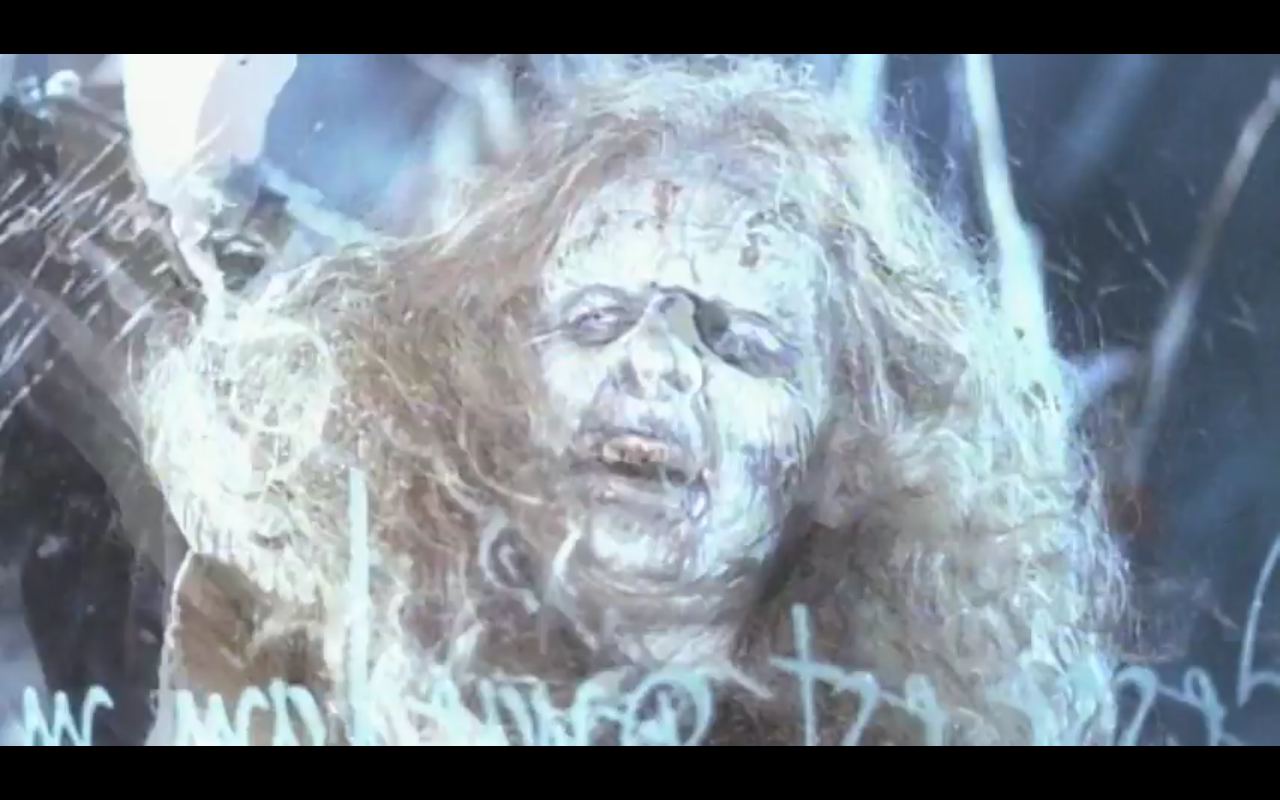
A maniacal and obsessed ghost hunter, Cyrus Kriticos, traps 12 tormented and violent spirits with the help of an avaricious, but anguished psychic, Dennis Rafkin, but when trapping the last ghost, the worst of the worst, a barbaric mass murder in life and in death named Juggernaut, Cyrus is killed in the process. His death leads to the inheritance of a one-of-a-kind house to his widowed nephew, Arthur, and his two children who are barely scraping by after the unexpected fiery death of their beloved wife and mother. When they enter what seemingly feels like a godsend house, immaculately structured entirely out of glass and metal, they find themselves trapped inside after tripping a series of mechanism that turn the isolated and elegant abode into a labyrinthic machine. Stuck inside with Arthur and his family are Dennis Rafkin and a ghost friendly liberator, Kalina Oretiza, who explain that the house is actually an evil machine with a goal of opening the eye to Hell and that the ghosts, imprisoned in the basement, are components that are being set free one-by-one in order to fulfill the ritual.
Screen shot 2020-07-24 at 9.52.18 PM
In the world of remakes, only a select few ever surpass the original. In fact, on rare occasions, do remakes actually replace the original due in part to being beyond respectful as well as masterful amongst critics and genre fans that have bestowed the reimagining an untouchable rendition to which no one can find anything wrong with it; this films include John Carpenter’s “The Thing,” David Cronenberg’s “The Fly,” and Chuck Russell’s “The Blob,” with Zack Synder’s “Dawn of the Dead” and Tom Savini’s “Night of the Living Dead” receiving well-deserved honorable mentions, because let’s face it, topping George Romero’s original work can be said to be blasphemous slander. What about those remakes in between? Those just above the pile of awfulness that generally makeup remakes? I consider Steve Beck’s “Thir13en Ghosts” to be one of this mid-level remake films that registers well with fans, but on the flips side of that coin, doesn’t ascend to total prominence over its predecessor. Written by longtime Full Moon Entertainment writer Neal Marshall Stevens (“Hideous!” and “The Killer Eye”) and Richard D’Ovidio (“The Call”), “Thir13en Ghosts” is a 2001 near-total rework of the 1960 William Castle directed and Robb White scripted “13 Ghosts” that used gimmicks like 3D specter glasses to draw audiences into the theater. “Thir13en Ghosts” was the second film after another William Castle remake, “House on Haunted Hill,” of the newly formed, William Castle nod-to, Dark Castle Entertainment, a division of Joel Silver’s Silver Productions formed by Silver, Robert Zemeckis (“Back to the Future”), and Gilbert Adler (“Bordello of Blood”) that honed initially on producing stylishly modern takes on classic gothic horror, such as “Ghost Ship,” the remake of “House of Wax,” and “Orphan.” What came out of this collaboration between Steve Beck and Dark Castle Entertainment is a complete dismantling of the wood paneling and lament flooring story for a modern marvel to emerge of unique terror that hasn’t been duplicated since.
Screen shot 2020-07-24 at 9.52.11 PM
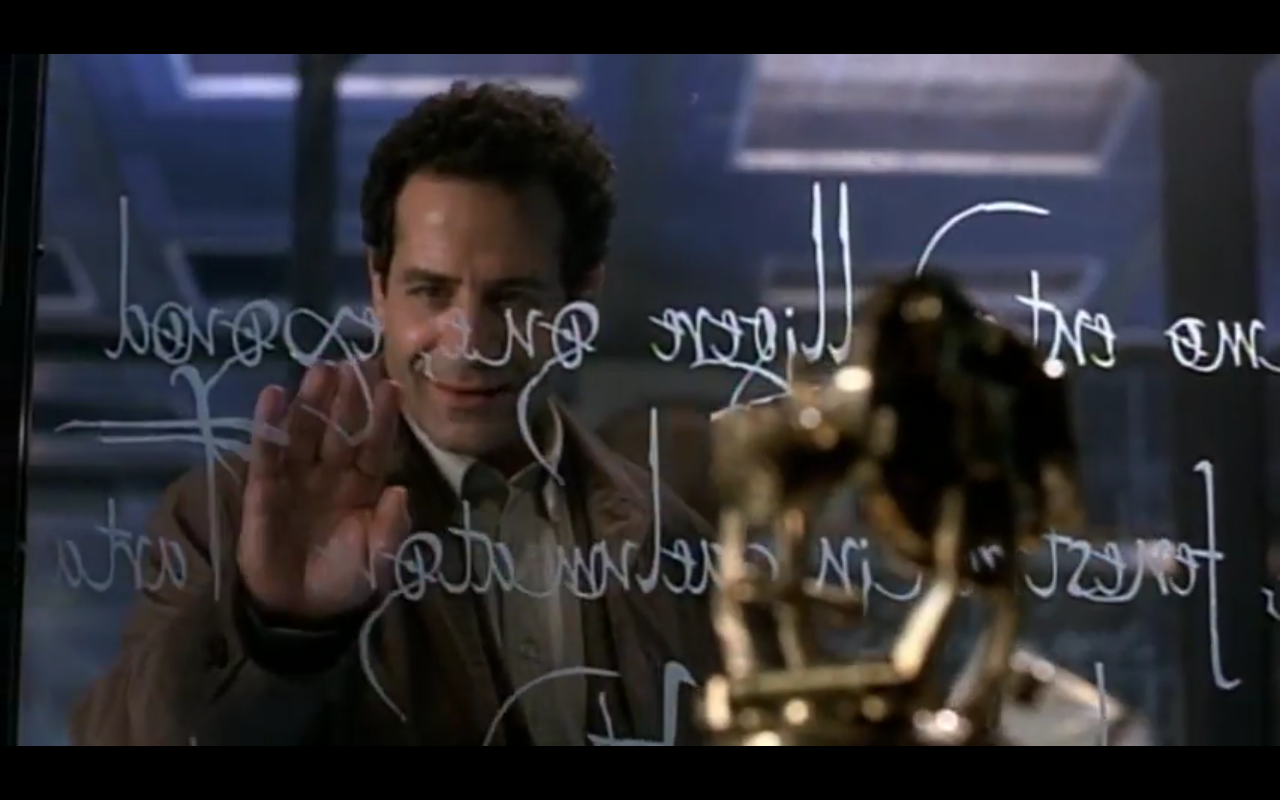
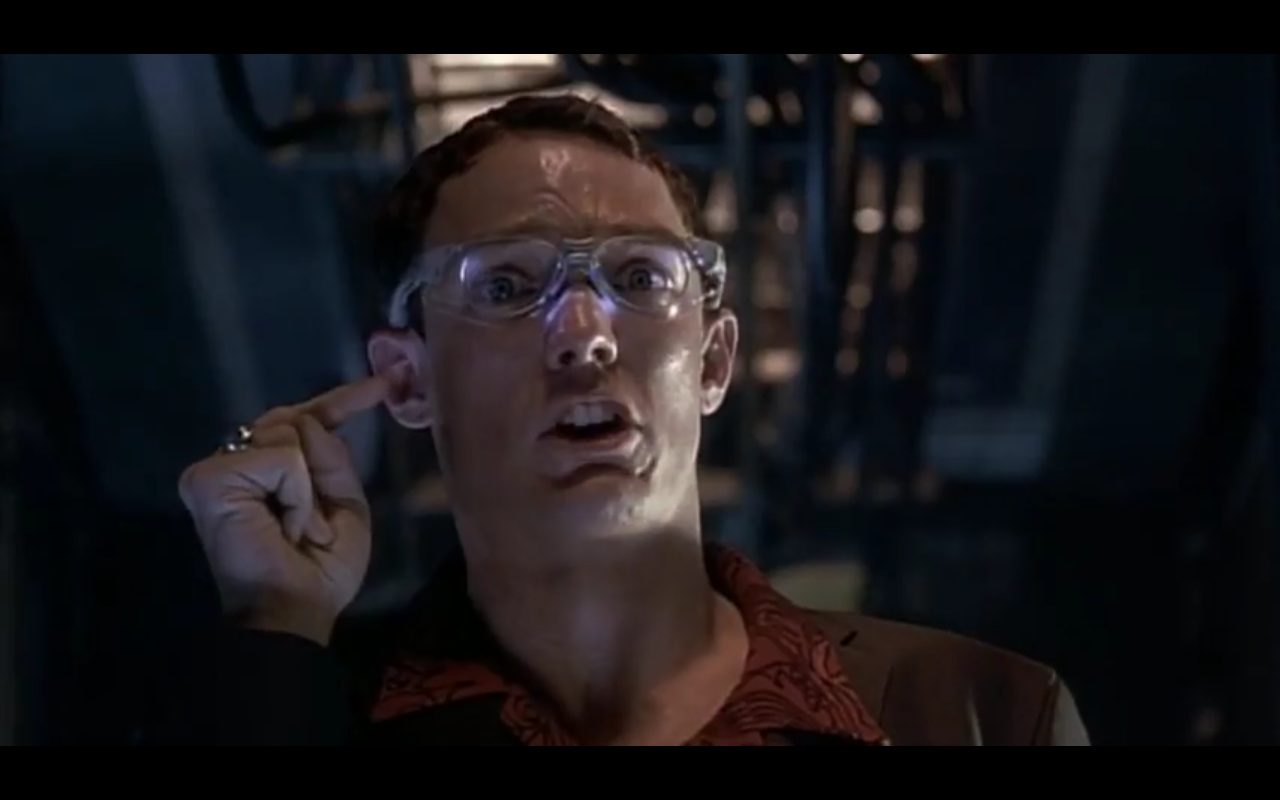
“Thir13en Ghosts” has an impressive, if not all-star, cast with diverse range of styles and experiences that it’s almost dumbfounding on how the filmmakers were able to contract some of these talents, including F. Murray Abraham, who has had an already eclectic credit list with “Amadeus,” “Surviving the Game,” and Mimic, and Tony Shalhoub who hand standout performances in “Addams Family Values,” “Men in Black,” and “Galaxy Quest.” Abraham and Shalhoub bring a sense of classical and methodological structure in a stark contrast between rationality and irrationality built upon an indifference of solitude and a sense of family. Then, there’s the comedic relief in the midst of danger, Matthew Lilliard (“Scream”) as the suffering psychic who uses his wit tongue to spur others and introducing hip-hop artist, Rah Digga, in one of her only motion picture performances to alleviate suspension with more tongue-and-cheek moments. Lilliard and Digga offer up two different comic styles while sustaining the underlying severity of being trapped inside an evil machine full of violent ghosts. Shannon Elizabeth, who we all know by now as the stunning “American Pie” girl, Nadia, or as I know her as the unfortunately raped and murder victim of a killer snowman in “Jack Frost,” plays Arthur Kriticos daughter, Kathy, who still a fresh faced newcomer to Hollywood despite being a hot commodity after her topless role in “American Pie.” The superb support roles don’t end there with notable roles from JR Bourne (“Ginger Snaps Back: The Beginning”), Matthew Harrison, Alec Roberts, John DeSantis, and EmBeth Davidtz, Sheila from “Army of Darkness,” as the ghost liberator.
Screen shot 2020-07-24 at 9.52.48 PM
It’s hard to believe that “Thir13en Ghosts” is nearly 20-years old. I still recall my 17 year old self sitting in for a theatrical showing, remembering the opening gargoyle growling as the Dark Castle Entertainment logo reveals itself during the opening title credits, and coming out of the maze-like, gory-ghost film having experienced something special, even if then I didn’t understand why, only to years later realize that I’ve never seen something like “Thir13en Ghosts” before in my life. How does a remake reinvent itself so much that it can separate itself from the original film while also beguile with fresh ideas and no take a slew of browbeating chirps from those who holdfast that the original is the one and only? Most remakes cheaply throw gore to the wind, adding buckets of blood in hopes to satisfy horror buffs, but what winds up happening is that we ultimately get bored, having experienced blood and guts from singular storied films. “Thir13n Ghosts’” premise isn’t the only worthwhile experience that deserves praise, but also the spectacular production design by Sean Hargraves that thrusts the glass house concept into new heights with the house actually becoming an interestingly steampunk character itself and the prosthetic effects from a team spearheaded by a trio of the best special makeup effects artists in horror today, such as Howard Berger, Robert Kurtzman, and Gregory Nicotero., turning ghoulish encounters to ghastly visions that convey truly a tormented soul in the 12 ghosts. Though the story itself isn’t perfect, flawed at times with static character development and a few plot holes involving the ghosts and sequences of events, “Thir13en Ghosts” remains a cult favorite gaslit by frightening imagery, a solid cast, and unforgetting production design that started 21st century horror off brazenly strong.
Screen shot 2020-07-24 at 9.52.36 PM
Collect all “Thir13en Ghosts” on the Collector’s Edition Blu-ray courtesy of Scream Factory sheathed in a cardboard slip cover and has a reverse artwork liner that has the original poster artwork and new vivid illustration by Joel Robinson. Presented in a 1080p, high definition widescreen, 1.85:1 aspect ratio, from the original 35mm negative, “Thir13en Ghosts” shares a consistent image and vibrancy layer with the DVD version with an enhanced color stability. No edge enhancement or cropping adjustments rendered or any other blemishes to speak of, but the softer details could have been sharpened to gave a hard edge around the non-spiritual energy. The English language DTS-HD Master Audio 5.1 boosts the already hefty soundtrack that’s full of explosions and ghostly swooshes and moaning hums, finished off with grand, orchestra soundtrack by John Frizzell It’s been said that audience had to excuse themselves from the film due in part to the overbearing noise coupled with the strobe-like imagery, but the overall audio and visuals are a combined one-two punch of sensory power that works well. The Scream Factory release has new interviews in the bonus material, including sit downs with actors Shannon Elizabeth, Matthew Harrison, and John DeSantis and producer Gilbert Adler. There’s also a audio commentary with director’s Steve Beck, production designer Sean Hargraves, and special effects artist Howard Berger. There’s also an in-depth look at the creation of the thirteen ghosts in a small featurette, their backstory profiles, and the theatrical trailer. However you want to call it, whether it’s “Thir13en Ghosts,” “Thirteen Ghosts, or “13 Ghosts,” this new century remake still holds up to today’s horror lot with spellbinding phantom pandemonium in a glass box!

“Thir13en Ghosts” on Blu-ray on Amazon.com

Shooting Up EVIL May Cause Hellish-Hallucinations! “Ozone” reviewed! (Temp Digital / Blu-ay and DVD)


On a stakeout to meet an informant, Detectives Eddie Boone and Mike Weitz are ambushed by a drug dealer named Richter and become separated in the fierce firefight. While detective Weitz tracks down their traitorous informant into a decrepit druggie den, Boone wrangles with Richter who injects him with a new street drug called Ozone. Unable to locate his missing partner for days, Eddie breaks standard police protocols to find his longtime friend and partner by digging into Ozone’s grimy underworld filled with powerful hallucinogenic manifestations from the drug that turns users into mindless mutated addicts and killing machines. Eddie will have to go through Hell to stop the distribution of Ozone and to rescue his partner from an elevated and fully transformed drug lord with unconventional powers that believes Eddie is key to his world dominance.

First, “The Dead Next Door.” Then, “Robot Ninja.” Now, TempVideo and MakeFlix present the next super-duper, 2-disc collector’s release from the visionary B-movie director, J.R. Bookwalter, with his 1995 horror film, “Ozone.” Co-written with the visual effects artist from “The Talisman” and “Subspecies 4: Bloodstorm, David A. Wagner pens his one and only option in which Bookwalter immediately took a shining to following a string of very taxing and bargain titles for a flyby label. Able to by clairvoyant with how “Ozone” should be constructed, deep inside the creative process of his auteur mind, Bookwalter felt desire to oversee the production, taking the helm on just how he would make an ambitious project come to a life on a microbudget. “Ozone” parallels the subculture of powerful narcotics, like heroin or cocaine, and amplifies the conditions of the euphoria side effects to monstrous, unpredictable heights through a labyrinth of what the hell is going to happen next? Mostly shot in Akron, Ohio, “Ozone” is a production of Bookwatler’s own company, Suburban Tempe Company aka TempeVideo, on an astonishingly low-budget of $3500 and a handpicked cast and crew.

Comprised mainly of Ohio based actors, “Ozone” finds it’s star in James Black who has previously worked with Bookwalter on “Zombie Cop” and “Chickboxer.” Black went on to stardom, making a living off of the Hollywood limelight by having roles in such films as “Soldier” alongside Kurt Russell and “Out of Sight” with George Clooney among many other television and movie roles, but Black’s humble beginnings shouldn’t be overlooked. His performance as the lead character, Eddie Boone, highlights his attributes as a leading man. The physicality of the former professional football player with good looks catches the corners of eyes that the man from Lima, Ohio can act as well as do action scenes professionally and effectively despite budget limitations. However, “Ozone’s” talent doesn’t end there with Black’s co-stars who wear multiple hats in other roles or behind the camera. Case in point is Bill Morrison and James L. Edwards as the two makeup a total of five characters in the film as well as serving to be critical components as crew. Morrison dons two roles plus crafting the special makeup effects and miniatures. Edwards supports three roles, including the main antagonist in what looks like a hefty body suit. Morrison and Edwards going through the rigors of makeup to pull off various characters with polar personalities provide “Ozone’s” well-rounded, always interesting, idiosyncratic individuals Eddie encounters through his misadventures of drug-fueled nightscapes. Tom Hoover, Michael Cagnoli, Michael Beatty, Jerry Camp, Mark S. Bosko, Wayne Alan Harold, Neil Graf, Leo Anastasio, Parris Washington, and Lori Scarlett in an unforgettable birth of a mutant baby scene rounds out this cast of colorful characters.

“Ozone” is a gooey, gory, gumshoe of a horror film baked on narcotics laced with nightmares and for the budget price of a dime bag, J.R. Bookwalter injects a full-fledged, black tar, down the rabbit hole thriller that’s akin to a Clive Barker Faustian concept. “Ozone” draws similarities from “Hellraiser” as well as could find strong congruence with “Lords of Illusions,” a film which was released the same year as “Ozone” in 1995. Instead of magicians of the occult, the use of a more salt of the Earth drug is a powerful, tangible substance that reflects relevance more so than of fantasy. Audiences can relate more to the idea of the twisted wrenching of habitual use of not only illegal drugs, but with perhaps medications, alcohol, or any number of other addictions that seemingly take over one’s life and replaces it with the worst part of themselves. The mysterious encounters Eddie Boone is subjected to during his tour of the drug enlightens the hardnose detective to an out of body horror experience wretched with disfigured humanoid shells and countless mutants determined on cornering the market on living not sober not on their own volition. The use of the new morph special effects merged with the respectable practice effects by Bill Morrison and his team gorge on body modification and overpowering death as synonymous to being high.

Just like “The Dead Next Door” and “Robot Ninja,” “Ozone” receives the king’s treatment into a duel format, 2-disc Blu-ray and DVD Signature edition release. Shot on Super-VHS C videotape in 1995 and then transferred to DVCAM in 2002 for the DVD remastering, the 2020 upgrade used the DVDCAM masters were captured as ProRes 442 HQ QuickTime video files for a new and comprehensive color upgrade, additional deinterlacing, and amend any other Super-VHS C tape imperfections. What resulted for the Blu-ray release is a super clean and enhanced look presented in the original 4:3 (1.33:1) aspect ratio of perfectly color corrected hues, brilliantly effusing various colors to coincide with the artistic storytelling of Eddie Boone’s trippy trek through “Ozone’s” chthonic evil. Seldom do minor blemishes pop up; in fact, you won’t even really notice when godsmacked on “Ozone’s” uncanny use of budgetary limitations. The English language DTS-HD Master Audio 5.1 surround sound mix is equally as impressive. Pulled from the DA-8 tape achieve of the original audio masters on an eight-track cassettes, all of the dialogue and some original sound effects were used as the basis for the new restoration in which Maui Holcomb and director, J.R. Bookwalter enhanced over the course of 18 years. Dialogue cuts to the front of the line, mixed and balanced well with the explosions, gunfire, and other skirmishes, delivering a flawless and discernable product. Depth and range render nicely throughout. The DVD specs are the original 1994 VHS version also in the original aspect ratio with an English language Dolby Digital 2.0 stereo mix. Jens C. Moller grand score elevates “Ozone” to the “next stage,” as the street mutates would coin it, offering up a bountiful, robust score that simultaneous blends action and horror seamlessly. If you’re looking for every nook and cranny bonus material on “Ozone,” you got it with an extensive bonus package on the Blu-ray disc that include a 2020 audio commentaries from J.R. Bookwalter, a 2003 commentary with the director and star, James Black, 2003 commentary, entitled “Street Zombies” from Bookwalter, bloopers and outtakes, production art and stills, news’ topic reels from 1993, promotional gallery, “Ozone’s origins explained through “Paying for Your Past Sins” with J.R. Bookwalter, “Into the Black” with star James Black and how he became involved, a 2003 location tour with actor James L. Edwards, behind the scenes footage with the only audio available is a commentary by J.R. Bookwalter, early test footage, and Tempe trailers. The DVD has additional material, such as awesomely isolating the musical score, 2020 audio commentary with Doug Tilley and Moe Porne of the No-Budget Nightmares Podcast, scenes from the Spanish dubbed version, the 1992 B’s Nest Video Magazine Intro, the original trailer, the Japanese trailer, the “Street Zombies” trailer, and more Tempe DVD trailers. The not rated, 81 minute, region free release also has optional English and Spanish subtitles. Inside the casing, which has a reversible wrap cover with the original VHS cover, housed inside a cardboard slipcover of revamped artwork by graphic designer Timothy Rooker includes an eight-page color booklet with liner notes by Tempe historian Ross Synder; it’s a good read up on “Ozone’s” conceiving and a little history on SOV of the 1990’s. Exquisitely enhanced and lush with material, the Signature Edition of “Ozone” just might be the definitive one of the wildly insane and bloodied occult cop fiction of independent horror ingenuity.

Available for pre-order. Hit shelves August 11th!