

After an intense stand off with a powerful and playful demon during a supernatural expedition gone wrong, the unfortunate death of a young girl has Jonas Littleton facing skeptics that hand the ghost hunter a five year sentence behind bars ruling. His release from an Arizona prison offers him a second chance to start over with his wife and young son and Jonas makes promises to no more paranormal pursuits in hopes for a normal life. Miraculously, Jonas is offered a good paying job despite his manslaughter record that affords him seven years of suburban comforts and family growth, but little does Littleton know that his good fortune is the handiwork of the very same demon who bested him so many years ago, tricking him into a underhanded deal that requires his son’s soul with his wife being a casualty of war. Another seven years later, an obsessed Jonas fields every call that comes across his paranormal investigator’s desk as he tirelessly searches for his son and with the help of an eager investigator, Ron Tippard, and a green horn assistant, Ellie French, Jonas will come face-to-face with his rival evil again for one last time.

Welcome back to part two of our unexpected two part review segment of films that were disowned, supposedly, by their filmmakers. Today, we take a look at the 2010 supernatural thriller, “Hunting Evil,” or more commonly known under the title as “Closets” or “The Closet.” Already, the evidence is clearly powerful against “Hunting Evil” that alternate titles bares the potential markings of a repudiated film, aimed to cloak and shield the ramifications that would be supplied to unsuspecting audiences renting or blind purchasing. Director Charles Peterson has been reported to have disowned the Bob Madia (“You Can’t Kill Stephen King”) penned film because of too many chefs in the kitchen, if you smell what I’m cooking. Peterson, who has directed other indie horror projects such as “The Eleventh Aggression” and most recently, “A Killer Awaits,” which will be released this month, has ties with the investment group Old World Investors Group Incorporated a.k.a. OWIGI Films. Now, OWIGI Films is ran by “Hunting Evil’s” producer and star Lenny Rethaber (“Blood Moon Rising”). So, the lingering questions is this: Did star-producer Lenny Rethaber force the whip and reigns from Charles Peterson? Well, all this reviewer can say is that Lenny Rethaber also produced “The Eleventh Aggression” and the upcoming release “A Killer Awaits,” so seems like any adversity between the two has long since settled or just comes and goes with the industry territory.

However, what’s inherently curious about the DVD release from World Wide Multi Media is the three names headlined on the DVD’s front cover to which none are the film’s star Lenny Rethaber as the embattled Jonas Littleton. Knowing the type of distribution company WWMM is, more than likely the case is the first three credits, which are also in alphabetical order, and slapped them onto the front cover, one of which is just an unnamed barkeep who has approx. 5 minutes of screen time and not one other single credit to his name. As Jonas Littleton, Rethaber is soda flat with no bite and fizz to his performance and though his entertaining enough, the producer-star is also on the wrong side of the tracks in that category. There’s even whispering talk that “Major League’s” Corbin Bernsen, who has dappled in directing horror with “Dead Air” starring Bill Moseley (“Devil’s Rejects”), had issues with the producer (Rethaber), yielding to yet another instance of production problems. Though I’ve had verbal disagreements with Bernsen with his previous work, I find his performance as an enigmatic father of a missing child refreshing and complex, but the fate of his character poofs into thin air as if the writers, directors, or, most likely, producer didn’t know how to finalize the character. The sole best role comes from Patrick Adams as the enthusiastic paranormal investigator Ron Tippard. Not to be confused with “Suits” actor Patrick J. Adams, the Arizona resident Adams sparked life into a relatively unhinged project with an amusing and interesting performance in a side kick role who has substantial screen time and adds value to the situation. Rounding out this remaining cast in this conundrum is Darl Chryst (“Autopsy: A Love Story”), Dena Esquivel Frederickson, Jackson Furedy, Sallie Glaner (“The Visitant”), Davina Joy (“Death of a Ghost Hunter”), Pete Kelly, and Orchid Tao.

A twitching, tingly part of my soul yearned for “Hunting Evil” to come out on top, to be a solid supernatural saturation that a viewer, like myself, can sink into immensely, and with a script that precedes “The Conjuring” with the perceptive view of an unoriginal, yet sparsely used investigator concept, the appeal hyperdrives into salivation, but instead of salivation, “Hunting Evil” sluggishly drips slowly from the mouth’s corner crevices with script plotholes, badly layout composites, and undercooked characters. The story follows Jonas for nearly two decades, yet the man never ages despite already starting out looking middle aged to begin with so where are the streaks of grey, the loose and wrinkled skin, or maybe even a display a little physical ailments? Each of these natural flaws could have further enhance his lifespan evolution on Earth and speak to a little down to Earth as well. The composites look horrendously old fashion like from an antiquated video game platform. It’s as if the creators of 3D Realms not only provided the MS-DOS source code for those amazing Duke Nukem 3D levels also provided the visual worlds for “Hunting Evil” actors to humorously and painfully act against. the underwhelming, unfinished characters were slightly touched on before, but their arcs just ultimately poof into smoke without constructive reasoning or even to leave as fishhook into another movie.

“Hunting Evil” haunts onto DVD from World Wide Multi Media and MDVisual. Presented in a widescreen format and clocking in a 90 minute runtime, the DVD technically has little faults to discuss aside from the coloring looking a little desaturated and don’t visually pop. Some digital noise from the low end production quality during the night scenes that are accompanied by a little compression blotchiness, but the DVD passes muster in image quality. The English language 5.1 surround sound finds itself limited moderately to a two-channel output which is unfortunate with the amount of demonic tomfoolery being subjected to Jonas and his team. Low of the LFE and minimalistic on the depth and range, “Hunting Evil” couldn’t scare the pants off viewers audibly alone. There are no bonus features on this disc. Jonas Littleton’s troubles spread beyond a malevolent and playful demon destroying his family with “Hunting Evil” targeted as a suspect of an unfinished and problematic film. Whether turmoil driven or just the lack of rightfully placed funding, the spooky stories of paranormal investigators are left to the genre platonic professionalism of James Wan and not Charles Peterson and Lenny Rethaber.
Category Archives: Trailers


Comic Book Vigilante Takes on Evil! “Robot Ninja” review!
The television adapted bastardization of his beloved illustrated Robot Ninja leaves comic book artist Lenny Miller with a bad taste in his mouth. His disgust with the direction angers him to part ways with the project, leaving the televised rights in the hands of a careless and uninspired studio crews and execs, but that won’t stop Miller’s creative juggernaut of the captivatedly violent, robot vigilante. Inspiration takes heart-rending form when Miller happens upon a roadside abduction and rape of a young couple where his attempt at a rescue ends tragic with the couple being brutally murdered and him severely injured, but with the help of his good inventor friend, Dr. Goodnight, the frustrated comic-book artist becomes the Robot Ninja, just as depicted in his comics, with a vengeful plan to hunt down the assailants and put a bloody end to their wrongdoing reign of terror. A good first night out ends with one thug dead and an ego boost for Miller, but Robot Ninja’s actions don’t deterrent crime and, in fact, crime hits back hard when not only Robot Ninja becomes the target, but also his friend Dr. Goodnight and innocent bystanders.

“Robot Ninja” is part one of an unintentional two part review segment about directors disowning their own cinematic handy work for X, Y, or Z reasons and while “Robot Ninja” was initially discarded by “Dead Next Door” writer-director J.R. Bookwalter due to poor post production that was essentially out of the filmmaker’s hands and a work print negative thought to have been lost for eternity, Tempe Entertainment foresaw the awesome potential for the late 80’s automaton avenger in an dual format ultimate edition after a unearthed work print surfaced and back into the Bookwalter’s hand to mend and correct his sophomore feature film! Forget Iron Man. Ignore Captain America. Incredible Hulk who? “Robot Ninja” is one of the only true comic book heroes from illustrations to to take a stand against crime passionately and not because if you have great power, there’s great responsibility.

Robot Ninja is the epitome of the combo character that could sway into either hero from the 1980’s, like in Paul Verhoeven’s “Robocop” and Amir Shervan’s “Samurai Cop,” or could even swerve straight up into the villain category though I have no examples floating around near the inner layers of my cerebral cortex, but the Robot Ninja bordered the very blurry gray lines of anti-hero status whether intentionally or not from the perspective you examine. The Robot Ninja character potentially could have set fire to the combo character direct-to-video cult underworld, but fell rather hard and flat on its face in the deadfall of the netherworld instead. None of film’s flaws or woes never sat its hampering weight upon the goldilocks graced shoulders of Michael Todd, who portrayed the clawed hand titular character. Todd’s enthusiasm for the role is beyond necessary, a real A for effort, into powering on Lenny Miller’s illustrated crime combatant. Lenny, aka Robot Ninja, vows to destroy, or rather disembowel, the local gang led by the ruthless Gody Sanchez, a she-devil aimed to please only one person – herself. Maria Markovic, another actor that’s in J.R. Bookwalter’s “Dead Next Door” circle, find herself in the antagonistic role in one of her sole two credits. Markovic’s acting chops are about as stiff as a board, but being surrounded by the right kind of thugs in James Edwards (“Bloodletting”), Bill Morrison (“Ozone”), Jon Killough (“Skinned Alive”), Rodney Shields, and Michael ‘D.O.C.’ Porter, Gody Sanchez is able to achieve par-level black heartedness. “Robot Ninja” round-kicks an uppercut class of actors such as Floyd Ewing Jr., Michael Kemper, the original Dick Grayson Burt Ward (“Batman” television series), the one and only Linnea Quigley (“Return of the Living Dead”), one of Sam Raimi’s entourage buddies Scott Spiegel, and Bogdan Pecic and the good Dr. Goodnight.
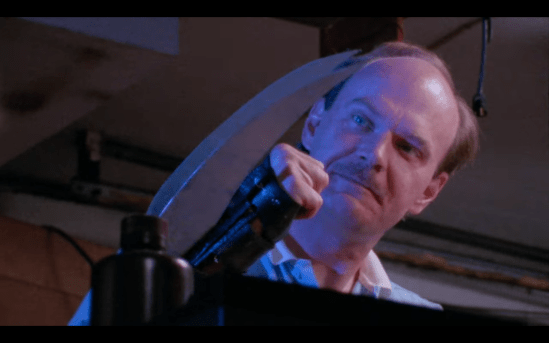
Without doubt, “Robot Ninja” was destined for the direct-to-video market and the quality of work obviously shows, but with flaws aside, the obscure 79 minute feature still manages to be a part of Bookwalter’s “Dead Next Door” universe full of gore, violence, and a distain for human nature despite briefly disavowing “Robot Ninja’s” mucked up existence for years. Subtempeco EFX, comprised of David Lange, Bill Morrison, and Joe Contracer, don’t exactly go cheap when Robot Ninja’s dual blades pierce and pop eye balls inside the skull of some punk or when Lenny’s patching up his injuries without as much flinching in pain, the open, surely is infected wound just pulsates with exploded flesh and blood. Bookwalter’s direction is hazy at times around the beginning with the dynamic between Lenny and his publisher that feels stagnant and irrelevant; however, the comic book scenes interwoven into the meatiest part of the story, the Robot Ninja action, is remarkably cool for a late 80’s budget gas.
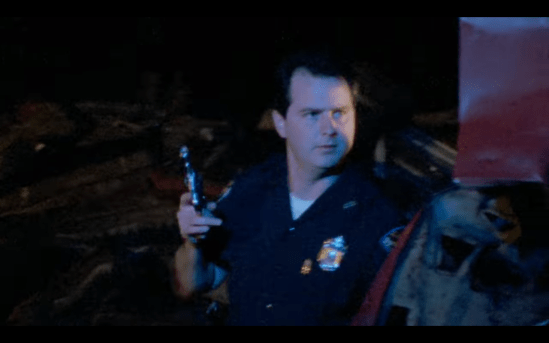
Tempe Entertainment have outdone themselves with the region free ultimate edition DVD and Blu-ray combos set of “Robot Ninja” with a “painstakingly” restored 2k film scan from the original 16mm A/B roll cut negative and presented in a 4:3 aspect ratio. The picture is night and day compared to previous VHS and DVD releases that underwhelm director J.R. Bookwalter’s vision. The vast color palette of various lighting and color schemes during the dream sequences have been gracefully corrected and the contrast has been restored to lighten up the much of the darker, almost unwatchable scenes. Good looking and unobtrusive natural grain from the 16mm stock and the re-edit makes a difference that finally seems cuts together without causing some confusion. The English language 5.1 DTS-HD Master Audio surround sound is entirely new construction from Bookwalter and the lossless tracks have ample range and depth, balanced nicely throughout, and have little-to-no distortion or other imperfections. English and Spanish subtitles are also included. A slew of bonus material on both formats include audio commentaries from J.R. Bookwalter, Matthew Dilts-Williams of Phantom Pain Films, producer David DeCoteau, James L. Edwards, Scott Plummer, David Lange, David Barton, Doug Tilly and Moe Porne of The No-Budget Nightmare. J.R. Bookwalter also has a 21 minute segment about the whole start-to-finish journey with restoring “Robot Ninja,” a Linnea Quigley retrospect on her small role experience in the film, an interview with Scott Spiegel, a location tour with Benjamin Bookwalter, “The Robot Ninja” fan film from 2013 with introduction by director Johnny Dickie, artwork and promotional material, behind the scenes gallery, production stills, “Robot Ninja” unmasked featurette, rough cut outtakes, TV show promo, newscast outtakes, the original VHS release trailer, and Tempe trailers, plus much more. Lets not also forget to mention the stunning cover art by Alex Sarabia, Carol Chable, and David Lange and a new title sequence also by David Lange. Tempe Entertainment’s ultimate edition of “Robot Ninja” is a thing of beauty that should be seen by all who love campy, Sci-Fi horror flicks with grisly skirmishes and intense tragedy in every corner. The restoration work “Robot Ninja” is founded on absolute love, a rare concept seen for direct-to-video features so you know this film must be something special – a true redemption story.


Satan’s Evil Indestructible, Hairy Servant! “Beast of the Yellow Night” review!

At the tail end of the second great war, Philippines based U.S. army deserter and Japanese sympathizer, Joseph Langdon, runs for his life as the Philippines police and guard track him down through the jungle for committed heinous acts that not only include treason, but also rape and murder. Exhausted and dying from his wounds, Langdon will do anything to stop the process of pain and death, including making a deal with Satan himself. In exchange for saving his life, Langdon commits himself to eternal servitude at the malevolent pleasures of Satan by inhabiting various souls and bodies through the decades and extracting the latent evil from his interactions with people, but Langdon finds himself again exhausted and exacts free thought and a rebellious stance against his master after inhabiting an American business man and given back his own face. The Dark Lord, as amusing as he wicked, bestows upon Langdon the ability to transform into a flesh hungry man-beast whenever his desires boil to the surface and he becomes the most wanted man in the Philippines, but how can they stop a monstrous fiend they can’t kill? The answer lies solely with the damned Langdon himself.

Rarely does a horror film birthed from the Philippines reach my critical virtual desk and, fortunately, “Beast of the Yellow Night” lands smack-dab in my lap as an absolute jewel from the early 1970’s from writer-director Eddie Romero. The 1969 “The Mad Doctor of Blood Island” director, who’s heritage is Pilipino, had visions of grandeur for his large scale features that stem from an infinitesimal budget, but with enthusiastic energy from former musician and beach party, teen heart throb John Ashley, the duo cofounded their theatrical finance company, Four Associates Ltd, to produce their very own horror feature films straight out of the Philippines which “Beast of the Yellow Night” was one of first to be released, if not the very first to be produced. Additional funding was provided by a little known distribution company, New World Pictures, jointly founded by the genre-setting Corman brothers, Roger and Gene, and thus forth “The Night of the Yellow Beast” was built upon a rich and solid cult foundation that began a Philipino-film circuit conversely well-known in the U.S. and put Eddie Romero on the proverbial map of relatively unknown and granular cult directors while providing a branching out of yet another successful credential façade for John Ashley that doesn’t involve country music or being just another pretty face in the beach party moviegoer crowd.

If you haven’t guessed by now or if you’re just as dense like myself, John Ashley also stars in his co-produced creature feature and Ashley, who goes without saying that he stands in his own rite, is also the Paul Naschy equivalent of the Philippine Islands with his all hands on deck attitude toward filmmaking and being the man behind the gnarly man-beast makeup that more than likely takes hours to apply. His performance as even tempered Joseph Langdon is a stark contrast from the wild and vicious beast with a flesh appetite and knack for mauling that herd this film into the werewolf category according many descriptive plots, summaries, and reviews, but “The Night of the Yellow Beast” actually resembles more of a Dr. Jekyll and Mr. Hyde familiarity as Langdon doesn’t transform when the full moon is high, but rather at the whims of his tormentor, in this case it’s Satan rather than an ill-fated elixir, and then he morphs more rapidly and explosively during exhilarating and endorphin stimulated moments like intimacy to further exacerbate his dreadful curse on Earth. Langdon and beast Langdon are befriended by a blind, long-tooth ex-con, Sabasas Nan, played by “The Big Bird Cage’s” Andreas Centenera and Centenera captures the gentle nature and extended wisdom of a man at the tail end of life and looking to right the wrong for his past mistakes. Sabasas Nan is similar to the blind man in the tale of Frankenstein that doesn’t judge, become frightened, or even shun the ugly shell of a monster, but though visionless, both blind men are able to clearly see into the soul of what used to be once a man. “Beast of the Yellow Night” also stars leading lady Mary Wilcox (“Love Me Deadly”), Leopoldo Salcedo, Eddie Garcia (“The Woman Hunt”), Ken Metcalfe (“TNT Jackson”), and labeled as the Filipino Peter Lorre, Vic Diaz (“Black Mama White Mama”) as the pot-belly Satan and Langdon’s mischievous master.

Eddie Romero’s deep and intellectual script sticks out amongst the fray of time lapse and post-skirmish makeup effects that teeters “Beast of the Yellow Night” on a B- to C- movie. Not that the special and makeup effects were completely awful or subpar by any means, but the directing filmmaker pushes the boundaries to scribe the pull strings of a man’s soul, really digging into the anguished flesh of redemption and mankind’s mortal coil, which puts a lightly coated dampening on Langdon’s transformations from man-to-beast that hasn’t yet reached the Paul Naschy level of editing and progressiveness toward his horror films. In fact, the “Yellow Beast’s” effects are merely one step below that aforementioned level. However, the beast is no wolf of any sorts, but nor it isn’t a man in a cheap leathery or latex rubber mask that materializes a rather mangled, mangy beheld fiend with razor sharp canine teeth shown through a ferociously hungry and breathy-snarling maw set below equally ravenous eyes that yearns for the blood of man. For 1971, the effects are exceptionally marvelous, but Romero’s script just blows the practicalities out of the water being ahead of its time and sorely overshadow the effects work.

MVDVisual and VCI Entertainment proudly gift to us “Beast of the Yellow Night” onto 2-disc all region DVD/Blu-ray home video. Produced from a 2K scan of the original 35mm negative, VCI Entertainment’s widescreen, 1.85:1 aspect ratio presentation in full Metrocolor is mondo cult cinema exhibited on a high level and despite some blotchy patches, the corrected coloring and cleaner picture are by far the best we’ll ever see while still sustaining a healthy amount of beneficial cinematic grain. The prologue has coloring issues with about 20% of the right side of the film strip in sepia harboring in sepia town, but becomes corrected after the title and credit sequence. The English and Tagalog, the national language of the Philippines, mono audio track has lossy bite that’s expected and yet, still maintains ample dialogue track and a solid and balanced in range ambient track. Optional English subtitles with SDH are also included. Bonus features include a 2018 commentary track by writer and filmmaker Howard S. Berger and the head of Mondo Digital, Nathaniel Thomspon, old and insightful video interviews about John Ashley and the Filipino films of the 19870’s with Eddie Romero, Sam Sherman, Patrick Wayne, Peter Tombs, Eddie Garcia, Gloria Hendry, Sig Haig, and Jan Martin, a Remembering John Ashley featurette that includes interviews with wife Jan Ashley, filmmaker Fred Olen Rey, Steve Stevens, and Andrew Stevens, original theatrical trailer and TV spots. Plus, a thorough inner liner essay from Howard S. Berger that goes examines “Beast of the Yellow Night” and the films of that era that are a metaphor for much, much more. “Beast of the Yellow Night” is a simple message cause and effect. If vileness becomes you, then villainy will forever run fluidly through your icy veins in this Eddie Romero and John Ashley monstrous picture that pulls at the tattered strings of a downtrodden soul.

Amazon has it on sale, now! Go Go Go!

The Great White Evil Hexad! “6-Headed Shark Attack” review!

In 1984, a floating marine biological station near Baja, Mexico becomes the target of an unnatural, genetically modified creature – a massive six-headed great white shark! The attack leaves the station afloat, but all the scientists fall victim the six, serrated jaws. Twenty-five years later, William, a couple’s therapy boot camp instructor hones in on assisting estranged lovers rekindling the romantic fire by having the couples journey to a remote, rocky island just off the Baja coast. Struggling to cope with his own divorce turbulence, William takes the reigns of the camp therapy business that was cofounded with his ex-wife, hoping for comfort through the program’s reconciliation message, but when the six-headed shark kills two of his colleagues, William’s new mission is for the safe harbor of his customers. However, every time one brains of the shark is damaged or destroy, the head is ripped off by another head and new one regenerates in it’s place and the beast can also hunt on land, fathoming as turf and surf’s most deadliest unstoppable creature known to mankind.

A SyFy Channel original premiere from The Asylum Home Entertainment group has astonishingly struck pure chaotic shark gold yet again with “6-Headed Shark Attack,” the latest monstrous sequel that follows that same flamboyant titular tradition. Director Mark Atkins, who is no stranger to b-movie shark horror with “Planet of the Sharks” and “Empire of the Sharks,” dives right into the water with his first multi-headed shark attack film that’s penned by Atkins along with Koichi Petetsky, a recognizable name from his scribe work on the recently reviewed “Megalodon,” another The Asylum and SyFy love child. To be honest, “6-Headed Shark Attack” is also this reviewers first venture into the multi-headed shark attack universe and, to be truthful to my audiences again, the absurdity of Atkin’s monster shark roister is reminiscent of the classic monster films that include giant ants and killer shrews!

William’s disheveled intangibility is being held together loosely by the wiry binds of his marriage counseling profession and though the painstaking process of divorce rattles his soul, the potentiality of being eaten by a 6-headed shark doesn’t phase his determination in saving survivors trapped on the remote island. Brandon Auret slips into the William’s embattled shoes and the actor, who been a steady Neill Blomkamp favorite South African for the steampunk-laden director’s films such as “Chappie,” “District 9,” and “Elysium,” finds himself as lead man versus mutant shark, but the multi-lingual and rugged Auret fails to sell the performance that falls flat with tremendous eyeshot quality of awkward hesitations and unsavory emotions. Blomkamp’s high concept science fiction doesn’t quite parallel Atkins’ budget flair that spotlit around great white shark country’s South African filming location that seems unfitting for Auret’s usual Hollywood wheelhouse. The female lead is bestowed upon fellow “Empire of the Shark” vet Thandi Sebe as Mary, one half of one of the four flailing couples, and Mary’s strength and common sense separates her from the pack and even her husband played by a very bushy haired stunt coordinator Cord Newman. The malaise between James and Mary push to a general distressing love triangle that’s been fabricated by a violent and vindictive James; Sebe and Newman aren’t the quintessential unhappy power couple, but they do make a stain that stands out. The remaining shark victims includes Naima Sebe, Tapiwa Musvosvi (also “Empire of the Sharks”), Chris Fisher, Meghan Oberholzer, Jonathan Pienaar (again, “Empire of the Sharks”), and Nikita Faber.

Like most of The Asylum productions, “6-Headed Shark Attack” is made on the extreme cheap. That isn’t to say that the extreme cheap and is extreme garbage as each film that is churned out as a SyFy original has some sort of redeeming quality to it. For “Megalodon,” the shark had characteristic features, like scarring, even if the Megalodon was two dimensional. “6-Headed Shark Attack” also saves itself from full outright embarrassment with schlocky, barmy charm such as a shark walking on land like a scorpion shark, using four of the heads as legs to charge toward steeplechased landlubbers, but the 6-headed shark has no definition from the visual effects team, losing some of the realism much need, or rather desired, in the computer generated leviathan.

MVDVisual and The Asylum Home Entertainment chum the water with “6-Headed Shark Attack” presented the digitally shot film in the original widescreen format, an 1.78:1 aspect ration. The shark was already touched upon that the visual effects lacked the creases, the scarring, and the overall personality a mutant shark should possess, but the look of the rest of the film needs to be questioned as well. The South African shoreline is exquisite and serene that’s beautifully captured by director Mark Atkins who also has an equal hand in being a cinematographer. Yet, the sunny, rocky island favors a washed look (no pun intended) that stems from an overexposure during the digital recording and loses some of the details in obvious portions such as large jagged rocks seemingly smooth or the granules of sand blending together to be one tan blanket on the beach. The English language 5.1 surround sound has no qualms for the most part other than The Asylum go-to stock score tracks by Christopher Cano and Chris Ridenhour, the musical duo behind “Megalodon.” Trailers to the film are the only extras available on a static menu. Having never seen 2, 3, 4 (is there a 4?), “5-Headed Shark Attack,” “6-Headed Shark Attack” seems to not be anchored down by series continuity despite reuniting the cast and crew of “Empire of the Sharks” and “Megalodon” and is a standalone creature feature constrained to being a run of the mill exploitation of man-eater mania.

Buy 6-Headed Shark Attack at Amazon.com!

Evil Takes Form in the “Terror 5” review!

In the wake of a tragedy that resulted in the loss of life, a small Argentinian funeral procession progresses in tandem with the court hearings of a supposedly corrupt politician, the governmental figurehead indirectly responsible for the deaths of innocents. When the verdict of not guilty surfaces over the news media waves, the grief-stricken family and friends, praying at a cemetery memorial, shrill in anguish their displeasure that becomes a calling for the undead to rise up and exact revenge toward the capital. In the midst of the resurrecting chaos, others simultaneously face terror in other forms such as exacting sadistic punishments in a backwards universe of role reversals, the elaborately ill-fated plan of swapping girlfriends on the streets of the city, a night of sordid carnalities at a hotel becomes a night of horrendous violence, and a group of candid friends indulge in a snuff film comfortably and safe inside an apartment, but an evil is slowly boiling to ahead right before their very unsuspecting eyes.

“Terror 5,” a title that one would assume on first thought that five horror icons team together for utter slaughter of hapless cheerleaders or, perhaps, clash in one epic villainous mêlée of monumental proportions, but the film is actually an Argentinian anthology of urges and terror and for the record, if “Terror 5” was a collection of the top five horror icons, this reviewer’s enlistment would include Michael Myers, Freddy Krueger, Pinhead, Predator, and Charles Lee Ray aka Chucky. Jason Voorhees is a bit of a mama’s boy, if you ask me! Let’s get back on the topic of the brothers Sebastian and Federico Rotstein’s helming of an interweaving, anthological horror film from 2016. The Buenos Aires born siblings collaborate with the “The Vampire Spider” writer, Nicholas Gueilburt, to construct five tales that plant the seed of danger from the sordid impulses that motivate impure, and sometimes supernatural, malevolencies. The five tales digs into the depths of quivering human interaction and the immorality of their choices that inevitably leads them toward their own gruesome destruction.

The complete South American cast will be more than likely unknown faces to audiences of the United States, unless broadening your film library is a must-do compulsion. In which case, Gaston Cocchiarate is a familiar face who had a supporting role in Gonzalo Calzada’s devilishly feministic empowering thriller, “Luciferina.” Cocchiarate’s character goes from being a naïve college kid in “Luciferina” to a bullied simpleton that gets pushed too far by his peers in “Terror 5.” Nicknamed Cherry for his plump figure and, more likely, his untapped virginity, Cocchiarate’s character seems like a nice enough guy, but powerful when provoked and Cocchiarate embraces the oppression punishment-to-maniacal psychosis well. Another fascinating actor to look for is Walter Cornas as the KISS-cladded Juan Carlos on a night of costumes, drugs, and booze during a small get-together. The dirt-bike riding jokester has a hard on for it all: booze, women, Cherry, and even snuff porn. The character is brutally charming like that one asshole guy who always manages to get with the girls no matter how much of a douchebag they are and the character is very relatable to us all because we all know someone like Juan Carlos. Under the black and white makeup and reckless cruelty is Walter Cornas whose versatile demo reel on IMDB.com and performance in “Terror 5” gives a great insight into his vibrant character performances that make him so enjoyable to behold. Cocchiarate and Cornas stand out with the better and most chilling performances amongst the remaining cast that includes Augusto Alvarez, Juan Barberini, Nai Awada, Magdalena Capobianco, Cecilia Cartasegna, Rafael Ferror, Lu Grasso, Flavia Marco, Jorge Prado, and Marcos Woinsky,.

As far as anthologies are concerned, “Terror 5” favors a string of scary stories to be strung together being each a cataclysm spun from the negativity produced by the outer story that includes blazingly blue-eyed revenge zombies and the result is, on the surface, quite convoluted. What doesn’t help “Terror 5’s” case either is that the Rosenstein brothers decided to interwoven all but one of the stories together, creating a multi-narrative mesh. Instead of individual chapters or title card introductions, the stories have a lattice blueprint and the audiences are forced to go back and forth between the dissimilar story lines that, on initial viewing, would be assumed that one story is a fraction to the other. The stories also didn’t have that killer kick in the pants that makes you go , “WTF!” Each tale ends rather abruptly, leaving morsels of the carnage to be further imagined rather than be digested in full and I’m sure, though couldn’t locate any background about it, that these tales are based in part of an Argentinian, or even in a broader South American sense, contemporary urban legends that are unfortunately not explored in detail. If approached positively, the human thirst for flesh, morbid curiosity, and unflinching corruption is well laced throughout and that’s the real terror behind the surface level macabre.

Artsploitatoin Films and Reel Suspects introduces Sebastian and Federico Rotstein’s “Terror 5” onto DVD home video presented in an anamorphic widescreen, 2.39:1 aspect ratio. Director of photography Marcelo Lavintman works in the shadows with a very cloaked and dark alleyway approach. Some minor digital jumping in the blacks that’s underwhelming at best and in more lit scenes, clarity reigns with promising detail and natural coloring, despite not being variably hue heavy. The Spanish language 5.1 Dolby Digital surround sound has prominent dialogue and a balanced, foreboding score by Pablo Borghi, but the tracks lack a range and a depth magnitude and, essentially, all the sound is right in front of you without the bulk of the surround sound too enhance the effect. English subtitles are available and though generally translated well, there were some slight typos. The only bonus material included is the trailer. As far as Argentinian horror anthologies go, “Terror 5” leads the pack with directors, Sebastian and Federico Rotstein, pulling from familiar filmic influences and gutter cravings with turnaround consequences and mortal coil tussles. Schematically, “Terror 5” has profound leap frogging narratives that challenge the conventional way we view anthologies or overall films, creating a bit of havoc on the tale or tales at hand.

Argentinian horror anthology available to purchase at Amazon.com

 It's Bloggin Evil!